
Three major changes in social media platforms in 2026: How multi-platform operation teams can avoid being eliminated.
introduction
At 9 a.m. on Monday, Operations Director Li Ming turned on his computer to check the data performance of various platforms over the weekend. YouTube video views had dropped by 30% compared to the previous week, and Instagram engagement was also declining. What worried him even more was that a competitor's video on TikTok garnered 500,000 views within 24 hours—while content his team had spent a week planning had less than 50,000 views.
"Has the algorithm changed again?" Li Ming asked in the team group chat. No one could give a definite answer.
This is not an isolated case. Since the beginning of 2026, the pace of change on social media platforms has been unprecedented: YouTube e-commerce growth has slowed to 49%, and the platform has begun to use AI to reconstruct its content distribution logic; Instagram shut down its Flipside private space feature on February 24, integrating private sharing into Stories and Notes; and TikTok's recommendation algorithm update frequency has changed from quarterly to monthly.
What do these changes mean for operations teams managing multiple platforms and accounts? If you're still playing the same games as in 2025, you might not even be able to get to the table in 2026.
I. Platform algorithms are shifting from "traffic dividends" to "content vectorization": Are your content tags correct?
TikTok's monthly update schedule: Can your content strategy keep up?
TikTok has changed its algorithm update frequency from quarterly to monthly. In January 2026, TikTok adjusted the weight of video completion rate; in February, it increased the weight of "effective interaction" (comments + shares); and in March, it was rumored that it would further optimize the recommendation logic for "long videos" (60 seconds or more).
For agencies managing multiple TikTok accounts, this is a nightmare. One agency representing an overseas brand revealed that their team has to retest their content strategy every month: What video length works best? What kind of opening will retain users? What hashtag combination will get more recommendations?
"We now hold an algorithm review meeting every week," the agent said. "If you don't make adjustments in time, your account will be 'forgotten' by the algorithm after a month."
Instagram's feature integration: The logic of private sharing has changed.
On February 24, 2026, Instagram officially shut down the Flipside private space feature, integrating private sharing into Stories and Notes. This may seem like a small adjustment, but it represents Instagram's redefinition of "meaningful interaction."
In the past, brands could create a "VIP user exclusive space" through Flipside to publish exclusive content and enhance user engagement. But now, this approach is no longer effective. Instagram wants brands to establish more direct and frequent interactions with users through the "close friends" feature of Stories and the instant messaging feature of Notes.
The operations manager of a beauty brand discovered that after shutting down Flipside, their Stories engagement rate actually increased by 20%. The reason is that users no longer need to "switch spaces" but can see the brand's exclusive content during their daily browsing, lowering the barrier to interaction.
The problem is that if your team is still using the traditional "posting + waiting for interaction" model, they may not even realize this change.
II. AI Reshaping Content Production: Marginal Costs Approaching Zero, But Homogenization Accelerating
AI makes "mass production of blockbuster products" possible.
By 2026, the widespread adoption of AI tools (such as Gemini and Seedance 2.0) will significantly reduce the talent density required for creating high-quality content. What used to require a five-person team (planning, copywriting, design, editing, and distribution) can now be accomplished by just one person and an AI tool.

A brand expanding overseas revealed that they used AI tools to generate 50 short video scripts within a week, four of which became viral hits, with each video garnering over 1 million views. "AI doesn't replace humans; it increases the efficiency of human creative output tenfold," said the brand's representative.
But the other side of the coin is that AI has accelerated the homogenization of high-quality content .
When all brands are using the same AI tools to generate content, the lifespan of viral content is drastically shortened. A social media agency found that in 2025, a viral video was effective for 2-3 weeks, but by 2026 it had shrunk to 3-5 days. "The viral video you post today will be imitated by 10 competitors tomorrow," the agency said.
The consequences of content homogenization: Platforms begin to penalize "template-based content".
TikTok and YouTube's algorithms have begun to identify "template-based content." If your video's opening, transitions, and background music are highly similar to other accounts, the algorithm will lower its recommendation weight.
In January 2026, an MCN agency experienced an "algorithm penalty": the video views of 30 of their accounts collectively dropped by 50% within a week. After reviewing the situation, it was discovered that these accounts were all using the same AI-generated video template, which was identified by the algorithm as "mass-produced low-quality content."
This presents a new challenge for the operations team : how to maintain content differentiation with the assistance of AI?
The answer is: AI is responsible for efficiency, humans are responsible for the soul . AI can generate 100 scripts, but the final decision on which 3 to release, how to adjust the details, and how to integrate the brand's tone must be made by humans.
- The complexity of multi-platform management is increasing exponentially: Is your team still "manually switching"?
5 platforms, 3 accounts, 2 people: This is a true daily routine.
A certain overseas brand's operations team consists of only 2 people, but they need to manage 3 accounts (brand main account + product account + founder's personal account) on 5 platforms (YouTube, TikTok, Instagram, Facebook, Pinterest).
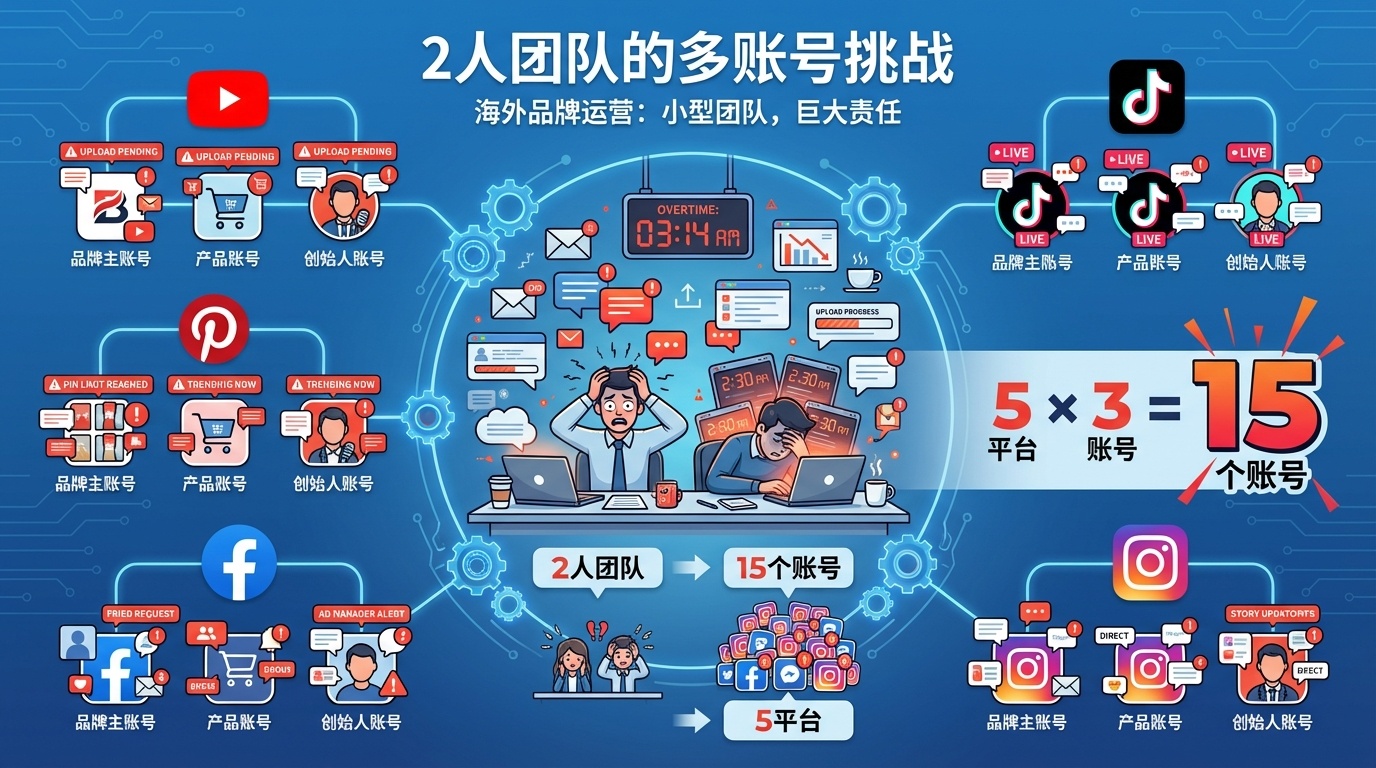
Their daily routine is like this:
- 9 AM: Log in to your YouTube account to view yesterday's video data and reply to comments.
- 9:30 AM: Switch to TikTok and post the pre-prepared video.
- 10 AM: Log in to Instagram and reply to private messages and comments.
- 10:30 AM: Switched to Facebook and posted the English version of the same content.
- 11:00 AM: Log in to Pinterest and view your notes data.
- 11:30 AM: Start preparing the content to be released this afternoon...
"We log into the backends of different platforms at least 15 times a day," said the team leader. "Sometimes we forget which platform we posted what content, leading to duplicate or missed posts."
To make matters worse, there were missed replies in the comments section .
A social media agency revealed that they once lost a $50,000 order because they didn't reply to a single TikTok comment for three hours. "The user asked about the price in the comments section, and we didn't see it until three hours later—but by then, the user had already gone to look for competitors," the agency said.
Data reporting: Your boss wants a weekly report, are you still manually taking screenshots and piecing together data?
Another pain point in multi-platform operation is data reporting .
Every Friday, the head of a brand's operations department has to submit a "social media weekly report" to the boss, which includes follower growth, content performance, interaction data, and competitor comparisons across five platforms. His method is to log into the backend of each platform, manually take screenshots, and then combine them into a single spreadsheet in Excel.
"It takes me 3-4 hours to prepare each weekly report," he said, "and the data is often incorrect—because different platforms use different statistical methods, and I have to manually convert them."
What frustrated him even more was that his boss would frequently ask during weekly meetings, "Why is our engagement rate lower than our competitors? What content did they post yesterday?"
He couldn't answer. Because he didn't have time to monitor the competitors' accounts every day.
Competitive Monitoring: You only found out today what your competitors posted yesterday
The operations director of a brand expanding overseas does one thing every morning by manually checking the latest updates of five competitors on various platforms. He opens each competitor's homepage one by one to check the posting time, content type, and interaction data.
"Once, a competitor posted a viral video on TikTok that garnered 500,000 views within 24 hours," he said. "But I didn't find out until the next day—by then it was too late. When we followed up with similar content, the results were far inferior to what our competitor achieved."
The timeliness of competitor monitoring is becoming a fatal weakness for multi-platform operation teams.
IV. Solution: From "Manual Compilation" to "Systematic Collaboration"
Unified management across multiple platforms: One backend manages all platforms
If your team is still manually switching platform backends, you'll need a unified multi-platform management tool in 2026.
Taking SocialEcho as an example, it supports managing multiple accounts across eight major platforms, including Facebook, Instagram, TikTok, Twitter, YouTube, LinkedIn, Telegram, and Pinterest, all from a single backend. Operators no longer need to repeatedly log into different platforms; all comments, private messages, and data are presented on a single interface.
After using SocialEcho, a social media agency saw its team's productivity increase fivefold. "In the past, we spent two hours a day on 'login-switch-view,' but now it only takes 10 minutes," the agency said.
Centralized comment management: Never miss a single potential order.
The comment management function can automatically aggregate user comments from multiple platforms and use AI to identify user sentiment (positive/negative) and intent (inquiry/purchase).
After using SocialEcho's AI-powered auto-response feature , a brand expanding overseas saw its comment response time reduced from an average of 3 hours to 5 minutes. "We set up auto-response rules: when user comments contain keywords such as 'price,' 'purchase,' or 'link,' the AI automatically replies with product links and promotional information," said the brand's representative. "This has increased our conversion rate by 30%."
Automatic data aggregation: One-click generation of weekly reports for multiple platforms
The data analytics feature can aggregate data from multiple platforms in real time and supports exporting weekly reports in Excel format. Operations staff don't need to manually take screenshots or piece together tables; the system automatically generates charts such as "Fan Growth," "Content Performance," and "Interaction Data."
After using SocialEcho, the weekly report production time for a brand's operations department was reduced from 4 hours to 10 minutes. "Now, every Friday afternoon, I only need to click the 'Export Report' button, and the system will automatically generate a complete weekly report," the person in charge said.
Real-time competitor monitoring: Get informed of competitor activities immediately.
The competitor monitoring function can automatically track the posts, interaction data, and comments of competitor accounts, and provide real-time alerts when competitors post viral content.
After using SocialEcho's competitor monitoring feature, a brand expanding overseas can receive notifications within one hour of competitors publishing content. "We can now analyze competitors' content strategies immediately and quickly adjust our own publishing plans," said the brand's representative.
Scheduled release: Let AI analyze the best time to release.
The scheduled publishing feature not only allows you to set a specific publishing time, but also lets AI analyze historical data to recommend the best time to publish.
After using SocialEcho's AI recommendation feature, a social media agency discovered that their TikTok account saw the highest engagement rate for videos posted between 8 and 9 PM, while their Instagram account performed best when posted between 12 and 1 PM. "We now plan our content posting schedule for the week in advance based on the AI-recommended time slots," the agency said.
Conclusion
In 2026, social media platforms will change at an unprecedented pace. Algorithms will shift from "traffic dividends" to "content vectorization," AI will bring the marginal cost of content production close to zero, and the complexity of managing multiple platforms will increase exponentially.
For brand operations departments, social media agencies, and matrix creators, if they are still managing multiple platforms in a "manual stacking" manner, they may not even be able to get on the poker table in 2026.
The real solution is not to "work harder", but to be "more systematic" .
From "manually switching platform backends" to "unified management across multiple platforms", from "seeing comments only after 3 hours" to "automatic replies within 5 minutes", from "manually taking screenshots to compile weekly reports" to "generating data reports with one click", from "not knowing about competitors' activities until the next day" to "receiving reminders within 1 hour"—these changes will determine whether your team can survive in the social media competition of 2026.
Now ask yourself a question : Is your team still using the tactics of 2025?
;}.cls-2{fill:%230868f7;}.cls-3{fill:url(%23未命名的渐变_44);}.cls-4{fill:%23333;}%3c/style%3e%3clinearGradient%20id='未命名的渐变_8'%20x1='33.73'%20y1='100.61'%20x2='-0.03'%20y2='-1.06'%20gradientUnits='userSpaceOnUse'%3e%3cstop%20offset='0'%20stop-color='%237ae9fb'/%3e%3cstop%20offset='0.67'%20stop-color='%232b90f8'/%3e%3cstop%20offset='1'%20stop-color='%230868f7'/%3e%3c/linearGradient%3e%3clinearGradient%20id='未命名的渐变_44'%20x1='27.86'%20y1='18.67'%20x2='68.36'%20y2='22.22'%20gradientUnits='userSpaceOnUse'%3e%3cstop%20offset='0'%20stop-color='%235ac7f2'/%3e%3cstop%20offset='1'%20stop-color='%230868f7'/%3e%3c/linearGradient%3e%3c/defs%3e%3cpath%20class='cls-1'%20d='M29,28.74V81.91l-9.51-3.68v0L8.52,74A7.17,7.17,0,0,1,4,67.32V24.54A3.76,3.76,0,0,1,9.08,21Z'/%3e%3cpath%20class='cls-2'%20d='M68.09,78.07a13.15,13.15,0,0,1-17.9,12.06L29,81.91h0V28.74L50.19,37A13.17,13.17,0,0,0,68.08,25.3h0Z'/%3e%3cpath%20class='cls-3'%20d='M68.08,25.3a13.19,13.19,0,0,1-6.73,10.87A13.09,13.09,0,0,1,50.19,37L29,28.74V6A3.76,3.76,0,0,1,34.1,2.52l25.59,9.91A13.22,13.22,0,0,1,68.08,25.3Z'/%3e%3cpath%20class='cls-4'%20d='M129.06,81.76a4.33,4.33,0,0,1-3.19-1.31,4.4,4.4,0,0,1-1.31-3.24V56.86H97.65V77.21a4.36,4.36,0,0,1-1.35,3.2A4.68,4.68,0,0,1,93,81.76a4.32,4.32,0,0,1-3.19-1.31,4.37,4.37,0,0,1-1.32-3.24V27.27A4.58,4.58,0,0,1,89.83,24a4.59,4.59,0,0,1,7.82,3.27V48.15h26.91V27.27A4.58,4.58,0,0,1,125.91,24a4.59,4.59,0,0,1,7.82,3.27V77.21a4.37,4.37,0,0,1-1.36,3.2A4.65,4.65,0,0,1,129.06,81.76Z'/%3e%3cpath%20class='cls-4'%20d='M163.77,81.66c-6.57,0-11.76-1.92-15.44-5.7s-5.54-9.07-5.54-15.74a26.76,26.76,0,0,1,2.09-10.43,17.72,17.72,0,0,1,6.67-8.06,19.15,19.15,0,0,1,10.68-2.95,19,19,0,0,1,10.46,2.8,18.7,18.7,0,0,1,6.55,7.36,22.53,22.53,0,0,1,2.36,10.28A4.51,4.51,0,0,1,177,63.77H152.23a10.8,10.8,0,0,0,3.49,6.65c2,1.68,4.88,2.52,8.66,2.52a22.25,22.25,0,0,0,7.54-1.21c.74-.3,1.55-.67,2.37-1.07a3.75,3.75,0,0,1,1.84-.4,4.09,4.09,0,0,1,3,1.15,4,4,0,0,1,1.12,3,4.38,4.38,0,0,1-2.58,3.82,32.34,32.34,0,0,1-6.36,2.61A28.67,28.67,0,0,1,163.77,81.66ZM172.4,55.9a9.72,9.72,0,0,0-1.63-4.56A9.9,9.9,0,0,0,167,48a10.38,10.38,0,0,0-4.64-1.14,12,12,0,0,0-4.77,1.06,9.54,9.54,0,0,0-4.89,5.66,11.78,11.78,0,0,0-.51,2.3Z'/%3e%3cpath%20class='cls-4'%20d='M193,81.64a4.49,4.49,0,0,1-4.51-4.55V27.28A4.58,4.58,0,0,1,189.84,24a4.48,4.48,0,0,1,3.28-1.36A4.36,4.36,0,0,1,196.35,24a4.46,4.46,0,0,1,1.31,3.31V77.09a4.34,4.34,0,0,1-1.35,3.2A4.67,4.67,0,0,1,193,81.64Z'/%3e%3cpath%20class='cls-4'%20d='M263.79,81.71a5.7,5.7,0,0,1-4.2-1.74,5.76,5.76,0,0,1-1.73-4.19V27.37a4.58,4.58,0,0,1,1.35-3.27A4.59,4.59,0,0,1,267,27.37V72.53h24a4.58,4.58,0,0,1,3.27,7.82A4.66,4.66,0,0,1,291,81.71Z'/%3e%3cpath%20class='cls-4'%20d='M424.48,81.74a4.71,4.71,0,0,1-2.71-.88,5.43,5.43,0,0,1-1-1l-.07-.09-12.41-17-5.41,5v9.44a4.31,4.31,0,0,1-1.36,3.19,4.66,4.66,0,0,1-3.3,1.36A4.29,4.29,0,0,1,395,80.42a4.36,4.36,0,0,1-1.32-3.23V27.37A4.58,4.58,0,0,1,395,24.1a4.52,4.52,0,0,1,6.58.12,4.54,4.54,0,0,1,1.24,3.15V56.31l17.72-16.38.05,0a4.8,4.8,0,0,1,2.94-1.11,4.4,4.4,0,0,1,3.27,1.2,4.57,4.57,0,0,1,1.2,3.27,4.44,4.44,0,0,1-.77,2.33,7.45,7.45,0,0,1-1.43,1.65l-11,9.64,13.34,17.68a5,5,0,0,1,1,2.71,4.12,4.12,0,0,1-1.36,3.24A4.64,4.64,0,0,1,424.48,81.74Z'/%3e%3cpath%20class='cls-4'%20d='M317.93,81.76a21.5,21.5,0,1,1,21.17-21.5A21.37,21.37,0,0,1,317.93,81.76Zm0-34.1a12.61,12.61,0,1,0,12.42,12.6A12.52,12.52,0,0,0,317.93,47.66Z'/%3e%3cpath%20class='cls-4'%20d='M212.18,101.22a4.12,4.12,0,0,1-3.05-1.26,4.17,4.17,0,0,1-1.26-3.1V43.34a4.37,4.37,0,0,1,1.3-3.14,4.26,4.26,0,0,1,3.13-1.3,4.19,4.19,0,0,1,3.1,1.26,4.32,4.32,0,0,1,1.26,3.16,20.77,20.77,0,0,1,13-4.54,21.51,21.51,0,0,1,0,43,20.51,20.51,0,0,1-13-4.57V96.86a4.15,4.15,0,0,1-1.3,3.06A4.5,4.5,0,0,1,212.18,101.22Zm17.43-53.63c-6.23,0-12.93,4.11-12.93,12.72a12.73,12.73,0,0,0,25.46,0A12.71,12.71,0,0,0,229.61,47.59Z'/%3e%3cpath%20class='cls-4'%20d='M365.76,81.76a21.5,21.5,0,1,1,21.18-21.5A21.37,21.37,0,0,1,365.76,81.76Zm0-34.1a12.61,12.61,0,1,0,12.42,12.6A12.52,12.52,0,0,0,365.76,47.66Z'/%3e%3c/svg%3e)