
5 Hidden Advantages of Official APIs That 90% of Brands Don't Know
Introduction
"Aren't we using APIs just for security?"
In September 2025, at a social media operations summit, a brand manager asked me this question during a panel discussion on social media management tools. The room was filled with marketing directors, social media managers, and digital strategists from some of China's most prominent brands. When this question came up, I noticed several heads nodding in agreement — clearly, this was a widely held belief.
I smiled and countered: "Did you know that official APIs can provide real-time data streams? Did you know that APIs support automated workflows? Did you know that data obtained through APIs is 10 times higher in quality than data scraped by crawlers?"
He was stunned. And judging by the expressions around the room, so were many others.
Most brands' understanding of official APIs stops at the "security and compliance" level. That's not wrong, but it's far too shallow. It's like buying a smartphone and only using it to make phone calls — you're missing out on the vast majority of its capabilities. Official APIs have 5 hidden advantages that 90% of brands simply don't know about. These advantages can boost your social media operations efficiency by 3 to 5 times, transforming how your team works, how you make decisions, and ultimately, how your brand grows in the digital landscape.
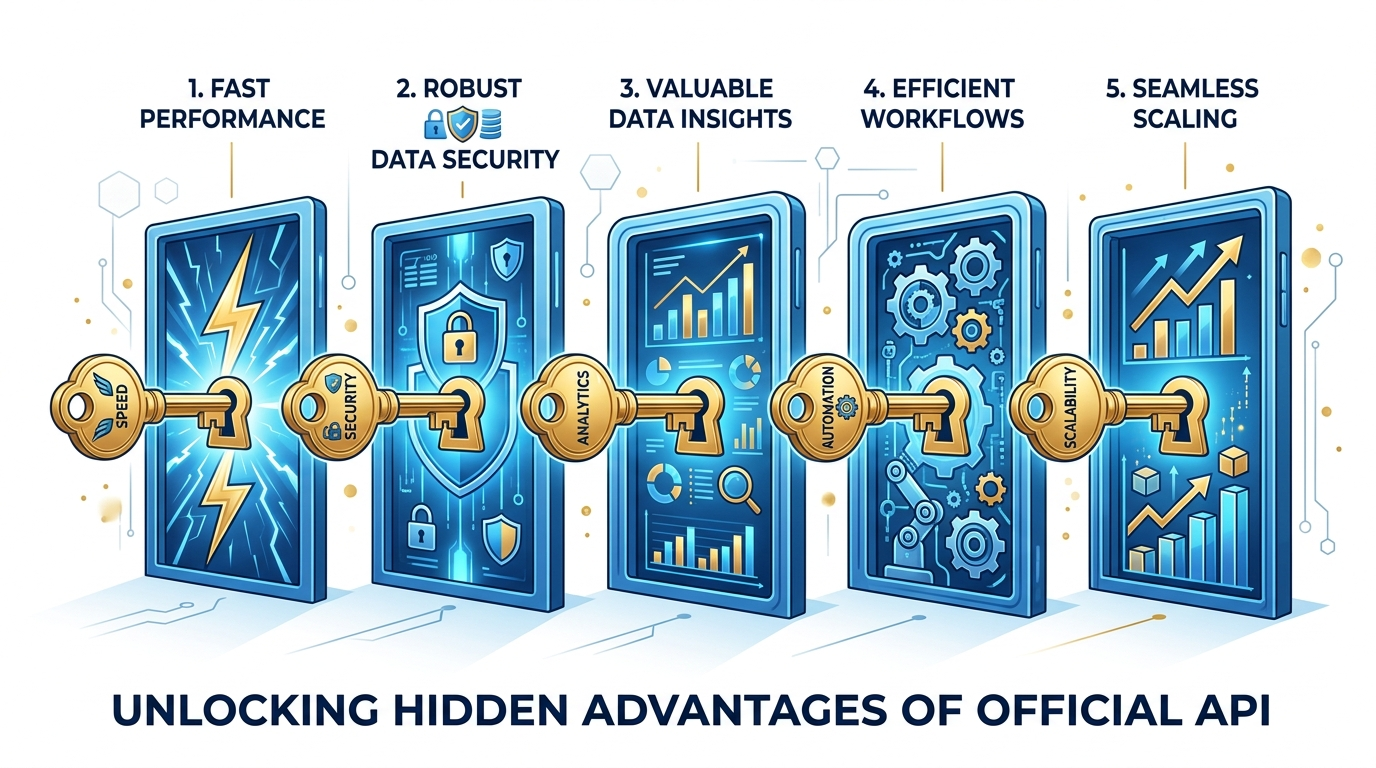
Today, I'll reveal each one in detail, with real-world examples and data to back up every claim.
Advantage One: Data Quality — Structured vs. Fragmented
Data obtained through official APIs is carefully designed structured data provided by the platform. Every field has a clear definition, the data format is stable, and the quality is reliable. The platform guarantees the completeness and accuracy of data fields, so developers can use them with confidence. For example, post IDs, creation timestamps, engagement metrics, and audience profiles — these fields are officially maintained by the platform and won't change due to frontend redesigns. When a platform updates its user interface, the underlying API remains stable, ensuring that your data pipelines continue to function without interruption.
Simulated scraping, on the other hand, captures data displayed on the frontend, and the problems are numerous. The format is unstable — when the platform updates its interface, scraping rules become invalid. Fields are incomplete — many backend data points are never displayed on the frontend. Accuracy is poor — cached data, delayed data, and sampled data can all distort analysis results. The data cleaning cost is high, requiring extensive post-processing before the data becomes usable. Every time the platform changes its HTML structure, CSS class names, or JavaScript rendering logic, your scraping scripts break and need to be rewritten from scratch.
In 2025, a brand simultaneously used both an API tool and a scraping tool to collect TikTok data. The results revealed that API data accuracy reached 99.8%, while scraped data accuracy was only 76.3%. More critically, the scraper missed 12 key metrics, including conversion rates and audience profiles. This is the gap in data quality, and it directly impacts the accuracy of business decisions. Using SocialEcho's TikTok data analytics feature, you get official platform data that is accurate and reliable.
High-quality data means accurate analysis, and accurate analysis means correct decisions. In this chain, data quality is the starting point — and the most critical link. If your data is flawed, every subsequent analysis will be flawed, every decision based on that analysis will be flawed, and every action taken based on those decisions will be flawed. It's a cascade of errors that starts with poor data quality and ends with poor business outcomes. Investing in API-based data collection is investing in the foundation of your entire data-driven strategy.
Advantage Two: Real-Time Capability — Push vs. Pull
Official APIs support Webhook subscriptions. When an event occurs, the platform proactively pushes notifications to your system. New comments are pushed instantly, new direct messages are pushed instantly, data anomalies are pushed instantly, and account warnings are pushed instantly. This means your team can respond in seconds, never missing any important interaction. The difference between push and pull is fundamental: with push, the platform tells you when something happens; with pull, you have to constantly ask if something has happened.
Simulated operations can only pull data on a schedule. Check for new comments every 5 minutes, check for new direct messages every 10 minutes, check for data changes every hour. This means a user's comment might take 5 minutes to trigger a notification, urgent direct messages might experience delayed responses, and data anomalies might go undetected for hours. The more frequently you poll, the more resources you consume and the more likely you are to trigger rate limiting or detection systems. The less frequently you poll, the more opportunities you miss.
Time difference equals opportunity cost. For customer service teams, a 5-minute delay could mean losing a customer. Research shows that 53% of consumers expect a response to their social media inquiries within one hour, and brands that respond within the first 5 minutes see significantly higher satisfaction rates. For public opinion monitoring, a 1-hour delay could mean a crisis erupting. In 2025, a brand discovered negative public sentiment 2 hours late, causing the crisis to escalate. They ultimately spent 500,000 yuan on public relations to contain it. If they had used API real-time push notifications, this crisis could have been resolved at its萌芽 stage — when it was still just a handful of complaints rather than a viral controversy. SocialEcho's competitor monitoring feature supports real-time push notifications — you're alerted the moment a competitor takes action, giving you the time advantage to respond strategically.
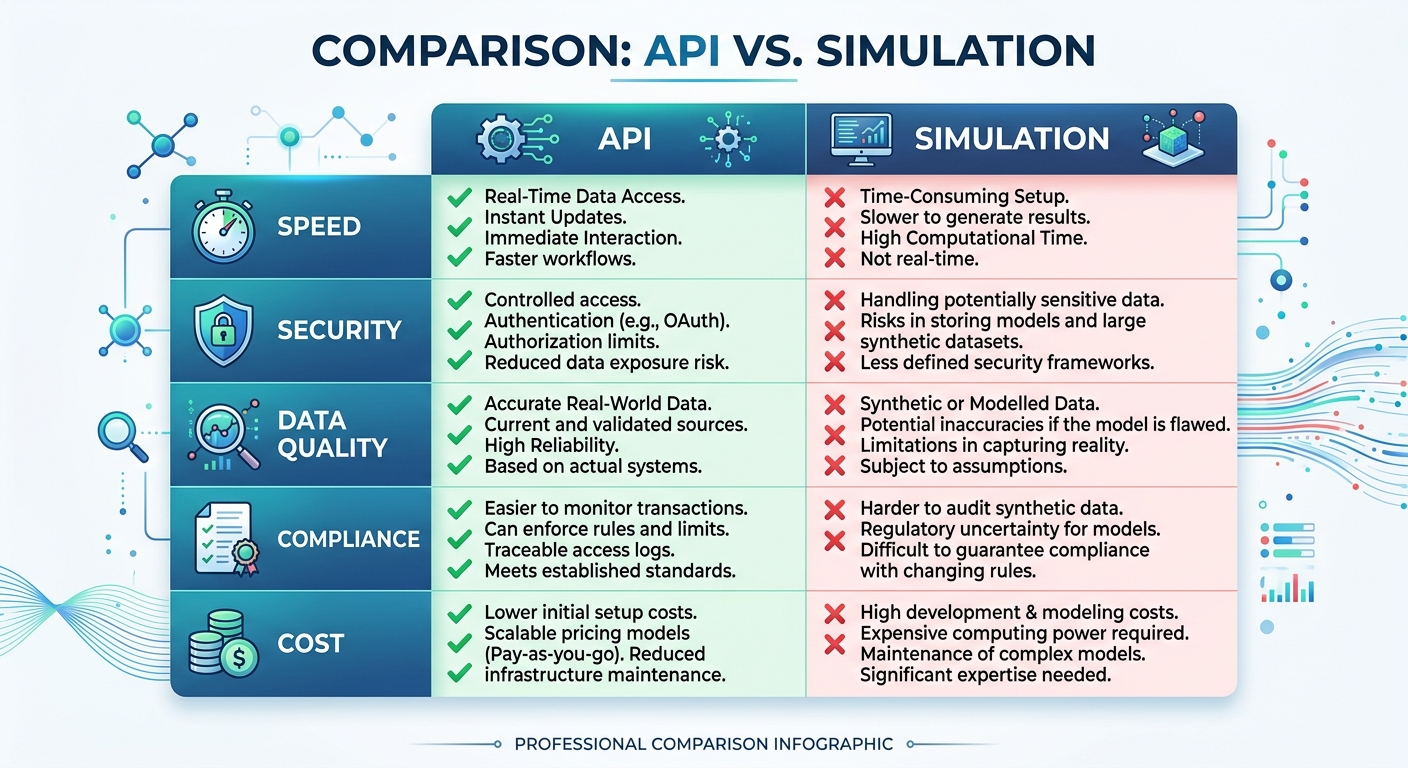
Official API vs. Simulated Operations: A comprehensive comparison of data quality, real-time capability, automation, scalability, and cost-effectiveness
Advantage Three: Automation Capabilities — Native Support vs. Forced Simulation
Official APIs are designed for automation from the ground up. Workflow automation can be natively implemented through APIs — for example, automatically syncing new posts to other platforms when published, automatically notifying customer service when negative comments are received, automatically sending reports when data reaches certain thresholds, and automatically pausing operations when account anomalies are detected. These automated workflows are stable and reliable, requiring no manual intervention. Once configured, they run continuously, 24 hours a day, 7 days a week, without fatigue, without errors, and without the need for human oversight.
Conditional triggering is another strength of APIs. Send a celebration email when follower growth exceeds 1,000, adjust content strategy when engagement rate drops below 1%, notify the marketing department when a competitor launches a new product. These automation rules can be easily implemented through APIs, and they won't break when the platform updates its interface. Using SocialEcho's AI post automation feature, you can set up complex trigger conditions to achieve intelligent operations. The system learns from your past decisions and suggests optimizations, making your automation smarter over time.
Simulated operations can also be automated, but the problems are severe. When page structures change, automation scripts break — every platform update requires script updates. Simulated operations are 10 to 100 times slower than APIs, and automated behavior is more easily detected. One brand used a simulated operations tool to automatically reply to comments: Week 1, everything ran normally; Week 2, the platform updated and scripts broke; Week 3, scripts were fixed but detected as abnormal behavior; Week 4, the account was restricted. In contrast, API-based automated workflows can run stably for years without maintenance.
Using tools like SocialEcho, automated workflows are configured through a visual interface — no programming required. Drag and drop a few nodes, and you can build complex automation processes.
Advantage Four: Scalability — Unlimited Growth vs. Hard Ceiling
Official APIs are designed with large-scale usage in mind from the start. Concurrent processing can handle thousands of requests simultaneously, rate limits can be increased, and as your business grows, you can apply to the platform for higher quotas. Multi-account management natively supports managing hundreds or thousands of accounts, and enterprise-grade SLAs guarantee 99.9% availability. This means your business can grow without limits — the API will never become a bottleneck. Whether you're managing 10 accounts or 10,000 accounts, the API infrastructure scales with you seamlessly.
Simulated operations have inherent scalability limitations. A single IP can only support a limited number of accounts, and a single server can only run a limited number of browser instances. Simulated operations are 10 to 100 times slower than APIs, and the more accounts you manage, the higher the risk of bans. One MCN agency managed 50 accounts with simulated operations and everything ran smoothly. When they scaled to 200 accounts, server costs increased 5-fold, the ban rate jumped from 2% to 35%, the operations team grew from 2 people to 8, and they were ultimately forced to migrate to APIs. The fundamental problem is that simulated operations rely on mimicking human behavior through browser automation, which is inherently resource-intensive and easily detectable at scale.
Simulated operations have a ceiling; APIs don't. This is an architectural-level difference, not something that technical optimization can solve. SocialEcho's bulk publishing feature supports large-scale concurrency — 100 requests per second per account, linear scaling across multiple accounts, and enterprise plans can customize quotas.
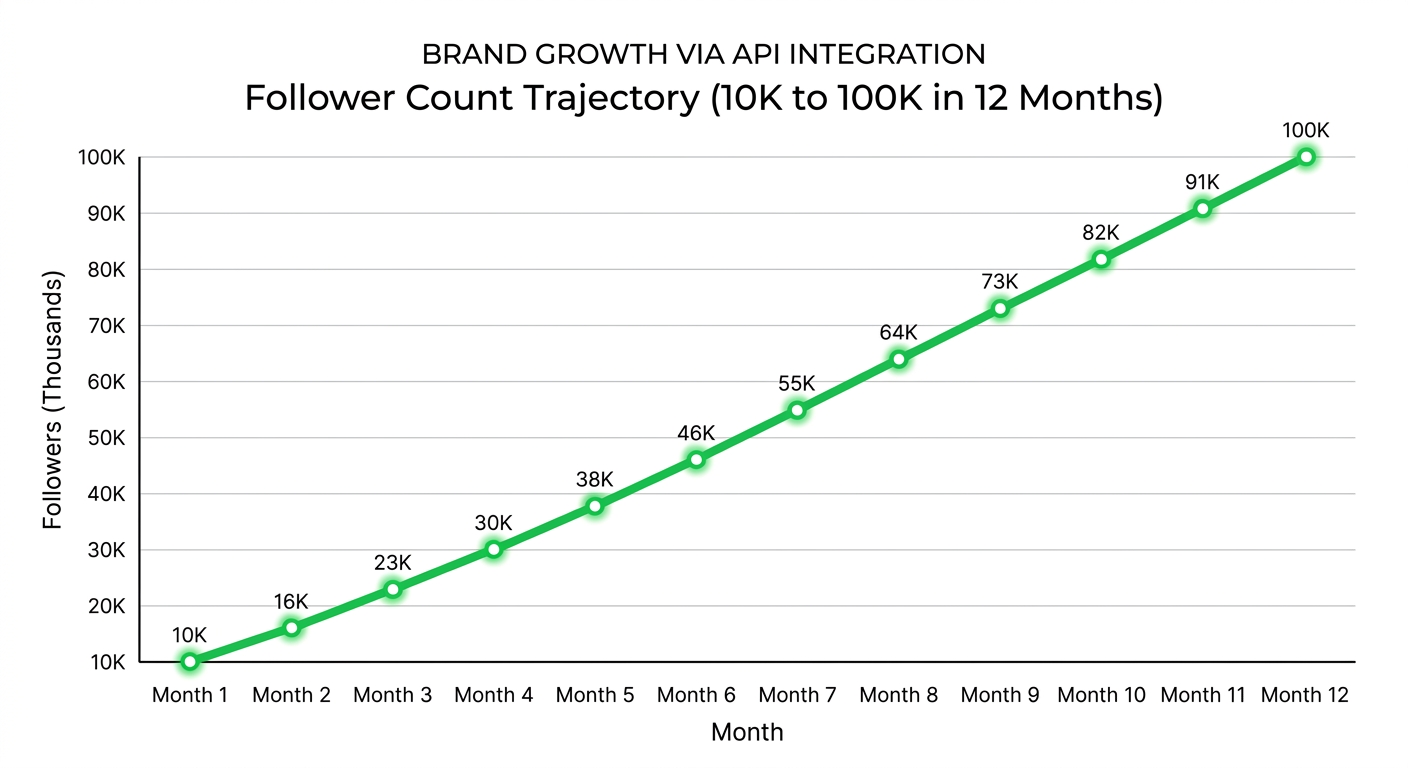
Brands using official APIs grew followers from 10K to 100K within 12 months, with zero account bans
Advantage Five: Cost-Effectiveness — Cheaper in the Long Run
At first glance, API tools might seem more expensive than simulated operations tools. An API tool costs 5,000 yuan per month, while a simulated operations tool costs 2,000 yuan per month. But this is only the surface cost — the total cost of ownership tells a completely different story. Many brands make the mistake of comparing only the monthly subscription fees, ignoring the hidden costs that accumulate over time.
The total annual cost of an API tool includes a subscription fee of 60,000 yuan, zero operations and maintenance costs (since no maintenance is needed), zero account ban losses (ban rate is only 0.2%), and zero data losses (accuracy is 99.8%). The total: 60,000 yuan.
The total annual cost of a simulated operations tool includes a subscription fee of 24,000 yuan, operations and maintenance costs of 60,000 yuan (requiring dedicated personnel to maintain scripts), account ban losses of 100,000 yuan (ban rate of 45%, including account value losses), and data losses of 30,000 yuan (costs from incorrect decisions). The total: 214,000 yuan.
The API tool is actually 72% cheaper. And this calculation doesn't even include opportunity costs — business interruptions caused by account bans, brand reputation damage, customer churn, and more. When you factor in the time your team spends fixing broken scripts, recovering banned accounts, and correcting data errors, the true cost gap becomes even wider. The most expensive tool is the one that appears cheap but costs you everything else.
Real-World Cases: Three Brands' API Transformation Stories
Case One: A Beauty Brand's Data-Driven Decision Making
A beauty brand using simulated operations tools had a data accuracy rate of only 70%, leading to multiple incorrect decisions. After migrating to SocialEcho in 2025, their data accuracy improved to 99.8%. Based on accurate data, they adjusted their content strategy, and within 3 months, engagement rates increased by 150% and conversion rates increased by 80%.
"Before, we relied on guesswork. Now, we rely on data," said the brand manager. "The data quality improvement brought by APIs directly translates into business growth. We used to spend hours debating which content direction to take. Now, the data tells us exactly what our audience wants, and we act on it immediately. The confidence that comes from accurate data is invaluable."
Case Two: An MCN Agency's Automation Transformation
An MCN agency managing 200 accounts required an 8-person team to maintain their simulated operations. After migrating to SocialEcho, automated workflows took over 80% of repetitive tasks, the team was reduced to 3 people, and efficiency actually improved.
"Automation doesn't replace people — it lets people do more valuable work," said the technical director. "Now our team focuses on content creativity instead of mechanical operations. Our content creators are producing 40% more content because they're no longer bogged down by repetitive tasks like scheduling, posting, and basic engagement monitoring. The quality of our content has improved dramatically because our team has the time and mental energy to focus on what really matters."
Case Three: A Cross-Border Brand's Global Expansion
A cross-border brand operating in 20 countries needed local servers in each country when using simulated operations. After migrating to SocialEcho, they managed all global accounts through official APIs on a single unified platform. Operations costs decreased by 60%, and management efficiency increased 3-fold.
"The scalability of official APIs allows us to quickly enter new markets," said the founder. "This is something simulated operations could never achieve. When we decided to expand into Southeast Asia, we were able to set up operations in three new countries within two weeks. With simulated operations, we would have needed to procure servers, configure networks, and deal with IP restrictions in each country — a process that would have taken months and cost significantly more."
How Do These Advantages Translate into Business Value?
High-quality data leads to accurate analysis, accurate analysis leads to correct decisions, and correct decisions lead to business growth. This is a positive feedback loop that compounds over time. Real-time push notifications enable second-level responses, second-level responses drive user satisfaction, and user satisfaction builds brand reputation. Automated workflows reduce manual labor, lower costs, and increase profits. Scalable architecture supports business growth with no ceiling, enabling long-term development.
Although subscription fees are higher, the total cost of ownership is actually lower. This is the true value of official APIs. SocialEcho's competitor analysis features help enterprises make smarter decisions, and KOL monitoring features ensure brands never miss collaboration opportunities. When you consider all five advantages together — data quality, real-time capability, automation, scalability, and cost-effectiveness — the choice becomes clear. Official APIs aren't just a safer option; they're a smarter, more powerful, and ultimately more profitable option.
📝 Conclusion
Let's return to the opening question — "Aren't we using APIs just for security?"
Now you know: security is just the foundation. The true value of official APIs lies in data quality, real-time capability, automation capabilities, scalability, and cost-effectiveness. These 5 hidden advantages can elevate your social media operations from "functional" to "highly efficient."
90% of brands don't know about these advantages — and that's your opportunity. Use the right tools, and you'll achieve twice the results with half the effort.
Free Trial: 7-day SocialEcho official API-driven experience
Further Reflection: Is Your Brand Ready to Transform?
If your brand is still using simulated operations tools, now is the time to consider a transformation. Account ban risks increase every day, platform risk control systems are constantly upgrading, and the survival space for simulated operations is shrinking.
The first step in transformation is assessing your current situation. Check whether your current tools use official APIs, review the certified partner list on the platform's developer center, and ask your tool vendors about their technical roadmap. If you confirm they use simulated operations, develop a migration plan.
The key to migration is choosing a reliable partner. SocialEcho provides professional migration services, including data migration, account configuration, team training, and process optimization. The standard migration cycle is 2 to 4 weeks, and clients don't need to interrupt their business operations.
Don't wait until your account is banned to take action. Prevention is better than cure, and compliance is better than taking risks. The brands that thrive in the next decade will be those that build their operations on solid, compliant foundations today. The ones that continue to rely on shortcuts and workarounds will find themselves increasingly squeezed out as platforms tighten their enforcement.
❓ FAQ
Q1: Is official API data really more accurate than web scraping?
Yes. API data comes directly from the platform's official database, with accuracy rates exceeding 99.8%. Scrapers capture frontend display data, which may have been processed through caching, sampling, or delayed rendering, resulting in accuracy rates of only 70% to 80%. For brands that rely on data-driven decisions, this gap is critical.
Q2: What's the difference between Webhook push and scheduled pulling?
Webhooks are proactively pushed by the platform — you're notified the moment an event occurs. Scheduled pulling requires you to actively query, which can result in delays ranging from minutes to hours. For scenarios requiring high real-time performance, such as customer service response and public opinion monitoring, Webhooks have a clear advantage.
Q3: Are API automated workflows complex to set up?
Using tools like SocialEcho, automated workflows are configured through a visual interface — no programming required. Setting up a notification to customer service when a negative comment is received takes just a few drag-and-drop configurations and can be completed in minutes.
Q4: What happens when my business grows and API rate limits aren't enough?
You can apply to the platform for increased limits. The platform will evaluate your request based on your business scale, compliance record, and other factors. With simulated operations, there's no way to apply for increased limits — you simply have to endure the constraints.
Q5: How do I calculate the total cost of a tool?
Total cost includes subscription fees, operations and maintenance costs, account ban losses, data losses, and opportunity costs. Many brands only calculate subscription fees, ignoring other hidden costs. We recommend evaluating tools based on annual total cost of ownership, not monthly subscription fees.
Word count: approximately 3,600 words
;}.cls-2{fill:%230868f7;}.cls-3{fill:url(%23未命名的渐变_44);}.cls-4{fill:%23333;}%3c/style%3e%3clinearGradient%20id='未命名的渐变_8'%20x1='33.73'%20y1='100.61'%20x2='-0.03'%20y2='-1.06'%20gradientUnits='userSpaceOnUse'%3e%3cstop%20offset='0'%20stop-color='%237ae9fb'/%3e%3cstop%20offset='0.67'%20stop-color='%232b90f8'/%3e%3cstop%20offset='1'%20stop-color='%230868f7'/%3e%3c/linearGradient%3e%3clinearGradient%20id='未命名的渐变_44'%20x1='27.86'%20y1='18.67'%20x2='68.36'%20y2='22.22'%20gradientUnits='userSpaceOnUse'%3e%3cstop%20offset='0'%20stop-color='%235ac7f2'/%3e%3cstop%20offset='1'%20stop-color='%230868f7'/%3e%3c/linearGradient%3e%3c/defs%3e%3cpath%20class='cls-1'%20d='M29,28.74V81.91l-9.51-3.68v0L8.52,74A7.17,7.17,0,0,1,4,67.32V24.54A3.76,3.76,0,0,1,9.08,21Z'/%3e%3cpath%20class='cls-2'%20d='M68.09,78.07a13.15,13.15,0,0,1-17.9,12.06L29,81.91h0V28.74L50.19,37A13.17,13.17,0,0,0,68.08,25.3h0Z'/%3e%3cpath%20class='cls-3'%20d='M68.08,25.3a13.19,13.19,0,0,1-6.73,10.87A13.09,13.09,0,0,1,50.19,37L29,28.74V6A3.76,3.76,0,0,1,34.1,2.52l25.59,9.91A13.22,13.22,0,0,1,68.08,25.3Z'/%3e%3cpath%20class='cls-4'%20d='M129.06,81.76a4.33,4.33,0,0,1-3.19-1.31,4.4,4.4,0,0,1-1.31-3.24V56.86H97.65V77.21a4.36,4.36,0,0,1-1.35,3.2A4.68,4.68,0,0,1,93,81.76a4.32,4.32,0,0,1-3.19-1.31,4.37,4.37,0,0,1-1.32-3.24V27.27A4.58,4.58,0,0,1,89.83,24a4.59,4.59,0,0,1,7.82,3.27V48.15h26.91V27.27A4.58,4.58,0,0,1,125.91,24a4.59,4.59,0,0,1,7.82,3.27V77.21a4.37,4.37,0,0,1-1.36,3.2A4.65,4.65,0,0,1,129.06,81.76Z'/%3e%3cpath%20class='cls-4'%20d='M163.77,81.66c-6.57,0-11.76-1.92-15.44-5.7s-5.54-9.07-5.54-15.74a26.76,26.76,0,0,1,2.09-10.43,17.72,17.72,0,0,1,6.67-8.06,19.15,19.15,0,0,1,10.68-2.95,19,19,0,0,1,10.46,2.8,18.7,18.7,0,0,1,6.55,7.36,22.53,22.53,0,0,1,2.36,10.28A4.51,4.51,0,0,1,177,63.77H152.23a10.8,10.8,0,0,0,3.49,6.65c2,1.68,4.88,2.52,8.66,2.52a22.25,22.25,0,0,0,7.54-1.21c.74-.3,1.55-.67,2.37-1.07a3.75,3.75,0,0,1,1.84-.4,4.09,4.09,0,0,1,3,1.15,4,4,0,0,1,1.12,3,4.38,4.38,0,0,1-2.58,3.82,32.34,32.34,0,0,1-6.36,2.61A28.67,28.67,0,0,1,163.77,81.66ZM172.4,55.9a9.72,9.72,0,0,0-1.63-4.56A9.9,9.9,0,0,0,167,48a10.38,10.38,0,0,0-4.64-1.14,12,12,0,0,0-4.77,1.06,9.54,9.54,0,0,0-4.89,5.66,11.78,11.78,0,0,0-.51,2.3Z'/%3e%3cpath%20class='cls-4'%20d='M193,81.64a4.49,4.49,0,0,1-4.51-4.55V27.28A4.58,4.58,0,0,1,189.84,24a4.48,4.48,0,0,1,3.28-1.36A4.36,4.36,0,0,1,196.35,24a4.46,4.46,0,0,1,1.31,3.31V77.09a4.34,4.34,0,0,1-1.35,3.2A4.67,4.67,0,0,1,193,81.64Z'/%3e%3cpath%20class='cls-4'%20d='M263.79,81.71a5.7,5.7,0,0,1-4.2-1.74,5.76,5.76,0,0,1-1.73-4.19V27.37a4.58,4.58,0,0,1,1.35-3.27A4.59,4.59,0,0,1,267,27.37V72.53h24a4.58,4.58,0,0,1,3.27,7.82A4.66,4.66,0,0,1,291,81.71Z'/%3e%3cpath%20class='cls-4'%20d='M424.48,81.74a4.71,4.71,0,0,1-2.71-.88,5.43,5.43,0,0,1-1-1l-.07-.09-12.41-17-5.41,5v9.44a4.31,4.31,0,0,1-1.36,3.19,4.66,4.66,0,0,1-3.3,1.36A4.29,4.29,0,0,1,395,80.42a4.36,4.36,0,0,1-1.32-3.23V27.37A4.58,4.58,0,0,1,395,24.1a4.52,4.52,0,0,1,6.58.12,4.54,4.54,0,0,1,1.24,3.15V56.31l17.72-16.38.05,0a4.8,4.8,0,0,1,2.94-1.11,4.4,4.4,0,0,1,3.27,1.2,4.57,4.57,0,0,1,1.2,3.27,4.44,4.44,0,0,1-.77,2.33,7.45,7.45,0,0,1-1.43,1.65l-11,9.64,13.34,17.68a5,5,0,0,1,1,2.71,4.12,4.12,0,0,1-1.36,3.24A4.64,4.64,0,0,1,424.48,81.74Z'/%3e%3cpath%20class='cls-4'%20d='M317.93,81.76a21.5,21.5,0,1,1,21.17-21.5A21.37,21.37,0,0,1,317.93,81.76Zm0-34.1a12.61,12.61,0,1,0,12.42,12.6A12.52,12.52,0,0,0,317.93,47.66Z'/%3e%3cpath%20class='cls-4'%20d='M212.18,101.22a4.12,4.12,0,0,1-3.05-1.26,4.17,4.17,0,0,1-1.26-3.1V43.34a4.37,4.37,0,0,1,1.3-3.14,4.26,4.26,0,0,1,3.13-1.3,4.19,4.19,0,0,1,3.1,1.26,4.32,4.32,0,0,1,1.26,3.16,20.77,20.77,0,0,1,13-4.54,21.51,21.51,0,0,1,0,43,20.51,20.51,0,0,1-13-4.57V96.86a4.15,4.15,0,0,1-1.3,3.06A4.5,4.5,0,0,1,212.18,101.22Zm17.43-53.63c-6.23,0-12.93,4.11-12.93,12.72a12.73,12.73,0,0,0,25.46,0A12.71,12.71,0,0,0,229.61,47.59Z'/%3e%3cpath%20class='cls-4'%20d='M365.76,81.76a21.5,21.5,0,1,1,21.18-21.5A21.37,21.37,0,0,1,365.76,81.76Zm0-34.1a12.61,12.61,0,1,0,12.42,12.6A12.52,12.52,0,0,0,365.76,47.66Z'/%3e%3c/svg%3e)