
Buffer vs SocialBee vs SocialEcho: A Travel Blogger's In-Depth Test Report of 3 Tools Over 45 Days
Travel blogger A-Feng operates on four platforms: Instagram, Pinterest, YouTube, and TikTok. He spends two whole days each week publishing content—just the process of downloading, compressing, re-uploading, writing copy, and choosing hashtags leaves him with almost no time to actually "create content."
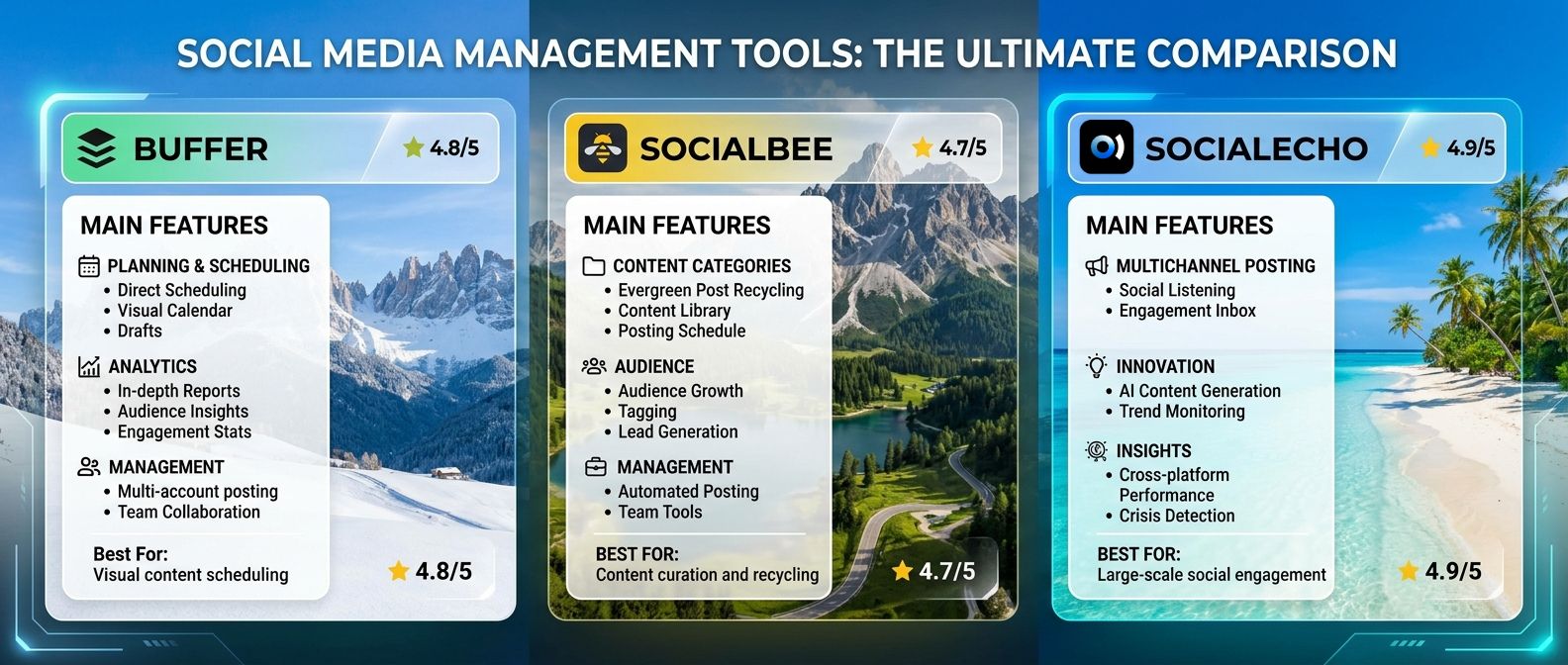
The Multi-Platform Dilemma of Matrix Creators
Afeng's predicament is not uncommon. As content creation enters the "matrix era," more and more bloggers are starting to operate on 3-5 platforms simultaneously. However, operating on multiple platforms brings not only an increase in exposure opportunities, but also an exponential increase in operating costs.
Each platform has its own "rules".
Different platforms have vastly different requirements for content format:
- Instagram : Square or portrait images (1:1 or 4:5), captions recommended to be under 500 words, 5-30 hashtags.
- Pinterest : Vertical cover image (3:4), 60-character limit for title, body text suitable for product recommendation style.
- YouTube : Horizontal 16:9 thumbnails, titles under 100 characters, keywords can be placed in the description box.
- TikTok : Vertical videos in 9:16 format, short and impactful titles, 3-5 hashtags are sufficient.
Just figuring out these parameters is already a headache. On top of that, you have to adjust the materials for different platforms before each release, turning one piece of content into four jobs.
Algorithmic Game of Release Time
The "golden time to post" varies from platform to platform. Instagram's peak user activity is around 9 a.m. and 7 p.m.; TikTok's feed prioritizes engagement within the first hour of posting; and Pinterest favors weekend mornings. Manually managing the optimal posting time for all four platforms would be a nightmare.
According to industry research data, creators operating on four platforms spend an average of 13 hours per week on "publishing management" rather than content creation . That translates to nearly two working days being entirely consumed by "copying and pasting."
To better understand why the same content can have 10 times different results when published on 5 different platforms , and how to optimize the timing of content publication to affect engagement , the choice of tools is crucial.
Against this backdrop, Afeng decided to spend 45 days systematically evaluating the three most mainstream social media management tools currently on the market: Buffer, SocialBee, and SocialEcho .
45-day real-world testing – 15 days per tool
Buffer (Days 1-15): Ideal for beginners, but with a clear ceiling.
Overall impression: Clean, restrained, and sufficient—provided your needs are not too complicated.
Buffer is a veteran in social media management tools, with a minimalist interface and virtually zero learning curve. Afeng completed the account connection for four platforms and arranged a week's content calendar in less than half an hour.
advantage:
- The interface is intuitive and user-friendly, with drag-and-drop scheduling that is clear at a glance.
- The free version supports three social media channels, which is more than enough for creators just starting out.
- The publishing queue logic is clear, and different publishing time periods can be set for each account.
- Smooth mobile app experience
shortcoming:
- Instagram Stories cannot be posted automatically (only notifications can be sent, requiring manual intervention).
- The data analysis function is relatively basic, only including basic metrics such as the number of posts, likes, and comments, and it cannot perform cross-platform horizontal comparisons.
- The AI-assisted functions are limited, the copywriting suggestions are too template-based, and the practicality is generally limited.
- The free version does not support multi-team collaboration features.
price:
- Free version: 3 channels, basic functions
- Essential: $6/month (annual fee applies), supports 1 user.
Who is this suitable for: Start-up solo creators with zero budget, fewer than 3 platforms, and primarily active on traditional social media platforms such as Facebook, Twitter, and LinkedIn.
SocialBee (Days 16-30): The most powerful feature, but you have to "tame" it first.
Overall impression: Like a sports car, it has powerful performance, but you have to learn how to drive it first.
SocialBee was the most difficult of Afeng's three tools to learn. It took him almost three days just to get started with the basic setup—content categorization, recurring publishing rules, RSS import… Each function has its own logical system.
advantage:
- The content categorization system is a core highlight: it allows content to be categorized by topic, and the posting frequency and time for each category can be set, achieving true automatic circulation.
- Importing RSS subscriptions is convenient and suitable for operations teams that need to reference a large amount of external content.
- Supports batch operations for multiple accounts, suitable for outsourced operation scenarios.
- The content recycling and reuse function is powerful, allowing older content to be republished periodically.
shortcoming:
- The interface is complex and the function entry points are scattered, making it easy for beginners to get lost.
- The initial setup time is high, making it unsuitable for scenarios where users want to "use it today and get started tomorrow".
- The price is too high and not friendly to individual creators.
- The AI feature was only recently added, and its maturity is not as advanced as products that focus on AI.
price:
- Bootstrap: $29/month
- Accelerate: $49/month
Who is it suitable for: Operation teams with a large volume of content that require meticulous scheduling, or social media management agencies that manage multiple client accounts.
SocialEcho (Days 31-45): A "Powerful Tool" for Matrix Creators
Overall impression: It's like having an automatically adaptable assistant that helps you turn one piece of content into four.
On the 31st day, Afeng switched to SocialEcho. The first thing that caught his attention was the "multi-platform content adaptation" feature—for the same content, AI would automatically generate corresponding versions based on the style and rules of different platforms: the copywriting for Pinterest was more persuasive, the version for Instagram was paired with appropriate hashtags, and the version for TikTok was short and concise.
advantage:
- AI content adaptation : Adapt the same content to multiple platform formats with one click, reducing repetitive work.
- Unified Inbox : Comments and private messages from Instagram, Facebook, and Twitter are all gathered in one interface, eliminating the need to switch between apps to reply.
- Multi-platform data analysis : Cross-platform data aggregation and display, clearly showing which platform and content type has the highest ROI.
- The interface is modern and simple, and its learning curve is somewhere between Buffer and SocialBee.
- Supports team collaboration and is suitable for small content teams of 1-5 people.
price:
- Basic version: starting at $12.5/month
- Team version: starting at $18.75/month
- Enjoy 20% off annual payments
Who is it suitable for: Matrix creators who operate on 3 or more platforms at the same time, content teams of small and medium-sized brands, and especially creators who need to maintain consistent output across multiple platforms.
For a more detailed introduction to SocialEcho 's features, refer to comprehensive reviews of multi-platform operation tools .
Additionally, if you're still betting too much on TikTok , this analysis is worth reading carefully.
Act Three: Summary of Comparative Analysis Data
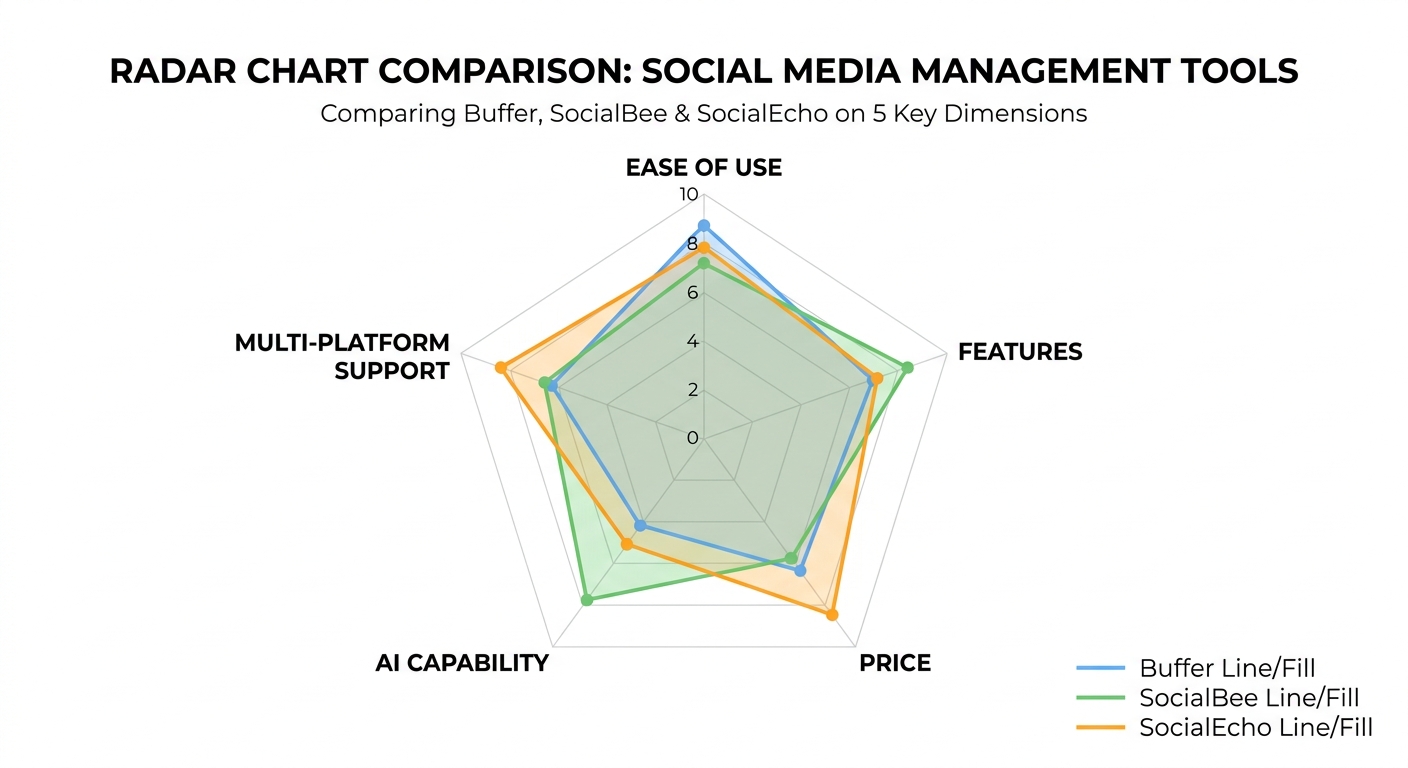
Comparison Table of Three Tools
| Dimension | Buffer | SocialBee | SocialEcho |
|---|---|---|---|
| Ease of use | ⭐⭐⭐⭐⭐ | ⭐⭐⭐ | ⭐⭐⭐⭐ |
| Feature richness | ⭐⭐⭐ | ⭐⭐⭐⭐⭐ | ⭐⭐⭐⭐ |
| Price and performance | ⭐⭐⭐⭐⭐ | ⭐⭐⭐ | ⭐⭐⭐⭐ |
| AI capabilities | ⭐⭐ | ⭐⭐⭐ | ⭐⭐⭐⭐⭐ |
| Multi-platform support | ⭐⭐⭐ | ⭐⭐⭐⭐ | ⭐⭐⭐⭐⭐ |
| Suitable for matrix operation | ❌ | ✅ (Team) | ✅ (Individual/Team) |
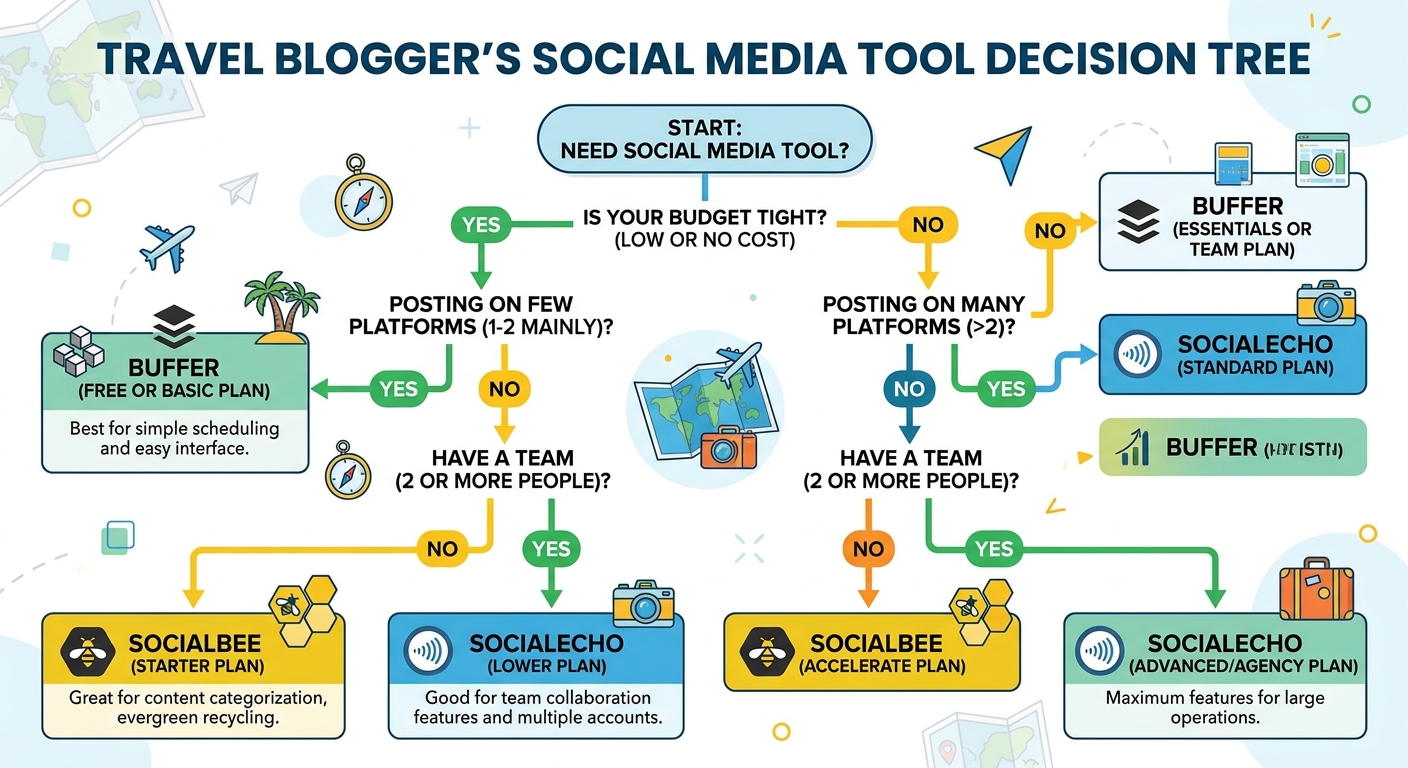
Three core questions for matrix creators when choosing tools
After a 45-day evaluation, Afeng summarized three key questions for choosing tools:
Question 1: Do you have more than 3 platforms?
If so, the free version of Buffer will be out of the game, and SocialBee's complex configuration will also be a hurdle. SocialEcho's unified management across multiple platforms is the most effortless solution.
Question 2: How much time do you spend "learning tools"?
If you need to get started quickly and use it immediately, Buffer is the fastest; SocialEcho takes 1-2 days to get familiar with, but the functional rewards are higher; SocialBee requires at least 3-5 days to configure.
Question 3: What is your biggest pain point?
- The pain point is "repetitive content creation" → Choose SocialEcho (AI-adapted).
- The pain point is "chaotic content scheduling management" → Choose SocialBee (category loop).
- The pain point is "zero budget but want to get started" → Choose Buffer (free version).
Recommended scene categories
Choose Buffer if you:
- When you first start creating content, use ≤3 platforms.
- With a limited budget, you need free tools to get started.
- Primarily posts image and text content, does not rely on Stories
Choose SocialBee if you:
- It is a social media management team that manages multiple client accounts.
- The content is extensive and requires meticulous, cyclical scheduling.
- Willing to spend time on initial setup in exchange for long-term automation.
Choose SocialEcho if you:
- A matrix creator who operates on four or more platforms simultaneously
- Need AI to help you save content adaptation time?
- The goal is to manage interactions and data across all platforms within a single interface.
For Afeng, the answer was clear: SocialEcho . The basic price of $12.5/month saved him nearly 8 hours per week in publishing management – hours he now uses to truly "create content."
FAQ
Q1: Is the free version of Buffer sufficient for a travel blogger?
If you only operate on 1-2 platforms, the free version of Buffer (3 channels) is perfectly adequate. However, travel bloggers typically need to manage multiple platforms simultaneously, such as Instagram, Pinterest, and TikTok. In this case, the channel limit of the free version of Buffer becomes a significant bottleneck. More importantly, Buffer does not support automatic posting to Instagram Stories, which is a very frequent requirement for travel content. Overall, Buffer is more suitable for beginners and creators with a limited number of platforms.
Q2: What is the biggest difference between SocialBee and Buffer?
The core difference lies in the "content recycling" mechanism. Buffer is a linear queue—once content is published, it's gone; SocialBee, on the other hand, allows you to establish "content categorization + cyclical publishing" rules, where older content can be reused repeatedly at a set frequency. For operations teams that need to post frequently and continuously, SocialBee's recycling mechanism can greatly reduce content production pressure. However, SocialBee has a steeper learning curve, takes longer to get started, and is more expensive (29/month starting, compared to Buffer's 6/month starting).
Q3: Which social media management tool should travel bloggers prioritize?
SocialEcho is highly recommended. Travel bloggers face two main pain points: first, the same travel content needs to be adapted for multiple platforms (different sizes, styles, and word count requirements); second, they need to promptly reply to comments and maintain community interaction. SocialEcho's AI content adaptation feature can generate versions adapted for various platforms with a single click, while its unified inbox improves comment management efficiency several times over. The basic version starts at $12.5/month, with a 20% discount for annual payments, making it exceptionally cost-effective compared to similar tools.
Q4: Which tool is the most labor-saving for operating more than 4 platforms at the same time?
SocialEcho is currently the most suitable tool for operating a matrix of 4 or more platforms. There are three reasons for this: ① AI-powered content adaptation reduces repetitive production; ② A unified inbox integrates multi-platform interaction; ③ Cross-platform data analysis helps you find the platforms and content types with the highest ROI. In comparison, Buffer is weaker in multi-platform management, and while SocialBee has powerful features, its configuration complexity is higher, making it more suitable for teams with dedicated operations personnel.
Q5: How much more expensive is SocialEcho compared to Buffer, and is it worth it?
Buffer Essential costs 6/month, while SocialEcho Basic costs 12.5/month, a difference of about 6-7/month (with an annual subscription, SocialEcho costs approximately 10/month, making the difference even smaller). However, the functional differences between the two go far beyond the price: SocialEcho offers core features such as AI content adaptation, a unified inbox, and cross-platform data aggregation. For creators who operate on multiple platforms weekly, the time saved by SocialEcho far outweighs the extra cost per month. To put it simply: saving 8 hours of operating time per month is worthwhile for creators earning over $1/hour.
Q6: What features are most important for matrix creators to look for when using social media tools?
The three most important dimensions are: ① Multi-platform simultaneous publishing capability (whether it supports all the platforms you use); ② AI-assisted content adaptation (whether it can automatically adjust the format and copywriting style); ③ Centralized interaction management (whether comments and private messages can be handled uniformly on one interface). Next, consider the depth of data analysis and price. Many creators only look at the publishing function when choosing tools, but interaction management is the truly time-consuming part—especially after an account has over ten thousand followers.
Q7: What was the most unexpected discovery after 45 days of testing?
The most unexpected discovery was that the cost of switching tools was higher than expected . When switching from Buffer to SocialBee, Afeng had to reconfigure almost all account connections and publishing rules, losing nearly two days of operational efficiency. This also illustrates a principle: choosing tools should be a "right choice from the start," rather than "making do first and then switching." For matrix creators, spending a few extra days on selection research in the early stages is much less costly than migrating later. Another surprise was that the practicality of the AI content adaptation function far exceeded expectations—it wasn't one of those "flashy but not very useful" features, but rather a core efficiency tool that truly reduced repetitive daily tasks.
;}.cls-2{fill:%230868f7;}.cls-3{fill:url(%23未命名的渐变_44);}.cls-4{fill:%23333;}%3c/style%3e%3clinearGradient%20id='未命名的渐变_8'%20x1='33.73'%20y1='100.61'%20x2='-0.03'%20y2='-1.06'%20gradientUnits='userSpaceOnUse'%3e%3cstop%20offset='0'%20stop-color='%237ae9fb'/%3e%3cstop%20offset='0.67'%20stop-color='%232b90f8'/%3e%3cstop%20offset='1'%20stop-color='%230868f7'/%3e%3c/linearGradient%3e%3clinearGradient%20id='未命名的渐变_44'%20x1='27.86'%20y1='18.67'%20x2='68.36'%20y2='22.22'%20gradientUnits='userSpaceOnUse'%3e%3cstop%20offset='0'%20stop-color='%235ac7f2'/%3e%3cstop%20offset='1'%20stop-color='%230868f7'/%3e%3c/linearGradient%3e%3c/defs%3e%3cpath%20class='cls-1'%20d='M29,28.74V81.91l-9.51-3.68v0L8.52,74A7.17,7.17,0,0,1,4,67.32V24.54A3.76,3.76,0,0,1,9.08,21Z'/%3e%3cpath%20class='cls-2'%20d='M68.09,78.07a13.15,13.15,0,0,1-17.9,12.06L29,81.91h0V28.74L50.19,37A13.17,13.17,0,0,0,68.08,25.3h0Z'/%3e%3cpath%20class='cls-3'%20d='M68.08,25.3a13.19,13.19,0,0,1-6.73,10.87A13.09,13.09,0,0,1,50.19,37L29,28.74V6A3.76,3.76,0,0,1,34.1,2.52l25.59,9.91A13.22,13.22,0,0,1,68.08,25.3Z'/%3e%3cpath%20class='cls-4'%20d='M129.06,81.76a4.33,4.33,0,0,1-3.19-1.31,4.4,4.4,0,0,1-1.31-3.24V56.86H97.65V77.21a4.36,4.36,0,0,1-1.35,3.2A4.68,4.68,0,0,1,93,81.76a4.32,4.32,0,0,1-3.19-1.31,4.37,4.37,0,0,1-1.32-3.24V27.27A4.58,4.58,0,0,1,89.83,24a4.59,4.59,0,0,1,7.82,3.27V48.15h26.91V27.27A4.58,4.58,0,0,1,125.91,24a4.59,4.59,0,0,1,7.82,3.27V77.21a4.37,4.37,0,0,1-1.36,3.2A4.65,4.65,0,0,1,129.06,81.76Z'/%3e%3cpath%20class='cls-4'%20d='M163.77,81.66c-6.57,0-11.76-1.92-15.44-5.7s-5.54-9.07-5.54-15.74a26.76,26.76,0,0,1,2.09-10.43,17.72,17.72,0,0,1,6.67-8.06,19.15,19.15,0,0,1,10.68-2.95,19,19,0,0,1,10.46,2.8,18.7,18.7,0,0,1,6.55,7.36,22.53,22.53,0,0,1,2.36,10.28A4.51,4.51,0,0,1,177,63.77H152.23a10.8,10.8,0,0,0,3.49,6.65c2,1.68,4.88,2.52,8.66,2.52a22.25,22.25,0,0,0,7.54-1.21c.74-.3,1.55-.67,2.37-1.07a3.75,3.75,0,0,1,1.84-.4,4.09,4.09,0,0,1,3,1.15,4,4,0,0,1,1.12,3,4.38,4.38,0,0,1-2.58,3.82,32.34,32.34,0,0,1-6.36,2.61A28.67,28.67,0,0,1,163.77,81.66ZM172.4,55.9a9.72,9.72,0,0,0-1.63-4.56A9.9,9.9,0,0,0,167,48a10.38,10.38,0,0,0-4.64-1.14,12,12,0,0,0-4.77,1.06,9.54,9.54,0,0,0-4.89,5.66,11.78,11.78,0,0,0-.51,2.3Z'/%3e%3cpath%20class='cls-4'%20d='M193,81.64a4.49,4.49,0,0,1-4.51-4.55V27.28A4.58,4.58,0,0,1,189.84,24a4.48,4.48,0,0,1,3.28-1.36A4.36,4.36,0,0,1,196.35,24a4.46,4.46,0,0,1,1.31,3.31V77.09a4.34,4.34,0,0,1-1.35,3.2A4.67,4.67,0,0,1,193,81.64Z'/%3e%3cpath%20class='cls-4'%20d='M263.79,81.71a5.7,5.7,0,0,1-4.2-1.74,5.76,5.76,0,0,1-1.73-4.19V27.37a4.58,4.58,0,0,1,1.35-3.27A4.59,4.59,0,0,1,267,27.37V72.53h24a4.58,4.58,0,0,1,3.27,7.82A4.66,4.66,0,0,1,291,81.71Z'/%3e%3cpath%20class='cls-4'%20d='M424.48,81.74a4.71,4.71,0,0,1-2.71-.88,5.43,5.43,0,0,1-1-1l-.07-.09-12.41-17-5.41,5v9.44a4.31,4.31,0,0,1-1.36,3.19,4.66,4.66,0,0,1-3.3,1.36A4.29,4.29,0,0,1,395,80.42a4.36,4.36,0,0,1-1.32-3.23V27.37A4.58,4.58,0,0,1,395,24.1a4.52,4.52,0,0,1,6.58.12,4.54,4.54,0,0,1,1.24,3.15V56.31l17.72-16.38.05,0a4.8,4.8,0,0,1,2.94-1.11,4.4,4.4,0,0,1,3.27,1.2,4.57,4.57,0,0,1,1.2,3.27,4.44,4.44,0,0,1-.77,2.33,7.45,7.45,0,0,1-1.43,1.65l-11,9.64,13.34,17.68a5,5,0,0,1,1,2.71,4.12,4.12,0,0,1-1.36,3.24A4.64,4.64,0,0,1,424.48,81.74Z'/%3e%3cpath%20class='cls-4'%20d='M317.93,81.76a21.5,21.5,0,1,1,21.17-21.5A21.37,21.37,0,0,1,317.93,81.76Zm0-34.1a12.61,12.61,0,1,0,12.42,12.6A12.52,12.52,0,0,0,317.93,47.66Z'/%3e%3cpath%20class='cls-4'%20d='M212.18,101.22a4.12,4.12,0,0,1-3.05-1.26,4.17,4.17,0,0,1-1.26-3.1V43.34a4.37,4.37,0,0,1,1.3-3.14,4.26,4.26,0,0,1,3.13-1.3,4.19,4.19,0,0,1,3.1,1.26,4.32,4.32,0,0,1,1.26,3.16,20.77,20.77,0,0,1,13-4.54,21.51,21.51,0,0,1,0,43,20.51,20.51,0,0,1-13-4.57V96.86a4.15,4.15,0,0,1-1.3,3.06A4.5,4.5,0,0,1,212.18,101.22Zm17.43-53.63c-6.23,0-12.93,4.11-12.93,12.72a12.73,12.73,0,0,0,25.46,0A12.71,12.71,0,0,0,229.61,47.59Z'/%3e%3cpath%20class='cls-4'%20d='M365.76,81.76a21.5,21.5,0,1,1,21.18-21.5A21.37,21.37,0,0,1,365.76,81.76Zm0-34.1a12.61,12.61,0,1,0,12.42,12.6A12.52,12.52,0,0,0,365.76,47.66Z'/%3e%3c/svg%3e)