
Cut Global Video Costs with AI Repurposing: A 2026 Guide
By SocialEcho Team — covering AI video localization and global social media workflows
When you work on global marketing long enough, you notice that the part that makes video budgets climb is often not the first video. It is every market version that comes after it.
The same product video may need a new language, a new on-screen person, a new SKU, or even a different ad angle once it enters another country. What started as one shoot can turn into several rounds of casting, dubbing, product shipping, set preparation, editing, and review.
Many teams do not lack video assets. The harder problem is that a strong video is often difficult to reshape for other markets after the first version is finished. AI video repurposing offers a different path: keep the reusable shots and message from an existing video, then adjust the language, person, product, audio, or visual quality for each market.
1. Why does global marketing video production keep getting more expensive?
The cost of global video is usually not decided by one shoot. It is amplified by the number of versions a team needs. Once the same piece of content enters multiple markets, the language may need translation and dubbing, the person on screen may need to change, the product may need to match a different SKU, and paid campaigns may need several messages and creative combinations. Every added version can mean another round of shooting, recording, editing, and approval.
For brands that run ads continuously and manage multiple social accounts, the issue is not only cash spend. Production hours, project timelines, and review capacity are also consumed by repeated work. The slower the creative pipeline, the slower the team can test ads and enter a market. While one team is still producing assets, a competitor may already be validating its first campaign.
2. What is AI video repurposing?
AI video repurposing means using AI to rework an existing video by changing its language, on-screen person, product, audio, or image quality, then producing new versions for different markets, platforms, and marketing goals.
Its difference from AI video generation is not simply that one starts with a source video and the other starts without one. They solve different problems:
| Dimension | AI video generation | AI video repurposing |
|---|---|---|
| Starting point | A text prompt, image, or concept | A video that has already been filmed |
| Main task | Create new visuals, people, and scenes | Modify specific elements in the source video |
| Relationship to the original frame | Build shots and expression from scratch | Preserve the original shots, actions, and scene structure as much as possible |
| Common use cases | Concept videos, new scenes, visual drafts | Change language, person, product, or voiceover |
| Suitable teams | Teams without existing assets that need new ideas | Teams with assets that need reuse across markets and versions |
| Output | A new piece of content | Multiple localized versions of the same content |
AI video repurposing is therefore not simple reposting, and it is not publishing the same video again and again. It is a way to reprocess content that has already proved useful so that it can fit a new market, person, product, or campaign goal.
3. How can one existing video be repurposed?
If the core idea, shot structure, and product message of a video already work, the team does not need to start from zero for every market. A more efficient approach is to identify which variable needs to change, then repurpose the video around that variable.
3.1 Change the language: take one idea into more markets
A product video that performs well in one home market does not automatically transfer overseas. Language, voice rhythm, subtitles, and lip movement can all affect how local audiences understand the message.
AI video language conversion can turn the source video into English, Spanish, Japanese, or other language versions, while replacing the voiceover and subtitles. For videos where a person speaks on camera, lip sync also matters so that the image and new voice remain believable together.
This is useful for product explainers, international ads, short-form social videos, and brand content localization. The marketing value is straightforward: a brand can validate one idea first, then extend that idea into more markets instead of producing a new ad for every country.
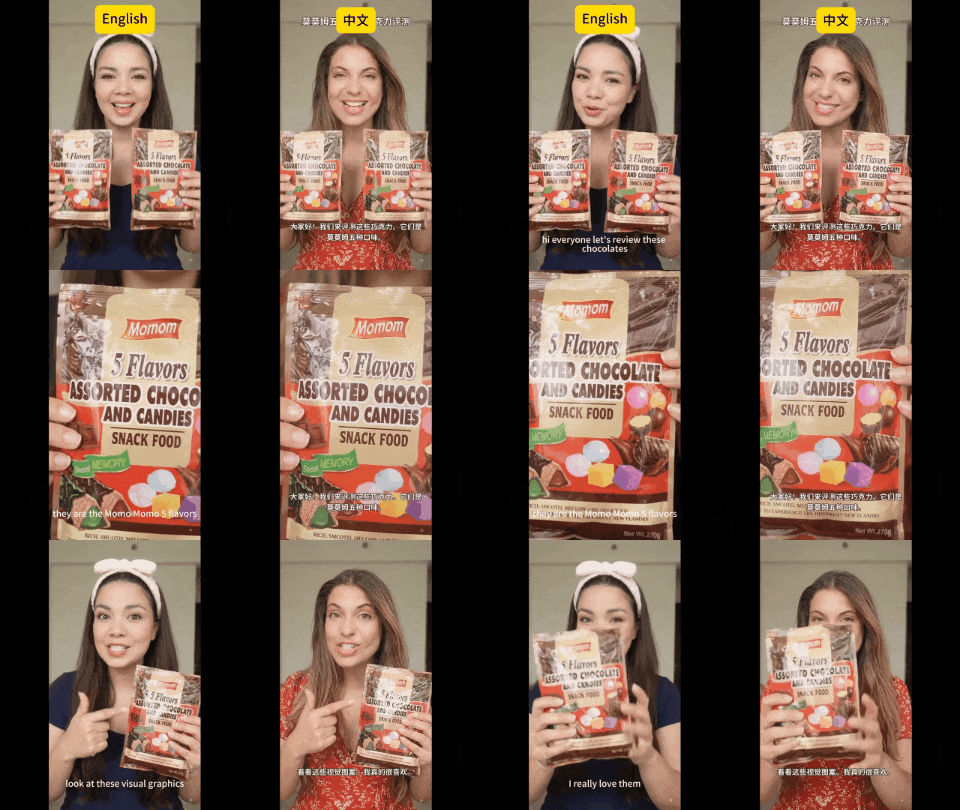
- Example: generate different language versions from the same product video while keeping the original visual structure and adapting dubbing, subtitles, and lip sync.
3.2 Change the on-screen person: make content feel closer to local audiences
People are often the entry point for trust in an ad. When a brand enters a new market, it may need an on-screen person who feels more familiar to local audiences. It may also want different presenters for different country accounts.
Changing the person in a video can adjust the character while keeping the original script, actions, and shot structure. For UGC videos where the script and expression style have already been tested, this is especially useful for market localization and ad creative testing.
After changing the person, the team should not only check whether the face looks natural. It also needs to review the contact between the person and the product, action continuity, facial expression, and brand tone. Before using real faces, voices, or source videos commercially, the team should confirm that it has the proper commercial rights.
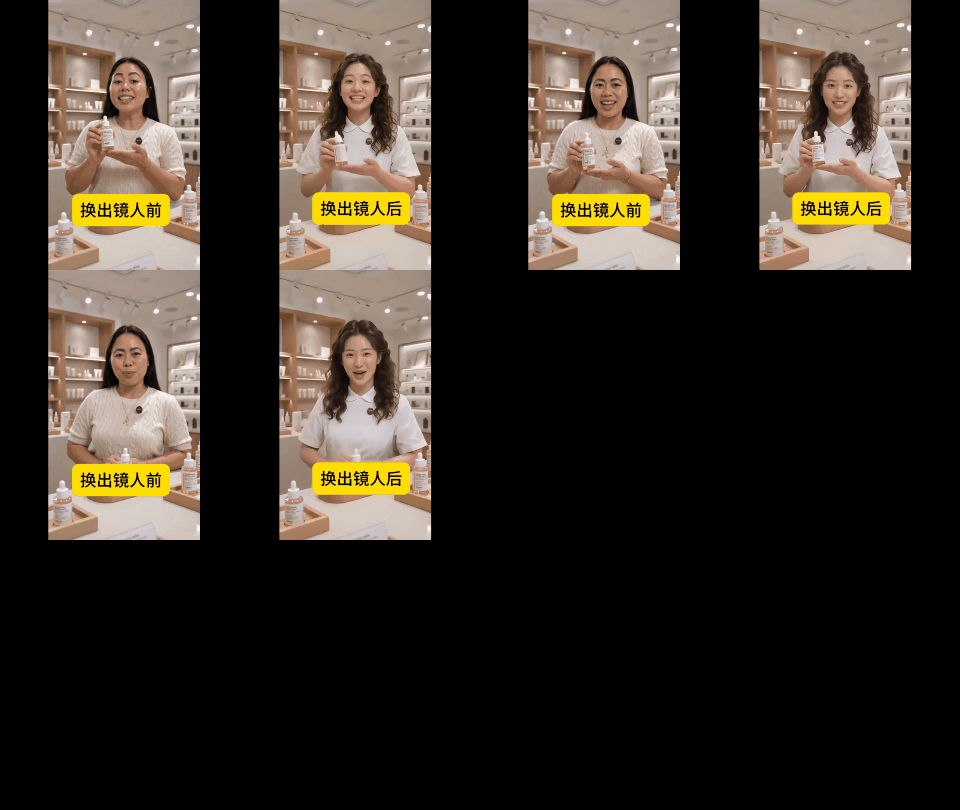
- Example: change the on-screen person while keeping the expression structure of the original video, creating versions for different marketing scenarios.
3.3 Change the product: extend one product video to multiple SKUs
When a brand has multiple colors, styles, models, or product bundles, product videos often need constant updates. If the scene, action, and demonstration logic of the source video are stable, the product shown in the frame can often be replaced.
AI product replacement is useful for ecommerce ads, consumer brands, product demos, and overseas social content. A hand-held product video, for example, can be turned into versions for different colors or models, then matched with the right copy and landing page for each market. This is especially useful for teams with many SKUs or frequent product launches.
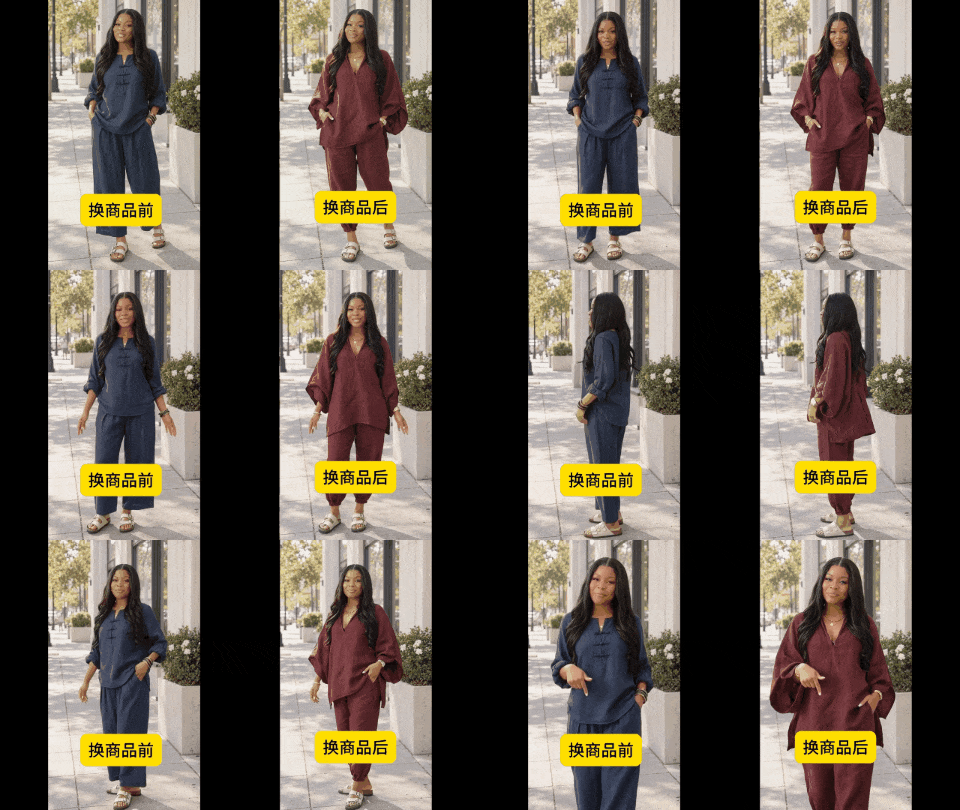
- Example: keep the original use scene and action, replace the product in the frame with other SKUs, and create multiple product marketing versions.
3.4 Change audio and voiceover: test different messages with the same visuals
Some ads do not need new visuals. They only need a new narration, voiceover, or marketing message. The same product demo can use a different language for another country, or a different voiceover and selling point for another ad group.
Video voiceover replacement usually includes uploading the source video, preparing new voice content, generating a new audio version, then checking subtitles, tone, and audio-video sync. If someone speaks on screen, the match between lip movement and the new voice needs special attention.
This is valuable for ad testing. The team can keep the filmed product demo, adjust only the opening line, selling point, or CTA in the audio, and observe how different expressions affect the audience without reshooting every copy variation.
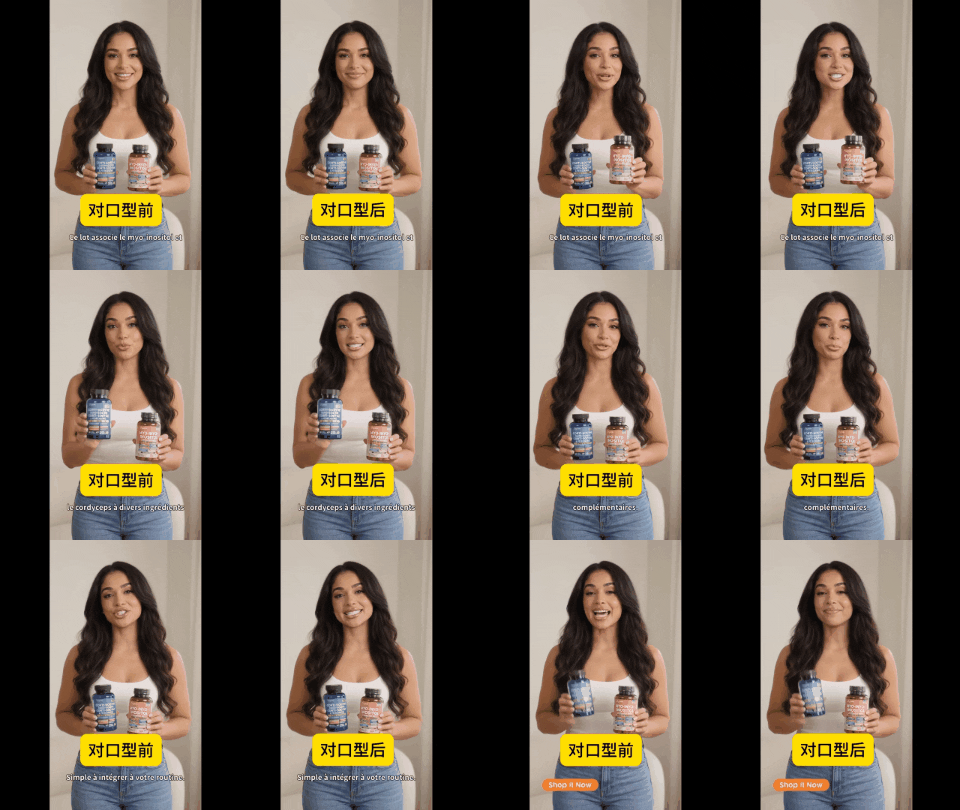
- Example: keep the original visuals and generate versions for different markets and marketing goals by changing the audio or voiceover.
3.5 Enhance video quality: bring archived assets back into the marketing workflow
Many brands have assets in their libraries that are strong in content but weak in visual quality. These may include old ads, livestream clips, creator videos, or older product materials.
Quality enhancement can be a preparation step before repurposing. A team can improve clarity first, then change the language, product, or voiceover. Assets that were once only good enough for internal reference may become usable again in ads, social posts, or product pages.
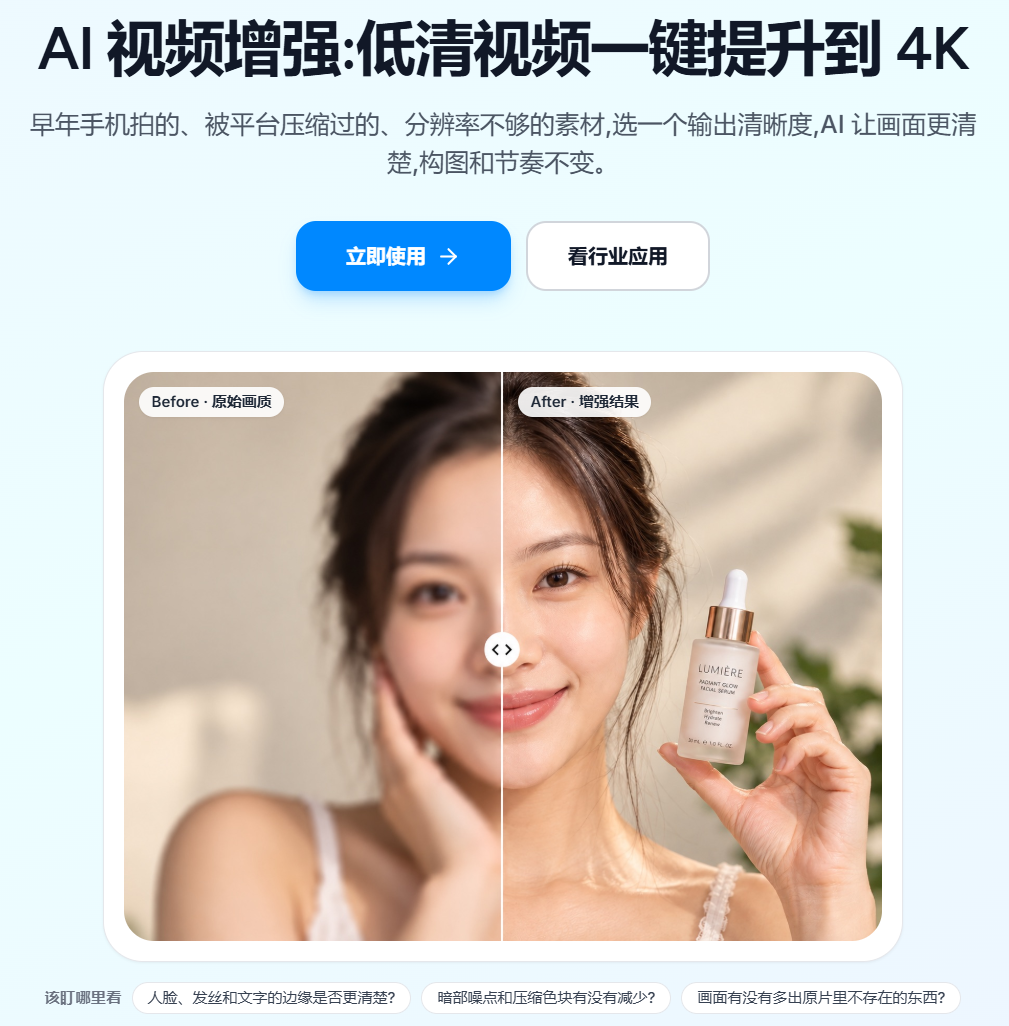
- Example: improve the clarity of low-resolution or older video so that archived assets can be edited and published again.
3.6 A basic AI video repurposing workflow
Decide what needs to change -> upload the existing video -> choose language change, person change, product replacement, voiceover replacement, or quality enhancement -> check visuals, audio, and lip sync -> export the version for the target market.
If one video has several needs, these steps can also be combined. With SocialEcho AI creation, for example, a team can enhance an old video first, then change its language and voiceover, and finally create product versions for different SKUs. One source asset can become several market-ready versions faster.
4. Which repeated investments can video repurposing reduce?
The value of video repurposing is not limited to saving one production fee. It can reduce repeated cash spend, production hours, team labor, and waiting time before a market test.
| Production scenario | Resources repeatedly used in the traditional workflow | Repeated work AI video repurposing can reduce |
|---|---|---|
| Multilingual versions | Translation coordination, voice talent, recording studio, reshoots, subtitle production, and review time | Fewer multilingual reshoots, repeated recordings, subtitle edits, and communication rounds; the team can spend more time on launch and campaign optimization |
| Changing the on-screen person | Casting, creator or actor communication, contracts, makeup, location, scheduling, and crew time | Less labor spent on recasting and scheduling, and fewer full reshoots caused by presenter changes |
| Multiple SKUs | Product samples, logistics, set preparation, photography, lighting, product organization, and individual edits | Less repeated sample shipping, set building, and SKU-by-SKU filming, helping the content team cover a product portfolio faster |
| Changing voiceover or message | Voice talent, recording equipment, narration, mixing, subtitle adjustment, and version review | Less recording and post-production for each version, while the same visuals can test more copy and marketing angles |
| Reusing old assets | Rebuilding a set, reshooting, re-editing, and repeating the approval process | Less rebuilding caused by weak image quality, and a longer usable life for video assets |
| Ad version testing | Separate production for each language, person, product, and message, with project management and reviews increasing by version | Shorter production waits before testing, so the team can use real campaign feedback to decide the next creative direction |
| Multi-market expansion | Repeated coordination with actors, vendors, translators, and post-production teams in each country | Less cross-team coordination and repeated delivery, leaving more focus for market strategy, audience insight, and conversion optimization |
For brands expanding into multiple overseas markets, AI video repurposing is not just a way to “edit a video once.” Its value is helping a proven idea move into the next market faster. Reuse what already works, then adjust the language, person, product, and message. The team can spend more time on the work that actually affects growth: understanding audiences, testing creative ideas, and improving conversion.
5. FAQ
5.1 How can one video be made into multiple language versions?
Upload the source video, choose the target language, and generate the matching voiceover and subtitles. For videos where a person speaks on camera, check lip sync as well. Before publishing, review product names, prices, units, brand terms, and local expressions.
5.2 How do you change the language and voiceover in a video?
Prepare a video with clear visuals and recognizable audio, then choose the target language or new voiceover content and generate a new version. Afterward, check translation, tone, subtitles, and audio-video sync. Do not stop at confirming that the words were translated correctly.
5.3 How do you change the person in a video?
Select the person who needs to be replaced, generate the new on-screen person version, and check actions, expressions, and the contact between the person and the product. For commercial use, the team must secure rights for likeness, voice, and the original video material.
5.4 How can product videos be produced in batches?
Choose one product video with stable demonstration logic, then generate versions for different colors, styles, models, or SKUs. Each version should be checked for product proportion, packaging text, material, and usage action. If product differences are too large, a new shoot may still be needed.
5.5 What is the difference between AI video repurposing and AI video generation?
AI video generation starts from text, images, or a creative idea and focuses on creating new visuals. AI video repurposing starts from an existing video and focuses on changing language, person, product, audio, or quality, making it more suitable for video localization and ad version testing.
5.6 Who is AI video repurposing suitable for?
It is suitable for teams that already have video assets and need versions for multiple markets or marketing goals, including global brands, overseas ad teams, social media teams, agencies, creators, and UGC content teams.
5.7 Does video repurposing require reshooting?
Not always. If the goal is to change language, voiceover, person, or product, reshooting may not be necessary. But if the source quality is too low, the product difference is large, the action is complex, or there is text or a prop in the frame that cannot be replaced, additional shooting may still be required.
5.8 Which costs can video repurposing reduce?
It can reduce communication with actors and creators, recasting, location scheduling, product sample shipping, repeated set preparation, voice recording, subtitle post-production, version review, and cross-team coordination, while shortening the wait from creative idea to market test.
5.9 Does changing the person in a video require likeness rights?
Yes. Before using a real person’s face, voice, or source video in commercial communication, confirm rights for likeness, voice use, video copyright, and commercial authorization scope, including target countries, platforms, usage period, and ad purposes.
;}.cls-2{fill:%230868f7;}.cls-3{fill:url(%23未命名的渐变_44);}.cls-4{fill:%23333;}%3c/style%3e%3clinearGradient%20id='未命名的渐变_8'%20x1='33.73'%20y1='100.61'%20x2='-0.03'%20y2='-1.06'%20gradientUnits='userSpaceOnUse'%3e%3cstop%20offset='0'%20stop-color='%237ae9fb'/%3e%3cstop%20offset='0.67'%20stop-color='%232b90f8'/%3e%3cstop%20offset='1'%20stop-color='%230868f7'/%3e%3c/linearGradient%3e%3clinearGradient%20id='未命名的渐变_44'%20x1='27.86'%20y1='18.67'%20x2='68.36'%20y2='22.22'%20gradientUnits='userSpaceOnUse'%3e%3cstop%20offset='0'%20stop-color='%235ac7f2'/%3e%3cstop%20offset='1'%20stop-color='%230868f7'/%3e%3c/linearGradient%3e%3c/defs%3e%3cpath%20class='cls-1'%20d='M29,28.74V81.91l-9.51-3.68v0L8.52,74A7.17,7.17,0,0,1,4,67.32V24.54A3.76,3.76,0,0,1,9.08,21Z'/%3e%3cpath%20class='cls-2'%20d='M68.09,78.07a13.15,13.15,0,0,1-17.9,12.06L29,81.91h0V28.74L50.19,37A13.17,13.17,0,0,0,68.08,25.3h0Z'/%3e%3cpath%20class='cls-3'%20d='M68.08,25.3a13.19,13.19,0,0,1-6.73,10.87A13.09,13.09,0,0,1,50.19,37L29,28.74V6A3.76,3.76,0,0,1,34.1,2.52l25.59,9.91A13.22,13.22,0,0,1,68.08,25.3Z'/%3e%3cpath%20class='cls-4'%20d='M129.06,81.76a4.33,4.33,0,0,1-3.19-1.31,4.4,4.4,0,0,1-1.31-3.24V56.86H97.65V77.21a4.36,4.36,0,0,1-1.35,3.2A4.68,4.68,0,0,1,93,81.76a4.32,4.32,0,0,1-3.19-1.31,4.37,4.37,0,0,1-1.32-3.24V27.27A4.58,4.58,0,0,1,89.83,24a4.59,4.59,0,0,1,7.82,3.27V48.15h26.91V27.27A4.58,4.58,0,0,1,125.91,24a4.59,4.59,0,0,1,7.82,3.27V77.21a4.37,4.37,0,0,1-1.36,3.2A4.65,4.65,0,0,1,129.06,81.76Z'/%3e%3cpath%20class='cls-4'%20d='M163.77,81.66c-6.57,0-11.76-1.92-15.44-5.7s-5.54-9.07-5.54-15.74a26.76,26.76,0,0,1,2.09-10.43,17.72,17.72,0,0,1,6.67-8.06,19.15,19.15,0,0,1,10.68-2.95,19,19,0,0,1,10.46,2.8,18.7,18.7,0,0,1,6.55,7.36,22.53,22.53,0,0,1,2.36,10.28A4.51,4.51,0,0,1,177,63.77H152.23a10.8,10.8,0,0,0,3.49,6.65c2,1.68,4.88,2.52,8.66,2.52a22.25,22.25,0,0,0,7.54-1.21c.74-.3,1.55-.67,2.37-1.07a3.75,3.75,0,0,1,1.84-.4,4.09,4.09,0,0,1,3,1.15,4,4,0,0,1,1.12,3,4.38,4.38,0,0,1-2.58,3.82,32.34,32.34,0,0,1-6.36,2.61A28.67,28.67,0,0,1,163.77,81.66ZM172.4,55.9a9.72,9.72,0,0,0-1.63-4.56A9.9,9.9,0,0,0,167,48a10.38,10.38,0,0,0-4.64-1.14,12,12,0,0,0-4.77,1.06,9.54,9.54,0,0,0-4.89,5.66,11.78,11.78,0,0,0-.51,2.3Z'/%3e%3cpath%20class='cls-4'%20d='M193,81.64a4.49,4.49,0,0,1-4.51-4.55V27.28A4.58,4.58,0,0,1,189.84,24a4.48,4.48,0,0,1,3.28-1.36A4.36,4.36,0,0,1,196.35,24a4.46,4.46,0,0,1,1.31,3.31V77.09a4.34,4.34,0,0,1-1.35,3.2A4.67,4.67,0,0,1,193,81.64Z'/%3e%3cpath%20class='cls-4'%20d='M263.79,81.71a5.7,5.7,0,0,1-4.2-1.74,5.76,5.76,0,0,1-1.73-4.19V27.37a4.58,4.58,0,0,1,1.35-3.27A4.59,4.59,0,0,1,267,27.37V72.53h24a4.58,4.58,0,0,1,3.27,7.82A4.66,4.66,0,0,1,291,81.71Z'/%3e%3cpath%20class='cls-4'%20d='M424.48,81.74a4.71,4.71,0,0,1-2.71-.88,5.43,5.43,0,0,1-1-1l-.07-.09-12.41-17-5.41,5v9.44a4.31,4.31,0,0,1-1.36,3.19,4.66,4.66,0,0,1-3.3,1.36A4.29,4.29,0,0,1,395,80.42a4.36,4.36,0,0,1-1.32-3.23V27.37A4.58,4.58,0,0,1,395,24.1a4.52,4.52,0,0,1,6.58.12,4.54,4.54,0,0,1,1.24,3.15V56.31l17.72-16.38.05,0a4.8,4.8,0,0,1,2.94-1.11,4.4,4.4,0,0,1,3.27,1.2,4.57,4.57,0,0,1,1.2,3.27,4.44,4.44,0,0,1-.77,2.33,7.45,7.45,0,0,1-1.43,1.65l-11,9.64,13.34,17.68a5,5,0,0,1,1,2.71,4.12,4.12,0,0,1-1.36,3.24A4.64,4.64,0,0,1,424.48,81.74Z'/%3e%3cpath%20class='cls-4'%20d='M317.93,81.76a21.5,21.5,0,1,1,21.17-21.5A21.37,21.37,0,0,1,317.93,81.76Zm0-34.1a12.61,12.61,0,1,0,12.42,12.6A12.52,12.52,0,0,0,317.93,47.66Z'/%3e%3cpath%20class='cls-4'%20d='M212.18,101.22a4.12,4.12,0,0,1-3.05-1.26,4.17,4.17,0,0,1-1.26-3.1V43.34a4.37,4.37,0,0,1,1.3-3.14,4.26,4.26,0,0,1,3.13-1.3,4.19,4.19,0,0,1,3.1,1.26,4.32,4.32,0,0,1,1.26,3.16,20.77,20.77,0,0,1,13-4.54,21.51,21.51,0,0,1,0,43,20.51,20.51,0,0,1-13-4.57V96.86a4.15,4.15,0,0,1-1.3,3.06A4.5,4.5,0,0,1,212.18,101.22Zm17.43-53.63c-6.23,0-12.93,4.11-12.93,12.72a12.73,12.73,0,0,0,25.46,0A12.71,12.71,0,0,0,229.61,47.59Z'/%3e%3cpath%20class='cls-4'%20d='M365.76,81.76a21.5,21.5,0,1,1,21.18-21.5A21.37,21.37,0,0,1,365.76,81.76Zm0-34.1a12.61,12.61,0,1,0,12.42,12.6A12.52,12.52,0,0,0,365.76,47.66Z'/%3e%3c/svg%3e)