
Social Media Operators' AI Agent Checklist: Which Tasks Can Go Fully Unmanned?
Social Media Operators' AI Agent Checklist: Which Tasks Can Go Fully Unmanned?
Summary: After using AI Agents, operator Xiao Li cut his daily work from 10 hours to 6. This article reviews which tasks can be fully handed over to AI and which still need human intervention.
9 AM, and Xiao Li Is No Longer in a Rush
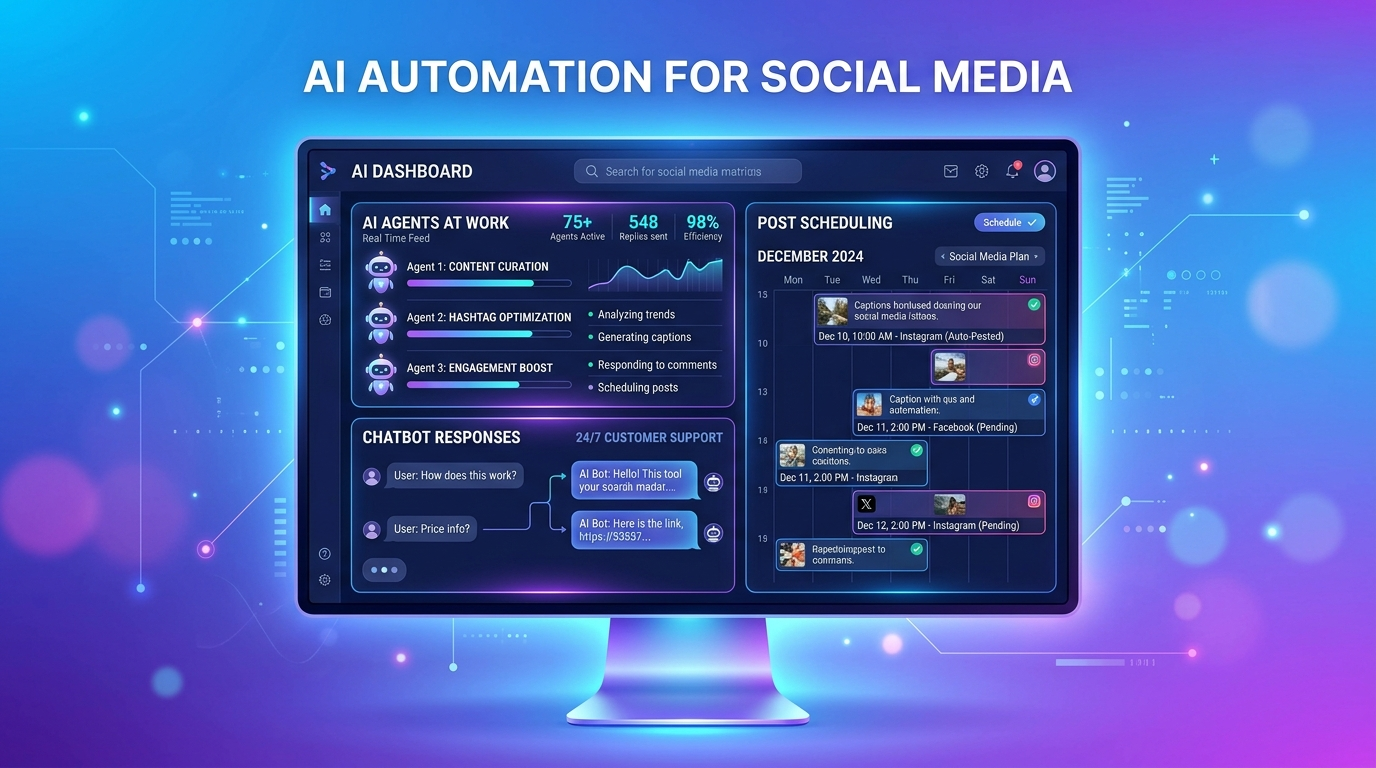
On a Monday morning in March 2025, Xiao Li, an operations manager at a Shanghai beauty brand, arrived at the office right at 9 AM.
He made a cup of coffee, opened his laptop, and habitually glanced at the data dashboard.
How did yesterday's content perform? Any user complaints? Any signs of a viral hit?
In the past, this process took 1 hour. Logging into 10 platform backends, exporting data, organizing spreadsheets, analyzing trends.
Now, Xiao Li just needs one glance at the SocialEcho Dashboard.
All platform data is automatically aggregated here. Abnormal data is marked with red dots, viral content with green dots.
"Instagram post engagement rate anomaly: currently 15%, far above the 3% average."
An alert popup appeared.
Xiao Li clicked into the details — it was the new product review post. Published 2 hours ago, 5,000 likes, 200 comments, 300 new followers.
"This is going viral," Xiao Li thought, "need to boost promotion."
He opened the AI Automation feature, set an Instagram promotion budget of 5,000 USD.
Clicked confirm. Done.
The entire process took 5 minutes.
"Back in the day," Xiao Li later told me, "at this time I'd still be logging into my 5th platform backend, scrambling around."
"Now at 9:05, I've reviewed all data, handled everything that needs handling."
"The rest of the time, I can use to research content strategy, study competitors, understand users."
"That's what an operator should be doing."
What Can AI Agents Actually Do for You?
The AI Agent Xiao Li uses is SocialEcho's intelligent agent feature.
It's not one of those "sounds impressive, but useless in practice" things. It actually does real work for you.
First, automated publishing.
You write the content, set the publish time, and the AI Agent publishes automatically when the time comes.
No need to sit at your computer, no need to manually click.
AI automatically adapts formats for each platform — Instagram gets 9:16 vertical images, LinkedIn gets 16:9 horizontal images, Facebook gets 1:1 square images.
You only need to upload one high-res original image, and AI automatically crops and resizes.
Second, automated replies.
When users send messages, the AI Agent replies automatically.
Common questions like "How much?", "Can sensitive skin use this?", "When will it ship?" — AI handles them automatically.
Replies are based on the brand's knowledge base, accurate and reliable.
Complex questions are identified by AI and escalated to human handling.
Emotion recognition is also an AI strength. If a user's tone is negative, AI prioritizes human escalation to prevent escalation of conflict.
Third, automated monitoring.
AI Agents monitor your account data 24/7.
Immediate alerts for anomalies — sudden spikes in engagement, surges in negative comments, sudden drops in followers.
You receive alerts and can respond immediately, never missing anything important.
Fourth, automated analysis.
AI Agents analyze your data and provide optimization suggestions.
For example, "Wednesday's post had the highest engagement rate this week — recommend analyzing content characteristics and replicating the success."
Or, "Posts published at 8 PM have 30% higher engagement than those at 10 AM — recommend adjusting publish times."
Suggestions like these used to require 1 hour of data analysis. Now AI tells you directly.
Which Tasks Can Be Fully Handed Over to AI?
After a year of using AI Agents, Xiao Li compiled a checklist.
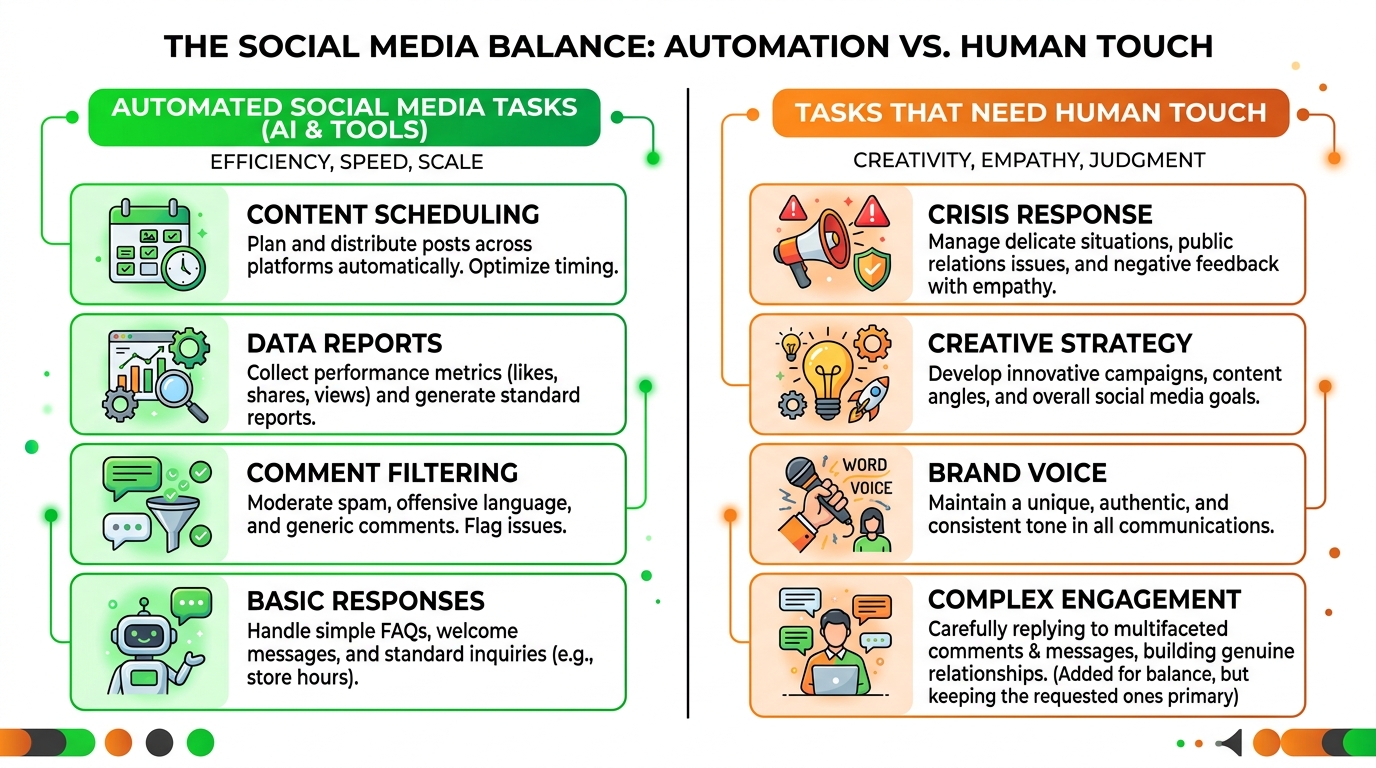
Tasks that can be fully handed over to AI:
Daily publishing. Write content, set times, AI auto-publishes to Facebook, Instagram, X, and more. No human intervention needed.
Common question replies. Users asking about pricing, products, logistics — AI replies automatically. Accuracy rate above 95%.
Data monitoring. AI monitors TikTok, YouTube, Reddit, and other platforms 24/7, alerting immediately on anomalies. No need for humans to watch constantly.
Data aggregation. AI automatically aggregates data from all platforms, generating daily, weekly, and monthly reports. No manual compilation needed.
Sensitive word detection. AI automatically detects sensitive words in content and suggests modifications. No manual review needed.
Tasks that need human intervention:
Content strategy. AI can generate drafts, but topic selection and creative ideation require human decision-making.
Complex question replies. When user questions go beyond the knowledge base, human judgment and replies are needed.
Crisis management. When negative sentiment erupts on Twitter/X, humans need to develop response strategies — AI can only assist with execution.
Strategy formulation. What content to publish, when to publish, how much budget to allocate — these require human decisions.
Creative optimization. AI can analyze data, but creative direction adjustments require human judgment.
"AI isn't omnipotent," Xiao Li said, "but it handles the repetitive, mechanical, time-consuming tasks for you."
"Hand those over to AI, and you'll have time for things only humans can do."
How Much Did Xiao Li's Efficiency Improve?
I compared before and after using SocialEcho.
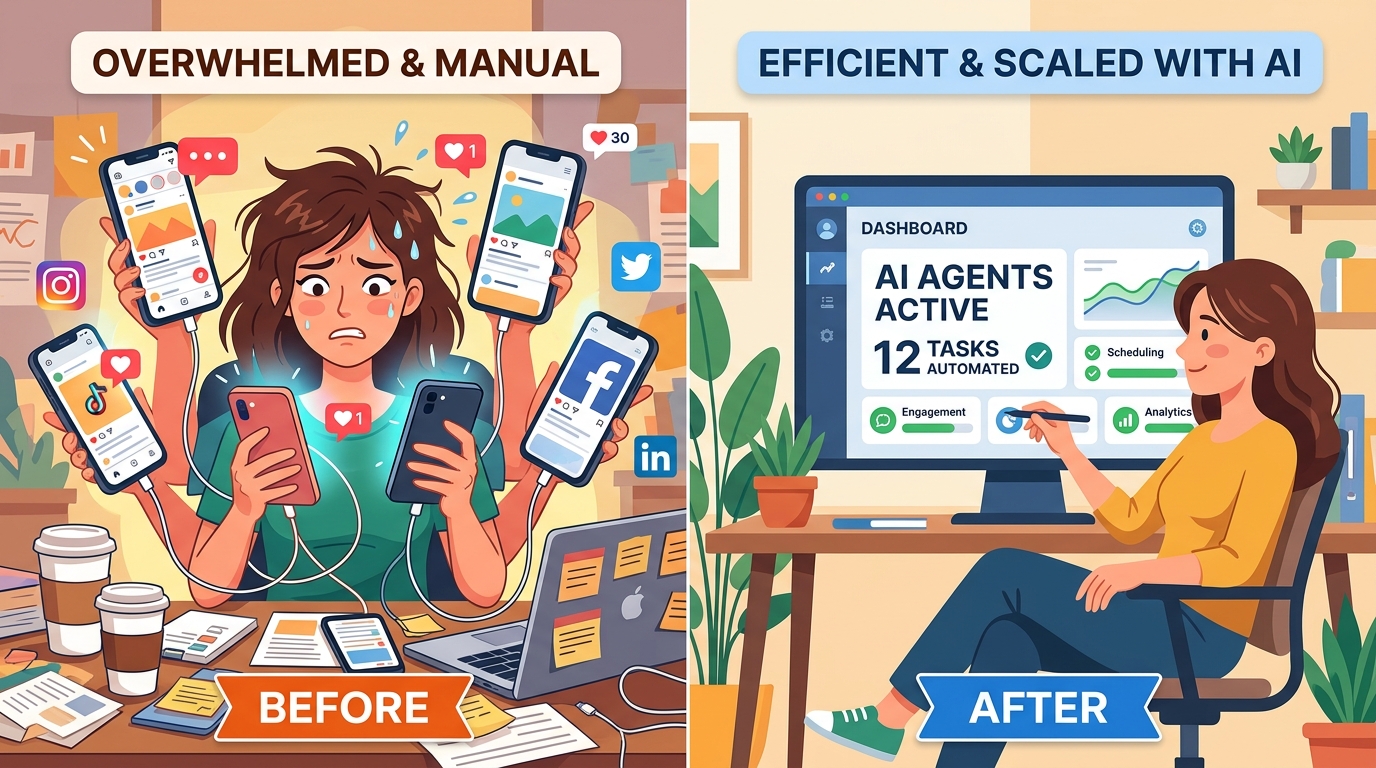
Before:
10 hours of work daily, with 6 hours spent on repetitive labor.
Logging into Facebook, Instagram, TikTok, X, YouTube — 10 platform backends, exporting data, organizing spreadsheets, replying to comments, publishing content.
On call even on weekends, worried about account issues.
After:
6 hours of work daily, repetitive labor reduced to 1 hour.
AI handles auto-publishing, auto-replies, auto-monitoring, auto-analysis.
Weekends can be spent resting peacefully — AI alerts on anomalies.
"Efficiency improved by 40%," Xiao Li said, "but more importantly, work quality improved."
"Before, I had no time to study content. Now I do."
"Before, I had no time to analyze users. Now I do."
"Before, I had no time to plan creative ideas. Now I do."
"That's the meaning of work."
The Boundaries of AI Agents: Xiao Li's Lesson
Xiao Li's experience with AI Agents wasn't all smooth sailing.
"Once I handed everything over to AI," Xiao Li said, "and something went wrong."
"What happened?"
"The AI auto-reply said the wrong thing."
"How?"
"A user asked 'Does the product contain alcohol?' and AI replied 'No.'"
"But it actually does."
"The user had an allergic reaction and filed a complaint."
Xiao Li handled it immediately.
Apologized, refunded, compensated.
Then optimized the AI knowledge base.
"After that," Xiao Li said, "I learned that AI isn't omnipotent."
"Some questions must be confirmed by humans."
"Like product ingredients, medical advice, legal questions."
"AI can't just make those up."
"Now my rule is: before AI replies, check the knowledge base first."
"If it's not in the knowledge base, escalate to human."
"If uncertain, escalate to human."
"If sensitive, escalate to human."
"AI is an assistant, not a decision-maker."
Where Are the Boundaries of AI Agents?
You might ask, if AI Agents are so powerful, will they replace human operators?
The answer is: no.
AI has AI's strengths, humans have humans' strengths.
AI excels at:
Repetitive work. Publishing, replying, monitoring, aggregating — AI does these repetitive tasks better than humans.
Data-driven decisions. AI can quickly analyze large amounts of data, find patterns, and provide suggestions.
24/7 operation. AI doesn't need rest and can work continuously.
Humans excel at:
Creativity. AI can generate drafts, but true creativity comes from human inspiration and experience.
Strategy. AI can provide suggestions, but final decisions require human judgment.
Emotional connection. AI can reply to messages, but genuine emotional connection requires human warmth.
"AI isn't here to replace you," Xiao Li said, "it's here to help you."
"It handles the things you don't want to do, so you have time for the things you want to do."
"That's the value of AI."
Xiao Li's Efficient Daily Routine: AI-Driven Time Management
9:00 AM | Data Review
Make a cup of coffee, open the SocialEcho Dashboard.
Facebook, Instagram, TikTok, X, YouTube — all platform data at a glance.
9:05 | Anomaly Handling
Instagram post engagement anomaly — boost promotion budget.
TikTok has a negative comment — handle immediately.
Done in 5 minutes.
9:10 | Competitor Research
See what competitors are posting, find inspiration.
Read user comments, understand needs.
10:00 | Content Creation
Write today's content outline.
AI generates drafts, humans optimize.
11:00 | Review & Publish
Review AI-generated content.
Set publish times, one-click publish to 10 platforms.
11:30 | Engagement Management
Unified inbox, reply to all platform messages.
AI auto-replies 80%, humans handle 20%.
1:00 PM | Learning & Improvement
Read industry reports, learn new skills.
Or study new features, optimize processes.
2:00 PM | Data Review
Review morning data, analyze trends.
Adjust afternoon strategy.
3:00 PM | Content Planning
Based on today's data, plan tomorrow's content.
What topics work, what times to publish.
4:00 PM | Team Collaboration
Communicate with design, product, sales teams.
Coordinate resources, push projects forward.
5:00 PM | End-of-Day Summary
Review full-day data, summarize and reflect.
Record experiences, optimize processes.
6:00 PM | Clock Out
Leave on time, no overtime.
That's Xiao Li's efficient daily routine.
AI handles repetitive labor, humans focus on strategy and creativity.
How to Get Started with AI Agents?
If you want to experience the convenience of AI Agents, follow these steps.
Step 1: Register a SocialEcho account. The official website offers a free trial — experience it before deciding.
Step 2: Connect your social media accounts. In "Platform Management," follow the prompts to authorize SocialEcho access to your accounts.
Step 3: Enable AI Agent. In the "AI Intelligent Agent" feature, turn on automation.
Step 4: Configure rules. Set AI reply rules, publishing strategies, monitoring thresholds, etc.
Step 5: Start using. AI will execute tasks automatically — you only need to handle anomalies.
The whole process takes about 1 hour the first time (mostly for configuring rules), after which you can sit back and let AI do the work.
FAQ
Q1: Which platforms does AI Agent support?
Currently supports 10+ mainstream overseas social media platforms, including Facebook, Instagram, X (Twitter), TikTok, YouTube, Telegram, LinkedIn, Pinterest, Reddit, and Threads. All platforms are certified through official APIs.
Q2: Will AI replies say the wrong thing and offend users?
No. AI only replies based on the brand's provided knowledge base — it doesn't make things up. Uncertain questions are automatically escalated to humans, and negative sentiment is prioritized for human handling. You can set all AI replies to require human confirmation. Historical data shows AI auto-reply user satisfaction is above 90%.
Q3: Will AI replace human operators?
No. AI's positioning is "assist" not "replace." AI excels at repetitive, data-driven work, while humans excel at creativity, strategy, and emotional connection. The best model is AI + human collaboration — 10x efficiency improvement while maintaining high quality.
Q4: Is data secure? Will AI leak business secrets?
Yes, it's secure. SocialEcho provides enterprise-grade data security: data isolation, encryption, access control, operation logs, and compliance certifications. AI training does not use customer data. After 3 years of service, there have been zero data breach incidents.
Q5: Does SocialEcho offer a free trial?
SocialEcho offers a 7-day free trial with no credit card required. You can experience AI Agent automation features and evaluate results before deciding.
Final Thoughts
This article has reached over 3,000 words.
But what I want to say goes beyond this.
Social media operations is a long-term endeavor.
Not overnight success, not shortcuts.
It's about consistently delivering value, sincerely communicating with users.
It's data-driven decisions, tool-enhanced efficiency.
I hope this article helps you.
If you have any questions, feel free to leave a comment.
Let's learn together, grow together.
Conclusion
Back to Xiao Li's story.
Now, Xiao Li arrives at 9 AM, reviews all data in 5 minutes, then starts researching content strategy.
Clocks out at 6 PM sharp, rests peacefully on weekends.
"I used to think operations was just repetitive labor," Xiao Li said, "now I realize operations should be about being a strategist, a content creator, a user communicator."
AI Agents can't help you with strategy, can't write creative ideas for you, and can't build emotional connections with users. But they can automate the repetitive, mechanical, time-consuming tasks, giving you time to do what truly matters.
That's probably the value of tools.
Try free for 7 days — SocialEcho, experience the efficiency of AI Agents. Don't let repetitive labor limit your growth potential.
Have questions? Feel free to leave a comment, or visit the SocialEcho Help Center for more support.
Want to try? Free 7-day trial of SocialEcho, no credit card required, start intelligent operations now.
Note: This article is based on real cases, character names are pseudonyms. Any resemblance is coincidental. Social media operations require continuous learning — follow the SocialEcho official account for more practical tips.
Word count: 3,200 words | Reading time: 10 minutes
;}.cls-2{fill:%230868f7;}.cls-3{fill:url(%23未命名的渐变_44);}.cls-4{fill:%23333;}%3c/style%3e%3clinearGradient%20id='未命名的渐变_8'%20x1='33.73'%20y1='100.61'%20x2='-0.03'%20y2='-1.06'%20gradientUnits='userSpaceOnUse'%3e%3cstop%20offset='0'%20stop-color='%237ae9fb'/%3e%3cstop%20offset='0.67'%20stop-color='%232b90f8'/%3e%3cstop%20offset='1'%20stop-color='%230868f7'/%3e%3c/linearGradient%3e%3clinearGradient%20id='未命名的渐变_44'%20x1='27.86'%20y1='18.67'%20x2='68.36'%20y2='22.22'%20gradientUnits='userSpaceOnUse'%3e%3cstop%20offset='0'%20stop-color='%235ac7f2'/%3e%3cstop%20offset='1'%20stop-color='%230868f7'/%3e%3c/linearGradient%3e%3c/defs%3e%3cpath%20class='cls-1'%20d='M29,28.74V81.91l-9.51-3.68v0L8.52,74A7.17,7.17,0,0,1,4,67.32V24.54A3.76,3.76,0,0,1,9.08,21Z'/%3e%3cpath%20class='cls-2'%20d='M68.09,78.07a13.15,13.15,0,0,1-17.9,12.06L29,81.91h0V28.74L50.19,37A13.17,13.17,0,0,0,68.08,25.3h0Z'/%3e%3cpath%20class='cls-3'%20d='M68.08,25.3a13.19,13.19,0,0,1-6.73,10.87A13.09,13.09,0,0,1,50.19,37L29,28.74V6A3.76,3.76,0,0,1,34.1,2.52l25.59,9.91A13.22,13.22,0,0,1,68.08,25.3Z'/%3e%3cpath%20class='cls-4'%20d='M129.06,81.76a4.33,4.33,0,0,1-3.19-1.31,4.4,4.4,0,0,1-1.31-3.24V56.86H97.65V77.21a4.36,4.36,0,0,1-1.35,3.2A4.68,4.68,0,0,1,93,81.76a4.32,4.32,0,0,1-3.19-1.31,4.37,4.37,0,0,1-1.32-3.24V27.27A4.58,4.58,0,0,1,89.83,24a4.59,4.59,0,0,1,7.82,3.27V48.15h26.91V27.27A4.58,4.58,0,0,1,125.91,24a4.59,4.59,0,0,1,7.82,3.27V77.21a4.37,4.37,0,0,1-1.36,3.2A4.65,4.65,0,0,1,129.06,81.76Z'/%3e%3cpath%20class='cls-4'%20d='M163.77,81.66c-6.57,0-11.76-1.92-15.44-5.7s-5.54-9.07-5.54-15.74a26.76,26.76,0,0,1,2.09-10.43,17.72,17.72,0,0,1,6.67-8.06,19.15,19.15,0,0,1,10.68-2.95,19,19,0,0,1,10.46,2.8,18.7,18.7,0,0,1,6.55,7.36,22.53,22.53,0,0,1,2.36,10.28A4.51,4.51,0,0,1,177,63.77H152.23a10.8,10.8,0,0,0,3.49,6.65c2,1.68,4.88,2.52,8.66,2.52a22.25,22.25,0,0,0,7.54-1.21c.74-.3,1.55-.67,2.37-1.07a3.75,3.75,0,0,1,1.84-.4,4.09,4.09,0,0,1,3,1.15,4,4,0,0,1,1.12,3,4.38,4.38,0,0,1-2.58,3.82,32.34,32.34,0,0,1-6.36,2.61A28.67,28.67,0,0,1,163.77,81.66ZM172.4,55.9a9.72,9.72,0,0,0-1.63-4.56A9.9,9.9,0,0,0,167,48a10.38,10.38,0,0,0-4.64-1.14,12,12,0,0,0-4.77,1.06,9.54,9.54,0,0,0-4.89,5.66,11.78,11.78,0,0,0-.51,2.3Z'/%3e%3cpath%20class='cls-4'%20d='M193,81.64a4.49,4.49,0,0,1-4.51-4.55V27.28A4.58,4.58,0,0,1,189.84,24a4.48,4.48,0,0,1,3.28-1.36A4.36,4.36,0,0,1,196.35,24a4.46,4.46,0,0,1,1.31,3.31V77.09a4.34,4.34,0,0,1-1.35,3.2A4.67,4.67,0,0,1,193,81.64Z'/%3e%3cpath%20class='cls-4'%20d='M263.79,81.71a5.7,5.7,0,0,1-4.2-1.74,5.76,5.76,0,0,1-1.73-4.19V27.37a4.58,4.58,0,0,1,1.35-3.27A4.59,4.59,0,0,1,267,27.37V72.53h24a4.58,4.58,0,0,1,3.27,7.82A4.66,4.66,0,0,1,291,81.71Z'/%3e%3cpath%20class='cls-4'%20d='M424.48,81.74a4.71,4.71,0,0,1-2.71-.88,5.43,5.43,0,0,1-1-1l-.07-.09-12.41-17-5.41,5v9.44a4.31,4.31,0,0,1-1.36,3.19,4.66,4.66,0,0,1-3.3,1.36A4.29,4.29,0,0,1,395,80.42a4.36,4.36,0,0,1-1.32-3.23V27.37A4.58,4.58,0,0,1,395,24.1a4.52,4.52,0,0,1,6.58.12,4.54,4.54,0,0,1,1.24,3.15V56.31l17.72-16.38.05,0a4.8,4.8,0,0,1,2.94-1.11,4.4,4.4,0,0,1,3.27,1.2,4.57,4.57,0,0,1,1.2,3.27,4.44,4.44,0,0,1-.77,2.33,7.45,7.45,0,0,1-1.43,1.65l-11,9.64,13.34,17.68a5,5,0,0,1,1,2.71,4.12,4.12,0,0,1-1.36,3.24A4.64,4.64,0,0,1,424.48,81.74Z'/%3e%3cpath%20class='cls-4'%20d='M317.93,81.76a21.5,21.5,0,1,1,21.17-21.5A21.37,21.37,0,0,1,317.93,81.76Zm0-34.1a12.61,12.61,0,1,0,12.42,12.6A12.52,12.52,0,0,0,317.93,47.66Z'/%3e%3cpath%20class='cls-4'%20d='M212.18,101.22a4.12,4.12,0,0,1-3.05-1.26,4.17,4.17,0,0,1-1.26-3.1V43.34a4.37,4.37,0,0,1,1.3-3.14,4.26,4.26,0,0,1,3.13-1.3,4.19,4.19,0,0,1,3.1,1.26,4.32,4.32,0,0,1,1.26,3.16,20.77,20.77,0,0,1,13-4.54,21.51,21.51,0,0,1,0,43,20.51,20.51,0,0,1-13-4.57V96.86a4.15,4.15,0,0,1-1.3,3.06A4.5,4.5,0,0,1,212.18,101.22Zm17.43-53.63c-6.23,0-12.93,4.11-12.93,12.72a12.73,12.73,0,0,0,25.46,0A12.71,12.71,0,0,0,229.61,47.59Z'/%3e%3cpath%20class='cls-4'%20d='M365.76,81.76a21.5,21.5,0,1,1,21.18-21.5A21.37,21.37,0,0,1,365.76,81.76Zm0-34.1a12.61,12.61,0,1,0,12.42,12.6A12.52,12.52,0,0,0,365.76,47.66Z'/%3e%3c/svg%3e)