
SocialEcho vs Buffer vs Hootsuite: In-depth comparative review of the three major social media tools for overseas expansion in 2026

Introduction: A Cross-Border E-commerce Owner's Social Media Management Anxiety
2 a.m., Shenzhen.
Lin Hao stared at the three browser tabs on his computer screen, rubbing his sore eyes. On the left was Buffer's scheduling interface, in the middle was Hootsuite's data dashboard, and on the right was a Facebook comment notification—47 more unread messages.
His cross-border e-commerce company mainly sells outdoor equipment, focusing on the North American market. They post 8-10 pieces of content on Facebook and Instagram every day. The team consists of only three people: an operations manager, a designer, and a customer service representative. These three people have to manage five accounts, and they spend most of their day just switching platforms, scheduling posts, and replying to comments.
"We're not running social media; we're being run by social media," Lin Hao said to me with a wry smile.
This isn't a problem unique to him. Over the past three months, he's tried almost every mainstream social media management tool on the market, eventually narrowing it down to three candidates: Buffer, Hootsuite, and a relatively new tool called SociaEcho.
"I need a tool that can truly save me time, help me understand the data, and manage comments, not just another thing that makes me open an extra tab."
This article is an in-depth comparative review of these three tools, based on Lin Hao's three months of real-world experience and my professional evaluation as the head of content operations.
If you're also struggling with social media management for your overseas brand, this article might save you three months of trial and error.
I. Content Release and Scheduling: Who is More Efficient?
Content publishing is the most basic and core function of social media management. Lin Hao's team processes a large amount of content every day, and publishing efficiency directly determines whether they can leave work on time.

Buffer: Concise but with limited functionality
Buffer's interface is indeed clean, and its drag-and-drop scheduling is intuitive, making it almost impossible for beginners to get started. However, its problems are also obvious:
- Weak batch publishing capability : It can only publish a few pieces of content at a time, which is very inefficient when intensive publishing is needed during peak sales periods.
- Lack of recommended optimal release time : You need to figure out the release time yourself, as there is no data to support it.
- The content calendar view is simple : it only shows the basic schedule and cannot be used for macro-level planning at the weekly/monthly level.
For a team like Lin Hao's that needs to post 8-10 pieces of content every day, Buffer's publishing efficiency is far from sufficient.
Hootsuite: Feature-rich but complex to use
Hootsuite's publishing features are indeed powerful, supporting batch uploads, content calendars, and simultaneous publishing across multiple platforms. However, the trade-off is:
- The learning curve was steep : After the new feature was launched, it took Lin Hao's operations team a full week to become familiar with it.
- The interface is bloated : too many functions result in long operation paths, requiring multiple clicks to post a single message.
- Insufficient scheduling flexibility : Modifying already scheduled content is cumbersome.
"Having many functions doesn't necessarily mean it's easy to use." Lin Hao's assessment was very direct.
SocialEcho: Balancing Efficiency and User Experience
SocialEcho strikes a good balance in its publishing functionality. Its batch publishing feature allows users to upload dozens of pieces of content at once, automatically distributing them to different accounts and platforms. Intelligent scheduling recommends the best publishing time based on historical data, eliminating the need for operators to guess.
The content calendar supports switching between daily, weekly, and monthly views, and allows for drag-and-drop adjustments to schedule dates, offering a smooth user experience. Lin Hao's team mastered it in just two days, improving publishing efficiency by approximately 40%.
Feature release rating:
- Buffer: ⭐⭐⭐ (Simple but lacking in features)
- Hootsuite: ⭐⭐⭐⭐ (Powerful but complex)
- SocialEcho: ⭐⭐⭐⭐⭐ (Highly efficient and easy to use)
II. Data Analysis: Who can truly help you make decisions?

Data is the eye of social media operations. Not understanding data is like driving blindfolded.
Buffer: Sufficient basic data, insufficient depth.
Buffer's dashboards can display basic engagement, follower growth, and post performance. However, for teams requiring in-depth analysis:
- Lack of competitor comparison data
- Unable to customize reports
- Limited data export formats
- No audience profiling analysis
"It can only tell me what happened, but it can't tell me why." This is Lin Hao's assessment of Buffer's data analysis.
Hootsuite: Abundant Data, But Difficult to Interpret
Hootsuite's data capabilities are indeed comprehensive, covering almost every metric you can think of. However, the problem is:
- Information overload : Displaying too much data at once makes it difficult to find the key points.
- Lack of actionable insights : There is a lot of data, but very few "what to do next" suggestions.
- Custom report configuration is complex and requires a significant amount of time to set up.
SocialEcho: Data-Driven Decision Making
Its data analytics capabilities are designed with a focus on "actionable insights." It doesn't just display data; it tells you:
- Which content types perform best, and why?
- Specific recommendations for the best release time
- Competitor account performance comparison (supports competitor analysis on both Facebook and Instagram platforms)
- Audience activity times and interest tags
Lin Hao is most satisfied with its weekly report function—it automatically generates a summary of the previous week's data every Monday morning, including changes in key indicators, best-performing items, and optimization suggestions for the following week. "Before, I had to spend two hours making a weekly report; now I can see it just by opening it."
Data analysis rating:
- Buffer: ⭐⭐⭐ (Sufficient for basic use)
- Hootsuite: ⭐⭐⭐⭐ (Comprehensive but complex)
- SocialEcho: ⭐⭐⭐⭐⭐ (Precise and actionable)
III. Interaction Management: Who manages comments and private messages?
For cross-border e-commerce, comments and private messages are an extension of customer service. If you're slow to respond, customers will leave.
Buffer: Almost no interactive management
Buffer is positioned more as a "publishing tool," with very weak interactive management features. Comments and private messages basically need to be handled on the native platform, which means that operations staff have to switch back and forth between multiple platforms.
Hootsuite: Yes, but not smart enough.
Hootsuite's interactive management features support multi-platform comment aggregation, unified private message management, and keyword monitoring. However:
- Lack of intelligent classification and priority sorting
- Unable to set automatic reply rules
- The team collaboration features are limited (when multiple people are processing comments simultaneously, it's easy to receive duplicate replies or miss some).
SocialEcho: Intelligent Interactive Management
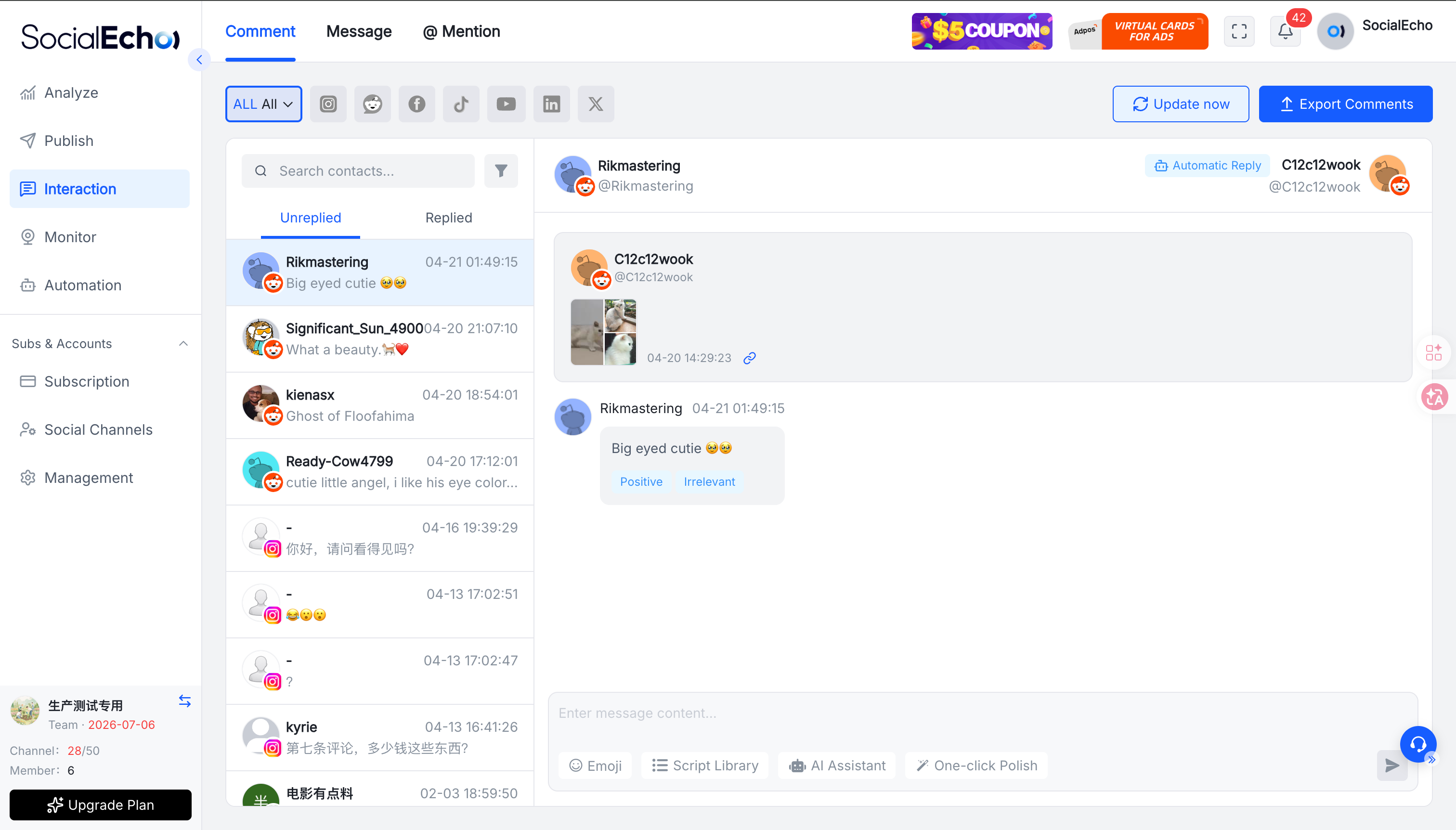
Its interactive management functions have been deeply optimized for e-commerce scenarios:
- Comment aggregation : All comments from Facebook and Instagram are centralized in one inbox, with filtering options by platform, time, and keywords.
- Optimize comment management experience for the specific characteristics of Facebook and Instagram platforms.
- Intelligent categorization : Automatically identifies types such as inquiries, complaints, and positive reviews, prioritizing the display of comments requiring urgent attention.
- Team collaboration : Supports assigning comments to different members to avoid duplicate replies.
- Quick reply templates : Preset frequently used replies, send with one click.
Lin Hao's customer service reported that after using it, the average time to reply to comments was reduced from 2 hours to less than 30 minutes.
Interaction Management Rating:
- Buffer: ⭐⭐ (Almost missing)
- Hootsuite: ⭐⭐⭐ (It has features, but it's not very smart)
- SocialEcho: ⭐⭐⭐⭐⭐ (Intelligent and efficient)
IV. AI Automation: Who can truly save you time?
It's 2026, and if social media tools don't yet have AI capabilities, they're already outdated.
Buffer: AI capabilities are just beginning.
Buffer recently launched an AI copywriting assistant that can help you generate post text. However, the functionality is still relatively basic.
- It can only generate English text and does not support multiple languages.
- The generated quality is mediocre and requires extensive modifications.
- No AI scheduling optimization
- No AI data analysis
Hootsuite: It has AI, but it's expensive.
Hootsuite's AI features are integrated into its premium plan, including content suggestions, sentiment analysis, and trend prediction. However, the problem is:
- AI functionality is only included in the most expensive plan.
- For small and medium-sized teams, the cost-effectiveness is not high.
- The actual effectiveness of AI functions falls short of the advertised claims.
SocialEcho: AI-Driven Efficiency Improvement
Its AI automation capabilities are its biggest differentiating advantage:
- AI copywriting generation : Automatically generates multilingual post copy based on product characteristics and target audience.
- Intelligent scheduling optimization : AI analyzes historical data and automatically adjusts release times to maximize exposure.
- Content performance prediction : Predict post engagement before publication to help optimize content.
- Automated workflow : Automatically execute repetitive tasks after setting rules (such as automatically replying to comments with specific keywords).
Lin Hao did the math: after using its AI function, the team saved about 3 hours of manual operation time every day. For a small team of three, this is equivalent to having an extra one and a half people.
More importantly, the price is crucial : its basic version costs only 10/month, and the team version costs 15/month, allowing you to manage up to 5 accounts, with all AI features included. In contrast, Hootsuite's AI features require a subscription to its most expensive plan, costing several times more per month.
AI-automated scoring:
- Buffer: ⭐⭐ (Beginner)
- Hootsuite: ⭐⭐⭐ (Available but expensive)
- SocialEcho: ⭐⭐⭐⭐⭐ (Comprehensive and cost-effective)
V. Price and Value for Money: Which is the Best Buy?
Finally, and most importantly: price.
Buffer
- Free version: 3 social media accounts, basic posting functions
- Essentials: $6/month/account
- Team: $12/month/account
- Premium features require an additional fee.
For a team like Lin Hao's that needs to manage 5 accounts, Buffer's monthly fee is at least between 30 and 60, and it does not include advanced data analysis features.
Hootsuite
- Professional: $99/month (10 social media accounts)
- Team: $249/month (20 social media accounts)
- Enterprise: Customized Quotation
Hootsuite's pricing is indeed too high for small to medium-sized teams. Lin Hao calculated that if they wanted to use AI features and advanced data analysis, the monthly fee would easily exceed $200.
SocialEcho
- Basic version: $10/month (can manage 5 accounts)
- Team Edition: $15/month (Manages 5 accounts, adds team collaboration features)
- All core functionalities (publishing, analytics, interaction, AI automation) are included.
Price comparison summary:
| Function | Buffer | Hootsuite | SocialEcho |
|---|---|---|---|
| Monthly fee (5 accounts) | $30-60 | $99-249 | $10-15 |
| Batch release | ❌ | ✅ | ✅ |
| Data Analysis | Base | comprehensive | Precise and actionable |
| Interactive Management | ❌ | ✅ | ✅ Intelligent |
| AI Automation | primary | Premium Set Meal | Fully included |
It's important to note that SocialEcho currently does not support Chinese platforms (WeChat, Xiaohongshu, Douyin); it focuses on mainstream overseas platforms such as Facebook, Instagram, Twitter, and LinkedIn. If your business covers both domestic and overseas markets, you will need to use other tools to work with domestic platforms.
FAQ
1. What is the biggest difference between SocialEcho and Buffer?
The biggest difference lies in the completeness of its features and the level of intelligence. Buffer is more like a pure publishing tool, suitable for individual bloggers who only need simple scheduling for publishing. Buffer, on the other hand, offers a complete workflow from publishing, data analysis, interaction management to AI automation, making it more suitable for cross-border e-commerce teams that require sophisticated operations. If you manage multiple accounts daily, process a large number of comments, and need to analyze data to make decisions, its efficiency advantage will be very obvious.
2. Is Hootsuite, which is so expensive, still worth choosing?
This depends on your team size and budget. Hootsuite is indeed feature-rich and suitable for large enterprises or teams with ample budgets. However, for small and medium-sized cross-border e-commerce businesses, a monthly fee of 99-249 is a significant expense. If you only need core social media management functions (posting, analytics, and interaction), SocialEcho offers an equivalent or even better experience at a price of 10-15 per month, providing much better value. Of course, if you require enterprise-level compliance and auditing features, Hootsuite remains a good choice.
3. Which social media platforms does SocialEcho support?
It currently supports major international social media platforms such as Facebook, Instagram, Twitter (X), LinkedIn, Pinterest, and TikTok. It's important to note that it does not support Chinese platforms, including WeChat, Xiaohongshu, and Douyin. If your business covers both domestic and international markets, it's recommended to use it for overseas platform operations and combine it with other tools to manage domestic platforms.
4. Can I use all the features during the free trial period?
Yes. It offers a 7-day free trial, during which you can use all core features, including bulk publishing, data analytics, interactive management, and AI automation. Seven days is enough time for you to fully experience the entire workflow and determine if it's right for your team. After the trial, you can choose to continue using either the Basic version (10/month) or the Team version (15/month).
5. Which tool is most suitable for a small team (2-3 people)?
For small teams of 2-3 people, I highly recommend SocialEcho. There are three reasons: First, it's the most affordable, costing only $10-15/month to manage 5 accounts with all features included; second, it's quick to learn, with a simple interface that team members can master in a day or two; and third, AI automation significantly reduces manual operation time, effectively adding manpower for small teams. Of course, if you only need the most basic publishing functionality, the free version of Buffer is sufficient. However, if your goal is refined operations and continuous growth, it's the wiser choice.
Conclusion
Let's return to Lin Hao's story at the beginning of the article.
After trying out three tools, he ultimately chose SocialEcho. SocialEcho strikes the perfect balance between efficiency, functionality, and price, which is exactly what a small team of three needs.
"After using it, our team is able to leave work two hours early every day," Lin Hao said. "This isn't an exaggeration; it's a real time saving."
If you're also struggling with social media management for your overseas brand, why not give it a try? SocialEcho offers a free 7-day trial , allowing you to experience all features without a credit card. After 7 days, the basic version is only $10/month, enabling you to manage 5 social media accounts.
👉Start your free trial now and make your social media operations easier and more efficient.
;}.cls-2{fill:%230868f7;}.cls-3{fill:url(%23未命名的渐变_44);}.cls-4{fill:%23333;}%3c/style%3e%3clinearGradient%20id='未命名的渐变_8'%20x1='33.73'%20y1='100.61'%20x2='-0.03'%20y2='-1.06'%20gradientUnits='userSpaceOnUse'%3e%3cstop%20offset='0'%20stop-color='%237ae9fb'/%3e%3cstop%20offset='0.67'%20stop-color='%232b90f8'/%3e%3cstop%20offset='1'%20stop-color='%230868f7'/%3e%3c/linearGradient%3e%3clinearGradient%20id='未命名的渐变_44'%20x1='27.86'%20y1='18.67'%20x2='68.36'%20y2='22.22'%20gradientUnits='userSpaceOnUse'%3e%3cstop%20offset='0'%20stop-color='%235ac7f2'/%3e%3cstop%20offset='1'%20stop-color='%230868f7'/%3e%3c/linearGradient%3e%3c/defs%3e%3cpath%20class='cls-1'%20d='M29,28.74V81.91l-9.51-3.68v0L8.52,74A7.17,7.17,0,0,1,4,67.32V24.54A3.76,3.76,0,0,1,9.08,21Z'/%3e%3cpath%20class='cls-2'%20d='M68.09,78.07a13.15,13.15,0,0,1-17.9,12.06L29,81.91h0V28.74L50.19,37A13.17,13.17,0,0,0,68.08,25.3h0Z'/%3e%3cpath%20class='cls-3'%20d='M68.08,25.3a13.19,13.19,0,0,1-6.73,10.87A13.09,13.09,0,0,1,50.19,37L29,28.74V6A3.76,3.76,0,0,1,34.1,2.52l25.59,9.91A13.22,13.22,0,0,1,68.08,25.3Z'/%3e%3cpath%20class='cls-4'%20d='M129.06,81.76a4.33,4.33,0,0,1-3.19-1.31,4.4,4.4,0,0,1-1.31-3.24V56.86H97.65V77.21a4.36,4.36,0,0,1-1.35,3.2A4.68,4.68,0,0,1,93,81.76a4.32,4.32,0,0,1-3.19-1.31,4.37,4.37,0,0,1-1.32-3.24V27.27A4.58,4.58,0,0,1,89.83,24a4.59,4.59,0,0,1,7.82,3.27V48.15h26.91V27.27A4.58,4.58,0,0,1,125.91,24a4.59,4.59,0,0,1,7.82,3.27V77.21a4.37,4.37,0,0,1-1.36,3.2A4.65,4.65,0,0,1,129.06,81.76Z'/%3e%3cpath%20class='cls-4'%20d='M163.77,81.66c-6.57,0-11.76-1.92-15.44-5.7s-5.54-9.07-5.54-15.74a26.76,26.76,0,0,1,2.09-10.43,17.72,17.72,0,0,1,6.67-8.06,19.15,19.15,0,0,1,10.68-2.95,19,19,0,0,1,10.46,2.8,18.7,18.7,0,0,1,6.55,7.36,22.53,22.53,0,0,1,2.36,10.28A4.51,4.51,0,0,1,177,63.77H152.23a10.8,10.8,0,0,0,3.49,6.65c2,1.68,4.88,2.52,8.66,2.52a22.25,22.25,0,0,0,7.54-1.21c.74-.3,1.55-.67,2.37-1.07a3.75,3.75,0,0,1,1.84-.4,4.09,4.09,0,0,1,3,1.15,4,4,0,0,1,1.12,3,4.38,4.38,0,0,1-2.58,3.82,32.34,32.34,0,0,1-6.36,2.61A28.67,28.67,0,0,1,163.77,81.66ZM172.4,55.9a9.72,9.72,0,0,0-1.63-4.56A9.9,9.9,0,0,0,167,48a10.38,10.38,0,0,0-4.64-1.14,12,12,0,0,0-4.77,1.06,9.54,9.54,0,0,0-4.89,5.66,11.78,11.78,0,0,0-.51,2.3Z'/%3e%3cpath%20class='cls-4'%20d='M193,81.64a4.49,4.49,0,0,1-4.51-4.55V27.28A4.58,4.58,0,0,1,189.84,24a4.48,4.48,0,0,1,3.28-1.36A4.36,4.36,0,0,1,196.35,24a4.46,4.46,0,0,1,1.31,3.31V77.09a4.34,4.34,0,0,1-1.35,3.2A4.67,4.67,0,0,1,193,81.64Z'/%3e%3cpath%20class='cls-4'%20d='M263.79,81.71a5.7,5.7,0,0,1-4.2-1.74,5.76,5.76,0,0,1-1.73-4.19V27.37a4.58,4.58,0,0,1,1.35-3.27A4.59,4.59,0,0,1,267,27.37V72.53h24a4.58,4.58,0,0,1,3.27,7.82A4.66,4.66,0,0,1,291,81.71Z'/%3e%3cpath%20class='cls-4'%20d='M424.48,81.74a4.71,4.71,0,0,1-2.71-.88,5.43,5.43,0,0,1-1-1l-.07-.09-12.41-17-5.41,5v9.44a4.31,4.31,0,0,1-1.36,3.19,4.66,4.66,0,0,1-3.3,1.36A4.29,4.29,0,0,1,395,80.42a4.36,4.36,0,0,1-1.32-3.23V27.37A4.58,4.58,0,0,1,395,24.1a4.52,4.52,0,0,1,6.58.12,4.54,4.54,0,0,1,1.24,3.15V56.31l17.72-16.38.05,0a4.8,4.8,0,0,1,2.94-1.11,4.4,4.4,0,0,1,3.27,1.2,4.57,4.57,0,0,1,1.2,3.27,4.44,4.44,0,0,1-.77,2.33,7.45,7.45,0,0,1-1.43,1.65l-11,9.64,13.34,17.68a5,5,0,0,1,1,2.71,4.12,4.12,0,0,1-1.36,3.24A4.64,4.64,0,0,1,424.48,81.74Z'/%3e%3cpath%20class='cls-4'%20d='M317.93,81.76a21.5,21.5,0,1,1,21.17-21.5A21.37,21.37,0,0,1,317.93,81.76Zm0-34.1a12.61,12.61,0,1,0,12.42,12.6A12.52,12.52,0,0,0,317.93,47.66Z'/%3e%3cpath%20class='cls-4'%20d='M212.18,101.22a4.12,4.12,0,0,1-3.05-1.26,4.17,4.17,0,0,1-1.26-3.1V43.34a4.37,4.37,0,0,1,1.3-3.14,4.26,4.26,0,0,1,3.13-1.3,4.19,4.19,0,0,1,3.1,1.26,4.32,4.32,0,0,1,1.26,3.16,20.77,20.77,0,0,1,13-4.54,21.51,21.51,0,0,1,0,43,20.51,20.51,0,0,1-13-4.57V96.86a4.15,4.15,0,0,1-1.3,3.06A4.5,4.5,0,0,1,212.18,101.22Zm17.43-53.63c-6.23,0-12.93,4.11-12.93,12.72a12.73,12.73,0,0,0,25.46,0A12.71,12.71,0,0,0,229.61,47.59Z'/%3e%3cpath%20class='cls-4'%20d='M365.76,81.76a21.5,21.5,0,1,1,21.18-21.5A21.37,21.37,0,0,1,365.76,81.76Zm0-34.1a12.61,12.61,0,1,0,12.42,12.6A12.52,12.52,0,0,0,365.76,47.66Z'/%3e%3c/svg%3e)