
Are Telegram Registration Fee and SMS Fee the same thing? Differences users need to know in 2026.
Are Telegram Registration Fee and SMS Fee the same thing? Differences users need to know in 2026.
A Hangzhou-based SaaS company is preparing to migrate its overseas customer announcements to Telegram. Operations manager Nadia posted a screenshot in an internal group chat: someone searched for "Telegram registration fee ," while others said they saw "Telegram SMS fee ." A sales colleague nervously asked, "Does Telegram charge for registration? What do we say if customers ask?" These kinds of questions are easily misinterpreted by a single sentence. Registration Fee, SMS Fee, and Telegram charging fee all seem related to "charging," but they don't necessarily refer to the same thing.
This article uses a comparative approach to clarify four concepts: official registration, SMS verification costs, region- or number-triggered prompts, and suspicious third-party payment tactics. You'll see which situations require caution, which are simply information gaps in the verification process, and how company teams can explain these concepts accurately and securely.

In short: Registration Fee and SMS Fee cannot be simply equated.
The Telegram registration fee is generally understood by users as "whether or not you have to pay to register an account." Telegram SMS fees are more commonly found in SMS verification contexts, referring to the cost of sending verification codes, regional differences, or verification process prompts. Both may appear simultaneously in the user experience, but their meanings are different. Confusing them can lead to two consequences: either mistakenly believing that all registrations are charged, or ignoring the risks of unofficial pages.
A more accurate way to put it is: Telegram account registration is based on mobile phone number verification, and different regions and phone number environments may affect the SMS verification experience; when users see any payment prompts, they should first check the source and context, rather than directly paying or looking for shortcuts.
Nadia later added this statement to her customer service knowledge base. When customers asked, "Is the Telegram charging fee an official charge?", customer service representatives no longer gave vague answers, but instead guided customers to confirm where the notification appeared, whether it was within the official app, and whether it required them to leave the official process.
II. Four Easily Confused "Payment" Scenarios
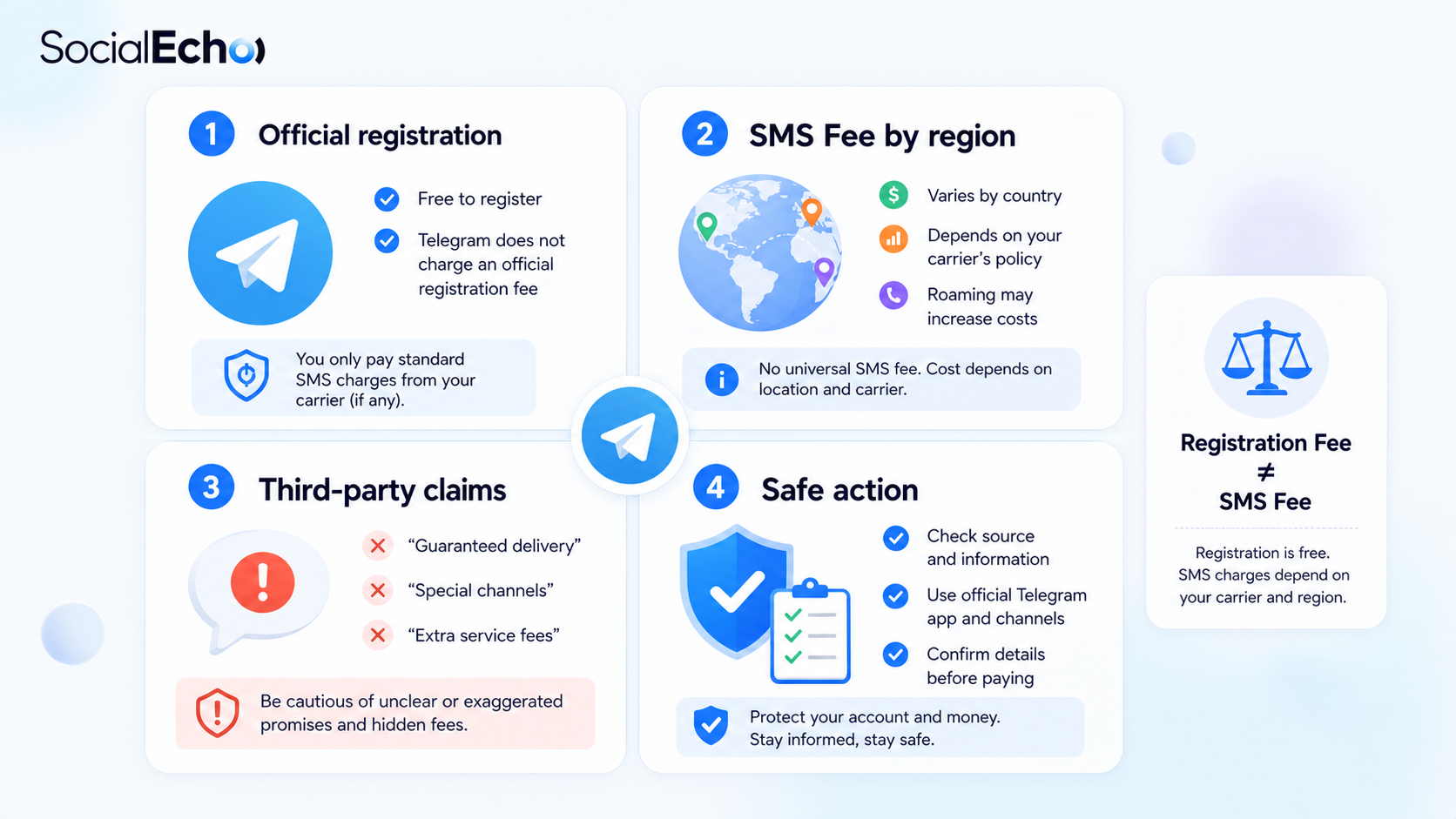
1. Official Registration Process
The core of the official registration process is phone number verification and account creation. Users need to confirm that the client comes from official Telegram channels, that the phone number is under their long-term control, and that verification codes are only entered within the official app. This discussion concerns identity verification, not the purchase of third-party services.
2. SMS Fee Related Information
SMS fee is more closely related to the cost or restrictions of SMS verification. Sending SMS across regions doesn't have a uniform cost; different carriers, phone numbers, and regional policies can all lead to different experiences. When you see a Telegram SMS fee, you should read the full message to determine if it's related to sending verification codes.
3. Differences in region and number
The same registration action may yield different results in different countries, phone numbers, devices, and network environments. Some people receive no notification, some see a notification, and some experience delays in receiving verification codes. These differences do not necessarily indicate a scam, but they serve as a reminder to verify and record the source of the information.
4. Third-party payment script
The most dangerous things to watch out for are claims of fees in search results, advertisements, or unfamiliar web pages. These may use the Telegram name to mislead you into believing you must pay to an external page. Stop immediately if you are asked to leave the official process, enter a verification code, or make payments to a personal account.
III. How to explain to the team or clients that Telegram charges for registration
If you're an individual user, you can make your own judgment; if you're a business operator, you need to provide a stable explanation to your team and clients. A three-part approach is recommended:
The first paragraph clarifies the boundaries: "We only recommend registering through the official Telegram app or website, and do not process any fees or verification codes through unfamiliar pages."
The second paragraph explains the differences. "Some users may see fee-related prompts during the SMS verification process. This usually needs to be determined by combining the region, phone number, and official prompts, and does not mean that all accounts are charged a registration fee uniformly."
The third paragraph provides action instructions: "When prompted, take a screenshot first, and do not leave the official payment process; check the phone number format, network, and device; if necessary, try again after a period of time."
The advantage of this approach is that it neither denies what users see nor amplifies panic. Nadia's team later used it in customer service training, so that when customers asked about the Telegram registration fee, customer service representatives could steer the question back to compliance assessments instead of making casual promises.
IV. Shift from Registration Fee Disputes to Account Operation and Governance
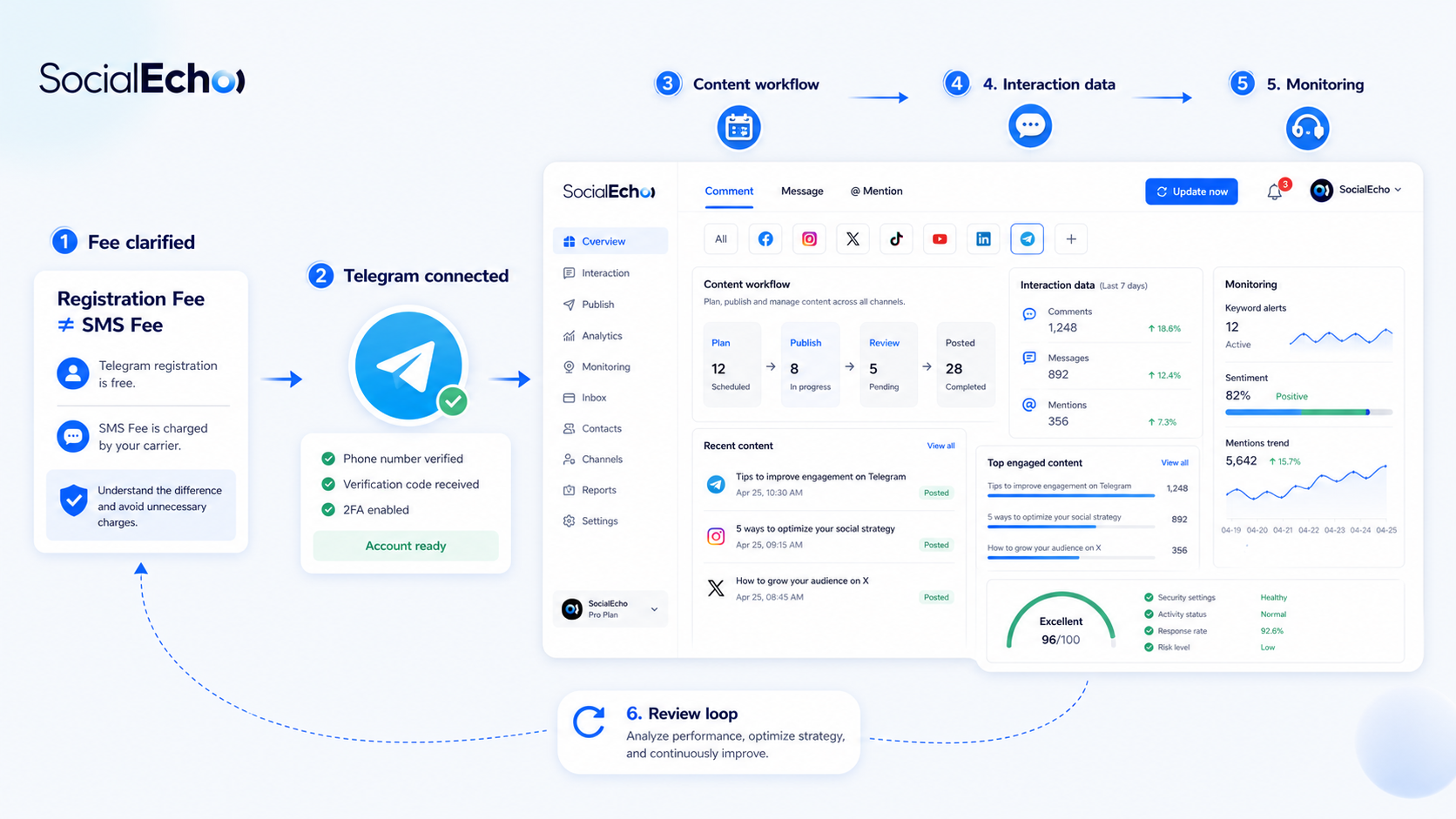
With the concept of paid services clarified, businesses should focus more on account governance. If Telegram is used for customer notifications, community interaction, or content distribution, it will fall under the operations system. Account security, content permissions, interaction response, and data review have a greater impact on long-term results than whether there were prompts during registration.
You can integrate Telegram into a unified schedule, use SocialEcho to publish content and plan announcements across multiple platforms; aggregate comments and user intent into interaction management ; use data analytics to see the performance differences between Telegram and other channels; monitor brand discussions through social media listening ; and use AI to automate the processing of duplicate categories and reply suggestions.
The key here is the balance: tools should serve compliant operations, not be used to package registration techniques. A clear account management process allows the team to spend less time consuming conceptual disputes and more time accumulating assets in content and user relationships.
V. User Self-Check: Which type of fee are you seeing?
You can quickly determine the answer by considering the following questions:
- Does the notification appear in the official Telegram app or on an unfamiliar webpage?
- Does it ask you to leave the official payment process?
- Does the page request a verification code, password, or additional account information?
- Is it clearly stated that it is related to SMS verification?
- Did you try retrying multiple times in a short period of time or change the device?
- Is this number under your long-term control?
If the answer leads to an unfamiliar page, leaves the official process, or asks for a verification code, stop immediately. Even if it's just a text message verification prompt within the official process, read it carefully, take a screenshot, and record it before deciding on the next step.
FAQ: Telegram Registration Fee vs SMS Fee
1. Are the Telegram registration fee and the Telegram SMS fee the same thing?
No. "Registration fee" usually refers to the user's understanding of the registration fee, while "SMS fee" leans more towards the cost of SMS verification or notification. The two terms may be used interchangeably, but should be distinguished separately.
2. Does Telegram charge for registration?
Users should refer to official Telegram information. When encountering any payment prompts, first verify the source and context; do not assume that information from unfamiliar websites is official policy.
3. Is the Telegram charging fee notification from a webpage reliable?
Not necessarily. Unfamiliar web pages, advertising pages, or redirecting pages pose a higher risk. Do not enter your phone number, verification code, or payment information on unofficial pages.
4. Why are SMS fees related to region?
Sending SMS messages across regions involves different carriers and channels, and the cost and delivery experience may vary. Region, number range, device, and number of retries all affect the verification experience.
5. How should enterprise customer service representatives answer customers' questions about charges?
We recommend using only the official payment portal, checking the source and context of fee-related prompts, not deviating from the official payment process, and encouraging customers to take screenshots for documentation before making a decision.
6. After clarifying the concepts, what else should companies do?
Account permissions, security settings, content scheduling, interaction management, and data review are all necessary. Registration is just the entry point; long-term operation is the real asset.
Conclusion
The difference between Telegram Registration Fee and SMS Fee appears to be a matter of terminology, but is essentially a matter of risk assessment. Don't assume all fees are official registration fees, and don't ignore the charging tactics of unfamiliar websites. Using official sources, complete context, and traceable records to determine the correct fee is the safer approach in 2026.
Use SocialEcho now and get 7 days free, no credit card required.
;}.cls-2{fill:%230868f7;}.cls-3{fill:url(%23未命名的渐变_44);}.cls-4{fill:%23333;}%3c/style%3e%3clinearGradient%20id='未命名的渐变_8'%20x1='33.73'%20y1='100.61'%20x2='-0.03'%20y2='-1.06'%20gradientUnits='userSpaceOnUse'%3e%3cstop%20offset='0'%20stop-color='%237ae9fb'/%3e%3cstop%20offset='0.67'%20stop-color='%232b90f8'/%3e%3cstop%20offset='1'%20stop-color='%230868f7'/%3e%3c/linearGradient%3e%3clinearGradient%20id='未命名的渐变_44'%20x1='27.86'%20y1='18.67'%20x2='68.36'%20y2='22.22'%20gradientUnits='userSpaceOnUse'%3e%3cstop%20offset='0'%20stop-color='%235ac7f2'/%3e%3cstop%20offset='1'%20stop-color='%230868f7'/%3e%3c/linearGradient%3e%3c/defs%3e%3cpath%20class='cls-1'%20d='M29,28.74V81.91l-9.51-3.68v0L8.52,74A7.17,7.17,0,0,1,4,67.32V24.54A3.76,3.76,0,0,1,9.08,21Z'/%3e%3cpath%20class='cls-2'%20d='M68.09,78.07a13.15,13.15,0,0,1-17.9,12.06L29,81.91h0V28.74L50.19,37A13.17,13.17,0,0,0,68.08,25.3h0Z'/%3e%3cpath%20class='cls-3'%20d='M68.08,25.3a13.19,13.19,0,0,1-6.73,10.87A13.09,13.09,0,0,1,50.19,37L29,28.74V6A3.76,3.76,0,0,1,34.1,2.52l25.59,9.91A13.22,13.22,0,0,1,68.08,25.3Z'/%3e%3cpath%20class='cls-4'%20d='M129.06,81.76a4.33,4.33,0,0,1-3.19-1.31,4.4,4.4,0,0,1-1.31-3.24V56.86H97.65V77.21a4.36,4.36,0,0,1-1.35,3.2A4.68,4.68,0,0,1,93,81.76a4.32,4.32,0,0,1-3.19-1.31,4.37,4.37,0,0,1-1.32-3.24V27.27A4.58,4.58,0,0,1,89.83,24a4.59,4.59,0,0,1,7.82,3.27V48.15h26.91V27.27A4.58,4.58,0,0,1,125.91,24a4.59,4.59,0,0,1,7.82,3.27V77.21a4.37,4.37,0,0,1-1.36,3.2A4.65,4.65,0,0,1,129.06,81.76Z'/%3e%3cpath%20class='cls-4'%20d='M163.77,81.66c-6.57,0-11.76-1.92-15.44-5.7s-5.54-9.07-5.54-15.74a26.76,26.76,0,0,1,2.09-10.43,17.72,17.72,0,0,1,6.67-8.06,19.15,19.15,0,0,1,10.68-2.95,19,19,0,0,1,10.46,2.8,18.7,18.7,0,0,1,6.55,7.36,22.53,22.53,0,0,1,2.36,10.28A4.51,4.51,0,0,1,177,63.77H152.23a10.8,10.8,0,0,0,3.49,6.65c2,1.68,4.88,2.52,8.66,2.52a22.25,22.25,0,0,0,7.54-1.21c.74-.3,1.55-.67,2.37-1.07a3.75,3.75,0,0,1,1.84-.4,4.09,4.09,0,0,1,3,1.15,4,4,0,0,1,1.12,3,4.38,4.38,0,0,1-2.58,3.82,32.34,32.34,0,0,1-6.36,2.61A28.67,28.67,0,0,1,163.77,81.66ZM172.4,55.9a9.72,9.72,0,0,0-1.63-4.56A9.9,9.9,0,0,0,167,48a10.38,10.38,0,0,0-4.64-1.14,12,12,0,0,0-4.77,1.06,9.54,9.54,0,0,0-4.89,5.66,11.78,11.78,0,0,0-.51,2.3Z'/%3e%3cpath%20class='cls-4'%20d='M193,81.64a4.49,4.49,0,0,1-4.51-4.55V27.28A4.58,4.58,0,0,1,189.84,24a4.48,4.48,0,0,1,3.28-1.36A4.36,4.36,0,0,1,196.35,24a4.46,4.46,0,0,1,1.31,3.31V77.09a4.34,4.34,0,0,1-1.35,3.2A4.67,4.67,0,0,1,193,81.64Z'/%3e%3cpath%20class='cls-4'%20d='M263.79,81.71a5.7,5.7,0,0,1-4.2-1.74,5.76,5.76,0,0,1-1.73-4.19V27.37a4.58,4.58,0,0,1,1.35-3.27A4.59,4.59,0,0,1,267,27.37V72.53h24a4.58,4.58,0,0,1,3.27,7.82A4.66,4.66,0,0,1,291,81.71Z'/%3e%3cpath%20class='cls-4'%20d='M424.48,81.74a4.71,4.71,0,0,1-2.71-.88,5.43,5.43,0,0,1-1-1l-.07-.09-12.41-17-5.41,5v9.44a4.31,4.31,0,0,1-1.36,3.19,4.66,4.66,0,0,1-3.3,1.36A4.29,4.29,0,0,1,395,80.42a4.36,4.36,0,0,1-1.32-3.23V27.37A4.58,4.58,0,0,1,395,24.1a4.52,4.52,0,0,1,6.58.12,4.54,4.54,0,0,1,1.24,3.15V56.31l17.72-16.38.05,0a4.8,4.8,0,0,1,2.94-1.11,4.4,4.4,0,0,1,3.27,1.2,4.57,4.57,0,0,1,1.2,3.27,4.44,4.44,0,0,1-.77,2.33,7.45,7.45,0,0,1-1.43,1.65l-11,9.64,13.34,17.68a5,5,0,0,1,1,2.71,4.12,4.12,0,0,1-1.36,3.24A4.64,4.64,0,0,1,424.48,81.74Z'/%3e%3cpath%20class='cls-4'%20d='M317.93,81.76a21.5,21.5,0,1,1,21.17-21.5A21.37,21.37,0,0,1,317.93,81.76Zm0-34.1a12.61,12.61,0,1,0,12.42,12.6A12.52,12.52,0,0,0,317.93,47.66Z'/%3e%3cpath%20class='cls-4'%20d='M212.18,101.22a4.12,4.12,0,0,1-3.05-1.26,4.17,4.17,0,0,1-1.26-3.1V43.34a4.37,4.37,0,0,1,1.3-3.14,4.26,4.26,0,0,1,3.13-1.3,4.19,4.19,0,0,1,3.1,1.26,4.32,4.32,0,0,1,1.26,3.16,20.77,20.77,0,0,1,13-4.54,21.51,21.51,0,0,1,0,43,20.51,20.51,0,0,1-13-4.57V96.86a4.15,4.15,0,0,1-1.3,3.06A4.5,4.5,0,0,1,212.18,101.22Zm17.43-53.63c-6.23,0-12.93,4.11-12.93,12.72a12.73,12.73,0,0,0,25.46,0A12.71,12.71,0,0,0,229.61,47.59Z'/%3e%3cpath%20class='cls-4'%20d='M365.76,81.76a21.5,21.5,0,1,1,21.18-21.5A21.37,21.37,0,0,1,365.76,81.76Zm0-34.1a12.61,12.61,0,1,0,12.42,12.6A12.52,12.52,0,0,0,365.76,47.66Z'/%3e%3c/svg%3e)