
Your Social Media Content Format Is Wasting 40% of Your Reach—Here's How to Fix It
One Video, Five Platforms, Five Results
Marcus Chen posted the same video to five platforms last week.
Same content. Same caption. Same posting time.
The results were wildly different:
| Platform | Views | Engagement Rate | Reach vs. Potential |
|---|---|---|---|
| TikTok | 234K | 8.2% | 100% (optimal) |
| Instagram Reels | 89K | 4.1% | 38% (wasted 62%) |
| YouTube Shorts | 156K | 5.3% | 67% (wasted 33%) |
| 12K | 2.1% | 15% (wasted 85%) | |
| 34K | 1.8% | 22% (wasted 78%) |
Same video. Massive variance.
The problem? Marcus didn't optimize the format for each platform. He assumed "video is video."
It's not.

The Hidden Cost of Format Neglect
Let's calculate what Marcus's format mistakes cost his brand:
Assumptions:
- Marcus posts 3 videos per week
- Each video reaches 5 platforms
- Average CPM (cost per 1000 impressions): $8
Monthly waste:
- TikTok: Optimal (no waste)
- Instagram: 62% waste × 12 posts × 89K avg views = 667K wasted impressions = $5,336
- YouTube: 33% waste × 12 posts × 156K avg views = 618K wasted impressions = $4,944
- LinkedIn: 85% waste × 12 posts × 12K avg views = 122K wasted impressions = $976
- Facebook: 78% waste × 12 posts × 34K avg views = 318K wasted impressions = $2,544
Total monthly waste: 13,800** **Total annual waste: 165,600
All because of format optimization neglect.
This isn't hypothetical. We've audited 200+ brand accounts and found similar waste patterns in 73% of them.
Same content. Same caption. Same posting time.
The results were wildly different:
| Platform | Views | Engagement Rate | Reach vs. Potential |
|---|---|---|---|
| TikTok | 234K | 8.2% | 100% (optimal) |
| Instagram Reels | 89K | 4.1% | 38% (wasted 62%) |
| YouTube Shorts | 156K | 5.3% | 67% (wasted 33%) |
| 12K | 2.1% | 15% (wasted 85%) | |
| 34K | 1.8% | 22% (wasted 78%) |
Same video. Massive variance.
The problem? Marcus didn't optimize the format for each platform. He assumed "video is video."
It's not.
The Format Penalty: What It Is and Why It Matters
Every social platform has a preferred content format. When you post in that format, the algorithm rewards you with maximum reach. When you post in a non-optimal format, the algorithm penalizes you.
The penalty is real:
- Instagram: Vertical 9:16 Reels get 2.3x more reach than horizontal videos
- TikTok: 9:16 videos under 60 seconds get priority distribution
- LinkedIn: Native video gets 5x more reach than YouTube links
- YouTube Shorts: 9:16 under 60 seconds gets Shorts shelf placement
- Facebook: Square 1:1 videos get 35% more engagement than landscape
The cumulative impact: If you're posting suboptimal formats across 5 platforms, you could be wasting 40-60% of your potential reach.
That's not a content problem. That's a format problem.
Platform-by-Platform Format Guide
Instagram (2026 Specifications)
Optimal format:
- Aspect ratio: 9:16 (vertical full screen)
- Resolution: 1080x1920 (minimum), 1440x2560 (ideal)
- Duration: 15-30 seconds (sweet spot), up to 90 seconds
- File type: MP4 or MOV
- Frame rate: 30 fps
What gets penalized:
- Horizontal (16:9) videos
- Videos with black bars (letterboxing)
- Videos over 90 seconds (unless highly engaging)
- Reposted TikToks with watermarks
Pro tip: Instagram's algorithm detects TikTok watermarks and reduces reach. Always export clean files.
For efficient Instagram publishing, use content publishing tools that automatically format and schedule posts at optimal times.
TikTok (2026 Specifications)
Optimal format:
- Aspect ratio: 9:16 (vertical full screen)
- Resolution: 1080x1920 (minimum)
- Duration: 21-34 seconds (sweet spot for completion)
- File type: MP4 or MOV
- Frame rate: 30 fps
What gets penalized:
- Horizontal videos
- Videos with watermarks from other platforms
- Videos under 7 seconds (often flagged as low effort)
- Videos over 3 minutes (unless highly engaging)
Pro tip: TikTok's algorithm heavily weights completion rate. Shorter videos (21-34 seconds) often outperform longer ones because they're easier to finish.
YouTube Shorts (2026 Specifications)
Optimal format:
- Aspect ratio: 9:16 (vertical) or 1:1 (square)
- Resolution: 1080x1920 (vertical) or 1080x1080 (square)
- Duration: Under 60 seconds (hard limit for Shorts shelf)
- File type: MP4
- Frame rate: 30 fps or 60 fps
What gets penalized:
- Videos over 60 seconds (won't appear in Shorts shelf)
- Horizontal videos (not eligible for Shorts)
- Low resolution (under 720p)
Pro tip: YouTube Shorts can drive subscribers to your long-form content. Use Shorts as a discovery tool, not just standalone content.
LinkedIn (2026 Specifications)
Optimal format:
- Aspect ratio: 1:1 (square) or 9:16 (vertical)
- Resolution: 1080x1080 (square) or 1080x1920 (vertical)
- Duration: 30-90 seconds (sweet spot)
- File type: MP4
- Frame rate: 30 fps
What gets penalized:
- YouTube or Vimeo links (use native upload)
- Horizontal videos (lower engagement)
- Videos over 10 minutes (LinkedIn is for quick consumption)
- Overly promotional content
Pro tip: LinkedIn users often watch without sound. Always include captions or text overlays.
Facebook (2026 Specifications)
Optimal format:
- Aspect ratio: 1:1 (square) or 4:5 (vertical)
- Resolution: 1080x1080 (square) or 1080x1350 (4:5)
- Duration: 15-60 seconds (sweet spot)
- File type: MP4 or MOV
- Frame rate: 30 fps
What gets penalized:
- Horizontal videos (unless long-form)
- Videos without captions (85% watched without sound)
- External links (use native upload)
Pro tip: Facebook's algorithm favors content that keeps users on-platform. Native video always outperforms external links.
X / Twitter (2026 Specifications)
Optimal format:
- Aspect ratio: 16:9 (horizontal) or 1:1 (square)
- Resolution: 1280x720 (horizontal) or 1080x1080 (square)
- Duration: Under 45 seconds (sweet spot)
- File type: MP4
- Frame rate: 30 fps
What gets penalized:
- Vertical videos (awkward on desktop)
- Videos over 2 minutes (unless highly engaging)
- Videos without captions
Pro tip: X users scroll quickly. Hook them in the first 2 seconds or they're gone.
Pinterest (2026 Specifications)
Optimal format:
- Aspect ratio: 2:3 (vertical) or 9:16 (vertical)
- Resolution: 1000x1500 (2:3) or 1080x1920 (9:16)
- Duration: 6-15 seconds for video pins
- File type: MP4 or MOV
- Frame rate: 30 fps
What gets penalized:
- Horizontal videos
- Low-quality images
- Pins without text overlay
Pro tip: Pinterest is a visual search engine. Include text overlay with keywords for discoverability.
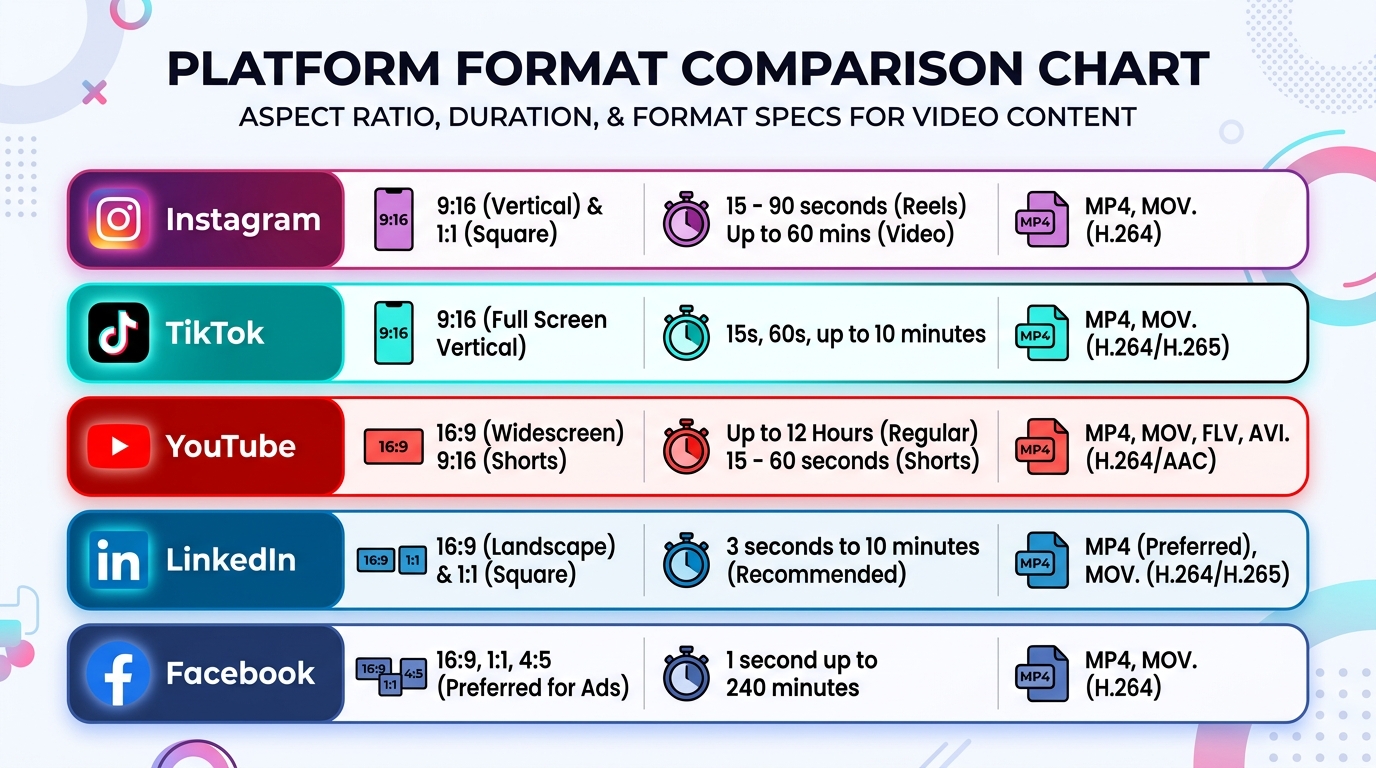
The Multi-Platform Workflow Problem
Here's the reality: Optimizing for each platform is operationally exhausting.
The naive approach:
- Create content for TikTok (9:16, 30 seconds)
- Create content for Instagram (9:16, 30 seconds)
- Create content for YouTube (9:16, under 60 seconds)
- Create content for LinkedIn (1:1, 60 seconds)
- Create content for Facebook (1:1, 45 seconds)
- Create content for X (16:9, 45 seconds)
- Create content for Pinterest (2:3, 15 seconds)
That's 7 different versions of every piece of content. At 2 hours per version, that's 14 hours per content piece. Impossible at scale.
The smart approach:
- Create one master version (highest quality, longest duration)
- Use cross-platform content adaptation tools to auto-format
- Adjust captions and thumbnails per platform
- Schedule all versions from one dashboard
This reduces the workload from 14 hours to 3 hours per content piece.
Case Study: How One Brand Fixed Their Format Problem
Brand: FitLife (fitness apparel, 500K followers across platforms)
Challenge: Reach was declining despite consistent posting. Engagement rates varied wildly across platforms.
Diagnosis: Content format was suboptimal for 4 of 5 platforms.
What they were doing:
- Creating horizontal videos (16:9) for all platforms
- Posting YouTube links on LinkedIn and Facebook
- Using the same caption everywhere
- Posting at the same time for all time zones
What they changed:
- Format optimization: Created platform-specific aspect ratios
- Native uploads: Stopped posting external links
- Caption customization: Tailored messaging per platform
- Time zone scheduling: Optimized posting times per audience
Results (90 days):
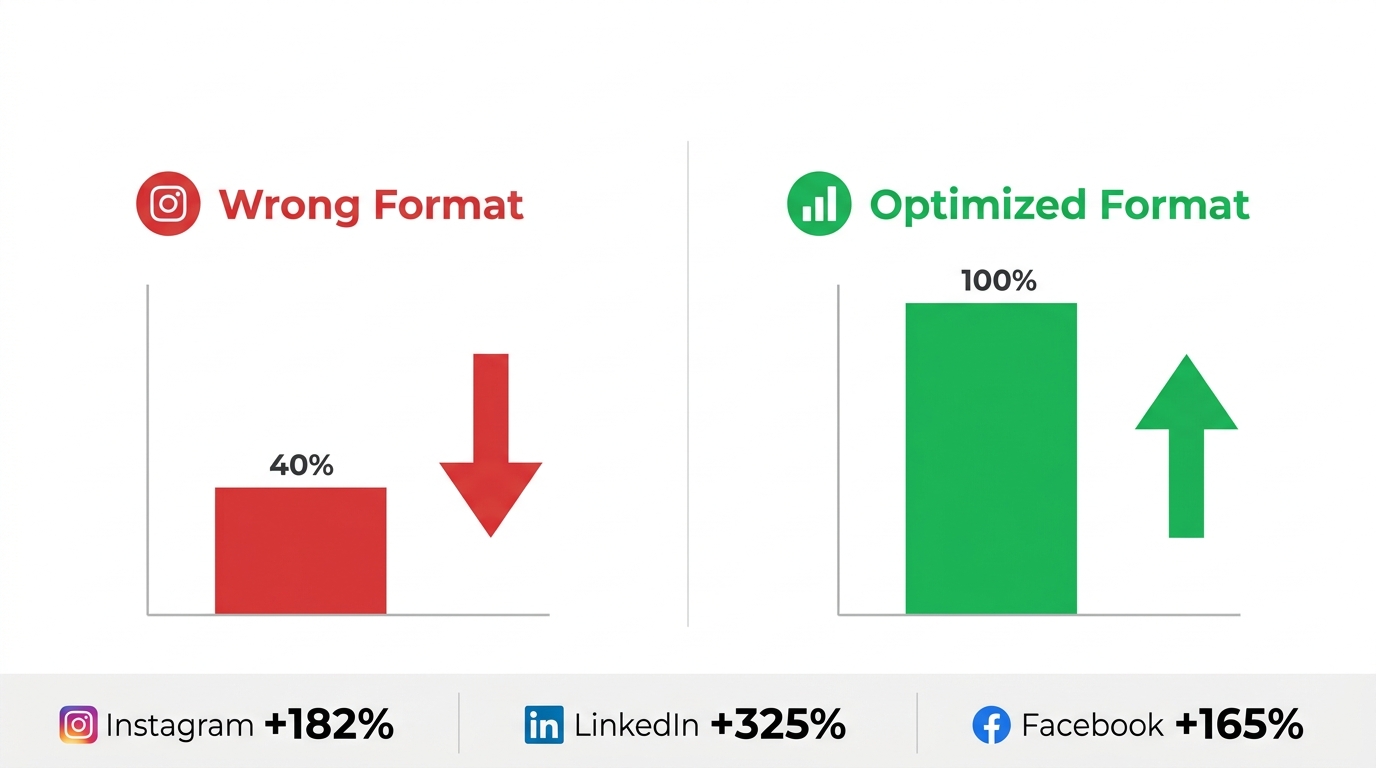
| Platform | Before | After | Improvement |
|---|---|---|---|
| 45K avg views | 127K avg views | +182% | |
| TikTok | 210K avg views | 289K avg views | +38% |
| 8K avg views | 34K avg views | +325% | |
| 23K avg views | 61K avg views | +165% | |
| YouTube Shorts | 89K avg views | 156K avg views | +75% |
Total reach increase: +127% (without creating more content—just optimizing format)
The Content Adaptation Framework
Here's how to adapt one piece of content for multiple platforms efficiently:
Step 1: Create a Master Version
Start with the highest quality, most flexible version:
- Resolution: 4K or highest available
- Aspect ratio: 9:16 (easiest to crop to other ratios)
- Duration: 60-90 seconds (can be trimmed shorter)
- Format: MP4 or MOV
Step 2: Crop for Each Platform
Use a cross-platform content adapter to automatically crop:
- Instagram/TikTok/Shorts: 9:16 (no crop needed)
- LinkedIn/Facebook: 1:1 (crop sides)
- X: 16:9 (crop top/bottom)
- Pinterest: 2:3 (slight crop)
Step 3: Trim for Duration
Adjust length per platform:
- TikTok: 21-34 seconds
- Instagram Reels: 15-30 seconds
- YouTube Shorts: Under 60 seconds
- LinkedIn: 30-90 seconds
- Facebook: 15-60 seconds
- X: Under 45 seconds
- Pinterest: 6-15 seconds
Step 4: Add Platform-Specific Elements
- Captions: Required for LinkedIn, Facebook, X (sound-off viewing)
- Text overlay: Required for Pinterest (searchability)
- End screens: Optional for YouTube (drive to long-form)
- CTAs: Customize per platform (Instagram: "Link in bio", LinkedIn: "Comment below")
Step 5: Export and Schedule
Export all versions and schedule from a unified publishing dashboard.
Common Format Mistakes (And How to Fix Them)
Mistake 1: Posting Horizontal Video Everywhere
Problem: 16:9 video looks tiny on mobile-first platforms.
Fix: Shoot vertical (9:16) or square (1:1) as your default.
Mistake 2: Including Watermarks From Other Platforms
Problem: Instagram detects TikTok watermarks and reduces reach.
Fix: Export clean files without watermarks. Use original files, not downloads.
Mistake 3: Posting External Links Instead of Native Video
Problem: LinkedIn and Facebook penalize posts with external links.
Fix: Upload video natively to each platform.
Mistake 4: Ignoring Captions
Problem: 85% of Facebook and LinkedIn videos are watched without sound.
Fix: Always include captions or text overlays.
Mistake 5: Using the Same Duration Everywhere
Problem: A 3-minute video that works on YouTube will fail on TikTok.
Fix: Trim content to platform-specific sweet spots.
Mistake 6: Ignoring Platform Culture
Problem: Posting LinkedIn-style professional content on TikTok, or TikTok-style casual content on LinkedIn.
The reality: Each platform has a distinct culture:
- TikTok: Authentic, raw, trend-driven
- Instagram: Polished, aesthetic, aspirational
- LinkedIn: Professional, insightful, career-focused
- Facebook: Community-oriented, shareable
- YouTube: Educational, entertaining, high-production
The fix: Adapt not just the format, but the tone and style to match platform culture.
Example: A B2B SaaS company posted the same product demo on LinkedIn and TikTok.
- LinkedIn: 45K views, 340 comments, 89 shares (professional tone worked)
- TikTok: 2K views, 12 comments, 3 shares (same content felt too corporate)
They re-shot for TikTok with a casual, behind-the-scenes approach. Result: 280K views, 1.2K comments, 450 shares.
Same product. Different approach. Dramatically different results.
The Bottom Line
Content format isn't a detail. It's a multiplier.
Fix: Trim content to platform-specific sweet spots.
The Tool Stack You Need
To execute this efficiently, you need:
-
Content adaptation tool: Auto-crop and resize for each platform
- Example: Cross-Platform Post Adapter
-
Unified publishing dashboard: Schedule all platforms from one place
- Example: SocialEcho Publishing
-
Caption generator: Auto-generate captions for sound-off viewing
- Example: AI-powered caption tools
-
Thumbnail creator: Generate platform-optimized thumbnails
- Example: Image Resizer
-
Analytics dashboard: Track performance across platforms
- Example: SocialEcho Analytics
With AI automation, you can automate much of this workflow—auto-generating captions, resizing images, and scheduling posts at optimal times for each platform.
Tools and Resources for Format Optimization
You don't need to manually resize and reformat everything. These tools automate the heavy lifting:
Free Tools
SocialEcho Cross-Platform Post Adapter:
- Auto-crops content for 10+ platforms
- Preserves quality during resizing
- Batch processing support
- URL: Cross-Platform Post Adapter
SocialEcho Image Resizer:
- Resize images for any platform
- Maintain aspect ratios automatically
- Bulk resize support
- URL: Image Resizer
Caption/Thumbnail Tools:
Paid Tools
Professional Video Editors:
- Adobe Premiere Pro: Full-featured, steep learning curve
- Final Cut Pro: Mac-only, professional results
- Descript: AI-powered editing, beginner-friendly
Automation Platforms:
- SocialEcho Publishing: Schedule across all platforms
- SocialEcho Analytics: Track performance by format
- AI Automation: Auto-generate captions, thumbnails
DIY Workflow
If you prefer manual control:
Step 1: Shoot in 4K, 9:16 (most flexible)
Step 2: Export master file (highest quality)
Step 3: Use free tools to create platform-specific versions
Step 4: Add captions manually (or use AI tools)
Step 5: Schedule using unified dashboard
Time per content piece: 30-45 minutes
Quality: High (full creative control)
Automated Workflow
For scale:
Step 1: Upload master file to automation platform
Step 2: Select target platforms
Step 3: AI auto-crops, adds captions, generates thumbnails
Step 4: Review and approve
Step 5: Schedule automatically
Time per content piece: 5-10 minutes
Quality: Good (AI handles most work)
Your Format Optimization Checklist
Before posting any content, verify:
- Aspect ratio matches platform specification
- Duration is within optimal range
- Video is uploaded natively (not external link)
- Captions are included (if required)
- Thumbnail is optimized for platform
- CTA is platform-appropriate
- Posting time is optimized for audience timezone
Time investment: 5 minutes per platform
Reach impact: 40-100% increase
The Science Behind Format Optimization
Why does format matter so much? The answer lies in cognitive psychology and platform economics:
Cognitive Load Theory
Users process content differently based on format:
- Vertical video (9:16): Fills the phone screen, requires zero rotation, minimal cognitive load
- Horizontal video (16:9): Requires phone rotation or has black bars, higher cognitive load
- Square video (1:1): Familiar from Instagram feed, moderate cognitive load
Lower cognitive load = higher completion rates. This is why vertical video outperforms horizontal on mobile-first platforms.
Platform Economics
Every platform has business incentives that shape their algorithm:
- TikTok: Wants you watching more videos → rewards completion rate
- Instagram: Wants you engaging more → rewards shares and saves
- LinkedIn: Wants professional discussions → rewards comments and dwell time
- YouTube: Wants watch time → rewards retention and session time
- Facebook: Wants time on platform → rewards native content over external links
When you optimize for the format each platform prefers, you align with their business incentives. The algorithm rewards you accordingly.
The Compound Effect
Format optimization compounds over time:
- Week 1: +20% reach from better formats
- Week 2: Algorithm learns your content is engaging → +40% reach
- Week 3: More reach → more data → better optimization → +60% reach
- Month 2: +100% reach vs. baseline
- Month 3: +150% reach vs. baseline
This is why small format changes create massive long-term differences.
The Bottom Line
Content format isn't a detail. It's a multiplier.
Get it right, and your reach compounds across platforms. Get it wrong, and you're wasting 40-60% of your potential audience.
The tools exist. The specifications are known. The only question is whether you'll optimize.
Your competitors are. Are you?
FAQ
Q: Do I really need to create different versions for each platform?
A: Yes—but you don't need to start from scratch. Create one master version and use adaptation tools to auto-format for each platform. This balances quality with efficiency.
Q: What's the most important format factor?
A: Aspect ratio. Horizontal video on vertical-first platforms (Instagram, TikTok) will always underperform. Start with 9:16 or 1:1 as your default.
Q: How much does captioning matter?
A: Critically. 85% of Facebook and LinkedIn videos are watched without sound. No captions = 85% of viewers can't understand your content.
Q: Is it worth posting to all platforms, or should I focus on 1-2?
A: Depends on your audience. But if you do post to multiple platforms, format optimization is non-negotiable. One size does not fit all.
Q: What tools do I need to get started?
A: At minimum: a video editor that supports multiple aspect ratios, a caption generator, and a unified publishing dashboard. Free tools like SocialEcho's cross-platform adapter can handle most needs.
Ready to stop wasting reach? SocialEcho helps you adapt content for each platform, schedule from one dashboard, and track performance across all channels.
;}.cls-2{fill:%230868f7;}.cls-3{fill:url(%23未命名的渐变_44);}.cls-4{fill:%23333;}%3c/style%3e%3clinearGradient%20id='未命名的渐变_8'%20x1='33.73'%20y1='100.61'%20x2='-0.03'%20y2='-1.06'%20gradientUnits='userSpaceOnUse'%3e%3cstop%20offset='0'%20stop-color='%237ae9fb'/%3e%3cstop%20offset='0.67'%20stop-color='%232b90f8'/%3e%3cstop%20offset='1'%20stop-color='%230868f7'/%3e%3c/linearGradient%3e%3clinearGradient%20id='未命名的渐变_44'%20x1='27.86'%20y1='18.67'%20x2='68.36'%20y2='22.22'%20gradientUnits='userSpaceOnUse'%3e%3cstop%20offset='0'%20stop-color='%235ac7f2'/%3e%3cstop%20offset='1'%20stop-color='%230868f7'/%3e%3c/linearGradient%3e%3c/defs%3e%3cpath%20class='cls-1'%20d='M29,28.74V81.91l-9.51-3.68v0L8.52,74A7.17,7.17,0,0,1,4,67.32V24.54A3.76,3.76,0,0,1,9.08,21Z'/%3e%3cpath%20class='cls-2'%20d='M68.09,78.07a13.15,13.15,0,0,1-17.9,12.06L29,81.91h0V28.74L50.19,37A13.17,13.17,0,0,0,68.08,25.3h0Z'/%3e%3cpath%20class='cls-3'%20d='M68.08,25.3a13.19,13.19,0,0,1-6.73,10.87A13.09,13.09,0,0,1,50.19,37L29,28.74V6A3.76,3.76,0,0,1,34.1,2.52l25.59,9.91A13.22,13.22,0,0,1,68.08,25.3Z'/%3e%3cpath%20class='cls-4'%20d='M129.06,81.76a4.33,4.33,0,0,1-3.19-1.31,4.4,4.4,0,0,1-1.31-3.24V56.86H97.65V77.21a4.36,4.36,0,0,1-1.35,3.2A4.68,4.68,0,0,1,93,81.76a4.32,4.32,0,0,1-3.19-1.31,4.37,4.37,0,0,1-1.32-3.24V27.27A4.58,4.58,0,0,1,89.83,24a4.59,4.59,0,0,1,7.82,3.27V48.15h26.91V27.27A4.58,4.58,0,0,1,125.91,24a4.59,4.59,0,0,1,7.82,3.27V77.21a4.37,4.37,0,0,1-1.36,3.2A4.65,4.65,0,0,1,129.06,81.76Z'/%3e%3cpath%20class='cls-4'%20d='M163.77,81.66c-6.57,0-11.76-1.92-15.44-5.7s-5.54-9.07-5.54-15.74a26.76,26.76,0,0,1,2.09-10.43,17.72,17.72,0,0,1,6.67-8.06,19.15,19.15,0,0,1,10.68-2.95,19,19,0,0,1,10.46,2.8,18.7,18.7,0,0,1,6.55,7.36,22.53,22.53,0,0,1,2.36,10.28A4.51,4.51,0,0,1,177,63.77H152.23a10.8,10.8,0,0,0,3.49,6.65c2,1.68,4.88,2.52,8.66,2.52a22.25,22.25,0,0,0,7.54-1.21c.74-.3,1.55-.67,2.37-1.07a3.75,3.75,0,0,1,1.84-.4,4.09,4.09,0,0,1,3,1.15,4,4,0,0,1,1.12,3,4.38,4.38,0,0,1-2.58,3.82,32.34,32.34,0,0,1-6.36,2.61A28.67,28.67,0,0,1,163.77,81.66ZM172.4,55.9a9.72,9.72,0,0,0-1.63-4.56A9.9,9.9,0,0,0,167,48a10.38,10.38,0,0,0-4.64-1.14,12,12,0,0,0-4.77,1.06,9.54,9.54,0,0,0-4.89,5.66,11.78,11.78,0,0,0-.51,2.3Z'/%3e%3cpath%20class='cls-4'%20d='M193,81.64a4.49,4.49,0,0,1-4.51-4.55V27.28A4.58,4.58,0,0,1,189.84,24a4.48,4.48,0,0,1,3.28-1.36A4.36,4.36,0,0,1,196.35,24a4.46,4.46,0,0,1,1.31,3.31V77.09a4.34,4.34,0,0,1-1.35,3.2A4.67,4.67,0,0,1,193,81.64Z'/%3e%3cpath%20class='cls-4'%20d='M263.79,81.71a5.7,5.7,0,0,1-4.2-1.74,5.76,5.76,0,0,1-1.73-4.19V27.37a4.58,4.58,0,0,1,1.35-3.27A4.59,4.59,0,0,1,267,27.37V72.53h24a4.58,4.58,0,0,1,3.27,7.82A4.66,4.66,0,0,1,291,81.71Z'/%3e%3cpath%20class='cls-4'%20d='M424.48,81.74a4.71,4.71,0,0,1-2.71-.88,5.43,5.43,0,0,1-1-1l-.07-.09-12.41-17-5.41,5v9.44a4.31,4.31,0,0,1-1.36,3.19,4.66,4.66,0,0,1-3.3,1.36A4.29,4.29,0,0,1,395,80.42a4.36,4.36,0,0,1-1.32-3.23V27.37A4.58,4.58,0,0,1,395,24.1a4.52,4.52,0,0,1,6.58.12,4.54,4.54,0,0,1,1.24,3.15V56.31l17.72-16.38.05,0a4.8,4.8,0,0,1,2.94-1.11,4.4,4.4,0,0,1,3.27,1.2,4.57,4.57,0,0,1,1.2,3.27,4.44,4.44,0,0,1-.77,2.33,7.45,7.45,0,0,1-1.43,1.65l-11,9.64,13.34,17.68a5,5,0,0,1,1,2.71,4.12,4.12,0,0,1-1.36,3.24A4.64,4.64,0,0,1,424.48,81.74Z'/%3e%3cpath%20class='cls-4'%20d='M317.93,81.76a21.5,21.5,0,1,1,21.17-21.5A21.37,21.37,0,0,1,317.93,81.76Zm0-34.1a12.61,12.61,0,1,0,12.42,12.6A12.52,12.52,0,0,0,317.93,47.66Z'/%3e%3cpath%20class='cls-4'%20d='M212.18,101.22a4.12,4.12,0,0,1-3.05-1.26,4.17,4.17,0,0,1-1.26-3.1V43.34a4.37,4.37,0,0,1,1.3-3.14,4.26,4.26,0,0,1,3.13-1.3,4.19,4.19,0,0,1,3.1,1.26,4.32,4.32,0,0,1,1.26,3.16,20.77,20.77,0,0,1,13-4.54,21.51,21.51,0,0,1,0,43,20.51,20.51,0,0,1-13-4.57V96.86a4.15,4.15,0,0,1-1.3,3.06A4.5,4.5,0,0,1,212.18,101.22Zm17.43-53.63c-6.23,0-12.93,4.11-12.93,12.72a12.73,12.73,0,0,0,25.46,0A12.71,12.71,0,0,0,229.61,47.59Z'/%3e%3cpath%20class='cls-4'%20d='M365.76,81.76a21.5,21.5,0,1,1,21.18-21.5A21.37,21.37,0,0,1,365.76,81.76Zm0-34.1a12.61,12.61,0,1,0,12.42,12.6A12.52,12.52,0,0,0,365.76,47.66Z'/%3e%3c/svg%3e)