
Multi-account management for third-party operations: A practical solution to compress 3 hours of platform switching per day into 20 minutes.
In conclusion: The average time spent by the outsourced operations team switching between ineffective platforms is between 2.5 and 3.5 hours per day. Reducing this time to under 20 minutes doesn't require additional staff, but only a single workflow refactoring.
This is not a theory, but an actionable solution supported by case studies.
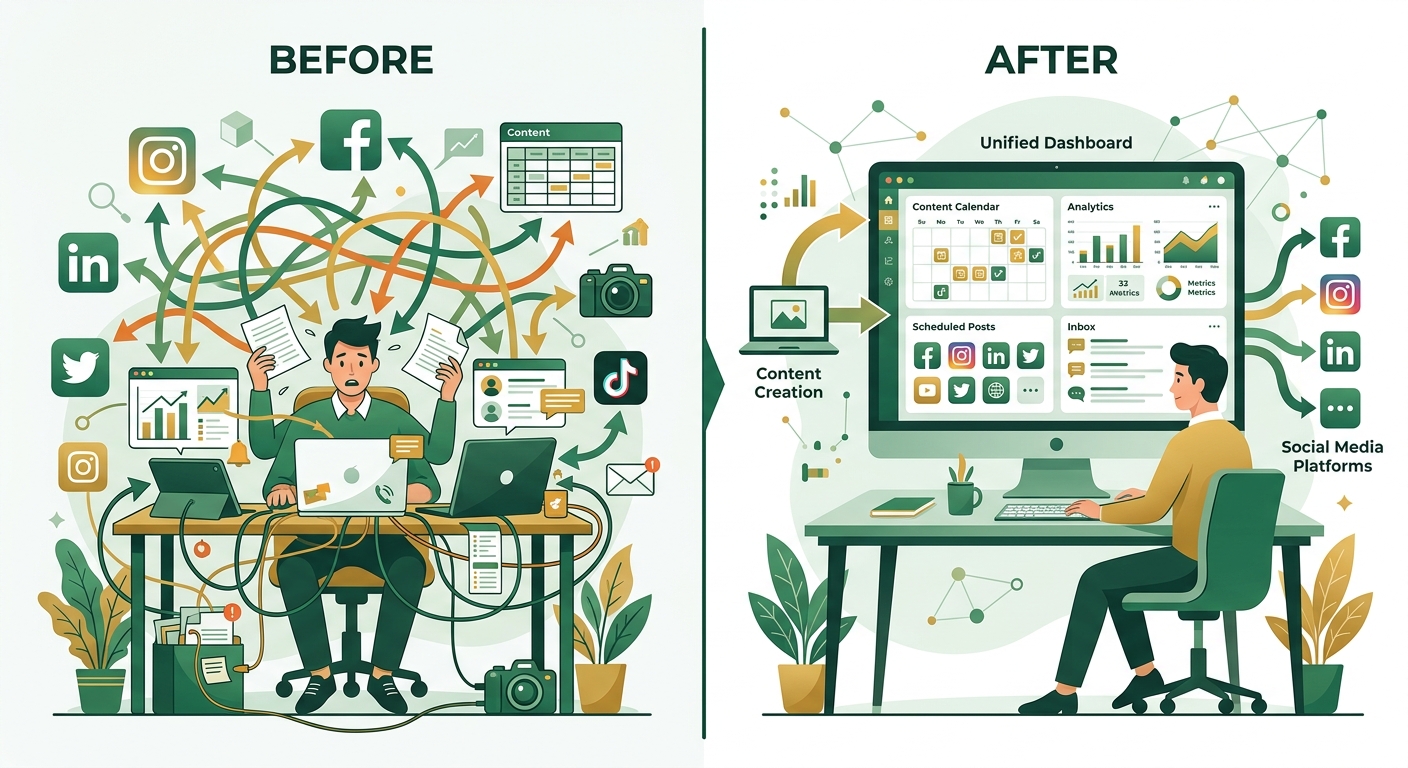
First, figure out where you're wasting your time.
Many outsourced operations teams feel busy, but can't pinpoint where their time is spent. Let's start with a time assessment:
For an account management service provider managing 5 clients and 15 accounts, without a unified tool, the daily workflow would typically look like this:
I turn on my computer at 9 a.m., first opening my four Facebook accounts, logging in one by one, checking yesterday's data, replying to comments, and posting today's content. Then I close Facebook, open Instagram, log in again, and repeat the same actions. Then it's TikTok, X, LinkedIn…
Logging into each platform once and switching between them takes 2-5 minutes. With 15 accounts spanning 5 platforms, the daily login and switching alone would consume 30-45 minutes.
Posting content is even more troublesome. Content for the same client needs to be manually published on five different platforms. Images need to be re-uploaded, text needs to be adjusted according to platform formats, and sometimes hashtags need to be added—posting each message on five platforms takes at least 15 minutes. Five clients, 15 posts, that's 225 minutes.
Add to that replying to comments, compiling data reports... it's no exaggeration to say that 3 out of 10 hours of work a day are spent on repetitive tasks.
The loss of these 3 hours is not essentially due to your low efficiency, but because the workflow design simply did not take the variable of "multiple accounts" into account.
Why the old workflow couldn't solve this problem?
Traditional social media operation workflows are designed for single accounts:
Open the platform → Post content → Reply to comments → View data → Close
This is fine when you only manage one account. But when you manage 15 accounts, the workflow becomes "do it 15 times".
Even worse, the data between the platforms is not shared. Instagram data can only be viewed in the Instagram backend, and TikTok data can only be viewed in the TikTok backend—if you want to create a monthly report for your clients, you have to open five different platforms, take screenshots, paste them, and manually summarize them. This process takes an experienced operations person 40 minutes, and a novice 2 hours.
The fundamental problem with the old workflow was that it was "platform-centric" rather than "customer-centric".
To reduce time, the workflow organization logic must be flipped from "platform" to "customer".
Practical Solution: Three Steps to Refactor Workflow
Step 1: Unify the login layer – completely eliminate duplicate logins
All customer accounts are grouped by customer and connected to a unified management backend.
Legitimate multi-account management tools support OAuth 2.0 authorization. You don't need to know the password for each account; you only need to authorize once to switch between any accounts in a unified backend.
Actual user experience: The time to switch customer accounts has been reduced from 2-3 minutes ("close tab → reopen platform → log in → wait for loading") to 3 seconds ("click customer name").
15 accounts, daily switching time: from 45 minutes to less than 5 minutes.
Step Two: Content Publishing Layer – One Operation Covers Multiple Platforms
This is the part where time is compressed the most.
Specific steps: Client A writes the text for this week's content in the unified backend, uploads the materials, selects the platforms to be published (Facebook, Instagram, TikTok, etc.), sets the publication time, and clicks "Schedule" once.
How to handle platform differences? This is the biggest concern for beginners. In reality, 80% of the core content material can be reused across platforms. Only details such as hashtags and text length need to be fine-tuned—most tools support "setting text individually for each platform," completing the differentiated settings for all platforms in one operation.
Posting the same message on 5 platforms: from 15 minutes to 3 minutes. Posting 15 messages a day: from 225 minutes to 45 minutes. Time saved: 180 minutes.

Step 3: Data Reporting Layer – Automatically Generate Monthly Customer Reports
Monthly reports are a must for outsourced operations, and also one of the most time-consuming tasks.
Traditional approach: Open 5 platforms → Take screenshots → Paste into PPT/Excel → Manually calculate month-on-month comparisons → Format. A monthly report for one client takes at least an hour to complete. For 5 clients, it takes 5 hours.
New approach: Select customers, select time range, click export—generate an Excel report that includes follower growth, content interaction, top content ranking, and customizable time range.
Practical data: Exporting a monthly customer report takes no more than 5 minutes. For 5 customers: from 5 hours to 25 minutes.
The data analysis function supports 180 days of historical data, synchronized aggregation across 8 major platforms, and automatic hourly data updates, allowing for the generation of the latest reports at any time.
Real-life case: From "doubting everything" to proving feasibility
A Shenzhen-based agency manages 22 accounts for 8 clients across four platforms: Facebook, Instagram, TikTok, and X. The team consists of 3 people.
Their pain points are very specific: the last three days of each month are "hell week," when they have to produce monthly reports for eight clients simultaneously, and it is common for the team to work overtime until the early hours of the morning.
My impressions after integrating SocialEcho for the first week:
"The biggest change is in the monthly reports. What used to take three days can now be done in an hour. Specifically, data export is automated; we only need to add operational suggestions and next month's plan to the report."
Data publishing efficiency has also changed. The two client accounts they manage each have different content strategies for each platform. Previously, they had to log in and publish to each platform separately. Now, they can set up differentiated copy in a unified backend and cover four platforms with a single operation.
From a team of 3 barely managing to support 22 accounts, to having the same manpower to take on new clients—the key is not to hire more people, but to reclaim time from ineffective operations.
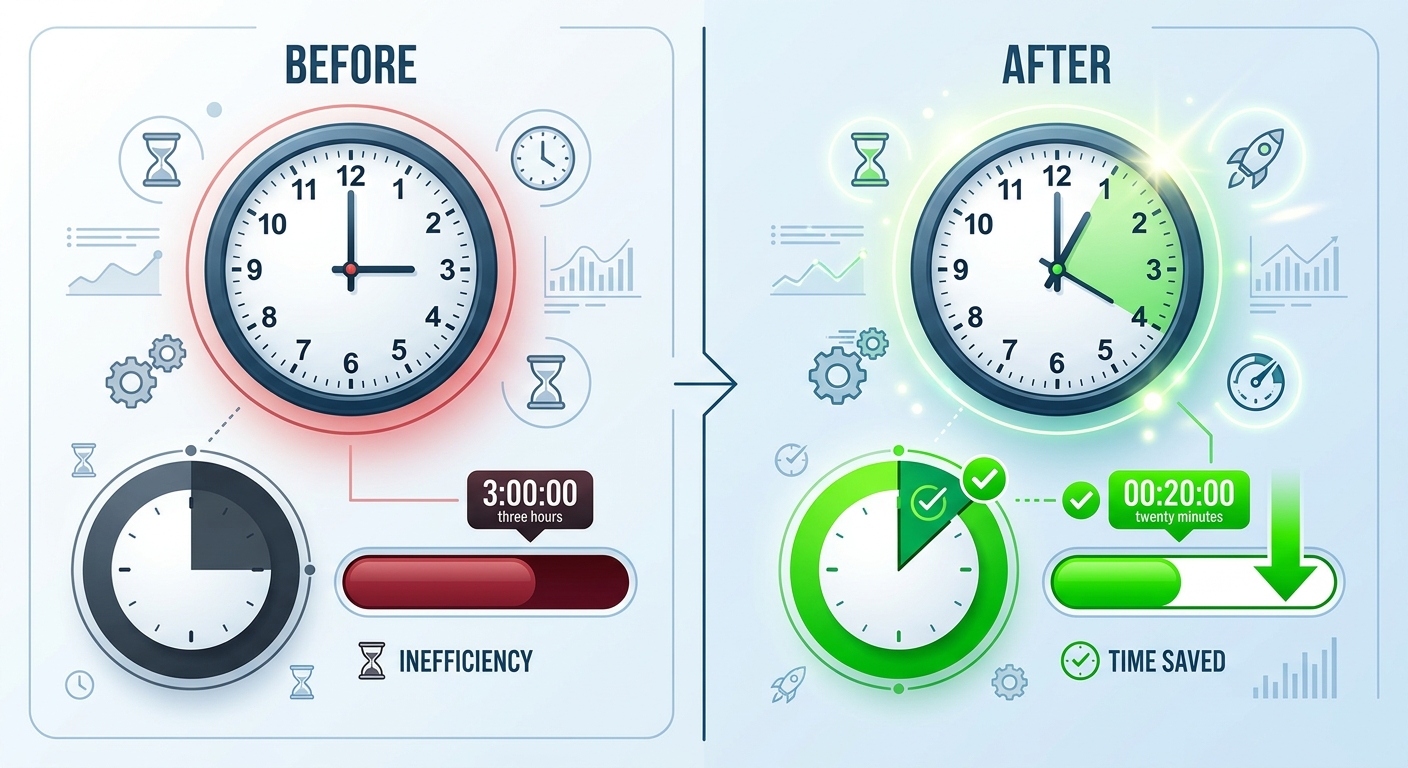
Timeline: Before and After Restructuring
| Operational steps | Before restructuring (daily) | After restructuring (daily) | save |
|---|---|---|---|
| Account login/switch | 45 minutes | 5 minutes | 40 minutes |
| Multi-platform content publishing | 225 minutes | 45 minutes | 180 minutes |
| Comment monitoring and replies | 60 minutes | 30 minutes | 30 minutes |
| Monthly report data summary | 300 minutes/month | 25 minutes/month | 275 minutes/month |
Daily recycling time: 250 minutes (more than 4 hours).
These 4 hours can be used to provide in-depth services to existing clients (to develop more refined content strategies); or they can be used to acquire new clients (to increase the number of clients from 8 to 12-14 for a team of the same size).
Three things to note when refactoring workflows
If your customers operate on TikTok, a TikTok comment management tool allows you to reply to comments from multiple TikTok accounts from a single backend, eliminating the need to switch between platforms. Comments with purchase intent are prioritized by AI, improving conversion rates in the comment section. For Instagram accounts, Instagram comment management also supports unified viewing, providing a single backend for managing comments from multiple platforms.
Do not switch all customer accounts at once. In the first week, migrate 2-3 customer accounts that you are most familiar with to familiarize yourself with the operation logic of the new tool, and then gradually expand.
Content approval processes should not be bypassed by automation. Scheduled publishing is convenient, but client confirmation before publication must be retained. It is recommended to send the content to the client for confirmation via the tool's internal collaboration process 24 hours before the official schedule, and keep a record of this.
Data anomalies require manual review. Data exported by tools is usually accurate, but when a platform's interface fluctuates, data gaps or anomalies may occur. A visual check should be performed before sending out the monthly report to avoid providing clients with abnormal data.
summary
The time wasted in managing multiple accounts through third-party operations is fundamentally due to the workflow being centered on the "platform" rather than the "customer".
Three-step restructuring path:
- Unified login layer: Eliminates duplicate logins; account switching is reduced from minutes to seconds.
- Content publishing layer: One operation covers multiple platforms, and multi-platform publishing time is reduced from 225 minutes to 45 minutes.
- Data reporting layer: Automatically generate monthly reports, reducing report creation time from 5 hours to 25 minutes.
By spending 4 hours a day on data retrieval, the maximum number of cases a team of the same size can handle can be increased by 40%-60%.
SocialEcho Team Edition starts at $18.75/month (minimum 5 accounts), with a 20% discount for annual payments. The free trial version allows you to verify whether the workflow is suitable for your business model.
Try SocialEcho for free now →
👉 https://www.socialecho.net
Frequently Asked Questions
Q1: What is the most difficult part of restructuring the workflow for outsourced operations?
A: The first step is usually to persuade the client to complete the account authorization migration. It's recommended to start with 1-2 of the most cooperative clients for a pilot program, and then expand after the process is running smoothly. The entire migration process usually takes less than a week and does not affect daily operations.
Q2: Will a unified publishing tool lower content quality? How will platform differences be handled?
A: No. The tool supports setting individual copy for each platform, and 80% of the materials can be reused, only requiring adjustments to details such as hashtags, length, and format. The review process before scheduled publication remains unchanged; quality control is still in human hands.
Q3: Can the accuracy of the monthly report data be guaranteed?
A: The data analysis function synchronizes data from various platforms hourly, with near real-time accuracy. However, it is recommended to visually check the data before sending it to the client—occasional fluctuations in platform APIs may cause data loss for a period of time, and manual review can identify outliers.
Q4: If a third-party operator needs to manage the comments on a TikTok account, does the unified tool support this?
A: Yes. TikTok's comment management feature allows users to view and reply to comments from multiple TikTok accounts in a unified backend. Combined with AI intent recognition, it prioritizes high-value comments that indicate purchase intent, reducing invalid and repetitive replies.
Q5: Is it safe to manage posting permissions for multiple platforms (TikTok, Instagram, Facebook) at the same time?
A: Security. SocialEcho uses OAuth 2.0 authorization, eliminating the need to store customer account passwords, and authorization for each account can be revoked at any time. Multi-account management supports grouping by customer, ensuring that different operations staff can only access the account groups they are responsible for.
Q6: How should a multi-person team divide tasks and collaborate?
A: It can group by customer, and each operations member can only see the accounts they are responsible for; content scheduling supports collaborative approval processes, and customers can be notified for confirmation before publication; comment replies can also be assigned to different members for processing, and AI automation functions can handle standardized common questions and answers, reducing repetitive manual work.
;}.cls-2{fill:%230868f7;}.cls-3{fill:url(%23未命名的渐变_44);}.cls-4{fill:%23333;}%3c/style%3e%3clinearGradient%20id='未命名的渐变_8'%20x1='33.73'%20y1='100.61'%20x2='-0.03'%20y2='-1.06'%20gradientUnits='userSpaceOnUse'%3e%3cstop%20offset='0'%20stop-color='%237ae9fb'/%3e%3cstop%20offset='0.67'%20stop-color='%232b90f8'/%3e%3cstop%20offset='1'%20stop-color='%230868f7'/%3e%3c/linearGradient%3e%3clinearGradient%20id='未命名的渐变_44'%20x1='27.86'%20y1='18.67'%20x2='68.36'%20y2='22.22'%20gradientUnits='userSpaceOnUse'%3e%3cstop%20offset='0'%20stop-color='%235ac7f2'/%3e%3cstop%20offset='1'%20stop-color='%230868f7'/%3e%3c/linearGradient%3e%3c/defs%3e%3cpath%20class='cls-1'%20d='M29,28.74V81.91l-9.51-3.68v0L8.52,74A7.17,7.17,0,0,1,4,67.32V24.54A3.76,3.76,0,0,1,9.08,21Z'/%3e%3cpath%20class='cls-2'%20d='M68.09,78.07a13.15,13.15,0,0,1-17.9,12.06L29,81.91h0V28.74L50.19,37A13.17,13.17,0,0,0,68.08,25.3h0Z'/%3e%3cpath%20class='cls-3'%20d='M68.08,25.3a13.19,13.19,0,0,1-6.73,10.87A13.09,13.09,0,0,1,50.19,37L29,28.74V6A3.76,3.76,0,0,1,34.1,2.52l25.59,9.91A13.22,13.22,0,0,1,68.08,25.3Z'/%3e%3cpath%20class='cls-4'%20d='M129.06,81.76a4.33,4.33,0,0,1-3.19-1.31,4.4,4.4,0,0,1-1.31-3.24V56.86H97.65V77.21a4.36,4.36,0,0,1-1.35,3.2A4.68,4.68,0,0,1,93,81.76a4.32,4.32,0,0,1-3.19-1.31,4.37,4.37,0,0,1-1.32-3.24V27.27A4.58,4.58,0,0,1,89.83,24a4.59,4.59,0,0,1,7.82,3.27V48.15h26.91V27.27A4.58,4.58,0,0,1,125.91,24a4.59,4.59,0,0,1,7.82,3.27V77.21a4.37,4.37,0,0,1-1.36,3.2A4.65,4.65,0,0,1,129.06,81.76Z'/%3e%3cpath%20class='cls-4'%20d='M163.77,81.66c-6.57,0-11.76-1.92-15.44-5.7s-5.54-9.07-5.54-15.74a26.76,26.76,0,0,1,2.09-10.43,17.72,17.72,0,0,1,6.67-8.06,19.15,19.15,0,0,1,10.68-2.95,19,19,0,0,1,10.46,2.8,18.7,18.7,0,0,1,6.55,7.36,22.53,22.53,0,0,1,2.36,10.28A4.51,4.51,0,0,1,177,63.77H152.23a10.8,10.8,0,0,0,3.49,6.65c2,1.68,4.88,2.52,8.66,2.52a22.25,22.25,0,0,0,7.54-1.21c.74-.3,1.55-.67,2.37-1.07a3.75,3.75,0,0,1,1.84-.4,4.09,4.09,0,0,1,3,1.15,4,4,0,0,1,1.12,3,4.38,4.38,0,0,1-2.58,3.82,32.34,32.34,0,0,1-6.36,2.61A28.67,28.67,0,0,1,163.77,81.66ZM172.4,55.9a9.72,9.72,0,0,0-1.63-4.56A9.9,9.9,0,0,0,167,48a10.38,10.38,0,0,0-4.64-1.14,12,12,0,0,0-4.77,1.06,9.54,9.54,0,0,0-4.89,5.66,11.78,11.78,0,0,0-.51,2.3Z'/%3e%3cpath%20class='cls-4'%20d='M193,81.64a4.49,4.49,0,0,1-4.51-4.55V27.28A4.58,4.58,0,0,1,189.84,24a4.48,4.48,0,0,1,3.28-1.36A4.36,4.36,0,0,1,196.35,24a4.46,4.46,0,0,1,1.31,3.31V77.09a4.34,4.34,0,0,1-1.35,3.2A4.67,4.67,0,0,1,193,81.64Z'/%3e%3cpath%20class='cls-4'%20d='M263.79,81.71a5.7,5.7,0,0,1-4.2-1.74,5.76,5.76,0,0,1-1.73-4.19V27.37a4.58,4.58,0,0,1,1.35-3.27A4.59,4.59,0,0,1,267,27.37V72.53h24a4.58,4.58,0,0,1,3.27,7.82A4.66,4.66,0,0,1,291,81.71Z'/%3e%3cpath%20class='cls-4'%20d='M424.48,81.74a4.71,4.71,0,0,1-2.71-.88,5.43,5.43,0,0,1-1-1l-.07-.09-12.41-17-5.41,5v9.44a4.31,4.31,0,0,1-1.36,3.19,4.66,4.66,0,0,1-3.3,1.36A4.29,4.29,0,0,1,395,80.42a4.36,4.36,0,0,1-1.32-3.23V27.37A4.58,4.58,0,0,1,395,24.1a4.52,4.52,0,0,1,6.58.12,4.54,4.54,0,0,1,1.24,3.15V56.31l17.72-16.38.05,0a4.8,4.8,0,0,1,2.94-1.11,4.4,4.4,0,0,1,3.27,1.2,4.57,4.57,0,0,1,1.2,3.27,4.44,4.44,0,0,1-.77,2.33,7.45,7.45,0,0,1-1.43,1.65l-11,9.64,13.34,17.68a5,5,0,0,1,1,2.71,4.12,4.12,0,0,1-1.36,3.24A4.64,4.64,0,0,1,424.48,81.74Z'/%3e%3cpath%20class='cls-4'%20d='M317.93,81.76a21.5,21.5,0,1,1,21.17-21.5A21.37,21.37,0,0,1,317.93,81.76Zm0-34.1a12.61,12.61,0,1,0,12.42,12.6A12.52,12.52,0,0,0,317.93,47.66Z'/%3e%3cpath%20class='cls-4'%20d='M212.18,101.22a4.12,4.12,0,0,1-3.05-1.26,4.17,4.17,0,0,1-1.26-3.1V43.34a4.37,4.37,0,0,1,1.3-3.14,4.26,4.26,0,0,1,3.13-1.3,4.19,4.19,0,0,1,3.1,1.26,4.32,4.32,0,0,1,1.26,3.16,20.77,20.77,0,0,1,13-4.54,21.51,21.51,0,0,1,0,43,20.51,20.51,0,0,1-13-4.57V96.86a4.15,4.15,0,0,1-1.3,3.06A4.5,4.5,0,0,1,212.18,101.22Zm17.43-53.63c-6.23,0-12.93,4.11-12.93,12.72a12.73,12.73,0,0,0,25.46,0A12.71,12.71,0,0,0,229.61,47.59Z'/%3e%3cpath%20class='cls-4'%20d='M365.76,81.76a21.5,21.5,0,1,1,21.18-21.5A21.37,21.37,0,0,1,365.76,81.76Zm0-34.1a12.61,12.61,0,1,0,12.42,12.6A12.52,12.52,0,0,0,365.76,47.66Z'/%3e%3c/svg%3e)