
AI Content Production Proof in 2026: A 10-person team achieved a net profit of 2 million RMB in 45 days; a revolution in social media operation efficiency has arrived.
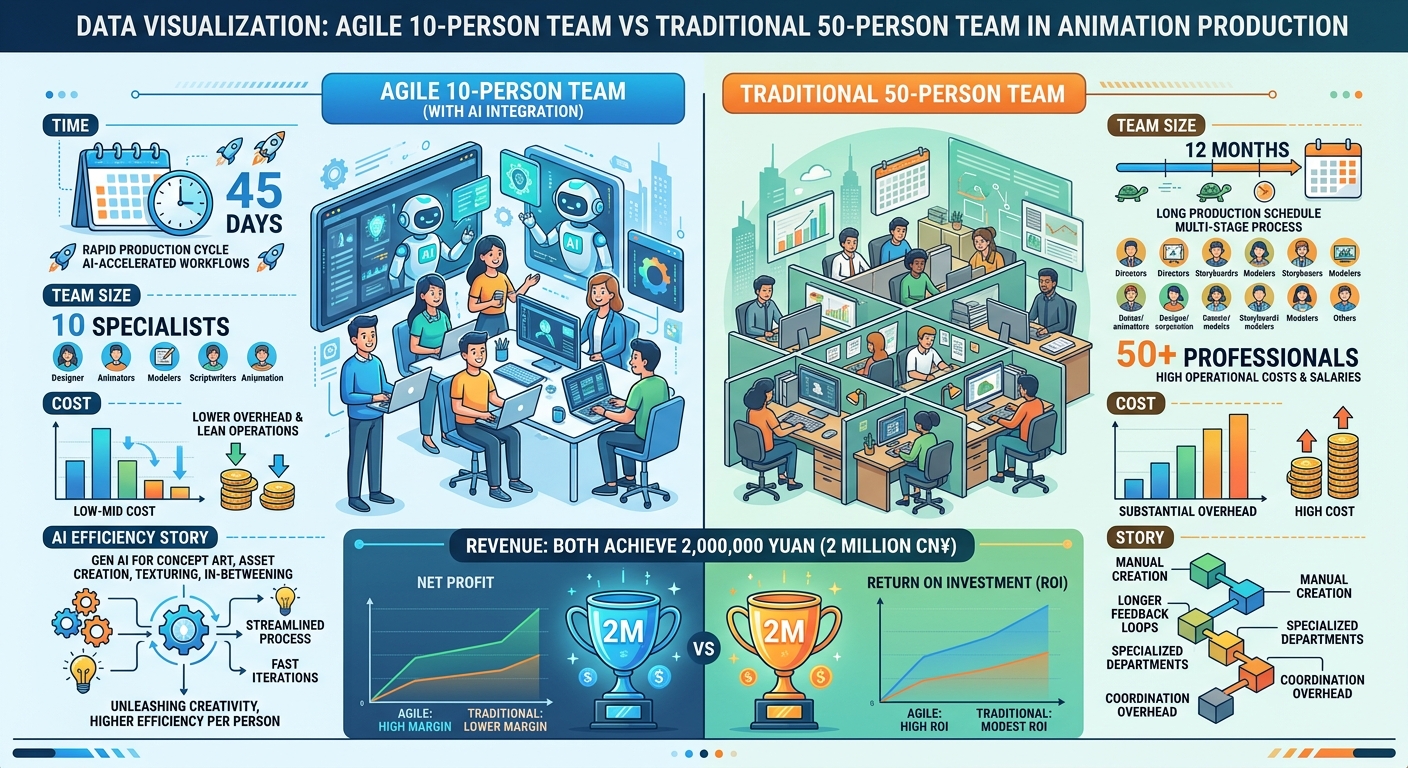
Brand Operations Director Lao Chen had just finished reading a report when the numbers on the screen left him speechless for three minutes—a 10-person team from Zhihu Yanyan, using AI with an involvement rate of over 50%, completed an animated IP in 45 days, achieving over 5 million views and a net profit of 2 million RMB within 5 days of its release.
He checked it three times to make sure he hadn't misread the unit or the decimal point.
This is not a concept, but a business fact that has already occurred.
Zhihu's "Tomorrow's Monday": A Case Study That Rewrote Industry Perceptions
In early 2026, Zhihu's Yanyan released an AI-assisted animated short film series titled "Tomorrow's Monday." The data from this work caused a stir in the content industry:
- Team size : 10 people (traditional similar projects usually require 50+ people)
- Production cycle : 45 days (traditional similar projects usually take 10-12 months).
- Performance upon release : Over 5 million views in 5 days
- Business return : Net profit of 2 million RMB
- AI involvement : Over 50% of production processes are completed by AI tools.
This isn't a prediction from an investor's PowerPoint presentation, nor is it a proof-of-concept in a lab. This is a real business event that will happen in 2026.
In which aspects did AI participate?
In their post-mortem analysis, the Zhihu Salt Talk team revealed specific application scenarios for their AI tools:
Preliminary planning : AI-assisted market analysis and audience profiling shortened the typical 2-3 week topic selection and research cycle.
Storyboard : Utilize AI image generation tools to quickly produce storyboard drafts, which the director only needs to review and modify, improving efficiency by more than 60%.
Voiceover and audio : AI-generated voice synthesis covers a large amount of non-protagonist narration, reducing voiceover costs. Protagonist voiceovers are still performed by professional voice actors, ensuring the quality of emotional expression.
Post-production effects : AI-assisted effects generation and scene rendering reduce post-production time from months to weeks.
Multi-platform content adaptation : The same content automatically adapts to different platform sizes and editing rhythms, such as Bilibili (horizontal version), Douyin (vertical version), and WeChat Video Channel, allowing for one-time production and distribution across multiple platforms.
The order of magnitude difference compared to traditional production
| Dimension | Traditional animation production | AI-assisted creation (Zhihu Salt Comment Mode) |
|---|---|---|
| Team size | 50+ people | 10 people |
| Production cycle | 10-12 months | 45 days |
| Budget level | tens of millions of RMB | Million-level |
| Trial and error cost | Extremely high risk, with enormous consequences for failure. | Low, rapid iteration |
| Multi-platform compatibility | Additional team and time required | AI automates the process. |
The core conclusion can be summed up in one sentence: AI has lowered the barrier to entry and cost of professional content production by an order of magnitude.
This is no less significant to the entire content industry than the advent of smartphones in 2012, which made everyone have a camera.
What does this mean for brand social media operations?
The competitive landscape has changed: the gap between large and small teams is disappearing.
In the past, large brands' content advantage stemmed from resources: more people, larger budgets, and more mature production lines. No matter how hard small teams tried, they could hardly compete with them in terms of content volume and production quality.
AI has changed this logic.
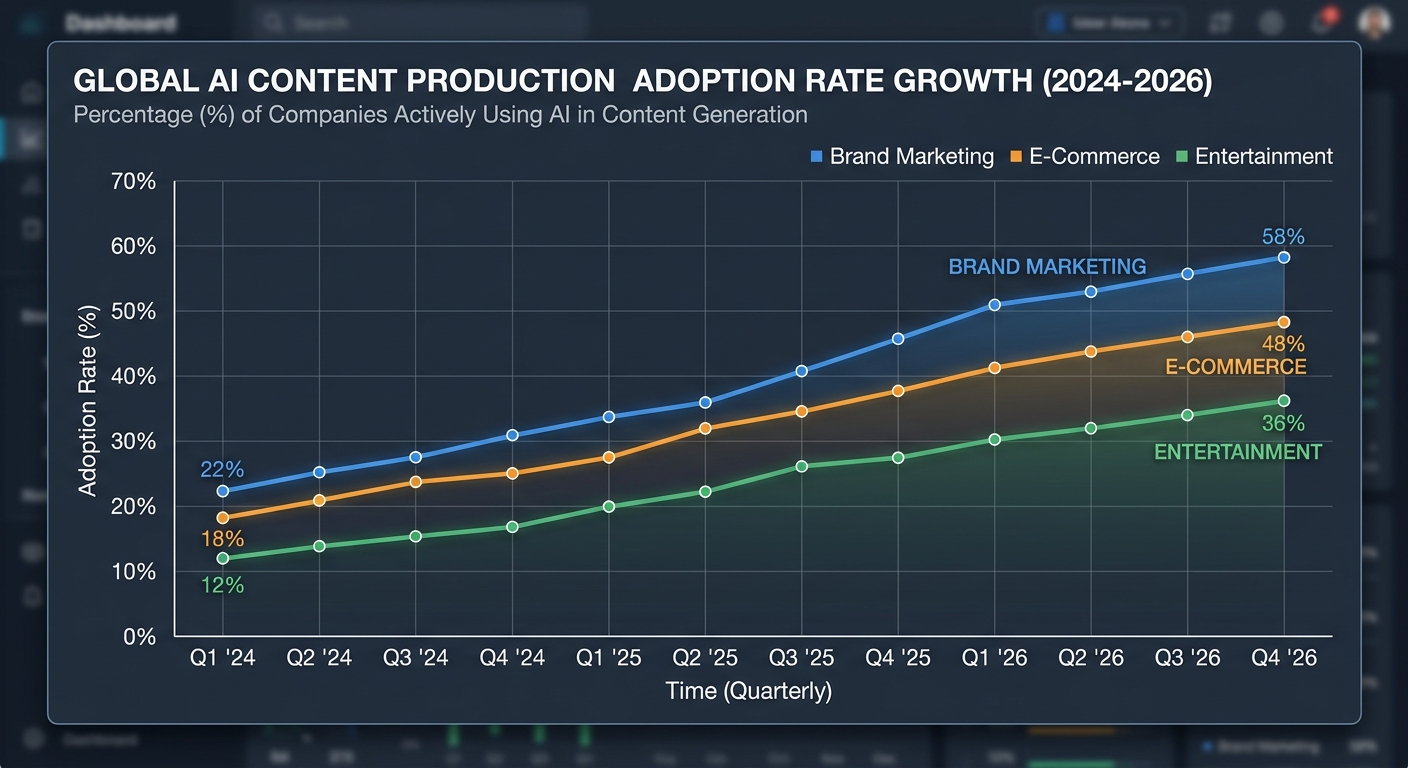
According to 2026 content industry research data, the penetration rate of AI-assisted content production in the brand marketing field has reached 47%, nearly tripling from 18% in 2024. More importantly, content teams of small and medium-sized brands using AI tools saw an average increase of 280% in content output, while costs increased by no more than 15%.
In other words, a brand content team of 3-5 people can now produce the amount of content that a team of 10-15 people used to produce. The three major changes in social media platforms in 2026 have clearly illustrated that in an era of explosive growth in content supply, failing to keep up means falling behind.
The content rhythm has changed: daily updates across multiple platforms are no longer a pipe dream.
Previously, the standard content rhythm for brand social media teams was: 1-2 articles per week on WeChat official accounts, 1-2 posts per day on Weibo, and 3-5 videos per week on Douyin. "Daily updates" was a distant goal for most teams.
Now, AI-assisted production has fundamentally changed the pace of content creation:
- Text and images: From weekly updates to daily updates
- Short videos: From 3 per week to 1-2 per day
- Multi-platform synchronization: From "manual formatting" to AI-powered automatic adaptation and distribution
For brand operations teams, this is not just about improving efficiency, but also a strategic opportunity—while competitors are still updating weekly, you are already updating daily; while competitors are still focusing on a single platform, you are already operating on five platforms simultaneously.
Of course, a complete guide to multi-platform content distribution also requires systematic tool support; otherwise, the benefits of efficiency improvement will be consumed by tedious manual operations.
The job roles have changed: from "executor" to "director".
This is the most profound and unsettling change.
With the widespread adoption of AI content tools, traditional "content execution" tasks—writing copy, editing videos, retouching images, and formatting—are being largely automated. However, this does not mean that operations staff will lose their jobs; rather, it means that the focus of these roles has shifted.
The core competency required of future content operators will no longer be "I can write good copy," but rather "I know what to make AI write, how to write it, and how to evaluate it after it's written." This is a command and dispatch ability, not an execution ability.
We have conducted an in-depth analysis of the impact of AI automation on operations roles —the conclusion is that operations personnel who know how to use AI tools will replace those who don't, rather than AI replacing operations personnel.
Data supporting the claim: Real industry figures for 2026
Here are the key data points for the content industry in 2026:
- AI-assisted copywriting adoption rate: 63% for brand marketing teams
- AI-assisted image/video generation adoption rate: Content teams 41%
- Teams using AI tools saw an average increase in content output of 280% .
- The average number of platforms managed per AI-assisted content team member: 4.2 (compared to 2.1 in the traditional model).
- Content production cost reduction: 55-70% (depending on tool combination)
Risk Warning: Two Issues That Cannot Be Ignored
Risk of homogenization : When everyone is using the same AI tools to produce content, content differentiation will become increasingly difficult. If the prompts are similar, the resulting content will also tend to be similar. By 2026, users were already experiencing aesthetic fatigue with "AI-featured" content, and data from some platforms showed that content that relied excessively on AI templates saw a 20-35% decrease in interaction rates.
Platform review is tightening : Major social media platforms are strengthening their requirements for identifying and labeling AI-generated content. WeChat, Douyin, and Weibo have all issued or are refining their AI content labeling standards. Content generated purely by AI and not subject to human review is facing increasing compliance risks.
Conclusion: AI is a tool, not a shield. Efficient production, human oversight, and a differentiated strategy are all indispensable.
How brand operations teams can leverage the efficiency revolution of AI
3 actions that can be started immediately
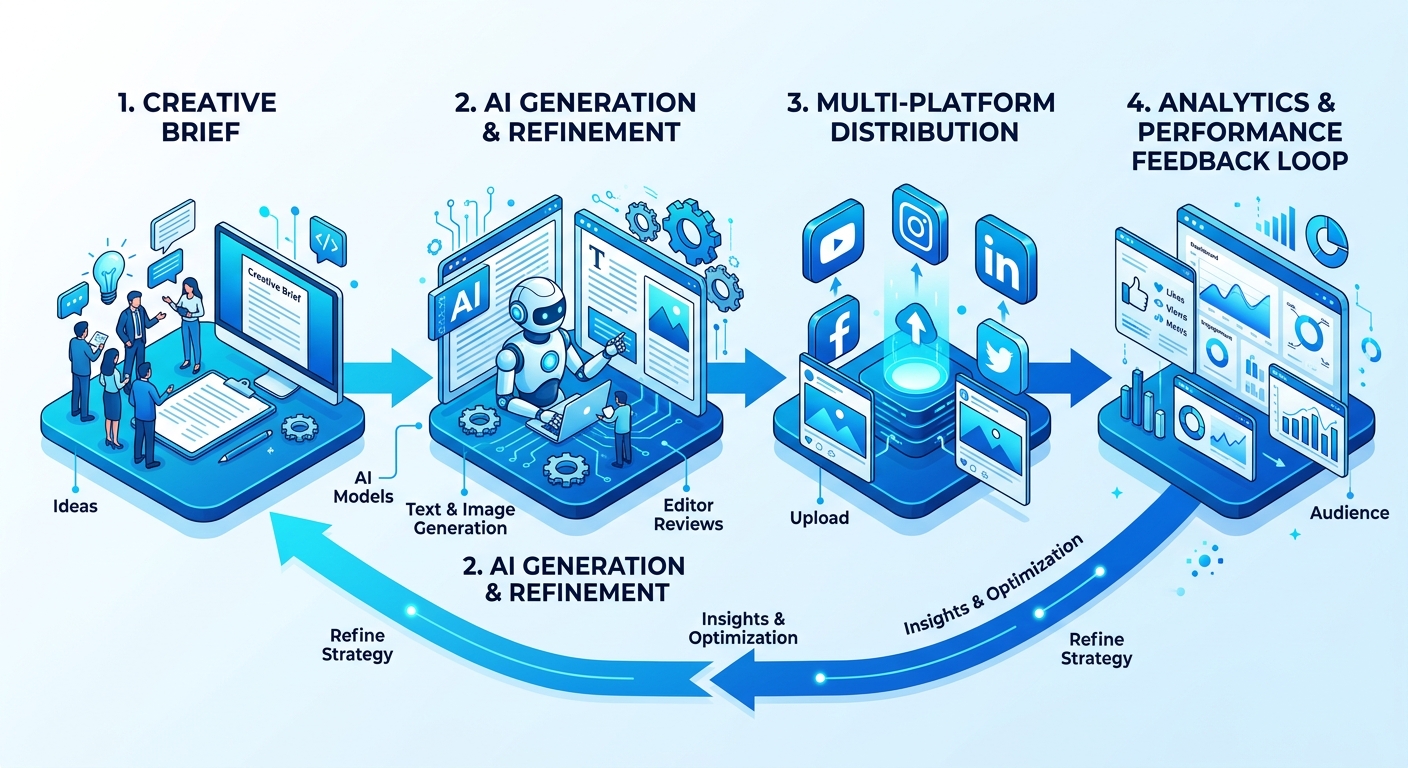
Action 1: Establish standard operating procedures (SOPs) for AI-assisted content.
Don't wait until you've "learned it all before you use it." Start with the simplest steps—for example, use AI to generate the first draft of the copy, and then have it polished and reviewed by humans. Establishing a repeatable workflow is more important than the tool itself.
Recommended starting point SOP:
- Manually determine the topic and core selling points (10 minutes)
- AI generates 3 different copywriting drafts (2 minutes each).
- Manually select and modify the optimal version (15 minutes)
- AI-assisted image matching and format adaptation (5 minutes)
- Distribute unified tools to multiple platforms (5 minutes)
A single article, from topic selection to publication, takes 30-40 minutes to complete.
Action 2: Establish a content performance data tracking system
AI can help you produce more content, but "more" doesn't equal "better." You need data to determine which type of AI-assisted content works best: Which copywriting style has a higher engagement rate? Which combination of images and text has a stronger conversion rate? Which publishing time is optimal?
Are you still manually taking screenshots for your boss's weekly reports? — If you're still manually compiling data from various platforms, then the time you're wasting has already offset the efficiency gains brought by AI.
Action 3: Unified multi-platform distribution management
AI-powered content production solves the efficiency problem on the "production end," but the "distribution end" also needs to be systematized. A team of 10 people simultaneously operates WeChat, Weibo, Douyin, Xiaohongshu, and Bilibili. If they are still manually publishing to each platform one by one, this is where the efficiency gap lies.
Tool Recommendation: How SocialEcho Works with AI Content Production Workflow
When AI helps you increase content production efficiency by 3-5 times, new problems arise: How do you manage this content? How do you synchronize across multiple platforms? How do you view data in a unified manner?
This is precisely the problem that SocialEcho aims to solve.
SocialEcho is a multi-platform management tool for brand social media operations teams, covering the entire process of content publishing, comment management, and data reporting.
- Unified publishing across multiple platforms : Edit once and publish simultaneously to 10+ platforms including Weibo, Douyin, Xiaohongshu, Twitter/X, Instagram, and Facebook.
- AI content adaptation : Automatically adapts the same content to the format requirements (word count, image ratio, hashtags, etc.) of different platforms.
- Unified comment management : Comments from multiple platforms are aggregated into one inbox, with AI-assisted replies and suggestions, eliminating the anxiety of "missed comments".
- Data reporting automation : Weekly cross-platform operation reports are automatically generated, eliminating the need for manual screenshotting and PowerPoint presentations.
Pricing scheme :
- Basic version: starting at $12.5/month
- Team version: starting at $18.75/month
- Enjoy 20% off annual payments
For brand teams that have already started or plan to introduce AI content tools, SocialEcho solves the "last mile" problem—enabling AI-generated content to reach audiences across multiple platforms efficiently and forming a data loop to drive continuous optimization.
Conclusion: The efficiency revolution waits for no one.
The case of Zhihu's Salt Talk has proven that AI content production is not the future, but the present.
Old Chen stared at the report for three minutes, then opened a new document and began writing his AI tool introduction plan.
When does your three minutes begin?
FAQ
Q1: What exactly does it mean that the AI participation rate in Zhihu's "Tomorrow's Monday" case exceeded 50%?
AI involvement exceeding 50% means that AI tools were used to assist in more than half of the content production process, including storyboard generation, background image rendering, some voice-over work, subtitle generation, post-production effects, and multi-platform format adaptation. Core creative planning, main character voice-over, and final quality control are still done manually. This percentage signifies that AI tools have risen from "assistance" to "primary productivity."
Q2: Will AI content production replace social media operators?
AI won't replace people, but it will restructure roles. AI will replace repetitive, standardized execution tasks, while core capabilities such as brand insight, strategic judgment, creative direction, and user relationship management will still require human intervention. More accurately, operations personnel who know how to utilize AI tools will replace those who don't. By 2026, "AI tool proficiency" will have become one of the basic requirements for content operations positions.
Q3: How do brand social media teams evaluate whether to introduce AI content tools?
The evaluation can be conducted using three dimensions: ① Content production bottlenecks – If the team frequently misses publication windows due to insufficient writing or filming time, AI tools are a high priority; ② Multi-platform pressure – If operating more than three platforms simultaneously is required, AI-adaptive tools typically have a high ROI; ③ Data analysis needs – If the boss frequently demands weekly reports but the team lacks time, data automation tools are a top priority. If two of these three dimensions apply, it is recommended to begin evaluating and implementing them immediately.
Q4: What are the review policies for AI-generated content on various social media platforms?
Platform policies are continuously tightening. WeChat Video Channels requires AI-generated videos to have prominent labels; Douyin has issued guidelines for AI content labeling, requiring purely AI-generated content to be labeled; Weibo has labeling requirements for AI-generated images; and overseas platforms such as YouTube and Instagram have also launched AI content disclosure policies. The current common practice is: AI-assisted production + human review + platform-required labeling—all three are indispensable. The risks of violations include demotion, post deletion, and even account suspension.
Q5: How can small brands start AI-assisted social media content production at a low cost?
We recommend starting with a "light intervention" approach: First, use AI copywriting tools (such as ChatGPT and Wenxin Yiyan) to help generate draft copy, then manually revise and publish—at zero additional cost. Second, introduce AI image tools to reduce image costs. Third, use multi-platform management tools for unified distribution, saving time spent on platform-by-platform operations. For example, SocialEcho's basic version costs $12.5/month, covering multi-platform publishing, comment management, and basic data reporting. For small brands with limited monthly content operation budgets, this is a highly cost-effective starting point. Learn more about SocialEcho solutions →
Q6: Which aspects of AI content production will be most mature in 2026?
The maturity levels are ranked from highest to lowest: ① Text generation (most mature, reliable quality, already commercially available on a large scale); ② Image generation (mature, but requires manual selection and fine-tuning); ③ Data analysis and reporting (mature, highly automated); ④ Short video editing assistance (relatively mature, with stable functions such as subtitles and editing point suggestions); ⑤ Complete video generation (under development, quality varies, still requires a lot of manual control); ⑥ Real-time interactive content (early stage, with functions such as AI-powered comment replies gradually becoming widespread).
Q7: How to avoid the risk of AI content homogenization?
Three strategies: ① Brand voice targeting – embedding brand-specific tone, vocabulary preferences, and taboos into AI tool prompts to create a "brand prompt template library"; ② Exclusive information asymmetry – using AI to process general information, but adding brand-specific data, case studies, and perspectives to the content, making it impossible for AI to replicate; ③ Iterative testing – continuously using data to test which content combinations work best, quickly eliminating homogenized content and retaining differentiated content models. Homogenization is not an AI problem, but a user strategy problem.
;}.cls-2{fill:%230868f7;}.cls-3{fill:url(%23未命名的渐变_44);}.cls-4{fill:%23333;}%3c/style%3e%3clinearGradient%20id='未命名的渐变_8'%20x1='33.73'%20y1='100.61'%20x2='-0.03'%20y2='-1.06'%20gradientUnits='userSpaceOnUse'%3e%3cstop%20offset='0'%20stop-color='%237ae9fb'/%3e%3cstop%20offset='0.67'%20stop-color='%232b90f8'/%3e%3cstop%20offset='1'%20stop-color='%230868f7'/%3e%3c/linearGradient%3e%3clinearGradient%20id='未命名的渐变_44'%20x1='27.86'%20y1='18.67'%20x2='68.36'%20y2='22.22'%20gradientUnits='userSpaceOnUse'%3e%3cstop%20offset='0'%20stop-color='%235ac7f2'/%3e%3cstop%20offset='1'%20stop-color='%230868f7'/%3e%3c/linearGradient%3e%3c/defs%3e%3cpath%20class='cls-1'%20d='M29,28.74V81.91l-9.51-3.68v0L8.52,74A7.17,7.17,0,0,1,4,67.32V24.54A3.76,3.76,0,0,1,9.08,21Z'/%3e%3cpath%20class='cls-2'%20d='M68.09,78.07a13.15,13.15,0,0,1-17.9,12.06L29,81.91h0V28.74L50.19,37A13.17,13.17,0,0,0,68.08,25.3h0Z'/%3e%3cpath%20class='cls-3'%20d='M68.08,25.3a13.19,13.19,0,0,1-6.73,10.87A13.09,13.09,0,0,1,50.19,37L29,28.74V6A3.76,3.76,0,0,1,34.1,2.52l25.59,9.91A13.22,13.22,0,0,1,68.08,25.3Z'/%3e%3cpath%20class='cls-4'%20d='M129.06,81.76a4.33,4.33,0,0,1-3.19-1.31,4.4,4.4,0,0,1-1.31-3.24V56.86H97.65V77.21a4.36,4.36,0,0,1-1.35,3.2A4.68,4.68,0,0,1,93,81.76a4.32,4.32,0,0,1-3.19-1.31,4.37,4.37,0,0,1-1.32-3.24V27.27A4.58,4.58,0,0,1,89.83,24a4.59,4.59,0,0,1,7.82,3.27V48.15h26.91V27.27A4.58,4.58,0,0,1,125.91,24a4.59,4.59,0,0,1,7.82,3.27V77.21a4.37,4.37,0,0,1-1.36,3.2A4.65,4.65,0,0,1,129.06,81.76Z'/%3e%3cpath%20class='cls-4'%20d='M163.77,81.66c-6.57,0-11.76-1.92-15.44-5.7s-5.54-9.07-5.54-15.74a26.76,26.76,0,0,1,2.09-10.43,17.72,17.72,0,0,1,6.67-8.06,19.15,19.15,0,0,1,10.68-2.95,19,19,0,0,1,10.46,2.8,18.7,18.7,0,0,1,6.55,7.36,22.53,22.53,0,0,1,2.36,10.28A4.51,4.51,0,0,1,177,63.77H152.23a10.8,10.8,0,0,0,3.49,6.65c2,1.68,4.88,2.52,8.66,2.52a22.25,22.25,0,0,0,7.54-1.21c.74-.3,1.55-.67,2.37-1.07a3.75,3.75,0,0,1,1.84-.4,4.09,4.09,0,0,1,3,1.15,4,4,0,0,1,1.12,3,4.38,4.38,0,0,1-2.58,3.82,32.34,32.34,0,0,1-6.36,2.61A28.67,28.67,0,0,1,163.77,81.66ZM172.4,55.9a9.72,9.72,0,0,0-1.63-4.56A9.9,9.9,0,0,0,167,48a10.38,10.38,0,0,0-4.64-1.14,12,12,0,0,0-4.77,1.06,9.54,9.54,0,0,0-4.89,5.66,11.78,11.78,0,0,0-.51,2.3Z'/%3e%3cpath%20class='cls-4'%20d='M193,81.64a4.49,4.49,0,0,1-4.51-4.55V27.28A4.58,4.58,0,0,1,189.84,24a4.48,4.48,0,0,1,3.28-1.36A4.36,4.36,0,0,1,196.35,24a4.46,4.46,0,0,1,1.31,3.31V77.09a4.34,4.34,0,0,1-1.35,3.2A4.67,4.67,0,0,1,193,81.64Z'/%3e%3cpath%20class='cls-4'%20d='M263.79,81.71a5.7,5.7,0,0,1-4.2-1.74,5.76,5.76,0,0,1-1.73-4.19V27.37a4.58,4.58,0,0,1,1.35-3.27A4.59,4.59,0,0,1,267,27.37V72.53h24a4.58,4.58,0,0,1,3.27,7.82A4.66,4.66,0,0,1,291,81.71Z'/%3e%3cpath%20class='cls-4'%20d='M424.48,81.74a4.71,4.71,0,0,1-2.71-.88,5.43,5.43,0,0,1-1-1l-.07-.09-12.41-17-5.41,5v9.44a4.31,4.31,0,0,1-1.36,3.19,4.66,4.66,0,0,1-3.3,1.36A4.29,4.29,0,0,1,395,80.42a4.36,4.36,0,0,1-1.32-3.23V27.37A4.58,4.58,0,0,1,395,24.1a4.52,4.52,0,0,1,6.58.12,4.54,4.54,0,0,1,1.24,3.15V56.31l17.72-16.38.05,0a4.8,4.8,0,0,1,2.94-1.11,4.4,4.4,0,0,1,3.27,1.2,4.57,4.57,0,0,1,1.2,3.27,4.44,4.44,0,0,1-.77,2.33,7.45,7.45,0,0,1-1.43,1.65l-11,9.64,13.34,17.68a5,5,0,0,1,1,2.71,4.12,4.12,0,0,1-1.36,3.24A4.64,4.64,0,0,1,424.48,81.74Z'/%3e%3cpath%20class='cls-4'%20d='M317.93,81.76a21.5,21.5,0,1,1,21.17-21.5A21.37,21.37,0,0,1,317.93,81.76Zm0-34.1a12.61,12.61,0,1,0,12.42,12.6A12.52,12.52,0,0,0,317.93,47.66Z'/%3e%3cpath%20class='cls-4'%20d='M212.18,101.22a4.12,4.12,0,0,1-3.05-1.26,4.17,4.17,0,0,1-1.26-3.1V43.34a4.37,4.37,0,0,1,1.3-3.14,4.26,4.26,0,0,1,3.13-1.3,4.19,4.19,0,0,1,3.1,1.26,4.32,4.32,0,0,1,1.26,3.16,20.77,20.77,0,0,1,13-4.54,21.51,21.51,0,0,1,0,43,20.51,20.51,0,0,1-13-4.57V96.86a4.15,4.15,0,0,1-1.3,3.06A4.5,4.5,0,0,1,212.18,101.22Zm17.43-53.63c-6.23,0-12.93,4.11-12.93,12.72a12.73,12.73,0,0,0,25.46,0A12.71,12.71,0,0,0,229.61,47.59Z'/%3e%3cpath%20class='cls-4'%20d='M365.76,81.76a21.5,21.5,0,1,1,21.18-21.5A21.37,21.37,0,0,1,365.76,81.76Zm0-34.1a12.61,12.61,0,1,0,12.42,12.6A12.52,12.52,0,0,0,365.76,47.66Z'/%3e%3c/svg%3e)