
The era of AI employees is coming: The role reshaping of social media operations teams in 2026.
introduction
You are someone who has been doing social media operations for 5 years.
My daily routine consists of: turning on my computer at 9 a.m., logging into 12 platform accounts one by one, taking screenshots to create a daily report, and sending it to various groups for management confirmation. Then I start finding content materials, editing copy, publishing content, handling comments, replying to private messages, and compiling data reports. The cycle repeats endlessly.
You feel like you're very busy, but one day you suddenly realize that the work you do is essentially repetitive tasks.
And this kind of work is exactly what AI excels at.
In 2026, AI will be able to automate most of your tasks, such as taking screenshots, posting, and organizing data. You will then face a choice: either your job will be replaced by AI, or you will learn to collaborate with AI and enhance your own value.
In this article, we will clearly analyze the impact of AI on social media operations, tell you what the truly valuable capabilities will be in the future, and how to build your own competitiveness in the AI era.
I. Which social media operations tasks are AI replacing?
First, clearly define which jobs are being replaced. This will give you a sense of crisis, but prevent you from becoming blindly anxious.
Jobs that are being replaced on a large scale (replacement rate > 60%):
Content publishing and scheduling. AI can automatically log in to accounts, publish content, and send messages on a scheduled basis. This task accounts for 30-40% of the work time of most social media operators.
Basic data screenshots and summaries. The daily data report, generated every morning, can be completed in 5 minutes in the form of AI, taking you 2 hours to do, with higher accuracy and fewer errors.
Basic replies to comments and private messages. For FAQs and frequently asked questions, AI can automatically identify and suggest replies, or provide automatic replies.
Cross-platform content adaptation. AI can automatically adapt content to the format, style, and tag requirements of different platforms faster and better than humans.
Competitor content monitoring and screenshots. AI can monitor competitor activities 24/7 and automatically generate daily competitor reports.
These tasks share common characteristics: repetitiveness, clearly defined rules, and minimal need for judgment. These are precisely the areas where AI excels.
II. What jobs cannot be replaced by AI?
Having discussed what AI can replace, let's talk about what AI cannot replace.
Jobs that AI is unlikely to replace in the short term:
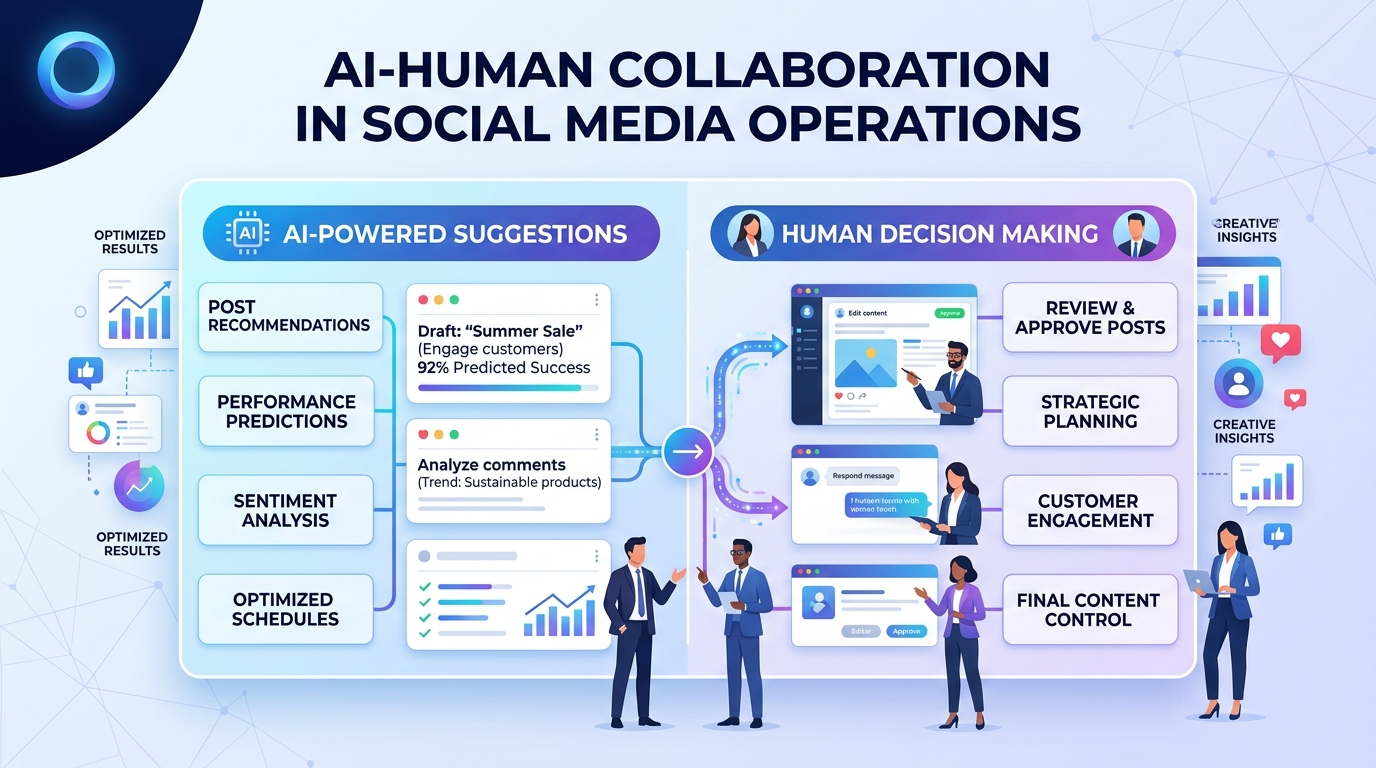
Strategic planning and decision-making. What is the overall strategy for social media? Who are the target users? What direction should the brand positioning take? These are decisions that require business acumen and judgment, and AI cannot provide you with the answers.
Creativity and insight. AI can mimic the format of viral content, but true creativity comes from a deep understanding of human nature, social trends, and user psychology. AI can generate content, but it cannot create "insight."
Crisis management and sensitive communication. When brands encounter negative public opinion and need to communicate with users, media, and regulators, what's needed is human empathy, judgment, and negotiation skills. AI-generated apologies always sound like they were written by AI.
Deep customer relationship maintenance. KOL collaborations, VIP customer communication, and in-depth user operations—these are areas that require building genuine interpersonal relationships, and AI can assist but cannot replace them.
Cross-departmental coordination and resource acquisition are crucial. Social media operations are not isolated; they require coordination with multiple departments, including product, marketing, customer service, and legal. These tasks demand human communication skills and political acumen, which AI cannot perform.
In summary: AI excels at improving efficiency at the execution level, while humans are irreplaceable in strategic judgment, creative insight, and interpersonal communication.
III. Capability Upgrading Path for Social Media Operations Teams
How should social media operators upgrade their skills in the face of the impact of AI?
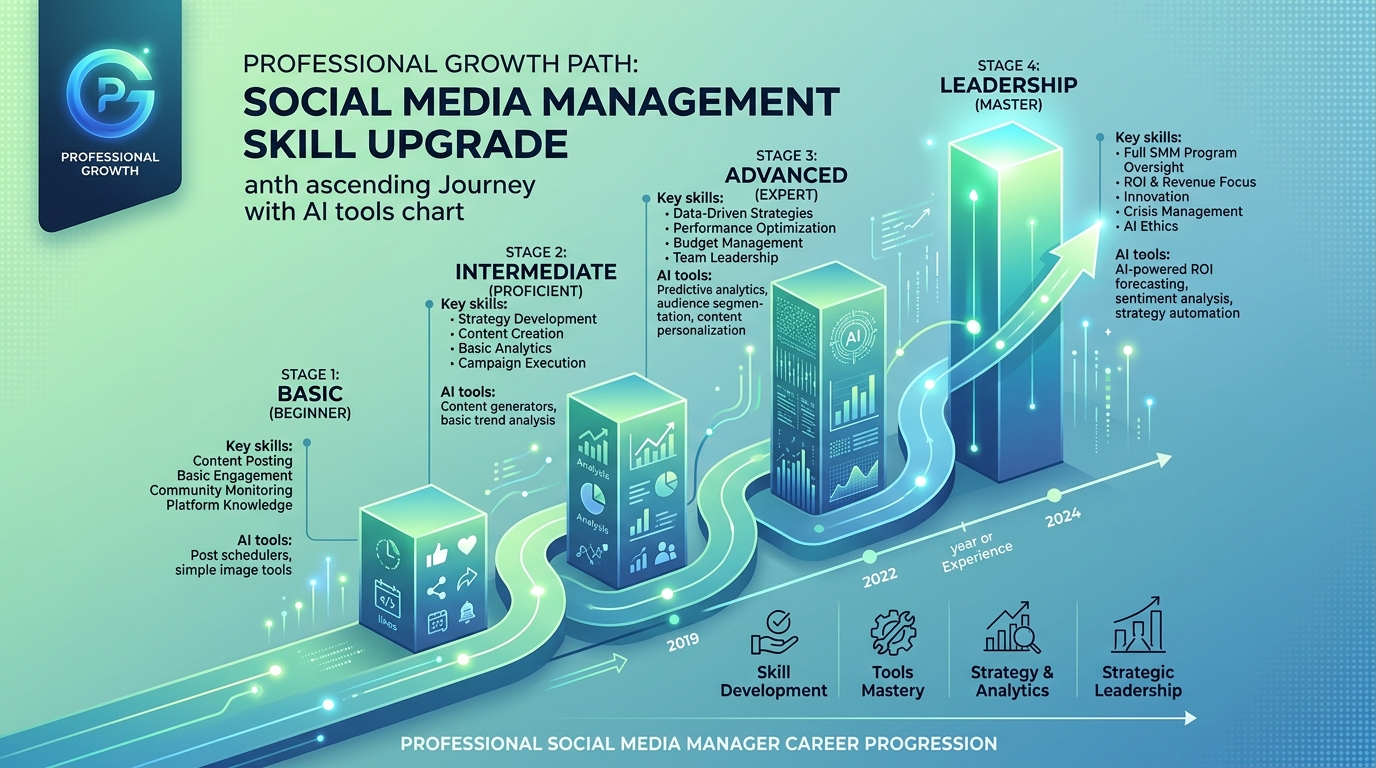
3.1 From Executor to Strategist
If your core competency right now is "proficient operation of various platform backends," this competency will become increasingly worthless. The reason is that AI's operational efficiency is more than 10 times higher than that of humans.
The direction you need to upgrade is: from "knowing how to post content" to "knowing what content to post".
This means you need to cultivate these abilities in yourself:
- Data analytics capabilities: Discovering insights from data to guide content strategy
- User research capabilities: Deeply understanding the underlying needs of target users
- Competitive analysis capability: Systematically researching and learning from competitors
- Content planning ability: planning the theme, format, and pacing of content, rather than simply executing it.
A simple criterion: if your daily work can be completely replaced by a "super publishing tool", then you need to upgrade your skills.
3.2 Learn to use AI tools, rather than being replaced by them.
This may sound contradictory, but the core point is that the efficiency with which you use AI tools determines the depth of your collaboration with AI.
A skilled AI operator can accomplish the work of 3-5 people; an unskilled operator can't even operate the AI tools properly and can only do the tasks that AI can do.
Essential AI tools and capabilities for social media operations in 2026:
Use AI to assist in content creation: Let AI help you generate initial drafts, optimize titles, and rewrite copy, but ultimately, it is you who judges the quality of the content.
Using AI for data analysis: Let AI handle data processing, chart generation, and anomaly detection, but you're responsible for interpretation and strategic decision-making. Using Facebook and Instagram data analytics can significantly improve data processing efficiency.
Use AI for user interaction: Let AI help you filter high-value comments and generate response suggestions, but you're still the one building deep relationships with users. TikTok comment management automates the comment filtering process.
AI-driven social media management tools are becoming industry standard. Proficiency in these tools will be a fundamental skill for operations professionals in 2026.
3.3 Cultivating capabilities that AI lacks
Based on the analysis above, the truly scarce abilities are these:
The ability to tell stories. Humans enjoy communicating with other humans, and even when interacting with a brand account, users want to feel that it's backed by a real person. The ability to tell stories that resonate with people is a core competency for human creators.
The ability to integrate across disciplines. AI excels at optimization within a single domain, but cross-domain integration and innovation is a human strength. Connecting social media operations with products, markets, and user experience to create greater value requires comprehensive human judgment.
The ability to build relationships. Negotiating collaborations with KOLs, establishing long-term trust with users, and maintaining brand reputation—these all fall under the category of interpersonal relationships, which AI can assist with but cannot replace.
IV. Organizational Changes for the Social Media Operations Team in 2026
The impact of AI on social media operations is not only on individuals, but also affects the organizational structure of the entire team.
4.1 The team size has decreased, but the output per person has increased significantly.
What used to require 10 people to manage an account matrix may now only require 3-4 people plus AI tools. But these 3-4 people are not "those left over from layoffs," but rather "those with upgraded capabilities."
This means that the team's hiring standards will undergo a fundamental change: instead of focusing on "whether you can post on Weibo", the focus will be on "whether you understand data analysis, user insights, and content strategy".
4.2 Differentiation of Operational Roles
In the future, several roles will emerge within social media operations teams:
Strategic operations: Responsible for content planning, data analysis, and KPI setting. They are the "brain" of the team; they don't directly produce content, but they decide what content to create.
Creative Operations: Responsible for creative brainstorming, in-depth content production, and crisis communication. They are the "soul" of the team, producing the most valuable and differentiated content.
Execution-oriented operations (partially retained): Responsible for daily postings, data monitoring, and basic customer service. This role will be significantly reduced, mainly handling tasks that AI tools cannot effectively perform and that require human judgment.
AI Tool Operations: Responsible for managing the operation of AI tools, maintaining the suggestion word library, and optimizing the quality of AI output. This is a newly emerging job role that requires talent with both social media operations and AI tool expertise.
V. Corporate Response Strategies
How should businesses strategize their social media operations in the AI era?
5.1 Embrace AI tools as soon as possible
Don't wait until labor costs become unbearable before starting to use AI. AI tools are already very inexpensive, yet offer enormous efficiency gains. The sooner you adopt AI, the sooner you'll benefit; this isn't just a matter of cost, but also a matter of competitive efficiency.
It is recommended that businesses complete the AI-driven transformation of their social media operations by 2026: introducing AI-powered posting tools, AI-powered data analytics tools, and AI-powered customer service assistance tools. Using scheduled posts on Instagram and TikTok can automate scheduling, while using the X platform for data analytics can generate multi-dimensional operational reports.
5.2 Redefining the Value of the Operations Team
If the value of the operations team is defined as "publishing content and handling comments," then this team can indeed be significantly reduced in size. However, if the operations team is defined as "the brand's user relationship managers on social media," then its value is entirely different.
Businesses need to consider: What kind of user relationships should my brand build on social media? And who should maintain these relationships?
5.3 Investing in upgrading human capabilities
AI tools are the lever, but the people who use that lever are the key. The same AI tool can produce output differences of up to 10 times in the hands of people with different skill levels.
Businesses should invest in upgrading the capabilities of their operations staff: training them in data analytics, AI tool usage, and strategic thinking. An operations professional who can leverage AI tools to amplify their abilities is worth more than five times that of someone who only knows basic operations.
VI. A Survival Guide for Individual Business Operators
Regardless of what companies think, as an individual operator, you need to be responsible for your own career development.
6.1 Start using AI tools now
Regardless of what tools you're using now, immediately start researching alternatives to the AI version:
- Content publishing: Check if your platform supports AI-powered batch publishing.
- Data Analysis: Find AI-Driven Data Analysis Tools
- Content creation: Use AI to assist in content generation, but maintain your judgment and creative drive.
- User interaction: AI-assisted comment filtering and replying, but core user communication is handled by ourselves.
6.2 Build irreplaceable capabilities
Now begin deliberate capacity building:
- Learning data analysis is not just about looking at backend numbers, but about being able to discover insights from them.
- Develop the ability to judge content quality, knowing what kind of content will go viral and what won't.
- Develop cross-departmental coordination skills to become a bridge connecting operations and business.
- Accumulate industry insights and build in-depth knowledge in a specific field.
6.3 Find your own AI collaboration mode
Everyone works differently, and AI collaboration models vary from person to person. It's recommended to spend a month of your spare time experimenting: how to use AI tools to optimize your daily workflow and find the human-machine collaboration method that best suits you.
FAQ
Q1: Will AI completely replace the social media operations role?
A1: It won't completely replace them, but it will significantly reduce demand. 70-80% of the execution-related work in social media operations will be replaced by AI, but 20-30% of the strategic, creative, and interpersonal work will still require human intervention. The future configuration of an operations team might be: what used to be done by 10 people can now be done better by 3 people plus AI tools. However, these "3 people" are not ordinary executors, but rather high-level operations personnel with upgraded capabilities.
Q2: It's 2026, is it too late to start learning AI tools now?
A2: It's absolutely not too late. The application of AI tools in social media operations is still in its early stages, and most practitioners haven't truly mastered them. The advantages of starting to learn now are: abundant learning resources, low trial-and-error costs, and competitors not having taken a significant lead yet. The key is to start immediately, not to wait until "later."
Q3: Do I need to learn programming to switch from social media operations to AI-related positions?
A3: You don't need to learn programming, but you do need to learn how to use AI tools. Most AI-powered social media management tools don't require programming knowledge; they work like regular software with graphical interfaces and user guides. However, you do need to understand the basic logic of AI (such as the need for good prompts in AI-generated content), which can be quickly mastered through practice.
Q4: What kind of social media operators will be the most valuable in the future?
A4: The three most valuable types of people are: First, "AI + Strategy" talents, who can use AI tools to amplify their strategic judgment; second, "Content Creativity" talents, who can produce unique insights and creative content that AI cannot generate; and third, "User Relationships" talents, who can build deep user trust and maintain brand reputation. The common thread among these three types of abilities is their irreplaceability—AI cannot do these things well.
Q5: How should companies evaluate the return on investment of AI tools?
A5: We mainly look at these metrics: how much human labor time has the AI tool replaced (in terms of cost per person-hour); how much has content production efficiency improved (in terms of content output per hour); how much has data accuracy improved (error rate compared to manual labor); and changes in user satisfaction (interaction rate, comment sentiment). We suggest running the AI tool for 1-3 months first, comparing the data before and after, before deciding whether to roll it out nationwide.
Conclusion
Social media operations in the AI era are not a competition between "humans vs. AI", but rather a competition between "humans who know how to use AI and humans who don't".
Your competitors are not AI tools, but people who use AI tools to improve their own efficiency.
It's 2026, and the wave of AI replacement has already begun. Instead of being anxious, take action. Starting today, learn to collaborate with AI, upgrade your skills, and redefine your value.
Remember: In an era where machines are becoming increasingly intelligent, what humans are most valuable are those things that machines can never learn—judgment, creativity, empathy, and insight.
These skills require deliberate cultivation and continuous investment.
Want to learn more about AI-driven social media management tools? Check out SocialEcho's AI automation features and experience a new generation of human-machine collaboration in management.
Free Trial: SocialEcho AI Operations Tool
Word count: Approximately 3500 words
;}.cls-2{fill:%230868f7;}.cls-3{fill:url(%23未命名的渐变_44);}.cls-4{fill:%23333;}%3c/style%3e%3clinearGradient%20id='未命名的渐变_8'%20x1='33.73'%20y1='100.61'%20x2='-0.03'%20y2='-1.06'%20gradientUnits='userSpaceOnUse'%3e%3cstop%20offset='0'%20stop-color='%237ae9fb'/%3e%3cstop%20offset='0.67'%20stop-color='%232b90f8'/%3e%3cstop%20offset='1'%20stop-color='%230868f7'/%3e%3c/linearGradient%3e%3clinearGradient%20id='未命名的渐变_44'%20x1='27.86'%20y1='18.67'%20x2='68.36'%20y2='22.22'%20gradientUnits='userSpaceOnUse'%3e%3cstop%20offset='0'%20stop-color='%235ac7f2'/%3e%3cstop%20offset='1'%20stop-color='%230868f7'/%3e%3c/linearGradient%3e%3c/defs%3e%3cpath%20class='cls-1'%20d='M29,28.74V81.91l-9.51-3.68v0L8.52,74A7.17,7.17,0,0,1,4,67.32V24.54A3.76,3.76,0,0,1,9.08,21Z'/%3e%3cpath%20class='cls-2'%20d='M68.09,78.07a13.15,13.15,0,0,1-17.9,12.06L29,81.91h0V28.74L50.19,37A13.17,13.17,0,0,0,68.08,25.3h0Z'/%3e%3cpath%20class='cls-3'%20d='M68.08,25.3a13.19,13.19,0,0,1-6.73,10.87A13.09,13.09,0,0,1,50.19,37L29,28.74V6A3.76,3.76,0,0,1,34.1,2.52l25.59,9.91A13.22,13.22,0,0,1,68.08,25.3Z'/%3e%3cpath%20class='cls-4'%20d='M129.06,81.76a4.33,4.33,0,0,1-3.19-1.31,4.4,4.4,0,0,1-1.31-3.24V56.86H97.65V77.21a4.36,4.36,0,0,1-1.35,3.2A4.68,4.68,0,0,1,93,81.76a4.32,4.32,0,0,1-3.19-1.31,4.37,4.37,0,0,1-1.32-3.24V27.27A4.58,4.58,0,0,1,89.83,24a4.59,4.59,0,0,1,7.82,3.27V48.15h26.91V27.27A4.58,4.58,0,0,1,125.91,24a4.59,4.59,0,0,1,7.82,3.27V77.21a4.37,4.37,0,0,1-1.36,3.2A4.65,4.65,0,0,1,129.06,81.76Z'/%3e%3cpath%20class='cls-4'%20d='M163.77,81.66c-6.57,0-11.76-1.92-15.44-5.7s-5.54-9.07-5.54-15.74a26.76,26.76,0,0,1,2.09-10.43,17.72,17.72,0,0,1,6.67-8.06,19.15,19.15,0,0,1,10.68-2.95,19,19,0,0,1,10.46,2.8,18.7,18.7,0,0,1,6.55,7.36,22.53,22.53,0,0,1,2.36,10.28A4.51,4.51,0,0,1,177,63.77H152.23a10.8,10.8,0,0,0,3.49,6.65c2,1.68,4.88,2.52,8.66,2.52a22.25,22.25,0,0,0,7.54-1.21c.74-.3,1.55-.67,2.37-1.07a3.75,3.75,0,0,1,1.84-.4,4.09,4.09,0,0,1,3,1.15,4,4,0,0,1,1.12,3,4.38,4.38,0,0,1-2.58,3.82,32.34,32.34,0,0,1-6.36,2.61A28.67,28.67,0,0,1,163.77,81.66ZM172.4,55.9a9.72,9.72,0,0,0-1.63-4.56A9.9,9.9,0,0,0,167,48a10.38,10.38,0,0,0-4.64-1.14,12,12,0,0,0-4.77,1.06,9.54,9.54,0,0,0-4.89,5.66,11.78,11.78,0,0,0-.51,2.3Z'/%3e%3cpath%20class='cls-4'%20d='M193,81.64a4.49,4.49,0,0,1-4.51-4.55V27.28A4.58,4.58,0,0,1,189.84,24a4.48,4.48,0,0,1,3.28-1.36A4.36,4.36,0,0,1,196.35,24a4.46,4.46,0,0,1,1.31,3.31V77.09a4.34,4.34,0,0,1-1.35,3.2A4.67,4.67,0,0,1,193,81.64Z'/%3e%3cpath%20class='cls-4'%20d='M263.79,81.71a5.7,5.7,0,0,1-4.2-1.74,5.76,5.76,0,0,1-1.73-4.19V27.37a4.58,4.58,0,0,1,1.35-3.27A4.59,4.59,0,0,1,267,27.37V72.53h24a4.58,4.58,0,0,1,3.27,7.82A4.66,4.66,0,0,1,291,81.71Z'/%3e%3cpath%20class='cls-4'%20d='M424.48,81.74a4.71,4.71,0,0,1-2.71-.88,5.43,5.43,0,0,1-1-1l-.07-.09-12.41-17-5.41,5v9.44a4.31,4.31,0,0,1-1.36,3.19,4.66,4.66,0,0,1-3.3,1.36A4.29,4.29,0,0,1,395,80.42a4.36,4.36,0,0,1-1.32-3.23V27.37A4.58,4.58,0,0,1,395,24.1a4.52,4.52,0,0,1,6.58.12,4.54,4.54,0,0,1,1.24,3.15V56.31l17.72-16.38.05,0a4.8,4.8,0,0,1,2.94-1.11,4.4,4.4,0,0,1,3.27,1.2,4.57,4.57,0,0,1,1.2,3.27,4.44,4.44,0,0,1-.77,2.33,7.45,7.45,0,0,1-1.43,1.65l-11,9.64,13.34,17.68a5,5,0,0,1,1,2.71,4.12,4.12,0,0,1-1.36,3.24A4.64,4.64,0,0,1,424.48,81.74Z'/%3e%3cpath%20class='cls-4'%20d='M317.93,81.76a21.5,21.5,0,1,1,21.17-21.5A21.37,21.37,0,0,1,317.93,81.76Zm0-34.1a12.61,12.61,0,1,0,12.42,12.6A12.52,12.52,0,0,0,317.93,47.66Z'/%3e%3cpath%20class='cls-4'%20d='M212.18,101.22a4.12,4.12,0,0,1-3.05-1.26,4.17,4.17,0,0,1-1.26-3.1V43.34a4.37,4.37,0,0,1,1.3-3.14,4.26,4.26,0,0,1,3.13-1.3,4.19,4.19,0,0,1,3.1,1.26,4.32,4.32,0,0,1,1.26,3.16,20.77,20.77,0,0,1,13-4.54,21.51,21.51,0,0,1,0,43,20.51,20.51,0,0,1-13-4.57V96.86a4.15,4.15,0,0,1-1.3,3.06A4.5,4.5,0,0,1,212.18,101.22Zm17.43-53.63c-6.23,0-12.93,4.11-12.93,12.72a12.73,12.73,0,0,0,25.46,0A12.71,12.71,0,0,0,229.61,47.59Z'/%3e%3cpath%20class='cls-4'%20d='M365.76,81.76a21.5,21.5,0,1,1,21.18-21.5A21.37,21.37,0,0,1,365.76,81.76Zm0-34.1a12.61,12.61,0,1,0,12.42,12.6A12.52,12.52,0,0,0,365.76,47.66Z'/%3e%3c/svg%3e)