
AI tools boost social media operational efficiency by 500%! The secret to turning 8 hours into 2 hours a day.
Are you like this too?
At 9 AM, I turn on my computer, log into my Facebook account, and post my first message of the day. Then I switch to Instagram, edit it again, and post it once more. Next comes TikTok, YouTube, Twitter, LinkedIn...
By the time you finished posting to all platforms, it was already 11 PM. Two hours had just vanished like that.
In the afternoon, you start replying to comments. There are 50 new comments on Facebook, 30 on Instagram, and 80 on TikTok... You switch back and forth between the backends of the different platforms, replying to each one one by one. By the time you finish, another two hours have passed.
In the evening, you start creating data reports. You export data from Facebook, from Instagram, from TikTok... then manually summarize it into Excel and create charts. By the time you finish, it's already late at night.
At the end of the day, 8 hours are spent on repetitive tasks. Less than 2 hours are actually used for content creation and strategy optimization.
This is a true reflection of social media operations overseas. It's not that you're not working hard enough, it's that your tools aren't good enough.
Why is your efficiency so low?
The problem isn't with you, it's with the tools.
Brands going global typically need to operate 5-8 social media platforms. Each platform has its own backend, rules, and user base. You need to switch back and forth between different platforms, repeating the same tasks.
The same content needs to be fast-paced and entertaining on TikTok; refined and aesthetically pleasing on Instagram; and professional and in-depth on LinkedIn. You need to spend a lot of time adjusting your content to suit different platforms.
The data formats differ across platforms, requiring you to manually aggregate them. Facebook's data is here, Instagram's data is there, and TikTok's data is in yet another place. You need to export them one by one and then manually organize them.
40-60 hours per week, equivalent to the workload of 1.5 full-time employees.
But what if I told you that AI tools could reduce that time to 10-15 hours?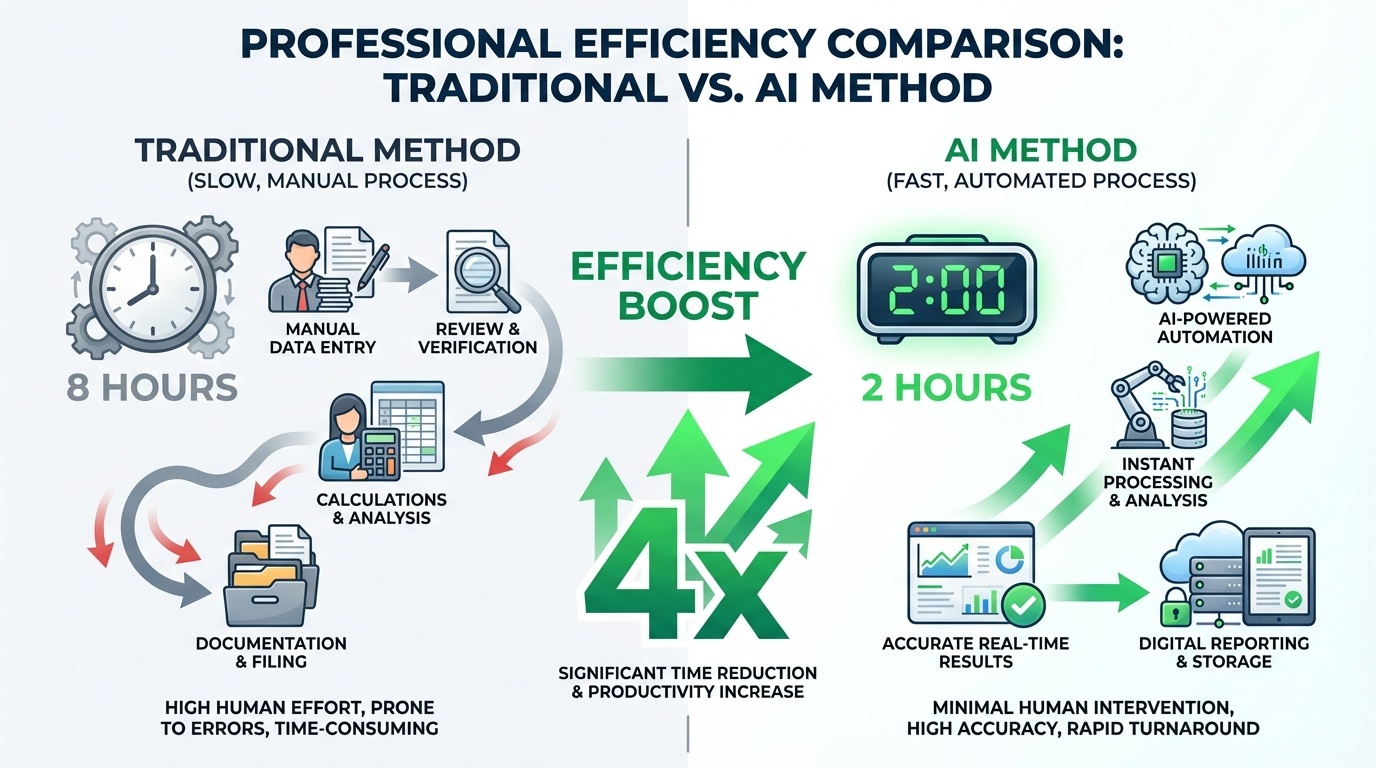
What can AI do for you?
Let me tell you a true story first.
Lily Chen is a lifestyle blogger who operates on Instagram, TikTok, and YouTube. Previously, she spent five hours each week manually compiling data, but still couldn't quite grasp what her followers liked. The data was scattered across different platforms, making it difficult for her to see the whole picture.
Later, she started using SocialEcho's AI data analytics capabilities. The AI automatically aggregated data from all platforms, generated insight reports, told her which content performed best, which topics were most popular, and even predicted what content would be most effective to publish the following week.
The result? Her topic selection success rate improved significantly, and the conversion rate of advertising collaborations increased by more than 30%.
That's the power of AI. It doesn't replace you, but rather frees you from repetitive tasks so you can focus on what truly matters.
Scenario 1: Content creation, from 3 hours to 30 minutes
How long does it take to create a piece of social media content in the traditional way?
You'll need to spend 30-60 minutes writing the copy, 30-60 minutes designing the accompanying images, and 1-2 hours editing the video. In total, it will take at least 3 hours.
But what if we use AI?
All you need to do is tell the AI, "I want to write an article about social media marketing trends in 2026." 30 seconds later, the AI will generate a complete article for you, including a title, body, and conclusion, and even add emojis and hashtags.
Need a cover image? Tell the AI: "Generate a professional social media cover image showcasing the logos of 5 platforms in a modern, tech-inspired style." The image will be ready in 2 minutes.
Need to edit a video? Upload the original video to AI, and it will automatically edit it into three 15-second short videos, automatically add subtitles, and automatically add background music. Done in 5 minutes.
From 3 hours to 30 minutes, efficiency increased by 6 times.
Of course, AI-generated content isn't perfect. You'll still need to adjust it to suit your brand image. But it's already done 80% of the work for you; you only need to do the final 20% optimization.
Scenario 2: Content distribution, from 2 hours to 1 minute
Have you ever wondered why you would manually publish the same content five times on five different platforms?
This isn't your problem; it's a problem with the tool.
Imagine this scenario: You've created content about "Social Media Marketing Trends in 2026." You want to publish it simultaneously on TikTok, Instagram, YouTube, Twitter, and LinkedIn.
In the traditional way, you need to:
- Log in to TikTok, edit content, add hashtags, and post.
- Log in to Instagram, edit the content (because Instagram has a different style), and post.
- Log in to YouTube, upload a video, fill in the title and description, and publish.
- Log in to Twitter, compress the content to no more than 280 characters, and post.
- Log in to LinkedIn, rewrite your profile in a professional style, and post.
Two hours have passed just like that.
But what if we use SocialEcho's AI rewriting feature?
You only need to create content once in the SocialEcho backend, and then click "One-Click Distribution". AI will automatically recognize the characteristics of each platform, automatically rewrite the content style, title, and description, and then publish it to all platforms simultaneously.
TikTok Version: 🔥If you don't know these 5 trends by 2026, your social media efforts will be wasted! #SocialMediaMarketing
Instagram version: ✨ 2026 Social Media Trends You Can't Miss | 5 Key Insights 📈
LinkedIn Edition: 2026 Social Media Marketing Trends: Data-Driven Analysis for B2B Brands
From 2 hours to 1 minute, efficiency increased by 120 times.
Scenario 3: User interaction, from manual replies to sub-second responses
Jason Wu is a marketing manager for a sportswear brand. Their TikTok account has 500,000 followers and receives hundreds of comments and private messages every day.
Previously, they had a dedicated customer service team that spent a significant amount of time responding to users every day. Even so, the response time was still slow. Users often had to wait several hours to receive a reply.
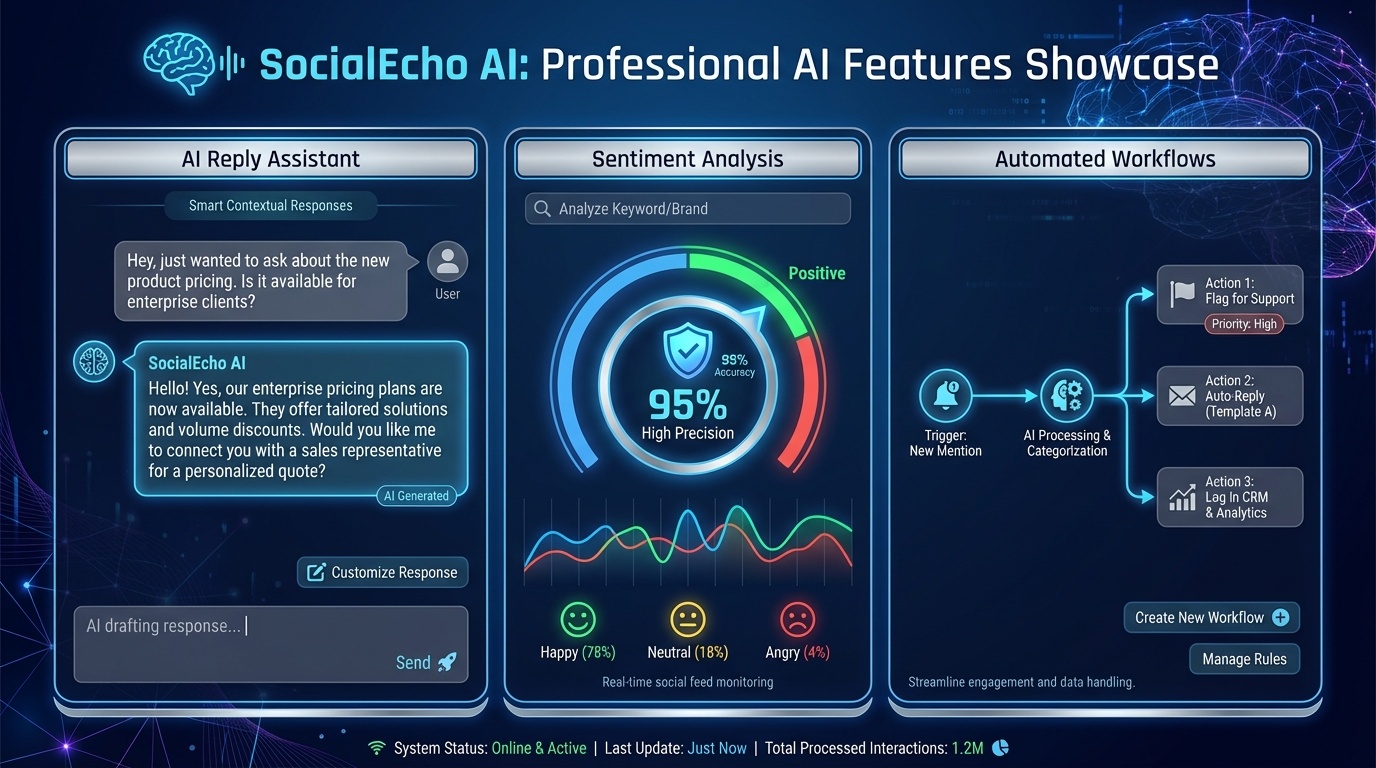
Later, they started using SocialEcho's AI response assistant. The AI automatically recognizes users' emotions and intentions, automatically answers frequently asked questions, and automatically marks high-value customers.
For example, if a user asks, "How much does this product cost?", the AI will immediately reply, "Hi! This product is currently on sale for $29.99, a limited-time offer! Click the link for details: [link]"
For example, if a user says, "I want to buy, but I don't know which color suits me," the AI will recognize this as a high-value customer (strong purchase intent), automatically marking it as "high priority, requiring human follow-up," and then replying: "Hi! Thank you for your interest! 🎨 We have three colors available: Classic Black, Elegant White, and Vibrant Red. Based on your skin tone and style, we can recommend the most suitable color for you. What style of products do you usually prefer?"
The result? Customer service efficiency increased fivefold, customer satisfaction improved significantly, and business opportunities were no longer missed.
More importantly, the AI's emotion recognition accuracy reaches over 95%. When users post negative comments, the AI immediately issues an alert, reminding the team to address the issue promptly. Jason said, "When launching new products, we can quickly monitor consumer feedback and optimize advertising copy in a timely manner, preventing the spread of negative word-of-mouth. Crisis response time has been shortened by 90%."
Scenario 4: Data analysis, from 5 hours to 1 minute
Do you remember Lily Chen's story? She used to spend 5 hours a week manually compiling data.
Now, all she needs to do is open the SocialEcho data analytics backend, and the AI has automatically aggregated data from all platforms and generated a detailed insight report.
The report will tell her:
- Total impressions this week reached 500,000, a 20% increase from last week.
- TikTok performed best, with 300,000 impressions and an 8% engagement rate.
- The top-performing content was "Social Media Marketing Trends 2026," with 100,000 impressions and a 12% engagement rate.
- The worst content was the "Product Feature Introduction," with 5,000 impressions and a 1% interaction rate.
The AI will also provide her with optimization suggestions:
- Increase the frequency of TikTok content posts (best performing).
- Optimize LinkedIn content strategy (performance is average)
- Publish more "trend analysis" type content (users like it).
- Reduce "product introduction" content (users are not interested).
From 5 hours to 1 minute, efficiency increased by 300 times.
More importantly, AI doesn't just aggregate data; it also analyzes trends and predicts the future. For example, AI might tell her, "Based on historical data analysis, content published next Tuesday at 10:00 AM is expected to reach 50,000 impressions and have a 6% engagement rate. We recommend publishing important content at this time."
This is the power of data-driven decision-making.
Scenario 5: Competitor monitoring, from manual monitoring to automatic tracking
Emily Zhang is a project manager at a social media management company, managing 15+ client accounts.
Previously, she had to manually monitor each client's competitor accounts and manually record their activities. But this was too inefficient and difficult to quantify.
Later, she started using SocialEcho's AI competitor monitoring feature. The AI automatically monitors competitor accounts, analyzes their content strategies, posting frequency, and performance data, and then generates a detailed competitor analysis report.
The report will tell her:
- Competitor A publishes 3 short videos daily and 2 live streams weekly.
- Competitor A primarily focuses on "product review" content, which accounts for 60% of their offerings.
- Competitor A has an average of 50,000 impressions per post and an engagement rate of 5%.
- Competitor A's fan growth is +3,000/week
The AI will also provide her with suggestions:
- Learn from competitors' "product review" content strategies
- Increase the frequency of live streams (competitors stream twice a week, we stream once a week).
- Optimize content publishing time (competitors publish at 10:00 AM, we publish at 2:00 PM).
Emily said, "The team can directly use the same dashboard to track interaction data and industry trends across different clients, doubling the speed of strategy adjustments and significantly improving customer satisfaction."
How should you begin?
Seeing this, you might be thinking, "These sound amazing, but where do I even begin?"
My advice is: start with the most time-consuming task.
Ask yourself three questions:
- How much time do you spend on repetitive tasks each day?
- Which tasks can be automated?
- Which tasks must be done manually?
Most people will find that publishing content on multiple platforms, replying to user comments, and compiling data reports take up more than 80% of their time. And these three tasks are precisely the easiest to automate.
Step 1: Choose the appropriate tools
For content creation, you can use ChatGPT to generate text, DALL-E 3 to generate images, and CapCut to edit videos.
In terms of content distribution, you can use SocialEcho to distribute content to all platforms with one click, and AI will automatically rewrite and adapt it to the style of each platform.
In terms of user interaction, you can use SocialEcho's AI reply assistant to automatically answer frequently asked questions and automatically identify emotions and intentions.
For data analysis, you can use SocialEcho's cross-platform data integration capabilities, where AI automatically summarizes data and generates insight reports.
Step 2: Develop an automated workflow
Take daily content publishing as an example. In the traditional way, you would need to spend 3 hours: 1 hour creating content and 2 hours manually publishing it on 5 platforms.
But what if you use AI to automate it? You only need to spend 30 minutes: 20 minutes to create content, 1 minute to distribute it with one click using SocialEcho, and AI will automatically rewrite and adapt it to various platforms, and publish it on a scheduled basis.
Efficiency increased by 6 times.
Step 3: Testing and Optimization
AI tools are not "one-off solutions," but rather "a process of continuous optimization."
You'll need to spend 2-4 weeks testing to see which tasks can be fully automated and which require manual intervention. Then, based on the data feedback, continuously adjust and optimize.
Key metrics include: How many hours are saved per day? Have exposure and engagement rates increased? Have labor costs decreased?
Real-life example: From 8 hours to 2 hours per day
Let me tell you the complete story.
A beauty brand operates on five platforms simultaneously: TikTok, Instagram, YouTube, Facebook, and Twitter. Previously, they had a three-person social media team that spent a significant amount of time each day on repetitive tasks.
Later, they started using SocialEcho's AI automation capabilities.
Content publishing: Reduced from 2 hours per day to 1 minute. Users only need to create content once in the SocialEcho backend, and AI will automatically rewrite and adapt it for various platforms, distributing it with one click.
User interaction time has been reduced from 2 hours to 30 minutes per day. AI automatically answers frequently asked questions and identifies high-value customers, allowing the team to focus on high-priority inquiries.
Data analytics: Reduced from 5 hours per week to 1 minute. AI automatically aggregates data and generates insightful reports, allowing teams to adjust strategies based solely on these reports.
The result? The workload of a 3-person team can now be completed by one person. They use the saved time for content creation and strategy optimization.
Six months later, their fan base grew by 300%, engagement rate increased by 200%, and customer acquisition cost decreased by 60%.
That's the power of AI. It doesn't replace you, but rather frees you from repetitive tasks so you can focus on what truly matters.
Start now
AI tools can improve social media operation efficiency by 3-5 times, but only if you choose the right tools and use the right methods.
If you're still manually posting content, manually replying to comments, and manually compiling data, then you're doing things in 2026 using methods from 2010.
Take action now:
Try SocialEcho free (7 days free, no credit card required): www.socialecho.cn
Assess your efficiency bottlenecks: Which tasks can be automated?
Develop automated workflows: start with the most time-consuming tasks.
Remember: This isn't a matter of ability, but a matter of tools. Choosing the right tools can make all the difference.
Regarding SocialEcho
SocialEcho is a comprehensive social media AI workbench for companies expanding overseas. It supports eight major platforms, including Facebook, Instagram, TikTok, YouTube, Twitter, LinkedIn, Telegram, and Pinterest, providing one-stop solutions for content publishing, interaction management, data analysis, and AI automation.
10,000+ Global Users | 4.9/5 Average Rating | 98% Recommendation Rate | 95%+ AI Emotion Recognition Accuracy | 24/7 Online Customer Service
Get started now: www.socialecho.cn
;}.cls-2{fill:%230868f7;}.cls-3{fill:url(%23未命名的渐变_44);}.cls-4{fill:%23333;}%3c/style%3e%3clinearGradient%20id='未命名的渐变_8'%20x1='33.73'%20y1='100.61'%20x2='-0.03'%20y2='-1.06'%20gradientUnits='userSpaceOnUse'%3e%3cstop%20offset='0'%20stop-color='%237ae9fb'/%3e%3cstop%20offset='0.67'%20stop-color='%232b90f8'/%3e%3cstop%20offset='1'%20stop-color='%230868f7'/%3e%3c/linearGradient%3e%3clinearGradient%20id='未命名的渐变_44'%20x1='27.86'%20y1='18.67'%20x2='68.36'%20y2='22.22'%20gradientUnits='userSpaceOnUse'%3e%3cstop%20offset='0'%20stop-color='%235ac7f2'/%3e%3cstop%20offset='1'%20stop-color='%230868f7'/%3e%3c/linearGradient%3e%3c/defs%3e%3cpath%20class='cls-1'%20d='M29,28.74V81.91l-9.51-3.68v0L8.52,74A7.17,7.17,0,0,1,4,67.32V24.54A3.76,3.76,0,0,1,9.08,21Z'/%3e%3cpath%20class='cls-2'%20d='M68.09,78.07a13.15,13.15,0,0,1-17.9,12.06L29,81.91h0V28.74L50.19,37A13.17,13.17,0,0,0,68.08,25.3h0Z'/%3e%3cpath%20class='cls-3'%20d='M68.08,25.3a13.19,13.19,0,0,1-6.73,10.87A13.09,13.09,0,0,1,50.19,37L29,28.74V6A3.76,3.76,0,0,1,34.1,2.52l25.59,9.91A13.22,13.22,0,0,1,68.08,25.3Z'/%3e%3cpath%20class='cls-4'%20d='M129.06,81.76a4.33,4.33,0,0,1-3.19-1.31,4.4,4.4,0,0,1-1.31-3.24V56.86H97.65V77.21a4.36,4.36,0,0,1-1.35,3.2A4.68,4.68,0,0,1,93,81.76a4.32,4.32,0,0,1-3.19-1.31,4.37,4.37,0,0,1-1.32-3.24V27.27A4.58,4.58,0,0,1,89.83,24a4.59,4.59,0,0,1,7.82,3.27V48.15h26.91V27.27A4.58,4.58,0,0,1,125.91,24a4.59,4.59,0,0,1,7.82,3.27V77.21a4.37,4.37,0,0,1-1.36,3.2A4.65,4.65,0,0,1,129.06,81.76Z'/%3e%3cpath%20class='cls-4'%20d='M163.77,81.66c-6.57,0-11.76-1.92-15.44-5.7s-5.54-9.07-5.54-15.74a26.76,26.76,0,0,1,2.09-10.43,17.72,17.72,0,0,1,6.67-8.06,19.15,19.15,0,0,1,10.68-2.95,19,19,0,0,1,10.46,2.8,18.7,18.7,0,0,1,6.55,7.36,22.53,22.53,0,0,1,2.36,10.28A4.51,4.51,0,0,1,177,63.77H152.23a10.8,10.8,0,0,0,3.49,6.65c2,1.68,4.88,2.52,8.66,2.52a22.25,22.25,0,0,0,7.54-1.21c.74-.3,1.55-.67,2.37-1.07a3.75,3.75,0,0,1,1.84-.4,4.09,4.09,0,0,1,3,1.15,4,4,0,0,1,1.12,3,4.38,4.38,0,0,1-2.58,3.82,32.34,32.34,0,0,1-6.36,2.61A28.67,28.67,0,0,1,163.77,81.66ZM172.4,55.9a9.72,9.72,0,0,0-1.63-4.56A9.9,9.9,0,0,0,167,48a10.38,10.38,0,0,0-4.64-1.14,12,12,0,0,0-4.77,1.06,9.54,9.54,0,0,0-4.89,5.66,11.78,11.78,0,0,0-.51,2.3Z'/%3e%3cpath%20class='cls-4'%20d='M193,81.64a4.49,4.49,0,0,1-4.51-4.55V27.28A4.58,4.58,0,0,1,189.84,24a4.48,4.48,0,0,1,3.28-1.36A4.36,4.36,0,0,1,196.35,24a4.46,4.46,0,0,1,1.31,3.31V77.09a4.34,4.34,0,0,1-1.35,3.2A4.67,4.67,0,0,1,193,81.64Z'/%3e%3cpath%20class='cls-4'%20d='M263.79,81.71a5.7,5.7,0,0,1-4.2-1.74,5.76,5.76,0,0,1-1.73-4.19V27.37a4.58,4.58,0,0,1,1.35-3.27A4.59,4.59,0,0,1,267,27.37V72.53h24a4.58,4.58,0,0,1,3.27,7.82A4.66,4.66,0,0,1,291,81.71Z'/%3e%3cpath%20class='cls-4'%20d='M424.48,81.74a4.71,4.71,0,0,1-2.71-.88,5.43,5.43,0,0,1-1-1l-.07-.09-12.41-17-5.41,5v9.44a4.31,4.31,0,0,1-1.36,3.19,4.66,4.66,0,0,1-3.3,1.36A4.29,4.29,0,0,1,395,80.42a4.36,4.36,0,0,1-1.32-3.23V27.37A4.58,4.58,0,0,1,395,24.1a4.52,4.52,0,0,1,6.58.12,4.54,4.54,0,0,1,1.24,3.15V56.31l17.72-16.38.05,0a4.8,4.8,0,0,1,2.94-1.11,4.4,4.4,0,0,1,3.27,1.2,4.57,4.57,0,0,1,1.2,3.27,4.44,4.44,0,0,1-.77,2.33,7.45,7.45,0,0,1-1.43,1.65l-11,9.64,13.34,17.68a5,5,0,0,1,1,2.71,4.12,4.12,0,0,1-1.36,3.24A4.64,4.64,0,0,1,424.48,81.74Z'/%3e%3cpath%20class='cls-4'%20d='M317.93,81.76a21.5,21.5,0,1,1,21.17-21.5A21.37,21.37,0,0,1,317.93,81.76Zm0-34.1a12.61,12.61,0,1,0,12.42,12.6A12.52,12.52,0,0,0,317.93,47.66Z'/%3e%3cpath%20class='cls-4'%20d='M212.18,101.22a4.12,4.12,0,0,1-3.05-1.26,4.17,4.17,0,0,1-1.26-3.1V43.34a4.37,4.37,0,0,1,1.3-3.14,4.26,4.26,0,0,1,3.13-1.3,4.19,4.19,0,0,1,3.1,1.26,4.32,4.32,0,0,1,1.26,3.16,20.77,20.77,0,0,1,13-4.54,21.51,21.51,0,0,1,0,43,20.51,20.51,0,0,1-13-4.57V96.86a4.15,4.15,0,0,1-1.3,3.06A4.5,4.5,0,0,1,212.18,101.22Zm17.43-53.63c-6.23,0-12.93,4.11-12.93,12.72a12.73,12.73,0,0,0,25.46,0A12.71,12.71,0,0,0,229.61,47.59Z'/%3e%3cpath%20class='cls-4'%20d='M365.76,81.76a21.5,21.5,0,1,1,21.18-21.5A21.37,21.37,0,0,1,365.76,81.76Zm0-34.1a12.61,12.61,0,1,0,12.42,12.6A12.52,12.52,0,0,0,365.76,47.66Z'/%3e%3c/svg%3e)