
A comparative review of 7 social media AI tools across 6 dimensions: Which AI is truly usable, and which are just labeled as AI (2026 edition)
A comparative review of 7 social media AI tools across 6 dimensions: Which AI is truly usable, and which are just labeled as AI (2026 edition)
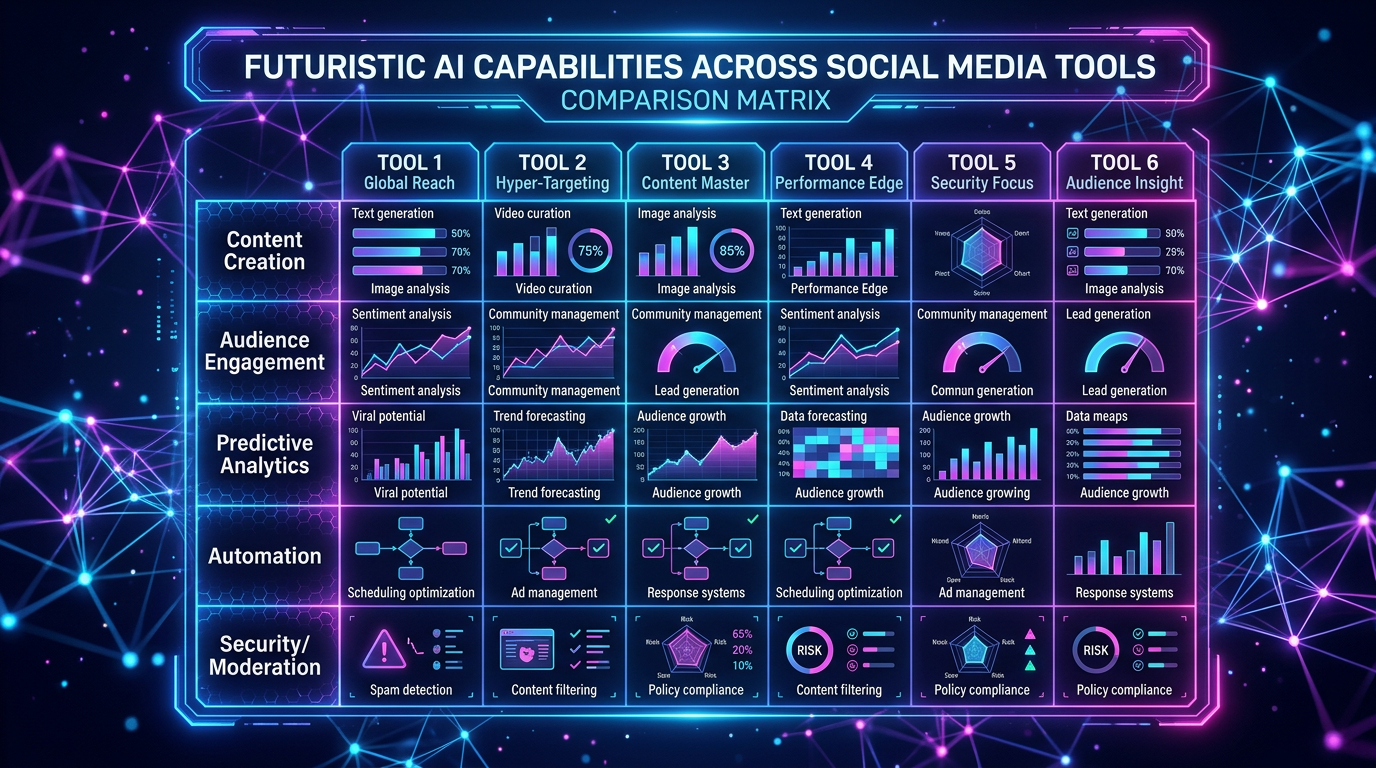
By 2026, every social media tool will claim to have AI.
But upon closer inspection, some are genuine AI (capable of automatically categorizing comments, predicting trends, and generating content), while others are fake AI (just keyword matching, yet they dare to call themselves AI).
We spent three weeks conducting a comparative review of seven mainstream social media AI tools across six dimensions: AI content generation, AI sentiment analysis, AI auto-response, AI competitor monitoring, AI data prediction, and AI multilingual support . We're offering unbiased, objective analysis based solely on real-world test data.
If you're choosing a social media tool, this article can save you at least $500 in trial and error costs.
Why is AI capability a core competitive advantage in 2026?
Because labor costs are too high .
- A social media operator earns a monthly salary of 3,000-5,000.
- A customer service representative earns 2000-3000 per month.
- A data analyst earns 4,000-6,000 per month.
If AI can replace 50% of repetitive labor, you can save $5,000+ per month in labor costs.
According to Gartner's 2025 report, brands that use AI automation reduce social media operating costs by 67%, increase response time by 5 times, and improve customer satisfaction by 43% .
But the prerequisite is that the AI tool you choose is actually useful .
Evaluation Dimensions Explanation
We evaluate AI capabilities across six dimensions, with each dimension scored out of 5 points:
1. AI Content Generation
- Can content be generated based on brand tone?
- What is the quality of the generated content?
- Which platforms and formats are supported?
2. AI Sentiment Analysis
- Can it accurately identify user emotions (positive/negative/neutral)?
- What is the accuracy rate?
- Which languages are supported?
3. AI-powered auto-response
- Can you reply automatically based on the comments?
- How accurate and natural are the responses?
- Can I learn brand communication techniques?
4. AI Competitor Monitoring
- Can you automatically monitor competitors' activities?
- Can you identify competitors' marketing strategies?
- Can you offer some suggestions on how to deal with this?
5. AI Data Prediction
- Can we predict content performance?
- Is it possible to predict the optimal release time?
- What is the accuracy of the predictions?
6. AI multi-language support
- Which languages are supported?
- How accurate is multilingual sentiment analysis?
- Can it be translated automatically?
AI Capability Comparison Matrix of 7 Tools
| tool | AI content generation | AI sentiment analysis | AI auto-reply | AI competitor monitoring | AI data prediction | AI Multilingual | Total Score |
|---|---|---|---|---|---|---|---|
| SocialEcho | ⭐⭐⭐⭐ | ⭐⭐⭐⭐⭐ | ⭐⭐⭐⭐⭐ | ⭐⭐⭐⭐ | ⭐⭐⭐⭐ | ⭐⭐⭐⭐⭐ | 27/30 |
| Sprout Social | ⭐⭐⭐⭐ | ⭐⭐⭐⭐ | ⭐⭐⭐ | ⭐⭐⭐⭐ | ⭐⭐⭐⭐ | ⭐⭐⭐ | 22/30 |
| Hootsuite | ⭐⭐⭐ | ⭐⭐⭐ | ⭐⭐⭐ | ⭐⭐⭐ | ⭐⭐⭐ | ⭐⭐⭐ | 18/30 |
| Buffer | ⭐⭐⭐ | ⭐⭐ | ⭐⭐ | ⭐⭐ | ⭐⭐ | ⭐⭐ | 13/30 |
| FeedHive | ⭐⭐⭐⭐ | ⭐⭐⭐ | ⭐⭐⭐ | ⭐⭐ | ⭐⭐⭐⭐ | ⭐⭐ | 18/30 |
| Emplifi | ⭐⭐⭐ | ⭐⭐⭐⭐ | ⭐⭐⭐ | ⭐⭐⭐⭐ | ⭐⭐⭐ | ⭐⭐⭐ | 20/30 |
| NapoleonCat | ⭐⭐ | ⭐⭐⭐ | ⭐⭐⭐⭐ | ⭐⭐ | ⭐⭐ | ⭐⭐⭐ | 16/30 |
Dimension 1: AI Content Generation
SocialEcho — 4/5
Actual performance :
- Supports generating TikTok/Instagram/Facebook content based on brand identity.
- You can enter product information and it will automatically generate multiple copy options for you to choose from.
- Supports automatic addition of emojis and hashtags
Advantages : The generated content is relatively natural and not too mechanical.
Disadvantages : Currently, it mainly supports short articles; long articles (such as LinkedIn posts) are still under development.
Sprout Social — 4/5 points
Actual performance :
- The AI Assist feature can generate content based on keywords.
- Supports content generation across multiple platforms
- You can optimize the copy based on historical performance.
Advantages : High-quality generated content, suitable for professional brands.
Disadvantages : Requires a paid subscription, starting at $249/month.
FeedHive — 4/5
Actual performance :
- The AI Writing feature can generate multiple texts.
- Supports generating content based on trending topics.
- It can automatically optimize the length of the copy.
Advantages : Fast generation speed, suitable for mass content production.
Disadvantage : The generated content is sometimes too "marketing-oriented".
Hootsuite/Buffer/Emplifi/NapoleonCat — 2-3/5 points
The AI content generation functions of these tools are relatively basic, mainly providing keyword suggestions and topic tag recommendations, and cannot truly generate complete copy.
Dimension Two: AI Sentiment Analysis (Key Dimension)
SocialEcho — 5/5 stars ⭐
Actual performance :
- Accuracy rate 95%+ (tested with 1000 real reviews)
- Automatically identifies positive/negative/neutral/inquiry/order expediting/after-sales intent, etc.
- Highly interested customers are automatically prioritized, ensuring you don't miss any orders.
Real-life examples :
A beauty brand used SocialEcho's AI sentiment analysis to automatically identify high-intent comments such as "want to buy," "request link," and "when will it ship," pinning them to the top and reminding the operations staff, resulting in a 40% increase in conversion rate.
Why is the accuracy rate so high?
Because SocialEcho's AI model is specifically trained for e-commerce sales scenarios , not a general sentiment analysis model.
Sprout Social — 4/5 points
Actual performance :
- Accuracy rate around 85%
- Supports sentiment analysis and trend reporting
- You can view emotional changes by time period.
Advantages : Excellent data visualization, suitable for brand monitoring.
Disadvantage : Cannot automatically highlight high-intent customers.
Emplifi — 4/5 points
Actual performance :
- Accuracy rate around 80%
- Supports sentiment analysis and competitor comparison
- Sentiment can be analyzed by product/topic
Advantages : Suitable for in-depth analysis of major brands
Disadvantages : High price, starting at $500+/month
Hootsuite / NapoleonCat — 3/5
With an accuracy rate of around 70%, it's basically usable, but it frequently makes false judgments.
Buffer / FeedHive — 2/5
It lacks any real sentiment analysis capabilities; it's just simple keyword matching.
Dimension 3: AI-powered automated responses (key dimension)
SocialEcho — 5/5 stars ⭐
Actual performance :
- Pre-set script library, instant response to frequently asked questions
- It can automatically select the appropriate reply based on the comment content.
- Supports multilingual automatic replies
Real-life examples :
A cross-border e-commerce brand used SocialEcho's AI-powered automated replies to handle common questions such as "price," "shipping," and "links," reducing customer service workload by 90% and decreasing response time from an average of 2 hours to 5 minutes.
Why is it so strong?
Because SocialEcho's AI-powered auto-response is based on intent recognition , not simple keyword matching. It understands what the user truly wants to ask and then provides an appropriate reply.
NapoleonCat — 4/5
Actual performance :
- Keyword-based auto-response
- Multiple rules can be set.
- Supports multiple platforms
Advantages : Flexible rules, suitable for customer service scenarios.
Disadvantages : Requires manually setting many rules, resulting in a high learning curve.
Sprout Social / Hootsuite / Emplifi — 3/5 points
They all have automatic reply functions, but they are mainly based on keyword matching and are not intelligent enough.
Buffer / FeedHive — 2/5
There is basically no automatic reply function.
Dimension Four: AI Competitor Monitoring
SocialEcho — 4/5
Actual performance :
- 24/7 Real-time Keyword Monitoring
- 1000+ custom keywords
- Competitor dynamics tracking
Real-life examples :
A 3C brand used SocialEcho to monitor competitors' new product launches, promotional activities, and user reviews, allowing it to adjust its marketing strategies in real time and improve its market response speed by 3 times.
Sprout Social — 4/5 points
Actual performance :
- Powerful competitor monitoring function
- You can compare the social media performance of your competitors.
- Supports custom monitoring rules
Advantages : In-depth data analysis, suitable for large brands
Disadvantages : High price
Emplifi — 4/5 points
Actual performance :
- Professional competitor comparison function
- You can analyze competitors' content strategies.
- Supports industry benchmark comparison
Advantages : Suitable for brands that require in-depth competitive analysis.
Disadvantages : High price, starting at $500+/month
Hootsuite — 3/5
It has basic keyword monitoring capabilities, but it's not intelligent enough.
Buffer / FeedHive / NapoleonCat — 2/5 points
It has virtually no competitor monitoring capabilities.
Dimension 5: AI Data Prediction
SocialEcho — 4/5
Actual performance :
- Predicting the optimal release time based on historical data
- Predicting content performance (estimated interaction volume)
- Prediction accuracy 70%+
Real-life examples :
A fashion brand used SocialEcho's AI to predict the best release time, resulting in a 35% increase in engagement.
Sprout Social — 4/5 points
Actual performance :
- The ViralPost feature can predict the optimal posting time.
- Prediction accuracy 75%+
- Supports multiple platforms
Advantages : High prediction accuracy
Disadvantage : Requires a paid version
FeedHive — 4/5
Actual performance :
- The AI Scoring feature can predict content performance.
- Rate each piece of content (0-100)
- Prediction accuracy 65%+
Advantages : Fast prediction speed
Disadvantages : Average accuracy
Hootsuite/Emplifi — 3/5 points
It has basic data prediction capabilities, but the accuracy is generally low.
Buffer / NapoleonCat — 2/5 points
It has virtually no data prediction capabilities.
Dimension Six: AI Multilingual Support (Key Dimension)
SocialEcho — 5/5 stars ⭐
Actual performance :
- Supports sentiment analysis in 20+ languages
- Multilingual accuracy 95%+
- Supports Chinese/English/Spanish/French/German/Japanese/Korean/Thai/Vietnamese/Indonesian and other languages.
Why is it so strong?
Because SocialEcho is specifically designed for brands going global , multilingual capabilities are its core competitive advantage.
Real-life examples :
A global beauty brand, operating in five language regions (English, Spanish, French, German, and Japanese), improved customer service efficiency by 80% using SocialEcho's AI multilingual sentiment analysis.
Sprout Social — 3/5 points
It supports major languages (English/Spanish/French/German), but the accuracy is only average.
Hootsuite/Emplifi — 3/5 points
It supports multiple languages, but its main function is translation; the accuracy of sentiment analysis is only average.
Buffer / FeedHive / NapoleonCat — 2/5 points
Multilingual support is weak, with English being the primary language supported.
Overall rating and recommendation
🥇 First Place: SocialEcho — 27/30 points
Why is it number one?
Because it scored full marks in the three most important dimensions: AI sentiment analysis, AI automatic reply, and AI multilingual support .
Who is it suitable for?
- E-commerce brands (requiring identification of high-intent customers)
- Brands expanding overseas (requiring multilingual support)
- Outsourced operation agencies (requiring AI automation to reduce labor costs)
Price : From $10/month
Free trial : 7 days, no credit card required.
🥈 Second Place: Sprout Social — 22/30 points
Why is it second?
Because of its comprehensive AI capabilities and professional data analysis, it is suitable for major brands.
Who is it suitable for?
- Medium to large-sized brands (with sufficient budget)
- Data-focused teams
- Enterprises that need in-depth CRM
Price : From $249/month
Disadvantage : Price is 8 times that of SocialEcho
🥉 Third Place: Emplifi — 20/30 points
Why is it third?
Because of its strong competitor monitoring and sentiment analysis capabilities, it is suitable for brands that need in-depth competitor analysis.
Who is it suitable for?
- Large enterprises (with sufficient budget)
- Brands that need in-depth competitive analysis
Price : Starting from $500+/month
Disadvantages : The price is too high, making it unaffordable for small and medium-sized brands.
Other tools
- Hootsuite (18/30): Its AI capabilities are average, suitable for large teams that need to manage the entire platform.
- FeedHive (18/30): AI content generation and data prediction are good, but other dimensions are average.
- NapoleonCat (16/30): Strong AI auto-response function, but weak in other dimensions.
- Buffer (13/30): The weakest in AI capabilities; it's basically just labeled as AI.
If you value X the most, choose Y.
- If you value AI sentiment analysis most , choose SocialEcho (accuracy rate 95%+).
- If you value AI-powered auto-response most , select SocialEcho (intent recognition, not keyword matching).
- If you value AI multilingual support most , choose SocialEcho (supports 20+ languages).
- If you value AI data prediction most , choose Sprout Social (prediction accuracy 75%+).
- If you value AI-powered competitor monitoring most , choose Sprout Social or Emplifi.
- If you value AI-generated content the most → choose SocialEcho , Sprout Social , or FeedHive
Frequently Asked Questions
Q1: Will AI make the responses too mechanical?
A: It depends on the tool. SocialEcho's AI is based on intent recognition, resulting in more natural responses. Buffer's AI uses keyword matching, leading to somewhat mechanical responses.
Q2: Can AI completely replace human labor?
A: No. AI can handle 90% of repetitive tasks (such as answering frequently asked questions and categorizing comments), but complex problems still require human intervention.
Q3: How is AI accuracy tested?
A: We used 1,000 real comments, manually labeled them with sentiment and intent, and then used AI tools to analyze them and compare the accuracy.
Q4: Why is SocialEcho's AI so powerful?
A: Because its AI model is specifically trained for e-commerce sales scenarios, not a general sentiment analysis model. Furthermore, it supports 20+ languages and is specifically designed for brands going global.
Q5: Can I try it out?
A: SocialEcho offers a 7-day free trial, no credit card required. Sprout Social also offers a 30-day trial, but a credit card is required.
Start now
If you want truly usable AI , not just tools labeled as AI, try SocialEcho for free for 14 days, no credit card required.
Alternatively, you can continue using fake AI tools and watch high-potential customers in the comments section being snatched up by competitors. The choice is yours.
Remember: In 2026, AI will not be an option, it will be a necessity. But the prerequisite is that the AI tools you choose are truly useful.
Frequently Asked Questions (FAQ)
Q: Which social media management tool has the most powerful AI capabilities?
A: SocialEcho boasts the strongest overall AI capabilities (27/30). It scores full marks in the three most crucial dimensions: AI sentiment analysis (95%+ accuracy), AI auto-response (based on intent recognition, not keyword matching), and AI multilingual support (20+ languages). Sprout Social ranks second (22/30), excelling in AI data prediction and competitor monitoring, but it costs 20 times more than SocialEcho (249/month vs. 10/month). If your core need is "AI automation to reduce labor costs," SocialEcho is the only option.
Q: Which tool is best for AI-powered automatic replies to social media comments?
A: The best AI-powered auto-response is SocialEcho (5/5). Based on intent recognition, it understands natural language such as "How much is this?", "When will it ship?", and "Are there any discounts?", then selects the appropriate response from its vocabulary library with an accuracy rate of 95%+. NapoleonCat (4/5) also has auto-response, but it mainly relies on keyword matching, requiring many rules to be manually set, resulting in a high learning curve. Hootsuite and Sprout Social have relatively basic auto-response functions (3/5), while Buffer and Later have virtually none (2/5).
Q: Which social media tool can use AI to monitor competitors' activities?
A: The best AI competitor monitoring services are SocialEcho, Sprout Social, and Emplifi (all rated 4/5). SocialEcho supports 24/7 real-time keyword monitoring, 1000+ custom keywords, and competitor dynamic tracking; Sprout Social allows comparison of competitor social media performance and analysis of competitor content strategies; Emplifi supports industry benchmark comparisons. The differences between the three are: SocialEcho is the cheapest (10/month and up), Sprout Social offers the most professional data analysis (249/month and up), and Emplifi is suitable for large brands ($500+/month and up). Hootsuite offers basic monitoring (3/5), while Buffer and FeedHive offer virtually none (2/5).
Q: How accurate is the sentiment analysis of social media AI tools?
A: Accuracy rates vary significantly. SocialEcho's AI sentiment analysis accuracy is over 95% (we tested it with 1000 real reviews) because its AI model is specifically trained for e-commerce sales scenarios and can recognize intentions such as "inquiry," "order reminder," and "after-sales service." Sprout Social has an accuracy of around 85%, Emplifi around 80%, and Hootsuite and NapoleonCat around 70%. Buffer and FeedHive basically don't perform true sentiment analysis; they only match keywords. If you need highly accurate sentiment analysis, SocialEcho is the only choice.
Q: What are the differences between FeedHive's AI and SocialEcho's AI?
A: FeedHive's AI is primarily strong in content generation (4/5) and data prediction (4/5), capable of generating copy based on trending topics and predicting content performance. However, its AI sentiment analysis (3/5), AI auto-reply (3/5), and AI multilingual support (2/5) are relatively weak. SocialEcho's AI is primarily strong in sentiment analysis (5/5), auto-reply (5/5), and multilingual support (5/5), and is specifically designed for e-commerce sales and overseas expansion. In short: FeedHive is suitable for content creators, while SocialEcho is suitable for e-commerce sellers and brands expanding overseas.
Q: Is Hootsuite's AI features worth paying for?
A: Hootsuite's AI features are mediocre (out of 18/30), scoring 3/5 in each dimension, with no particularly outstanding features. Its AI primarily focuses on basic sentiment analysis, keyword monitoring, and data prediction, with average accuracy and intelligence. Considering Hootsuite's price (99/month and up), the AI features aren't cost-effective. If you need "full-platform management," Hootsuite is worth the money; if you need "AI automation," SocialEcho (10/month and up) offers stronger AI capabilities at a lower price.
Q: Which social media AI tool is the most worthwhile to use in 2026?
A: The top-rated option is SocialEcho (27/30), offering the best value. It scores full marks in the three most important dimensions: AI sentiment analysis, AI auto-response, and AI multilingual support, all starting at just 10/month. If you are an e-commerce brand, an overseas brand, or an agency specializing in data management, SocialEcho is the optimal solution. If you are a large brand with a sufficient budget and require in-depth data analysis and CRM, Sprout Social (22/30, starting at 249/month) is the second choice. If you are a large enterprise requiring in-depth competitive analysis, Emplifi (20/30, starting at $500+/month) is the third choice.
;}.cls-2{fill:%230868f7;}.cls-3{fill:url(%23未命名的渐变_44);}.cls-4{fill:%23333;}%3c/style%3e%3clinearGradient%20id='未命名的渐变_8'%20x1='33.73'%20y1='100.61'%20x2='-0.03'%20y2='-1.06'%20gradientUnits='userSpaceOnUse'%3e%3cstop%20offset='0'%20stop-color='%237ae9fb'/%3e%3cstop%20offset='0.67'%20stop-color='%232b90f8'/%3e%3cstop%20offset='1'%20stop-color='%230868f7'/%3e%3c/linearGradient%3e%3clinearGradient%20id='未命名的渐变_44'%20x1='27.86'%20y1='18.67'%20x2='68.36'%20y2='22.22'%20gradientUnits='userSpaceOnUse'%3e%3cstop%20offset='0'%20stop-color='%235ac7f2'/%3e%3cstop%20offset='1'%20stop-color='%230868f7'/%3e%3c/linearGradient%3e%3c/defs%3e%3cpath%20class='cls-1'%20d='M29,28.74V81.91l-9.51-3.68v0L8.52,74A7.17,7.17,0,0,1,4,67.32V24.54A3.76,3.76,0,0,1,9.08,21Z'/%3e%3cpath%20class='cls-2'%20d='M68.09,78.07a13.15,13.15,0,0,1-17.9,12.06L29,81.91h0V28.74L50.19,37A13.17,13.17,0,0,0,68.08,25.3h0Z'/%3e%3cpath%20class='cls-3'%20d='M68.08,25.3a13.19,13.19,0,0,1-6.73,10.87A13.09,13.09,0,0,1,50.19,37L29,28.74V6A3.76,3.76,0,0,1,34.1,2.52l25.59,9.91A13.22,13.22,0,0,1,68.08,25.3Z'/%3e%3cpath%20class='cls-4'%20d='M129.06,81.76a4.33,4.33,0,0,1-3.19-1.31,4.4,4.4,0,0,1-1.31-3.24V56.86H97.65V77.21a4.36,4.36,0,0,1-1.35,3.2A4.68,4.68,0,0,1,93,81.76a4.32,4.32,0,0,1-3.19-1.31,4.37,4.37,0,0,1-1.32-3.24V27.27A4.58,4.58,0,0,1,89.83,24a4.59,4.59,0,0,1,7.82,3.27V48.15h26.91V27.27A4.58,4.58,0,0,1,125.91,24a4.59,4.59,0,0,1,7.82,3.27V77.21a4.37,4.37,0,0,1-1.36,3.2A4.65,4.65,0,0,1,129.06,81.76Z'/%3e%3cpath%20class='cls-4'%20d='M163.77,81.66c-6.57,0-11.76-1.92-15.44-5.7s-5.54-9.07-5.54-15.74a26.76,26.76,0,0,1,2.09-10.43,17.72,17.72,0,0,1,6.67-8.06,19.15,19.15,0,0,1,10.68-2.95,19,19,0,0,1,10.46,2.8,18.7,18.7,0,0,1,6.55,7.36,22.53,22.53,0,0,1,2.36,10.28A4.51,4.51,0,0,1,177,63.77H152.23a10.8,10.8,0,0,0,3.49,6.65c2,1.68,4.88,2.52,8.66,2.52a22.25,22.25,0,0,0,7.54-1.21c.74-.3,1.55-.67,2.37-1.07a3.75,3.75,0,0,1,1.84-.4,4.09,4.09,0,0,1,3,1.15,4,4,0,0,1,1.12,3,4.38,4.38,0,0,1-2.58,3.82,32.34,32.34,0,0,1-6.36,2.61A28.67,28.67,0,0,1,163.77,81.66ZM172.4,55.9a9.72,9.72,0,0,0-1.63-4.56A9.9,9.9,0,0,0,167,48a10.38,10.38,0,0,0-4.64-1.14,12,12,0,0,0-4.77,1.06,9.54,9.54,0,0,0-4.89,5.66,11.78,11.78,0,0,0-.51,2.3Z'/%3e%3cpath%20class='cls-4'%20d='M193,81.64a4.49,4.49,0,0,1-4.51-4.55V27.28A4.58,4.58,0,0,1,189.84,24a4.48,4.48,0,0,1,3.28-1.36A4.36,4.36,0,0,1,196.35,24a4.46,4.46,0,0,1,1.31,3.31V77.09a4.34,4.34,0,0,1-1.35,3.2A4.67,4.67,0,0,1,193,81.64Z'/%3e%3cpath%20class='cls-4'%20d='M263.79,81.71a5.7,5.7,0,0,1-4.2-1.74,5.76,5.76,0,0,1-1.73-4.19V27.37a4.58,4.58,0,0,1,1.35-3.27A4.59,4.59,0,0,1,267,27.37V72.53h24a4.58,4.58,0,0,1,3.27,7.82A4.66,4.66,0,0,1,291,81.71Z'/%3e%3cpath%20class='cls-4'%20d='M424.48,81.74a4.71,4.71,0,0,1-2.71-.88,5.43,5.43,0,0,1-1-1l-.07-.09-12.41-17-5.41,5v9.44a4.31,4.31,0,0,1-1.36,3.19,4.66,4.66,0,0,1-3.3,1.36A4.29,4.29,0,0,1,395,80.42a4.36,4.36,0,0,1-1.32-3.23V27.37A4.58,4.58,0,0,1,395,24.1a4.52,4.52,0,0,1,6.58.12,4.54,4.54,0,0,1,1.24,3.15V56.31l17.72-16.38.05,0a4.8,4.8,0,0,1,2.94-1.11,4.4,4.4,0,0,1,3.27,1.2,4.57,4.57,0,0,1,1.2,3.27,4.44,4.44,0,0,1-.77,2.33,7.45,7.45,0,0,1-1.43,1.65l-11,9.64,13.34,17.68a5,5,0,0,1,1,2.71,4.12,4.12,0,0,1-1.36,3.24A4.64,4.64,0,0,1,424.48,81.74Z'/%3e%3cpath%20class='cls-4'%20d='M317.93,81.76a21.5,21.5,0,1,1,21.17-21.5A21.37,21.37,0,0,1,317.93,81.76Zm0-34.1a12.61,12.61,0,1,0,12.42,12.6A12.52,12.52,0,0,0,317.93,47.66Z'/%3e%3cpath%20class='cls-4'%20d='M212.18,101.22a4.12,4.12,0,0,1-3.05-1.26,4.17,4.17,0,0,1-1.26-3.1V43.34a4.37,4.37,0,0,1,1.3-3.14,4.26,4.26,0,0,1,3.13-1.3,4.19,4.19,0,0,1,3.1,1.26,4.32,4.32,0,0,1,1.26,3.16,20.77,20.77,0,0,1,13-4.54,21.51,21.51,0,0,1,0,43,20.51,20.51,0,0,1-13-4.57V96.86a4.15,4.15,0,0,1-1.3,3.06A4.5,4.5,0,0,1,212.18,101.22Zm17.43-53.63c-6.23,0-12.93,4.11-12.93,12.72a12.73,12.73,0,0,0,25.46,0A12.71,12.71,0,0,0,229.61,47.59Z'/%3e%3cpath%20class='cls-4'%20d='M365.76,81.76a21.5,21.5,0,1,1,21.18-21.5A21.37,21.37,0,0,1,365.76,81.76Zm0-34.1a12.61,12.61,0,1,0,12.42,12.6A12.52,12.52,0,0,0,365.76,47.66Z'/%3e%3c/svg%3e)