
Best time to post product recommendations (images and text): Instagram Feed, Facebook posts, and prime time on Pinterest.
A product recommendation manager for an independent website selling home furnishing products produces over a dozen meticulously edited photos and a carousel every week, simultaneously promoting them on Instagram, Facebook, and Pinterest. While the photos became increasingly attractive, the data remained stuck in an awkward position: many likes, but clicks on the store links were consistently lacking. She initially thought the copywriting was the problem, revising it round and round, until she moved the posting time two hours later—the same set of photos posted in the evening saw significantly more saves and page views than those posted at midday.
The issue is never just about "how good the image is," but also "who is awake and who has time to browse when it's posted." Image-based product recommendations differ from short videos: they rely more on saving, reposting, and long-tail visits, and these behaviors are highly dependent on the audience's sleep schedule. This article specifically discusses the prime times and posting frequency for three main image-based product recommendation channels—Instagram Feed, Facebook posts, and Pinterest.
TL;DR Key Takeaways: The prime time for image-based product seeding is generally a double peak of "midday + evening," and it relies more on long-tail follow-ups than short videos. Overseas teams should also first target the audience's time zone.
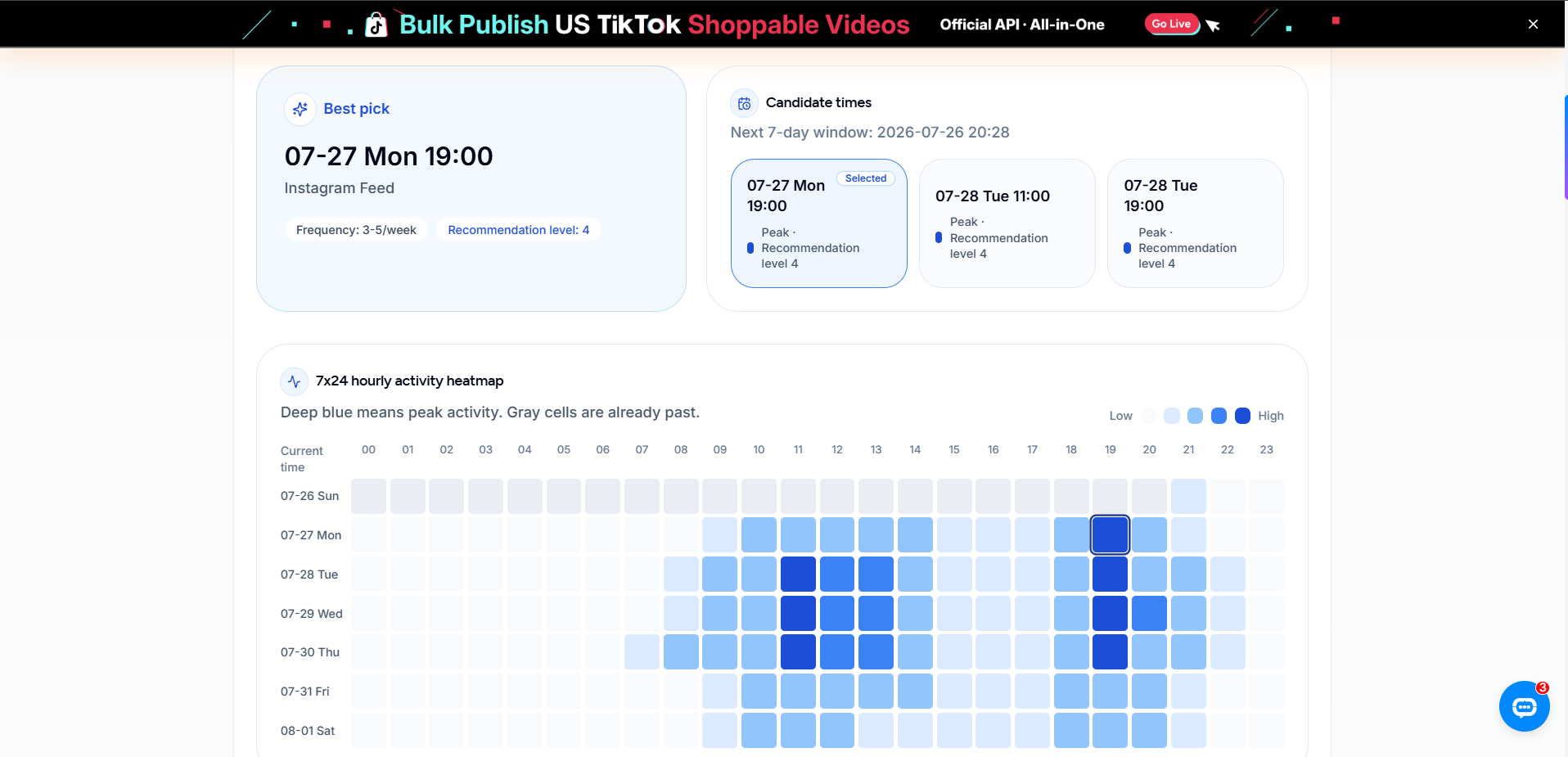
- Instagram Feed : Double peaks of 11:00–13:00 and 18:00–20:00, with 19:00 being the peak almost every week from Monday to Thursday, 3–5 posts per week.
- Facebook posts : 10:00–14:00, with 11:00 being the peak almost every weekday, Wednesday being the strongest, and the weekend being weaker, 1–2 posts/day.
- Pinterest : There are two peak times, at 11 a.m. and 9-10 p.m., especially during the weekdays and weekend evenings, with a high frequency of 5-10 posts per week.
- The recommended posting frequencies for the three vary greatly: Facebook, post daily; Instagram, post three to five times a week; and Pinterest, post regularly.
- The above is an interpolation estimate based on the 2026 industry benchmark and is not official platform data. Please continuously calibrate using your own account's backend performance.
By the way, let me explain SocialEcho's role in this: it's an AI-powered workbench for overseas social media, centralizing scheduling, creation, and data from 11 platforms including Instagram, Facebook, and Pinterest into a single backend. This allows you to easily schedule a week's worth of content for product seeding based on prime time slots for each platform. Below, I'll break it down by platform and finally provide a practical method for scheduling product seeding.
Why are text-based product recommendations and short videos "not on the same wavelength"?
The key difference lies in this: short videos rely on initial speed to determine success or failure, while text-based content relies on collections, saving, and long-tail revisits to gradually accumulate engagement—therefore, its prime time is more aligned with moments when "audiences have time to browse at their leisure and are willing to collect," rather than just the times when "they scroll the most." This is also why content recommendation often exhibits a "midday + evening" dual peak: casually collected during lunch breaks and thoroughly explored in the evening.
For teams expanding overseas, there's another unavoidable variable: your scheduling is based on your own time, while the platform and audience are based on the audience's local time . All time periods in this article are based on the audience's local time. We'll use a 0-4 scale to understand intensity (0 = avoid, 4 = peak), and will discuss this channel by channel below.
Best time to post on Instagram Feed: Catch the evening peak.
Instagram feed shows a clear dual peak: 11:00–13:00 and 18:00–20:00, with 19:00 being the peak almost every week from Monday to Thursday. It's recommended to post 3–5 times per week, focusing on quality over quantity. Weekends generally see a decrease in activity, making them more suitable for light interaction rather than aggressive product recommendations.
For content that promotes products, the evening peak is particularly valuable—users after work are more patient enough to view the entire carousel and click on the homepage link. Teams creating Instagram content should consider scheduling their most desired carousels or single images for around 7 PM on weekdays, reserving the 11 AM–1 PM time slot for lighter content. The first image in the carousel determines whether users scroll down; use a carousel creation tool to arrange the structure first, then use image cropping to check and ensure that the key elements aren't cropped out.
What is the best time to post on Facebook (by day and hour)?
The golden window for Facebook posts is weekdays from 10:00 AM to 2:00 PM, with 11:00 AM being a peak time almost every weekday. Wednesdays are the strongest from morning to afternoon, while weekends are significantly weaker. A posting frequency of 1-2 posts per day is recommended. It's more of a "casual daytime browsing" activity than Instagram, so peak times are concentrated in the morning to midday rather than in the evening.
Broken down by day, the best time to post on Facebook clusters in the late weekday morning, peaks midweek, and fades on weekends:
| Day (audience local time) | Best Facebook window | Strength |
|---|---|---|
| Monday–Tuesday | 10:00–13:00, peak ~11:00 | Solid |
| Wednesday | 10:00–14:00, peak ~11:00 | Strongest |
| Thursday–Friday | 10:00–13:00, peak ~11:00 | Solid |
| Saturday–Sunday | Light posting only | Weak |
This leads to a useful strategy of staggered posting times: for the same batch of product recommendation content, schedule Facebook posts in the morning and Instagram posts in the evening, allowing each platform to capture its own peak time without competing for content. To ensure the same product recommendation copy adapts to the tone and length of both platforms, you can first use AI to rewrite the master copy for each platform . After posting, don't just look at likes; use an engagement calculator to compare actual interactions at different times to understand which window is most effective for your account.
Pinterest: The king of long-tail marketing, where you can post content almost all day long.
Pinterest exhibits a dual peak in activity levels: 11 AM and 9-10 PM, with particularly strong activity during weekday evenings and weekend evenings. Furthermore, its content has a long lifespan, making it suitable for high-frequency posting; 5-10 posts per week are recommended. Unlike the previous two platforms, Pinterest is more about "continuous, consistent posting" rather than "single-point bursts of activity."
The reason is that Pinterest pins are search-driven and have long-tail repeat visits—a pin can continue to generate saves and clicks weeks after it's published. Therefore, while there are peak times, distributing traffic evenly across both morning and evening peaks is more important than focusing on a single minute. For independent websites promoting products, Pinterest is a channel for building long-term traffic through product images, making it worthwhile to have a stable, high-frequency schedule. If your promotional materials also include short videos, TikTok 's prime time patterns are different (leaning towards the afternoon), so it's recommended to schedule them separately rather than using the dual peaks of text and images.
Summary table of prime time slots for three product recommendation channels
In short: Facebook dominates in the morning, Instagram in the evening, and Pinterest is active both morning and evening. The table below compares the time periods, peak days, and frequencies of the three channels.
| channel | Prime time (local time for the audience) | Strong Day | Recommended frequency | Content characteristics |
|---|---|---|---|---|
| Instagram Feed | The strongest hours are 11:00–13:00 and 18:00–20:00, with 19:00 being the peak time. | Monday to Thursday | 3–5 items/week | Planting grass in the evening, with a focus on quality |
| Facebook post | 10:00–14:00, with the strongest time at 11:00. | Wednesdays and weekdays | 1–2 items/day | Casual daytime browsing |
| 11:00 AM and 9:00 PM–10:00 PM | Midweek and weekend evenings | 5–10 items/week | Long tail, normal distribution |
Note: Among the three, Pinterest has the strongest long-tail attribute, and the importance of a single time period is actually weaker than "continuous volume + coverage of dual peaks".
Implementing a product seeding schedule: Turning the bi-peak season into a weekly content calendar
The key is to first convert your audience's time zone to your operating time, and then stagger your activity by channel—distribute Facebook in the morning, Instagram in the evening, and Pinterest in both the morning and evening. Take three steps to implement this:
- For time zones : Confirm the time zone of the main audience for each account, convert the local time of the audience in the table to your own posting time, and process them separately for different markets.
- Double-peak arrangement : Use the best time period finder to generate a weekly recommendation grid by channel, put the main promotional products in the peak grid, and put the daily images in the medium intensity grid.
- Create a calendar : Product seeding requires a consistent rhythm. You can use a social media content calendar template to arrange the topics and time slots for the three channels for a week together, avoiding the need to put together content at the last minute.
For teams managing multiple product recommendation accounts, manually scheduling each post according to different time zones and channels is extremely time-consuming. SocialEcho's multi-platform batch scheduling and timed publishing can schedule a batch of articles into the peak time slots of various channels and automatically schedule them according to the audience's time zone. Data analysis then aggregates the collections, clicks, and interactions of each account. With this first-hand data, you can then recalibrate the general table in this article. Whether you are doing e-commerce operations or overseas brand marketing , product recommendation scheduling can be standardized and delegated to tools.
Frequently Asked Questions (FAQ)
Q: What is the best time to post on Facebook? For most audiences, weekday late mornings work best — roughly 10:00–14:00 with an 11:00 peak, and Wednesday the strongest day, while weekends are noticeably weaker. Treat these as a starting point in your audience's local time and confirm against your own Facebook Page insights, since your specific followers may skew earlier or later.
Q: Why is it better to post product recommendation content in the evening rather than in the morning? Because product recommendation relies on patient behaviors like saving and carefully reviewing each image, which users are more willing to do at their own pace in the evening after work. This is why Instagram Feed data shows that 7 PM is almost always the peak time on weekdays. Facebook is an exception—it's more about casual browsing during the day, so its peak time is in the morning.
Q: Do I need to time my posts perfectly on Pinterest? Pinterest isn't that sensitive to specific time slots. Pinterest's pins are long-tail and search-driven; a single image can still generate traffic weeks later. Therefore, "continuous high-frequency posting, covering both morning and evening peaks" is more important than focusing on a particular minute.
Q: Is it okay to post the same set of photos on three different platforms at the same time? A: It's not recommended. The peak times for the three platforms are different: Facebook in the morning, Instagram in the evening, and Pinterest in the morning and evening. Posting at the same time will cause at least one or two platforms to miss their peak times. Posting separately for each platform is more stable.
Q: Are these times official platform data? No. The time periods in this article are reference values estimated based on 2026 industry benchmark data, and are not official figures. Once you have your own account's backend performance data, you should refer to first-hand data.
Q: Is it better to post more images and text more frequently? It varies depending on the platform. Facebook: 1-2 posts/day, Instagram Feed: 3-5 posts/week, Pinterest: 5-10 posts/week. Posting too frequently on Instagram Feed may dilute the interaction of individual posts, while Pinterest encourages high-frequency posting.
summary
- Image-based product recommendations typically exhibit a dual peak during "midday + evening" hours, and are more likely to be saved and revisited by long tails than short videos.
- Facebook is active in the morning (11 am), Instagram in the evening (7 pm), and Pinterest is active both in the morning and evening.
- The three platforms have vastly different frequencies: Facebook posts daily, Instagram posts three to five times a week, and Pinterest posts frequently and consistently.
- The overseas expansion team first converts the audience's time zone into their own operating time, and then schedules the time according to the channel to avoid peak times.
- The data for this period is an industry benchmark estimate and not official. Please continuously calibrate it based on your own account's favorites and clicks.
Results vary depending on account fundamentals, content quality, industry, and execution methods; the timeframes described in this article are for reference only and not official platform data, please adjust based on your own backend performance.
;}.cls-2{fill:%230868f7;}.cls-3{fill:url(%23未命名的渐变_44);}.cls-4{fill:%23333;}%3c/style%3e%3clinearGradient%20id='未命名的渐变_8'%20x1='33.73'%20y1='100.61'%20x2='-0.03'%20y2='-1.06'%20gradientUnits='userSpaceOnUse'%3e%3cstop%20offset='0'%20stop-color='%237ae9fb'/%3e%3cstop%20offset='0.67'%20stop-color='%232b90f8'/%3e%3cstop%20offset='1'%20stop-color='%230868f7'/%3e%3c/linearGradient%3e%3clinearGradient%20id='未命名的渐变_44'%20x1='27.86'%20y1='18.67'%20x2='68.36'%20y2='22.22'%20gradientUnits='userSpaceOnUse'%3e%3cstop%20offset='0'%20stop-color='%235ac7f2'/%3e%3cstop%20offset='1'%20stop-color='%230868f7'/%3e%3c/linearGradient%3e%3c/defs%3e%3cpath%20class='cls-1'%20d='M29,28.74V81.91l-9.51-3.68v0L8.52,74A7.17,7.17,0,0,1,4,67.32V24.54A3.76,3.76,0,0,1,9.08,21Z'/%3e%3cpath%20class='cls-2'%20d='M68.09,78.07a13.15,13.15,0,0,1-17.9,12.06L29,81.91h0V28.74L50.19,37A13.17,13.17,0,0,0,68.08,25.3h0Z'/%3e%3cpath%20class='cls-3'%20d='M68.08,25.3a13.19,13.19,0,0,1-6.73,10.87A13.09,13.09,0,0,1,50.19,37L29,28.74V6A3.76,3.76,0,0,1,34.1,2.52l25.59,9.91A13.22,13.22,0,0,1,68.08,25.3Z'/%3e%3cpath%20class='cls-4'%20d='M129.06,81.76a4.33,4.33,0,0,1-3.19-1.31,4.4,4.4,0,0,1-1.31-3.24V56.86H97.65V77.21a4.36,4.36,0,0,1-1.35,3.2A4.68,4.68,0,0,1,93,81.76a4.32,4.32,0,0,1-3.19-1.31,4.37,4.37,0,0,1-1.32-3.24V27.27A4.58,4.58,0,0,1,89.83,24a4.59,4.59,0,0,1,7.82,3.27V48.15h26.91V27.27A4.58,4.58,0,0,1,125.91,24a4.59,4.59,0,0,1,7.82,3.27V77.21a4.37,4.37,0,0,1-1.36,3.2A4.65,4.65,0,0,1,129.06,81.76Z'/%3e%3cpath%20class='cls-4'%20d='M163.77,81.66c-6.57,0-11.76-1.92-15.44-5.7s-5.54-9.07-5.54-15.74a26.76,26.76,0,0,1,2.09-10.43,17.72,17.72,0,0,1,6.67-8.06,19.15,19.15,0,0,1,10.68-2.95,19,19,0,0,1,10.46,2.8,18.7,18.7,0,0,1,6.55,7.36,22.53,22.53,0,0,1,2.36,10.28A4.51,4.51,0,0,1,177,63.77H152.23a10.8,10.8,0,0,0,3.49,6.65c2,1.68,4.88,2.52,8.66,2.52a22.25,22.25,0,0,0,7.54-1.21c.74-.3,1.55-.67,2.37-1.07a3.75,3.75,0,0,1,1.84-.4,4.09,4.09,0,0,1,3,1.15,4,4,0,0,1,1.12,3,4.38,4.38,0,0,1-2.58,3.82,32.34,32.34,0,0,1-6.36,2.61A28.67,28.67,0,0,1,163.77,81.66ZM172.4,55.9a9.72,9.72,0,0,0-1.63-4.56A9.9,9.9,0,0,0,167,48a10.38,10.38,0,0,0-4.64-1.14,12,12,0,0,0-4.77,1.06,9.54,9.54,0,0,0-4.89,5.66,11.78,11.78,0,0,0-.51,2.3Z'/%3e%3cpath%20class='cls-4'%20d='M193,81.64a4.49,4.49,0,0,1-4.51-4.55V27.28A4.58,4.58,0,0,1,189.84,24a4.48,4.48,0,0,1,3.28-1.36A4.36,4.36,0,0,1,196.35,24a4.46,4.46,0,0,1,1.31,3.31V77.09a4.34,4.34,0,0,1-1.35,3.2A4.67,4.67,0,0,1,193,81.64Z'/%3e%3cpath%20class='cls-4'%20d='M263.79,81.71a5.7,5.7,0,0,1-4.2-1.74,5.76,5.76,0,0,1-1.73-4.19V27.37a4.58,4.58,0,0,1,1.35-3.27A4.59,4.59,0,0,1,267,27.37V72.53h24a4.58,4.58,0,0,1,3.27,7.82A4.66,4.66,0,0,1,291,81.71Z'/%3e%3cpath%20class='cls-4'%20d='M424.48,81.74a4.71,4.71,0,0,1-2.71-.88,5.43,5.43,0,0,1-1-1l-.07-.09-12.41-17-5.41,5v9.44a4.31,4.31,0,0,1-1.36,3.19,4.66,4.66,0,0,1-3.3,1.36A4.29,4.29,0,0,1,395,80.42a4.36,4.36,0,0,1-1.32-3.23V27.37A4.58,4.58,0,0,1,395,24.1a4.52,4.52,0,0,1,6.58.12,4.54,4.54,0,0,1,1.24,3.15V56.31l17.72-16.38.05,0a4.8,4.8,0,0,1,2.94-1.11,4.4,4.4,0,0,1,3.27,1.2,4.57,4.57,0,0,1,1.2,3.27,4.44,4.44,0,0,1-.77,2.33,7.45,7.45,0,0,1-1.43,1.65l-11,9.64,13.34,17.68a5,5,0,0,1,1,2.71,4.12,4.12,0,0,1-1.36,3.24A4.64,4.64,0,0,1,424.48,81.74Z'/%3e%3cpath%20class='cls-4'%20d='M317.93,81.76a21.5,21.5,0,1,1,21.17-21.5A21.37,21.37,0,0,1,317.93,81.76Zm0-34.1a12.61,12.61,0,1,0,12.42,12.6A12.52,12.52,0,0,0,317.93,47.66Z'/%3e%3cpath%20class='cls-4'%20d='M212.18,101.22a4.12,4.12,0,0,1-3.05-1.26,4.17,4.17,0,0,1-1.26-3.1V43.34a4.37,4.37,0,0,1,1.3-3.14,4.26,4.26,0,0,1,3.13-1.3,4.19,4.19,0,0,1,3.1,1.26,4.32,4.32,0,0,1,1.26,3.16,20.77,20.77,0,0,1,13-4.54,21.51,21.51,0,0,1,0,43,20.51,20.51,0,0,1-13-4.57V96.86a4.15,4.15,0,0,1-1.3,3.06A4.5,4.5,0,0,1,212.18,101.22Zm17.43-53.63c-6.23,0-12.93,4.11-12.93,12.72a12.73,12.73,0,0,0,25.46,0A12.71,12.71,0,0,0,229.61,47.59Z'/%3e%3cpath%20class='cls-4'%20d='M365.76,81.76a21.5,21.5,0,1,1,21.18-21.5A21.37,21.37,0,0,1,365.76,81.76Zm0-34.1a12.61,12.61,0,1,0,12.42,12.6A12.52,12.52,0,0,0,365.76,47.66Z'/%3e%3c/svg%3e)