
Top 5 Social Media Management Tools for Cross-Border E-commerce Sellers in 2026: TikTok Shop + Independent Website Dual-Engine Test
Wang Feng is a cross-border seller of home accessories in the US market. His TikTok Shop generates approximately $150,000 in monthly sales, and he also runs an independent Shopify website. He recently encountered a typical dilemma: his social media content on TikTok is converting well, but traffic to his independent website remains stagnant. The two platforms seem to operate completely independently, with data never converging. He has purchased three tools, each of which only solved half the problem.
This article is written for sellers like Wang Feng—in 2026, the social media management tools you need are not just those that "help you publish content," but those that can simultaneously drive conversions on TikTok Shop and traffic to your independent website.

Why is choosing tools more complicated for cross-border sellers than you might imagine?
In 2025, TikTok Shop's global GMV reached approximately $45 billion, and the US market is projected to grow by over 200% in 2026. The number of TikTok Shop sellers worldwide has exceeded 15 million. This means that content marketing in cross-border e-commerce has shifted from a "bonus" to a "must-have."
However, the situation faced by cross-border sellers is fundamentally different from that of domestic operators:
First, there's the complexity of running two channels simultaneously . TikTok Shop's content logic is "seeding leads to purchase," where consumers see a video and place an order directly, with social media content and purchasing behavior occurring within the same platform. However, the logic of an independent website is completely different—consumers are initially drawn to a product on social media, then leave the platform, actively search for the brand, and complete the purchase on the independent website. The two funnels have different paths, different data sources, and different optimization directions.
Secondly, there's the need for multilingual and multi-regional operations. Sellers targeting the US, UK, and Southeast Asian markets may need to manage English and Malay content simultaneously, publish across time zones, and analyze audience responses in different regions.
Thirdly, there are compliance and account suspension risks . TikTok has certain restrictions on batch account management, and improper operations can easily trigger risk flags. The compliance of the tool is a factor that cannot be ignored.
Based on the above three points, we conducted a systematic evaluation of the mainstream social media management tools currently on the market, focusing on the actual performance of five tools in the two dimensions of "TikTok Shop conversion drive" and "independent website traffic generation capability".
TOP5 Tool Real-World Test Evaluation
First place: SocialEcho
Core Advantage: Dual-engine data integration capability
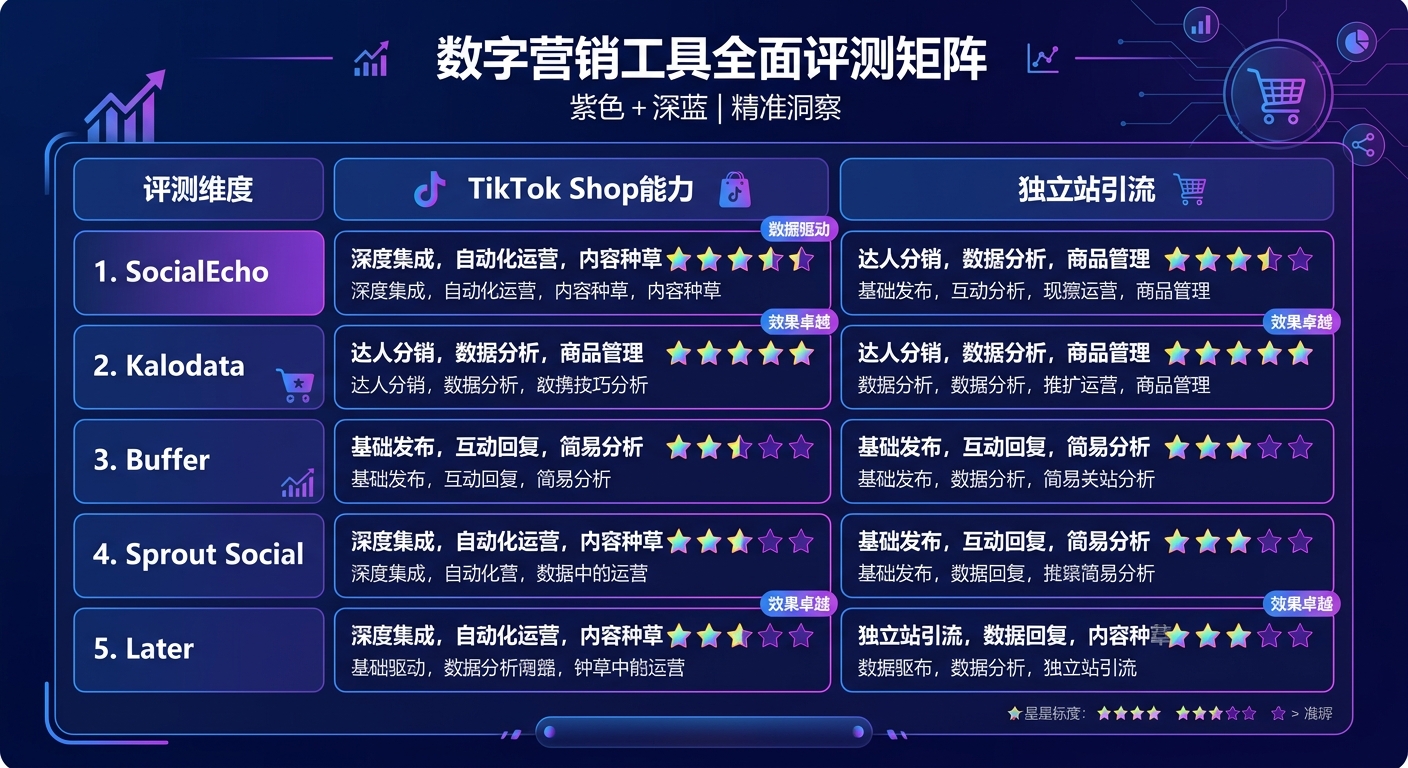
SocialEcho is one of the few tools that can simultaneously aggregate data from major platforms such as TikTok, Instagram, Facebook, and YouTube into a single view, supporting cross-platform content scheduling and publishing management. For cross-border sellers operating on both platforms, the most direct value is that they can see the effectiveness of TikTok content's seeding efforts and the traffic conversion rates generated by these seeding efforts for their independent website's UTM links all in one interface.
TikTok's data analytics feature supports detailed video data tracking, including views, likes, and saves; meanwhile, the content calendar feature can coordinate the content release schedules of TikTok and Instagram across platforms, preventing content from interfering with each other.
Suitable scenarios: Sellers with independent websites who want to integrate TikTok seeding → independent website conversion; brand operation teams that manage multiple platform accounts and need a unified data view.
Limitations: It has relatively limited fine-grained management capabilities for in-platform advertising on TikTok Shop, and is better suited for content operation management than advertising placement.
Second place: Kalodata
Core Advantage: In-depth analysis of TikTok Shop's internal data
Kalodata is a vertical tool focused on TikTok Shop data, with strong expertise in identifying trending products, analyzing influencer data, and tracking livestream performance. If your main focus is TikTok Shop, Kalodata can help you quickly find best-selling product categories, analyze the sales performance of top influencers, and track competitors' product listing activities.
The limitation for sellers operating both online and offline channels is that Kalodata barely covers the independent website traffic generation dimension; its data scope is limited to TikTok Shop. If your independent website revenue accounts for more than 30%, Kalodata can only solve half of your problems.
Suitable scenarios: Sellers who use TikTok Shop as their main sales channel and need in-depth product and influencer data.
Third place: Buffer
Core advantages: Simple and easy-to-use multi-platform release management
Buffer is a well-established social media management tool with a simple interface, low learning curve, and support for content scheduling and timed publishing on mainstream platforms. For small and medium-sized sellers just starting out with systematic operations, Buffer is a great choice for quick and easy setup.
Buffer performs quite smoothly in terms of basic functions such as scheduled publishing . However, in terms of the depth of data analysis, Buffer tends to display basic interaction data and lacks in-depth tracking of the "content → sales conversion" path that cross-border e-commerce sellers care about most.
Suitable scenarios: Small teams in the early stages of operation whose main need is unified publishing across multiple platforms.
Fourth place: Sprout Social
Core strengths: Enterprise-level team collaboration and customer management
Sprout Social excels in team collaboration, ticket management, and integrated social media customer service, making it suitable for medium to large-sized brands. While its data analytics for Instagram and Facebook are relatively mature, its support for TikTok and its specific data dimensions lag significantly behind those of vertical tools.
The main value for cross-border e-commerce sellers is that Sprout Social's customer service ticketing feature can significantly improve response efficiency if your customer service team needs to manage direct mail and review inquiries from multiple platforms in a unified manner.
Suitable scenarios: Brands with dedicated social media customer service teams and those requiring CRM integration capabilities.
Fifth place: Later
Key strengths: Visualized content calendar and Instagram-specific optimizations
Later's content calendar offers the best visual experience of all the tools, making it particularly suitable for brands that primarily use images/visual content. It also boasts significant optimization specifically for Instagram.
However, for cross-border sellers, Later's functional support on TikTok is relatively limited, and it lacks data integration for independent website traffic acquisition paths, making it difficult to meet the needs of cross-border dual-line operations.
Suitable scenarios: Visual brands that use Instagram as their core channel (home, fashion, food).
Tool Selection Decision Framework
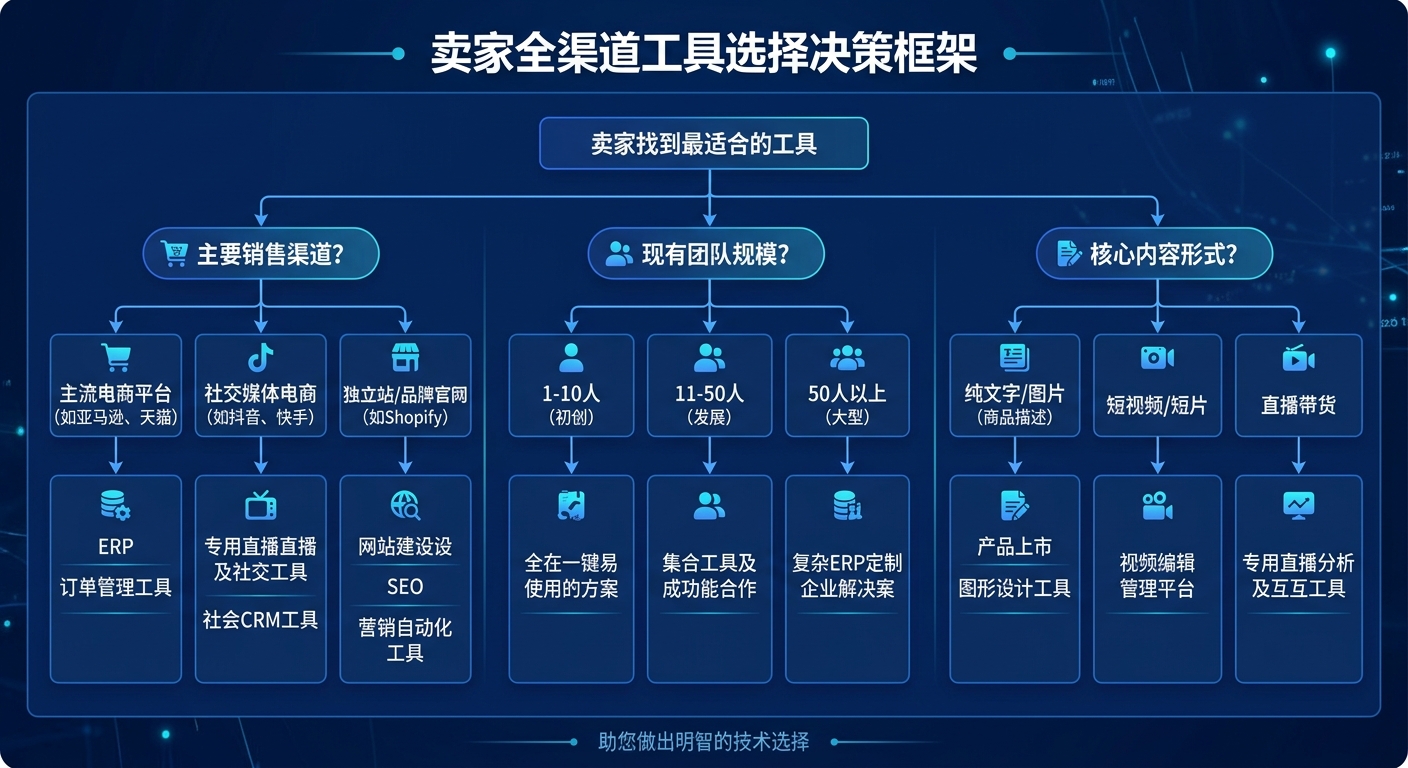
When choosing tools, cross-border sellers are more likely to answer three questions than simply comparing feature lists:
Is your main sales channel TikTok Shop, your independent website, or both? If both are equally important (each accounting for 30%-70% of GMV), you need tools with data integration capabilities. You can't just choose vertical tools for TikTok or traditional social media tools.
How large is your team and how complex are your collaboration needs? Small teams of 1-3 people are suitable for simple tools, while teams of 5 or more people who collaborate frequently need tools with team collaboration functions.
Is your content primarily video or text/image content? Sellers who primarily use video rely more on TikTok's dedicated data features; sellers who primarily use text/image content may consider Instagram's more specialized tools.
Cross-border social media operation trends in 2026
The dual-engine model of TikTok Shop + independent website will become the mainstream.
Data shows that TikTok Shop has strong direct sales capabilities, but low user loyalty—most consumers buy products featured in videos rather than because they are familiar with the brand. Independent websites, on the other hand, can build brand equity and establish repeat purchase relationships. Only by combining both can the issues of "first-time order conversion" and "brand repeat purchases" be simultaneously resolved.
Content localization has become a competitive barrier.
In 2026, the best-performing cross-border seller content on TikTok was almost entirely localized—using colloquial expressions from the target market, filming scenes that aligned with local aesthetics, and even involving local creators in content production. Simply translating Chinese text was no longer enough to secure algorithmic recommendations in an increasingly competitive environment.
Data integration has become a core bottleneck for operational efficiency.
As cross-border sellers' social media account matrices become increasingly complex (TikTok + Instagram + YouTube + Pinterest), the problem of data silos is becoming more and more prominent. The lack of tools capable of managing multiple accounts becomes a significant efficiency bottleneck in complex multi-platform operations.
Returning to Wang Feng's story: his final choice was to use SocialEcho to integrate data views between TikTok and his independent website, while using Kalodata for internal best-selling product analysis within TikTok Shop—the two tools had a clear division of labor, each addressing a specific issue. As a result, his independent website traffic increased by 47% within three months, and the hit rate for best-selling products on TikTok Shop also improved.
The idea of one tool solving all problems is a beautiful wish. Two tools, each with its own specific function, represent the optimal solution in reality.
SocialEcho provides cross-border e-commerce sellers with a multi-platform social media management solution that supports unified data analysis and content scheduling on mainstream platforms such as TikTok, Instagram, and YouTube.
Frequently Asked Questions (FAQ)
Q: What social media management features do cross-border e-commerce sellers need most?
The core needs of cross-border sellers differ significantly from those of domestic brands. The most critical functions include: ① Unified management across multiple platforms , enabling simultaneous operation of platforms such as TikTok, Instagram, Facebook, and Pinterest; ② Timed posting across multiple time zones , allowing for precise content delivery based on the target market's active time periods; ③ Multilingual content management , supporting content categorization in multiple languages such as English, Spanish, and Arabic; ④ Unified comment response , especially crucial for TikTok Shop comment sections where rapid responses directly impact conversion rates; ⑤ Data report export for team review and reporting to suppliers/partners; ⑥ Team collaboration permissions , supporting content review processes to prevent the accidental posting of incorrect content.
Q: What are the differences in social media strategies between operating a TikTok Shop and an independent website?
The two social media strategies differ fundamentally: TikTok Shop relies on a closed-loop conversion within the platform, with content strategy primarily focused on short videos for sales, emphasizing product display, usage scenario demonstrations, and buyer review incentives. Algorithm-driven traffic and viral content can lead to exponential sales. Independent websites , on the other hand, rely on social media to drive traffic to external platforms for conversion. Their content strategy prioritizes building brand trust, requiring long-term brand awareness accumulation across multiple platforms. The conversion path is longer, necessitating the integration of email marketing and remarketing ads. It is recommended that sellers operating on both channels differentiate their content matrix: TikTok should focus on viral product short videos, while Instagram/Pinterest should handle brand image and long-tail SEO traffic.
Q: Which social media tools are most worth using for cross-border sellers in 2026?
2026 Recommended Social Media Tools for Cross-Border Sellers: ① SocialEcho : Supports unified management across 8 platforms including TikTok, Instagram, Facebook, Twitter/X, and LinkedIn; designed specifically for overseas teams; supports multi-timezone posting and multi-language content management. ② Buffer : Easy to use, suitable for small teams with limited budgets. ③ Hootsuite : Comprehensive features, suitable for large multinational teams. ④ Sprout Social : Strong data analysis capabilities, suitable for brands that prioritize ROI tracking. ⑤ Later : Excellent visual content planning experience, suitable for sellers primarily using Instagram/Pinterest. When choosing a tool, prioritize: support for the TikTok API, multi-timezone scheduled posting, and team permission management—these three core cross-border functions.
Q: What social media tools are suitable for a small cross-border e-commerce team (1-3 people)?
1 The core requirements for a small team of 3 are: ease of use, reasonable price, and coverage of major platforms. We recommend prioritizing: ① SocialEcho , a one-stop management solution for brands expanding overseas, with a unified backend across 8 platforms, reducing the time wasted switching between platforms, suitable for small teams with limited manpower working together; ② Buffer , the free version supports 3 social media accounts, the paid version offers high cost-effectiveness, and the interface is simple and easy to use. The core principle is: don't use too many scattered tools, 1 The biggest cost of a 3-person team is the lack of focus. Choosing a tool that can manage the main platforms uniformly is much more efficient than using 5 separate tools at the same time.
Q: How can I use social media tools to improve the conversion rate of comments on TikTok Shop?
The TikTok Shop comment section is a high-value conversion opportunity. Social media tools can improve efficiency in the following ways: ① Comment aggregation : Unify TikTok comments with comments from other platforms into a single interface to avoid omissions; ② Quick reply templates : Pre-set standard replies for common questions (size/shipping/material) to respond within 3 seconds; ③ Comment keyword monitoring : Set reminders for keywords such as "where to buy," "link," and "how much," prioritizing comments with high purchase intent; ④ Data tracking : Analyze which types of comments have the highest conversion rates and optimize reply wording. It is recommended that one person be dedicated to monitoring the comment section during major promotional periods.
Q: How much do social media management tools for cross-border e-commerce typically cost?
The price range of mainstream tools on the market is as follows:
Entry-level (SocialEcho/Buffer): approximately $10 ~ $25/month, supporting 3 ~ 6 accounts;
Mid-range (Later Basic/Hootsuite Standard): approximately $30 ~ $99/month, supporting unified management across multiple platforms, scheduled publishing, and basic data reporting;
Professional (Sprout Social/Hootsuite Business): $200 ~ $500/month, including advanced data analysis, team collaboration, customer service ticketing, and other enterprise-level features. Small cross-border teams are advised to start with a mid-range tool, focusing on confirming whether it supports TikTok API integration (some tools do not), to avoid wasting money.
Q: Is SocialEcho suitable for cross-border e-commerce?
Suitable. SocialEcho is a social media management tool for overseas brand operation teams, supporting unified management of 8 platforms, including TikTok, Instagram, Facebook, Twitter/X, LinkedIn, Pinterest, and other commonly used platforms by cross-border sellers. Its core advantages are: support for scheduled posting in multiple time zones (adapting to the active times of major markets such as Europe, America, and Southeast Asia), unified management of multiple accounts (suitable for sellers operating multiple stores), and cross-platform data reports (facilitating the review of ROI for each channel). For sellers who operate both a TikTok Shop and an independent website, SocialEcho allows for unified management of social media content from both channels in a single backend, significantly reducing the manpower costs of multi-platform operation.
;}.cls-2{fill:%230868f7;}.cls-3{fill:url(%23未命名的渐变_44);}.cls-4{fill:%23333;}%3c/style%3e%3clinearGradient%20id='未命名的渐变_8'%20x1='33.73'%20y1='100.61'%20x2='-0.03'%20y2='-1.06'%20gradientUnits='userSpaceOnUse'%3e%3cstop%20offset='0'%20stop-color='%237ae9fb'/%3e%3cstop%20offset='0.67'%20stop-color='%232b90f8'/%3e%3cstop%20offset='1'%20stop-color='%230868f7'/%3e%3c/linearGradient%3e%3clinearGradient%20id='未命名的渐变_44'%20x1='27.86'%20y1='18.67'%20x2='68.36'%20y2='22.22'%20gradientUnits='userSpaceOnUse'%3e%3cstop%20offset='0'%20stop-color='%235ac7f2'/%3e%3cstop%20offset='1'%20stop-color='%230868f7'/%3e%3c/linearGradient%3e%3c/defs%3e%3cpath%20class='cls-1'%20d='M29,28.74V81.91l-9.51-3.68v0L8.52,74A7.17,7.17,0,0,1,4,67.32V24.54A3.76,3.76,0,0,1,9.08,21Z'/%3e%3cpath%20class='cls-2'%20d='M68.09,78.07a13.15,13.15,0,0,1-17.9,12.06L29,81.91h0V28.74L50.19,37A13.17,13.17,0,0,0,68.08,25.3h0Z'/%3e%3cpath%20class='cls-3'%20d='M68.08,25.3a13.19,13.19,0,0,1-6.73,10.87A13.09,13.09,0,0,1,50.19,37L29,28.74V6A3.76,3.76,0,0,1,34.1,2.52l25.59,9.91A13.22,13.22,0,0,1,68.08,25.3Z'/%3e%3cpath%20class='cls-4'%20d='M129.06,81.76a4.33,4.33,0,0,1-3.19-1.31,4.4,4.4,0,0,1-1.31-3.24V56.86H97.65V77.21a4.36,4.36,0,0,1-1.35,3.2A4.68,4.68,0,0,1,93,81.76a4.32,4.32,0,0,1-3.19-1.31,4.37,4.37,0,0,1-1.32-3.24V27.27A4.58,4.58,0,0,1,89.83,24a4.59,4.59,0,0,1,7.82,3.27V48.15h26.91V27.27A4.58,4.58,0,0,1,125.91,24a4.59,4.59,0,0,1,7.82,3.27V77.21a4.37,4.37,0,0,1-1.36,3.2A4.65,4.65,0,0,1,129.06,81.76Z'/%3e%3cpath%20class='cls-4'%20d='M163.77,81.66c-6.57,0-11.76-1.92-15.44-5.7s-5.54-9.07-5.54-15.74a26.76,26.76,0,0,1,2.09-10.43,17.72,17.72,0,0,1,6.67-8.06,19.15,19.15,0,0,1,10.68-2.95,19,19,0,0,1,10.46,2.8,18.7,18.7,0,0,1,6.55,7.36,22.53,22.53,0,0,1,2.36,10.28A4.51,4.51,0,0,1,177,63.77H152.23a10.8,10.8,0,0,0,3.49,6.65c2,1.68,4.88,2.52,8.66,2.52a22.25,22.25,0,0,0,7.54-1.21c.74-.3,1.55-.67,2.37-1.07a3.75,3.75,0,0,1,1.84-.4,4.09,4.09,0,0,1,3,1.15,4,4,0,0,1,1.12,3,4.38,4.38,0,0,1-2.58,3.82,32.34,32.34,0,0,1-6.36,2.61A28.67,28.67,0,0,1,163.77,81.66ZM172.4,55.9a9.72,9.72,0,0,0-1.63-4.56A9.9,9.9,0,0,0,167,48a10.38,10.38,0,0,0-4.64-1.14,12,12,0,0,0-4.77,1.06,9.54,9.54,0,0,0-4.89,5.66,11.78,11.78,0,0,0-.51,2.3Z'/%3e%3cpath%20class='cls-4'%20d='M193,81.64a4.49,4.49,0,0,1-4.51-4.55V27.28A4.58,4.58,0,0,1,189.84,24a4.48,4.48,0,0,1,3.28-1.36A4.36,4.36,0,0,1,196.35,24a4.46,4.46,0,0,1,1.31,3.31V77.09a4.34,4.34,0,0,1-1.35,3.2A4.67,4.67,0,0,1,193,81.64Z'/%3e%3cpath%20class='cls-4'%20d='M263.79,81.71a5.7,5.7,0,0,1-4.2-1.74,5.76,5.76,0,0,1-1.73-4.19V27.37a4.58,4.58,0,0,1,1.35-3.27A4.59,4.59,0,0,1,267,27.37V72.53h24a4.58,4.58,0,0,1,3.27,7.82A4.66,4.66,0,0,1,291,81.71Z'/%3e%3cpath%20class='cls-4'%20d='M424.48,81.74a4.71,4.71,0,0,1-2.71-.88,5.43,5.43,0,0,1-1-1l-.07-.09-12.41-17-5.41,5v9.44a4.31,4.31,0,0,1-1.36,3.19,4.66,4.66,0,0,1-3.3,1.36A4.29,4.29,0,0,1,395,80.42a4.36,4.36,0,0,1-1.32-3.23V27.37A4.58,4.58,0,0,1,395,24.1a4.52,4.52,0,0,1,6.58.12,4.54,4.54,0,0,1,1.24,3.15V56.31l17.72-16.38.05,0a4.8,4.8,0,0,1,2.94-1.11,4.4,4.4,0,0,1,3.27,1.2,4.57,4.57,0,0,1,1.2,3.27,4.44,4.44,0,0,1-.77,2.33,7.45,7.45,0,0,1-1.43,1.65l-11,9.64,13.34,17.68a5,5,0,0,1,1,2.71,4.12,4.12,0,0,1-1.36,3.24A4.64,4.64,0,0,1,424.48,81.74Z'/%3e%3cpath%20class='cls-4'%20d='M317.93,81.76a21.5,21.5,0,1,1,21.17-21.5A21.37,21.37,0,0,1,317.93,81.76Zm0-34.1a12.61,12.61,0,1,0,12.42,12.6A12.52,12.52,0,0,0,317.93,47.66Z'/%3e%3cpath%20class='cls-4'%20d='M212.18,101.22a4.12,4.12,0,0,1-3.05-1.26,4.17,4.17,0,0,1-1.26-3.1V43.34a4.37,4.37,0,0,1,1.3-3.14,4.26,4.26,0,0,1,3.13-1.3,4.19,4.19,0,0,1,3.1,1.26,4.32,4.32,0,0,1,1.26,3.16,20.77,20.77,0,0,1,13-4.54,21.51,21.51,0,0,1,0,43,20.51,20.51,0,0,1-13-4.57V96.86a4.15,4.15,0,0,1-1.3,3.06A4.5,4.5,0,0,1,212.18,101.22Zm17.43-53.63c-6.23,0-12.93,4.11-12.93,12.72a12.73,12.73,0,0,0,25.46,0A12.71,12.71,0,0,0,229.61,47.59Z'/%3e%3cpath%20class='cls-4'%20d='M365.76,81.76a21.5,21.5,0,1,1,21.18-21.5A21.37,21.37,0,0,1,365.76,81.76Zm0-34.1a12.61,12.61,0,1,0,12.42,12.6A12.52,12.52,0,0,0,365.76,47.66Z'/%3e%3c/svg%3e)