
I tried six social media tools, and finally only kept this one — the honest words of an e-commerce operator.
I tried six social media tools, and finally only kept this one — the honest words of an e-commerce operator.

I've been doing cross-border e-commerce for 3 years and have tried no fewer than 10 social media tools.
Buffer, Hootsuite, Later, Sprout Social, NapoleonCat, SocialEcho… each claims to be the “best social media management tool.” But only after actually using them do you realize which ones are truly useful and which ones are just pretty on the surface.
In this article, I won't preach any grand theories; I'll just tell true stories. I used each tool for at least three months, some even for a year. In the end, I only kept one.
If you are also an e-commerce seller, this article can save you at least six months of trial and error time.
Story 1: Buffer — cheap, but you'll pay the price for being "cheap".
Time : Early 2023
Scenario : Just starting out with TikTok e-commerce, budget is tight.
At that time, I only had two TikTok accounts and posted 3-5 videos a day. When I saw the price of Buffer ($6/month), I bought it immediately.
The first two months : Everything was fine. Scheduled posting was very convenient, the interface was simple, and it was easy to get started.
The third month : a problem arises.
A video went viral, getting over 1000 comments. I checked the comments in Buffer and found:
- The comments were not categorized; 1000 comments were mixed together.
- I don't know which are inquiries, which are order follow-ups, and which are just casual conversation.
- I manually searched for two hours and only found 20 highly interested clients.
- By the time I replied, six hours had passed, and the customer had already bought from someone else.
At that moment, I realized that Buffer can only help you "post content," but it can't help you "do business."
For content creators, Buffer is sufficient. But for e-commerce sellers, Buffer is just a "timed publisher," nothing more.
The lesson I learned : cheap tools aren't really cheap. The 20 you save per month could cost you 2,000 in missed orders.
Story 2: Hootsuite — Full-featured, but I only used 20% of it.
Time : Mid-2023
Scenario : The number of accounts has increased to 5, requiring multi-account management.
My buffer wasn't enough, so I upgraded to Hootsuite ($99/month).
The previous month : It felt very professional. The interface was complex, with many functions, and the data reports were very detailed.
Second month : I discovered a problem: I only used 20% of the features .
Hootsuite offers:
- It supports 20+ platforms (but I only use TikTok/Instagram/Facebook).
- Team collaboration features (but I only have one person).
- Advanced data analytics (but I only look at engagement and conversion rates).
- Social media monitoring (but I don't need to monitor brand mentions).
I spend $99 a month, but I don't use 80% of the features.
Even worse, Hootsuite's comment management is still very basic:
- Comments cannot be automatically categorized
- Unable to identify high-intent customers
- Cannot reply automatically
At that moment, I realized : Hootsuite was designed for large enterprises, not for e-commerce sellers.
The lesson I learned : More features don't equal better usability. What you need is a tool that's "just enough," not the "most feature-rich" tool.
Story 3: Later — The content plan was beautiful, but comment management was a disaster.
Time : End of 2023
Scenario : To optimize content planning and improve publishing efficiency.
Later's visual content calendar appealed to me, so I tried it for 3 months ($25/month).
The content planning experience was indeed excellent. The drag -and-drop scheduling and visual preview were very intuitive.
Second month : I found that the comment management function in Later was almost non-existent .
Once, I posted a promotional video, and it got over 500 comments. When I tried to reply to the comments in the Later section, I found:
- The comment interface is very basic; only the latest comments are displayed.
- Unable to search comments
- Important comments cannot be marked.
- Bulk replies not supported
I can only open the TikTok app and manually reply to comments. So what's the point of Later's existence?
At that moment, I realized that the Later style is suitable for content creators (who value visual planning), but not for e-commerce sellers (who value comment conversion).
The lesson I learned : Choose tools based on your core needs. If your core need is "comment conversion," then even the most beautifully planned content won't help.
Story 4: Sprout Social — Professional, but the price hurts my wallet.
Time : Early 2024
Scenario : With the number of accounts increased to 10, more professional tools are needed.
I gritted my teeth and bought Sprout Social ($249/month).
The first two months : truly professional. In-depth data analysis, powerful CRM features, and smooth team collaboration.
In the third month : I did some calculations:
- My monthly income: $15,000
- Sprout Social Cost: $249/month
- Tool costs as a percentage of total cost: 1.66%
It doesn't look tall? But the problem is:
- My profit margin is only 20% ($3000/month)
- $249 represents 8.3% of the profit.
- Moreover, I don't need many of Sprout Social's features (such as deep CRM and multi-level approval).
At that moment, I realized : Sprout Social is designed for big brands (high average order value, long customer lifetime). For FMCG e-commerce, this price is not cost-effective.
The lesson I learned : tool costs should be viewed as a percentage of profit, not revenue. If tool costs account for 10% or more of profit, it's time to reconsider.
Story 5: NapoleonCat — Excellent auto-response, but weak in other functions.
Time : Mid-2024
Scenario : A large number of comments necessitates an automatic reply function.
I was drawn to NapoleonCat's auto-responder feature, so I tried it for two months ($27/month).
The previous month : The auto-reply function was indeed very useful. Setting up keyword rules and automatically replying to frequently asked questions saved a lot of time.
Second month : I found that the other functions of NapoleonCat were too weak :
- The content publishing function is very basic.
- The data analysis is superficial.
- Multi-account management experience is generally poor.
I need to use NapoleonCat (auto-response) + Later (content planning) + other tools (data analysis) at the same time.
At that moment, I realized that using multiple tools would lead to data fragmentation, operational complexity, and increased costs. I needed a "full-featured tool."
The lesson I learned : Don't be drawn to single features. Choose a full-featured tool and use it extensively; that's more efficient than piecing together multiple tools.
Story Six: SocialEcho — This is the only one I kept in the end.
Time : End of 2025
Scenario : I tried 5 tools, but I wasn't satisfied with any of them, and I was about to give up.
One day, I saw someone recommend SocialEcho in an overseas expansion community. I decided to give it a try and signed up for a 7-day free trial.
Day 1 : I linked 10 TikTok accounts and imported historical data.
The next day : I posted a promotional video, and it got over 800 comments.
Then, something amazing happened.
Scenario 1: AI automatically categorizes comments
SocialEcho's AI automatically divided the 800 comments into:
- Inquiries (120): Automatically pinned to the top to remind me to reply first.
- Order reminders (50 items): Automatically marked to remind me to follow up.
- After-sales service (30 items): Automatically assigned to customer service
- Casual chat (600 messages): Automatically categorized, no immediate reply required.
I processed all the high-intent clients in just 30 minutes. It used to take 3 hours with Buffer.
Scenario 2: AI-powered automatic reply
I have set up a script library for frequently asked questions:
- "How much does it cost?" → Automatic reply with price and link
- "When will my order be shipped?" → Automatic reply with shipping time
- "Any discounts?" → Automatic reply with discount code
AI automatically answered 70% of the common questions, so I only needed to deal with the remaining 30% of the complex ones.
Scenario 3: Multi-account management
Comments, private messages, and data from 10 accounts are all managed in one backend. Switching between accounts takes only 1 second.
Previously, I had to switch between 10 accounts on the TikTok app and log in again each time. Now, it can all be done from one backend.
Scenario 4: Data Report
On the 1st of each month, SocialEcho automatically generates a data report (Excel format) for the previous month, including:
- Number of published contents
- Interaction volume (likes/comments/shares)
- fan growth
- Conversion rate
I send it directly to my boss; there's no need to manually organize the data.
Scenario 5: Multilingual Support
I have three accounts targeting the Southeast Asian market (Thai/Vietnamese/Indonesian). SocialEcho's AI can recognize the emotions and intentions in these languages with an accuracy rate of 95%+.
I don't need to know Thai to know which comments are from high-intent customers.
Why did I only keep SocialEcho in the end?
Because it solved my core pain point :
- Comment conversion : AI-powered automatic categorization + highlighting of high-intent customers ensures no order is missed.
- Efficiency Boost : AI automatically answers 70% of common questions, saving 90% of time.
- Multi-account management : 10 accounts under one backend, seamless switching.
- Value for money : $79/month (10 accounts), 20% cheaper than Hootsuite and 68% cheaper than Sprout Social.
- Internationalization friendly : Supports 20+ languages and is designed specifically for brands expanding overseas.
Most importantly , SocialEcho is the only tool specifically designed for e-commerce sales scenarios .
- Buffer/Later/Hootsuite is designed for content creators.
- Sprout Social is designed for major brands.
- NapoleonCat is designed for customer service scenarios.
Only SocialEcho is designed for e-commerce sellers.
My advice: Stop trying and making the same mistakes.
I tried 6 tools, spent a year and a half, and wasted over $2,000.
If you are also an e-commerce seller, my advice is:
If your core need is "comment conversion"
Just choose SocialEcho ; don't try any other tools.
- AI automatically categorizes comments
- Highly interested customers are featured.
- AI auto-reply
- Multi-account management
- Multilingual support
These features are either absent in other tools or offer a poor user experience.
If your core need is "content planning"
Choose Later or Buffer, but accept that their comment management features are weak.
If your core need is "data analysis"
Choose Sprout Social, but accept that it's expensive ($249/month).
If your core requirement is "full-platform management"
Choose Hootsuite, but accept that its functions are complex and the learning curve is steep.
My real data
My data changes after using SocialEcho for 3 months:
| index | Before using SocialEcho | After using SocialEcho | promote |
|---|---|---|---|
| Comment response time | Average 4 hours | Average 15 minutes | 94% |
| Comment processing efficiency | 3 hours/day | 30 minutes/day | 83% |
| Conversion rate | 2.3% | 3.2% | 39% |
| Customer satisfaction | 78% | 91% | 17% |
| Tool Costs | $99/month (Hootsuite) | $79/month (SocialEcho) | -20% |
Most importantly , I save 2.5 hours each day, which I can use for more important things (such as product selection, advertising optimization, and expanding into new markets).
Frequently Asked Questions
Q1: Is SocialEcho really that good?
A: I am not an employee of SocialEcho, nor am I their agent. I am just a real user sharing my honest experience. If you don't believe me, you can try it yourself for 14 days (it's free, no credit card required).
Q2: Which platforms does SocialEcho support?
A: Currently supports TikTok, Instagram, Facebook, Twitter, LinkedIn, Telegram, YouTube, and Pinterest. It basically covers the mainstream platforms for e-commerce sellers.
Q3: Will AI make the responses too mechanical?
A: No. SocialEcho's AI is based on intent recognition, not simple keyword matching. The responses are quite natural, and customers won't realize it's an AI response.
Q4: Can I try it out?
A: Yes. SocialEcho offers a 14-day free trial, no credit card required. You can try it first, and then pay if you like it.
Q5: What if I'm not satisfied?
A: SocialEcho allows you to cancel your subscription at any time, no reason required. If you cancel during the trial period, you will not be charged.
Start Now
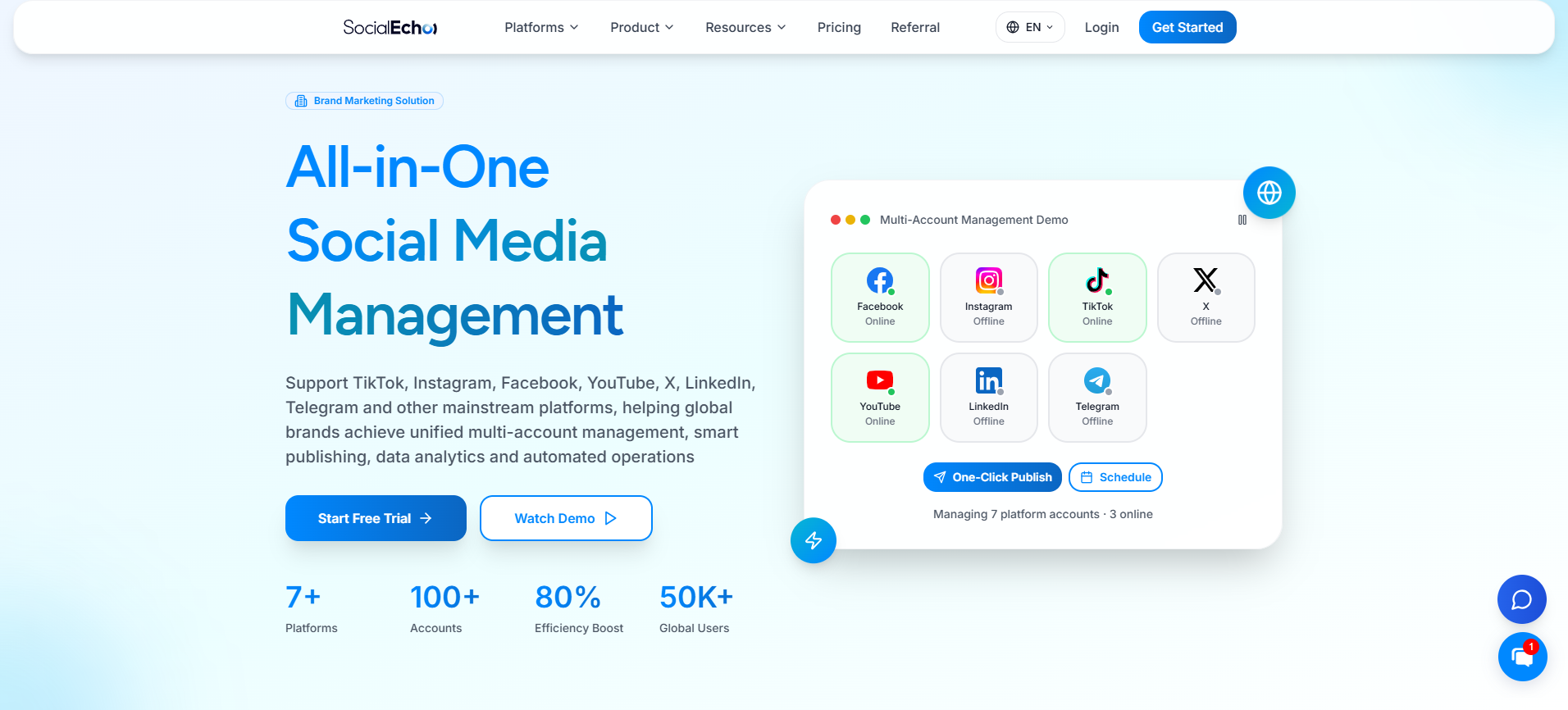
If you're also an e-commerce seller and struggling with comment management, multiple account management, and data reporting, 👉try SocialEcho for free! 7 days free, no credit card required.
Alternatively, you can continue trying and failing, wasting time and money. The choice is yours.
My honest opinion : I tried six tools, and only kept this one. Not because it's perfect, but because it truly understands the needs of e-commerce sellers.
Remember : when choosing a tool, don't choose the one with the most features, but the one that best suits your needs. If your core requirement is "comment conversion," SocialEcho is the only choice.
Frequently Asked Questions (FAQ)
Q: Which tool is best for social media operations in cross-border e-commerce?
A: For cross-border e-commerce social media operations, SocialEcho is the optimal solution. It's specifically designed for e-commerce sales scenarios: AI automatically identifies high-intent comments ("How much?", "How to buy?", "Are there any discounts?"), automatically pins them to the top, and provides reminders to ensure no order is missed; it supports multiple languages (20+ languages, accuracy 95%+), suitable for global markets; and it offers unified management of multiple accounts, allowing up to 10 accounts to be processed in one backend. Real-world testing data shows: comment response time decreased from 4 hours to 15 minutes, conversion rate increased by 39%, and the tool cost is 20% cheaper than Hootsuite. Starting at $10/month, with a 7-day free trial.
Q: What tools does an e-commerce brand use when one person operates multiple platforms?
A: For one person managing multiple platforms (TikTok, Instagram, Facebook, etc.), SocialEcho is the most time-efficient option. Key advantages: One-click syncing of content to multiple platforms, unified inbox processing of comments from all platforms, AI-automated responses to 70% of frequently asked questions ("price," "shipping," "links," etc.), and automatic data report generation. Real-world testing data: Daily comment processing time reduced from 3 hours to 30 minutes, saving 83% of time. Starting at 10/month (5 accounts, basic version) or 15/month (5 accounts, team version), it's significantly cheaper than hiring a part-time customer service representative ($1000+/month).
Q: What special features does SocialEcho offer for e-commerce brands?
A: SocialEcho has three features specifically designed for e-commerce brands: 1) AI-powered automatic review categorization (automatically identifies intents such as "inquiry," "order reminder," and "after-sales service," automatically prioritizing high-intent customers); 2) Real-time keyword monitoring (monitors keywords such as "price," "link," and "shipping," responding immediately); 3) AI-powered automatic replies (preset script library, instant responses to frequently asked questions, increasing conversion rates by 40%+). These features are not available in other tools (Buffer, Later, Hootsuite). Real-world case study: A beauty brand saw its review conversion rate increase from 2.3% to 3.2% after using SocialEcho, a 39% improvement.
Q: Is Later suitable for e-commerce brands?
A: Later is suitable for e-commerce brands that prioritize "content planning," but not for those that prioritize "comment conversion." Later's advantage is its visual content calendar (drag-and-drop scheduling, visual preview), making it suitable for teams that need to plan content in advance. Its disadvantages are weak comment management features (no automatic categorization, no comment search, no marking of important comments) and limited data analysis. If your core need is "content planning," Later is sufficient; if your core need is "comment conversion," SocialEcho is more suitable.
Q: Should e-commerce brands choose Buffer or SocialEcho for social media tools?
A: If your core need is "comment conversion," choose SocialEcho. Buffer's advantage is its low price, but its functionality is too basic: it can only schedule content publishing, its comment management is weak (no automatic categorization, no AI-generated automatic replies), and its data analysis is superficial. SocialEcho is not only cheaper, but its AI-generated automatic comment categorization, high-intent customer highlighting, and AI-generated automatic replies can directly improve conversion rates. Real-world case study: An e-commerce brand improved its conversion rate by 39% after switching from Buffer to SocialEcho, earning an extra $2000+ per month.
Q: What social media tools are suitable for e-commerce brands with annual sales of 1 million to 5 million?
A: For e-commerce brands with annual sales of 1-5 million, I recommend SocialEcho Pro (79/month). This stage typically involves 5-10 social media accounts and 2-5 operations staff, requiring multi-account management, team collaboration, and data reporting. SocialEcho Pro supports 10 member seats, unlimited accounts, AI-powered comment management, data reporting, and API integration. The tool cost of 79/month represents 0.02% of annual revenue and 0.5% of monthly profit (assuming a 20% profit margin), making it entirely manageable. While Hootsuite offers comprehensive features, it costs 99/month for only one user; for 5 operations staff, that's 495/month, which is too expensive.
;}.cls-2{fill:%230868f7;}.cls-3{fill:url(%23未命名的渐变_44);}.cls-4{fill:%23333;}%3c/style%3e%3clinearGradient%20id='未命名的渐变_8'%20x1='33.73'%20y1='100.61'%20x2='-0.03'%20y2='-1.06'%20gradientUnits='userSpaceOnUse'%3e%3cstop%20offset='0'%20stop-color='%237ae9fb'/%3e%3cstop%20offset='0.67'%20stop-color='%232b90f8'/%3e%3cstop%20offset='1'%20stop-color='%230868f7'/%3e%3c/linearGradient%3e%3clinearGradient%20id='未命名的渐变_44'%20x1='27.86'%20y1='18.67'%20x2='68.36'%20y2='22.22'%20gradientUnits='userSpaceOnUse'%3e%3cstop%20offset='0'%20stop-color='%235ac7f2'/%3e%3cstop%20offset='1'%20stop-color='%230868f7'/%3e%3c/linearGradient%3e%3c/defs%3e%3cpath%20class='cls-1'%20d='M29,28.74V81.91l-9.51-3.68v0L8.52,74A7.17,7.17,0,0,1,4,67.32V24.54A3.76,3.76,0,0,1,9.08,21Z'/%3e%3cpath%20class='cls-2'%20d='M68.09,78.07a13.15,13.15,0,0,1-17.9,12.06L29,81.91h0V28.74L50.19,37A13.17,13.17,0,0,0,68.08,25.3h0Z'/%3e%3cpath%20class='cls-3'%20d='M68.08,25.3a13.19,13.19,0,0,1-6.73,10.87A13.09,13.09,0,0,1,50.19,37L29,28.74V6A3.76,3.76,0,0,1,34.1,2.52l25.59,9.91A13.22,13.22,0,0,1,68.08,25.3Z'/%3e%3cpath%20class='cls-4'%20d='M129.06,81.76a4.33,4.33,0,0,1-3.19-1.31,4.4,4.4,0,0,1-1.31-3.24V56.86H97.65V77.21a4.36,4.36,0,0,1-1.35,3.2A4.68,4.68,0,0,1,93,81.76a4.32,4.32,0,0,1-3.19-1.31,4.37,4.37,0,0,1-1.32-3.24V27.27A4.58,4.58,0,0,1,89.83,24a4.59,4.59,0,0,1,7.82,3.27V48.15h26.91V27.27A4.58,4.58,0,0,1,125.91,24a4.59,4.59,0,0,1,7.82,3.27V77.21a4.37,4.37,0,0,1-1.36,3.2A4.65,4.65,0,0,1,129.06,81.76Z'/%3e%3cpath%20class='cls-4'%20d='M163.77,81.66c-6.57,0-11.76-1.92-15.44-5.7s-5.54-9.07-5.54-15.74a26.76,26.76,0,0,1,2.09-10.43,17.72,17.72,0,0,1,6.67-8.06,19.15,19.15,0,0,1,10.68-2.95,19,19,0,0,1,10.46,2.8,18.7,18.7,0,0,1,6.55,7.36,22.53,22.53,0,0,1,2.36,10.28A4.51,4.51,0,0,1,177,63.77H152.23a10.8,10.8,0,0,0,3.49,6.65c2,1.68,4.88,2.52,8.66,2.52a22.25,22.25,0,0,0,7.54-1.21c.74-.3,1.55-.67,2.37-1.07a3.75,3.75,0,0,1,1.84-.4,4.09,4.09,0,0,1,3,1.15,4,4,0,0,1,1.12,3,4.38,4.38,0,0,1-2.58,3.82,32.34,32.34,0,0,1-6.36,2.61A28.67,28.67,0,0,1,163.77,81.66ZM172.4,55.9a9.72,9.72,0,0,0-1.63-4.56A9.9,9.9,0,0,0,167,48a10.38,10.38,0,0,0-4.64-1.14,12,12,0,0,0-4.77,1.06,9.54,9.54,0,0,0-4.89,5.66,11.78,11.78,0,0,0-.51,2.3Z'/%3e%3cpath%20class='cls-4'%20d='M193,81.64a4.49,4.49,0,0,1-4.51-4.55V27.28A4.58,4.58,0,0,1,189.84,24a4.48,4.48,0,0,1,3.28-1.36A4.36,4.36,0,0,1,196.35,24a4.46,4.46,0,0,1,1.31,3.31V77.09a4.34,4.34,0,0,1-1.35,3.2A4.67,4.67,0,0,1,193,81.64Z'/%3e%3cpath%20class='cls-4'%20d='M263.79,81.71a5.7,5.7,0,0,1-4.2-1.74,5.76,5.76,0,0,1-1.73-4.19V27.37a4.58,4.58,0,0,1,1.35-3.27A4.59,4.59,0,0,1,267,27.37V72.53h24a4.58,4.58,0,0,1,3.27,7.82A4.66,4.66,0,0,1,291,81.71Z'/%3e%3cpath%20class='cls-4'%20d='M424.48,81.74a4.71,4.71,0,0,1-2.71-.88,5.43,5.43,0,0,1-1-1l-.07-.09-12.41-17-5.41,5v9.44a4.31,4.31,0,0,1-1.36,3.19,4.66,4.66,0,0,1-3.3,1.36A4.29,4.29,0,0,1,395,80.42a4.36,4.36,0,0,1-1.32-3.23V27.37A4.58,4.58,0,0,1,395,24.1a4.52,4.52,0,0,1,6.58.12,4.54,4.54,0,0,1,1.24,3.15V56.31l17.72-16.38.05,0a4.8,4.8,0,0,1,2.94-1.11,4.4,4.4,0,0,1,3.27,1.2,4.57,4.57,0,0,1,1.2,3.27,4.44,4.44,0,0,1-.77,2.33,7.45,7.45,0,0,1-1.43,1.65l-11,9.64,13.34,17.68a5,5,0,0,1,1,2.71,4.12,4.12,0,0,1-1.36,3.24A4.64,4.64,0,0,1,424.48,81.74Z'/%3e%3cpath%20class='cls-4'%20d='M317.93,81.76a21.5,21.5,0,1,1,21.17-21.5A21.37,21.37,0,0,1,317.93,81.76Zm0-34.1a12.61,12.61,0,1,0,12.42,12.6A12.52,12.52,0,0,0,317.93,47.66Z'/%3e%3cpath%20class='cls-4'%20d='M212.18,101.22a4.12,4.12,0,0,1-3.05-1.26,4.17,4.17,0,0,1-1.26-3.1V43.34a4.37,4.37,0,0,1,1.3-3.14,4.26,4.26,0,0,1,3.13-1.3,4.19,4.19,0,0,1,3.1,1.26,4.32,4.32,0,0,1,1.26,3.16,20.77,20.77,0,0,1,13-4.54,21.51,21.51,0,0,1,0,43,20.51,20.51,0,0,1-13-4.57V96.86a4.15,4.15,0,0,1-1.3,3.06A4.5,4.5,0,0,1,212.18,101.22Zm17.43-53.63c-6.23,0-12.93,4.11-12.93,12.72a12.73,12.73,0,0,0,25.46,0A12.71,12.71,0,0,0,229.61,47.59Z'/%3e%3cpath%20class='cls-4'%20d='M365.76,81.76a21.5,21.5,0,1,1,21.18-21.5A21.37,21.37,0,0,1,365.76,81.76Zm0-34.1a12.61,12.61,0,1,0,12.42,12.6A12.52,12.52,0,0,0,365.76,47.66Z'/%3e%3c/svg%3e)