
Best Time to Post on Social Media: Platform-by-Platform Data Guide (2026)
Best Time to Post on Social Media: A Data-Driven Guide by Platform (2026)

You craft the perfect piece of content, hit publish — and get a handful of likes. It's not that the content is bad. The timing might just be off.
Posting time is one of the most underrated variables in social media marketing. Platform algorithms use early engagement data to decide whether to amplify your content — and that initial engagement depends heavily on how many of your followers are online when you post.
This guide compiles best posting time benchmarks for major platforms in 2026, along with practical scheduling recommendations.
Note: The data below is synthesized from industry research (sources: annual reports from Sprout Social, Hootsuite, and similar platforms), applicable to accounts targeting global/North American English-speaking audiences. Results vary by industry and audience geography. Use this as a starting point and calibrate with your own account data.
Facebook: Weekday Daytime Is Prime Time
Facebook's active user base skews older and tends to browse during work hours. Based on recent industry data:
- Best posting times: Tuesday through Thursday, 9:00–11:00 AM (audience local time)
- Secondary windows: Monday through Friday, 1:00–3:00 PM
- Low-performance periods: Saturday late nights, Sunday early mornings
Operational tip: Facebook is better suited for medium-length content — event news, industry article shares, video content. Avoid posting important content on holidays unless your audience naturally browses on holidays (like e-commerce promotional accounts).
Instagram: Midday and Early Evening Drive Highest Engagement
Instagram usage is characterized by snackable, on-the-go browsing — users are most active during lunch breaks and after work.
- Best posting times (Feed and Reels): Tuesday through Friday, 10:00 AM–12:00 PM; Early evening 6:00–8:00 PM
- Stories exception: Stories get traffic all day, with morning 7:00–9:00 AM (commute time) showing particularly stable performance
- Low-performance periods: Wednesday late nights (unless your audience spans multiple time zones)
Operational tip: Reels and Feed posts have different cadences. Reels' algorithm has stronger "long-tail distribution" capabilities, so they don't need to go live at peak times — but early engagement still affects distribution reach. Recommended: schedule Feed content, and spread Reels randomly within peak windows to avoid posting at the same time every day.
X (formerly Twitter): For News and Real-Time Conversations
X's core is immediacy. The algorithm prefers fresh content, and users habitually consume news in the morning.
- Best posting times: Monday through Friday, 7:00–9:00 AM; Noon 12:00–1:00 PM
- Secondary windows: Wednesday afternoon 3:00–5:00 PM
- Low-performance periods: Weekend afternoons (unless major events are happening)
Operational tip: Content on X has an extremely short "shelf life" — the same post gets almost no new traffic 24 hours later. So rather than "finding the best single time to post," the more effective strategy is high frequency + fixed times — one post in the morning, one at noon each day, maintaining a stable presence.
TikTok: Evening Entertainment Window Is Strongest
TikTok's user base skews younger, with usage concentrated in leisure time after work/school.
- Best posting times: Tuesday through Thursday, 7:00–9:00 PM; Friday and Saturday evenings
- Secondary windows: Weekday afternoons 5:00–6:00 PM (commute)
- Low-performance periods: Weekday mornings (unless your audience is non-9-to-5)
Operational tip: TikTok's algorithm gives new accounts a certain "cold-start distribution" — not entirely dependent on follower count. This means posting time has slightly less impact than on other platforms, but still matters. More critically, 3-second retention rate in the video determines distribution reach — posting time and content quality are both essential legs, and you can't limp on just one.
LinkedIn: Tuesday and Thursday Are Most Active
LinkedIn's audience is working professionals, with weekday daytime browsing as the primary use case.
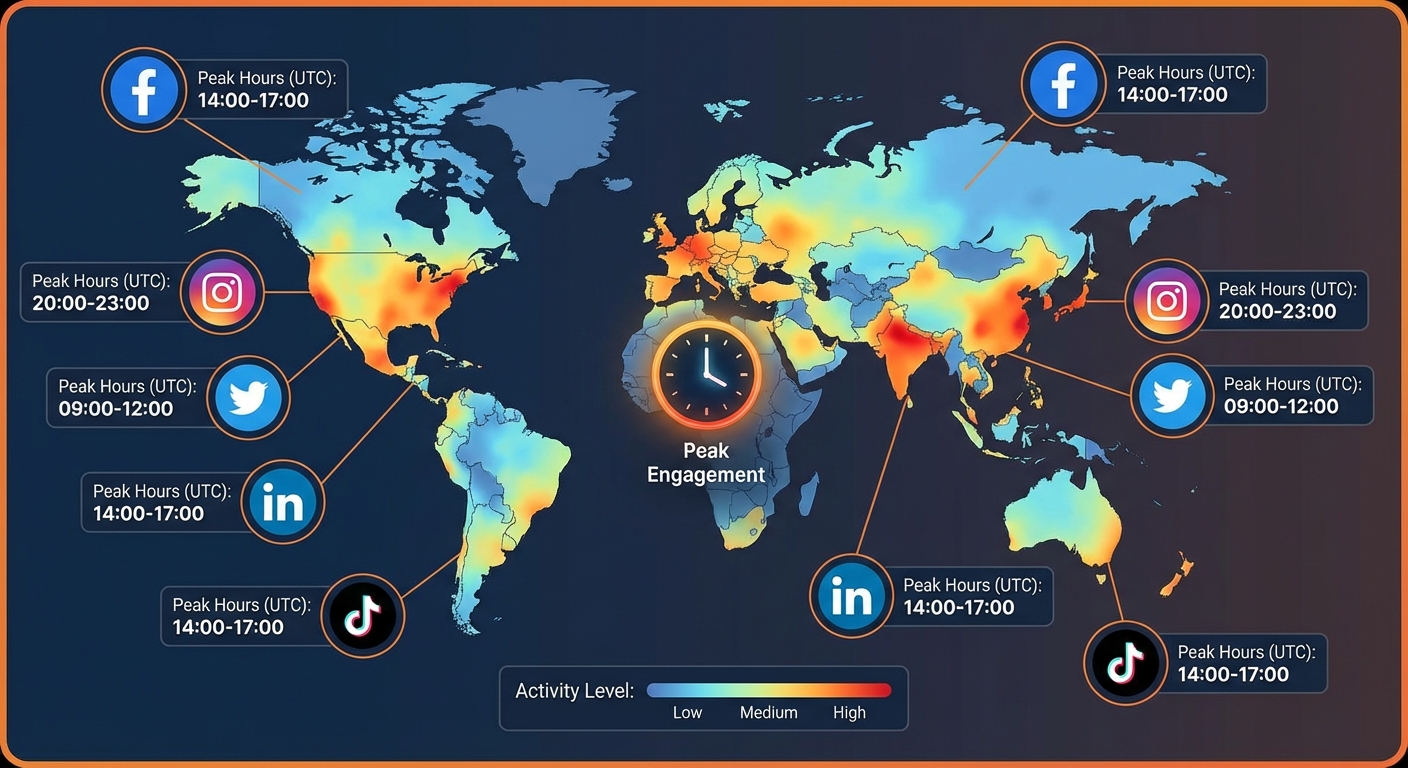
- Best posting times: Tuesday and Thursday, 8:00–10:00 AM; Noon 12:00 PM
- Secondary windows: Wednesday mornings
- Low-performance periods: Weekends (unless content is workplace-reflection style "Friday thoughts" — those actually get higher engagement)
Operational tip: LinkedIn doesn't need the same posting frequency as IG or TikTok — 3–5 posts per week is enough to maintain visibility. Content quality and professional depth matter more than frequency. Recommend posting long-form articles during weekday mornings, and short posts/opinion pieces on Monday mornings — professionals' browsing appetite is strongest when starting a new week.
How to Find Your Own Best Times
Industry benchmarks are a starting point, not a destination. Truly effective posting times come from your own account's audience data.
Step 1: Check native platform Insights/Analytics to find your followers' activity distribution by hour. All major platforms provide this.
Step 2: For 4–6 consecutive weeks, post content during recommended windows and record each post's publish time along with engagement data (likes, comments, shares, reach).
Step 3: Analyze the data to find patterns of when engagement rates peak, and build a "custom posting calendar" specific to your account.
Step 4: Review quarterly. Audience habits and algorithm strategies both change — your "best times" aren't set in stone.
Using a unified management tool (like SocialEcho) lets you handle scheduling, publishing, and data collection in one interface — no more platform-hopping — and makes cross-platform data comparison much easier to accumulate.
Closing Thoughts
Finding the best posting time isn't a mystery — it's math. But data has to come from practice, not just industry reports.
Finding the posting rhythm that fits your account is worth more than chasing trends or obsessing over "am I posting enough." Get the timing right, and your content can work twice as hard with half the effort.
FAQ
Q: How do I handle audiences across multiple time zones?
A: If your audience is spread across multiple time zones, prioritize the time zone where followers are most concentrated, or choose a window where two time zones overlap (e.g., US East Coast + Europe: the crossover of UTC-5 and UTC+1 is roughly 2:00–4:00 PM UTC).
Q: Is there a daily post limit?
A: Platforms don't set hard limits, but posting too frequently causes each post's distributed reach to be diluted. Instagram Feed recommends 1–2 per day.
Related features: Instagram Multi-Account Management · TikTok Multi-Account Management · Facebook Multi-Account Management · X/Twitter Management · YouTube Management · LinkedIn Management

TikTok can go 1–3 times per day, and X has no frequency limit but keep quality high.
Q: Is there a difference between scheduled and manual posting?
A: Platforms don't treat them differently — results depend on how many of your followers are online when the post goes live, regardless of whether you scheduled it with a tool or posted manually.
;}.cls-2{fill:%230868f7;}.cls-3{fill:url(%23未命名的渐变_44);}.cls-4{fill:%23333;}%3c/style%3e%3clinearGradient%20id='未命名的渐变_8'%20x1='33.73'%20y1='100.61'%20x2='-0.03'%20y2='-1.06'%20gradientUnits='userSpaceOnUse'%3e%3cstop%20offset='0'%20stop-color='%237ae9fb'/%3e%3cstop%20offset='0.67'%20stop-color='%232b90f8'/%3e%3cstop%20offset='1'%20stop-color='%230868f7'/%3e%3c/linearGradient%3e%3clinearGradient%20id='未命名的渐变_44'%20x1='27.86'%20y1='18.67'%20x2='68.36'%20y2='22.22'%20gradientUnits='userSpaceOnUse'%3e%3cstop%20offset='0'%20stop-color='%235ac7f2'/%3e%3cstop%20offset='1'%20stop-color='%230868f7'/%3e%3c/linearGradient%3e%3c/defs%3e%3cpath%20class='cls-1'%20d='M29,28.74V81.91l-9.51-3.68v0L8.52,74A7.17,7.17,0,0,1,4,67.32V24.54A3.76,3.76,0,0,1,9.08,21Z'/%3e%3cpath%20class='cls-2'%20d='M68.09,78.07a13.15,13.15,0,0,1-17.9,12.06L29,81.91h0V28.74L50.19,37A13.17,13.17,0,0,0,68.08,25.3h0Z'/%3e%3cpath%20class='cls-3'%20d='M68.08,25.3a13.19,13.19,0,0,1-6.73,10.87A13.09,13.09,0,0,1,50.19,37L29,28.74V6A3.76,3.76,0,0,1,34.1,2.52l25.59,9.91A13.22,13.22,0,0,1,68.08,25.3Z'/%3e%3cpath%20class='cls-4'%20d='M129.06,81.76a4.33,4.33,0,0,1-3.19-1.31,4.4,4.4,0,0,1-1.31-3.24V56.86H97.65V77.21a4.36,4.36,0,0,1-1.35,3.2A4.68,4.68,0,0,1,93,81.76a4.32,4.32,0,0,1-3.19-1.31,4.37,4.37,0,0,1-1.32-3.24V27.27A4.58,4.58,0,0,1,89.83,24a4.59,4.59,0,0,1,7.82,3.27V48.15h26.91V27.27A4.58,4.58,0,0,1,125.91,24a4.59,4.59,0,0,1,7.82,3.27V77.21a4.37,4.37,0,0,1-1.36,3.2A4.65,4.65,0,0,1,129.06,81.76Z'/%3e%3cpath%20class='cls-4'%20d='M163.77,81.66c-6.57,0-11.76-1.92-15.44-5.7s-5.54-9.07-5.54-15.74a26.76,26.76,0,0,1,2.09-10.43,17.72,17.72,0,0,1,6.67-8.06,19.15,19.15,0,0,1,10.68-2.95,19,19,0,0,1,10.46,2.8,18.7,18.7,0,0,1,6.55,7.36,22.53,22.53,0,0,1,2.36,10.28A4.51,4.51,0,0,1,177,63.77H152.23a10.8,10.8,0,0,0,3.49,6.65c2,1.68,4.88,2.52,8.66,2.52a22.25,22.25,0,0,0,7.54-1.21c.74-.3,1.55-.67,2.37-1.07a3.75,3.75,0,0,1,1.84-.4,4.09,4.09,0,0,1,3,1.15,4,4,0,0,1,1.12,3,4.38,4.38,0,0,1-2.58,3.82,32.34,32.34,0,0,1-6.36,2.61A28.67,28.67,0,0,1,163.77,81.66ZM172.4,55.9a9.72,9.72,0,0,0-1.63-4.56A9.9,9.9,0,0,0,167,48a10.38,10.38,0,0,0-4.64-1.14,12,12,0,0,0-4.77,1.06,9.54,9.54,0,0,0-4.89,5.66,11.78,11.78,0,0,0-.51,2.3Z'/%3e%3cpath%20class='cls-4'%20d='M193,81.64a4.49,4.49,0,0,1-4.51-4.55V27.28A4.58,4.58,0,0,1,189.84,24a4.48,4.48,0,0,1,3.28-1.36A4.36,4.36,0,0,1,196.35,24a4.46,4.46,0,0,1,1.31,3.31V77.09a4.34,4.34,0,0,1-1.35,3.2A4.67,4.67,0,0,1,193,81.64Z'/%3e%3cpath%20class='cls-4'%20d='M263.79,81.71a5.7,5.7,0,0,1-4.2-1.74,5.76,5.76,0,0,1-1.73-4.19V27.37a4.58,4.58,0,0,1,1.35-3.27A4.59,4.59,0,0,1,267,27.37V72.53h24a4.58,4.58,0,0,1,3.27,7.82A4.66,4.66,0,0,1,291,81.71Z'/%3e%3cpath%20class='cls-4'%20d='M424.48,81.74a4.71,4.71,0,0,1-2.71-.88,5.43,5.43,0,0,1-1-1l-.07-.09-12.41-17-5.41,5v9.44a4.31,4.31,0,0,1-1.36,3.19,4.66,4.66,0,0,1-3.3,1.36A4.29,4.29,0,0,1,395,80.42a4.36,4.36,0,0,1-1.32-3.23V27.37A4.58,4.58,0,0,1,395,24.1a4.52,4.52,0,0,1,6.58.12,4.54,4.54,0,0,1,1.24,3.15V56.31l17.72-16.38.05,0a4.8,4.8,0,0,1,2.94-1.11,4.4,4.4,0,0,1,3.27,1.2,4.57,4.57,0,0,1,1.2,3.27,4.44,4.44,0,0,1-.77,2.33,7.45,7.45,0,0,1-1.43,1.65l-11,9.64,13.34,17.68a5,5,0,0,1,1,2.71,4.12,4.12,0,0,1-1.36,3.24A4.64,4.64,0,0,1,424.48,81.74Z'/%3e%3cpath%20class='cls-4'%20d='M317.93,81.76a21.5,21.5,0,1,1,21.17-21.5A21.37,21.37,0,0,1,317.93,81.76Zm0-34.1a12.61,12.61,0,1,0,12.42,12.6A12.52,12.52,0,0,0,317.93,47.66Z'/%3e%3cpath%20class='cls-4'%20d='M212.18,101.22a4.12,4.12,0,0,1-3.05-1.26,4.17,4.17,0,0,1-1.26-3.1V43.34a4.37,4.37,0,0,1,1.3-3.14,4.26,4.26,0,0,1,3.13-1.3,4.19,4.19,0,0,1,3.1,1.26,4.32,4.32,0,0,1,1.26,3.16,20.77,20.77,0,0,1,13-4.54,21.51,21.51,0,0,1,0,43,20.51,20.51,0,0,1-13-4.57V96.86a4.15,4.15,0,0,1-1.3,3.06A4.5,4.5,0,0,1,212.18,101.22Zm17.43-53.63c-6.23,0-12.93,4.11-12.93,12.72a12.73,12.73,0,0,0,25.46,0A12.71,12.71,0,0,0,229.61,47.59Z'/%3e%3cpath%20class='cls-4'%20d='M365.76,81.76a21.5,21.5,0,1,1,21.18-21.5A21.37,21.37,0,0,1,365.76,81.76Zm0-34.1a12.61,12.61,0,1,0,12.42,12.6A12.52,12.52,0,0,0,365.76,47.66Z'/%3e%3c/svg%3e)