
The content you spent two hours creating lost half its engagement because it was posted at the wrong time.
The content you spent two hours creating lost half its engagement because it was posted at the wrong time.

You think that just sending it out is enough?
On Tuesday afternoon at 1 p.m., you spent two whole hours editing a TikTok video—the background music was perfectly timed, you made three versions of the cover image, and revised the text six times. You posted it, and then went to get a coffee.
When I came back and checked, the number of views hadn't even reached 1,000.
You open Instagram and repost the same content. This time, you added a caption, adjusted the aspect ratio, and it looks much better. But the comment section is completely silent.
Then you open YouTube Shorts, change the cover image, and post it again.
Three platforms, the same day, the same content, three efforts—resulting in three mediocre results.
Most people fall into a misconception at this point: Is the content not good enough? Should the cover be changed? Should the copy be rewritten?
But anyone who has experience operating multiple platforms knows that the pitfall you encountered had little to do with content quality. The mistake you made occurred the moment you clicked "publish"—you had no idea whether your target audience was online at that time.
The timing of a release is much more complicated than you might imagine.
TikTok, Instagram, and YouTube—each platform has its own peak user periods—this is not new knowledge.
The problem is that peak periods are not static.
In 2026, user behavior on the platforms underwent a significant shift. TikTok's evening peak hours are gradually shifting from 8:00 PM to 10:00 PM Eastern Time, due to the continued growth of the user base in Southeast Asia and the Middle East, resulting in an overall activity window that is about 1.5 hours later than in 2024. Instagram Reels, on the other hand, exhibits a distinct "bimodal structure"—fragmented, scrolling traffic from 7:00 AM to 9:00 AM and deep engagement traffic from 9:00 PM to 11:00 PM, with two distinctly different audience characteristics.
What's more complicated is that this peak period is also related to your account type, fan demographics, and content format. The optimal posting time for a LinkedIn account targeting tech professionals on the US West Coast and an Instagram account targeting Southeast Asian consumers might differ by as much as nine hours.
You can track your fans' active periods in real time through TikTok data analytics , instead of guessing based on feelings.
You manage five platforms by yourself, and each platform has more than one account—how do you remember all of them?
The answer is usually: I can't remember, so I just send whatever comes to mind, and then I complain that the algorithm is unfair.
How important is the time window? Three layers of conflict will make it clear.
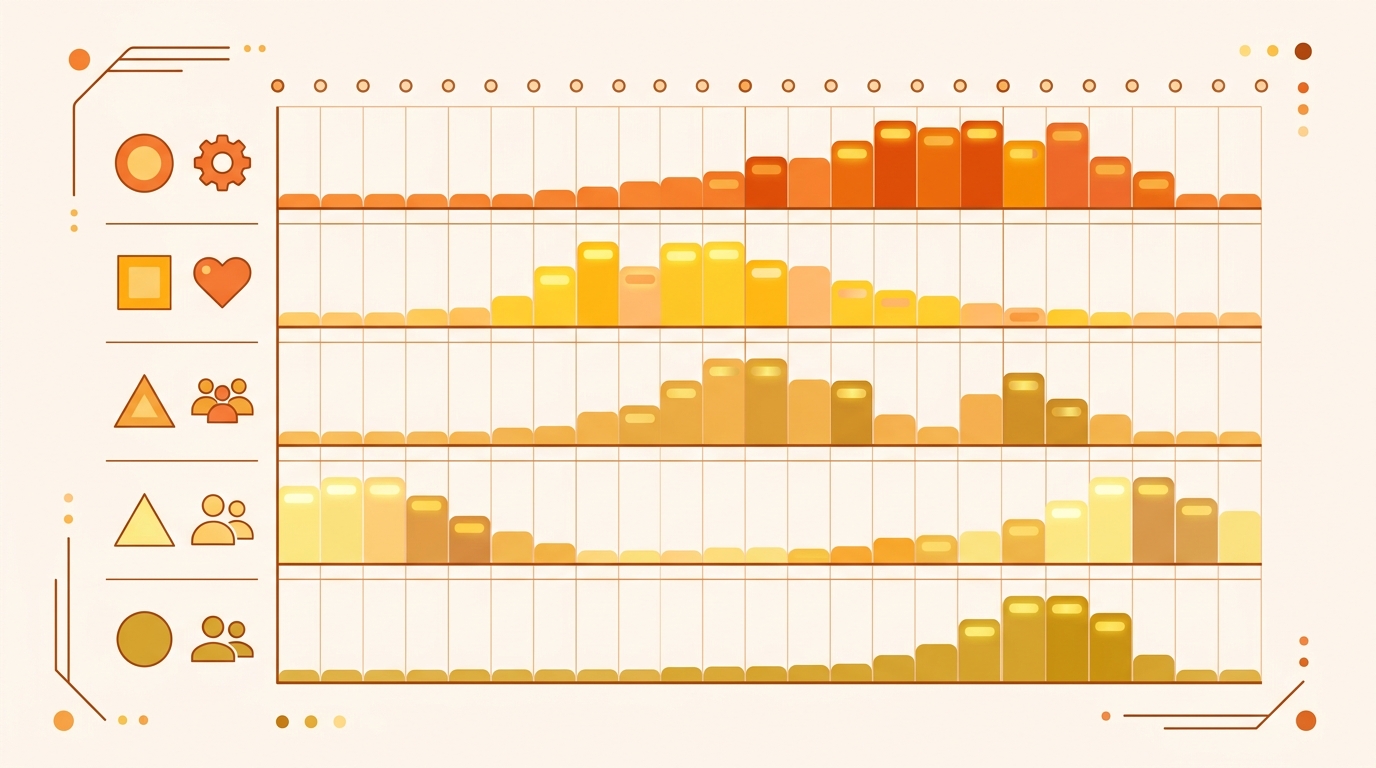
First layer: Algorithm window
There is a key consensus in the streaming logic of TikTok and Instagram: in the first 30-60 minutes after content is published, the algorithm will decide whether to continue to expand the push based on the early interaction rate (completion rate, likes, comments, shares).
This means that if you publish content when your audience is sleeping, the engagement rate in the first 60 minutes will inevitably be dismal. The algorithm will judge the content as "unpopular," and the promotion ceiling will be locked. Even if your fans are online in the afternoon, the algorithm will no longer give the content a chance.
The content is fine, but you've put it in an empty room—that's the problem.
Second layer: Competition for attention
Creators managing five platforms face not only algorithms but also the attention market.
Every day from 5 PM to 7 PM is the peak time for content creation globally—because everyone knows this is the "evening rush hour." Your content needs to compete for streaming resources during this period, and your competitors aren't just ordinary users, but tens of thousands of creators posting at the same time.
The counterintuitive approach is to release content early, around times when competition is low and peak audience reach is approaching. For example, 20 minutes before the morning rush hour, or an hour after competitors have released their content. Most tools' "AI-powered best time recommendation" features don't cover this level of detail—because they provide platform averages, not a personalized window for your account.
The third layer: The real situation across time zones
A creator who expands overseas typically targets audiences in multiple regions simultaneously.
Your Instagram account has 30% of its followers in the US, 40% in Southeast Asia, and 20% in the Middle East. These three regions have overlapping and even conflicting activity peaks. The so-called "best time to post" doesn't exist for you—what you need is the "time of least damage," or a differentiated scheduling strategy for accounts in different regions.
This is no longer something that one person can manage with their brain.
The solution used by most people, and why it only solves 30% of the problems.
Once creators realize the importance of release timing, they typically do two things:
First, check the platform's official "fan activity time" data. Every platform has this function in its backend; TikTok Analytics and Instagram Insights both show peak fan activity times.
This is useful, but not enough. The reason is that the platform's backend provides "fan activity time," not "the optimal time for the algorithm to push content to non-fans after posting." In the early stages, accounts have few fans, so the data on fan activity time is inherently unstable; during the growth phase, accounts rely on expanding their reach, and the key is to target the activity window of non-fan users, not existing fans.
The second point is to use tools to set up scheduled publishing. This is the right direction, but most tools implement it by giving a fixed "suggested time" and then letting you manually set the date and time. If you manage 8 accounts and have to set the time for each piece of content in 8 different places, this actually becomes a new form of repetitive work.
What's more troublesome is that the scheduling across platforms is fragmented. Your TikTok and Instagram timers are set on two separate screens, so you can't see in one place whether the weekly posting schedule is reasonable, whether there are time window conflicts, or whether a platform has stopped posting.
The truly useful solution is to turn "timing" into a system.
Anyone who has managed more than five platforms knows that the timing of releases is fundamentally an information integration issue .
What you need is not to monitor the backend more diligently, but a system that can aggregate the "best release time for each platform" into your workflow.
Specifically, there are two things that need to be done simultaneously:
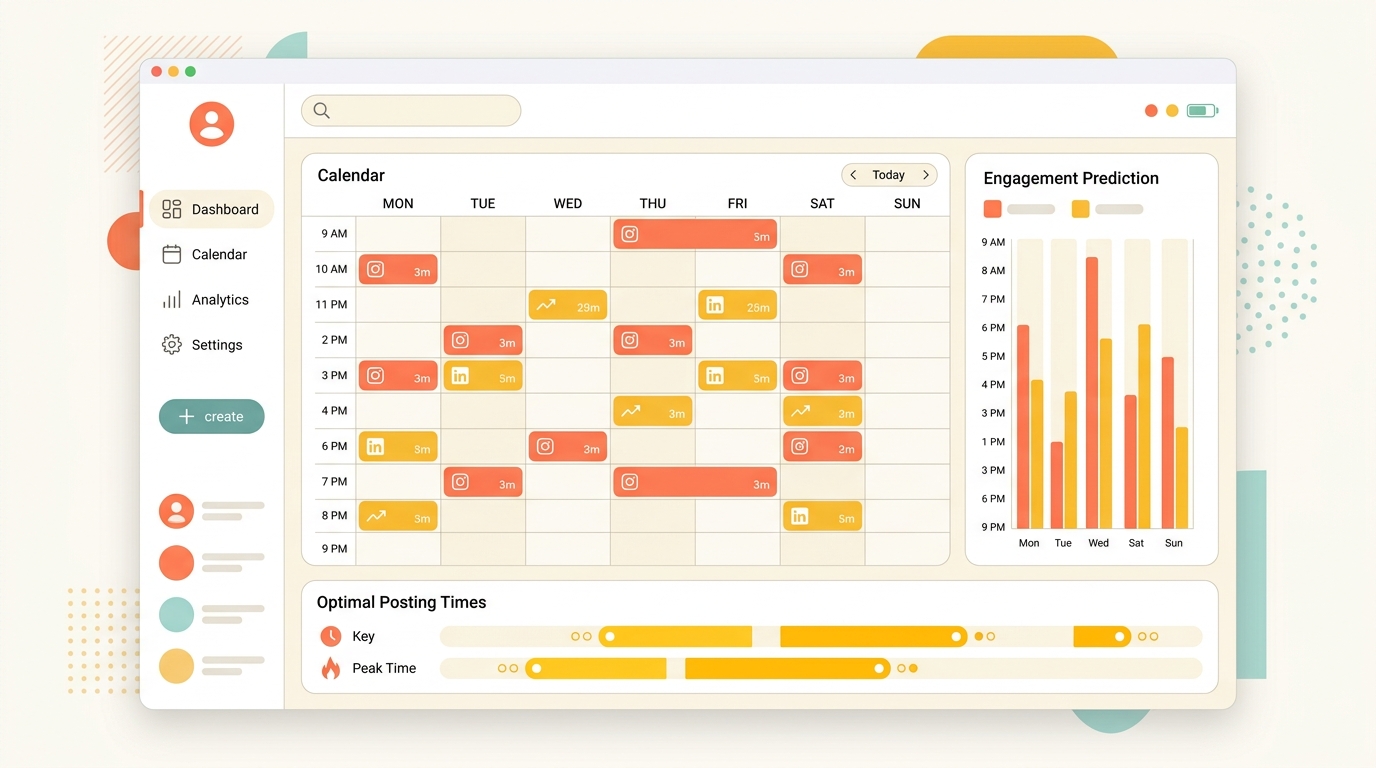
First, it integrates the schedules of multiple platforms into a single interface. You should be able to see in a calendar view: what the daily posting schedules are for TikTok, Instagram, Facebook, X, and LinkedIn this week, which time slots are available, and which platforms have had no content for three consecutive days. This bird's-eye view is something that single-platform operation simply cannot provide.
Secondly, use AI data analysis to assist in timing decisions, rather than relying on memory and guesswork. What you need to know is not the "best time to publish across the entire internet," but rather the historically best-performing time periods for your account, your audience, and this type of content. This needs to be discovered through your own data analysis , not copied from industry reports.
Third, AI can be used to automate batch processing of scheduling tasks. When you need to manage the posting times of multiple accounts at the same time, AI can automatically recommend the optimal time window for each account based on historical data and generate a weekly schedule with one click, automating the repetitive decisions that were originally done every day.
SocialEcho's scheduled publishing feature supports unified scheduling across multiple platforms and accounts. You can set the publishing schedule for all content this week on a single interface, eliminating the need to operate separately on eight different platform backends. Combined with platform data analytics, it allows you to clearly see the differences in content performance at different times, gradually finding a publishing rhythm suitable for your account.
For creators managing multiple platforms, the core issue that multi-account management addresses is not "can I manage them all?", but rather "can I make better timing judgments without fragmenting information?"
SocialEcho currently offers a basic version starting at 12.5/month** and **a team version starting at 18.75/month , with a 20% discount for annual payments. For creators managing a matrix of 5-8 platforms, the amount of content saved in a month far exceeds the cost of the tool itself.
Things that can be done now
If you currently manage more than 3 platform accounts, there's one specific thing you can do this week:
Open the backend data for each platform (TikTok Analytics / Instagram Insights / YouTube Analytics) and find the distribution of fan activity times. Then compare this to your posting time records over the past 30 days to see how many posts were published outside of peak fan activity times.
This number often leaves you speechless for 3 seconds.
After seeing this data, most creators will realize that it's not that their content is bad, but that they sent their good content to the wrong time slot, wasting the algorithm's first wave of push opportunities.
The change starts here: treat publishing time as part of content production, not as a button clicked afterward.
FAQ
Q: Is the optimal release time fixed for each platform?
It's not fixed. The platform's user structure, your fan demographics, and content type all influence the optimal posting window, and these factors change over time. The peak period in 2026 was significantly different from that in 2024, so it's recommended to review your account's data quarterly.
Q: Is the "AI-recommended release time" feature reliable?
It depends on the basis of the data. AI suggestions based on your account's historical data are more accurate than those based on platform averages. New accounts can refer to platform averages, but once they have more than 1,000 followers, they should start making judgments based on their own data.
Q: How should posting timing be handled for accounts that span different time zones?
It is recommended to manage accounts based on the primary target audience's region, and set the optimal window for each regional account in the corresponding time zone. If an account's audience is spread across multiple time zones, choose the compromise time that minimizes the impact, or create differentiated story/post schedules for audiences in different time zones.
Q: Will scheduled posting affect the natural reach of content?
No. All platforms support scheduled publishing of API interfaces, using the same push mechanism as manual publishing. Content published through tools with official OAuth 2.0 security certification (such as SocialEcho) will not be affected by platform risk control. SocialEcho Basic starts at 12.5/month and supports scheduled publishing across multiple platforms; Team Edition starts at 18.75/month and also supports collaborative workflows and batch scheduling; annual payments receive a 20% discount.
Q: How much time does it take for one person to manage 8 accounts and schedule the process?
Using a unified scheduling tool, batch scheduling is set up weekly, and content plans for all platforms can typically be completed within one hour. This saves more than 70% of the time compared to manually publishing to each platform one by one.
Q: Which is more important, release frequency or release timing?
Both are important, but with different priorities. For accounts in the initial stages, prioritize maintaining frequency (continuous output); for accounts in a stable phase, prioritize optimizing timing (precise window). If you can only choose one, it's recommended to stabilize the posting frequency first, and then gradually optimize the timing.
Q: How can I quickly determine which time period is best for my account?
The simplest method: Over two weeks, post 3-5 pieces of content of equal quality at different times and compare the interaction data (completion rate, likes/plays ratio). Let your own account data speak for itself, rather than relying on online "best schedules".
Try SocialEcho for free now and manage your multi-platform schedules to find the best posting rhythm for your account.
👉 https://www.socialecho.cn
;}.cls-2{fill:%230868f7;}.cls-3{fill:url(%23未命名的渐变_44);}.cls-4{fill:%23333;}%3c/style%3e%3clinearGradient%20id='未命名的渐变_8'%20x1='33.73'%20y1='100.61'%20x2='-0.03'%20y2='-1.06'%20gradientUnits='userSpaceOnUse'%3e%3cstop%20offset='0'%20stop-color='%237ae9fb'/%3e%3cstop%20offset='0.67'%20stop-color='%232b90f8'/%3e%3cstop%20offset='1'%20stop-color='%230868f7'/%3e%3c/linearGradient%3e%3clinearGradient%20id='未命名的渐变_44'%20x1='27.86'%20y1='18.67'%20x2='68.36'%20y2='22.22'%20gradientUnits='userSpaceOnUse'%3e%3cstop%20offset='0'%20stop-color='%235ac7f2'/%3e%3cstop%20offset='1'%20stop-color='%230868f7'/%3e%3c/linearGradient%3e%3c/defs%3e%3cpath%20class='cls-1'%20d='M29,28.74V81.91l-9.51-3.68v0L8.52,74A7.17,7.17,0,0,1,4,67.32V24.54A3.76,3.76,0,0,1,9.08,21Z'/%3e%3cpath%20class='cls-2'%20d='M68.09,78.07a13.15,13.15,0,0,1-17.9,12.06L29,81.91h0V28.74L50.19,37A13.17,13.17,0,0,0,68.08,25.3h0Z'/%3e%3cpath%20class='cls-3'%20d='M68.08,25.3a13.19,13.19,0,0,1-6.73,10.87A13.09,13.09,0,0,1,50.19,37L29,28.74V6A3.76,3.76,0,0,1,34.1,2.52l25.59,9.91A13.22,13.22,0,0,1,68.08,25.3Z'/%3e%3cpath%20class='cls-4'%20d='M129.06,81.76a4.33,4.33,0,0,1-3.19-1.31,4.4,4.4,0,0,1-1.31-3.24V56.86H97.65V77.21a4.36,4.36,0,0,1-1.35,3.2A4.68,4.68,0,0,1,93,81.76a4.32,4.32,0,0,1-3.19-1.31,4.37,4.37,0,0,1-1.32-3.24V27.27A4.58,4.58,0,0,1,89.83,24a4.59,4.59,0,0,1,7.82,3.27V48.15h26.91V27.27A4.58,4.58,0,0,1,125.91,24a4.59,4.59,0,0,1,7.82,3.27V77.21a4.37,4.37,0,0,1-1.36,3.2A4.65,4.65,0,0,1,129.06,81.76Z'/%3e%3cpath%20class='cls-4'%20d='M163.77,81.66c-6.57,0-11.76-1.92-15.44-5.7s-5.54-9.07-5.54-15.74a26.76,26.76,0,0,1,2.09-10.43,17.72,17.72,0,0,1,6.67-8.06,19.15,19.15,0,0,1,10.68-2.95,19,19,0,0,1,10.46,2.8,18.7,18.7,0,0,1,6.55,7.36,22.53,22.53,0,0,1,2.36,10.28A4.51,4.51,0,0,1,177,63.77H152.23a10.8,10.8,0,0,0,3.49,6.65c2,1.68,4.88,2.52,8.66,2.52a22.25,22.25,0,0,0,7.54-1.21c.74-.3,1.55-.67,2.37-1.07a3.75,3.75,0,0,1,1.84-.4,4.09,4.09,0,0,1,3,1.15,4,4,0,0,1,1.12,3,4.38,4.38,0,0,1-2.58,3.82,32.34,32.34,0,0,1-6.36,2.61A28.67,28.67,0,0,1,163.77,81.66ZM172.4,55.9a9.72,9.72,0,0,0-1.63-4.56A9.9,9.9,0,0,0,167,48a10.38,10.38,0,0,0-4.64-1.14,12,12,0,0,0-4.77,1.06,9.54,9.54,0,0,0-4.89,5.66,11.78,11.78,0,0,0-.51,2.3Z'/%3e%3cpath%20class='cls-4'%20d='M193,81.64a4.49,4.49,0,0,1-4.51-4.55V27.28A4.58,4.58,0,0,1,189.84,24a4.48,4.48,0,0,1,3.28-1.36A4.36,4.36,0,0,1,196.35,24a4.46,4.46,0,0,1,1.31,3.31V77.09a4.34,4.34,0,0,1-1.35,3.2A4.67,4.67,0,0,1,193,81.64Z'/%3e%3cpath%20class='cls-4'%20d='M263.79,81.71a5.7,5.7,0,0,1-4.2-1.74,5.76,5.76,0,0,1-1.73-4.19V27.37a4.58,4.58,0,0,1,1.35-3.27A4.59,4.59,0,0,1,267,27.37V72.53h24a4.58,4.58,0,0,1,3.27,7.82A4.66,4.66,0,0,1,291,81.71Z'/%3e%3cpath%20class='cls-4'%20d='M424.48,81.74a4.71,4.71,0,0,1-2.71-.88,5.43,5.43,0,0,1-1-1l-.07-.09-12.41-17-5.41,5v9.44a4.31,4.31,0,0,1-1.36,3.19,4.66,4.66,0,0,1-3.3,1.36A4.29,4.29,0,0,1,395,80.42a4.36,4.36,0,0,1-1.32-3.23V27.37A4.58,4.58,0,0,1,395,24.1a4.52,4.52,0,0,1,6.58.12,4.54,4.54,0,0,1,1.24,3.15V56.31l17.72-16.38.05,0a4.8,4.8,0,0,1,2.94-1.11,4.4,4.4,0,0,1,3.27,1.2,4.57,4.57,0,0,1,1.2,3.27,4.44,4.44,0,0,1-.77,2.33,7.45,7.45,0,0,1-1.43,1.65l-11,9.64,13.34,17.68a5,5,0,0,1,1,2.71,4.12,4.12,0,0,1-1.36,3.24A4.64,4.64,0,0,1,424.48,81.74Z'/%3e%3cpath%20class='cls-4'%20d='M317.93,81.76a21.5,21.5,0,1,1,21.17-21.5A21.37,21.37,0,0,1,317.93,81.76Zm0-34.1a12.61,12.61,0,1,0,12.42,12.6A12.52,12.52,0,0,0,317.93,47.66Z'/%3e%3cpath%20class='cls-4'%20d='M212.18,101.22a4.12,4.12,0,0,1-3.05-1.26,4.17,4.17,0,0,1-1.26-3.1V43.34a4.37,4.37,0,0,1,1.3-3.14,4.26,4.26,0,0,1,3.13-1.3,4.19,4.19,0,0,1,3.1,1.26,4.32,4.32,0,0,1,1.26,3.16,20.77,20.77,0,0,1,13-4.54,21.51,21.51,0,0,1,0,43,20.51,20.51,0,0,1-13-4.57V96.86a4.15,4.15,0,0,1-1.3,3.06A4.5,4.5,0,0,1,212.18,101.22Zm17.43-53.63c-6.23,0-12.93,4.11-12.93,12.72a12.73,12.73,0,0,0,25.46,0A12.71,12.71,0,0,0,229.61,47.59Z'/%3e%3cpath%20class='cls-4'%20d='M365.76,81.76a21.5,21.5,0,1,1,21.18-21.5A21.37,21.37,0,0,1,365.76,81.76Zm0-34.1a12.61,12.61,0,1,0,12.42,12.6A12.52,12.52,0,0,0,365.76,47.66Z'/%3e%3c/svg%3e)