
How different are the two accounts operated by the same persona on Douyin and TikTok?
Douyin vs. TikTok: How different are the two accounts operated by the same persona?
The core principle is that the operational strategies for the same persona must be completely different on Douyin and TikTok because the user groups, algorithm logic, and monetization paths of the two platforms are at different stages of development.
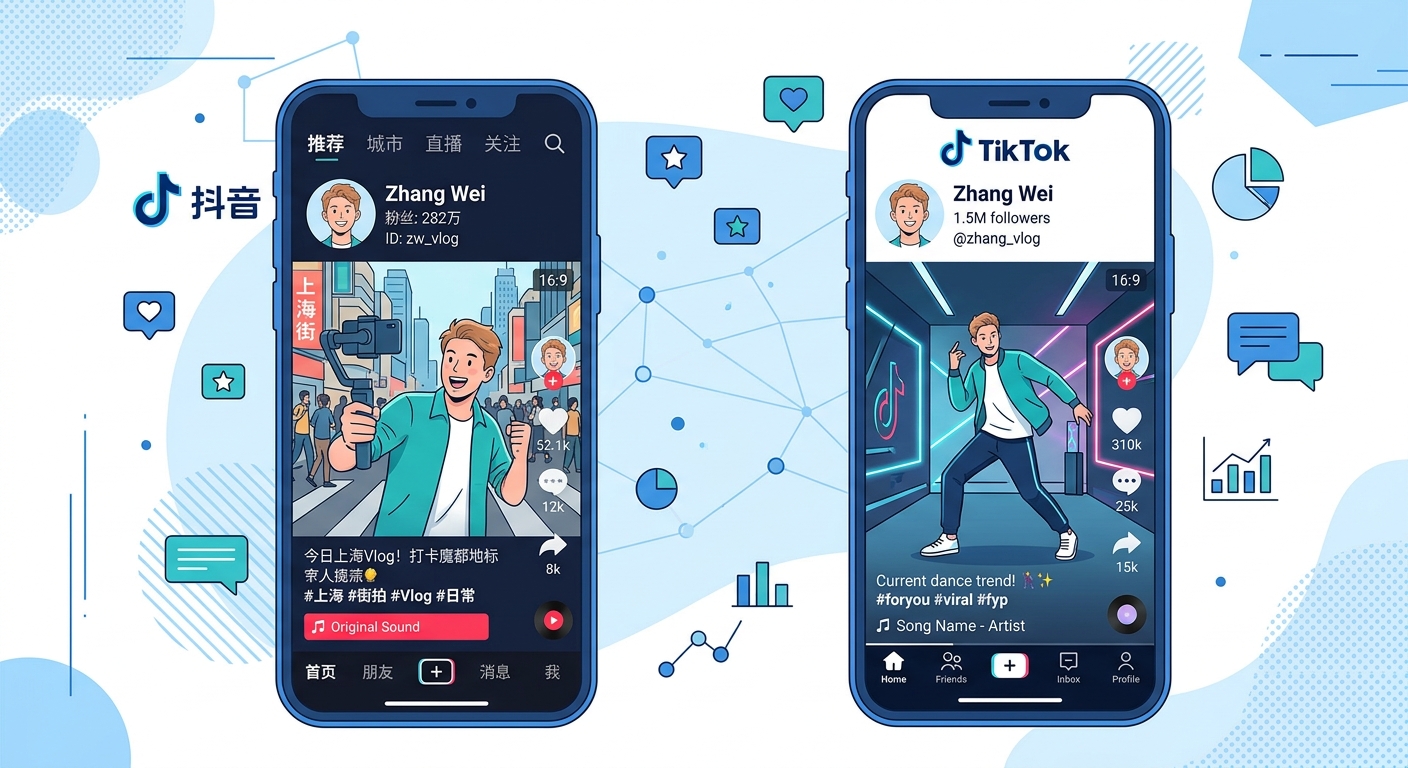 He posted the same content on two platforms, but the results were ten times worse.
Chen Mo is a content creator who focuses on workplace skills. He has 300,000 followers on Douyin. His content style is "explaining a workplace communication skill in 3 minutes". Each video has an average of 50,000 to 100,000 views.
In the middle of last year, he decided to start a TikTok account and directly copied dozens of the best-performing videos from Douyin (TikTok) to the platform—the same content, the same cover, with English subtitles added before posting them.
The result puzzled him for a long time: the content performed poorly on TikTok, mostly getting only a few hundred views with no improvement whatsoever. At first, he thought it was a problem with the account's authority, then he thought it was a problem with the quality of the English subtitles, and finally, by comparing it with competing accounts, he realized that the users of the two platforms were not the same group of people at all, and their expectations for content were completely different.
In this article, we will carefully analyze the operational differences between Douyin and TikTok from three dimensions: content format, algorithm logic, and monetization path, and how to make the same persona work on both platforms simultaneously.
User groups: superficially similar, but fundamentally different
Let's start with the users, because they determine how the content needs to be presented.
Douyin users (2025 data) : Over 700 million monthly active users, with the core user group concentrated in the 18-35 age group. The penetration rate is high in first- and second-tier cities, with strong purchasing power and highly mature content consumption preferences. They spend more than 1 hour a day on Douyin, expecting content to be "useful, interesting, and resonant," and have a very high immunity to pure advertising content.
TikTok users (2025 data) : Over 1.2 billion monthly active users, distributed in 150+ countries. The largest user group is in the United States, Southeast Asia, and Europe. The age distribution is more skewed towards Generation Z aged 18-24. Their content consumption habits are more impulsive and quick, with a higher demand for "novelty" and relatively less patience for "in-depth content".
The core difference between these two user groups is that Douyin users have been "trained" to be very discerning with high-quality content, and they have high requirements for information density and content quality; TikTok has a larger global user base, but the average attention window is shorter, and "capturing" people is more important than "educating" them.
Algorithm logic: Same root, different branches
Douyin and TikTok originated from the same underlying technology, but after several years of independent operation, their algorithm logic has become significantly different.
Douyin Algorithm: Tiered Traffic Pool, Emphasis on Content Data
Douyin's streaming logic is the classic "funnel-shaped layering": after new content is released, it first enters a small traffic pool (usually a few hundred to a few thousand). Based on data such as completion rate, like rate, and comment rate, it is decided whether to enter a larger traffic pool, and so on to increase traffic.
On Douyin, completion rate and like rate are the most crucial indicators . Researchers, through extensive A/B testing, have found that Douyin places relatively less weight on "strong relationship interactions" (comments, private messages) and prioritizes "content consumption behavior" (watching and rewatching). This means that the core of Douyin success is getting users to finish watching, and even rewatch.
Furthermore, Douyin's hashtag (#) system and search engine are strongly integrated—Douyin has become a search tool for young users, with many actively searching for terms like "workplace communication skills" and "Douyin cooking tutorials." This means that keyword placement in content is far more important than on TikTok, and keywords in titles and copy directly impact search visibility.
TikTok Algorithm: Decentralized, Emphasizing "Spread Potential"
TikTok's algorithm is more aggressive. It allocates more initial traffic to new accounts (including those with zero followers) than Douyin, and is more willing to "bet" on the explosive potential of a piece of content. This explains why there are more stories of zero-follower accounts going viral on TikTok than on Douyin.
TikTok's algorithm prioritizes share rate —the number of times a piece of content is shared. This is the primary signal the algorithm uses to determine whether content is worth widespread promotion. Secondly, it considers the quality of comments and interactions (genuine comments are more valuable than emoji comments), and then likes and completion rates.
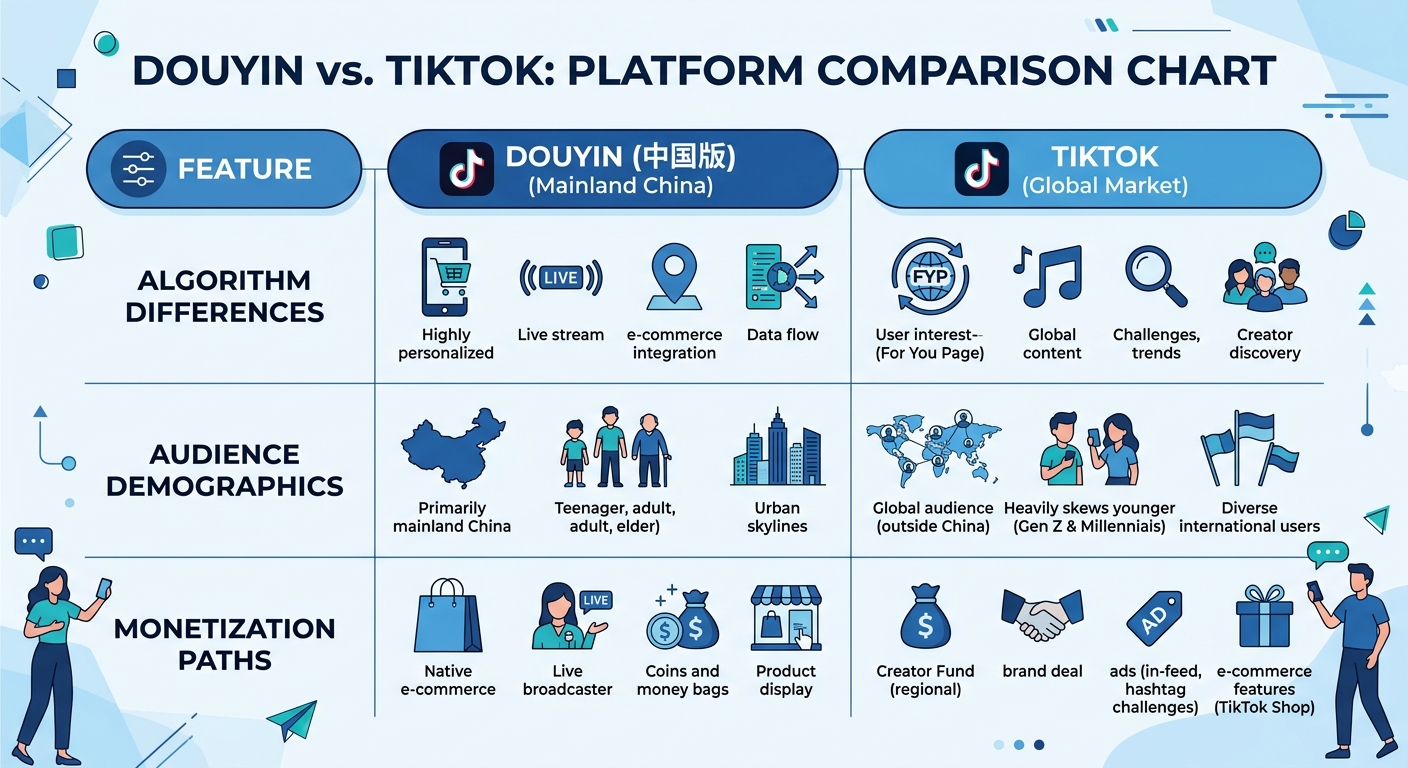 This means that TikTok content needs to have a reason to "get people to share it with their friends"—strong resonance, counterintuitive thinking, and topicality—which is different from Douyin's optimization direction of "getting people to watch it all and rewatch it."
Furthermore, TikTok's language is English (or the target region's language), and its cultural background is globally diverse, which places high demands on the "cross-cultural communicability" of its content. Much content that resonates in a Chinese context loses much of its emotional impact when translated into English; this isn't just a language issue, but a cultural translation problem.
Content format: The differences are bigger than you think.
What format should be used to output the same "workplace skills" persona on two different platforms?
On Douyin , content with high information density and practical value performs best. A 3-minute video explaining 5 techniques, each with a specific scenario and wording, fast-paced editing, and precise subtitles, is ideal. Users come to Douyin to "learn," and content with truly replicable methods will accumulate "save-type users," leading to continuous data accumulation. The golden length for Douyin creators' content is 1-3 minutes ; exceeding 3 minutes significantly increases user churn.
On TikTok : The same "workplace skills" presented in the same pragmatic style are unlikely to gain traction on TikTok. TikTok users prefer emotionally driven content—not "5 tips," but a narrative framework like "I made this mistake at work, and then I changed something." Storytelling is more effective at spreading on TikTok than knowledge-sharing.
The optimal viewing time also varies: TikTok's high-completion-rate videos are concentrated in two ranges: 15-30 seconds and 60-90 seconds . The 30-60 second range in the middle has a lower completion rate. Users either swipe away quickly or are willing to watch the full narrative for more than a minute, but are unwilling to stop in the middle.
In short: Douyin users want "practical content," while TikTok users want "experience." The same persona needs to be told in two different languages.
Monetization Paths: Two Completely Different Ecosystems
This is the part that many matrix creators care about most, and it is also the dimension with the greatest differences.
Douyin's monetization path (highly mature)
TikTok's commercial ecosystem is the most complete among global short video platforms.
Live-streaming e-commerce is the biggest monetization channel. In 2024, Douyin's live-streaming e-commerce GMV exceeded one trillion yuan, and top creators can earn hundreds of thousands to millions of yuan per month through live-streaming. However, the entry barrier is also very high: it requires a source of goods, a live-streaming team, and a stable amount of live-streaming time. For individual creators, a lighter entry path is "video-linked content"—short video content that includes product links, allowing users to buy while watching.
Brand collaborations (advertising) are the second largest channel. Douyin's Star Map platform is the official platform for matching brands and creators. An account with 300,000 followers can receive promotional videos priced between 2,000 and 10,000 yuan each, depending on the account's verticality and engagement rate.
Knowledge-based paid content also has a considerable following on Douyin. Workplace and skills-related accounts can monetize through "paid columns" and "live courses," which provides a relatively stable income structure for creators with the ability to systematically output knowledge.
TikTok's monetization path (rapid development, window of opportunity opening)
TikTok's commercialization ecosystem started about 3-5 years later than Douyin's, but it is catching up rapidly.
TikTok Shop (e-commerce) is growing rapidly in the US, Southeast Asia, and the UK, with GMV exceeding $30 billion in 2024. TikTok is replicating its successful e-commerce model overseas. For creators with sourcing capabilities, this is currently the fastest way to monetize on TikTok.
TikTok Creator Fund and Creator Rewards Program are mechanisms where the platform pays creators directly, calculated based on views. The price is approximately 0.02-0.04 per thousand views. For high-viewership content (such as a video with over 5 million views), creators can receive 100-200. While this amount may not seem high individually, for accounts with a consistent ability to produce viral content, it can create a passive income stream.
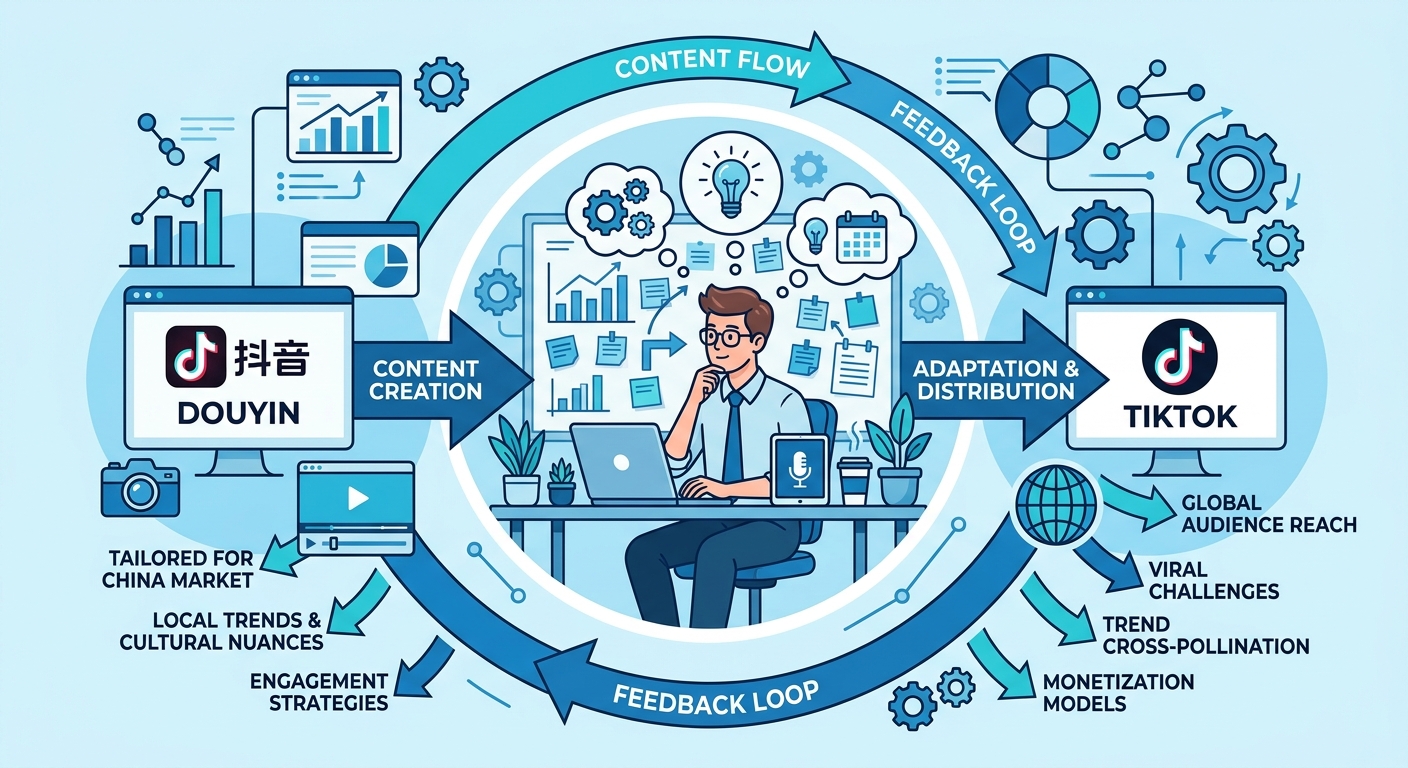 Sponsored content is the main source of income for TikTok creators. Accounts with more than 100,000 followers can usually get brand contracts through the TikTok Creator Marketplace, with prices ranging from a few hundred dollars to tens of thousands of dollars, depending on the size of the account, the category, and the region.
A feasible strategy for operating on two platforms with the same persona.
Having understood the differences, let's answer the most practical question: How can you maintain the same persona on two platforms simultaneously, instead of ruining the other by doing one?
The core principle is to "make the best of both worlds" rather than "reuse and reuse".
For the same topic, two versions were produced in two different styles. For example, on the topic of "workplace communication and refusal skills": on Douyin, a 2-minute video with practical tips was produced, listing 3 effective refusal techniques, with subtitles and a CTA at the end pointing to a paid course; on TikTok, a 60-second story video was produced, starting from my personal experience of "being exhausted because I couldn't say no" and finally giving a core method, with a more casual and emotional tone.
In terms of time allocation, don't try to maintain a high frequency of updates on both platforms simultaneously—this is almost impossible for a solo creator to sustain. A more feasible approach is to post 3-4 times per week on Douyin (the main platform) and 2-3 times per week on TikTok (the growth platform), keeping the total number within a sustainable range.
In terms of tools, multi-account management tools allow you to manage both Douyin and TikTok accounts within a single interface. Scheduled posting allows you to set optimal posting times for both platforms, and data analysis helps you compare the content performance of the two accounts and identify growth patterns on each platform. Competitor monitoring features can track top accounts in the same field on both platforms to see what content strategies they use on different platforms.
Clear advice for matrix creators
If you're currently only on Douyin and considering starting a TikTok account: the answer is yes, but be prepared—TikTok isn't another Douyin, it's a completely different market.
If you are currently working on two platforms but the results are not ideal: first check if you are "copying" content. If so, stop and design content formats that are adapted for each platform.
If you're just starting out and have limited resources, prioritize building a strong presence on one platform until you have over 300,000 followers before starting a second one. Trying to start on two platforms simultaneously often results in failing at both.
Douyin and TikTok are two ecosystems that share the same origin but have taken different paths. Understanding this difference is more important than any content creation technique.
SocialEcho is a social media management tool for matrix creators and brand operation teams. It supports 8 platforms including TikTok, Instagram, and Facebook, and provides features such as multi-account management , data analysis , and scheduled posting to help creators efficiently manage content strategies across multiple platforms.
Free trial: https://www.socialecho.cn
;}.cls-2{fill:%230868f7;}.cls-3{fill:url(%23未命名的渐变_44);}.cls-4{fill:%23333;}%3c/style%3e%3clinearGradient%20id='未命名的渐变_8'%20x1='33.73'%20y1='100.61'%20x2='-0.03'%20y2='-1.06'%20gradientUnits='userSpaceOnUse'%3e%3cstop%20offset='0'%20stop-color='%237ae9fb'/%3e%3cstop%20offset='0.67'%20stop-color='%232b90f8'/%3e%3cstop%20offset='1'%20stop-color='%230868f7'/%3e%3c/linearGradient%3e%3clinearGradient%20id='未命名的渐变_44'%20x1='27.86'%20y1='18.67'%20x2='68.36'%20y2='22.22'%20gradientUnits='userSpaceOnUse'%3e%3cstop%20offset='0'%20stop-color='%235ac7f2'/%3e%3cstop%20offset='1'%20stop-color='%230868f7'/%3e%3c/linearGradient%3e%3c/defs%3e%3cpath%20class='cls-1'%20d='M29,28.74V81.91l-9.51-3.68v0L8.52,74A7.17,7.17,0,0,1,4,67.32V24.54A3.76,3.76,0,0,1,9.08,21Z'/%3e%3cpath%20class='cls-2'%20d='M68.09,78.07a13.15,13.15,0,0,1-17.9,12.06L29,81.91h0V28.74L50.19,37A13.17,13.17,0,0,0,68.08,25.3h0Z'/%3e%3cpath%20class='cls-3'%20d='M68.08,25.3a13.19,13.19,0,0,1-6.73,10.87A13.09,13.09,0,0,1,50.19,37L29,28.74V6A3.76,3.76,0,0,1,34.1,2.52l25.59,9.91A13.22,13.22,0,0,1,68.08,25.3Z'/%3e%3cpath%20class='cls-4'%20d='M129.06,81.76a4.33,4.33,0,0,1-3.19-1.31,4.4,4.4,0,0,1-1.31-3.24V56.86H97.65V77.21a4.36,4.36,0,0,1-1.35,3.2A4.68,4.68,0,0,1,93,81.76a4.32,4.32,0,0,1-3.19-1.31,4.37,4.37,0,0,1-1.32-3.24V27.27A4.58,4.58,0,0,1,89.83,24a4.59,4.59,0,0,1,7.82,3.27V48.15h26.91V27.27A4.58,4.58,0,0,1,125.91,24a4.59,4.59,0,0,1,7.82,3.27V77.21a4.37,4.37,0,0,1-1.36,3.2A4.65,4.65,0,0,1,129.06,81.76Z'/%3e%3cpath%20class='cls-4'%20d='M163.77,81.66c-6.57,0-11.76-1.92-15.44-5.7s-5.54-9.07-5.54-15.74a26.76,26.76,0,0,1,2.09-10.43,17.72,17.72,0,0,1,6.67-8.06,19.15,19.15,0,0,1,10.68-2.95,19,19,0,0,1,10.46,2.8,18.7,18.7,0,0,1,6.55,7.36,22.53,22.53,0,0,1,2.36,10.28A4.51,4.51,0,0,1,177,63.77H152.23a10.8,10.8,0,0,0,3.49,6.65c2,1.68,4.88,2.52,8.66,2.52a22.25,22.25,0,0,0,7.54-1.21c.74-.3,1.55-.67,2.37-1.07a3.75,3.75,0,0,1,1.84-.4,4.09,4.09,0,0,1,3,1.15,4,4,0,0,1,1.12,3,4.38,4.38,0,0,1-2.58,3.82,32.34,32.34,0,0,1-6.36,2.61A28.67,28.67,0,0,1,163.77,81.66ZM172.4,55.9a9.72,9.72,0,0,0-1.63-4.56A9.9,9.9,0,0,0,167,48a10.38,10.38,0,0,0-4.64-1.14,12,12,0,0,0-4.77,1.06,9.54,9.54,0,0,0-4.89,5.66,11.78,11.78,0,0,0-.51,2.3Z'/%3e%3cpath%20class='cls-4'%20d='M193,81.64a4.49,4.49,0,0,1-4.51-4.55V27.28A4.58,4.58,0,0,1,189.84,24a4.48,4.48,0,0,1,3.28-1.36A4.36,4.36,0,0,1,196.35,24a4.46,4.46,0,0,1,1.31,3.31V77.09a4.34,4.34,0,0,1-1.35,3.2A4.67,4.67,0,0,1,193,81.64Z'/%3e%3cpath%20class='cls-4'%20d='M263.79,81.71a5.7,5.7,0,0,1-4.2-1.74,5.76,5.76,0,0,1-1.73-4.19V27.37a4.58,4.58,0,0,1,1.35-3.27A4.59,4.59,0,0,1,267,27.37V72.53h24a4.58,4.58,0,0,1,3.27,7.82A4.66,4.66,0,0,1,291,81.71Z'/%3e%3cpath%20class='cls-4'%20d='M424.48,81.74a4.71,4.71,0,0,1-2.71-.88,5.43,5.43,0,0,1-1-1l-.07-.09-12.41-17-5.41,5v9.44a4.31,4.31,0,0,1-1.36,3.19,4.66,4.66,0,0,1-3.3,1.36A4.29,4.29,0,0,1,395,80.42a4.36,4.36,0,0,1-1.32-3.23V27.37A4.58,4.58,0,0,1,395,24.1a4.52,4.52,0,0,1,6.58.12,4.54,4.54,0,0,1,1.24,3.15V56.31l17.72-16.38.05,0a4.8,4.8,0,0,1,2.94-1.11,4.4,4.4,0,0,1,3.27,1.2,4.57,4.57,0,0,1,1.2,3.27,4.44,4.44,0,0,1-.77,2.33,7.45,7.45,0,0,1-1.43,1.65l-11,9.64,13.34,17.68a5,5,0,0,1,1,2.71,4.12,4.12,0,0,1-1.36,3.24A4.64,4.64,0,0,1,424.48,81.74Z'/%3e%3cpath%20class='cls-4'%20d='M317.93,81.76a21.5,21.5,0,1,1,21.17-21.5A21.37,21.37,0,0,1,317.93,81.76Zm0-34.1a12.61,12.61,0,1,0,12.42,12.6A12.52,12.52,0,0,0,317.93,47.66Z'/%3e%3cpath%20class='cls-4'%20d='M212.18,101.22a4.12,4.12,0,0,1-3.05-1.26,4.17,4.17,0,0,1-1.26-3.1V43.34a4.37,4.37,0,0,1,1.3-3.14,4.26,4.26,0,0,1,3.13-1.3,4.19,4.19,0,0,1,3.1,1.26,4.32,4.32,0,0,1,1.26,3.16,20.77,20.77,0,0,1,13-4.54,21.51,21.51,0,0,1,0,43,20.51,20.51,0,0,1-13-4.57V96.86a4.15,4.15,0,0,1-1.3,3.06A4.5,4.5,0,0,1,212.18,101.22Zm17.43-53.63c-6.23,0-12.93,4.11-12.93,12.72a12.73,12.73,0,0,0,25.46,0A12.71,12.71,0,0,0,229.61,47.59Z'/%3e%3cpath%20class='cls-4'%20d='M365.76,81.76a21.5,21.5,0,1,1,21.18-21.5A21.37,21.37,0,0,1,365.76,81.76Zm0-34.1a12.61,12.61,0,1,0,12.42,12.6A12.52,12.52,0,0,0,365.76,47.66Z'/%3e%3c/svg%3e)