
Top 5 Social Media Management Tools for Online Education Brands in 2026: From LinkedIn Customer Acquisition to YouTube Retention, Which One Can Run the Entire Journey Smoothly?

You know which piece of content led to the registration, but you don't know the data.
The operations manager of an online programming education brand once posted the following message in an industry exchange group: "We post three course content articles on LinkedIn every week, update four student interview videos on YouTube every month, and KOLs on X also share course discount activities—but every month-end review, we have no idea which platform our new students came from. When we ask about the source in the form, 80% of people say 'saw it online.'"
This is not an isolated phenomenon. The customer acquisition path for online education brands is inherently longer than that of other industries: a potential student might see your industry report on LinkedIn and develop initial interest; then search for your course reviews on YouTube, watching three videos repeatedly; then see peers discussing your courses on social media, and finally enroll on the official website. This process can take anywhere from two to three months.
The problem is that the data generated by these three platforms is scattered across three different backends, and there's no single tool to connect them. LinkedIn tells you how many impressions your post gets, YouTube tells you how many views your video gets, and X tells you how many times your topic has been shared—but nobody tells you which link in this chain is the real conversion point, which content deserves more investment, or which comment section holds potential students considering enrolling.
This is precisely the question that online education brands need to think clearly about when choosing social media management tools in 2026: You need more than just a posting tool; you need a data platform that can run the entire education customer acquisition process smoothly.
This article reviews five mainstream social media management tools currently on the market, focusing on their actual performance on LinkedIn, YouTube, and X—three core platforms for education brands—to help brand operation teams of online education/training institutions make more informed choices.
Evaluation Dimensions Explanation
The needs of online education brands for social media tools differ fundamentally from those of e-commerce and FMCG brands. The core demands of education brands focus on four aspects:
First, cross-platform data integration— data from LinkedIn, YouTube, and X must be analyzed in a single interface, rather than requiring manual aggregation through three separate backends. Second, comment intent recognition —every comment a student makes carries significant value; comments like "How much does this course cost?" and "The instructor's lecture was too dry" require completely different priorities. Third, KOL and competitor monitoring —word-of-mouth marketing in the education sector heavily relies on niche bloggers and student UGC, while competitor course updates and pricing adjustments need to be monitored in real time. Fourth, content scheduling and execution efficiency —educational brands' content delivery rhythm is often tied to course schedules and exam seasons; batch scheduling and timed releases are essential.
Based on these four dimensions, we conducted a detailed evaluation of the following five tools.
First Place: SocialEcho – A social media management platform designed for multi-platform education brands
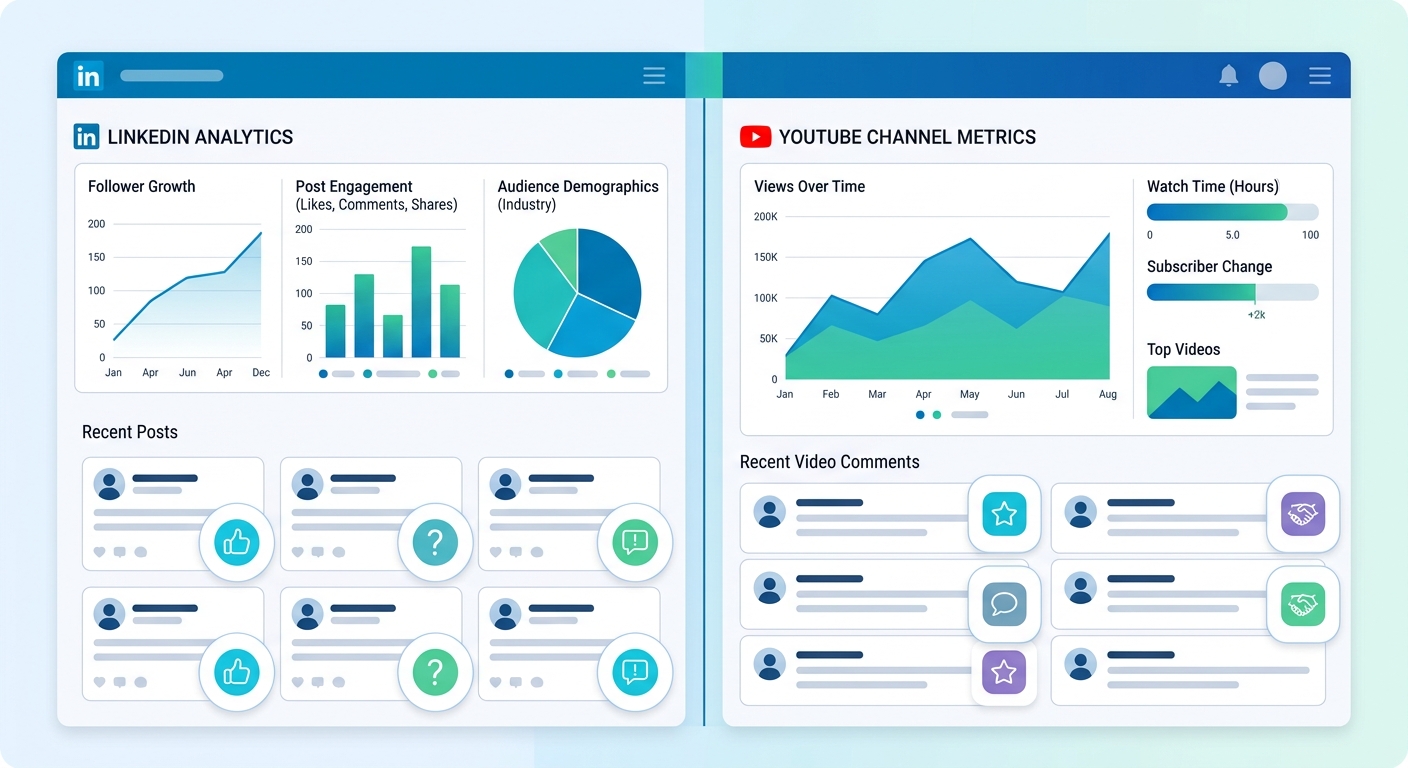
Who is it suitable for? SocialEcho is a social media management tool for multi-platform brand operations. It supports unified management of 8 major platforms (including LinkedIn, YouTube, and X), and is especially suitable for online education and training institution brand teams that need to maintain multiple content platforms at the same time and rely heavily on data feedback to optimize advertising decisions.
Core advantages of the education scenario:
SocialEcho's biggest differentiating capability in the education industry is its true integration of data from LinkedIn and YouTube—something most competing tools haven't achieved even in 2026. The operations team can simultaneously see the reading and engagement trends of a specific industry report on LinkedIn, as well as the completion rate and comment activity of corresponding videos on YouTube, all within a single dashboard. This allows them to determine where the "content resonance points" lie and which types of content are worth promoting across both platforms.
LinkedIn's scheduled posting feature supports batch uploads and precise timing, allowing users to plan postings for an entire month in advance based on course launch dates and exam seasons, significantly reducing the daily execution burden on operations staff. Meanwhile, LinkedIn's unified inbox for comment management and YouTube comments eliminates the need for teams to repeatedly switch between backends to handle all interactive messages.
What education brands should focus on most is SocialEcho's AI-powered comment intent recognition capabilities. The system automatically categorizes every message in the comment section into four types: "inquiry and registration," "purchase intention," "positive reviews," or "complaints and venting," with an emotion recognition accuracy rate of over 95%. For education brands, this means that potential students asking vague questions like "Is this course suitable for people with weak foundations?" or "Are there any discounts available?" in LinkedIn and YouTube comment sections will be automatically flagged by the system and prioritized for follow-up responses from operations staff—these are genuine sales leads, and manual screening would be almost impossible to respond to in a timely manner.
Competitor and KOL monitoring:
The YouTube KOL monitoring feature allows you to track the content activity of education bloggers and niche KOLs without authorization, using publicly available data. This helps brands quickly identify "who is recommending similar courses" and "what kind of content is spreading rapidly in the education sector." YouTube competitor analytics automatically monitors competitor accounts' course content updates, posting frequency, and engagement, eliminating the need for manual daily updates to your competitors' channels; data changes are proactively pushed to you.
X Keyword Monitoring supports real-time monitoring of 1000+ custom keywords. You can set course names, institutional brand words, trending keywords in the field, etc., to capture public opinion and word-of-mouth spread related to education on X in real time.
Data capabilities:
LinkedIn's data analytics and cross-platform data analytics support exporting to Excel format, with historical data traceable up to 180 days, sufficient to support quarterly reviews and semi-annual content strategy adjustments.
Objective Assessment: SocialEcho currently offers relatively basic features for in-depth video editing and creative assistance. If a team heavily relies on video editing workflows, it will require the use of specialized video tools in conjunction with it. Overall, for online education brands operating simultaneously on LinkedIn, YouTube, and X platforms, SocialEcho currently offers the most comprehensive data integration capabilities on the market.
Second place: Hootsuite – Excellent enterprise-level management, but obvious shortcomings in YouTube.
Hootsuite is one of the world's largest social media management platforms in terms of user base. It offers mature solutions for enterprise-level account permission management and team collaboration approval workflows, making it particularly suitable for large education groups with compliance requirements and multi-level content review needs. LinkedIn integration is a strength of Hootsuite, with comprehensive publishing, scheduling, and basic data analysis functions to meet daily operational needs.
However, Hootsuite's most significant weakness for online education brands is its limited support for YouTube comment management . YouTube is a core platform for education brands to build content and establish long-term trust, and the quality of interaction in the comment section directly impacts search ranking and potential students' decisions. However, Hootsuite currently offers limited support for unified management and response to YouTube comments, requiring teams to frequently log into the native YouTube backend to handle interactions, thus diminishing the value of cross-platform collaboration.
Furthermore, Hootsuite's pricing is relatively high , with the lowest plan starting at $99/month, which is a significant cost burden for small and medium-sized online education institutions. Its KOL monitoring and competitor tracking capabilities are also relatively basic, requiring additional third-party tools to supplement them. If your team is large and has a strong need for hierarchical access control, Hootsuite is worth considering; however, if YouTube is a crucial platform for you, you need to carefully confirm its actual functional boundaries before evaluating it.
Third place: Agorapulse – Good cross-platform interactive experience, but average KOL monitoring capabilities.
Agorapulse boasts one of the smoothest user experiences among similar tools in cross-platform interaction management. Its unified inbox design is remarkably comprehensive, allowing users to manage LinkedIn and Facebook comments, private messages, and @mentions all within a single interface, making it ideal for brand teams with a high concentration of community management personnel. For educational institutions with both LinkedIn content marketing and Facebook community management needs, Agorapulse is a reliable option.
However, in terms of in-depth YouTube features, Agorapulse performs similarly to Hootsuite, falling into the category of "usable but not sufficient"—it has basic publishing scheduling functions, but the depth of YouTube data analysis and the granularity of comment management still fall short of the actual needs of educational brands.
KOL monitoring capabilities are another significant weakness of Agorapulse. For online education brands, monitoring the dissemination of educational KOLs and student UGC is crucial, but Agorapulse's current capabilities in this area are relatively basic, primarily relying on keyword mention monitoring and lacking the ability to systematically track specific accounts and bloggers. Regarding pricing, Agorapulse's mid-range packages are moderately priced, acceptable for small and medium-sized institutions with limited budgets, but a comprehensive evaluation based on the actual coverage of its features is necessary.
Fourth place: CoSchedule – Strong in content calendar, but weak in native social media capabilities.
CoSchedule's core strengths lie in its content calendar and content marketing workflow . It integrates well with blogs, course landing pages, email marketing, and social media publishing, making it suitable for content teams managing both website content and social media channels. If your education brand has a large number of course articles that need regular updates and requires precise coordination between social media publishing schedules and content release dates, CoSchedule's calendar view will significantly clarify your team's workflow.
However, in terms of pure social media operations, CoSchedule's native functions are relatively basic. It lacks AI-driven interactive capabilities ; features such as comment management, intent recognition, and sentiment analysis are virtually nonexistent. For educational brands that need to respond to student inquiries in real time, this is a major weakness. KOL monitoring and competitor tracking are also largely outside CoSchedule's capabilities, requiring complete reliance on external tools.
CoSchedule uses a modular pricing approach, with prices varying significantly depending on the feature packages. If your team focuses on content production and topic planning rather than real-time interaction and data monitoring, CoSchedule is worth considering; however, if your daily operations require handling comments from multiple platforms and student conversion leads simultaneously, it may not be the most suitable primary tool.
Fifth place: Sprout Social – Top-tier reporting capabilities, but the price is unaffordable for small and medium-sized organizations.
Sprout Social boasts the most powerful data analysis and reporting capabilities on this list. Its cross-platform data visualization, custom reports, and team performance tracking are among the best in its class, making it ideal for large education groups that need to regularly report content operation results to headquarters or the board of directors. Its integration with LinkedIn and other mainstream social media platforms is also quite comprehensive, and its posting management features are mature and stable.
However, price is Sprout Social's biggest hurdle . The lowest plan starts at 199/month, while premium plans often cost 300-400/month. For most small and medium-sized online education institutions and independent training brands, this cost is almost unsustainable. Even for medium to large institutions, the ROI of Sprout Social needs careful calculation—if your core needs are in-depth YouTube operations and KOL monitoring, Sprout Social's capabilities in these areas don't offer a significant advantage over other competitors, yet its price is much higher.
Sprout Social is suitable for large education brands that already have a mature social media operation system and whose main needs are "data accumulation and upward reporting"; it is not the first choice for online education institutions that are in the growth stage and need to run the entire customer acquisition process within a limited budget.
Horizontal comparison: Which tool is best suited for the entire online education process?
Before concluding our evaluation of specific tools, let's conduct a structured horizontal comparison to help education brands at different stages quickly position themselves.
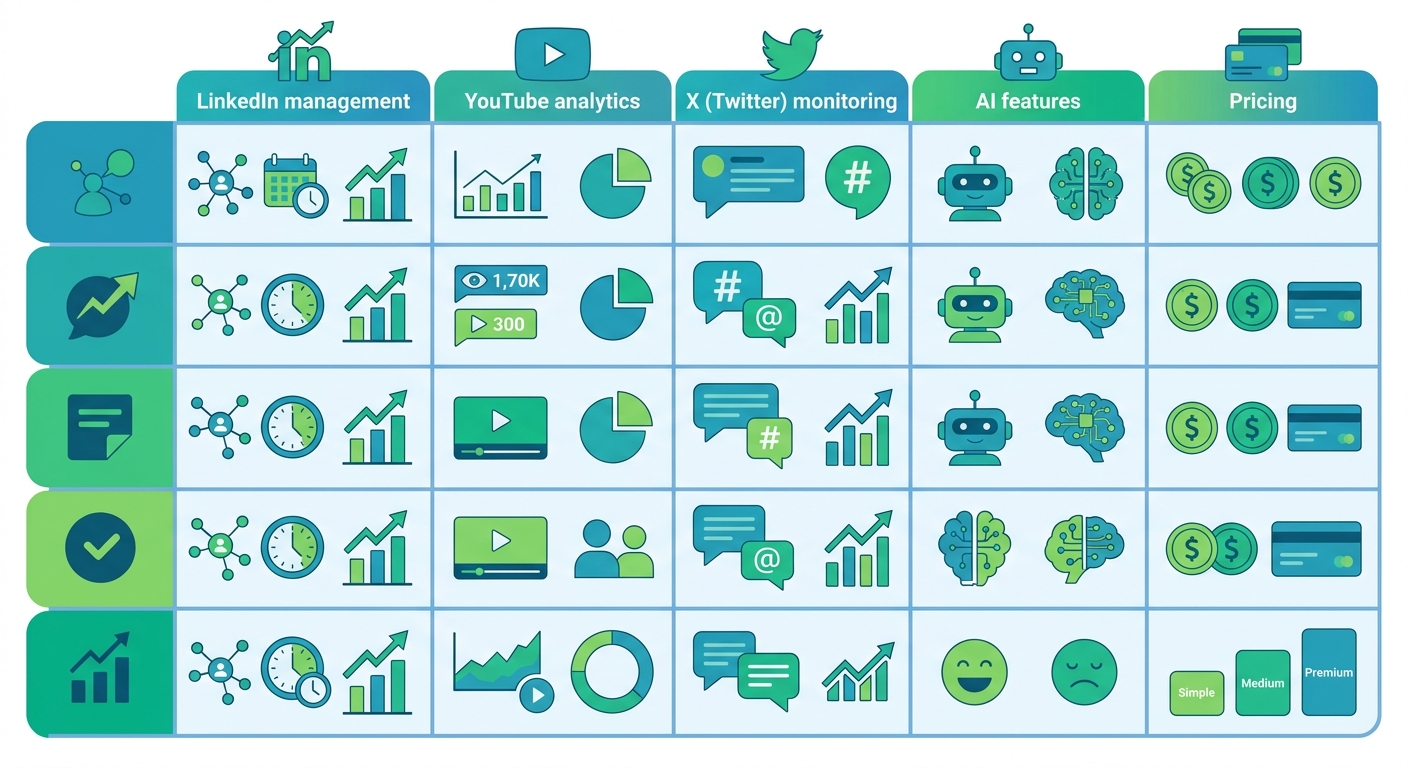
LinkedIn's full-chain coverage (posting + commenting + data): SocialEcho, Hootsuite, and Agorapulse are relatively complete; CoSchedule is basic; Sprout Social is mature but has a high price barrier.
YouTube deep operational capabilities (comment management + data analysis + KOL monitoring): SocialEcho is the only tool with substantial capabilities in all three areas; the other four all have varying degrees of shortcomings, especially Hootsuite and Agorapulse, which are clearly lacking in YouTube comment management.
X Platform Real-time Monitoring (Keywords + Public Opinion + Reputation): SocialEcho's real-time keyword monitoring supports 1000+ custom keywords, making it the most comprehensive option for this scenario; other tools are basically limited to basic mention monitoring.
AI interaction capabilities (comment intent recognition + automatic classification): Only SocialEcho provides a dedicated AI comment intent recognition function, while other tools either lack this capability or only offer simple sentiment analysis.
Price suitability (small and medium-sized educational institutions): SocialEcho and Agorapulse are more price-friendly for small and medium-sized institutions; CoSchedule depends on the feature package; Hootsuite (99 and up) and Sprout Social (199 and up) are more challenging for teams with tight budgets.
Recommendation: Decide based on your team's stage.
If your team is in the customer acquisition growth phase , running three channels simultaneously on LinkedIn, YouTube, and X, and needs to know the "actual conversion contribution of each piece of content" while also capturing sales leads in the comments section in a timely manner—then SocialEcho is currently the tool on the market that best meets this need, and it is also one of the few options that can truly integrate the data from the three platforms within a price range acceptable to small and medium-sized educational institutions.
If your organization is large , has a complete social media operations team, a clear content approval process, and a need to report data to headquarters regularly, Sprout Social's reporting capabilities are worth evaluating, provided you have sufficient budget.
If a team focuses on content engagement on LinkedIn and Facebook and has a relatively low reliance on YouTube, Agorapulse is a balanced and stable option.
If your team's core work involves content planning and course page collaboration , and you need to manage the publishing schedule of blogs, course articles, and social media in a unified manner, CoSchedule provides the best calendar view and workflow integration for this scenario.
Conclusion: In the social media competition among education brands, winning hinges on data integration.
In 2026, the competition in the online education sector will no longer be about "who publishes more content," but rather "who can convert content signals into enrollment decisions faster." A potential student who has seen your articles on LinkedIn, watched your courses on YouTube, and seen student reviews on X will ultimately decide to enroll because of the combined effect of content from all three platforms. However, without tools to connect the data along this chain, you will never know where to increase your investment.
This is why choosing a social media management tool that truly fits the entire customer acquisition journey for education brands has gone from being a "nice-to-have" to an "infrastructure." Hopefully, this review will help your team avoid pitfalls in tool selection and focus more on content and strategies that genuinely impact student recruitment and conversion rates.
The data in this review is based on publicly available feature pages and user feedback from various platforms in Q1 2026. The pricing of the tools is based on the prices published on the official websites, and the actual contract prices may vary depending on the version and region.
;}.cls-2{fill:%230868f7;}.cls-3{fill:url(%23未命名的渐变_44);}.cls-4{fill:%23333;}%3c/style%3e%3clinearGradient%20id='未命名的渐变_8'%20x1='33.73'%20y1='100.61'%20x2='-0.03'%20y2='-1.06'%20gradientUnits='userSpaceOnUse'%3e%3cstop%20offset='0'%20stop-color='%237ae9fb'/%3e%3cstop%20offset='0.67'%20stop-color='%232b90f8'/%3e%3cstop%20offset='1'%20stop-color='%230868f7'/%3e%3c/linearGradient%3e%3clinearGradient%20id='未命名的渐变_44'%20x1='27.86'%20y1='18.67'%20x2='68.36'%20y2='22.22'%20gradientUnits='userSpaceOnUse'%3e%3cstop%20offset='0'%20stop-color='%235ac7f2'/%3e%3cstop%20offset='1'%20stop-color='%230868f7'/%3e%3c/linearGradient%3e%3c/defs%3e%3cpath%20class='cls-1'%20d='M29,28.74V81.91l-9.51-3.68v0L8.52,74A7.17,7.17,0,0,1,4,67.32V24.54A3.76,3.76,0,0,1,9.08,21Z'/%3e%3cpath%20class='cls-2'%20d='M68.09,78.07a13.15,13.15,0,0,1-17.9,12.06L29,81.91h0V28.74L50.19,37A13.17,13.17,0,0,0,68.08,25.3h0Z'/%3e%3cpath%20class='cls-3'%20d='M68.08,25.3a13.19,13.19,0,0,1-6.73,10.87A13.09,13.09,0,0,1,50.19,37L29,28.74V6A3.76,3.76,0,0,1,34.1,2.52l25.59,9.91A13.22,13.22,0,0,1,68.08,25.3Z'/%3e%3cpath%20class='cls-4'%20d='M129.06,81.76a4.33,4.33,0,0,1-3.19-1.31,4.4,4.4,0,0,1-1.31-3.24V56.86H97.65V77.21a4.36,4.36,0,0,1-1.35,3.2A4.68,4.68,0,0,1,93,81.76a4.32,4.32,0,0,1-3.19-1.31,4.37,4.37,0,0,1-1.32-3.24V27.27A4.58,4.58,0,0,1,89.83,24a4.59,4.59,0,0,1,7.82,3.27V48.15h26.91V27.27A4.58,4.58,0,0,1,125.91,24a4.59,4.59,0,0,1,7.82,3.27V77.21a4.37,4.37,0,0,1-1.36,3.2A4.65,4.65,0,0,1,129.06,81.76Z'/%3e%3cpath%20class='cls-4'%20d='M163.77,81.66c-6.57,0-11.76-1.92-15.44-5.7s-5.54-9.07-5.54-15.74a26.76,26.76,0,0,1,2.09-10.43,17.72,17.72,0,0,1,6.67-8.06,19.15,19.15,0,0,1,10.68-2.95,19,19,0,0,1,10.46,2.8,18.7,18.7,0,0,1,6.55,7.36,22.53,22.53,0,0,1,2.36,10.28A4.51,4.51,0,0,1,177,63.77H152.23a10.8,10.8,0,0,0,3.49,6.65c2,1.68,4.88,2.52,8.66,2.52a22.25,22.25,0,0,0,7.54-1.21c.74-.3,1.55-.67,2.37-1.07a3.75,3.75,0,0,1,1.84-.4,4.09,4.09,0,0,1,3,1.15,4,4,0,0,1,1.12,3,4.38,4.38,0,0,1-2.58,3.82,32.34,32.34,0,0,1-6.36,2.61A28.67,28.67,0,0,1,163.77,81.66ZM172.4,55.9a9.72,9.72,0,0,0-1.63-4.56A9.9,9.9,0,0,0,167,48a10.38,10.38,0,0,0-4.64-1.14,12,12,0,0,0-4.77,1.06,9.54,9.54,0,0,0-4.89,5.66,11.78,11.78,0,0,0-.51,2.3Z'/%3e%3cpath%20class='cls-4'%20d='M193,81.64a4.49,4.49,0,0,1-4.51-4.55V27.28A4.58,4.58,0,0,1,189.84,24a4.48,4.48,0,0,1,3.28-1.36A4.36,4.36,0,0,1,196.35,24a4.46,4.46,0,0,1,1.31,3.31V77.09a4.34,4.34,0,0,1-1.35,3.2A4.67,4.67,0,0,1,193,81.64Z'/%3e%3cpath%20class='cls-4'%20d='M263.79,81.71a5.7,5.7,0,0,1-4.2-1.74,5.76,5.76,0,0,1-1.73-4.19V27.37a4.58,4.58,0,0,1,1.35-3.27A4.59,4.59,0,0,1,267,27.37V72.53h24a4.58,4.58,0,0,1,3.27,7.82A4.66,4.66,0,0,1,291,81.71Z'/%3e%3cpath%20class='cls-4'%20d='M424.48,81.74a4.71,4.71,0,0,1-2.71-.88,5.43,5.43,0,0,1-1-1l-.07-.09-12.41-17-5.41,5v9.44a4.31,4.31,0,0,1-1.36,3.19,4.66,4.66,0,0,1-3.3,1.36A4.29,4.29,0,0,1,395,80.42a4.36,4.36,0,0,1-1.32-3.23V27.37A4.58,4.58,0,0,1,395,24.1a4.52,4.52,0,0,1,6.58.12,4.54,4.54,0,0,1,1.24,3.15V56.31l17.72-16.38.05,0a4.8,4.8,0,0,1,2.94-1.11,4.4,4.4,0,0,1,3.27,1.2,4.57,4.57,0,0,1,1.2,3.27,4.44,4.44,0,0,1-.77,2.33,7.45,7.45,0,0,1-1.43,1.65l-11,9.64,13.34,17.68a5,5,0,0,1,1,2.71,4.12,4.12,0,0,1-1.36,3.24A4.64,4.64,0,0,1,424.48,81.74Z'/%3e%3cpath%20class='cls-4'%20d='M317.93,81.76a21.5,21.5,0,1,1,21.17-21.5A21.37,21.37,0,0,1,317.93,81.76Zm0-34.1a12.61,12.61,0,1,0,12.42,12.6A12.52,12.52,0,0,0,317.93,47.66Z'/%3e%3cpath%20class='cls-4'%20d='M212.18,101.22a4.12,4.12,0,0,1-3.05-1.26,4.17,4.17,0,0,1-1.26-3.1V43.34a4.37,4.37,0,0,1,1.3-3.14,4.26,4.26,0,0,1,3.13-1.3,4.19,4.19,0,0,1,3.1,1.26,4.32,4.32,0,0,1,1.26,3.16,20.77,20.77,0,0,1,13-4.54,21.51,21.51,0,0,1,0,43,20.51,20.51,0,0,1-13-4.57V96.86a4.15,4.15,0,0,1-1.3,3.06A4.5,4.5,0,0,1,212.18,101.22Zm17.43-53.63c-6.23,0-12.93,4.11-12.93,12.72a12.73,12.73,0,0,0,25.46,0A12.71,12.71,0,0,0,229.61,47.59Z'/%3e%3cpath%20class='cls-4'%20d='M365.76,81.76a21.5,21.5,0,1,1,21.18-21.5A21.37,21.37,0,0,1,365.76,81.76Zm0-34.1a12.61,12.61,0,1,0,12.42,12.6A12.52,12.52,0,0,0,365.76,47.66Z'/%3e%3c/svg%3e)