
Facebook 2026 data: Organic reach for brand accounts continues to decline, where is the way out?
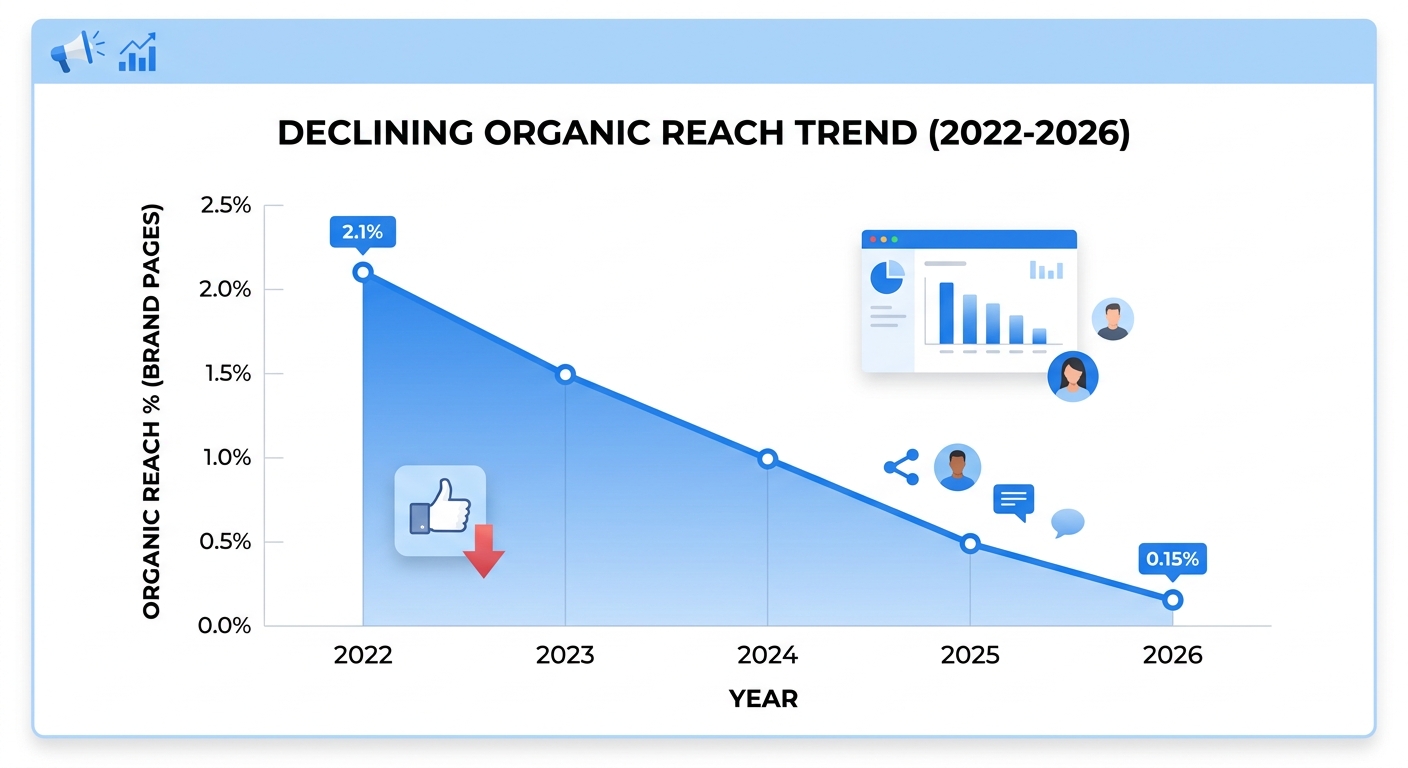
0.15%—this number is changing the logic behind brands using Facebook.
According to Socialinsider's 2026 Social Media Benchmarks Report, the average engagement rate for Facebook brand accounts has fallen to 0.15% and continues to decline.
This number might not seem significant on its own, but its impact becomes apparent in a real-world operational scenario: Suppose your brand's Facebook page has 50,000 followers, and your operations team diligently produces 30 pieces of content in a month—text, images, videos, and event announcements—with an average engagement of only about 75 times per piece. The percentage of followers reached? Less than 1%. And these 75 interactions include likes, shares, and comments; the actual number of interactions that generate purchase intent or brand awareness is likely less than ten.
For a small social media team of 1-3 people for an overseas brand, the reality is quite harsh: you spend a lot of time planning content, aligning visuals, writing copy, and scheduling, but most of the content disappears within hours of being published, and the algorithm gives you almost no chance for organic distribution.
This isn't a problem with your team; it's the fundamental operational reality of the Facebook platform in 2026.
But the key issue is not the conclusion of "low reach," but rather: why is this the case, what does it mean, and what should brands do next .
- Why is Facebook's organic reach so low?
The decline in organic reach for brand accounts is not a sudden phenomenon, but rather a result of the continuous evolution of Facebook's platform strategy. Organizations such as Hootsuite and Social Media Today, which have long tracked this trend, characterize it as a structural decline rather than a cyclical fluctuation. To understand this, we must begin with the logic of Facebook's algorithm.
The first reason is that the algorithm prioritizes social content over brand content.
Facebook's initial product positioning was "connecting people," not "connecting brands and consumers." This core principle has never truly changed. Since Mark Zuckerberg announced a shift in News Feed strategy in 2018, placing "meaningful social interaction" at the core of content ranking, Facebook's algorithm has systematically reduced the organic distribution weight of brand page content. A family video shared by your friend is inherently more valuable in the algorithm's eyes than a product tweet posted by a brand account—even if the latter has higher content quality and better visuals.
The logic behind this is not complicated: the platform's profit model relies on advertising, and advertising requires brands to pay for reach. If organic traffic were too easy to generate, brands wouldn't invest in advertising. Therefore, suppressing organic reach for brand content and guiding brands towards paid promotion is an inherent driving force of Facebook's business model, not a "side effect" of the algorithm.
The second reason is that the weight given to the quality of interaction is being increased across the board.
Another significant change in Facebook's algorithm after 2025 is that it no longer simply counts the number of interactions, but instead deeply evaluates the quality and authenticity of those interactions. A post that receives 500 likes but no comments, shares, or private messages will be considered a "low-quality interaction" by the algorithm, and its distribution weight will be reduced accordingly. Conversely, a post with only 50 comments, but rich in content, engaging in questions and answers, and forming a genuine dialogue, will receive a higher content distribution coefficient from the algorithm.
This means that the era of brands simply pursuing posting frequency or the number of likes is over . Genuine conversations triggered by content, especially the depth of interaction in the comments section, have become one of the key signals for Facebook's algorithm weighting in 2026.
The third reason: Oversupply of content leads to an exponential increase in competition.
Over the past decade, the daily volume of content posted on Facebook has increased exponentially, but the time users spend scrolling through news feeds daily has not increased proportionally. Content supply far exceeds the total amount of user attention, forcing platforms to make trade-offs. In this highly competitive environment, brand content without paid support or high-quality interaction will be submerged in the information overload and will have virtually no chance of surviving through organic traffic.
II. Is Facebook still worthwhile? What would be the cost of giving it up?
Faced with such low organic reach, many overseas brand operation teams may have a reasonable question: instead of working hard on Facebook with little success, wouldn't it be more cost-effective to bet resources on TikTok, Instagram or YouTube?
This idea is understandable, but there are a few data points that need to be carefully considered before implementation.
Facebook remains the world's largest social media platform in terms of monthly active users, exceeding 3 billion . This is not a number to be easily ignored—it means that your target consumers, whether they are young mothers in Southeast Asia, middle-class consumers in Europe, or B2B purchasing decision-makers in North America, are likely still active on Facebook.
Abandoning Facebook is not simply a "shift in territory," but a proactive severing of the connection with a pool of 3 billion monthly active users. For many brands going global, Facebook remains a crucial entry point for brand search—before considering purchasing a brand's product, users often check its Facebook page first: Are there genuine user reviews? Does the brand respond promptly? Is the page content professional and credible? This is an implicit "brand trust filter," not just a content distribution channel.
Furthermore, Facebook's advertising system remains one of the most mature social media advertising platforms globally in terms of conversion efficiency. Its Pixel tracking, custom audiences, and remarketing capabilities are still core infrastructure for many overseas brands' DTC (direct-to-consumer) models. If your Facebook page content is inactive for a long period and has almost zero interaction, the accumulation of optimization data for the advertising system will also be affected, and the overall advertising efficiency will decline.
Therefore, the question for Facebook is not whether it should have done it or not, but how it should have done it again .
The real problem is that the old "post content and wait for organic traffic" operating model is no longer effective in 2026. What brands need is not to retreat, but to upgrade their strategies.
III. What Brands Can Do Right on Facebook in 2026
Moving up from the industry average of 0.15% is not an unattainable goal. Brand accounts that still maintain a relatively healthy engagement rate on Facebook all share a common characteristic: they are not "creating content," but rather "cultivating relationships."
Specifically, effective operations on Facebook in 2026 will focus on three areas.
1. Treat the comment section as the core operational platform.
In the past, many brands treated the comment section as an "accessory to the content"—after posting the content, the comment section was basically left to its own devices, with occasional customer service replies to a few complaints, while the rest were ignored.
This approach will be fatal in 2026.
As mentioned earlier, Facebook's algorithm now places great emphasis on the quality of interactions. The activity level in the comment section, and the speed and quality of brand responses, directly affect how many additional audiences a piece of content can be pushed to. If a post generates a large number of comments within two hours of its publication, the algorithm will judge it as "high-value social content" and give it wider organic distribution. Conversely, content with few comments will be quickly demoted.
More importantly, the comments section is the best place for brands to identify the true intentions of users . Behind every user comment may lie convertible commercial signals—some are asking about prices, some are expressing complaints, some are hinting at purchase intentions, and some are giving the brand free advertising. If brands can identify these signals in real time and respond effectively as soon as possible, conversion rates and user engagement will significantly improve.
Effective Facebook comment management is the fundamental infrastructure for brand account management in 2026, not a nice-to-have "service bonus".
For a 1-3 person social media team of a brand going global, manually managing all comments is almost impractical. This is especially true when a brand operates Facebook pages in multiple regions simultaneously, where the number of comments can reach hundreds or even thousands. The value of ** Facebook comment auto-response ** tools becomes particularly clear in this context—they are not meant to replace human intervention, but rather to ensure that "every valuable comment is not missed," while allowing the team to focus its energy on high-value interactions that truly require human judgment.
2. Turn the private messaging (DM) channel into a conversion funnel.
Facebook's Messenger private messaging feature is a touchpoint that has long been underestimated in brand operations.
Users choosing to send private messages to brands represent a stronger desire for interaction than simply commenting publicly—they want more direct communication or have more private questions that need answering. This group typically has a significantly higher purchase intention than ordinary users who merely like or comment.
However, many brands are slow to respond to private messages: messages may take hours or even days to get a reply, or they may simply disappear without a trace. This delay directly loses out on the most valuable potential customers.
In the brand operation logic of 2026, private messaging channels need to be treated as a 24/7 conversion portal. Facebook's DM automatic reply mechanism can ensure that inquiries sent by users in any time zone receive an immediate response, while collecting user needs and guiding them into subsequent sales or service processes. This is not "laziness," but a systemic upgrade to brand operation efficiency.
3. Treat the group ecosystem as a brand's "private domain moat".
Facebook Groups are one of the few content ecosystems on the Facebook platform that still maintains a high level of organic reach. This is because Groups are "interest communities" that users actively join, and their content is subject to far fewer restrictions in terms of algorithmic weighting compared to public posts on brand pages.
If a brand can build and operate a truly valuable user community—centered around product usage scenarios, user pain points, and industry insights—it's equivalent to building a relatively controllable private traffic pool within the Facebook platform. Members of this group can see the brand's content without needing algorithmic filtering, and the discussion atmosphere within the group can organically build brand trust.
The key to effective group management is not sending advertisements, but rather outputting truly valuable content for users and proactively creating opportunities for interaction among them. In this process, the brand's role is that of a "community curator," not a "salesperson."
IV. Actionable Recommendations: Re-establish Facebook's operational rhythm starting today.
Once you understand the strategic direction, what are the specific steps? Here are some actionable suggestions for 1-3 person social media teams of brands going global.
Establish a rapid response mechanism for the comment section, aiming to complete the first round of replies within two hours of posting. The first two hours after content is published are a critical window for Facebook's algorithm to decide whether to grant wider distribution. The interaction density generated in the comment section during this period will significantly affect the subsequent reach of the content. Brands need to proactively respond to every comment within this time window, including asking questions and extending discussions, rather than passively waiting.
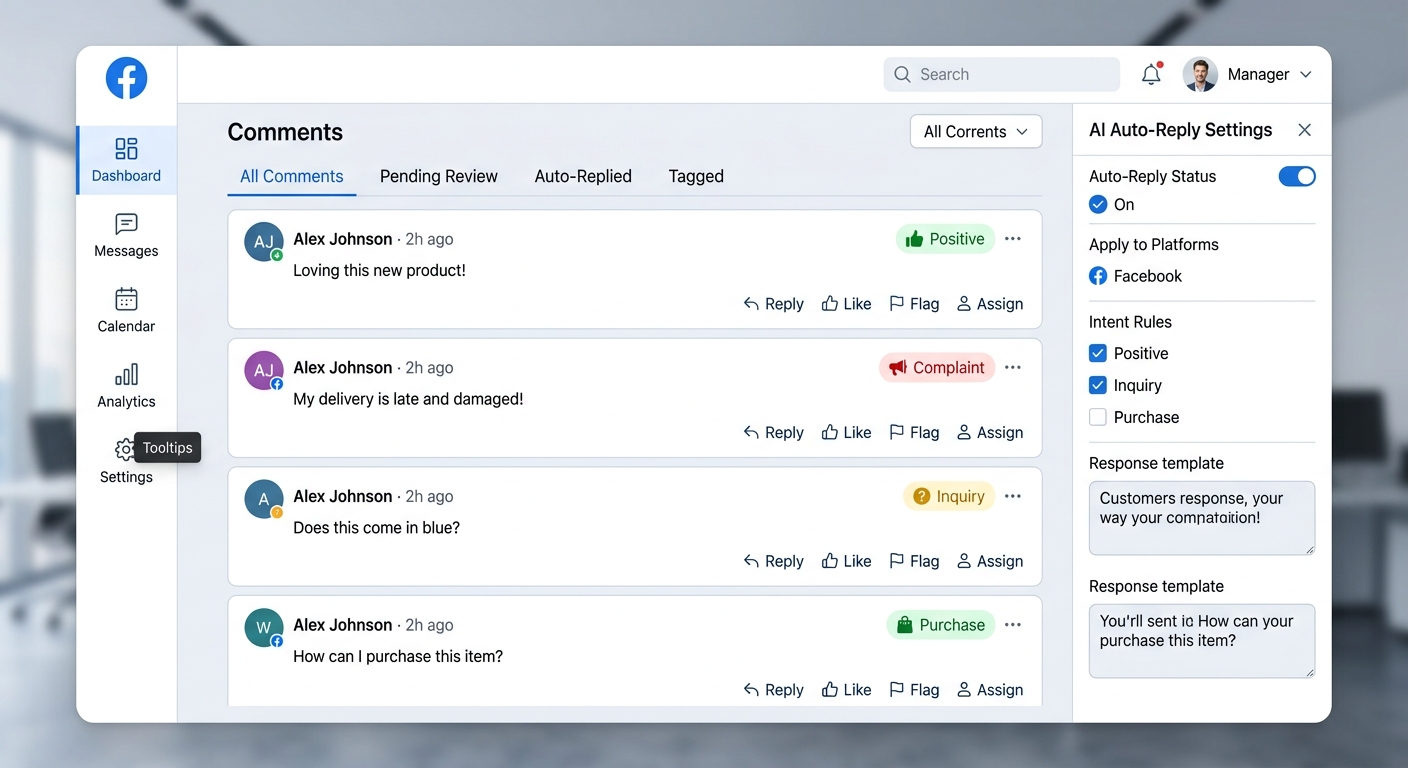
Enable AI intent recognition to filter out noise in the comment section and focus on processing valuable signals. Not all comments deserve equal time investment. Inquiry-based and purchase intention comments are high-value signals that need to be prioritized; while complaint comments need to be addressed promptly but shouldn't require excessive effort; spam and advertising comments should be quickly identified and filtered. SocialEcho's interaction management features, through Facebook comment AI intent recognition (covering four main types: positive reviews, complaints, inquiries, and purchases), achieve an accuracy rate of over 95% in sentiment assessment, helping teams concentrate their limited energy on truly important interactions.
SocialEcho is a social media interaction management tool designed specifically for brands going global, suitable for social media operation teams of 1-10 people. Its core capabilities lie in helping brands achieve intelligent management and automated response to comments and private messages on platforms such as Facebook, while providing competitor monitoring and in-depth data analysis, enabling small teams to achieve the operational efficiency of large brands.
Let the data speak for itself, not your gut feeling when making operational decisions. Brand teams often rely on intuition to judge the quality of content performance, but this intuition is frequently wrong. Is a piece of content with a high engagement rate due to the topic itself resonating with the audience, the appropriate timing of publication, or the more appealing visual format? Without data, these are all guesses. Facebook's data analytics tools can break down data to a daily level and support 180 days of historical data review, helping teams truly understand which types of content, at which times, and with which interaction methods are effective for this account.
Regularly monitor competitors and quickly learn from successful practices in the industry. Even in an environment of generally low engagement rates, some brand accounts still maintain relatively healthy engagement. What content are these accounts posting? In what format? Which topics are generating genuine discussion in their comment sections? This information is a free operational reference. Facebook's competitor analytics tool supports automatic monitoring of competitor accounts and provides cross-sectional comparisons of engagement data, allowing brands to make strategy adjustments based on evidence, rather than working in isolation.
Content strategy is shifting from "mass production" to "refined production." When organic reach is extremely low, the actual effect of posting 30 mediocre pieces of content may be far less than posting 10 high-quality pieces that truly spark discussion. Brands need to reassess the pace of content production and use the saved time and energy to deeply cultivate comment sections, maintain groups, and handle private messages—these are the operational actions that will truly influence algorithm ranking in 2026.
Conclusion: Reaching atrophy is a signal, not the end.
The 0.15% figure in Socialinsider's 2026 report is indeed disheartening. But it doesn't reveal that "Facebook has no value," but rather that "the old ways of doing things have completely failed."
Facebook still boasts 3 billion monthly active users and remains a core social media platform that global brands cannot bypass. It has simply transformed from a "content distribution channel" into a "relationship management arena."
The shift from "posting content and waiting for traffic" to "deeply engaging with the algorithm to retain users" is not just a catchy slogan, but a fundamental difference in whether a brand account can continue to generate commercial value on Facebook in 2026. Comments, private messages, and groups—these three touchpoints together constitute the interactive ecosystem that brands can truly control on Facebook.
Reaching a low level of market penetration is not a reason to exit, but rather the starting point for transformation.
Data sources: Socialinsider 2026 Social Media Benchmarks Report; Hootsuite 2026 Social Media Trends Report; Social Media Today industry report.
;}.cls-2{fill:%230868f7;}.cls-3{fill:url(%23未命名的渐变_44);}.cls-4{fill:%23333;}%3c/style%3e%3clinearGradient%20id='未命名的渐变_8'%20x1='33.73'%20y1='100.61'%20x2='-0.03'%20y2='-1.06'%20gradientUnits='userSpaceOnUse'%3e%3cstop%20offset='0'%20stop-color='%237ae9fb'/%3e%3cstop%20offset='0.67'%20stop-color='%232b90f8'/%3e%3cstop%20offset='1'%20stop-color='%230868f7'/%3e%3c/linearGradient%3e%3clinearGradient%20id='未命名的渐变_44'%20x1='27.86'%20y1='18.67'%20x2='68.36'%20y2='22.22'%20gradientUnits='userSpaceOnUse'%3e%3cstop%20offset='0'%20stop-color='%235ac7f2'/%3e%3cstop%20offset='1'%20stop-color='%230868f7'/%3e%3c/linearGradient%3e%3c/defs%3e%3cpath%20class='cls-1'%20d='M29,28.74V81.91l-9.51-3.68v0L8.52,74A7.17,7.17,0,0,1,4,67.32V24.54A3.76,3.76,0,0,1,9.08,21Z'/%3e%3cpath%20class='cls-2'%20d='M68.09,78.07a13.15,13.15,0,0,1-17.9,12.06L29,81.91h0V28.74L50.19,37A13.17,13.17,0,0,0,68.08,25.3h0Z'/%3e%3cpath%20class='cls-3'%20d='M68.08,25.3a13.19,13.19,0,0,1-6.73,10.87A13.09,13.09,0,0,1,50.19,37L29,28.74V6A3.76,3.76,0,0,1,34.1,2.52l25.59,9.91A13.22,13.22,0,0,1,68.08,25.3Z'/%3e%3cpath%20class='cls-4'%20d='M129.06,81.76a4.33,4.33,0,0,1-3.19-1.31,4.4,4.4,0,0,1-1.31-3.24V56.86H97.65V77.21a4.36,4.36,0,0,1-1.35,3.2A4.68,4.68,0,0,1,93,81.76a4.32,4.32,0,0,1-3.19-1.31,4.37,4.37,0,0,1-1.32-3.24V27.27A4.58,4.58,0,0,1,89.83,24a4.59,4.59,0,0,1,7.82,3.27V48.15h26.91V27.27A4.58,4.58,0,0,1,125.91,24a4.59,4.59,0,0,1,7.82,3.27V77.21a4.37,4.37,0,0,1-1.36,3.2A4.65,4.65,0,0,1,129.06,81.76Z'/%3e%3cpath%20class='cls-4'%20d='M163.77,81.66c-6.57,0-11.76-1.92-15.44-5.7s-5.54-9.07-5.54-15.74a26.76,26.76,0,0,1,2.09-10.43,17.72,17.72,0,0,1,6.67-8.06,19.15,19.15,0,0,1,10.68-2.95,19,19,0,0,1,10.46,2.8,18.7,18.7,0,0,1,6.55,7.36,22.53,22.53,0,0,1,2.36,10.28A4.51,4.51,0,0,1,177,63.77H152.23a10.8,10.8,0,0,0,3.49,6.65c2,1.68,4.88,2.52,8.66,2.52a22.25,22.25,0,0,0,7.54-1.21c.74-.3,1.55-.67,2.37-1.07a3.75,3.75,0,0,1,1.84-.4,4.09,4.09,0,0,1,3,1.15,4,4,0,0,1,1.12,3,4.38,4.38,0,0,1-2.58,3.82,32.34,32.34,0,0,1-6.36,2.61A28.67,28.67,0,0,1,163.77,81.66ZM172.4,55.9a9.72,9.72,0,0,0-1.63-4.56A9.9,9.9,0,0,0,167,48a10.38,10.38,0,0,0-4.64-1.14,12,12,0,0,0-4.77,1.06,9.54,9.54,0,0,0-4.89,5.66,11.78,11.78,0,0,0-.51,2.3Z'/%3e%3cpath%20class='cls-4'%20d='M193,81.64a4.49,4.49,0,0,1-4.51-4.55V27.28A4.58,4.58,0,0,1,189.84,24a4.48,4.48,0,0,1,3.28-1.36A4.36,4.36,0,0,1,196.35,24a4.46,4.46,0,0,1,1.31,3.31V77.09a4.34,4.34,0,0,1-1.35,3.2A4.67,4.67,0,0,1,193,81.64Z'/%3e%3cpath%20class='cls-4'%20d='M263.79,81.71a5.7,5.7,0,0,1-4.2-1.74,5.76,5.76,0,0,1-1.73-4.19V27.37a4.58,4.58,0,0,1,1.35-3.27A4.59,4.59,0,0,1,267,27.37V72.53h24a4.58,4.58,0,0,1,3.27,7.82A4.66,4.66,0,0,1,291,81.71Z'/%3e%3cpath%20class='cls-4'%20d='M424.48,81.74a4.71,4.71,0,0,1-2.71-.88,5.43,5.43,0,0,1-1-1l-.07-.09-12.41-17-5.41,5v9.44a4.31,4.31,0,0,1-1.36,3.19,4.66,4.66,0,0,1-3.3,1.36A4.29,4.29,0,0,1,395,80.42a4.36,4.36,0,0,1-1.32-3.23V27.37A4.58,4.58,0,0,1,395,24.1a4.52,4.52,0,0,1,6.58.12,4.54,4.54,0,0,1,1.24,3.15V56.31l17.72-16.38.05,0a4.8,4.8,0,0,1,2.94-1.11,4.4,4.4,0,0,1,3.27,1.2,4.57,4.57,0,0,1,1.2,3.27,4.44,4.44,0,0,1-.77,2.33,7.45,7.45,0,0,1-1.43,1.65l-11,9.64,13.34,17.68a5,5,0,0,1,1,2.71,4.12,4.12,0,0,1-1.36,3.24A4.64,4.64,0,0,1,424.48,81.74Z'/%3e%3cpath%20class='cls-4'%20d='M317.93,81.76a21.5,21.5,0,1,1,21.17-21.5A21.37,21.37,0,0,1,317.93,81.76Zm0-34.1a12.61,12.61,0,1,0,12.42,12.6A12.52,12.52,0,0,0,317.93,47.66Z'/%3e%3cpath%20class='cls-4'%20d='M212.18,101.22a4.12,4.12,0,0,1-3.05-1.26,4.17,4.17,0,0,1-1.26-3.1V43.34a4.37,4.37,0,0,1,1.3-3.14,4.26,4.26,0,0,1,3.13-1.3,4.19,4.19,0,0,1,3.1,1.26,4.32,4.32,0,0,1,1.26,3.16,20.77,20.77,0,0,1,13-4.54,21.51,21.51,0,0,1,0,43,20.51,20.51,0,0,1-13-4.57V96.86a4.15,4.15,0,0,1-1.3,3.06A4.5,4.5,0,0,1,212.18,101.22Zm17.43-53.63c-6.23,0-12.93,4.11-12.93,12.72a12.73,12.73,0,0,0,25.46,0A12.71,12.71,0,0,0,229.61,47.59Z'/%3e%3cpath%20class='cls-4'%20d='M365.76,81.76a21.5,21.5,0,1,1,21.18-21.5A21.37,21.37,0,0,1,365.76,81.76Zm0-34.1a12.61,12.61,0,1,0,12.42,12.6A12.52,12.52,0,0,0,365.76,47.66Z'/%3e%3c/svg%3e)