
AI-powered automated replies aren't about saving time; they're about filtering out repetitive questions: 3 scenarios where Facebook private messages are best suited for automation.
When many teams hear about AI-powered automated responses, their first thoughts are often "saving on customer service," "reducing manpower," and "allowing for nighttime staffing." These are all valid points, but if you only understand automated responses as saving manpower, you're easily missing the point. The core value of AI-powered automated responses isn't replacing all human intervention, but rather preventing repetitive, standardized, and low-judgment-cost issues from escalating, allowing messages that truly require human intervention to surface earlier.
Especially in Facebook private messaging, when the message volume surges, teams can easily be interrupted by the same types of questions repeatedly: When does the promotion end? How are shipping costs calculated? Is there stock available? How do I get a refund? How do I contact the store? Truly high-value leads and truly high-risk complaints are often drowned out by these repetitive questions.
Therefore, good automation is not about how well the robot answers, but about how well it helps the team complete the screening process first.
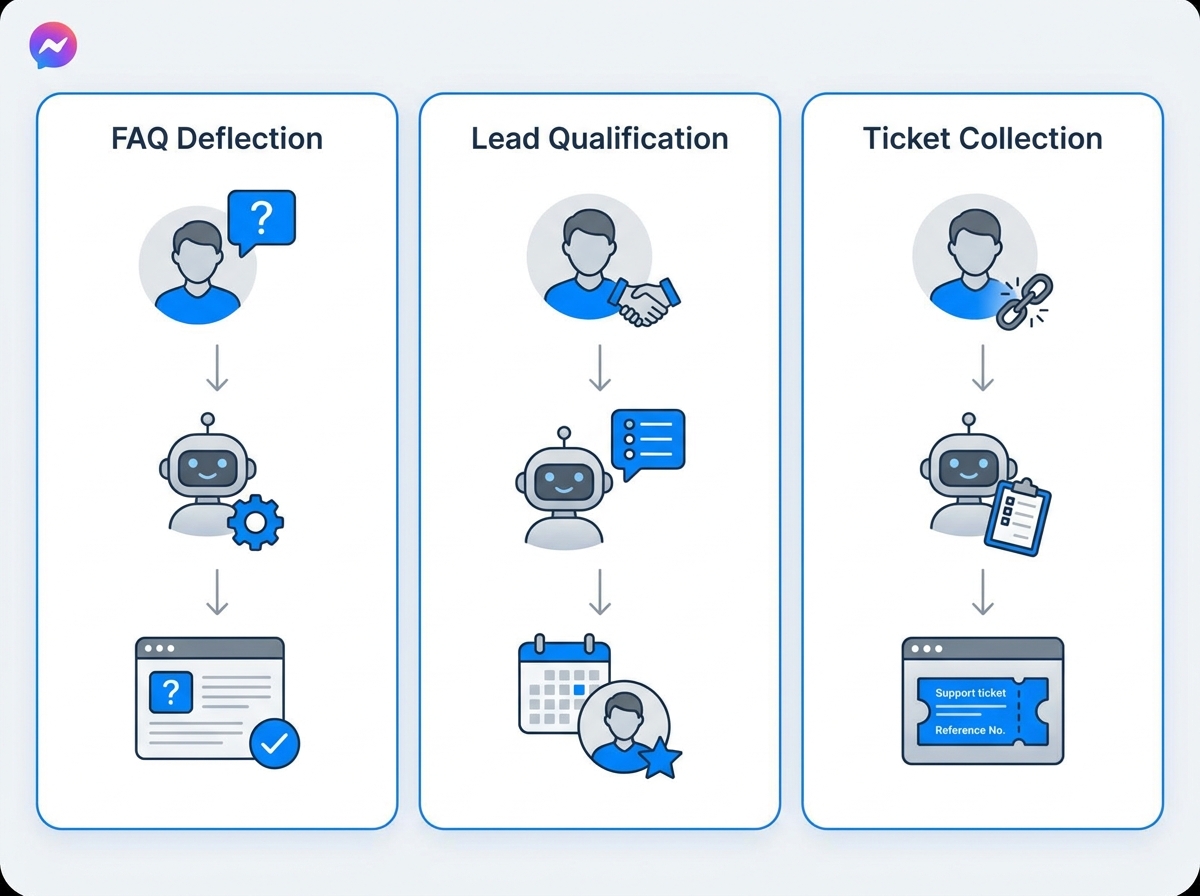
Scenario 1: High-frequency FAQs are best suited for priority automation.
The first category best suited for automation consists of FAQs with very high repetition rates and consistently stable answers. Examples include business hours, delivery areas, price ranges, after-sales service channels, activity rules, registration methods, store addresses, and invoice information. If these questions are still being manually entered line by line, the team will almost certainly be too busy to handle more complex messages.
At this point, the role of AI's automatic response is not to "pretend there's a real person chatting," but to quickly identify the user's intent and then provide the standard answer and the next steps. The clearer the answer, the cleaner the human queue becomes.
If you haven't systematically compiled these frequently asked questions yet, you can start by finding suitable tools in SocialEcho Free Tools to categorize the most common questions in your private messages. Many teams only realize after doing this step that over 40% of their private messages are asking almost the same things.
Of course, the premise of automating FAQs is that the answers are stable. If policies, inventory, and activity rules change frequently, and you don't have a synchronization mechanism, automated replies will quickly turn from a "stress-reducing tool" into a "source of misleading information."
Scenario 2: Initial screening of leads is more important than "immediately turning them into sales".
The second type most suitable for automation is not after-sales service, but rather the initial screening of leads before sales. Many teams rush to forward a user's private message saying "I want to know more" to sales, only to find that the user just wants to ask about the basic price, applicable scenarios, or even doesn't understand what the product is.
If all these private messages were handled manually, it would consume a significant amount of sales time. A better approach is to first have AI automatically reply and collect a few key pieces of information: type of need, budget range, number of users, location, problem to be solved, and estimated start time. This way, when the message is actually forwarded to sales, they will no longer see a vague opening, but rather a lead with minimal background information.
The key here isn't how long the questionnaire is, but rather obtaining enough information to prioritize tasks. Asking too many questions will lead to user churn; asking too few will force sales to resubmit. SocialEcho's AI Automation is well-suited for this "identify first, then route" approach, rather than simply replying with "Received, please wait."
Once a lead enters the human stage, it's smoother to hand it over to Engagement for further processing, because the context, tags, and responsible parties can all be preserved, avoiding the problem of automation and human processes operating like two separate systems.
Scenario 3: Pre-sales data collection allows for faster human intervention in problem-solving.
The third category most suitable for automation is pre-sales information collection. Note that this doesn't mean letting AI directly handle complex after-sales processes, but rather collecting the information that humans will definitely need to ask later.
For example, scenarios such as returns and exchanges, logistics anomalies, account issues, appointment rescheduling, and service complaints typically require order numbers, purchase times, screenshots, contact information, or a description of the problem. If every private message requires manual input from scratch, customer service will not only be slow, but users will also find the process cumbersome.
If the automated response system could collect all the materials before sending them to a human agent, the overall experience would be much better. This is because when customer service opens the conversation, it's no longer a vague "Hello, I have a question," but a basic summary of the case. Users would clearly perceive that "things are moving forward," instead of constantly receiving repeated confirmations.
A more reasonable approach is to understand automation as a "preprocessing layer" rather than a "final processing layer." With proper preprocessing, human intervention becomes more like problem-solving than data collection.
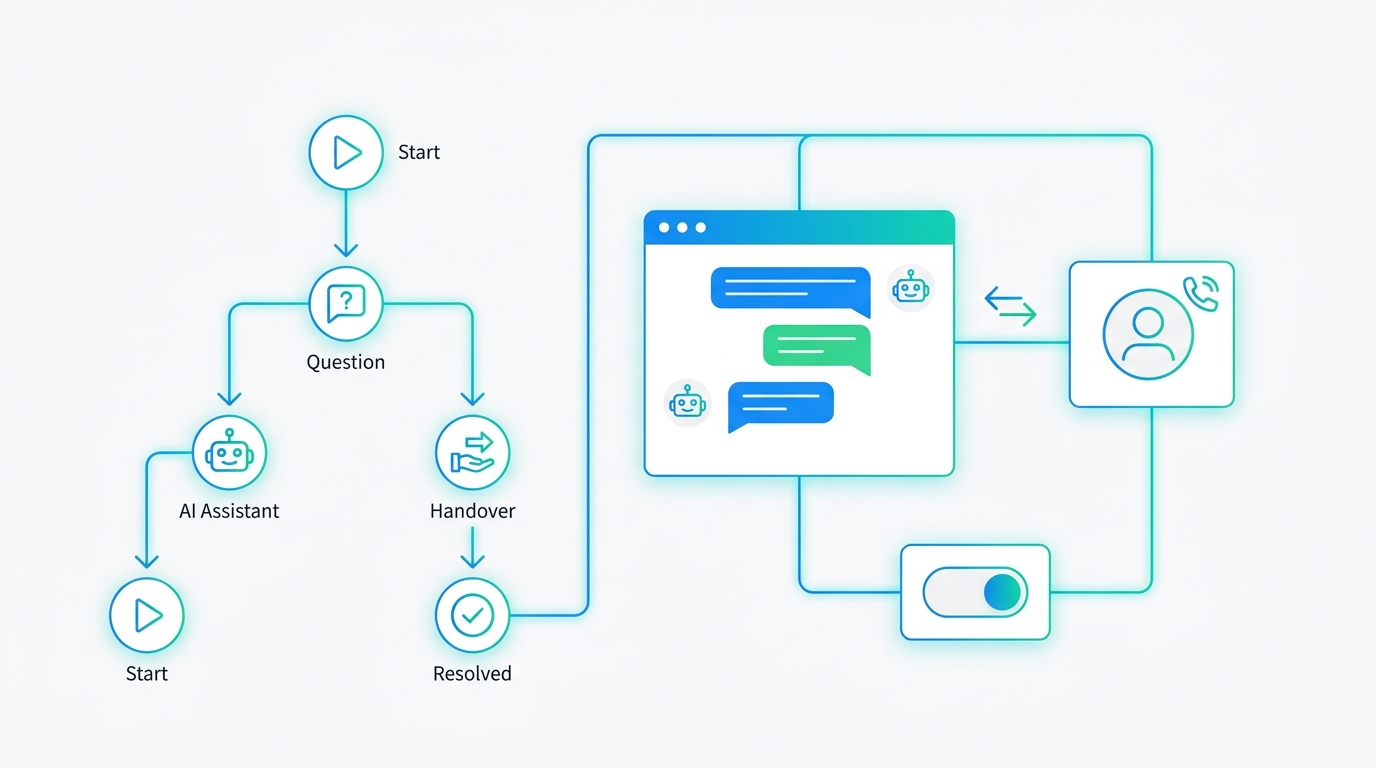
Which Facebook DMs shouldn't be automated with AI? (Hard post)
This leads to another misconception for many teams: since automation is so useful, is more always better? The answer is quite the opposite.
Complaints with obvious emotional conflict, after-sales issues involving compensation decisions, business communications requiring flexible negotiation, and public opinion incidents that have escalated to the point of being transferred to private messages—these are all unsuitable for automated replies to remain in place for extended periods. AI can first confirm receipt and collect necessary information, but it must be transferred to a human agent as soon as possible.
The criteria are simple: if a message requires emotional reassurance, exception handling, accountability confirmation, or negotiation of interests, human intervention must be initiated as early as possible. Otherwise, what appears to be "highly efficient automation" is actually delaying the resolution, ultimately worsening the user's mood.
If you primarily handle these types of messages on Facebook, it's advisable to consider the platform's context as well. You can refer to the approaches of Facebook Direct Message Management and Facebook DM Auto Reply , because the automation strategies differ depending on the source of the private messages: leads from ads are suitable for initial screening, while private messages redirected from after-sales comments are better suited for quick case handling and transfer to human agents.
FAQ
1. Will AI-generated auto-responders make Facebook DMs seem fake?
Whether it appears "fake" depends on whether it solves the user's problem. If it's just a template-based, perfunctory solution, then of course it will; but if it can quickly provide standard answers and correctly categorize complex problems, users will actually find it more efficient.
2. How many private messages should automation cover to be reasonable?
There is no uniform ratio, but usually covering the three categories of high-frequency FAQs, initial lead screening, and pre-sales information collection can significantly reduce the workload.
3. How can automated replies and human assistance be best integrated?
The key is to maintain a consistent context. The intent, tags, materials, and status collected during the automation phase must be directly visible to humans and still be usable.
4. What are the most common mistakes?
The most common problem is that all issues are left to AI to handle, resulting in delays for high-risk complaints; or the FAQ information changes frequently, but the automatic reply content is not maintained, ultimately misleading users.
Final words
If you're planning to implement AI-powered auto-response in Facebook DMs, don't focus on "saving a lot of manpower," but rather on identifying which recurring questions are most worth blocking. It's recommended to start with three categories: FAQs, initial lead screening, and pre-sales data collection. Clean up the entry points first, then improve the efficiency of manual processing. You can start by reviewing existing questions using SocialEcho Free Tools , and then further explore AI Automation , Engagement , and relevant platform pages such as Facebook DM Auto Reply . The true value of automation isn't replacing teams, but allowing teams to focus their energy on tasks that must be handled by humans.
;}.cls-2{fill:%230868f7;}.cls-3{fill:url(%23未命名的渐变_44);}.cls-4{fill:%23333;}%3c/style%3e%3clinearGradient%20id='未命名的渐变_8'%20x1='33.73'%20y1='100.61'%20x2='-0.03'%20y2='-1.06'%20gradientUnits='userSpaceOnUse'%3e%3cstop%20offset='0'%20stop-color='%237ae9fb'/%3e%3cstop%20offset='0.67'%20stop-color='%232b90f8'/%3e%3cstop%20offset='1'%20stop-color='%230868f7'/%3e%3c/linearGradient%3e%3clinearGradient%20id='未命名的渐变_44'%20x1='27.86'%20y1='18.67'%20x2='68.36'%20y2='22.22'%20gradientUnits='userSpaceOnUse'%3e%3cstop%20offset='0'%20stop-color='%235ac7f2'/%3e%3cstop%20offset='1'%20stop-color='%230868f7'/%3e%3c/linearGradient%3e%3c/defs%3e%3cpath%20class='cls-1'%20d='M29,28.74V81.91l-9.51-3.68v0L8.52,74A7.17,7.17,0,0,1,4,67.32V24.54A3.76,3.76,0,0,1,9.08,21Z'/%3e%3cpath%20class='cls-2'%20d='M68.09,78.07a13.15,13.15,0,0,1-17.9,12.06L29,81.91h0V28.74L50.19,37A13.17,13.17,0,0,0,68.08,25.3h0Z'/%3e%3cpath%20class='cls-3'%20d='M68.08,25.3a13.19,13.19,0,0,1-6.73,10.87A13.09,13.09,0,0,1,50.19,37L29,28.74V6A3.76,3.76,0,0,1,34.1,2.52l25.59,9.91A13.22,13.22,0,0,1,68.08,25.3Z'/%3e%3cpath%20class='cls-4'%20d='M129.06,81.76a4.33,4.33,0,0,1-3.19-1.31,4.4,4.4,0,0,1-1.31-3.24V56.86H97.65V77.21a4.36,4.36,0,0,1-1.35,3.2A4.68,4.68,0,0,1,93,81.76a4.32,4.32,0,0,1-3.19-1.31,4.37,4.37,0,0,1-1.32-3.24V27.27A4.58,4.58,0,0,1,89.83,24a4.59,4.59,0,0,1,7.82,3.27V48.15h26.91V27.27A4.58,4.58,0,0,1,125.91,24a4.59,4.59,0,0,1,7.82,3.27V77.21a4.37,4.37,0,0,1-1.36,3.2A4.65,4.65,0,0,1,129.06,81.76Z'/%3e%3cpath%20class='cls-4'%20d='M163.77,81.66c-6.57,0-11.76-1.92-15.44-5.7s-5.54-9.07-5.54-15.74a26.76,26.76,0,0,1,2.09-10.43,17.72,17.72,0,0,1,6.67-8.06,19.15,19.15,0,0,1,10.68-2.95,19,19,0,0,1,10.46,2.8,18.7,18.7,0,0,1,6.55,7.36,22.53,22.53,0,0,1,2.36,10.28A4.51,4.51,0,0,1,177,63.77H152.23a10.8,10.8,0,0,0,3.49,6.65c2,1.68,4.88,2.52,8.66,2.52a22.25,22.25,0,0,0,7.54-1.21c.74-.3,1.55-.67,2.37-1.07a3.75,3.75,0,0,1,1.84-.4,4.09,4.09,0,0,1,3,1.15,4,4,0,0,1,1.12,3,4.38,4.38,0,0,1-2.58,3.82,32.34,32.34,0,0,1-6.36,2.61A28.67,28.67,0,0,1,163.77,81.66ZM172.4,55.9a9.72,9.72,0,0,0-1.63-4.56A9.9,9.9,0,0,0,167,48a10.38,10.38,0,0,0-4.64-1.14,12,12,0,0,0-4.77,1.06,9.54,9.54,0,0,0-4.89,5.66,11.78,11.78,0,0,0-.51,2.3Z'/%3e%3cpath%20class='cls-4'%20d='M193,81.64a4.49,4.49,0,0,1-4.51-4.55V27.28A4.58,4.58,0,0,1,189.84,24a4.48,4.48,0,0,1,3.28-1.36A4.36,4.36,0,0,1,196.35,24a4.46,4.46,0,0,1,1.31,3.31V77.09a4.34,4.34,0,0,1-1.35,3.2A4.67,4.67,0,0,1,193,81.64Z'/%3e%3cpath%20class='cls-4'%20d='M263.79,81.71a5.7,5.7,0,0,1-4.2-1.74,5.76,5.76,0,0,1-1.73-4.19V27.37a4.58,4.58,0,0,1,1.35-3.27A4.59,4.59,0,0,1,267,27.37V72.53h24a4.58,4.58,0,0,1,3.27,7.82A4.66,4.66,0,0,1,291,81.71Z'/%3e%3cpath%20class='cls-4'%20d='M424.48,81.74a4.71,4.71,0,0,1-2.71-.88,5.43,5.43,0,0,1-1-1l-.07-.09-12.41-17-5.41,5v9.44a4.31,4.31,0,0,1-1.36,3.19,4.66,4.66,0,0,1-3.3,1.36A4.29,4.29,0,0,1,395,80.42a4.36,4.36,0,0,1-1.32-3.23V27.37A4.58,4.58,0,0,1,395,24.1a4.52,4.52,0,0,1,6.58.12,4.54,4.54,0,0,1,1.24,3.15V56.31l17.72-16.38.05,0a4.8,4.8,0,0,1,2.94-1.11,4.4,4.4,0,0,1,3.27,1.2,4.57,4.57,0,0,1,1.2,3.27,4.44,4.44,0,0,1-.77,2.33,7.45,7.45,0,0,1-1.43,1.65l-11,9.64,13.34,17.68a5,5,0,0,1,1,2.71,4.12,4.12,0,0,1-1.36,3.24A4.64,4.64,0,0,1,424.48,81.74Z'/%3e%3cpath%20class='cls-4'%20d='M317.93,81.76a21.5,21.5,0,1,1,21.17-21.5A21.37,21.37,0,0,1,317.93,81.76Zm0-34.1a12.61,12.61,0,1,0,12.42,12.6A12.52,12.52,0,0,0,317.93,47.66Z'/%3e%3cpath%20class='cls-4'%20d='M212.18,101.22a4.12,4.12,0,0,1-3.05-1.26,4.17,4.17,0,0,1-1.26-3.1V43.34a4.37,4.37,0,0,1,1.3-3.14,4.26,4.26,0,0,1,3.13-1.3,4.19,4.19,0,0,1,3.1,1.26,4.32,4.32,0,0,1,1.26,3.16,20.77,20.77,0,0,1,13-4.54,21.51,21.51,0,0,1,0,43,20.51,20.51,0,0,1-13-4.57V96.86a4.15,4.15,0,0,1-1.3,3.06A4.5,4.5,0,0,1,212.18,101.22Zm17.43-53.63c-6.23,0-12.93,4.11-12.93,12.72a12.73,12.73,0,0,0,25.46,0A12.71,12.71,0,0,0,229.61,47.59Z'/%3e%3cpath%20class='cls-4'%20d='M365.76,81.76a21.5,21.5,0,1,1,21.18-21.5A21.37,21.37,0,0,1,365.76,81.76Zm0-34.1a12.61,12.61,0,1,0,12.42,12.6A12.52,12.52,0,0,0,365.76,47.66Z'/%3e%3c/svg%3e)