
One person managing Facebook private messages on 12 platforms—high-potential clients just disappeared one by one.
At 2 a.m., Lin Xiao put down her phone, ready to sleep, but habitually checked her Facebook notifications one last time. A message popped up on her screen—"Hello, I'd like to learn about your collaboration methods. Would it be convenient to chat?" Sent at 3:14 p.m. A full 11 hours had passed. She clicked on the account's profile; it was a brand with a real profile picture and verified identity. This was the only message they'd sent her, and then there was no further contact.
Lin Xiao manages 12 Facebook accounts. That message, along with over forty other unread messages, lay dormant in the inbox of one of the accounts, quietly waiting for 11 hours.

Act One: The Vanished Private Message
This wasn't the first time Lin Xiao had encountered a "late customer."
Last month, while organizing her account data, she discovered a private message from a home furnishing account inquiring about details of a custom collaboration. After waiting two days without a response, the account commented on another competitor's account: "We've found a partner, thank you everyone." This message made Lin Xiao stare at the screen for a long time.
It wasn't that she didn't want to reply. It was that she simply didn't know the message existed.
Managing 12 Facebook accounts, posting content, monitoring data, and handling comments every day, she never had a unified place to view private messages. Each account had its own independent inbox, and notifications were all mixed together. Sometimes her phone would vibrate a dozen times, and when she finally checked, it was all system push notifications, while the real customer private messages had already been missed.
This is the most realistic situation for matrix creators: the content is published, the traffic comes, and high-interest clients even send private messages—but the money is there, and no one is taking it.
Act Two: Why Facebook private messages are so difficult to manage
The first level: multiple accounts, essentially managing a dozen or so independent inboxes.
Facebook's product logic is based on "accounts". Each page has its own inbox, and each inbox requires separate login to view. There is no native cross-account aggregation function.
For ordinary users who only operate 1-2 accounts, this is not a problem. But the situation is completely different for matrix creators—12 accounts mean 12 inboxes, which means you have to open at least 12 different entry points every day to ensure that nothing is missed. If some of the accounts are managed through different devices, the situation becomes even more complicated: one phone has only 3 accounts logged in, another tablet has another 4, and the rest are opened separately in a computer browser.
Each time I "check my private messages," it's actually a physically demanding task.
Managing multiple accounts is never just a login issue; its core contradiction is that your customers contact you in units of "messages," but your work platform is organized in units of "accounts." There is no automatic bridge between these two dimensions.
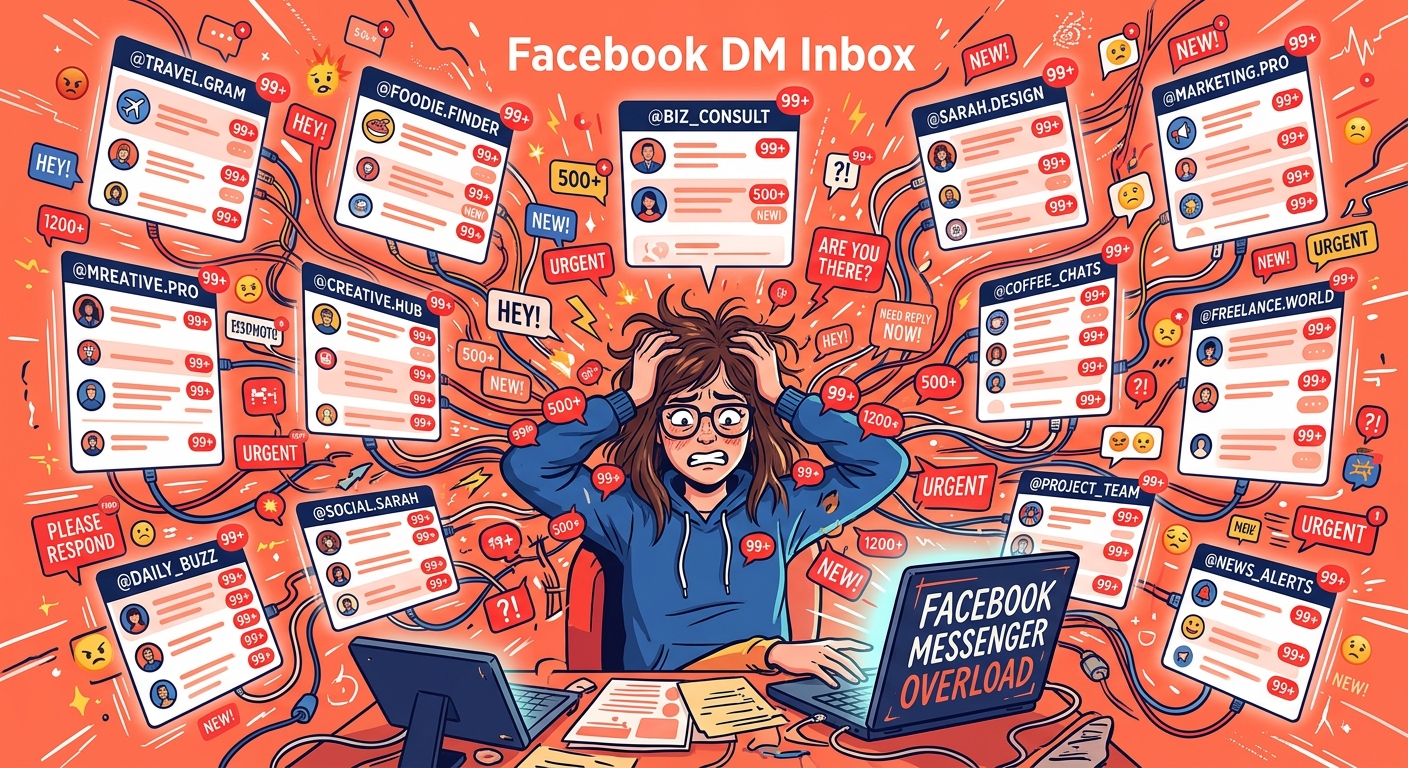
Second layer: Disorganized notifications, high-interest private messages sinking to the bottom amidst the noise.
Facebook's notification system is designed to maximize engagement, not to help you distinguish "which notification is most important".
A genuine private message from a customer and a system push notification saying "Your post has been liked by 5 people" have the same visual weight in the notification bar. What's more troublesome is that if you have push notifications enabled for multiple accounts, your phone can receive dozens of notifications a day, most of which are content interactions, system reminders, and advertising suggestions—only a small fraction of them are private messages that actually require your reply.
The human brain naturally becomes accustomed to high-frequency noise. When notifications come too frequently, you start to ignore them; and when you start ignoring them, it's only a matter of time before you miss important messages.
Many content creators using a multi-account model deal with this by "scheduled checks"—opening all accounts at fixed times each day. While theoretically feasible, this method is extremely time-consuming, and "scheduled checks" mean there could be a gap of several hours. If a highly interested client waits four hours without a response, the initiative is already slipping away.
Effective Facebook private message management doesn't rely on sheer manpower; it requires a mechanism that can separate the signal from the noise.
The third layer: lacks a summary and has no overall perspective.
This is the most crucial issue.
If you ask a matrix creator, "How many unanswered private messages do you have right now?", nine times out of ten they won't be able to answer.
It's not because of irresponsibility, but because this information simply doesn't exist anywhere you can directly view it. You have to open each account one by one and count them to piece together an incomplete picture—and by the time you get to the eighth account, the previous accounts might have received new messages.
Without a holistic perspective, there's no way to prioritize. You don't know which account received the most inquiries today, which message took the longest to arrive, or how many messages you thought you'd seen but were actually just "read but not replied to."
This information blind spot is the most fundamental structural flaw in private message management under the matrix operation model. Simply reminding yourself to "check messages frequently" is useless without addressing this issue.
Act Three: Establishing a system that ensures no orders are missed via private messages.
Once you know where the problem lies, the direction of the solution becomes clear.
Repairing this system requires three things: establishing a unified entry point, setting priority filtering, and using automation as a fallback.
Step 1: Gather all private messages from all accounts in one place.
This is a prerequisite for solving the problem. If you still need to log in to each account individually to view private messages, then missed orders are almost inevitable.
In terms of tools, there are several options. One is to use Facebook Business Suite, which allows you to view messages from multiple pages under your company in one inbox, but there is a limit to the number of accounts you can have, and the functionality is relatively basic. Another option is to use third-party social media management tools specifically designed to solve the problem of aggregating messages from multiple accounts.
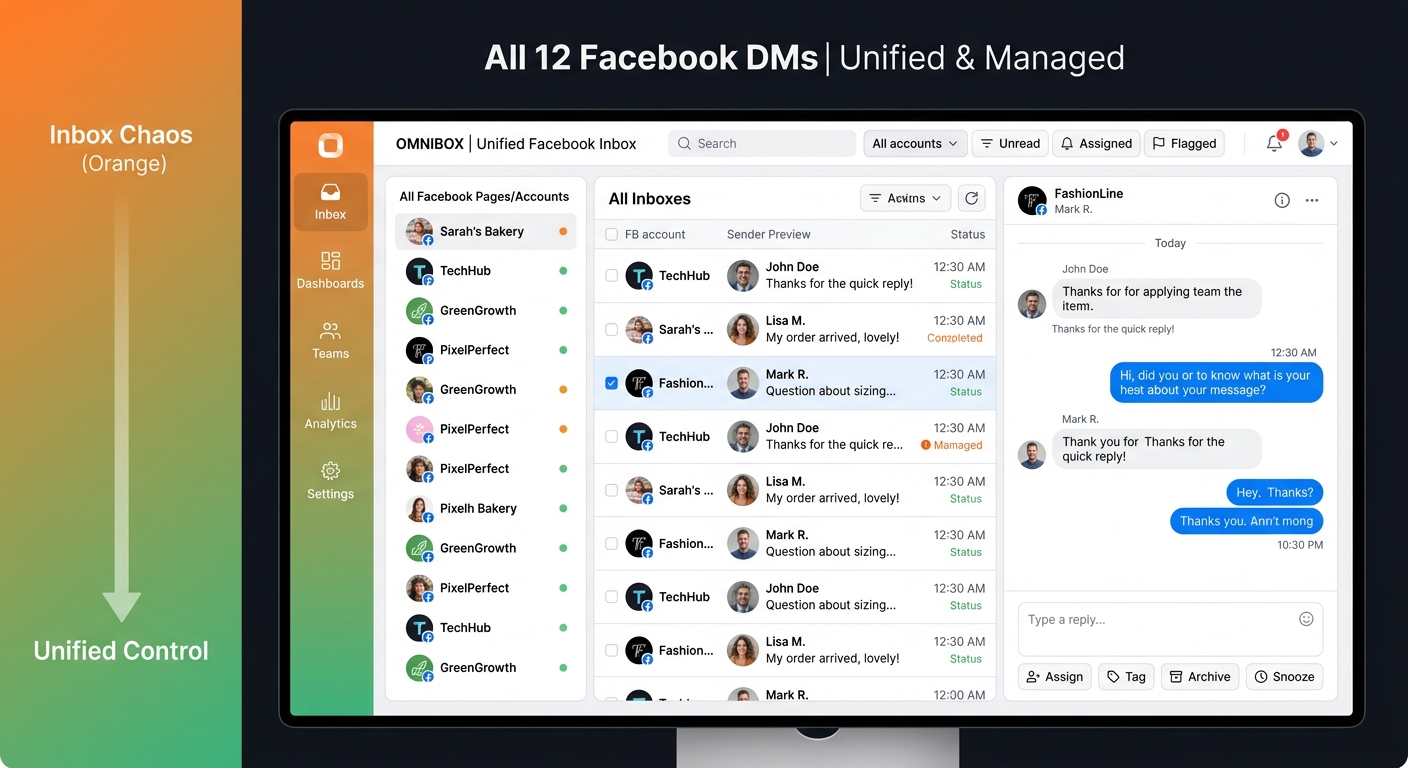
SocialEcho is one option worth noting – its unified inbox allows you to aggregate private messages from multiple Facebook pages, eliminating the need to switch between different accounts. Messages are arranged chronologically, and with Facebook's private message management features, you can reply directly within the platform. Once processed, messages can be marked and archived, and the entire process can be completed in one interface. The basic plan starts at 12.50/month, and the team plan starts at 18.75/month, with a 20% discount for annual payments.
Regardless of the tool you use, there is only one principle: your inbox can only have one entry point.
Step 2: Establish a priority marking mechanism
With a unified entry point in place, the next step is to differentiate between messages that "require immediate response" and those that "can be processed later."
Private messages from highly interested clients typically have several characteristics: the message content is specific (inquiring about prices, cooperation methods, product details), the account has a real profile picture and historical content, and the message is sent during working hours.
You can establish a simple tagging rule within your team: any private messages containing keywords like "collaboration/price/customization/how to buy" should be automatically tagged with "high priority" and must be replied to on the same day. Other interactive private messages (asking questions, expressing liking, requesting recommendations) can be handled with second priority.
The core of this mechanism is not "no leaks," but "knowing what absolutely cannot be leaked."
Step 3: Use automated replies to buy time for high-intent customers.
Even with a unified entry point, you can't guarantee a response to every message within 5 minutes. Someone managing 12 accounts also has dozens of other tasks to handle daily.
This is where the value of automatic replies becomes apparent.
A well-designed automated reply isn't a cold, impersonal "Hello, we've received your message," but rather a gentle signal that the customer feels "someone is there." For example: "Thank you for your message! We usually reply within X hours. If you have an urgent matter, you can also contact us through [other methods]."
Facebook Direct Mail (DM) auto-response can be configured to trigger responses based on keywords. For example, when a customer's private message contains "collaboration" or "price," an automatic prompting reply can be sent, while simultaneously sending an internal notification to the operations team. This way, even if you are not online at the time, the customer won't feel like they are talking to thin air.
Automatic replies are not meant to replace human intervention, but rather to help maintain your customers' attention and patience before a human response arrives.
Step 4: Regularly review private messages
Spend 20 minutes each week reviewing the previous week's private message data: how many messages were received, how many were replied to, the average reply time, and whether any high-interest messages were ultimately not followed up.
This isn't about self-criticism, but about identifying systemic flaws. If you find that several private messages go unanswered for more than 24 hours each week, it's not because you're lazy, but because there's a fixed blind spot in your current process—find it and plug it.
With the integration of AI automation , some platforms can now automatically calculate private message response rates and trigger alerts when key metrics decline, which is much more reliable than relying on human memory.
Similarly, comment management and private message management complement each other—many clients will comment on your posts to test the waters before sending you a private message. If your Facebook comment management is also effective, quickly identifying and responding to comments that indicate a willingness to collaborate, your private message conversion rate will also increase.
You might also want to know
Q: Can Facebook's native inbox feature manage multiple pages?
Meta Business Suite offers a basic multi-page message aggregation feature, but it has some limitations: management efficiency decreases after a certain number of pages, and it lacks features such as priority marking, keyword filtering, and team collaboration. For matrix creators managing more than 5 accounts, supplementing with third-party tools is usually necessary.
Q: Will automated replies make customers feel that the responses are unrealistic or perfunctory?
It depends on the design of the automated reply. A template like "Your message has been received" can easily create a sense of distance. However, if the automated reply includes a specific waiting time, alternative contact methods, or immediate answers to frequently asked questions, customers will usually understand and accept it. The key is to make the other party feel that "there is a real person behind you, just temporarily busy."
Q: How should the work be divided when a team of multiple people manages multiple Facebook accounts?
A clearer division of labor is the "account responsibility system": each person is responsible for all interactions (private messages + comments) across several accounts, rather than dividing tasks by function (one person specifically replies to private messages, another to comments). This avoids information fragmentation and ensures a more consistent customer communication style across all accounts. SocialEcho's team version supports assigning different members to different accounts, and messages can also be forwarded within the team for easy collaboration.
Q: What are the typical characteristics of private messages with high intent, and how can they be quickly identified?
There are usually a few signs: the message content is specific rather than vague praise ("Can you do X?", "How much does it cost?"); the account has a real profile picture, posting history, and high-quality followers; the message is sent during normal working hours; and the other party actively asks for or adds details. Turn these characteristics into the team's identification criteria, mark them as high priority, and follow up on them first.
Q: My private message replies are too slow, and the customer has already left. Is there any way to salvage the situation?
You can try proactively following up, but you need to control the method and timing. If the other party's message is only 1-2 days old, a short and sincere apology plus additional information usually still has a chance: for example, "Sorry, I just saw your message. Regarding your question about X, here is our answer..." If it has been more than a week, the success rate of proactively contacting them will drop significantly, but it is still worth trying, after all, finding high-intent customers is not easy in the first place.
Q: Besides private messages, what other customer signals are easily missed by matrix creators?
Besides private messages, high-interest signals in the comments section are often overlooked. Some potential clients don't proactively send private messages; instead, they comment below the post asking "How to contact me?" or "Any collaboration opportunities?"—these comments, if not responded to promptly, will also lead to lost business. It's recommended to treat private message management and comment management as a unified system, covering both entry points, and not just focusing on private messages.
Conclusion
Lin Xiao later posted a comment under the brand's account that she had missed, explaining that she had missed the message, but the other party did not reply.
That message ultimately became a lesson and a turning point: from then on, she began to seriously build her own private message management system, unifying the entry point, configuring automatic replies, and reviewing the process weekly. Three months later, her average reply time to private messages changed from "random" to "within 4 hours," and she missed significantly fewer high-potential customers.
Traffic is precious, and every customer who takes the initiative to knock on the door deserves to be seen.
If you're currently experiencing "too many messages to manage," the problem isn't how hard you're trying, but whether you have a comprehensive view of the situation. Solving this issue will have a more direct impact on your business conversion than any content optimization.
;}.cls-2{fill:%230868f7;}.cls-3{fill:url(%23未命名的渐变_44);}.cls-4{fill:%23333;}%3c/style%3e%3clinearGradient%20id='未命名的渐变_8'%20x1='33.73'%20y1='100.61'%20x2='-0.03'%20y2='-1.06'%20gradientUnits='userSpaceOnUse'%3e%3cstop%20offset='0'%20stop-color='%237ae9fb'/%3e%3cstop%20offset='0.67'%20stop-color='%232b90f8'/%3e%3cstop%20offset='1'%20stop-color='%230868f7'/%3e%3c/linearGradient%3e%3clinearGradient%20id='未命名的渐变_44'%20x1='27.86'%20y1='18.67'%20x2='68.36'%20y2='22.22'%20gradientUnits='userSpaceOnUse'%3e%3cstop%20offset='0'%20stop-color='%235ac7f2'/%3e%3cstop%20offset='1'%20stop-color='%230868f7'/%3e%3c/linearGradient%3e%3c/defs%3e%3cpath%20class='cls-1'%20d='M29,28.74V81.91l-9.51-3.68v0L8.52,74A7.17,7.17,0,0,1,4,67.32V24.54A3.76,3.76,0,0,1,9.08,21Z'/%3e%3cpath%20class='cls-2'%20d='M68.09,78.07a13.15,13.15,0,0,1-17.9,12.06L29,81.91h0V28.74L50.19,37A13.17,13.17,0,0,0,68.08,25.3h0Z'/%3e%3cpath%20class='cls-3'%20d='M68.08,25.3a13.19,13.19,0,0,1-6.73,10.87A13.09,13.09,0,0,1,50.19,37L29,28.74V6A3.76,3.76,0,0,1,34.1,2.52l25.59,9.91A13.22,13.22,0,0,1,68.08,25.3Z'/%3e%3cpath%20class='cls-4'%20d='M129.06,81.76a4.33,4.33,0,0,1-3.19-1.31,4.4,4.4,0,0,1-1.31-3.24V56.86H97.65V77.21a4.36,4.36,0,0,1-1.35,3.2A4.68,4.68,0,0,1,93,81.76a4.32,4.32,0,0,1-3.19-1.31,4.37,4.37,0,0,1-1.32-3.24V27.27A4.58,4.58,0,0,1,89.83,24a4.59,4.59,0,0,1,7.82,3.27V48.15h26.91V27.27A4.58,4.58,0,0,1,125.91,24a4.59,4.59,0,0,1,7.82,3.27V77.21a4.37,4.37,0,0,1-1.36,3.2A4.65,4.65,0,0,1,129.06,81.76Z'/%3e%3cpath%20class='cls-4'%20d='M163.77,81.66c-6.57,0-11.76-1.92-15.44-5.7s-5.54-9.07-5.54-15.74a26.76,26.76,0,0,1,2.09-10.43,17.72,17.72,0,0,1,6.67-8.06,19.15,19.15,0,0,1,10.68-2.95,19,19,0,0,1,10.46,2.8,18.7,18.7,0,0,1,6.55,7.36,22.53,22.53,0,0,1,2.36,10.28A4.51,4.51,0,0,1,177,63.77H152.23a10.8,10.8,0,0,0,3.49,6.65c2,1.68,4.88,2.52,8.66,2.52a22.25,22.25,0,0,0,7.54-1.21c.74-.3,1.55-.67,2.37-1.07a3.75,3.75,0,0,1,1.84-.4,4.09,4.09,0,0,1,3,1.15,4,4,0,0,1,1.12,3,4.38,4.38,0,0,1-2.58,3.82,32.34,32.34,0,0,1-6.36,2.61A28.67,28.67,0,0,1,163.77,81.66ZM172.4,55.9a9.72,9.72,0,0,0-1.63-4.56A9.9,9.9,0,0,0,167,48a10.38,10.38,0,0,0-4.64-1.14,12,12,0,0,0-4.77,1.06,9.54,9.54,0,0,0-4.89,5.66,11.78,11.78,0,0,0-.51,2.3Z'/%3e%3cpath%20class='cls-4'%20d='M193,81.64a4.49,4.49,0,0,1-4.51-4.55V27.28A4.58,4.58,0,0,1,189.84,24a4.48,4.48,0,0,1,3.28-1.36A4.36,4.36,0,0,1,196.35,24a4.46,4.46,0,0,1,1.31,3.31V77.09a4.34,4.34,0,0,1-1.35,3.2A4.67,4.67,0,0,1,193,81.64Z'/%3e%3cpath%20class='cls-4'%20d='M263.79,81.71a5.7,5.7,0,0,1-4.2-1.74,5.76,5.76,0,0,1-1.73-4.19V27.37a4.58,4.58,0,0,1,1.35-3.27A4.59,4.59,0,0,1,267,27.37V72.53h24a4.58,4.58,0,0,1,3.27,7.82A4.66,4.66,0,0,1,291,81.71Z'/%3e%3cpath%20class='cls-4'%20d='M424.48,81.74a4.71,4.71,0,0,1-2.71-.88,5.43,5.43,0,0,1-1-1l-.07-.09-12.41-17-5.41,5v9.44a4.31,4.31,0,0,1-1.36,3.19,4.66,4.66,0,0,1-3.3,1.36A4.29,4.29,0,0,1,395,80.42a4.36,4.36,0,0,1-1.32-3.23V27.37A4.58,4.58,0,0,1,395,24.1a4.52,4.52,0,0,1,6.58.12,4.54,4.54,0,0,1,1.24,3.15V56.31l17.72-16.38.05,0a4.8,4.8,0,0,1,2.94-1.11,4.4,4.4,0,0,1,3.27,1.2,4.57,4.57,0,0,1,1.2,3.27,4.44,4.44,0,0,1-.77,2.33,7.45,7.45,0,0,1-1.43,1.65l-11,9.64,13.34,17.68a5,5,0,0,1,1,2.71,4.12,4.12,0,0,1-1.36,3.24A4.64,4.64,0,0,1,424.48,81.74Z'/%3e%3cpath%20class='cls-4'%20d='M317.93,81.76a21.5,21.5,0,1,1,21.17-21.5A21.37,21.37,0,0,1,317.93,81.76Zm0-34.1a12.61,12.61,0,1,0,12.42,12.6A12.52,12.52,0,0,0,317.93,47.66Z'/%3e%3cpath%20class='cls-4'%20d='M212.18,101.22a4.12,4.12,0,0,1-3.05-1.26,4.17,4.17,0,0,1-1.26-3.1V43.34a4.37,4.37,0,0,1,1.3-3.14,4.26,4.26,0,0,1,3.13-1.3,4.19,4.19,0,0,1,3.1,1.26,4.32,4.32,0,0,1,1.26,3.16,20.77,20.77,0,0,1,13-4.54,21.51,21.51,0,0,1,0,43,20.51,20.51,0,0,1-13-4.57V96.86a4.15,4.15,0,0,1-1.3,3.06A4.5,4.5,0,0,1,212.18,101.22Zm17.43-53.63c-6.23,0-12.93,4.11-12.93,12.72a12.73,12.73,0,0,0,25.46,0A12.71,12.71,0,0,0,229.61,47.59Z'/%3e%3cpath%20class='cls-4'%20d='M365.76,81.76a21.5,21.5,0,1,1,21.18-21.5A21.37,21.37,0,0,1,365.76,81.76Zm0-34.1a12.61,12.61,0,1,0,12.42,12.6A12.52,12.52,0,0,0,365.76,47.66Z'/%3e%3c/svg%3e)