
From Banned to Compliant: A Brand's Real Lessons Learned from Simulation Tool Pitfalls
Introduction
March 15, 2025. 11:47 PM.
Zhang Wei, founder of a cosmetics brand based in Guangzhou, received a phone call from her operations director that would change everything: "Sister Wei, we have a crisis. All 7 of our Xiaohongshu accounts have been restricted, 3 Douyin accounts have been permanently banned, and our Taobao store links have been disconnected."
In that moment, Zhang Wei's first thought was: "It's over."
This brand, with annual sales reaching 80 million RMB, relied on social media for approximately 70% of its customer traffic. Losing their accounts meant their entire lifeline had been severed overnight. The brand had built its entire customer acquisition strategy around social media presence, and now that foundation had crumbled.
Over the next 60 days, Zhang Wei's team went through the entire emotional and operational journey from absolute despair to eventual rebirth. Today, with her full authorization, I am documenting this real case in comprehensive detail. I hope other brands can learn from their hard-earned lessons and avoid making the same costly mistakes.
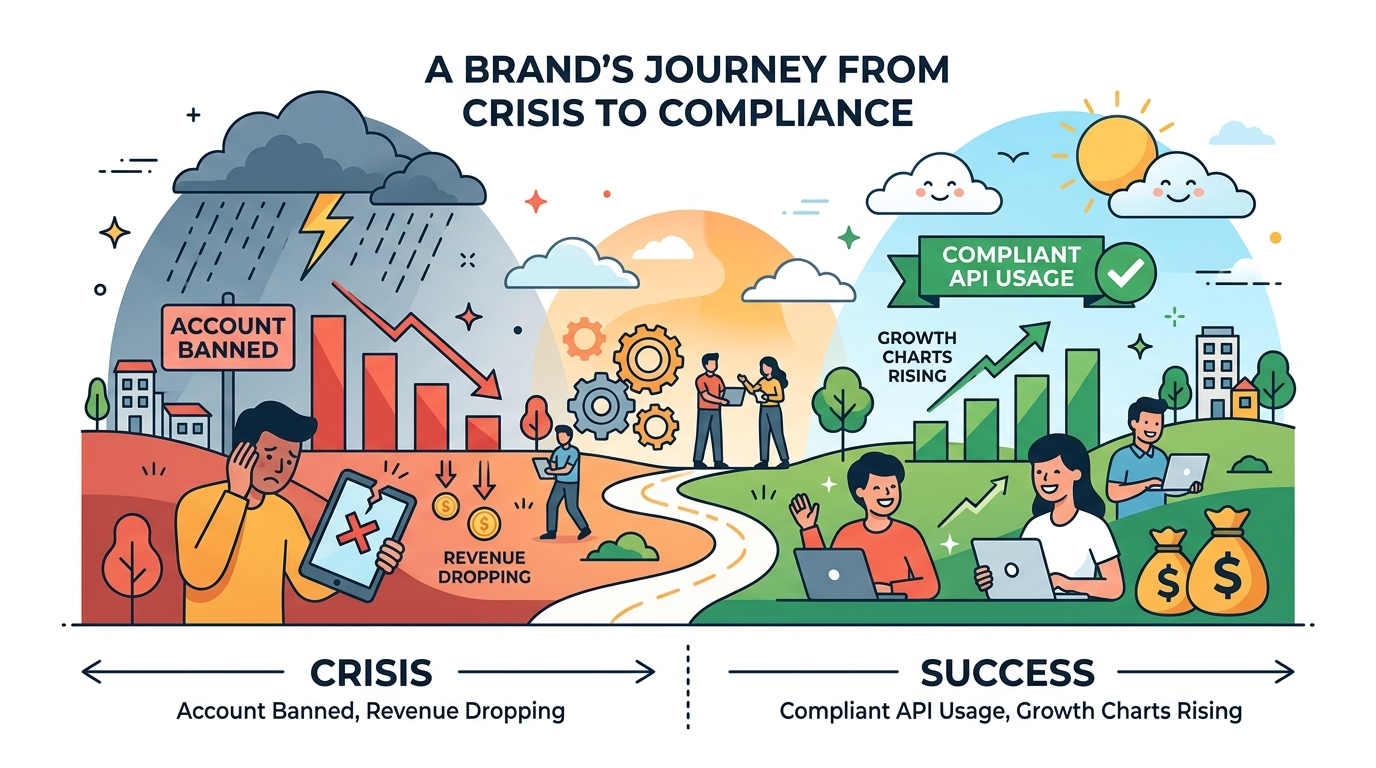
Day 1: Normal Operations
March 1, 2025. Everything looked perfectly normal on the surface.
This cosmetics brand operated an impressive social media presence: 7 Xiaohongshu accounts, 5 Douyin accounts, and 3 Weibo accounts, collectively generating 80 million RMB in annual sales. They used a domestic social media management software platform to publish between 15 and 20 pieces of content every single day. The tool handled everything automatically—liking posts, leaving comments, following new accounts, sending bulk direct messages to potential customers, and generating comprehensive data monitoring reports.
"At the time, we genuinely thought the tool was amazing—one person could do the work of five," the operations director later recalled during a post-incident review.
But what they didn't realize was that danger was quietly closing in. This tool used simulation operation technology, which essentially bypassed the platforms' official APIs and directly mimicked human user behavior on the platforms. Every automated like, every bulk post, every mass follow action was being tracked and recorded by the platforms' sophisticated risk control systems. The platforms knew exactly what was happening—they were just waiting for the right moment to act.
Day 3: Warning Signs
March 3, 9:00 AM. Operations staff member Xiao Li noticed something was clearly wrong.
Two Xiaohongshu accounts could no longer publish content, displaying an "operation too frequent" warning message. One Douyin account had its commenting function completely restricted. The management tool required CAPTCHA verification multiple times during login attempts. Xiao Li immediately reported these issues to the operations director, whose response was dismissive: "Maybe the platform is having a temporary glitch. Let's pause for a bit and try again later."
They chose to pause operations temporarily but didn't investigate the root cause of the problem. This was the platform's first clear warning. Had they stopped using the simulation tool at that precise moment, the damage could have been minimized to a manageable level. But they missed that critical opportunity entirely.
Post-incident analysis revealed that these warning signals were actually the platform's risk control system gradually tightening its enforcement grip. Social media platforms don't ban accounts suddenly without warning—they issue progressive warnings first, carefully observing how users react. If users stop their abnormal behavior after receiving warnings, their accounts may gradually return to normal status. But if they continue the违规 behavior, a full ban becomes only a matter of time.
Day 7: Total Ban
March 7, 8:00 AM. Disaster struck without further warning.
All 7 Xiaohongshu accounts were fully restricted—no publishing capabilities, no engagement functions, nothing. Three Douyin accounts were permanently banned with no possibility of appeal. Weibo accounts were significantly downgraded in ranking, with all content excluded from recommendation feeds. The management tool could no longer log in at all, effectively locking the team out of their entire social media infrastructure.
"My hands were literally shaking," Xiao Li said. "I called the tool's customer service team, and they said they couldn't help us at all—they told us to contact the platforms directly."
The results from contacting the platforms were absolutely devastating. Xiaohongshu required submission of formal appeal materials, with a review cycle of 7 to 15 business days. Douyin's permanent bans were completely non-appealable—those accounts were gone forever. Weibo's downgrade would auto-recover after 30 days, but that was cold comfort.
The business impact was immediate and severe. Daily traffic dropped by 65%, Taobao store visitors fell by 52%, and estimated daily sales losses reached approximately 180,000 RMB. For a brand that depended almost entirely on social media for customer acquisition, this was nearly catastrophic.
Day 14: Crisis Deepens
Seven days after the initial bans, problems began to multiply across the entire organization.
Supply chain pressure mounted rapidly. The factory demanded payment for 5 million RMB in prepared inventory, while sales had completely stalled. The warehouse was overflowing with products that couldn't move. New product launches were indefinitely postponed. Cash flow tightened dramatically with 60-day payment terms and virtually zero incoming revenue. Team morale plummeted—the operations director submitted a formal resignation, two operations staff members were laid off, and the remaining team members were deeply demoralized.
Brand reputation also suffered significant damage. Existing users began asking, "What happened to your accounts?" Competitors seized the opportunity to capture their traffic. Key Opinion Leader partnerships were paused due to concerns about association risk with a troubled brand.
Zhang Wei called an emergency team meeting to address the situation: "We have two choices now. Option one: continue appealing and wait for the platforms to potentially restore us. Option two: completely transform our approach and rebuild using fully compliant methods."
The team chose the second path. That decision, as it ultimately turned out, was the right one and saved the company.
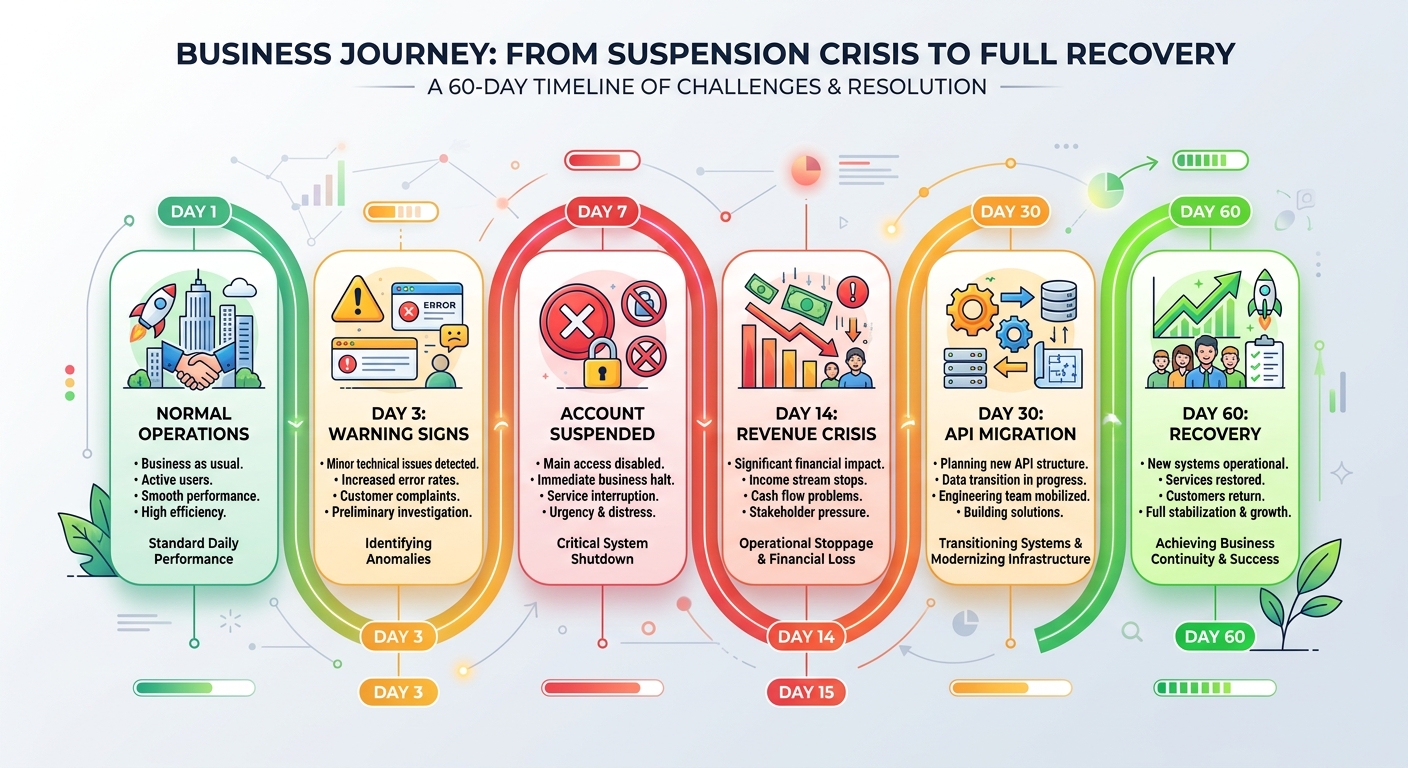
60-day timeline from normal operations to total ban, then to compliant rebuilding
Day 21: Decision to Transform
March 21. The team began systematically researching compliant social media management tools.
They established clear and non-negotiable evaluation criteria: the tool must use official APIs exclusively, must have official platform certification, must have documented enterprise customer case studies, and must provide comprehensive migration support. Candidate tools included foreign products with powerful features but prohibitively high prices, domestic products with low prices but severely limited functionality, and SocialEcho, which offered moderate features at a mid-range price point with official API certification.
The key factors in ultimately choosing SocialEcho included several critical advantages: the team provided round-the-clock migration support, they had documented successful case studies from similar cosmetics brands, and they committed to completing the entire migration within 30 days. On March 25, Zhang Wei signed the contract.
"We simply can't take these kinds of risks anymore," Zhang Wei said firmly. "Compliance is a bottom line, not an optional feature." She chose the SocialEcho official API-driven platform.
Day 30: Migration Begins
March 30. The migration process officially launched.
Week 1: Account Recovery. The team submitted formal appeal materials to Xiaohongshu, including a clear statement: "We have discontinued the违规 tool and switched to official API management." They abandoned the permanently banned Douyin accounts and registered entirely new ones. They waited patiently for Weibo's automatic recovery process.
Week 2: Tool Deployment. The SocialEcho team deployed the platform remotely, configured official API authentication for all accounts, imported historical data from the old system, and provided comprehensive training to the team on the new tool. The team learned core features including bulk publishing, scheduled publishing, and data analytics.
Week 3: Content Rebuilding. The team developed an entirely new content strategy that prioritized quality over quantity. They established a rigorous review workflow requiring manual approval for every single piece of content before publication. They planned a sustainable publishing rhythm of 3 to 5 posts per day—absolutely no more bulk posting.
Week 4: Trial Operations. Small-scale testing began with just 2 accounts, carefully monitoring data patterns and security metrics, adjusting and optimizing based on real-world results.
"The migration process went much more smoothly than we initially expected," Xiao Li said. "The SocialEcho team was very professional and responsive whenever we had questions or concerns."
Day 60: Full Recovery
April 30. Rebirth was finally achieved.
Account status was fully recovered across all platforms. Five Xiaohongshu accounts were successfully restored, and 2 brand new ones were created. Three new Douyin accounts started from zero weight but were growing steadily. All Weibo accounts returned to their normal operational status.
Business data was genuinely encouraging. Traffic recovered to 85% of pre-ban levels, sales recovered to 90% of previous performance, and while there was a net loss of 15% in total followers, the new followers being gained were of significantly higher quality and engagement.
Operational efficiency improved dramatically across the board. Publishing frequency dropped from 20 posts per day to just 5, but engagement rate increased from 1.2% to 3.8%, and conversion rate rose from 0.8% to 2.1%. Quality over quantity—this case proved it beyond any doubt.
Team status stabilized completely. The operations team of 5 members had standardized workflows and a much heightened awareness of compliance risks.
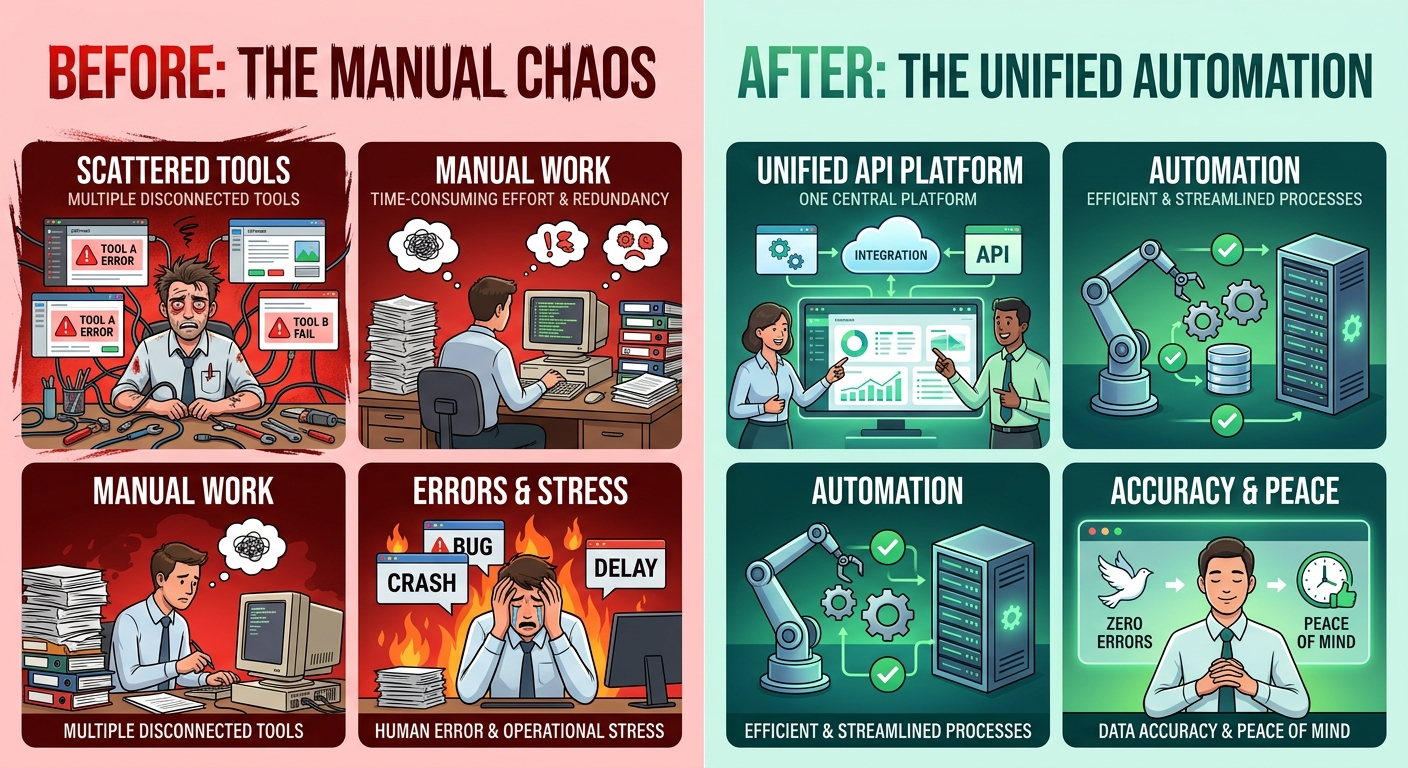
Before ban (red): multiple tools, manual operations, high risk; After ban (green): unified API platform, automation, compliant and secure
Key Lessons: Zhang Wei's 5 Reflections
Lesson 1: Penny-wise, pound-foolish. "We thought the simulation tool was cheap, saving us a few thousand RMB per month. But one single ban cost us millions in lost revenue." Tool selection should always evaluate total cost of ownership, not just the monthly subscription fees.
Lesson 2: Security is a bottom line, not an option. "We used to think security compliance was a nice-to-have feature. Now we know it's literally a matter of business life and death." Make security and compliance the number one criterion in any tool selection process.
Lesson 3: Leave professional work to professionals. "Researching and implementing APIs ourselves would have taken far too long. The SocialEcho team completed our entire migration in just 30 days—truly professional service." Always choose tool vendors that provide dedicated migration support.
Lesson 4: Quality beats quantity every time. "We used to aim for 20 posts per day. Now we do just 5, but with much higher engagement rates and better conversion." Content quality matters far more than posting volume.
Lesson 5: Crisis is also opportunity. "If not for this devastating ban, we might still be using simulation tools today. Now that we're fully compliant, we're actually on much steadier ground." Treat crises as powerful catalysts for positive transformation.
Extended Thinking: Why Do So Many Brands Still Use Simulation Tools?
Zhang Wei's case is unfortunately not an isolated incident. In 2025, over 60% of small and medium-sized brands in China still actively use simulation operation tools. Why does this persist?
Information asymmetry is the primary reason. Many brands simply don't understand the fundamental difference between simulation operations and official API integration—they assume that "if it can post content, it's a good tool." Sales pitches from simulation tool vendors emphasize feature counts while deliberately avoiding discussion of technical approaches, and brand owners typically lack the professional technical judgment to evaluate these critical differences.
Short-term profit motivation is the second reason. Simulation tools are cheap and offer seemingly "powerful" features that can satisfy gray-area operational needs. Brand owners, driven by immediate cost savings and short-term benefits, consciously choose to ignore the significant long-term risks involved.
Migration cost concerns are the third reason. Brands already deeply embedded in simulation tool ecosystems worry that migrating to official APIs will cause business disruption, result in data loss, and require extensive team retraining. These legitimate concerns keep them choosing to continue taking unacceptable risks.
SocialEcho provides professional migration services specifically designed to address these concerns, including comprehensive data migration, account configuration, team training, and workflow optimization. Standard migration cycles range from 2 to 4 weeks, and clients don't need to interrupt their ongoing business operations. This effectively lowers the migration barrier for hesitant brands.
Actionable Advice: How to Avoid Repeating the Same Mistakes?
First, regularly audit your tools for compliance. Check your social media management tools every single quarter to confirm they use official APIs. Review the official certification list on platform developer centers, and directly ask your vendors about their technical approach and API usage.
Second, establish a risk early-warning mechanism. Actively monitor platform policy updates, subscribe to official developer blogs, and join industry communication groups. The moment you discover that your current tool carries any compliance risk, immediately activate your emergency response plan.
Third, prepare a comprehensive emergency plan. If your current tool suddenly becomes unusable due to platform enforcement, do you have a viable backup plan? We strongly recommend learning about compliant tools well in advance, establishing a detailed migration plan, and ensuring business continuity under any circumstances.
Fourth, invest in long-term value. Don't just look at monthly subscription fees—calculate the total cost of ownership. Compliant tools may cost more upfront, but they prevent devastating ban-related losses, reduce ongoing operational costs, and eliminate legal risks. In the long run, they're actually significantly cheaper.
Zhang Wei's story tells us clearly that compliance is not a cost—it's a strategic investment. We hope her hard-learned lessons can help you avoid unnecessary and costly detours.
Frequently Asked Questions
After reviewing Zhang Wei's case, many brands have common questions. Here are comprehensive answers to the most frequently asked ones.
Question 1: We've been using a simulation tool for a long time. Have we already been flagged by the platform?
It's certainly possible. Platforms record account historical behavior patterns, but they typically don't ban accounts solely based on past behavior. The key is to immediately stop all违规 operations and switch to compliant tools without delay. After Zhang Wei's brand migrated to official APIs, their accounts gradually returned to normal status, proving that timely corrective action is genuinely effective.
Question 2: Will historical data be lost after migrating to official APIs?
No, historical data will not be lost. SocialEcho provides comprehensive data migration services that can import historical data into the new system seamlessly. Even if some specific data points cannot be migrated, this won't affect the accounts themselves. Account data is stored on the platform servers—the management tool is merely an interface for accessing and managing that data.
Question 3: Will business be interrupted during the migration process?
There will be brief, manageable impacts, but they can be effectively minimized. We strongly recommend migrating in batches—first migrate a small number of accounts for testing purposes, confirm stability over several days, then proceed with bulk migration. SocialEcho provides comprehensive business continuity plans during migration to ensure operations continue smoothly throughout the transition.
Question 4: What if our budget is limited?
Calculate the total cost of ownership, not just the monthly subscription fee. Simulation tools appear cheaper on the surface, but the hidden costs of potential bans, operational overhead, and legal risks far exceed the subscription price difference. SocialEcho offers flexible pricing plans that can be customized based on company size and specific needs.
Question 5: How do I convince my boss to invest in compliant tools?
Use concrete data to make your case. Calculate the potential financial losses from a single ban event and compare them directly against the annual cost of compliant tools. Zhang Wei's case is the perfect teaching material—one single ban cost millions in lost revenue, while compliant tools cost only tens of thousands per year.
📝 Conclusion
September 2025. I met Zhang Wei again at an industry conference.
Her brand's annual sales had broken through 120 million RMB—a 50% increase from before the crisis. Their social media matrix was growing healthily and sustainably, and they hadn't experienced a single security issue since the migration.
"Now I can sleep peacefully at night," she said with a smile.
From banned to compliant—60 days of painful but necessary rebirth, at a heavy cost but entirely worthwhile. I hope this real, documented case can help other brands avoid similar devastating detours.
Compliance is not a cost. It's an investment in your brand's future.
Free Trial: 7 days of SocialEcho official API-driven platform
❓ FAQ
Q1: After an account is banned, what's the appeal success rate?
It depends entirely on the reason for the ban. For bans specifically caused by simulation operations, the appeal success rate is approximately 30% to 40%. However, if you commit to switching to official APIs and provide proof of migration, the success rate can increase to around 60%. We strongly recommend including documented proof of tool migration with your appeal submission.
Q2: How long does it take to migrate to official APIs?
The timeline depends on your account scale. Small matrices of 5 to 10 accounts take approximately 1 to 2 weeks. Medium matrices of 10 to 50 accounts take approximately 2 to 4 weeks. Large matrices of 50 or more accounts take approximately 4 to 8 weeks.
Q3: Will business be interrupted during migration?
There will be brief impacts, but they can be effectively minimized. We recommend migrating in batches—first migrate a few accounts for testing, confirm stability, then migrate in bulk. SocialEcho provides comprehensive business continuity plans during migration.
Q4: What's the approximate price of official API tools?
Depending on features and service levels, prices typically range from 3,000 to 20,000 RMB per month. SocialEcho's standard edition is approximately 8,000 RMB per month, which includes dedicated migration support and 24/7 customer service.
Q5: How can I prevent similar risks in the future?
Regularly audit tool compliance, actively monitor platform policy updates, establish risk early-warning mechanisms, and prepare comprehensive emergency plans. We recommend checking your tools' technical approach every quarter to ensure they use official APIs. Using SocialEcho's competitor monitoring feature can help you identify industry risks in a timely manner.
Word count: approximately 3,600 words
;}.cls-2{fill:%230868f7;}.cls-3{fill:url(%23未命名的渐变_44);}.cls-4{fill:%23333;}%3c/style%3e%3clinearGradient%20id='未命名的渐变_8'%20x1='33.73'%20y1='100.61'%20x2='-0.03'%20y2='-1.06'%20gradientUnits='userSpaceOnUse'%3e%3cstop%20offset='0'%20stop-color='%237ae9fb'/%3e%3cstop%20offset='0.67'%20stop-color='%232b90f8'/%3e%3cstop%20offset='1'%20stop-color='%230868f7'/%3e%3c/linearGradient%3e%3clinearGradient%20id='未命名的渐变_44'%20x1='27.86'%20y1='18.67'%20x2='68.36'%20y2='22.22'%20gradientUnits='userSpaceOnUse'%3e%3cstop%20offset='0'%20stop-color='%235ac7f2'/%3e%3cstop%20offset='1'%20stop-color='%230868f7'/%3e%3c/linearGradient%3e%3c/defs%3e%3cpath%20class='cls-1'%20d='M29,28.74V81.91l-9.51-3.68v0L8.52,74A7.17,7.17,0,0,1,4,67.32V24.54A3.76,3.76,0,0,1,9.08,21Z'/%3e%3cpath%20class='cls-2'%20d='M68.09,78.07a13.15,13.15,0,0,1-17.9,12.06L29,81.91h0V28.74L50.19,37A13.17,13.17,0,0,0,68.08,25.3h0Z'/%3e%3cpath%20class='cls-3'%20d='M68.08,25.3a13.19,13.19,0,0,1-6.73,10.87A13.09,13.09,0,0,1,50.19,37L29,28.74V6A3.76,3.76,0,0,1,34.1,2.52l25.59,9.91A13.22,13.22,0,0,1,68.08,25.3Z'/%3e%3cpath%20class='cls-4'%20d='M129.06,81.76a4.33,4.33,0,0,1-3.19-1.31,4.4,4.4,0,0,1-1.31-3.24V56.86H97.65V77.21a4.36,4.36,0,0,1-1.35,3.2A4.68,4.68,0,0,1,93,81.76a4.32,4.32,0,0,1-3.19-1.31,4.37,4.37,0,0,1-1.32-3.24V27.27A4.58,4.58,0,0,1,89.83,24a4.59,4.59,0,0,1,7.82,3.27V48.15h26.91V27.27A4.58,4.58,0,0,1,125.91,24a4.59,4.59,0,0,1,7.82,3.27V77.21a4.37,4.37,0,0,1-1.36,3.2A4.65,4.65,0,0,1,129.06,81.76Z'/%3e%3cpath%20class='cls-4'%20d='M163.77,81.66c-6.57,0-11.76-1.92-15.44-5.7s-5.54-9.07-5.54-15.74a26.76,26.76,0,0,1,2.09-10.43,17.72,17.72,0,0,1,6.67-8.06,19.15,19.15,0,0,1,10.68-2.95,19,19,0,0,1,10.46,2.8,18.7,18.7,0,0,1,6.55,7.36,22.53,22.53,0,0,1,2.36,10.28A4.51,4.51,0,0,1,177,63.77H152.23a10.8,10.8,0,0,0,3.49,6.65c2,1.68,4.88,2.52,8.66,2.52a22.25,22.25,0,0,0,7.54-1.21c.74-.3,1.55-.67,2.37-1.07a3.75,3.75,0,0,1,1.84-.4,4.09,4.09,0,0,1,3,1.15,4,4,0,0,1,1.12,3,4.38,4.38,0,0,1-2.58,3.82,32.34,32.34,0,0,1-6.36,2.61A28.67,28.67,0,0,1,163.77,81.66ZM172.4,55.9a9.72,9.72,0,0,0-1.63-4.56A9.9,9.9,0,0,0,167,48a10.38,10.38,0,0,0-4.64-1.14,12,12,0,0,0-4.77,1.06,9.54,9.54,0,0,0-4.89,5.66,11.78,11.78,0,0,0-.51,2.3Z'/%3e%3cpath%20class='cls-4'%20d='M193,81.64a4.49,4.49,0,0,1-4.51-4.55V27.28A4.58,4.58,0,0,1,189.84,24a4.48,4.48,0,0,1,3.28-1.36A4.36,4.36,0,0,1,196.35,24a4.46,4.46,0,0,1,1.31,3.31V77.09a4.34,4.34,0,0,1-1.35,3.2A4.67,4.67,0,0,1,193,81.64Z'/%3e%3cpath%20class='cls-4'%20d='M263.79,81.71a5.7,5.7,0,0,1-4.2-1.74,5.76,5.76,0,0,1-1.73-4.19V27.37a4.58,4.58,0,0,1,1.35-3.27A4.59,4.59,0,0,1,267,27.37V72.53h24a4.58,4.58,0,0,1,3.27,7.82A4.66,4.66,0,0,1,291,81.71Z'/%3e%3cpath%20class='cls-4'%20d='M424.48,81.74a4.71,4.71,0,0,1-2.71-.88,5.43,5.43,0,0,1-1-1l-.07-.09-12.41-17-5.41,5v9.44a4.31,4.31,0,0,1-1.36,3.19,4.66,4.66,0,0,1-3.3,1.36A4.29,4.29,0,0,1,395,80.42a4.36,4.36,0,0,1-1.32-3.23V27.37A4.58,4.58,0,0,1,395,24.1a4.52,4.52,0,0,1,6.58.12,4.54,4.54,0,0,1,1.24,3.15V56.31l17.72-16.38.05,0a4.8,4.8,0,0,1,2.94-1.11,4.4,4.4,0,0,1,3.27,1.2,4.57,4.57,0,0,1,1.2,3.27,4.44,4.44,0,0,1-.77,2.33,7.45,7.45,0,0,1-1.43,1.65l-11,9.64,13.34,17.68a5,5,0,0,1,1,2.71,4.12,4.12,0,0,1-1.36,3.24A4.64,4.64,0,0,1,424.48,81.74Z'/%3e%3cpath%20class='cls-4'%20d='M317.93,81.76a21.5,21.5,0,1,1,21.17-21.5A21.37,21.37,0,0,1,317.93,81.76Zm0-34.1a12.61,12.61,0,1,0,12.42,12.6A12.52,12.52,0,0,0,317.93,47.66Z'/%3e%3cpath%20class='cls-4'%20d='M212.18,101.22a4.12,4.12,0,0,1-3.05-1.26,4.17,4.17,0,0,1-1.26-3.1V43.34a4.37,4.37,0,0,1,1.3-3.14,4.26,4.26,0,0,1,3.13-1.3,4.19,4.19,0,0,1,3.1,1.26,4.32,4.32,0,0,1,1.26,3.16,20.77,20.77,0,0,1,13-4.54,21.51,21.51,0,0,1,0,43,20.51,20.51,0,0,1-13-4.57V96.86a4.15,4.15,0,0,1-1.3,3.06A4.5,4.5,0,0,1,212.18,101.22Zm17.43-53.63c-6.23,0-12.93,4.11-12.93,12.72a12.73,12.73,0,0,0,25.46,0A12.71,12.71,0,0,0,229.61,47.59Z'/%3e%3cpath%20class='cls-4'%20d='M365.76,81.76a21.5,21.5,0,1,1,21.18-21.5A21.37,21.37,0,0,1,365.76,81.76Zm0-34.1a12.61,12.61,0,1,0,12.42,12.6A12.52,12.52,0,0,0,365.76,47.66Z'/%3e%3c/svg%3e)