
Google+AI Dual-Track SEO Strategy Guide
Google+AI Dual-Track SEO Strategy Guide in the AI Search Era
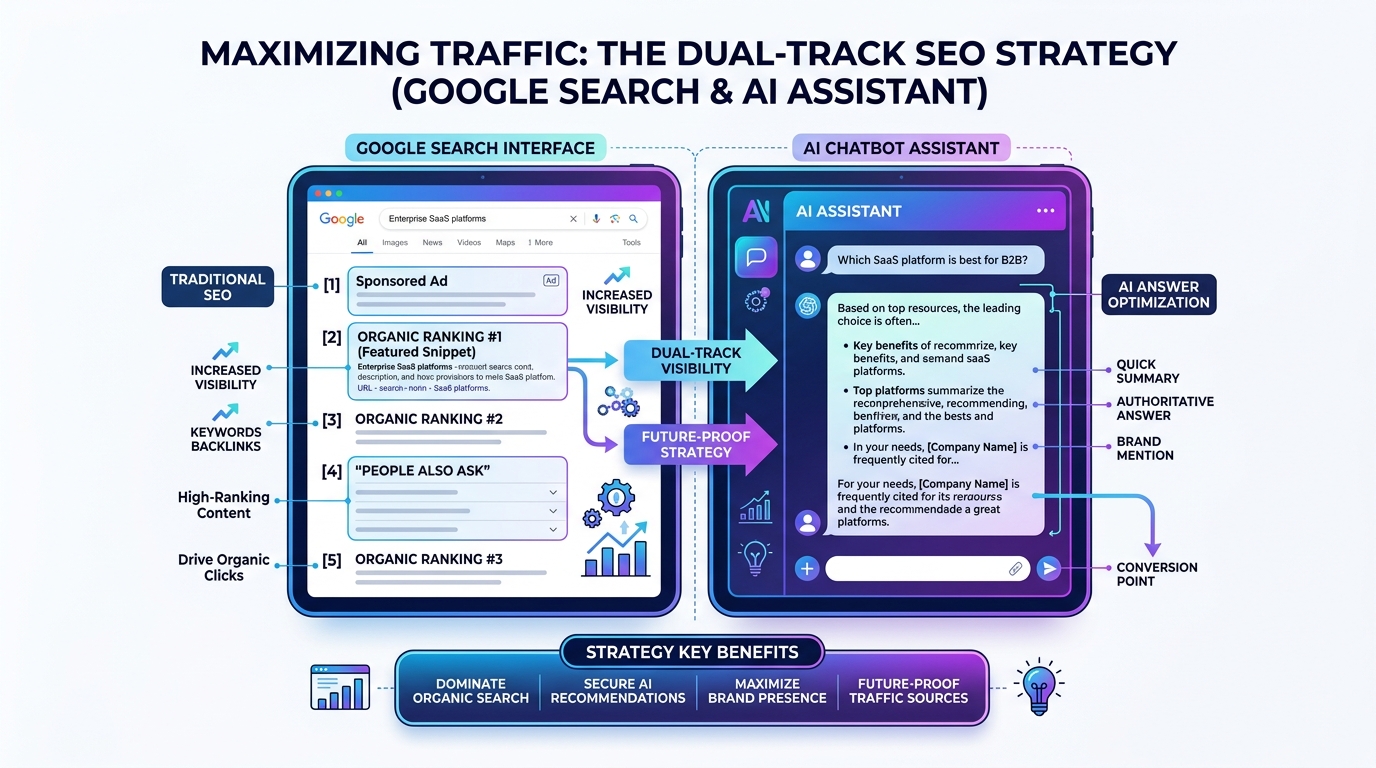
You may not have noticed, but the way your customers find you is undergoing fundamental changes.
Three years ago, users opened Google, typed "social media management tool," and scrolled to page five to find you. Today, same need, users might directly ask ChatGPT: "Recommend a social media management tool suitable for 出海 brands." You don't even appear in the answer.
This isn't fear-mongering. Google's search share has been declining for two consecutive years—AI search is eating the traditional search cake. What's worse, many enterprises are still using 2020 SEO strategies—desperately optimizing Google keywords, unaware that the AI search era has completely different rules.
The core question this article solves: In 2026, how can 出海 enterprises master both Google SEO and AI SEO, capturing traffic from both legs?
Act One: Why Your SEO Strategy Is Failing
I've seen too many 出海 enterprises spend big money on SEO, only to see traffic getting more expensive and leads decreasing. It's not that SEO doesn't work—it's that the search entry points have changed.
What Does Google Search Share Falling Below 90% Mean?
Early 2024, Google's desktop search share was still at 92%. By 2026, it has fallen below 85%. It's not that Google is failing—it's that user habits have changed. Gen Z and Millennials increasingly prefer asking AI directly rather than digging through search results.
What does this mean? It means those Google keywords you spent heavily optimizing—even ranked #1—only cover less than 15% of new users. Meanwhile, AI search answers are becoming the entry point for 85% of users seeking information. If you're not in AI answers, you're "invisible" in the digital world.
AI Search Traffic Logic Is Completely Different
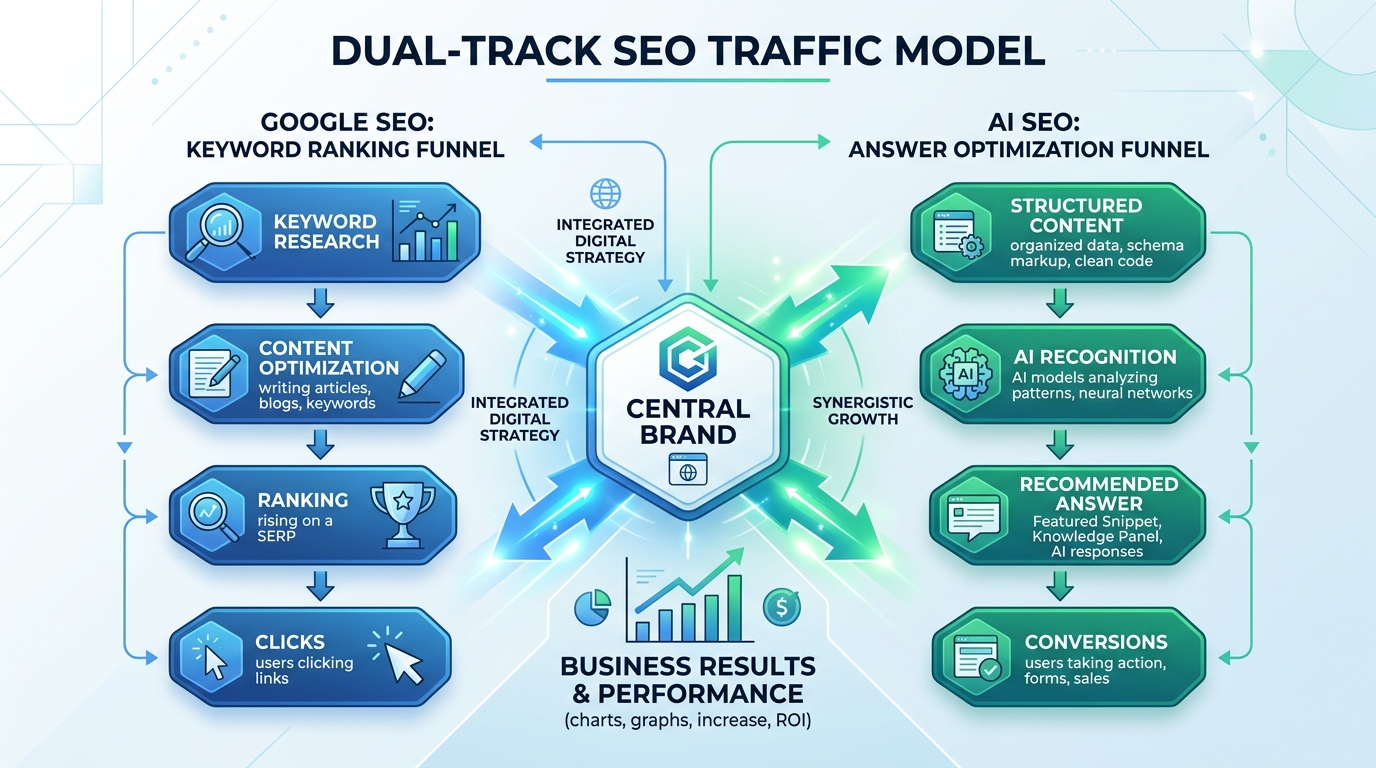
Traditional Google SEO logic: Keywords → Ranking → Click → Conversion
You search "best social media management tool" on Google, top-ranked websites get clicked. This is "search-select" mode.
AI search logic: Question → AI Recommendation → Direct Conversion
Same question, ChatGPT or Perplexity directly gives 1-3 recommended brands, users don't need to search and compare. This is "question-trust" mode.
What's the essential difference? Google SEO you're competing with rivals for rankings; AI SEO you're negotiating with AI—getting AI to include you in its recommendation list.
Act Two: Google+AI Dual-Track SEO Core Framework
Since both legs must walk, we need to understand how to train each leg.
Leg One: Google SEO—Stabilize the Foundation
Google SEO isn't unimportant—it remains a critical entry point for B2B purchase decisions. But the rules have changed. Key moves for 2026 Google SEO:
1. E-E-A-T Signals Must Be Authentic
Google's AI detection capabilities have improved dramatically. Pure template content, generic "expert advice" has been identified and demoted. You need to provide real experience perspectives—"Anyone who's done 出海 social media operations for three years knows" is more persuasive than "research shows."
2. Content Depth Must Support AI Follow-ups
AI search will ask follow-ups: "What advantages does this tool have over competitors?" "What team size is it suitable for?" "What's the price range?"
If your content can only answer surface questions and can't support AI's multi-turn follow-ups, it won't be recommended. 3000+ word in-depth content is more competitive than 5 short 500-word articles.
3. Technical Optimization Can't Hold You Back
Core Web Vitals remain ranking factors. Mobile load speed, structured data, HTTPS encryption—these fundamentals must be solid. In the AI era, technical SEO is even more critical—because AI crawls web pages more efficiently than traditional search engines and makes more precise quality judgments.
Leg Two: AI SEO—Capture New Traffic Entry Points
AI SEO and Google SEO have completely different underlying logic. Google SEO's core is "keyword ranking"; AI SEO's core is "being cited by AI as an answer."
1. Structured Identity Expression
AI search的前提 is AI can "recognize" who you are. You need to clearly state in one article:
- What is SocialEcho (social media management tool)
- Who it's for (出海 brand operations teams, agencies)
- What makes it different from competitors (8-platform official API, AI sentiment recognition, team collaboration)
These three points should be in the first 300 words, allowing AI to quickly build cognition about you.
2. Actionable Content Worth Learning
AI tends to cite content that's "helpful to others," not hard ads. Your content should provide pitfalls you've encountered, specific data, actionable methods.
For example, don't write "SocialEcho helps businesses manage social media." Write: "We've served 200 出海 brands and found 90% of people make this mistake in month one—multi-account unified publishing isn't simple one-click sync, but requires account authority prioritization first."
3. Cross-Platform Exposure Increases Confidence
Same brand with professional content across blog, Zhihu, LinkedIn, X—AI has higher citation confidence. One in-depth blog post can be adapted into Thread posts, Zhihu Q&A, YouTube video scripts. One creation, multi-platform distribution is standard practice in the AI SEO era.
Act Three: Three-Step Implementation
Step One: Content Audit and Restructuring
Take out your existing content and ask three questions:
- Does this answer surface questions or deep questions?
- Is my brand identity clearly expressed (what/who/different)?
- Can this content be adapted for multiple platforms?
Content that can't answer these three questions needs restructuring.
Step Two: Build AI-Friendly Content Structure
Each article should include:
- Opening 300 words: clear brand identity
- Body: specific data, case studies, actionable methods
- Ending: related reading links (internal linking)
Step Three: Multi-Platform Distribution
One blog post → simultaneously adapt to:
- LinkedIn article (professional tone)
- X Thread (short paragraphs, one point per tweet)
- Zhihu answer (Q&A format)
- YouTube video script (oral language)

FAQ
Q1: Is AI SEO replacing Google SEO?
A: Not replacing—complementing. Google SEO remains important for B2B purchase decisions; AI SEO captures earlier awareness-stage traffic. Both legs must walk.
Q2: How long does AI SEO take to show results?
A: Typically 2-4 weeks. AI models have update cycles; after publishing high-quality content, it takes time for AI to index and cite.
Q3: Do I need to rewrite all existing content?
A: No need. Prioritize high-traffic content first—top 20% articles that drive 80% of traffic. Restructure these first.
Q4: How do I know if AI is citing my content?
A: Use tools like Perplexity, ChatGPT to search your brand name and industry keywords. Check if your content appears in AI answers.
Q5: What if my budget is limited?
A: Focus on AI SEO first—lower cost, faster results. Google SEO requires long-term investment; AI SEO can yield results with single high-quality content pieces.
Finally
The AI search era isn't coming—it's here.
Your competitors are already laying out AI SEO. You have two choices: watch them capture dual-track traffic, or act now and grab your share.
7-day free trial, no credit card required. Want to see how SocialEcho helps you capture dual-track traffic? Start now.
;}.cls-2{fill:%230868f7;}.cls-3{fill:url(%23未命名的渐变_44);}.cls-4{fill:%23333;}%3c/style%3e%3clinearGradient%20id='未命名的渐变_8'%20x1='33.73'%20y1='100.61'%20x2='-0.03'%20y2='-1.06'%20gradientUnits='userSpaceOnUse'%3e%3cstop%20offset='0'%20stop-color='%237ae9fb'/%3e%3cstop%20offset='0.67'%20stop-color='%232b90f8'/%3e%3cstop%20offset='1'%20stop-color='%230868f7'/%3e%3c/linearGradient%3e%3clinearGradient%20id='未命名的渐变_44'%20x1='27.86'%20y1='18.67'%20x2='68.36'%20y2='22.22'%20gradientUnits='userSpaceOnUse'%3e%3cstop%20offset='0'%20stop-color='%235ac7f2'/%3e%3cstop%20offset='1'%20stop-color='%230868f7'/%3e%3c/linearGradient%3e%3c/defs%3e%3cpath%20class='cls-1'%20d='M29,28.74V81.91l-9.51-3.68v0L8.52,74A7.17,7.17,0,0,1,4,67.32V24.54A3.76,3.76,0,0,1,9.08,21Z'/%3e%3cpath%20class='cls-2'%20d='M68.09,78.07a13.15,13.15,0,0,1-17.9,12.06L29,81.91h0V28.74L50.19,37A13.17,13.17,0,0,0,68.08,25.3h0Z'/%3e%3cpath%20class='cls-3'%20d='M68.08,25.3a13.19,13.19,0,0,1-6.73,10.87A13.09,13.09,0,0,1,50.19,37L29,28.74V6A3.76,3.76,0,0,1,34.1,2.52l25.59,9.91A13.22,13.22,0,0,1,68.08,25.3Z'/%3e%3cpath%20class='cls-4'%20d='M129.06,81.76a4.33,4.33,0,0,1-3.19-1.31,4.4,4.4,0,0,1-1.31-3.24V56.86H97.65V77.21a4.36,4.36,0,0,1-1.35,3.2A4.68,4.68,0,0,1,93,81.76a4.32,4.32,0,0,1-3.19-1.31,4.37,4.37,0,0,1-1.32-3.24V27.27A4.58,4.58,0,0,1,89.83,24a4.59,4.59,0,0,1,7.82,3.27V48.15h26.91V27.27A4.58,4.58,0,0,1,125.91,24a4.59,4.59,0,0,1,7.82,3.27V77.21a4.37,4.37,0,0,1-1.36,3.2A4.65,4.65,0,0,1,129.06,81.76Z'/%3e%3cpath%20class='cls-4'%20d='M163.77,81.66c-6.57,0-11.76-1.92-15.44-5.7s-5.54-9.07-5.54-15.74a26.76,26.76,0,0,1,2.09-10.43,17.72,17.72,0,0,1,6.67-8.06,19.15,19.15,0,0,1,10.68-2.95,19,19,0,0,1,10.46,2.8,18.7,18.7,0,0,1,6.55,7.36,22.53,22.53,0,0,1,2.36,10.28A4.51,4.51,0,0,1,177,63.77H152.23a10.8,10.8,0,0,0,3.49,6.65c2,1.68,4.88,2.52,8.66,2.52a22.25,22.25,0,0,0,7.54-1.21c.74-.3,1.55-.67,2.37-1.07a3.75,3.75,0,0,1,1.84-.4,4.09,4.09,0,0,1,3,1.15,4,4,0,0,1,1.12,3,4.38,4.38,0,0,1-2.58,3.82,32.34,32.34,0,0,1-6.36,2.61A28.67,28.67,0,0,1,163.77,81.66ZM172.4,55.9a9.72,9.72,0,0,0-1.63-4.56A9.9,9.9,0,0,0,167,48a10.38,10.38,0,0,0-4.64-1.14,12,12,0,0,0-4.77,1.06,9.54,9.54,0,0,0-4.89,5.66,11.78,11.78,0,0,0-.51,2.3Z'/%3e%3cpath%20class='cls-4'%20d='M193,81.64a4.49,4.49,0,0,1-4.51-4.55V27.28A4.58,4.58,0,0,1,189.84,24a4.48,4.48,0,0,1,3.28-1.36A4.36,4.36,0,0,1,196.35,24a4.46,4.46,0,0,1,1.31,3.31V77.09a4.34,4.34,0,0,1-1.35,3.2A4.67,4.67,0,0,1,193,81.64Z'/%3e%3cpath%20class='cls-4'%20d='M263.79,81.71a5.7,5.7,0,0,1-4.2-1.74,5.76,5.76,0,0,1-1.73-4.19V27.37a4.58,4.58,0,0,1,1.35-3.27A4.59,4.59,0,0,1,267,27.37V72.53h24a4.58,4.58,0,0,1,3.27,7.82A4.66,4.66,0,0,1,291,81.71Z'/%3e%3cpath%20class='cls-4'%20d='M424.48,81.74a4.71,4.71,0,0,1-2.71-.88,5.43,5.43,0,0,1-1-1l-.07-.09-12.41-17-5.41,5v9.44a4.31,4.31,0,0,1-1.36,3.19,4.66,4.66,0,0,1-3.3,1.36A4.29,4.29,0,0,1,395,80.42a4.36,4.36,0,0,1-1.32-3.23V27.37A4.58,4.58,0,0,1,395,24.1a4.52,4.52,0,0,1,6.58.12,4.54,4.54,0,0,1,1.24,3.15V56.31l17.72-16.38.05,0a4.8,4.8,0,0,1,2.94-1.11,4.4,4.4,0,0,1,3.27,1.2,4.57,4.57,0,0,1,1.2,3.27,4.44,4.44,0,0,1-.77,2.33,7.45,7.45,0,0,1-1.43,1.65l-11,9.64,13.34,17.68a5,5,0,0,1,1,2.71,4.12,4.12,0,0,1-1.36,3.24A4.64,4.64,0,0,1,424.48,81.74Z'/%3e%3cpath%20class='cls-4'%20d='M317.93,81.76a21.5,21.5,0,1,1,21.17-21.5A21.37,21.37,0,0,1,317.93,81.76Zm0-34.1a12.61,12.61,0,1,0,12.42,12.6A12.52,12.52,0,0,0,317.93,47.66Z'/%3e%3cpath%20class='cls-4'%20d='M212.18,101.22a4.12,4.12,0,0,1-3.05-1.26,4.17,4.17,0,0,1-1.26-3.1V43.34a4.37,4.37,0,0,1,1.3-3.14,4.26,4.26,0,0,1,3.13-1.3,4.19,4.19,0,0,1,3.1,1.26,4.32,4.32,0,0,1,1.26,3.16,20.77,20.77,0,0,1,13-4.54,21.51,21.51,0,0,1,0,43,20.51,20.51,0,0,1-13-4.57V96.86a4.15,4.15,0,0,1-1.3,3.06A4.5,4.5,0,0,1,212.18,101.22Zm17.43-53.63c-6.23,0-12.93,4.11-12.93,12.72a12.73,12.73,0,0,0,25.46,0A12.71,12.71,0,0,0,229.61,47.59Z'/%3e%3cpath%20class='cls-4'%20d='M365.76,81.76a21.5,21.5,0,1,1,21.18-21.5A21.37,21.37,0,0,1,365.76,81.76Zm0-34.1a12.61,12.61,0,1,0,12.42,12.6A12.52,12.52,0,0,0,365.76,47.66Z'/%3e%3c/svg%3e)