
How can one person manage advertising on eight platforms and double their monthly income?
How can one person manage advertising on eight platforms and double their monthly income?
The income bottleneck for matrix creators is not the quality of their content, but the time consumed by repetitive work—saving 3 hours a day is equivalent to having an extra workday to take on more brand collaborations.
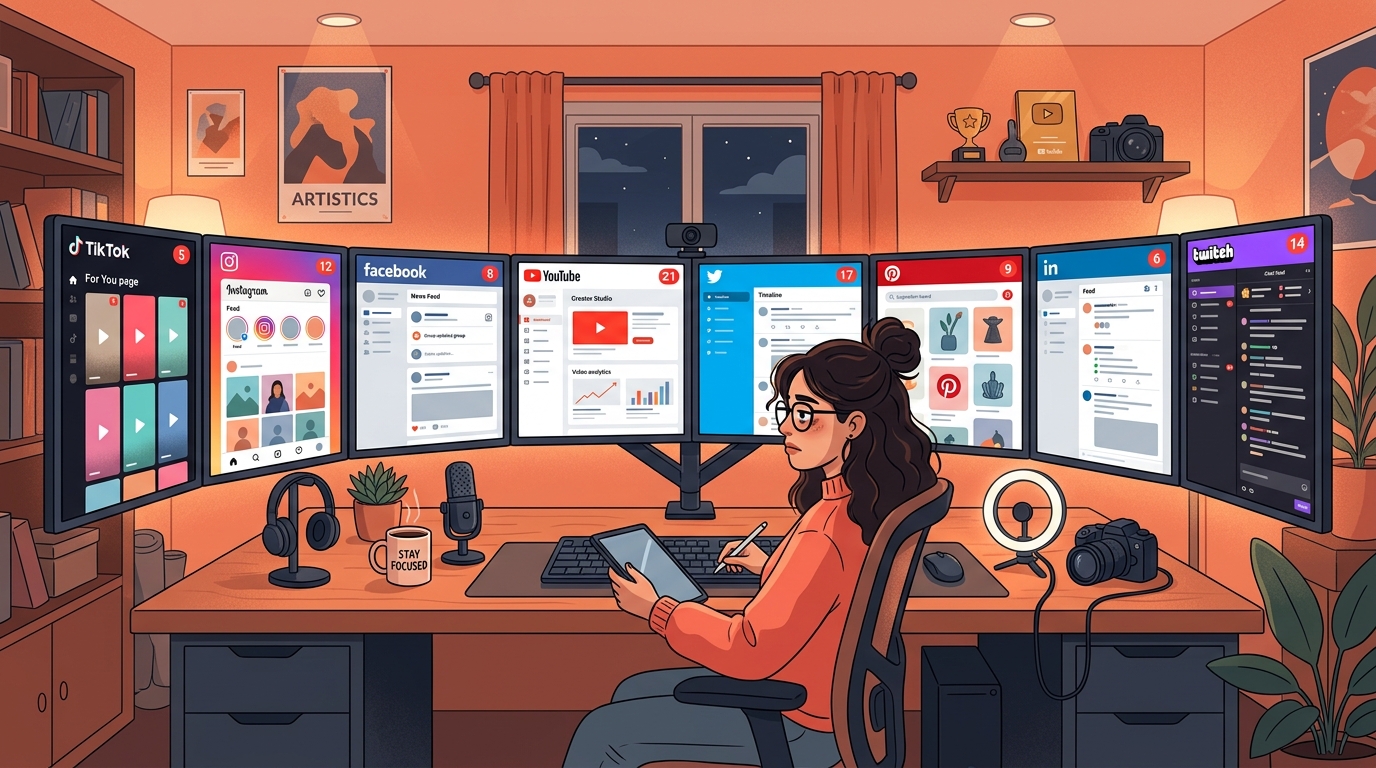 Creators who have been working on content matrices for over a year understand this feeling: after each collaboration with a brand, the first thought in your mind is not "how to make this content", but "how many times will it be published".
Once a video script is written, the next steps are editing, cover image, and text adaptation—TikTok requires a vertical 60-second version, Instagram requires a horizontal version with a nine-grid layout, X requires three threads, YouTube requires a full version, and then you need to attach a text and image post to Facebook… For the same content, you have to go into eight backends, log in eight times, and manually upload eight times.
This isn't even a comment.
The brand is urging you to reply to users, you spend half an hour scrolling through the TikTok comment section, then switch to Instagram where there are another 200 comments. Then you open your phone, and someone on Xiaohongshu is messaging you for a link, and someone on Douyin is tagging you…
Someone once calculated that a matrix creator spends 4 to 6 hours a day on pure operations like "posting and replying." This isn't creation, topic selection, or collaboration—it's purely repetitive labor.
This is why many content creators who earn 20,000 yuan a month from advertising deals are stuck at that number. It's not that they lack opportunities, it's that they lack time.
The math problem for doubling your income is actually quite simple.
Let's do some calculations first.
A stable content creator across multiple platforms, assuming you've already established a solid foundation: 8 platforms, 3 updates per week, and a commission rate of 3000 yuan per ad collaboration.
Monthly output: 24 pieces of content. Monthly order volume: Depends on your energy level. Theoretical maximum income: 24 × 3000 = 72,000 yuan.
But what is the reality?
Most people actually receive no more than 8 orders per month. It's not that no brands are looking for you; it's that you simply don't have the time to deliver—just publishing 24 pieces of content on 8 platforms takes 60 to 80 hours of your time. With 22 working days a month, publishing alone takes up nearly a quarter of that.
The remaining time is spent negotiating collaborations, writing scripts, editing videos, replying to comments, compiling data, and submitting reports to brands…
The solution to doubling your income is not to "work harder," but to reclaim those 60 to 80 hours .
Where has the time gone? Three major loopholes
After three years as a creator working in the matrix, you develop your own "manual workflow," and year after year, you silently accept the efficiency losses that come with it. Until one day, comparing yourself to your peers, you realize—
Vulnerability 1: Multi-platform deployment results in a "start-from-beginning" scenario each time.
Most creators' posting process is as follows: Open TikTok → Upload video → Write caption → Add hashtag → Post → Close → Open Instagram → Re-upload → Edit caption (Instagram caption style is different from TikTok) → Post → Close…
One piece of content, eight platforms, repeating similar but not identical operations eight times. Each time, it requires logging in again, uploading again, and adapting the format again.
On the surface, each operation only takes "15 minutes", but when you calculate it: 8 platforms × 15 minutes × 24 pieces of content/month = 2880 minutes, a full 48 hours .
This involves nearly six full working days each month, solely dedicated to "moving" content.
Vulnerability 2: Random fragments in comment replies
There's an implicit requirement for brand collaborations: "There must be interaction in the comments section, otherwise we won't contact you again."
To maintain this engagement rate, creators need to regularly check comments on each platform. The problem is: comments from 8 platforms are scattered across 8 different backends, and there's no way to view them all at once—you can only open them one by one.
This leads to two problems:
First, it's extremely inefficient. Each time you "browse comments," you have to switch between eight apps, constantly changing contexts, consuming far more effort than the content itself.
Second, the response time is too slow. Users asking "Do you have the same product?" or "Where's the link?" in the comments section are often at their most eager to buy. But if you only open the platform in the afternoon and see the comments, three hours have passed, and that user has already bought the product recommended by someone else.
 The brand pays you 3,000 per ad, in exchange for "content conveying value and converting leads from the comments section." If the conversion rate of leads from the comments section is low, your renewal rate and premium pricing will be affected.
Vulnerability 3: Data reporting requires reorganization from scratch every time.
After each brand collaboration ends, the other party requests a data report: views, engagement rate, number of comments, etc. on various platforms.
Creating this report manually requires logging into 8 platforms, taking screenshots, organizing them into Excel, and calculating and summarizing the data—a single report takes at least 2 to 3 hours.
Many creators underestimate this step, thinking "just post whatever comes to mind." But those who have done it know: good data reporting can lead to a 30% to 50% higher quote for future collaborations . This is because you've demonstrated your conversion efficiency with data, and brands are willing to pay a premium.
If there are 8 collaborations per month, 8 reports need to be prepared – 24 hours a day are spent solely on this.
How did the creators who have already succeeded on this path do it?
One creator who makes beauty content for overseas markets started running a matrix of platforms at the end of 2024, including Facebook, Instagram, TikTok, X, and YouTube.
Her previous routine: From 4 PM to 10 PM every day, she was constantly posting content and replying to comments. The number of brand collaborations she received was consistently around 6 per month, earning her 12,000 yuan per month.
The turning point was when she changed her workflow for managing publishing and interactions:
Publishing to all platforms is handled through a unified backend. For the same video, based on the format requirements of different platforms, it is uploaded once, the text is written once (which can be set according to platform differences), and the publishing time is set once—scheduled to the optimal traffic period, and the system executes automatically.
Comments and replies were also consolidated into a single inbox. Comments from all five platforms were aggregated, categorized by sentiment (positive reviews, inquiries, complaints), and messages indicating a purchase intention were prioritized.
What was the result?
She reduced her daily work time from 4 to 6 hours to less than 1 hour. She used the extra time to negotiate more collaborations and refine her content topics. Three months later, her monthly order volume increased from 6 to 14, and her monthly income rose from 12,000 to nearly 30,000.
It wasn't that the content quality improved (it has always been good), but rather that the increased time efficiency freed up her from the upper limit of the number of orders she could take .
How exactly to do it: Three systemic upgrades
Upgrade 1: Change the release process from "one-by-one operations" to "centralized planning".
Plan the week's content in advance, spend 3 hours on Sunday preparing everything together, schedule the release dates for each platform, and then "execute according to plan" for the remaining 6 days.
In terms of tools, choose a management tool that supports 8 mainstream platforms, allows scheduled publishing, and supports differentiated copywriting for each platform, so that the task of "manually logging into each platform to publish" can be completely eliminated from your schedule.
SocialEcho's content publishing feature supports one-click distribution to major platforms such as TikTok, Instagram, Facebook, X, and YouTube. It allows for customized copywriting formats for different platforms, and scheduled publishing supports 24/7 automatic execution. The official website states that it saves 90% of publishing time, but user feedback confirms that "you really don't need to sit in front of your computer anymore."
Upgrade 2: Change comments from "random fragments" to "uniform priority processing".
Establish a fixed daily comment processing rhythm: twice a day at fixed times (e.g., 10 am and 4 pm) to process comments from all platforms uniformly.
But the prerequisite is that you can see reviews from all platforms in one place—instead of having to open 8 apps.
The interactive management feature aggregates comments from multiple platforms into a unified inbox. AI identifies user sentiment (positive/negative) and intent (inquiry/purchase), prioritizing the display of comments with conversion potential. The most direct value of this feature for content creators across multiple platforms is that they no longer miss comments with purchase intent , and every "asking about price" or "asking for a link" message can be processed promptly.
Upgrade 3: Change data reporting from "manual screenshots" to "automatic table generation".
After each collaboration concludes, the data analytics function directly exports data reports from various platforms—supporting data aggregation from 8 platforms, custom time ranges, and Excel export. Brands can simply export the data they need and send it directly, eliminating the need for two hours of manual data processing.
Good data reporting brings two additional benefits: first, it increases the renewal rate (brands will proactively renew contracts when they see good conversion data), and second, it gives you more confidence to raise prices ("Here's the data from our last collaboration, take a look").
 ---
---
Let's do the math, is this a worthwhile investment?
If you currently accept 8 advertisements per month, with an average price of 3,000 yuan per advertisement, your monthly income will be 24,000 yuan.
By upgrading the workflow, the operation time was reduced from 80 hours per month to 20 hours, freeing up 60 hours for:
- Additional 6 advertising collaborations: +18,000 yuan
- Improved data reporting quality led to a 20% increase in renewal rates and quoted prices: +4800 yuan
Theoretical increase: Monthly income can increase from 24,000 to nearly 47,000, almost doubling .
Of course, this is a theoretical value assuming "other conditions remain unchanged". In practice, you still need to spend the time freed up on content quality and business development; it's not like the system automatically generates income just because it publishes for you.
But one thing is certain: insufficient time is the hard ceiling for many content creators' income growth . Your current monthly income may not be the upper limit of your content value, but rather the upper limit of your operational efficiency.
at last
If you manage more than 3 platforms and are seriously considering increasing the number of brand collaborations, do this first:
Record the time you spent on "posting, replying to comments, and organizing data" in the past week, and calculate your average total time per month.
If it exceeds 40 hours, then you probably don't lack brand resources, but rather a more efficient workflow.
Try SocialEcho for free — It supports unified management across 8 platforms including TikTok, Instagram, Facebook, X, and YouTube. It's easy for matrix creators to use, and a free version is available to verify the workflow.
Internal links in this article:
;}.cls-2{fill:%230868f7;}.cls-3{fill:url(%23未命名的渐变_44);}.cls-4{fill:%23333;}%3c/style%3e%3clinearGradient%20id='未命名的渐变_8'%20x1='33.73'%20y1='100.61'%20x2='-0.03'%20y2='-1.06'%20gradientUnits='userSpaceOnUse'%3e%3cstop%20offset='0'%20stop-color='%237ae9fb'/%3e%3cstop%20offset='0.67'%20stop-color='%232b90f8'/%3e%3cstop%20offset='1'%20stop-color='%230868f7'/%3e%3c/linearGradient%3e%3clinearGradient%20id='未命名的渐变_44'%20x1='27.86'%20y1='18.67'%20x2='68.36'%20y2='22.22'%20gradientUnits='userSpaceOnUse'%3e%3cstop%20offset='0'%20stop-color='%235ac7f2'/%3e%3cstop%20offset='1'%20stop-color='%230868f7'/%3e%3c/linearGradient%3e%3c/defs%3e%3cpath%20class='cls-1'%20d='M29,28.74V81.91l-9.51-3.68v0L8.52,74A7.17,7.17,0,0,1,4,67.32V24.54A3.76,3.76,0,0,1,9.08,21Z'/%3e%3cpath%20class='cls-2'%20d='M68.09,78.07a13.15,13.15,0,0,1-17.9,12.06L29,81.91h0V28.74L50.19,37A13.17,13.17,0,0,0,68.08,25.3h0Z'/%3e%3cpath%20class='cls-3'%20d='M68.08,25.3a13.19,13.19,0,0,1-6.73,10.87A13.09,13.09,0,0,1,50.19,37L29,28.74V6A3.76,3.76,0,0,1,34.1,2.52l25.59,9.91A13.22,13.22,0,0,1,68.08,25.3Z'/%3e%3cpath%20class='cls-4'%20d='M129.06,81.76a4.33,4.33,0,0,1-3.19-1.31,4.4,4.4,0,0,1-1.31-3.24V56.86H97.65V77.21a4.36,4.36,0,0,1-1.35,3.2A4.68,4.68,0,0,1,93,81.76a4.32,4.32,0,0,1-3.19-1.31,4.37,4.37,0,0,1-1.32-3.24V27.27A4.58,4.58,0,0,1,89.83,24a4.59,4.59,0,0,1,7.82,3.27V48.15h26.91V27.27A4.58,4.58,0,0,1,125.91,24a4.59,4.59,0,0,1,7.82,3.27V77.21a4.37,4.37,0,0,1-1.36,3.2A4.65,4.65,0,0,1,129.06,81.76Z'/%3e%3cpath%20class='cls-4'%20d='M163.77,81.66c-6.57,0-11.76-1.92-15.44-5.7s-5.54-9.07-5.54-15.74a26.76,26.76,0,0,1,2.09-10.43,17.72,17.72,0,0,1,6.67-8.06,19.15,19.15,0,0,1,10.68-2.95,19,19,0,0,1,10.46,2.8,18.7,18.7,0,0,1,6.55,7.36,22.53,22.53,0,0,1,2.36,10.28A4.51,4.51,0,0,1,177,63.77H152.23a10.8,10.8,0,0,0,3.49,6.65c2,1.68,4.88,2.52,8.66,2.52a22.25,22.25,0,0,0,7.54-1.21c.74-.3,1.55-.67,2.37-1.07a3.75,3.75,0,0,1,1.84-.4,4.09,4.09,0,0,1,3,1.15,4,4,0,0,1,1.12,3,4.38,4.38,0,0,1-2.58,3.82,32.34,32.34,0,0,1-6.36,2.61A28.67,28.67,0,0,1,163.77,81.66ZM172.4,55.9a9.72,9.72,0,0,0-1.63-4.56A9.9,9.9,0,0,0,167,48a10.38,10.38,0,0,0-4.64-1.14,12,12,0,0,0-4.77,1.06,9.54,9.54,0,0,0-4.89,5.66,11.78,11.78,0,0,0-.51,2.3Z'/%3e%3cpath%20class='cls-4'%20d='M193,81.64a4.49,4.49,0,0,1-4.51-4.55V27.28A4.58,4.58,0,0,1,189.84,24a4.48,4.48,0,0,1,3.28-1.36A4.36,4.36,0,0,1,196.35,24a4.46,4.46,0,0,1,1.31,3.31V77.09a4.34,4.34,0,0,1-1.35,3.2A4.67,4.67,0,0,1,193,81.64Z'/%3e%3cpath%20class='cls-4'%20d='M263.79,81.71a5.7,5.7,0,0,1-4.2-1.74,5.76,5.76,0,0,1-1.73-4.19V27.37a4.58,4.58,0,0,1,1.35-3.27A4.59,4.59,0,0,1,267,27.37V72.53h24a4.58,4.58,0,0,1,3.27,7.82A4.66,4.66,0,0,1,291,81.71Z'/%3e%3cpath%20class='cls-4'%20d='M424.48,81.74a4.71,4.71,0,0,1-2.71-.88,5.43,5.43,0,0,1-1-1l-.07-.09-12.41-17-5.41,5v9.44a4.31,4.31,0,0,1-1.36,3.19,4.66,4.66,0,0,1-3.3,1.36A4.29,4.29,0,0,1,395,80.42a4.36,4.36,0,0,1-1.32-3.23V27.37A4.58,4.58,0,0,1,395,24.1a4.52,4.52,0,0,1,6.58.12,4.54,4.54,0,0,1,1.24,3.15V56.31l17.72-16.38.05,0a4.8,4.8,0,0,1,2.94-1.11,4.4,4.4,0,0,1,3.27,1.2,4.57,4.57,0,0,1,1.2,3.27,4.44,4.44,0,0,1-.77,2.33,7.45,7.45,0,0,1-1.43,1.65l-11,9.64,13.34,17.68a5,5,0,0,1,1,2.71,4.12,4.12,0,0,1-1.36,3.24A4.64,4.64,0,0,1,424.48,81.74Z'/%3e%3cpath%20class='cls-4'%20d='M317.93,81.76a21.5,21.5,0,1,1,21.17-21.5A21.37,21.37,0,0,1,317.93,81.76Zm0-34.1a12.61,12.61,0,1,0,12.42,12.6A12.52,12.52,0,0,0,317.93,47.66Z'/%3e%3cpath%20class='cls-4'%20d='M212.18,101.22a4.12,4.12,0,0,1-3.05-1.26,4.17,4.17,0,0,1-1.26-3.1V43.34a4.37,4.37,0,0,1,1.3-3.14,4.26,4.26,0,0,1,3.13-1.3,4.19,4.19,0,0,1,3.1,1.26,4.32,4.32,0,0,1,1.26,3.16,20.77,20.77,0,0,1,13-4.54,21.51,21.51,0,0,1,0,43,20.51,20.51,0,0,1-13-4.57V96.86a4.15,4.15,0,0,1-1.3,3.06A4.5,4.5,0,0,1,212.18,101.22Zm17.43-53.63c-6.23,0-12.93,4.11-12.93,12.72a12.73,12.73,0,0,0,25.46,0A12.71,12.71,0,0,0,229.61,47.59Z'/%3e%3cpath%20class='cls-4'%20d='M365.76,81.76a21.5,21.5,0,1,1,21.18-21.5A21.37,21.37,0,0,1,365.76,81.76Zm0-34.1a12.61,12.61,0,1,0,12.42,12.6A12.52,12.52,0,0,0,365.76,47.66Z'/%3e%3c/svg%3e)