
We grew from serving 5 clients to 15 without hiring more staff—and that's why.
We grew from serving 5 clients to 15 without hiring more staff—and that's why.
The bottleneck for scaling up outsourced service providers is not the number of clients, but the cost per client, because the marginal cost of manual operation cannot be reduced.
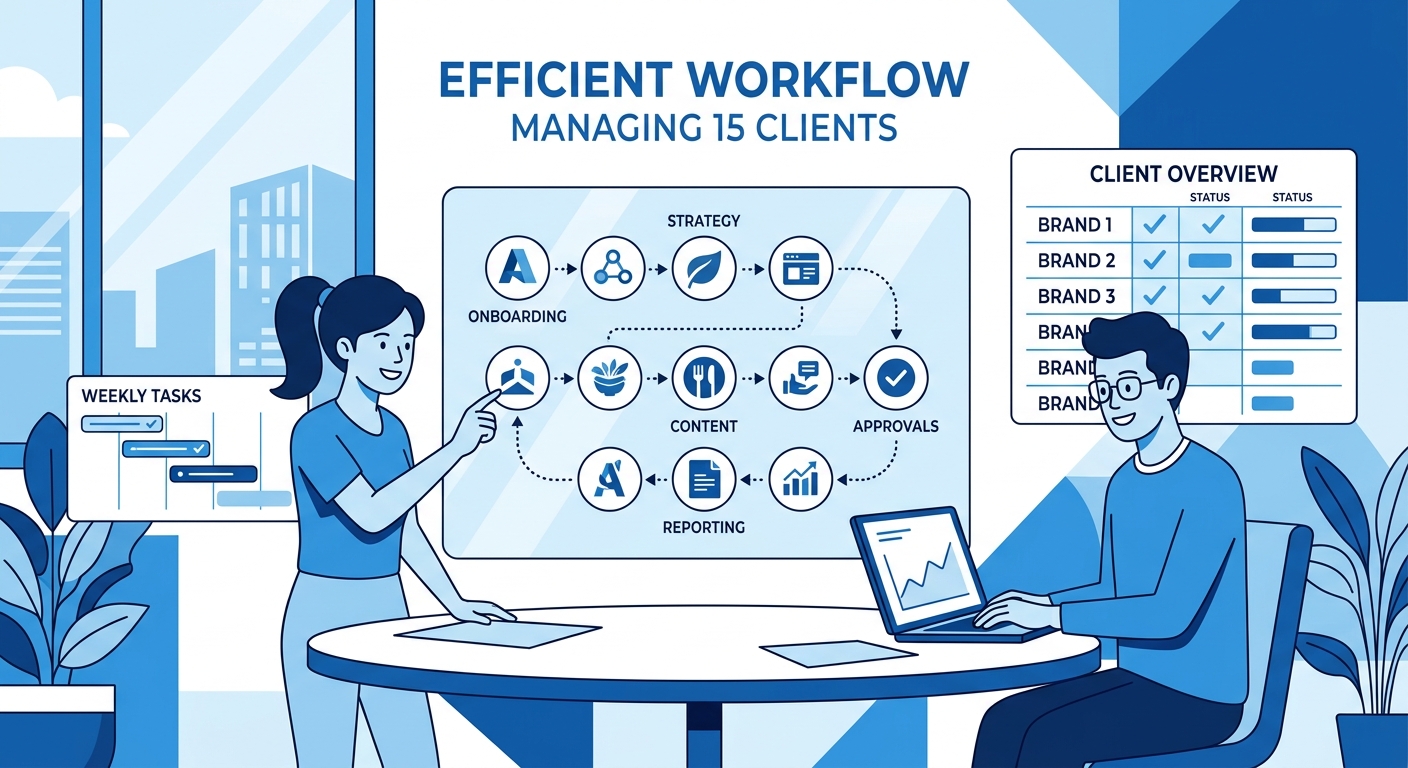 Two years ago, she turned down her sixth client.
Liu Fang started her agency operations business in 2022, initially with a small team of 3 people, and gradually grew to have 5 brand clients.
That period was the most anxious time for her. It wasn't because there weren't any new clients—three or four clients she'd been referred were waiting—but because she knew that if she took on just one more, her team would collapse.
It's not because we're not working hard enough; it's because each client requires content production, publishing management, and data reporting from an average of 3-4 platforms, consistently consuming about 60-80 hours per month. Five clients already keep the team running at full capacity; adding another person would mean compromising the existing quality, and compromising quality means losing clients.
Her solution at the time was to expand recruitment. Hire more people, hire more operations staff, and then you can get more clients.
She shared this idea with a friend who had worked in operations for 10 years, and her friend gave her a piece of advice: "Expanding recruitment is the most expensive way to scale up, and it's also the most vulnerable."
She pondered this sentence for a long time, and it took her two years to understand its meaning.
Why expanding enrollment is a wrong solution
Faced with the bottleneck of "not being able to handle more clients," many third-party service providers' first reaction is to expand their workforce. The logic seems reasonable: more people mean more processing capacity, which in turn allows them to take on more clients.
However, this logic has a fundamental problem: the marginal cost of manual operation is linear, or even increasing.
What does this mean? An operations specialist can efficiently serve 3 clients, but the quality starts to decline with the 4th, and the 5th is the peak. Hiring another person won't change that; they'll reach the same limit. Your service capacity expands linearly with the number of people, but the revenue growth from new clients can't keep up with the compounded growth of labor costs, management costs, and communication costs.
What's more troublesome is that the expansion of personnel brings new management burdens. Team coordination, quality control, and information synchronization—these are all hidden costs, not on the books, but they really consume the energy of the founders and management.
Someone has done the math: if an agency expands from 5 clients to 10 clients by recruiting more staff, the headcount would need to increase from 3 to 6-7. Add to that management and training costs, and the actual profit might actually decrease instead of increase.
The bottleneck to scaling up is never "insufficient number of customers," but rather **"too high service cost per customer."** Without reducing the cost per customer, expanding recruitment only increases losses.
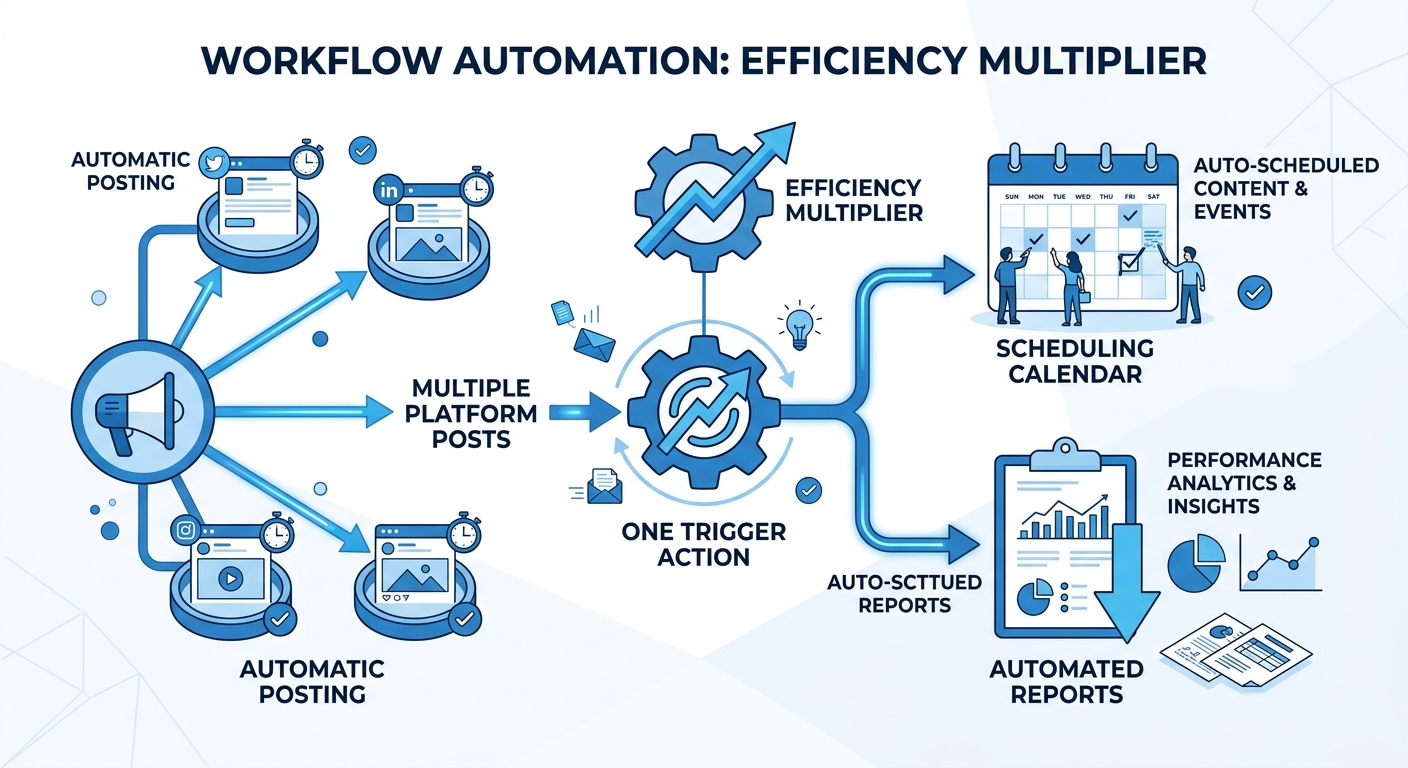 Marginal costs can be reduced, but a different approach is needed.
The answer Liu Fang found was not to expand recruitment, but to redesign the way we work—to switch the "standardized and automated" steps in each customer service process from manual operation to tool execution.
She made a breakdown: the time her team spent on each client could be roughly divided into four categories:
Content production (topic selection, copywriting, and material allocation) requires deep human involvement and cannot be fully automated. It accounts for approximately 40% of service time.
Content publishing (multi-platform scheduling, timed delivery, format adaptation) is entirely repetitive, with almost identical steps on each platform, differing only in the account used. It accounts for approximately 25% of the service time.
Data reporting (data collection, integration, PPT creation, and client delivery) is largely information transfer and can be tool-based. It accounts for approximately 20% of the service time.
Customer communication (daily coordination, issue handling, review processes) requires judgment, but unnecessary back-and-forth can be reduced through standardized processes. This accounts for approximately 15% of service time.
The latter three categories combined account for 60% of the time, yet contribute the least core value—this time can be replaced by tools.
How exactly can we reduce the cost of serving a single customer?
Release management: Switching from manual to unified scheduling
The previous workflow was as follows: the operations specialist would log into each platform and manually post, or use the built-in timer function of each platform to set up separate posts. With 5 clients and 15 accounts, the posting cycle had to be switched dozens of times each week.
After switching to the scheduled publishing tool, content from all accounts is scheduled on the same interface. Once the content is prepared, the publishing plan for all accounts this week is set up once, and no manual follow-up is required afterward. The publishing process itself has been reduced from 4-5 hours of manual work per week to zero.
This feature alone reduced the time spent serving a single customer by approximately 20%.
Data Report: From Month-End Centralized Compilation to Continuous Automatic Accumulation
The previous monthly reporting process involved operations specialists repeatedly logging into the backends of various platforms for three days at the end of the month, taking screenshots, piecing together data, and creating PPT presentations. Each client took 5-6 hours, so five clients meant 25-30 hours of pure manual labor.
After switching to data analytics tools, data is synchronized in real time across multiple platforms. At the end of the month, you only need to select the time range, and the data has already been aggregated. The operations staff's job changes from "integrating data" to "analyzing data," allowing them to produce higher-quality monthly reports in the same amount of time.
This feature reduces the time for month-end data reporting from 30 hours to approximately 8 hours, saving 22 hours of manpower.
Comment management: From platform-by-platform patrols to centralized processing
Previous comment management involved logging in separately for each account to check for new comments that needed replying. This involved several rounds of checks per day, which, while taking up a significant amount of time, accumulated into a large volume.
After switching to the comment management tool, comments from all accounts are aggregated into a single inbox, allowing operations staff to process them only once, eliminating the need for platform-by-platform monitoring. Combined with AI-automated comment preprocessing, frequently asked questions can be automatically addressed with suggested responses, requiring only manual confirmation or modification.
Multiple account switching: From repeated logins to a unified view
The multi-account management feature solves the most basic friction—there is no need to repeatedly log in and out of different customer accounts; all accounts can be switched on the same interface, permissions are clearly controlled, and content from different accounts will not be mixed up.
Changes in numbers
After switching their work methods, Liu Fang's team made a rough estimate:
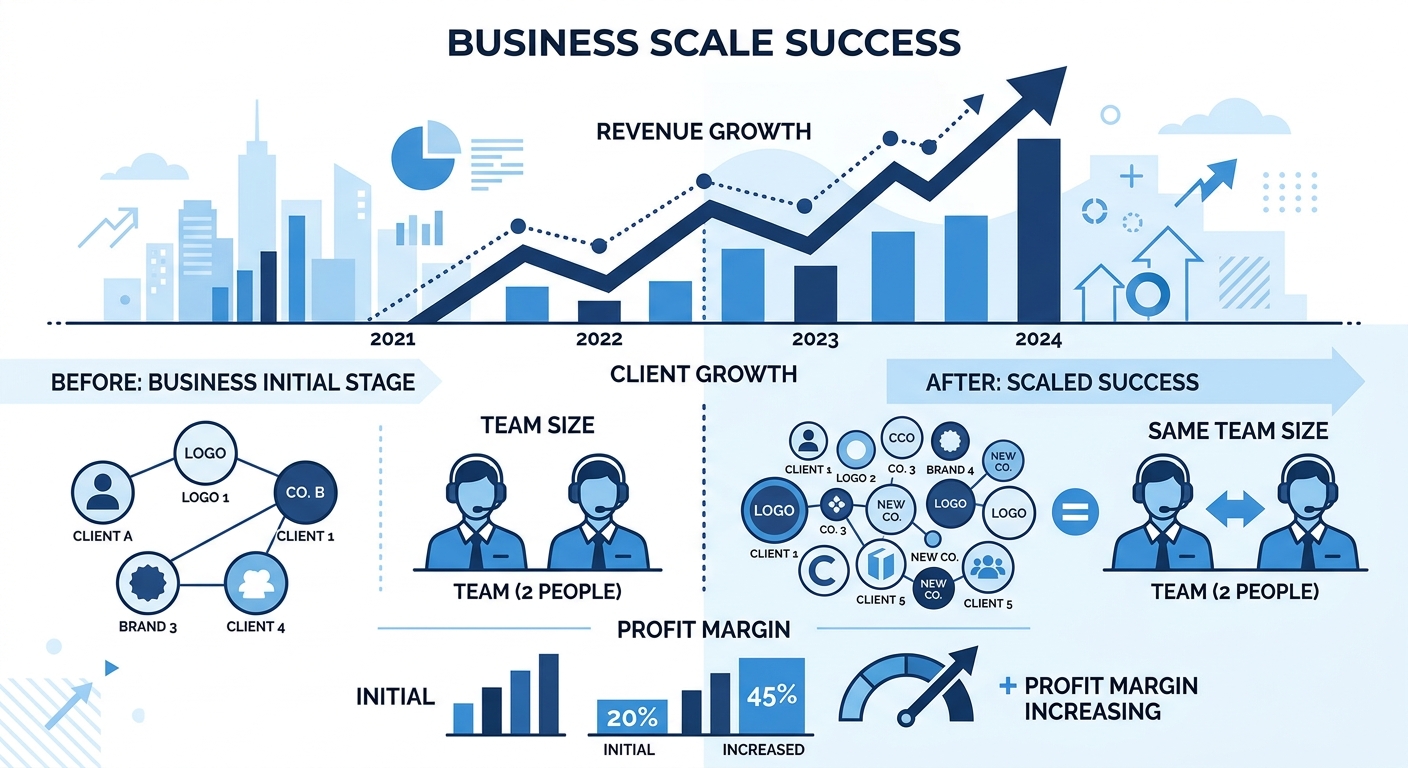
Originally, there were 5 clients, each with an average monthly service time of about 70 hours. The total productivity of the 3-person team was about 420 hours/month. After deducting internal affairs, about 380 hours/month could be used for client service. This was basically full capacity.
After the switch, through automated publishing, data reporting tools, and centralized comment management, the average monthly service time per client decreased from 70 hours to approximately 40 hours. With the same team productivity, the number of clients that can be served increased from 5 to nearly 10.
She actually landed 8 new clients, bringing her total to 13, and later increased that to 15. The team expanded from 3 to 4 people (adding a content planner), instead of the 6-7 she had originally expected.
With increased unit productivity, controllable labor costs, and significantly improved profit margins, she transformed her anxiety about "not being able to handle clients" into confidence in "controllable scaling" in just two years.
 A detail that "only those who do this know".
There's something that outsiders find hard to understand: the most energy-consuming part of outsourced operations isn't "doing the work," but "switching between tasks."
Switching from one client's mindset to another's brand tone incurs a cognitive cost. You need to remember who the client's target audience is, what their tone is, what the key promotions for this month are, and what content performed well last time—you have to reload this information every time you switch.
When you're serving five clients simultaneously, this switching happens dozens of times a day. It doesn't appear on your schedule, but it's a real source of fatigue.
Tooling not only saves operation time, but it also reduces the number of "switches"—you see all customer activity in a unified interface, without having to repeatedly switch between different mental states. Many organizations only realize how important this implicit benefit is after using the tools.
The right path to scaling
There are two paths to scaling up outsourcing agencies:
One path is expansion – linearly increasing manpower and customers, but management costs rise non-linearly, profits become thinner and thinner, and eventually it becomes an organization that is “very large in scale but doesn’t make much money”.
Another approach is to reduce costs—first compress the cost of serving a single customer to a sustainable level, and then acquire new customers. The marginal cost of each new customer becomes lower and lower, and the profit margin becomes higher and higher.
Tooling is the core of the second path. It's not about "buying software," but about redesigning workflows, embedding tools into them, letting tools do what tools are supposed to do, and letting humans do what only humans can do.
SocialEcho is positioned to help agencies take a second path – by using features such as scheduled publishing , data analysis , multi-account management , and AI automation , it toolizes high-frequency and repetitive tasks such as publishing, reporting, and monitoring, allowing the operations team to focus their energy on strategy and creativity.
From which step should we begin?
If you're currently struggling between "not being able to handle more clients" and "the risks of expanding recruitment are too great," you can do one thing first:
Record the time allocation for serving a client, breaking it down into each step—content production, publishing, data reporting, comment management, and client communication—and how much time each takes.
You'll find out how much of that time is done by "human-powered replacement tools." That number is your scaling potential.
The reason we didn't expand enrollment wasn't because we didn't need growth, but because we found a better way to grow.
SocialEcho is a social media management tool for agencies that manage social media accounts. It supports unified management of eight platforms including TikTok, Instagram, and Facebook, and provides features such as scheduled posting , data analysis , multi-account management , and AI automation , helping agencies achieve scalable services without increasing staff.
Try it free for 7 days: https://www.socialecho.cn
;}.cls-2{fill:%230868f7;}.cls-3{fill:url(%23未命名的渐变_44);}.cls-4{fill:%23333;}%3c/style%3e%3clinearGradient%20id='未命名的渐变_8'%20x1='33.73'%20y1='100.61'%20x2='-0.03'%20y2='-1.06'%20gradientUnits='userSpaceOnUse'%3e%3cstop%20offset='0'%20stop-color='%237ae9fb'/%3e%3cstop%20offset='0.67'%20stop-color='%232b90f8'/%3e%3cstop%20offset='1'%20stop-color='%230868f7'/%3e%3c/linearGradient%3e%3clinearGradient%20id='未命名的渐变_44'%20x1='27.86'%20y1='18.67'%20x2='68.36'%20y2='22.22'%20gradientUnits='userSpaceOnUse'%3e%3cstop%20offset='0'%20stop-color='%235ac7f2'/%3e%3cstop%20offset='1'%20stop-color='%230868f7'/%3e%3c/linearGradient%3e%3c/defs%3e%3cpath%20class='cls-1'%20d='M29,28.74V81.91l-9.51-3.68v0L8.52,74A7.17,7.17,0,0,1,4,67.32V24.54A3.76,3.76,0,0,1,9.08,21Z'/%3e%3cpath%20class='cls-2'%20d='M68.09,78.07a13.15,13.15,0,0,1-17.9,12.06L29,81.91h0V28.74L50.19,37A13.17,13.17,0,0,0,68.08,25.3h0Z'/%3e%3cpath%20class='cls-3'%20d='M68.08,25.3a13.19,13.19,0,0,1-6.73,10.87A13.09,13.09,0,0,1,50.19,37L29,28.74V6A3.76,3.76,0,0,1,34.1,2.52l25.59,9.91A13.22,13.22,0,0,1,68.08,25.3Z'/%3e%3cpath%20class='cls-4'%20d='M129.06,81.76a4.33,4.33,0,0,1-3.19-1.31,4.4,4.4,0,0,1-1.31-3.24V56.86H97.65V77.21a4.36,4.36,0,0,1-1.35,3.2A4.68,4.68,0,0,1,93,81.76a4.32,4.32,0,0,1-3.19-1.31,4.37,4.37,0,0,1-1.32-3.24V27.27A4.58,4.58,0,0,1,89.83,24a4.59,4.59,0,0,1,7.82,3.27V48.15h26.91V27.27A4.58,4.58,0,0,1,125.91,24a4.59,4.59,0,0,1,7.82,3.27V77.21a4.37,4.37,0,0,1-1.36,3.2A4.65,4.65,0,0,1,129.06,81.76Z'/%3e%3cpath%20class='cls-4'%20d='M163.77,81.66c-6.57,0-11.76-1.92-15.44-5.7s-5.54-9.07-5.54-15.74a26.76,26.76,0,0,1,2.09-10.43,17.72,17.72,0,0,1,6.67-8.06,19.15,19.15,0,0,1,10.68-2.95,19,19,0,0,1,10.46,2.8,18.7,18.7,0,0,1,6.55,7.36,22.53,22.53,0,0,1,2.36,10.28A4.51,4.51,0,0,1,177,63.77H152.23a10.8,10.8,0,0,0,3.49,6.65c2,1.68,4.88,2.52,8.66,2.52a22.25,22.25,0,0,0,7.54-1.21c.74-.3,1.55-.67,2.37-1.07a3.75,3.75,0,0,1,1.84-.4,4.09,4.09,0,0,1,3,1.15,4,4,0,0,1,1.12,3,4.38,4.38,0,0,1-2.58,3.82,32.34,32.34,0,0,1-6.36,2.61A28.67,28.67,0,0,1,163.77,81.66ZM172.4,55.9a9.72,9.72,0,0,0-1.63-4.56A9.9,9.9,0,0,0,167,48a10.38,10.38,0,0,0-4.64-1.14,12,12,0,0,0-4.77,1.06,9.54,9.54,0,0,0-4.89,5.66,11.78,11.78,0,0,0-.51,2.3Z'/%3e%3cpath%20class='cls-4'%20d='M193,81.64a4.49,4.49,0,0,1-4.51-4.55V27.28A4.58,4.58,0,0,1,189.84,24a4.48,4.48,0,0,1,3.28-1.36A4.36,4.36,0,0,1,196.35,24a4.46,4.46,0,0,1,1.31,3.31V77.09a4.34,4.34,0,0,1-1.35,3.2A4.67,4.67,0,0,1,193,81.64Z'/%3e%3cpath%20class='cls-4'%20d='M263.79,81.71a5.7,5.7,0,0,1-4.2-1.74,5.76,5.76,0,0,1-1.73-4.19V27.37a4.58,4.58,0,0,1,1.35-3.27A4.59,4.59,0,0,1,267,27.37V72.53h24a4.58,4.58,0,0,1,3.27,7.82A4.66,4.66,0,0,1,291,81.71Z'/%3e%3cpath%20class='cls-4'%20d='M424.48,81.74a4.71,4.71,0,0,1-2.71-.88,5.43,5.43,0,0,1-1-1l-.07-.09-12.41-17-5.41,5v9.44a4.31,4.31,0,0,1-1.36,3.19,4.66,4.66,0,0,1-3.3,1.36A4.29,4.29,0,0,1,395,80.42a4.36,4.36,0,0,1-1.32-3.23V27.37A4.58,4.58,0,0,1,395,24.1a4.52,4.52,0,0,1,6.58.12,4.54,4.54,0,0,1,1.24,3.15V56.31l17.72-16.38.05,0a4.8,4.8,0,0,1,2.94-1.11,4.4,4.4,0,0,1,3.27,1.2,4.57,4.57,0,0,1,1.2,3.27,4.44,4.44,0,0,1-.77,2.33,7.45,7.45,0,0,1-1.43,1.65l-11,9.64,13.34,17.68a5,5,0,0,1,1,2.71,4.12,4.12,0,0,1-1.36,3.24A4.64,4.64,0,0,1,424.48,81.74Z'/%3e%3cpath%20class='cls-4'%20d='M317.93,81.76a21.5,21.5,0,1,1,21.17-21.5A21.37,21.37,0,0,1,317.93,81.76Zm0-34.1a12.61,12.61,0,1,0,12.42,12.6A12.52,12.52,0,0,0,317.93,47.66Z'/%3e%3cpath%20class='cls-4'%20d='M212.18,101.22a4.12,4.12,0,0,1-3.05-1.26,4.17,4.17,0,0,1-1.26-3.1V43.34a4.37,4.37,0,0,1,1.3-3.14,4.26,4.26,0,0,1,3.13-1.3,4.19,4.19,0,0,1,3.1,1.26,4.32,4.32,0,0,1,1.26,3.16,20.77,20.77,0,0,1,13-4.54,21.51,21.51,0,0,1,0,43,20.51,20.51,0,0,1-13-4.57V96.86a4.15,4.15,0,0,1-1.3,3.06A4.5,4.5,0,0,1,212.18,101.22Zm17.43-53.63c-6.23,0-12.93,4.11-12.93,12.72a12.73,12.73,0,0,0,25.46,0A12.71,12.71,0,0,0,229.61,47.59Z'/%3e%3cpath%20class='cls-4'%20d='M365.76,81.76a21.5,21.5,0,1,1,21.18-21.5A21.37,21.37,0,0,1,365.76,81.76Zm0-34.1a12.61,12.61,0,1,0,12.42,12.6A12.52,12.52,0,0,0,365.76,47.66Z'/%3e%3c/svg%3e)