
The brand account hasn't gained any followers in six months; the problem isn't the content.
Operations Director Chen Fei sat in the conference room, reporting to the boss on the social media results for the second quarter: 84 pieces of content were posted, with an average production time of 2 days per piece, and the interaction rate was acceptable, but—the number of followers had increased from 12,000 six months ago to 12,800.
"800 followers," the boss paused for three seconds, "then why are we maintaining this team?"
Chen Fei had no answer because he himself didn't understand: the content wasn't bad, and there was interaction, so why wasn't it growing?
This problem kept many brand operations managers up at night. Their intuition told them: it must be a content issue—either the style was wrong, or the frequency wasn't enough. So they changed the style, increased the frequency, and switched themes, but after three months of this, the numbers remained stagnant.
The fundamental reason for not gaining followers is often not the content itself, but three things outside of the content.

You're using the word "content" to cover up the real problem.
"The content isn't good enough" is the most convenient excuse because it's vague, unverifiable, and shifts all the blame onto the creator.
But if you analyze it calmly, you'll find something strange: content of the same quality, published at different times, can have data differences of 3-5 times. The same copywriting, with different tags, reaches completely different audiences. Sometimes a casually posted image or text goes viral, while a meticulously crafted video flops.
This illustrates one point: the variables affecting follower growth are not only content quality, but also algorithm reach efficiency, distribution strategies, and account health.
The harsher truth is that the platform's algorithms underwent several major adjustments between 2025 and 2026. Instagram shifted its recommendation feed weighting towards creator-original content; TikTok's algorithm increasingly prioritizes video completion rates over likes; and YouTube's search ranking increased the requirement for channel thematic consistency.
The methodology you mastered six months ago may now be outdated.
Three hidden dangers that are really hindering your follower growth
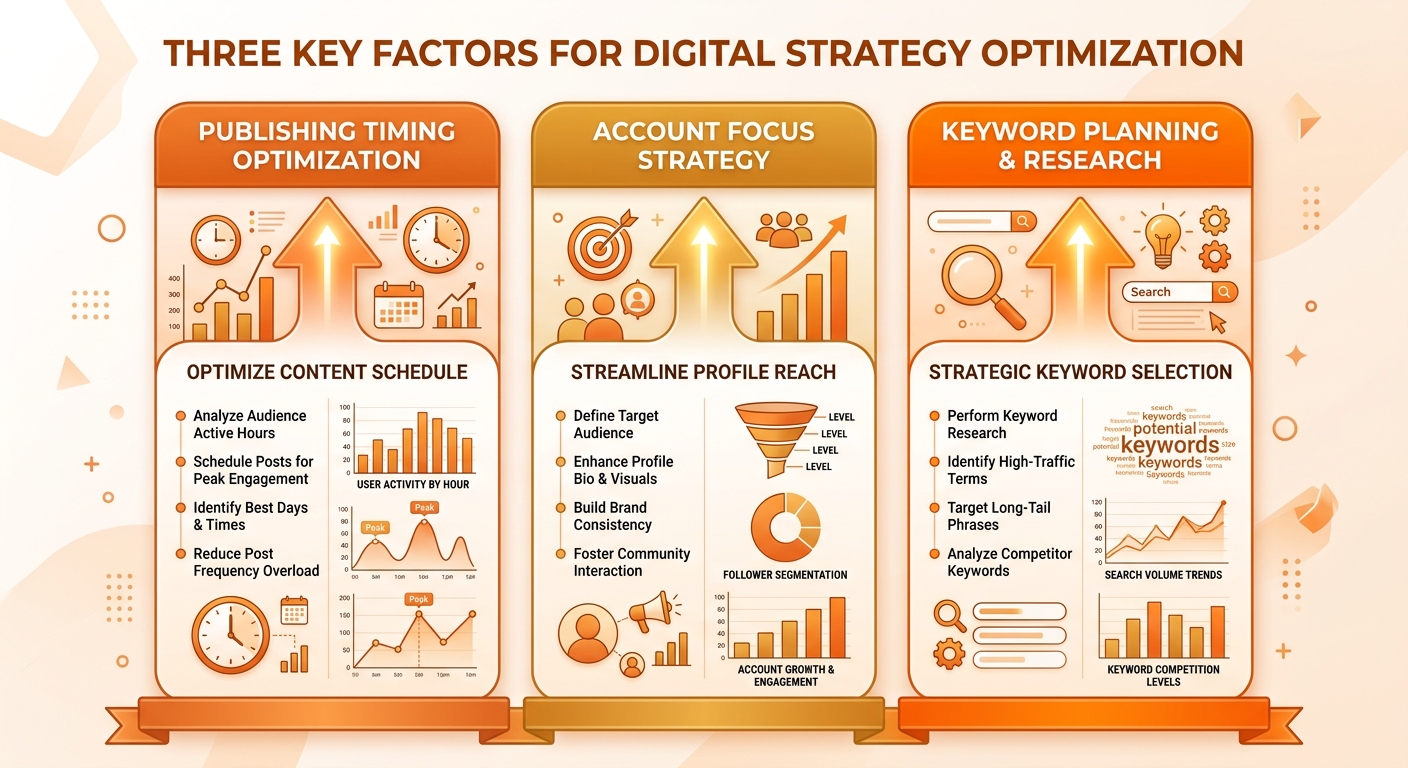
Hidden danger 1: Systemic deviation in the timing of release
Most operations teams choose their posting time based on experience or intuition ("There are more people at 7 pm").
That's not wrong, but it's not precise enough.
Where is your target audience? If you're expanding overseas, what time zone are they in? Are they students or working professionals? Do they use their phones during their commute or before bed?
The same piece of content, published four hours apart, could reach twice as many users. The algorithm window is typically the first 30-60 minutes after publication—early interactions during this period determine how many people the content is pushed to.
Many brand accounts fail to gain followers not because their content is bad, but because they post their content when no one is around.
Use data analytics tools to review the relationship between your posting time and engagement rate over the past six months. Most people will frown when they first see this data: the posting time with the highest engagement rate is often not the time you thought it was.
Hidden Danger 2: Disrupted Account Location Signal
Algorithms identify an account's "persona" by analyzing: what topics you post, what users you attract, what their characteristics are, and then pushing you to similar people.
The premise of this logic is that your account must give the algorithm a clear signal.
Many brand accounts follow this content logic: post 5 product promotions, 3 holiday greetings, 2 industry news articles, 1 employee story, and a few random "lifestyle" posts this month.
From the operator's perspective, this is called "content diversification." From the algorithm's perspective, this is called "not knowing what this account is."
The result is that each piece of content reaches a different audience, failing to create a cumulative effect. The newly acquired followers are unrelated to each other, and the next piece of content is also irrelevant to them, so they don't interact, the algorithm doesn't push it, and the cycle repeats itself.
Gaining followers requires compound interest, and the prerequisite for compound interest is consistency of theme.
Hidden Danger 3: Lack of a systematic keyword strategy
This is especially crucial on Instagram and YouTube, but many people completely overlook it.
Users discover new accounts not only through "recommendations from others" and "snagging," but also through "search." On YouTube, search is a significant source of traffic; on Instagram, the search function on the Discover page is becoming increasingly important.
If your video title is "Our new product is now available!" and there are no searchable keywords, the algorithm cannot push it to users who are searching for related content.
If your competitors are using SEO-driven content titles, such as "2026 [Category] Buying Guide: Avoid These Three Pitfalls," they are stealing the organic traffic you should be getting.
The solution is not to "do it better", but to "do it more accurately".
The good news is that all three of these potential problems have quantifiable solutions. We don't need to start from scratch; what we need is to shift operations from being driven by intuition to being driven by data .
Fix release timing
Step 1: Don't rely on intuition, rely on data. Create a scatter plot of all posts from the past six months, broken down by posting time and engagement rate. Identify your "golden window"—the time period when highly interactive posts are concentrated.
Step 2: Verify that this time window aligns with the active times of your target audience. If your target users are in Europe, your prime time for posting should be in the morning or evening.
Step 3: Use scheduled publishing to establish a fixed schedule so that each piece of content is published at the optimal time window, rather than "publishing as soon as it's done".
Narrowing account positioning
Choose 2-3 core topics and cut all other "filler" content. This takes courage, because in the short term it may seem like there's less content, but in the long run it will allow the algorithm to clearly identify your account's positioning.
Judgment criteria: What specific problems does your account solve for users? If you are an outdoor sports brand, then every piece of content should make outdoor sports enthusiasts feel, "This account is useful to me."
Establish a keyword content strategy
Analyze your competitors' high-viewership content to find out what keywords they're using. Use competitor monitoring tools to compare your competitors' popular video topics and identify high-demand keywords that you haven't yet covered.
Produce 2-3 pieces of "keyword-driven" content each month, specifically targeting the questions users are searching for. This type of content typically grows followers 3-5 times faster than purely promotional content.
An uncomfortable fact
After doing these three things, your content creation output may actually decrease.
Many operations directors worry about this: Will sending too few messages affect account activity?
The answer is: small quantity with high quality is far better than large quantity with poor quality.
The algorithm has changed in 2026. Frequently publishing low-quality content is not only ineffective, but it will also lower your account's ranking. The platform will label you as a "low-interaction account," and the recommendation coverage of each subsequent piece of content will be systematically reduced.
Posting 8 highly targeted pieces of content a month will increase your follower count faster than posting 30 random pieces of content. This isn't speculation; it's a conclusion that can be verified with data.
What happens after you gain more followers?
Many people see gaining followers as the ultimate goal. But a more important question is: how relevant are these new followers to your brand?
If you gain 50,000 followers who have absolutely no interest in your product category, the conversion rate of your next product-selling video will be abysmal. The algorithm will further determine that your content is "irrelevant to your existing followers," creating a negative cycle.
The truly healthy path to gaining followers is: precise content → attracting precise followers → high interaction rate → algorithm-amplified recommendations → more precise users.
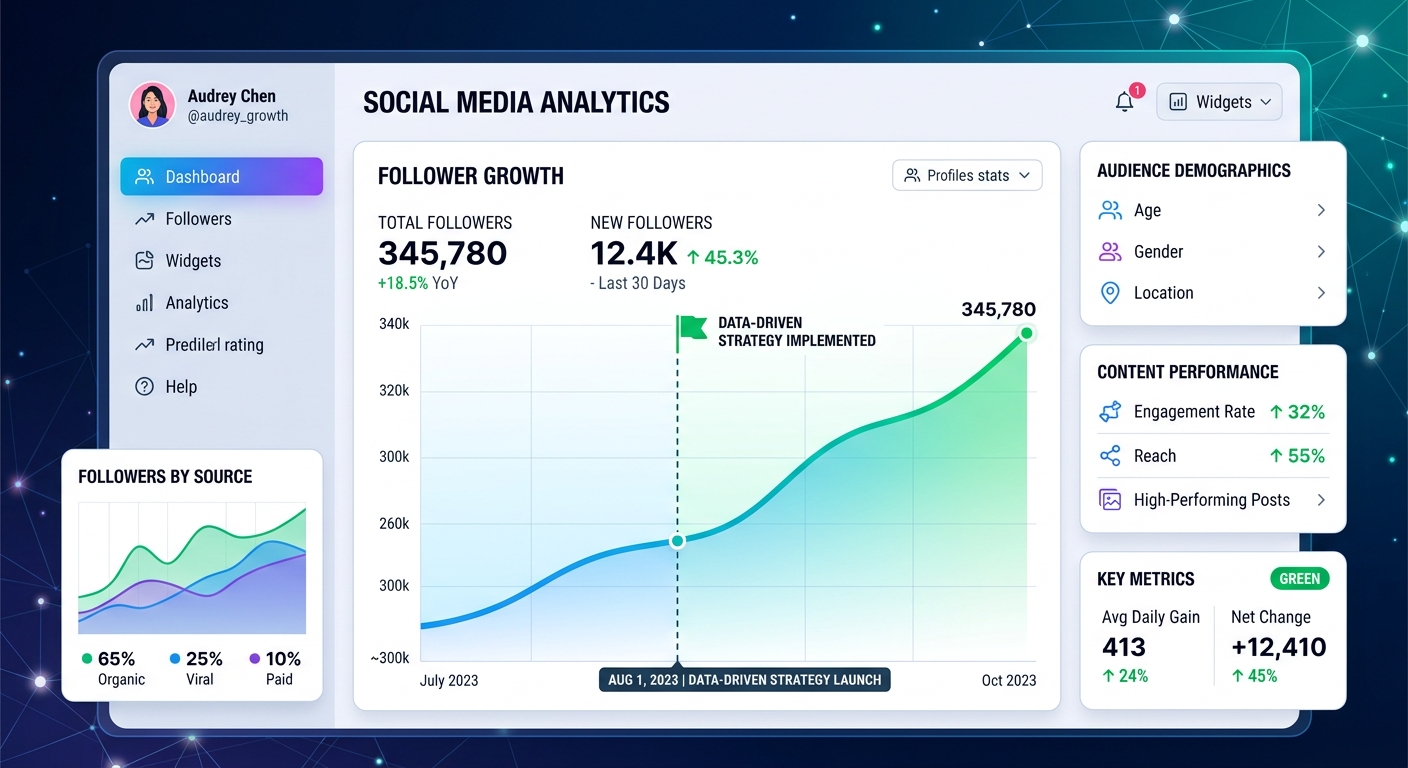
Once this flywheel starts moving, there will be a noticeable inflection point. Usually, after implementing a precise strategy for three consecutive months, the number of followers gained in a single month will suddenly double—not because any piece of content went viral, but because the algorithm systematically improves the weight score of your account.
Use Instagram competitor analysis or TikTok data analysis to continuously track the health metrics of your account. When you see your engagement rate steadily increasing, the inflection point for follower growth is approaching.
What type of team is SocialEcho suitable for?
SocialEcho is a social media management tool specifically designed for brand overseas expansion teams, supporting unified management across 8 platforms. Especially suitable for:
- A brand operations department with multiple platform accounts but a limited team of 1-3 people.
- A team that wants to centralize release scheduling and data analysis into one tool
- Overseas brands need to regularly compare their competitors' activities and adjust their strategies accordingly.
Basic plan starts at 12.5/month, team plan starts at 18.75/month, annual payment is 20% off.
👉 Free trial: https://www.socialecho.cn
FAQ
Q: Should I consider switching platforms if my account hasn't gained any followers in six months? A: Before switching platforms, it's recommended to conduct a thorough review. Does the problem stem from timing of posting, a confused positioning, or a lack of keyword strategy? These three issues exist on any platform. Blindly switching platforms is simply changing where you're making the same mistakes.
Q: Do I need professional tools for account data analysis? A: The platform's built-in data backend only provides basic metrics. To perform correlation analysis between posting time and interaction rate, and to make horizontal comparisons with competitors, third-party tools are required. Manually compiling Excel spreadsheets is also possible, but it's costly and prone to missing key variables.
Q: After narrowing the account's focus, the amount of content decreased. Will the boss question this? A: Show us the data. Do an A/B comparison: the average interaction cost per user and the quality of fan growth during the targeted posting phase, vs. the previous high-frequency, random posting phase. The numbers will convince the boss.
Q: How to implement keyword strategy in video content? A: Title optimization is the first step (including core keywords); write a complete 200-300 word summary in the description box; use long-tail precise keywords for tags; and another often overlooked element is the video subtitle content, as YouTube's search crawler will index the subtitles.
Q: What metrics can I see in SocialEcho's data analytics? A: SocialEcho supports viewing interaction rates, posting time performance, and follower growth trends for content published across multiple platforms, and allows comparison with competitor accounts' data during the same period. You can check out the specific supported platforms and metrics through the free trial on the official website.
Q: Is this method applicable to newly created accounts? A: It is very applicable and more effective than for old accounts—because new accounts are not burdened by a history of "confusing positioning" and can execute a precise strategy from the beginning, resulting in faster accumulation of algorithm weight.
Q: Platform algorithms change so quickly, will these methods become outdated? A: Specific operations may iterate, but the underlying logic remains the same: high interaction rate → algorithm approval → wider reach. Each platform algorithm adjustment essentially rewards "content that satisfies users" and punishes "accounts that only consider posting frequency." The direction is stable; the details need to be reviewed regularly.
;}.cls-2{fill:%230868f7;}.cls-3{fill:url(%23未命名的渐变_44);}.cls-4{fill:%23333;}%3c/style%3e%3clinearGradient%20id='未命名的渐变_8'%20x1='33.73'%20y1='100.61'%20x2='-0.03'%20y2='-1.06'%20gradientUnits='userSpaceOnUse'%3e%3cstop%20offset='0'%20stop-color='%237ae9fb'/%3e%3cstop%20offset='0.67'%20stop-color='%232b90f8'/%3e%3cstop%20offset='1'%20stop-color='%230868f7'/%3e%3c/linearGradient%3e%3clinearGradient%20id='未命名的渐变_44'%20x1='27.86'%20y1='18.67'%20x2='68.36'%20y2='22.22'%20gradientUnits='userSpaceOnUse'%3e%3cstop%20offset='0'%20stop-color='%235ac7f2'/%3e%3cstop%20offset='1'%20stop-color='%230868f7'/%3e%3c/linearGradient%3e%3c/defs%3e%3cpath%20class='cls-1'%20d='M29,28.74V81.91l-9.51-3.68v0L8.52,74A7.17,7.17,0,0,1,4,67.32V24.54A3.76,3.76,0,0,1,9.08,21Z'/%3e%3cpath%20class='cls-2'%20d='M68.09,78.07a13.15,13.15,0,0,1-17.9,12.06L29,81.91h0V28.74L50.19,37A13.17,13.17,0,0,0,68.08,25.3h0Z'/%3e%3cpath%20class='cls-3'%20d='M68.08,25.3a13.19,13.19,0,0,1-6.73,10.87A13.09,13.09,0,0,1,50.19,37L29,28.74V6A3.76,3.76,0,0,1,34.1,2.52l25.59,9.91A13.22,13.22,0,0,1,68.08,25.3Z'/%3e%3cpath%20class='cls-4'%20d='M129.06,81.76a4.33,4.33,0,0,1-3.19-1.31,4.4,4.4,0,0,1-1.31-3.24V56.86H97.65V77.21a4.36,4.36,0,0,1-1.35,3.2A4.68,4.68,0,0,1,93,81.76a4.32,4.32,0,0,1-3.19-1.31,4.37,4.37,0,0,1-1.32-3.24V27.27A4.58,4.58,0,0,1,89.83,24a4.59,4.59,0,0,1,7.82,3.27V48.15h26.91V27.27A4.58,4.58,0,0,1,125.91,24a4.59,4.59,0,0,1,7.82,3.27V77.21a4.37,4.37,0,0,1-1.36,3.2A4.65,4.65,0,0,1,129.06,81.76Z'/%3e%3cpath%20class='cls-4'%20d='M163.77,81.66c-6.57,0-11.76-1.92-15.44-5.7s-5.54-9.07-5.54-15.74a26.76,26.76,0,0,1,2.09-10.43,17.72,17.72,0,0,1,6.67-8.06,19.15,19.15,0,0,1,10.68-2.95,19,19,0,0,1,10.46,2.8,18.7,18.7,0,0,1,6.55,7.36,22.53,22.53,0,0,1,2.36,10.28A4.51,4.51,0,0,1,177,63.77H152.23a10.8,10.8,0,0,0,3.49,6.65c2,1.68,4.88,2.52,8.66,2.52a22.25,22.25,0,0,0,7.54-1.21c.74-.3,1.55-.67,2.37-1.07a3.75,3.75,0,0,1,1.84-.4,4.09,4.09,0,0,1,3,1.15,4,4,0,0,1,1.12,3,4.38,4.38,0,0,1-2.58,3.82,32.34,32.34,0,0,1-6.36,2.61A28.67,28.67,0,0,1,163.77,81.66ZM172.4,55.9a9.72,9.72,0,0,0-1.63-4.56A9.9,9.9,0,0,0,167,48a10.38,10.38,0,0,0-4.64-1.14,12,12,0,0,0-4.77,1.06,9.54,9.54,0,0,0-4.89,5.66,11.78,11.78,0,0,0-.51,2.3Z'/%3e%3cpath%20class='cls-4'%20d='M193,81.64a4.49,4.49,0,0,1-4.51-4.55V27.28A4.58,4.58,0,0,1,189.84,24a4.48,4.48,0,0,1,3.28-1.36A4.36,4.36,0,0,1,196.35,24a4.46,4.46,0,0,1,1.31,3.31V77.09a4.34,4.34,0,0,1-1.35,3.2A4.67,4.67,0,0,1,193,81.64Z'/%3e%3cpath%20class='cls-4'%20d='M263.79,81.71a5.7,5.7,0,0,1-4.2-1.74,5.76,5.76,0,0,1-1.73-4.19V27.37a4.58,4.58,0,0,1,1.35-3.27A4.59,4.59,0,0,1,267,27.37V72.53h24a4.58,4.58,0,0,1,3.27,7.82A4.66,4.66,0,0,1,291,81.71Z'/%3e%3cpath%20class='cls-4'%20d='M424.48,81.74a4.71,4.71,0,0,1-2.71-.88,5.43,5.43,0,0,1-1-1l-.07-.09-12.41-17-5.41,5v9.44a4.31,4.31,0,0,1-1.36,3.19,4.66,4.66,0,0,1-3.3,1.36A4.29,4.29,0,0,1,395,80.42a4.36,4.36,0,0,1-1.32-3.23V27.37A4.58,4.58,0,0,1,395,24.1a4.52,4.52,0,0,1,6.58.12,4.54,4.54,0,0,1,1.24,3.15V56.31l17.72-16.38.05,0a4.8,4.8,0,0,1,2.94-1.11,4.4,4.4,0,0,1,3.27,1.2,4.57,4.57,0,0,1,1.2,3.27,4.44,4.44,0,0,1-.77,2.33,7.45,7.45,0,0,1-1.43,1.65l-11,9.64,13.34,17.68a5,5,0,0,1,1,2.71,4.12,4.12,0,0,1-1.36,3.24A4.64,4.64,0,0,1,424.48,81.74Z'/%3e%3cpath%20class='cls-4'%20d='M317.93,81.76a21.5,21.5,0,1,1,21.17-21.5A21.37,21.37,0,0,1,317.93,81.76Zm0-34.1a12.61,12.61,0,1,0,12.42,12.6A12.52,12.52,0,0,0,317.93,47.66Z'/%3e%3cpath%20class='cls-4'%20d='M212.18,101.22a4.12,4.12,0,0,1-3.05-1.26,4.17,4.17,0,0,1-1.26-3.1V43.34a4.37,4.37,0,0,1,1.3-3.14,4.26,4.26,0,0,1,3.13-1.3,4.19,4.19,0,0,1,3.1,1.26,4.32,4.32,0,0,1,1.26,3.16,20.77,20.77,0,0,1,13-4.54,21.51,21.51,0,0,1,0,43,20.51,20.51,0,0,1-13-4.57V96.86a4.15,4.15,0,0,1-1.3,3.06A4.5,4.5,0,0,1,212.18,101.22Zm17.43-53.63c-6.23,0-12.93,4.11-12.93,12.72a12.73,12.73,0,0,0,25.46,0A12.71,12.71,0,0,0,229.61,47.59Z'/%3e%3cpath%20class='cls-4'%20d='M365.76,81.76a21.5,21.5,0,1,1,21.18-21.5A21.37,21.37,0,0,1,365.76,81.76Zm0-34.1a12.61,12.61,0,1,0,12.42,12.6A12.52,12.52,0,0,0,365.76,47.66Z'/%3e%3c/svg%3e)