
Shocking! His agency's order volume increased from 5 to 11: He only changed one thing.
The upper limit of revenue from account management services is not determined by the client's wishes, but by the marginal time cost of each account—reducing the latter by 50% can double the number of orders.

You can't take on a sixth client, not because nobody else is asking.
In his 18th month as an e-commerce operations manager, Li Yang encountered a wall.
He serves five clients simultaneously, handling two to three platforms for each—TikTok, Instagram, and Facebook in rotation. Every Monday morning, he prepares a data report for each client for the previous week. Every Friday afternoon, he checks to ensure the next week's release schedule is complete. Every day, he manages the comment sections of three client accounts, distinguishing which comments contain genuine issues, which are just casual comments, and which reveal a potential buyer.
At that time, a sixth client approached them. They had a good brand background and offered a reasonable monthly fee. Li Yang declined.
He said, "I'd die if I took the call. I'm 12 hours a day now, every minute of it is fully booked."
This is the ceiling that many third-party service providers hit after 2 to 3 years. It's not that there's no market demand, or that there's no room for pricing; it's simply that—there's not enough time.
Each new client means more reviews to read, more data to process, more reports to prepare, and more platform logins to complete. The number of clients you can serve is directly limited by your total available time.
Many people's first reaction is to hire someone. Hire an assistant or part-time worker to offload some of the work. This direction isn't wrong, but it solves the problem of division of labor, not efficiency. Hiring people will spread the workload, but the operational cost of each account itself won't be reduced—you're just distributing the same amount of work among more people.
The solution Li Yang ultimately found was not this one.
How is the time spent on outsourced operations?
Let me start with a counterintuitive fact: when doing outsourced operations, posting content is often not the most time-consuming part.
Content can be produced in batches; clients can provide materials, and a weekly release schedule can be planned out in advance. In the hands of experienced content providers, the time cost of content creation can actually be kept very low.
The real time black hole exists in two places.
The first one is the comments section.
Anyone who has managed accounts on more than three platforms knows that the comment section isn't something you can "just glance at" every day; it's something you "must keep an eye on." Users ask about product sizes, shipping times, and prices, and occasionally someone will directly say, "I want to buy." Missing these messages could mean missing out on an order. But you don't know when they'll come, so you can only keep refreshing.
Managing 5 clients, each with 2 platforms, results in 10 comment sections. Sometimes, after one account posts content, dozens of comments suddenly appear. After filtering them all out, another account starts posting new comments.
This task cannot be outsourced or postponed—it's one of the most incompressible parts of the time available to outsource operations.
The second is the end-of-month data processing.
At the end of each month, the outsourced operations team needs to provide reports to clients. The data has to be manually pulled from the backends of various platforms, including follower growth, post interaction rate, number of comments, and most popular content—one set of data for each platform, compiled separately for each client, and sometimes charts need to be created.
Managing 5 clients means spending several consecutive days doing this at the end of the month. Many agency managers say that the last week of the month is their most tiring time, and they basically have no energy left to do anything else during that week.
These two things together form the core structure of the time cost of outsourced operations. They are not occasional occurrences, but rather fixed costs that inevitably occur weekly and monthly.
Why is a sixth customer possible?
Li Yang eventually accepted the 6th, 7th, and then the 11th.
The change occurred after he started using a single tool to manage the comment sections of all his client accounts.
What exactly are the changes?
It turns out he needed to open 10 accounts every day, switching between different platform interfaces to read comments, and determine which ones needed to be replied to, which ones didn't need to be addressed, and which ones needed screenshots to be sent to customers for confirmation. This task took him an average of 3 to 4 hours every day.
After being aggregated using a comment management tool, all comments from all accounts went into the same inbox. The AI first performed a round of sentiment and intent recognition—labeling comments as purchase intentions, inquiries, general interactions, and negative comments separately. He no longer needed to read each comment individually; he only needed to process the parts that the AI marked as "requiring human follow-up."
This change reduced his daily processing time in the comments section from 3-4 hours to less than 1 hour.
Another change is in data reporting.
Previously, it would take a whole week to produce a report at the end of the month. Now, with the data analysis function, data from various platforms is synchronized in real time, and reports can be viewed and exported at any time, eliminating the need for centralized compilation at the end of the month.
These two things combined save him nearly 20 hours a week.
What does 20 hours mean? That's almost all the time he used to spend each week on comment management and data processing. After reallocating that time, he can now serve two or three new clients.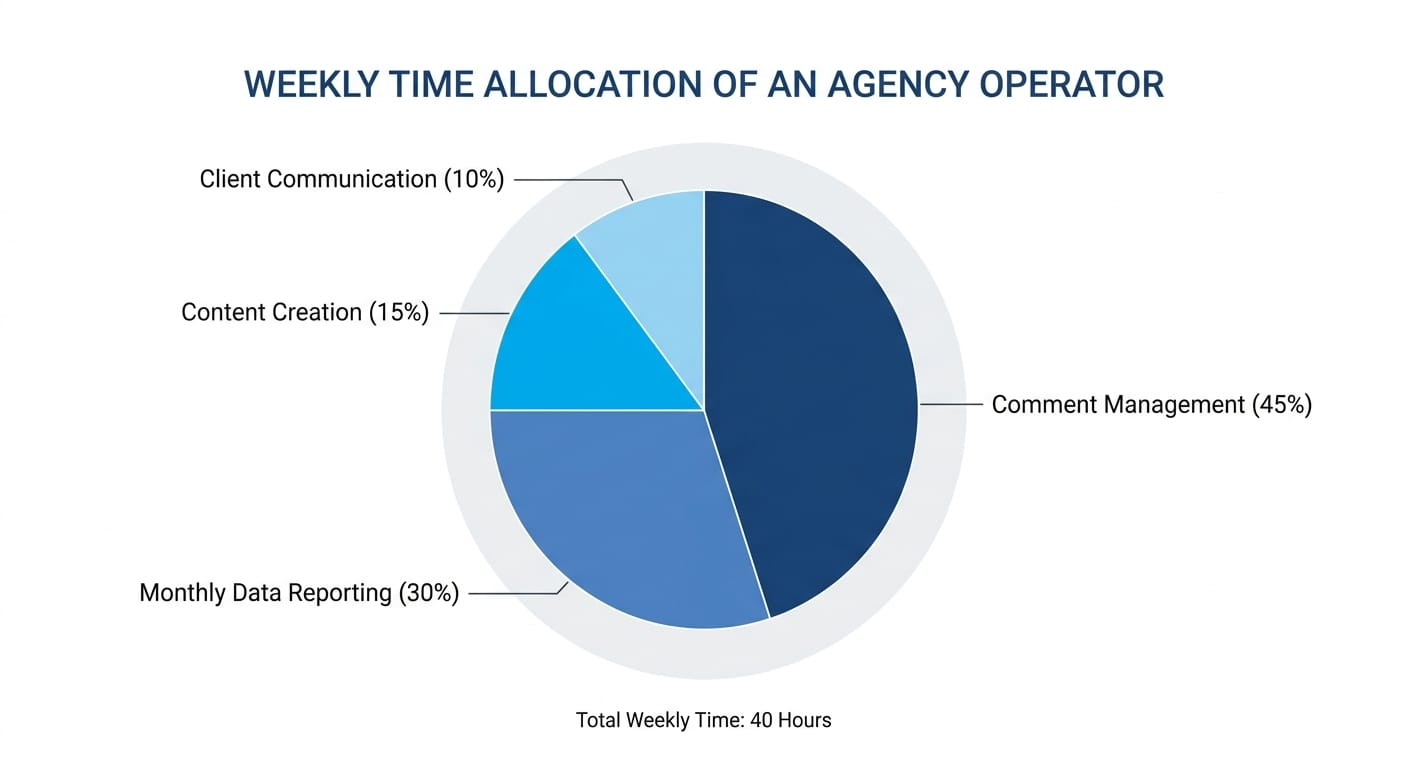
Marginal time cost: the true upper limit of order volume
The business logic of outsourced operations is essentially very simple: the number of clients you can take on depends on how much service time you can generate each month.
However, there is a variable in this calculation that many people are unaware of: the marginal time cost for each customer.
If you need to invest an extra 30 hours per month for each new customer, your order limit is your total available time divided by 30. If you reduce this number to 15 hours, your order limit doubles, but your customer unit price and service quality remain the same.
This is the real mechanism for increasing revenue through outsourced operations: it's not about increasing the unit price (customers have an upper limit to what they can accept), nor is it about reducing the depth of service (customers will perceive this), but rather about compressing the marginal time cost of each account and expanding the scale of services without sacrificing quality.
From 5 clients to 11 clients, Li Yang's unit price did not decrease; instead, his working hours decreased from 12 hours/day to 9 hours. The only difference was that he no longer used manpower to solve problems that could have been solved with tools.
It's worth calculating: if 5 clients generate 100,000 RMB in revenue per month, then 11 clients at the same price would generate 220,000 RMB. There's an extra 120,000 RMB, but the additional cost of the tool subscriptions is far less than that.
Where can outsourced operations reduce time costs?
Based on the above analysis, there are three areas where outsourced operations can be optimized.
The first step is automating comment management. Using AI automation , the system performs an initial classification: which comments indicate purchase intent, which are general questions, and which express negative sentiment requiring special attention. Human staff only need to review and process the tagged comments, eliminating the need for individual filtering.
For outsourced operations that manage multiple clients simultaneously, this step can save the most time—because the comment section is a fixed daily expense, and saving a little on each account adds up to a considerable amount.
The second is the centralization of content publishing across multiple accounts. Content that previously required logging into each platform and publishing individually can now be scheduled and published uniformly. A single operation can publish content from multiple platforms and accounts, eliminating the need for repeated daily logins and manual processes.
The time saved in this matter may not seem like much each time, but it saves time every day, and the cumulative effect over a month is quite significant.
The third feature is the automation of data reporting. The data analysis function supports 180 days of historical data, multi-account data displayed on a single screen, and Excel export. Month-end reports no longer require a dedicated week to produce; the data structure required by the client can be exported at any time.
These three aspects combined constitute the main area for optimizing the time cost of outsourced operations.

The next question
There is no shortage of demand in the outsourced social media management market, and the demand for professional social media services from brands going global continues to grow. Managing accounts on platforms like TikTok, Instagram, Facebook, and LinkedIn is beyond the capabilities of most brands, making outsourcing to experienced outsourced agencies a natural choice.
However, the bottleneck for third-party service providers remains: the more clients they serve, the harder it is to guarantee operational quality; and once operational quality declines, client renewal rates will suffer.
This is a problem that has never been truly solved – without efficient tools, outsourced operations can only rely on piling on manpower to solve the scale problem, which is not a good business structure.
However, this structure changes if the marginal time cost of each account can be effectively compressed. Outsourced operations can serve more clients with the same manpower and use the saved time where it is truly needed—content strategy, client communication, and data insights.
The difference between having 5 clients and 11 clients wasn't a market opportunity, but rather time.
SocialEcho is a social media management tool for agencies and overseas brand teams. It supports unified management of 8 platforms: TikTok, Instagram, Facebook, X, LinkedIn, YouTube, Pinterest, and Telegram. It offers features such as AI-based comment categorization, scheduled posting from multiple accounts, and data integration and export from multiple platforms.
👉 Register for free and experience unified management of multiple accounts → https://www.socialecho.cn
;}.cls-2{fill:%230868f7;}.cls-3{fill:url(%23未命名的渐变_44);}.cls-4{fill:%23333;}%3c/style%3e%3clinearGradient%20id='未命名的渐变_8'%20x1='33.73'%20y1='100.61'%20x2='-0.03'%20y2='-1.06'%20gradientUnits='userSpaceOnUse'%3e%3cstop%20offset='0'%20stop-color='%237ae9fb'/%3e%3cstop%20offset='0.67'%20stop-color='%232b90f8'/%3e%3cstop%20offset='1'%20stop-color='%230868f7'/%3e%3c/linearGradient%3e%3clinearGradient%20id='未命名的渐变_44'%20x1='27.86'%20y1='18.67'%20x2='68.36'%20y2='22.22'%20gradientUnits='userSpaceOnUse'%3e%3cstop%20offset='0'%20stop-color='%235ac7f2'/%3e%3cstop%20offset='1'%20stop-color='%230868f7'/%3e%3c/linearGradient%3e%3c/defs%3e%3cpath%20class='cls-1'%20d='M29,28.74V81.91l-9.51-3.68v0L8.52,74A7.17,7.17,0,0,1,4,67.32V24.54A3.76,3.76,0,0,1,9.08,21Z'/%3e%3cpath%20class='cls-2'%20d='M68.09,78.07a13.15,13.15,0,0,1-17.9,12.06L29,81.91h0V28.74L50.19,37A13.17,13.17,0,0,0,68.08,25.3h0Z'/%3e%3cpath%20class='cls-3'%20d='M68.08,25.3a13.19,13.19,0,0,1-6.73,10.87A13.09,13.09,0,0,1,50.19,37L29,28.74V6A3.76,3.76,0,0,1,34.1,2.52l25.59,9.91A13.22,13.22,0,0,1,68.08,25.3Z'/%3e%3cpath%20class='cls-4'%20d='M129.06,81.76a4.33,4.33,0,0,1-3.19-1.31,4.4,4.4,0,0,1-1.31-3.24V56.86H97.65V77.21a4.36,4.36,0,0,1-1.35,3.2A4.68,4.68,0,0,1,93,81.76a4.32,4.32,0,0,1-3.19-1.31,4.37,4.37,0,0,1-1.32-3.24V27.27A4.58,4.58,0,0,1,89.83,24a4.59,4.59,0,0,1,7.82,3.27V48.15h26.91V27.27A4.58,4.58,0,0,1,125.91,24a4.59,4.59,0,0,1,7.82,3.27V77.21a4.37,4.37,0,0,1-1.36,3.2A4.65,4.65,0,0,1,129.06,81.76Z'/%3e%3cpath%20class='cls-4'%20d='M163.77,81.66c-6.57,0-11.76-1.92-15.44-5.7s-5.54-9.07-5.54-15.74a26.76,26.76,0,0,1,2.09-10.43,17.72,17.72,0,0,1,6.67-8.06,19.15,19.15,0,0,1,10.68-2.95,19,19,0,0,1,10.46,2.8,18.7,18.7,0,0,1,6.55,7.36,22.53,22.53,0,0,1,2.36,10.28A4.51,4.51,0,0,1,177,63.77H152.23a10.8,10.8,0,0,0,3.49,6.65c2,1.68,4.88,2.52,8.66,2.52a22.25,22.25,0,0,0,7.54-1.21c.74-.3,1.55-.67,2.37-1.07a3.75,3.75,0,0,1,1.84-.4,4.09,4.09,0,0,1,3,1.15,4,4,0,0,1,1.12,3,4.38,4.38,0,0,1-2.58,3.82,32.34,32.34,0,0,1-6.36,2.61A28.67,28.67,0,0,1,163.77,81.66ZM172.4,55.9a9.72,9.72,0,0,0-1.63-4.56A9.9,9.9,0,0,0,167,48a10.38,10.38,0,0,0-4.64-1.14,12,12,0,0,0-4.77,1.06,9.54,9.54,0,0,0-4.89,5.66,11.78,11.78,0,0,0-.51,2.3Z'/%3e%3cpath%20class='cls-4'%20d='M193,81.64a4.49,4.49,0,0,1-4.51-4.55V27.28A4.58,4.58,0,0,1,189.84,24a4.48,4.48,0,0,1,3.28-1.36A4.36,4.36,0,0,1,196.35,24a4.46,4.46,0,0,1,1.31,3.31V77.09a4.34,4.34,0,0,1-1.35,3.2A4.67,4.67,0,0,1,193,81.64Z'/%3e%3cpath%20class='cls-4'%20d='M263.79,81.71a5.7,5.7,0,0,1-4.2-1.74,5.76,5.76,0,0,1-1.73-4.19V27.37a4.58,4.58,0,0,1,1.35-3.27A4.59,4.59,0,0,1,267,27.37V72.53h24a4.58,4.58,0,0,1,3.27,7.82A4.66,4.66,0,0,1,291,81.71Z'/%3e%3cpath%20class='cls-4'%20d='M424.48,81.74a4.71,4.71,0,0,1-2.71-.88,5.43,5.43,0,0,1-1-1l-.07-.09-12.41-17-5.41,5v9.44a4.31,4.31,0,0,1-1.36,3.19,4.66,4.66,0,0,1-3.3,1.36A4.29,4.29,0,0,1,395,80.42a4.36,4.36,0,0,1-1.32-3.23V27.37A4.58,4.58,0,0,1,395,24.1a4.52,4.52,0,0,1,6.58.12,4.54,4.54,0,0,1,1.24,3.15V56.31l17.72-16.38.05,0a4.8,4.8,0,0,1,2.94-1.11,4.4,4.4,0,0,1,3.27,1.2,4.57,4.57,0,0,1,1.2,3.27,4.44,4.44,0,0,1-.77,2.33,7.45,7.45,0,0,1-1.43,1.65l-11,9.64,13.34,17.68a5,5,0,0,1,1,2.71,4.12,4.12,0,0,1-1.36,3.24A4.64,4.64,0,0,1,424.48,81.74Z'/%3e%3cpath%20class='cls-4'%20d='M317.93,81.76a21.5,21.5,0,1,1,21.17-21.5A21.37,21.37,0,0,1,317.93,81.76Zm0-34.1a12.61,12.61,0,1,0,12.42,12.6A12.52,12.52,0,0,0,317.93,47.66Z'/%3e%3cpath%20class='cls-4'%20d='M212.18,101.22a4.12,4.12,0,0,1-3.05-1.26,4.17,4.17,0,0,1-1.26-3.1V43.34a4.37,4.37,0,0,1,1.3-3.14,4.26,4.26,0,0,1,3.13-1.3,4.19,4.19,0,0,1,3.1,1.26,4.32,4.32,0,0,1,1.26,3.16,20.77,20.77,0,0,1,13-4.54,21.51,21.51,0,0,1,0,43,20.51,20.51,0,0,1-13-4.57V96.86a4.15,4.15,0,0,1-1.3,3.06A4.5,4.5,0,0,1,212.18,101.22Zm17.43-53.63c-6.23,0-12.93,4.11-12.93,12.72a12.73,12.73,0,0,0,25.46,0A12.71,12.71,0,0,0,229.61,47.59Z'/%3e%3cpath%20class='cls-4'%20d='M365.76,81.76a21.5,21.5,0,1,1,21.18-21.5A21.37,21.37,0,0,1,365.76,81.76Zm0-34.1a12.61,12.61,0,1,0,12.42,12.6A12.52,12.52,0,0,0,365.76,47.66Z'/%3e%3c/svg%3e)