
Instagram Reels 2026 Q1 Data Report: Brand Account Engagement Rate Down 23% Year-on-Year, Only This Type of Content Remains as Winners
When Lin Xiao saw the Q1 data report, her first thought was that there was a problem with the data export—the company's average engagement rate on Instagram Reels had plummeted from 3.2% in the same period last year to 1.9%, a full 40% drop. She re-exported the data three times, but the numbers remained unchanged. "We haven't reduced our posting frequency, and the content quality hasn't declined, so why has the engagement rate dropped so drastically?" When she sent this message in the internal group chat, the replies she received were almost unanimously: "The same for us."
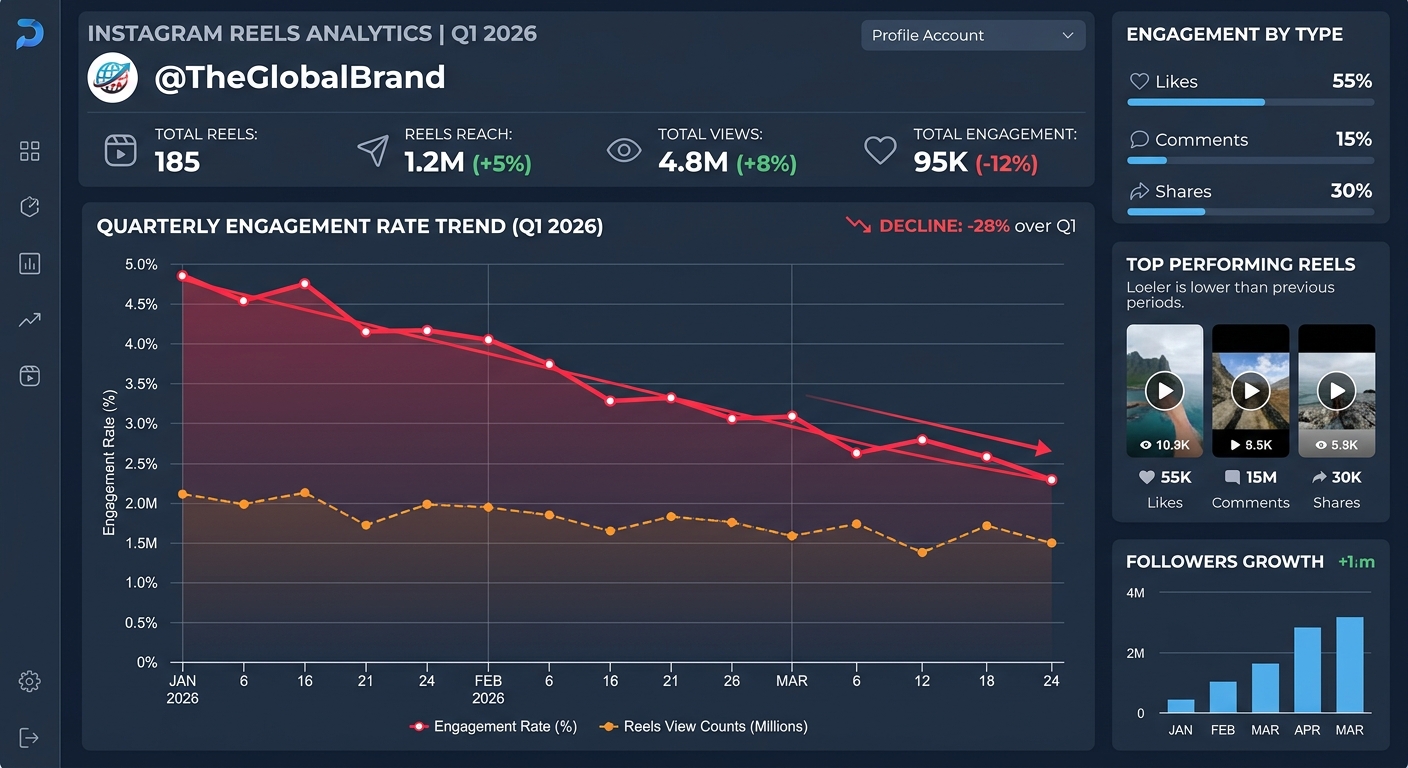
This is not an isolated case. In Q1 of 2026, the overall engagement rate of Instagram Reels brand accounts declined by 23% year-over-year—the largest single-quarter drop in the past three years. If you are experiencing similar confusion, this article will tell you: what is happening behind the data, which types of content are bucking the trend, and how brand accounts should adjust their strategies.
Data Anomalies – Brand Accounts Across Industries Collectively "Grow Slow"
Q1 Key Data Overview
Based on tracking data from multiple social media analytics firms on over 15,000 brand Instagram accounts, the following key metrics emerged for Q1 2026:
- Overall Engagement Rate : The average engagement rate for brand accounts decreased to 2.0% from 2.6% in Q1 2025, a year-on-year decrease of approximately 23%.
- Reels' average completion rate dropped from 38.4% to 29.7%, a decrease of 22.7%.
- Comments per thousand views : decreased from 4.2 to 2.8, a reduction of approximately 33%.
- Share Rate : Down 18% year-over-year
- Save Rate : Down 11% year-over-year
It's worth noting that this decline wasn't evenly distributed. Consumer goods, fashion apparel, and beauty brands experienced the most dramatic drops, averaging over 30%; while education, tools, and technology accounts saw relatively stable engagement rates, with some even achieving positive growth.
Common Brand Confusion
Most brand operation teams found a common phenomenon during their post-mortem analysis: content quality did not decline, and the posting frequency did not decrease, but "organic reach" continued to shrink.
One brand team even conducted a comparative experiment—re-releasing the original Reels video that performed best in Q1 of last year, and found that the same content only received about 40% of the original views under the current algorithm environment. This shows that the problem is not with the content itself, but with a fundamental change in the platform rules .
Decoding—What Happened to Instagram's Q1 2026 Algorithm?
Core Change 1: The weight of the interest graph has surpassed that of the attention graph.
In late 2025, Instagram hinted at further increasing the proportion of "Suggested Content" in user feeds. This adjustment was fully implemented in Q1 of 2026.
- In the user feed, the proportion of recommended content from "accounts not followed" increased from 35% to approximately 52%.
- Reels tabs are almost entirely driven by interest graphs, with follower relationships having the lowest weight in content distribution ever.
This means that the old model of relying on a "core fan base" to guarantee initial views has completely failed . Now, when a Reels post is published, the algorithm will first push it to a group of "cold users" who have no connection with you for testing, and decide whether to expand distribution based on the interaction feedback of these users.
For most brand accounts, this presents a fatal problem: brand content is far less appealing to unfamiliar users than content created by individual creators or niche KOLs.
The second key change: "Completion rate" and "Replay rate" have become the primary indicators for distribution.
Instagram's algorithm significantly increased the weighting of "completion rate" and "replay rate" in Q1 2026. According to internal testing data:
- Videos with a completion rate below 25% are unlikely to be included in the secondary recommendation pool.
- Videos with a replay rate exceeding 15% can see a 3-5 times increase in distribution volume.
- The "retention rate" in the first 3 seconds becomes the primary signal for the algorithm to judge video quality.
This directly led to a result: the traditional brand Reels' "opening" model—showing the brand logo and product images first, and then entering the content—became the biggest algorithm killer.
Third key change: Comment quality far exceeds comment quantity
In the past, many brands used to use "comment guidance" (such as "Tell us what you think!") to inflate comment counts. In Q1 of 2026, Instagram's algorithm began to identify "low-quality interactions"—the weight of short comments, repetitive comments, and obviously guiding comments was significantly reduced.
Instead, user-generated comments with specific content have become 4-6 times more effective at algorithmic distribution than short-sentence comments.
This means that only content that can spark genuine discussion and emotional resonance will survive under the new algorithm.
Which types of content are bucking the trend and growing?
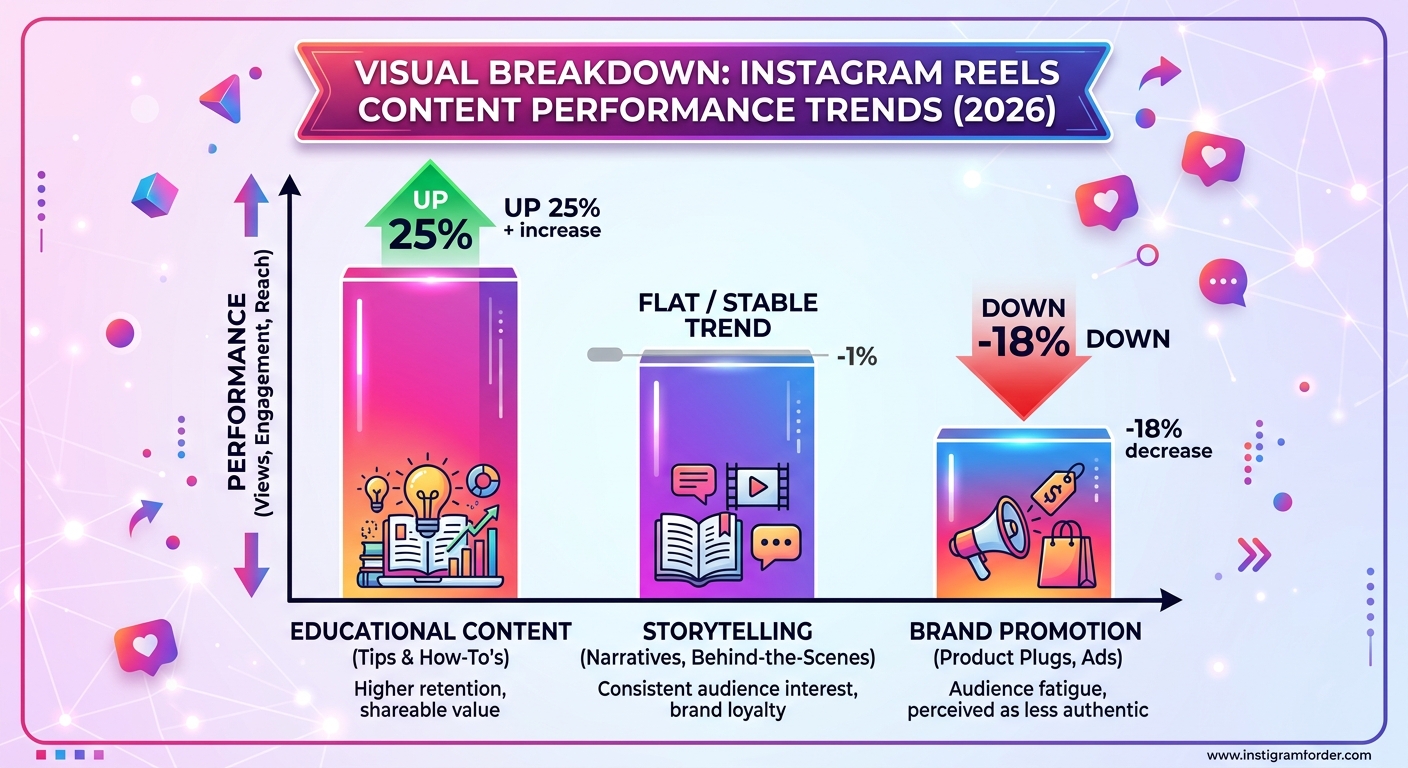
Amidst an overall downturn, three types of content have bucked the trend and achieved growth:
① Education/practical tips Reels (+31%) are driven by the core concept of "learning is earning," with user retention and sharing rates far exceeding the average. Typical format: 5 tips, 3 common mistakes, and comparative demonstrations.
② Real-world/process-oriented Reels (+24%) showcase the product development process, the team's daily work, and post-failure analyses. This type of content has an extremely high replay rate and easily generates genuine comments.
③ Reels (+19%) leverages trending topics to quickly respond to current hot topics and deliver viewpoints from a brand perspective. Its timeliness is strong, and its ability to grab attention within the first 3 seconds is a natural advantage.
With Instagram's data analytics tools, you can track the completion rate, save rate, and share rate of various content formats on your account in real time, accurately identifying which type of content performs best in your vertical, rather than relying on industry average data to make decisions.
Breaking the Mold: New Content Strategies for Brand Accounts
Strategy 1: Reconstruct the starting point of content, shifting from a "brand perspective" to a "user perspective".
The most fundamental strategic shift: stop asking "what do we want to show?" and start asking "why should users watch this video?"
Specific execution framework:
| Old ideas | New ideas |
|---|---|
| Brand Story → Product Advantages → Purchase Guide | User pain points → Solutions → Brand endorsement |
| First 3 seconds: Logo + Brand Name | First 3 seconds: Conflict, suspense, or strong viewpoint |
| Unified brand tone | Content value takes precedence over brand exposure. |
| Encourage comments | Ask real questions and spark real discussions |
A workable testing method: Take the first 3 seconds of your Reels video and ask someone who knows nothing about your brand: "Would you continue watching? Why?" If the answer is no, or the reason is vague, the video needs to have its beginning redone.
Strategy 2: Establish a "3+1" content matrix
In the new algorithm environment, it is difficult to maintain account health with a single content type. Brands are advised to establish a "3+1" content matrix:
- Three core content categories : Educational insights (40%) + Behind-the-scenes stories (35%) + Leveraging trending topics (25%)
- Category 1 testing content : Reserve 10-15% of the monthly releases for format experiments (interactive challenges, user co-creation, special narrative structures, etc.).
This ratio is not fixed and needs to be dynamically adjusted based on data analysis results. It is recommended to review the completion rate and save rate of various types of content every two weeks and adjust the ratio accordingly.
Strategy 3: Elevate "release timing" to a strategic priority
The algorithm testing mechanism in Q1 2026 is more sensitive to the "release timing" - the interaction density in the cold start phase (the first 60 minutes after release) has an impact of more than 50% on the final distribution volume.
This means that the era of arbitrary posting is over, and precise posting has become a necessity.
Instagram's scheduled posting feature allows you to identify peak periods of fan activity based on account history data, precisely scheduling posting times to ensure each Reels receives maximum initial engagement within the optimal time window. SocialEcho supports advance scheduling and batch planning, freeing content teams from the tedious task of "remembering to post" and allowing them to focus on the content itself.
Strategy 4: Turn the comment section into an "extension of content"
With the increased weighting of comment quality, the operational value of the comment section has been severely underestimated .
Effective comment section strategies:
- Within the first 30 minutes of posting , use your own account to post a substantial comment in the comment section (ask a relevant question or add a detail not included in the video) to guide users to discuss the topic.
- Recognizing high-quality comments and providing substantial responses rather than just liking them will encourage users to create more in-depth comments.
- Regularly compile frequently asked questions from the comments section and transform them into topics for the next Reels post.
Instagram's comment management tools can help teams process comments efficiently, set up automatic keyword filtering, and track comment interaction data, making the comment section a true part of the brand's content ecosystem.
Strategy 5: Unleash the team's creative productivity through AI automation
The content competition in 2026 will not only be about the quality of creativity, but also the sustainability and responsiveness of content production .
Brand accounts are inherently slower than individual creators in leveraging trending topics, primarily due to lengthy approval processes and cumbersome production workflows. AI-automated tools can significantly accelerate processes such as content selection, initial copywriting, and posting time optimization, allowing teams to focus on creative decisions that require human judgment.
SocialEcho's AI-assisted features have helped multiple brand teams reduce the time from topic selection to publication of a single Reels post from 3 days to less than 8 hours. The basic plan starts at 12.5/month, and the team plan starts at 18.75/month, with a 20% discount for annual payments . For small and medium-sized brand operation teams, this is a highly cost-effective efficiency investment.

The bottom line of data interpretation
Before we conclude, one thing needs to be made clear: a decrease in engagement does not mean that Instagram Reels is ineffective.
The 23% year-over-year decline reflects increased platform competition and higher algorithmic barriers, rather than a decline in overall user interest in video content. In fact, total views on Instagram Reels still achieved year-over-year growth in Q1 2026—it's just that traffic is becoming increasingly concentrated in the hands of a few high-quality accounts.
This means that for brands that are truly willing to adjust their strategies and improve the quality of their content, now is actually a window of opportunity to build a competitive advantage—because there are still a large number of brands struggling with old strategies.
FAQ
Q1: My brand account's engagement rate has dropped. Is it being throttled by Instagram?
A: Algorithm adjustments and "traffic limiting" are different concepts. Traffic limiting usually refers to an account being proactively demoted due to violations, while the current decline in interaction rate is mainly a natural change caused by adjustments to the algorithm's distribution logic—for most brand accounts, this is an environmental change faced by the entire industry, not a penalty targeting a specific account. You can confirm this through account insights data: if the reach ratio from "non-followers" does not show an abnormal decline, traffic limiting can generally be ruled out.
Q2: Does a higher posting frequency help increase overall exposure?
A: Under the new algorithm, high-frequency, low-quality content will actually lower the overall content score of an account. Instagram builds a "quality profile" of an account's historical content performance, and frequently posting content with low completion rates will affect the initial distribution of all subsequent content. It is recommended to focus resources on fewer but higher-quality pieces of content, while monitoring the completion rate trend of each piece of content through Instagram's data analytics tools.
Q3: Is educational content suitable for all types of brands?
A: Not all brands can directly adopt the "practical tutorial" format, but almost all brands can find their own "educational angle." Consumer brands can create content on "common product usage mistakes" or "ingredient science"; apparel brands can create "outfit guidelines for different occasions"; B2B brands can create content on "industry data interpretation" or "tool usage tips." The key is to find the intersection between brand expertise and users' real needs.
Q4: Can using SocialEcho directly help increase Reels interaction rates?
A: SocialEcho itself cannot replace high-quality content creation, but it can solve two key issues affecting engagement rates: posting timing and operational efficiency. Through precise Instagram timed posting , it ensures content is posted during peak user activity periods, maximizing engagement density during the cold start phase; through Instagram comment management , it helps the team respond quickly to comments, improving the quality of interaction in the comment section—both of which directly impact the algorithm's rating of the content.
Q5: How risky is it to leverage trending topics for content? How should brands strike a balance?
A: The risks of leveraging trending topics mainly come from two aspects: misjudging the sensitivity of the topic and misjudging its timeliness. We recommend brands establish a simple "trend-leveraging assessment framework": topic-brand tone matching degree (high/medium/low) + topic risk factor (political/controversial/neutral) + content response speed (whether it can be published within 24 hours). Only when the matching degree is high, the risk factor is low, and a rapid response is possible should it be recommended to follow up on trending topics.
Q6: Will Reels and Stories perform differently in Q1 of 2026?
A: The differences are significant. Stories have a relatively stable engagement rate, but their reach is still primarily limited to existing fans; Reels have a wider reach, but require higher quality content from non-fans. We recommend brands position the two as complementary: Reels for expanding reach to new users, and Stories for maintaining deep relationships with existing fans.
Q7: Will Instagram Reels' algorithm continue to be adjusted in Q2 of 2026?
A: Based on Meta's product iteration rhythm and historical patterns, there will most likely be further algorithm fine-tuning in Q2. The most prudent approach at present is to continuously optimize the first 3 seconds of content experience, improve completion rates, and maintain regular monitoring of data analysis to quickly identify any new changes in performance patterns. Adaptability is more important than betting on a single strategy.
Data source: Compiled from Q1 2026 public reports from social media analytics platforms such as Socialbakers, Rival IQ, and Metricool, as well as tracking and analysis of 15,000+ brand Instagram accounts.
;}.cls-2{fill:%230868f7;}.cls-3{fill:url(%23未命名的渐变_44);}.cls-4{fill:%23333;}%3c/style%3e%3clinearGradient%20id='未命名的渐变_8'%20x1='33.73'%20y1='100.61'%20x2='-0.03'%20y2='-1.06'%20gradientUnits='userSpaceOnUse'%3e%3cstop%20offset='0'%20stop-color='%237ae9fb'/%3e%3cstop%20offset='0.67'%20stop-color='%232b90f8'/%3e%3cstop%20offset='1'%20stop-color='%230868f7'/%3e%3c/linearGradient%3e%3clinearGradient%20id='未命名的渐变_44'%20x1='27.86'%20y1='18.67'%20x2='68.36'%20y2='22.22'%20gradientUnits='userSpaceOnUse'%3e%3cstop%20offset='0'%20stop-color='%235ac7f2'/%3e%3cstop%20offset='1'%20stop-color='%230868f7'/%3e%3c/linearGradient%3e%3c/defs%3e%3cpath%20class='cls-1'%20d='M29,28.74V81.91l-9.51-3.68v0L8.52,74A7.17,7.17,0,0,1,4,67.32V24.54A3.76,3.76,0,0,1,9.08,21Z'/%3e%3cpath%20class='cls-2'%20d='M68.09,78.07a13.15,13.15,0,0,1-17.9,12.06L29,81.91h0V28.74L50.19,37A13.17,13.17,0,0,0,68.08,25.3h0Z'/%3e%3cpath%20class='cls-3'%20d='M68.08,25.3a13.19,13.19,0,0,1-6.73,10.87A13.09,13.09,0,0,1,50.19,37L29,28.74V6A3.76,3.76,0,0,1,34.1,2.52l25.59,9.91A13.22,13.22,0,0,1,68.08,25.3Z'/%3e%3cpath%20class='cls-4'%20d='M129.06,81.76a4.33,4.33,0,0,1-3.19-1.31,4.4,4.4,0,0,1-1.31-3.24V56.86H97.65V77.21a4.36,4.36,0,0,1-1.35,3.2A4.68,4.68,0,0,1,93,81.76a4.32,4.32,0,0,1-3.19-1.31,4.37,4.37,0,0,1-1.32-3.24V27.27A4.58,4.58,0,0,1,89.83,24a4.59,4.59,0,0,1,7.82,3.27V48.15h26.91V27.27A4.58,4.58,0,0,1,125.91,24a4.59,4.59,0,0,1,7.82,3.27V77.21a4.37,4.37,0,0,1-1.36,3.2A4.65,4.65,0,0,1,129.06,81.76Z'/%3e%3cpath%20class='cls-4'%20d='M163.77,81.66c-6.57,0-11.76-1.92-15.44-5.7s-5.54-9.07-5.54-15.74a26.76,26.76,0,0,1,2.09-10.43,17.72,17.72,0,0,1,6.67-8.06,19.15,19.15,0,0,1,10.68-2.95,19,19,0,0,1,10.46,2.8,18.7,18.7,0,0,1,6.55,7.36,22.53,22.53,0,0,1,2.36,10.28A4.51,4.51,0,0,1,177,63.77H152.23a10.8,10.8,0,0,0,3.49,6.65c2,1.68,4.88,2.52,8.66,2.52a22.25,22.25,0,0,0,7.54-1.21c.74-.3,1.55-.67,2.37-1.07a3.75,3.75,0,0,1,1.84-.4,4.09,4.09,0,0,1,3,1.15,4,4,0,0,1,1.12,3,4.38,4.38,0,0,1-2.58,3.82,32.34,32.34,0,0,1-6.36,2.61A28.67,28.67,0,0,1,163.77,81.66ZM172.4,55.9a9.72,9.72,0,0,0-1.63-4.56A9.9,9.9,0,0,0,167,48a10.38,10.38,0,0,0-4.64-1.14,12,12,0,0,0-4.77,1.06,9.54,9.54,0,0,0-4.89,5.66,11.78,11.78,0,0,0-.51,2.3Z'/%3e%3cpath%20class='cls-4'%20d='M193,81.64a4.49,4.49,0,0,1-4.51-4.55V27.28A4.58,4.58,0,0,1,189.84,24a4.48,4.48,0,0,1,3.28-1.36A4.36,4.36,0,0,1,196.35,24a4.46,4.46,0,0,1,1.31,3.31V77.09a4.34,4.34,0,0,1-1.35,3.2A4.67,4.67,0,0,1,193,81.64Z'/%3e%3cpath%20class='cls-4'%20d='M263.79,81.71a5.7,5.7,0,0,1-4.2-1.74,5.76,5.76,0,0,1-1.73-4.19V27.37a4.58,4.58,0,0,1,1.35-3.27A4.59,4.59,0,0,1,267,27.37V72.53h24a4.58,4.58,0,0,1,3.27,7.82A4.66,4.66,0,0,1,291,81.71Z'/%3e%3cpath%20class='cls-4'%20d='M424.48,81.74a4.71,4.71,0,0,1-2.71-.88,5.43,5.43,0,0,1-1-1l-.07-.09-12.41-17-5.41,5v9.44a4.31,4.31,0,0,1-1.36,3.19,4.66,4.66,0,0,1-3.3,1.36A4.29,4.29,0,0,1,395,80.42a4.36,4.36,0,0,1-1.32-3.23V27.37A4.58,4.58,0,0,1,395,24.1a4.52,4.52,0,0,1,6.58.12,4.54,4.54,0,0,1,1.24,3.15V56.31l17.72-16.38.05,0a4.8,4.8,0,0,1,2.94-1.11,4.4,4.4,0,0,1,3.27,1.2,4.57,4.57,0,0,1,1.2,3.27,4.44,4.44,0,0,1-.77,2.33,7.45,7.45,0,0,1-1.43,1.65l-11,9.64,13.34,17.68a5,5,0,0,1,1,2.71,4.12,4.12,0,0,1-1.36,3.24A4.64,4.64,0,0,1,424.48,81.74Z'/%3e%3cpath%20class='cls-4'%20d='M317.93,81.76a21.5,21.5,0,1,1,21.17-21.5A21.37,21.37,0,0,1,317.93,81.76Zm0-34.1a12.61,12.61,0,1,0,12.42,12.6A12.52,12.52,0,0,0,317.93,47.66Z'/%3e%3cpath%20class='cls-4'%20d='M212.18,101.22a4.12,4.12,0,0,1-3.05-1.26,4.17,4.17,0,0,1-1.26-3.1V43.34a4.37,4.37,0,0,1,1.3-3.14,4.26,4.26,0,0,1,3.13-1.3,4.19,4.19,0,0,1,3.1,1.26,4.32,4.32,0,0,1,1.26,3.16,20.77,20.77,0,0,1,13-4.54,21.51,21.51,0,0,1,0,43,20.51,20.51,0,0,1-13-4.57V96.86a4.15,4.15,0,0,1-1.3,3.06A4.5,4.5,0,0,1,212.18,101.22Zm17.43-53.63c-6.23,0-12.93,4.11-12.93,12.72a12.73,12.73,0,0,0,25.46,0A12.71,12.71,0,0,0,229.61,47.59Z'/%3e%3cpath%20class='cls-4'%20d='M365.76,81.76a21.5,21.5,0,1,1,21.18-21.5A21.37,21.37,0,0,1,365.76,81.76Zm0-34.1a12.61,12.61,0,1,0,12.42,12.6A12.52,12.52,0,0,0,365.76,47.66Z'/%3e%3c/svg%3e)