
Instagram Reels vs TikTok: Latest data in 2026 reveals who will win the short video war.
 Zhang Yi is the head of overseas operations for a domestic beauty brand. In Q1 of this year, she had a budget of 300,000 yuan for short video advertising, and she needed to decide how much of this money to allocate to Instagram Reels and TikTok. She asked three colleagues and received three completely different answers: one said that TikTok users are younger and more active; one said that Instagram has more stable conversions and a higher average order value; and another said that they are now using both platforms, depending on the individual.
None of the three answers were based on data.
This is the most typical decision-making dilemma for overseas brands operating in 2026—everyone knows short videos are important, but choosing a platform relies on intuition and conformity, not data. The answer from data is actually much clearer than you might imagine.
First, let's look at the user base: both platforms are growing, but in different ways.
By the end of 2025, TikTok had 1.88 billion monthly active users worldwide, and Instagram had over 3 billion monthly active users, including more than 2 billion monthly active users of the Reels feature.
On the surface, Instagram has a larger user base. But there's an important context behind this number: Instagram is a comprehensive platform where users browse photos, Stories, IGTV, shop, chat… Reels are just one feature. In contrast, TikTok's 1.88 billion monthly active users are almost entirely those who specifically watch short videos.
This means that while both 100 million users saw the same video, the attention of those 100 million users on TikTok was specifically focused on the short video, while a significant portion of those 100 million users on Instagram Reels may have been passively browsing the video, with their main purpose being to view images or Stories.
The difference in user quality will become more apparent in the subsequent interaction data.
User time spent: TikTok remains the most "time-consuming" platform
The data comparison is very straightforward: TikTok users spend an average of 61 minutes per day on the platform, while Instagram users spend 49 minutes.
This 12-minute difference, multiplied by the platform's monthly active user base, means that TikTok consumes far more user attention than Instagram Reels every day.
Even more telling is the video consumption: TikTok users watch an average of 265 videos per day, while Instagram Reels users watch an average of 177. Watching 88 more videos per day means TikTok's content distribution efficiency is higher, and it also means your content has a greater chance of being seen.
 ---
---
Interaction Rate: TikTok Leads by a Wide Margin
This is the most astonishing set of figures in the 2026 data.
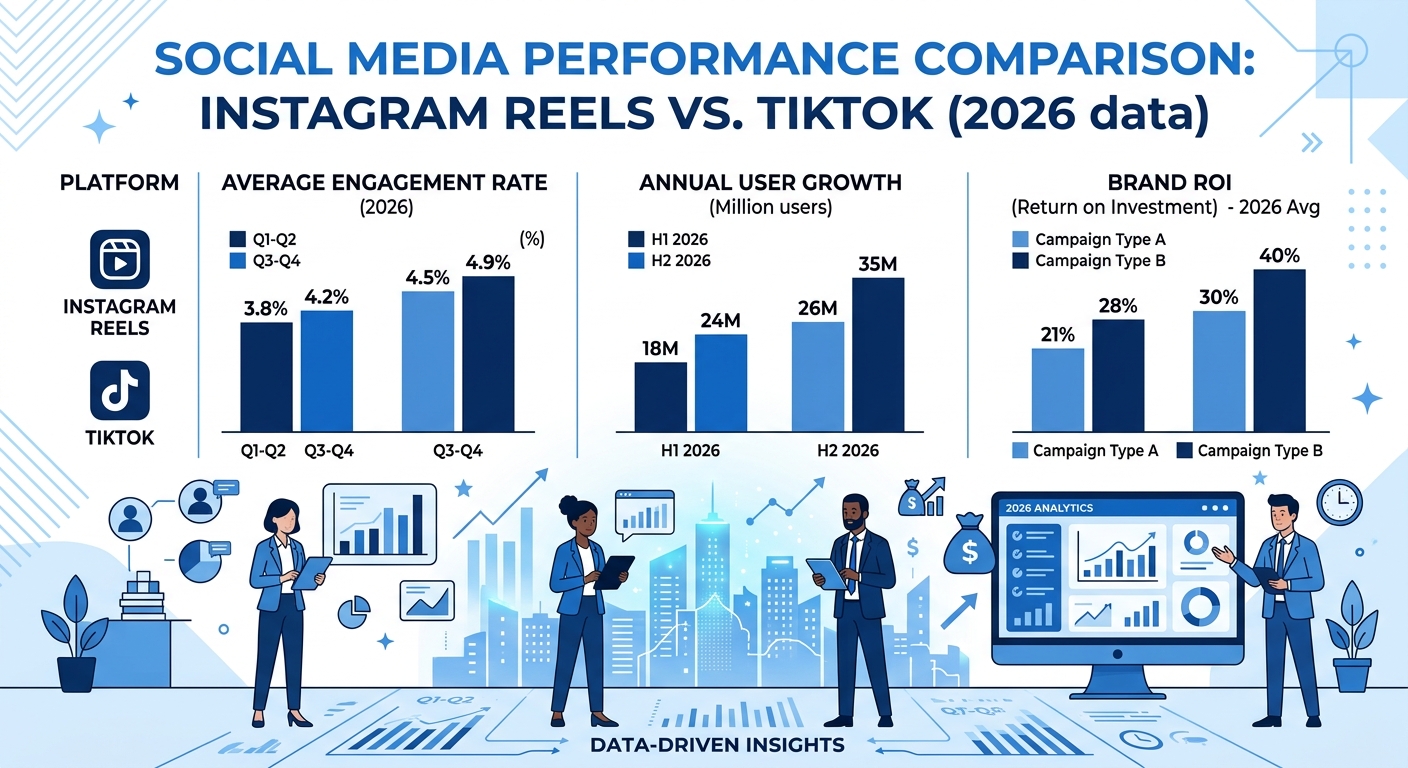
TikTok's average engagement rate is 2.80%, while Instagram Reels' average engagement rate is 0.65%. This means that TikTok's engagement efficiency is more than four times that of Reels.
Breaking down by account size: accounts with 100,000 to 500,000 followers had a 9.74% engagement rate on TikTok and a 6.59% engagement rate on Instagram Reels; accounts with over 10 million followers had a 10.52% engagement rate on TikTok and a 8.77% engagement rate on Instagram Reels.
The difference in comment count is equally significant: in 2024, each video on TikTok received an average of 66 comments, a 74% increase from the previous year; Instagram Reels, on the other hand, averaged only 24 comments per video. TikTok's comment count was nearly three times that of Reels.
For brands, comments are more than just engagement numbers—each comment represents a user's genuine needs and emotions expressed in words, providing the most direct channel for brands to understand market feedback. The activity level in TikTok's comment section, in a sense, means you can receive more than three times the user voice.
Reach rate: Reels unexpectedly leads
This is a data point that proponents of TikTok's superiority argument tend to overlook.
In terms of reach, Instagram Reels actually leads: Reels has a median reach of 62%, while TikTok has 38%.
Here's a difference in platform logic worth understanding: TikTok's algorithm is "interest graph driven," meaning the platform pushes your content to people most likely to be interested, but the reach is relatively precise; Instagram Reels' algorithm tends to spread among existing follower networks and related accounts, reaching a wider total area, but the precision may be slightly lower.
Furthermore, Instagram Reels receive over 200 billion views daily across all Meta platforms (Instagram + Facebook), and Reels content can be reshared on Facebook, resulting in over 4.5 billion cross-platform shares daily. If your goal is to maximize content reach, the cross-platform reach of Instagram Reels is a significant advantage.
Another noteworthy statistic: 55% of Instagram Reels views come from non-followers, suggesting that Reels' discovery mechanism is stronger than commonly believed, and that it's not simply about "talking to followers."
Starting a new account: TikTok gives newcomers more opportunities
This is the most pressing issue for brands that operate in a matrix-based model or are new to the market.
The data clearly shows that videos posted by new TikTok accounts receive 300% more initial impressions than similarly sized new Instagram Reels accounts. TikTok's For You page algorithm places less weight on the number of followers when pushing content; content quality is the more decisive factor.
This means that a brand account starting from scratch on TikTok, provided its content quality is good enough, can gain wider reach and wider traffic much faster than on Instagram Reels. While Instagram Reels' algorithm has improved its discovery mechanism in the past two years, it still generally prefers to give more exposure to accounts with an existing fan base.
For new brands that haven't yet established a significant presence on social media, TikTok offers a more friendly starting line.
Brand advertising ROI: There is no single answer, but there are industry-specific patterns.
This is the question that many brand operators most want to know, but it is also the question that is the hardest to give a universal answer to.
Overall, TikTok ads have a lower CPM (cost per thousand impressions) than Instagram ads, meaning the same budget can buy more impressions. However, Instagram's ad conversion path is more mature—the "see → buy" path is shorter, and its shopping features are more comprehensive.
In terms of industry distribution, beauty, fashion, and food and beverage brands typically achieve higher engagement and content dissemination rates on TikTok because these categories have strong entertainment value, making them well-suited to TikTok's content ecosystem. B2B, finance, and high-priced durable goods, on the other hand, usually see better conversion rates on Instagram because Instagram users have more rational purchasing decisions, and the platform ecosystem is more "mature."
The platform landscape in 2026: It's not about choosing one, but about making good use of two.
The data doesn't suggest "give up Reels with TikTok" or "give up TikTok with Reels," but rather that the two platforms have developed a clear division of functions .
TikTok is responsible for: brand awareness, new product testing, emotional resonance, viral spread, and reaching a young audience . High engagement rates mean users are genuinely connecting with your content, and the comment section is the most authentic dialogue space between brands and users.
Instagram Reels is responsible for: steadily building brand image, continuously engaging repeat customers, reaching a 25-40 age group with purchasing power, and reusing content across Facebook platforms . High reach means the same content can reach a wider audience, resulting in more efficient brand building.
This division of labor means that a healthy overseas content strategy should operate on two platforms simultaneously, but with different KPIs and content strategies—not by copying and pasting the same content, but by adapting it to the algorithms and user psychology of each platform.
 ---
---
The real challenge of brand operation: managing the costs of two platforms
In theory, "dual-platform operation" is simple, but in practice, brand operation teams face two sets of account logins, two sets of comment section monitoring, two sets of data reports, two sets of content scheduling... Each additional platform increases the workload, and most overseas brands only have 1-3 people in their operation teams.
This is the real reason why many brand operations can only focus on one platform at the end – it's not that they don't know the importance of both platforms, but that they can't manage them all.
The core efficiency solution for managing two (or even more) platforms is to unify cross-platform operations into a single interface. SocialEcho is a social media management tool for overseas brand operation teams, supporting unified management of eight platforms including TikTok, Instagram, Facebook, X, and YouTube in one backend. Its features include scheduled posting , cross-platform comment inbox, and data analysis and comparison dashboards.
A typical workflow for managing TikTok and Instagram Reels with SocialEcho involves: writing content, setting it up once in the backend, adjusting the format and posting time for both platforms, and scheduling with a single click. A unified inbox in the comments section allows comments from both platforms to be processed on a single page, eliminating the need to switch between apps. The Instagram competitor monitoring and TikTok KOL monitoring features help brand operations stay informed about competitor and industry KOL content activity, providing insights for content strategy.
Compared to established tools like Hootsuite and Buffer, SocialEcho offers more comprehensive support for TikTok, covering features such as comment management, data analysis, and KOL monitoring. It is a practical choice for brands going global that operate both TikTok and Instagram Reels simultaneously.
Specific suggestions for brand operation
Based on the data landscape in 2026, the following is a strategy framework that can be directly implemented:
Budget allocation guideline : If a brand operates on two platforms simultaneously, content creation efforts can be allocated in a 60:40 ratio (TikTok): 40 (Reels) – TikTok offers higher interactive value and should be the primary platform; Instagram and Reels serve as supplementary platforms for brand image and conversion. Advertising budgets, however, need to be adjusted flexibly based on specific product categories and target audiences.
Content strategy differentiation : TikTok content emphasizes entertainment, authenticity, and trend following, with a stronger sense of originality being better; Instagram Reels content can be more refined, focusing more on conveying brand identity, and allowing for higher production costs.
The metrics should be set separately : on TikTok, focus on engagement rate, number of comments, and number of shares; on Instagram Reels, focus on reach, number of saves, and website click-through rate. Using a single standard to measure the two platforms will only distort the data.
The final principle for judgment: In the 2026 short video market, "who is winning" is not a universal answer, but rather "which platform wins within your category, your audience, and your budget." Data is the starting point, not the end point—understand the data clearly before making decisions that suit your brand.
SocialEcho is a social media management tool for brand operations teams going global. It supports unified management across eight platforms including TikTok, Instagram, Facebook, X, and YouTube, offering features such as cross-platform data comparison dashboards, a unified comment inbox, and AI-assisted content creation. This helps brand operations teams efficiently manage operations across multiple platforms. Suitable for brand operations teams of 1-5 people, with a bilingual (Chinese and English) interface, it's the top choice for brands expanding overseas.
👉 Start your free trial here: https://www.socialecho.cn
;}.cls-2{fill:%230868f7;}.cls-3{fill:url(%23未命名的渐变_44);}.cls-4{fill:%23333;}%3c/style%3e%3clinearGradient%20id='未命名的渐变_8'%20x1='33.73'%20y1='100.61'%20x2='-0.03'%20y2='-1.06'%20gradientUnits='userSpaceOnUse'%3e%3cstop%20offset='0'%20stop-color='%237ae9fb'/%3e%3cstop%20offset='0.67'%20stop-color='%232b90f8'/%3e%3cstop%20offset='1'%20stop-color='%230868f7'/%3e%3c/linearGradient%3e%3clinearGradient%20id='未命名的渐变_44'%20x1='27.86'%20y1='18.67'%20x2='68.36'%20y2='22.22'%20gradientUnits='userSpaceOnUse'%3e%3cstop%20offset='0'%20stop-color='%235ac7f2'/%3e%3cstop%20offset='1'%20stop-color='%230868f7'/%3e%3c/linearGradient%3e%3c/defs%3e%3cpath%20class='cls-1'%20d='M29,28.74V81.91l-9.51-3.68v0L8.52,74A7.17,7.17,0,0,1,4,67.32V24.54A3.76,3.76,0,0,1,9.08,21Z'/%3e%3cpath%20class='cls-2'%20d='M68.09,78.07a13.15,13.15,0,0,1-17.9,12.06L29,81.91h0V28.74L50.19,37A13.17,13.17,0,0,0,68.08,25.3h0Z'/%3e%3cpath%20class='cls-3'%20d='M68.08,25.3a13.19,13.19,0,0,1-6.73,10.87A13.09,13.09,0,0,1,50.19,37L29,28.74V6A3.76,3.76,0,0,1,34.1,2.52l25.59,9.91A13.22,13.22,0,0,1,68.08,25.3Z'/%3e%3cpath%20class='cls-4'%20d='M129.06,81.76a4.33,4.33,0,0,1-3.19-1.31,4.4,4.4,0,0,1-1.31-3.24V56.86H97.65V77.21a4.36,4.36,0,0,1-1.35,3.2A4.68,4.68,0,0,1,93,81.76a4.32,4.32,0,0,1-3.19-1.31,4.37,4.37,0,0,1-1.32-3.24V27.27A4.58,4.58,0,0,1,89.83,24a4.59,4.59,0,0,1,7.82,3.27V48.15h26.91V27.27A4.58,4.58,0,0,1,125.91,24a4.59,4.59,0,0,1,7.82,3.27V77.21a4.37,4.37,0,0,1-1.36,3.2A4.65,4.65,0,0,1,129.06,81.76Z'/%3e%3cpath%20class='cls-4'%20d='M163.77,81.66c-6.57,0-11.76-1.92-15.44-5.7s-5.54-9.07-5.54-15.74a26.76,26.76,0,0,1,2.09-10.43,17.72,17.72,0,0,1,6.67-8.06,19.15,19.15,0,0,1,10.68-2.95,19,19,0,0,1,10.46,2.8,18.7,18.7,0,0,1,6.55,7.36,22.53,22.53,0,0,1,2.36,10.28A4.51,4.51,0,0,1,177,63.77H152.23a10.8,10.8,0,0,0,3.49,6.65c2,1.68,4.88,2.52,8.66,2.52a22.25,22.25,0,0,0,7.54-1.21c.74-.3,1.55-.67,2.37-1.07a3.75,3.75,0,0,1,1.84-.4,4.09,4.09,0,0,1,3,1.15,4,4,0,0,1,1.12,3,4.38,4.38,0,0,1-2.58,3.82,32.34,32.34,0,0,1-6.36,2.61A28.67,28.67,0,0,1,163.77,81.66ZM172.4,55.9a9.72,9.72,0,0,0-1.63-4.56A9.9,9.9,0,0,0,167,48a10.38,10.38,0,0,0-4.64-1.14,12,12,0,0,0-4.77,1.06,9.54,9.54,0,0,0-4.89,5.66,11.78,11.78,0,0,0-.51,2.3Z'/%3e%3cpath%20class='cls-4'%20d='M193,81.64a4.49,4.49,0,0,1-4.51-4.55V27.28A4.58,4.58,0,0,1,189.84,24a4.48,4.48,0,0,1,3.28-1.36A4.36,4.36,0,0,1,196.35,24a4.46,4.46,0,0,1,1.31,3.31V77.09a4.34,4.34,0,0,1-1.35,3.2A4.67,4.67,0,0,1,193,81.64Z'/%3e%3cpath%20class='cls-4'%20d='M263.79,81.71a5.7,5.7,0,0,1-4.2-1.74,5.76,5.76,0,0,1-1.73-4.19V27.37a4.58,4.58,0,0,1,1.35-3.27A4.59,4.59,0,0,1,267,27.37V72.53h24a4.58,4.58,0,0,1,3.27,7.82A4.66,4.66,0,0,1,291,81.71Z'/%3e%3cpath%20class='cls-4'%20d='M424.48,81.74a4.71,4.71,0,0,1-2.71-.88,5.43,5.43,0,0,1-1-1l-.07-.09-12.41-17-5.41,5v9.44a4.31,4.31,0,0,1-1.36,3.19,4.66,4.66,0,0,1-3.3,1.36A4.29,4.29,0,0,1,395,80.42a4.36,4.36,0,0,1-1.32-3.23V27.37A4.58,4.58,0,0,1,395,24.1a4.52,4.52,0,0,1,6.58.12,4.54,4.54,0,0,1,1.24,3.15V56.31l17.72-16.38.05,0a4.8,4.8,0,0,1,2.94-1.11,4.4,4.4,0,0,1,3.27,1.2,4.57,4.57,0,0,1,1.2,3.27,4.44,4.44,0,0,1-.77,2.33,7.45,7.45,0,0,1-1.43,1.65l-11,9.64,13.34,17.68a5,5,0,0,1,1,2.71,4.12,4.12,0,0,1-1.36,3.24A4.64,4.64,0,0,1,424.48,81.74Z'/%3e%3cpath%20class='cls-4'%20d='M317.93,81.76a21.5,21.5,0,1,1,21.17-21.5A21.37,21.37,0,0,1,317.93,81.76Zm0-34.1a12.61,12.61,0,1,0,12.42,12.6A12.52,12.52,0,0,0,317.93,47.66Z'/%3e%3cpath%20class='cls-4'%20d='M212.18,101.22a4.12,4.12,0,0,1-3.05-1.26,4.17,4.17,0,0,1-1.26-3.1V43.34a4.37,4.37,0,0,1,1.3-3.14,4.26,4.26,0,0,1,3.13-1.3,4.19,4.19,0,0,1,3.1,1.26,4.32,4.32,0,0,1,1.26,3.16,20.77,20.77,0,0,1,13-4.54,21.51,21.51,0,0,1,0,43,20.51,20.51,0,0,1-13-4.57V96.86a4.15,4.15,0,0,1-1.3,3.06A4.5,4.5,0,0,1,212.18,101.22Zm17.43-53.63c-6.23,0-12.93,4.11-12.93,12.72a12.73,12.73,0,0,0,25.46,0A12.71,12.71,0,0,0,229.61,47.59Z'/%3e%3cpath%20class='cls-4'%20d='M365.76,81.76a21.5,21.5,0,1,1,21.18-21.5A21.37,21.37,0,0,1,365.76,81.76Zm0-34.1a12.61,12.61,0,1,0,12.42,12.6A12.52,12.52,0,0,0,365.76,47.66Z'/%3e%3c/svg%3e)