
Which platform—Instagram, TikTok, or X—will see the fastest follower growth in 2026? A comparison of real-world data from matrix creators.
Which platform—Instagram, TikTok, or X—will see the fastest follower growth in 2026? A comparison of real-world data from matrix creators.
A message to creators who are constantly busy switching between multiple platforms: Three platforms, three logics, where should you invest your time?
What's it like to manage three platforms all by yourself?
Li Xiao is a matrix creator of beauty content, operating three accounts on Instagram, TikTok, and X.
Every morning, the first thing she does isn't washing her face, but grabbing her phone to check the backends of three platforms—how many views her videos posted yesterday had, whether she gained any new followers, and whether there were any price inquiries in the comments. Switching between the three apps repeatedly, recording the data in her notes, this process takes her about 40 minutes every day.
What troubled her even more was not the 40 minutes, but that she had no idea where to invest her time.
TikTok's algorithm is "brutal"; a video might go viral occasionally, but the next one could get zero views. Instagram's Reels have a higher engagement rate than Feed posts, but the activity level of existing followers is decreasing. Text content is the easiest for X, but after an occasional viral post, the follower conversion rate is negligible.
At the end of 2025, she made a decision: she could no longer devote all her efforts to the three platforms; she had to choose one to focus on. But the question was—which one?
This article aims to help her, and all creators facing the same dilemma, by providing a reference framework for judgment updated in 2026.
What changes occurred in the fundamentals of the three platforms in 2026?
TikTok: Major Adjustment to Recommendation Logic, "Time Cost" Increased
If you had a few viral videos on TikTok in 2024, you'll clearly feel in 2026 that content of the same quality is being pushed to higher-quality platforms more conservatively than before.
In late 2025, TikTok made a significant adjustment to its recommendation algorithm, shifting its core logic from "completion rate priority" to "interaction quality weighting"—comments, saves, and shares received increased weighting, while the initial push from pure views decreased. This change significantly impacted creators who relied solely on entertaining content to gain popularity, but it was actually a plus for niche accounts that could consistently drive discussion in the comments section.
Another change is that TikTok has started to reduce "bubble pushes" for new accounts, lengthening the cold start period. Anyone who has worked with matrix marketing knows that previously a new account could gain traction with just three posts, but now it takes at least 15-20 posts to see a clear signal.
Instagram: Search ranking fully upgraded, SEO value begins to materialize.
In Q4 of 2025, Instagram made a major update to its platform search algorithm—users can no longer rely solely on hashtags to find content, and the scope of keyword search has been greatly expanded, with words from Bio, Caption, and Reel captions now included in the index.
This means that for creators: previously, content on Instagram was mainly distributed to strangers through hashtags and algorithms. Now, with more users actively searching, the "search lifespan" of content has increased. A piece of content posted can continue to attract new followers through search even three months later.
However, there are also negative effects—the upgrade in search ranking means that the "content quality threshold" will be raised simultaneously, the algorithm's ability to identify the quality of copywriting will be enhanced, and the distribution of posts that rely solely on a large number of tags will decline.
▌X (Twitter): The window for Chinese content is actually quite narrow, but it has value in B2B scenarios.
In early 2026, X adjusted its streaming logic for non-English content, giving higher priority to content posted by English Premium subscribers. For Chinese creators, this meant that the path to gaining followers on X through regular accounts had significantly narrowed.
However, for creators who are going global, building B2B brands, or whose accounts are primarily in English, X still has unique value: it is currently the most effective platform for "building a professional persona." A tweet with a clear viewpoint that is retweeted by a big influencer can bring in hundreds of high-quality followers, an efficiency that has no counterpart on other platforms.
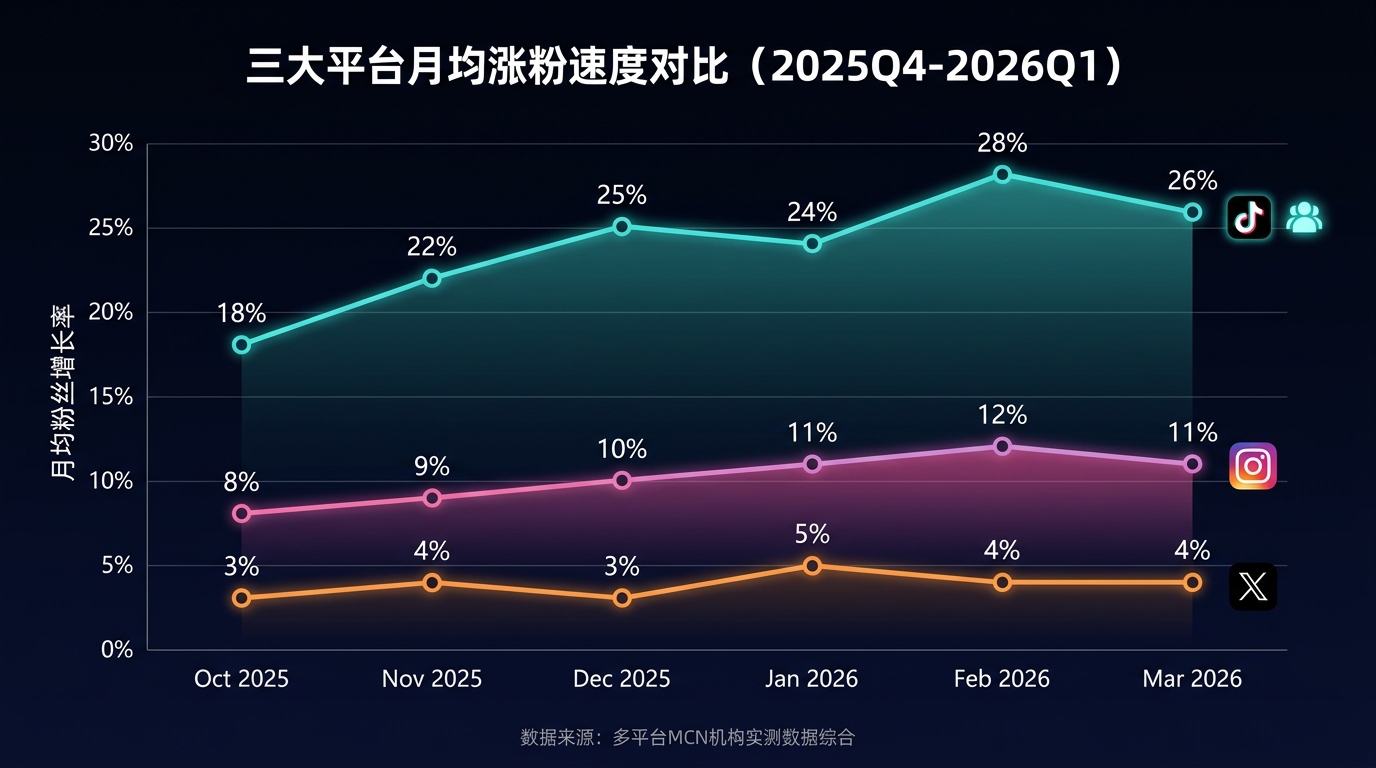
What do the follower growth data from the three platforms say over the same three months?
Here we refer to the average follower growth data of vertical content accounts with similar active update frequencies (3-5 posts per week) from Q4 2025 to Q1 2026 (approximately 90 days). The data source combines user account sampling analysis on the SocialEcho platform with cross-comparison of multiple publicly available content marketing reports.
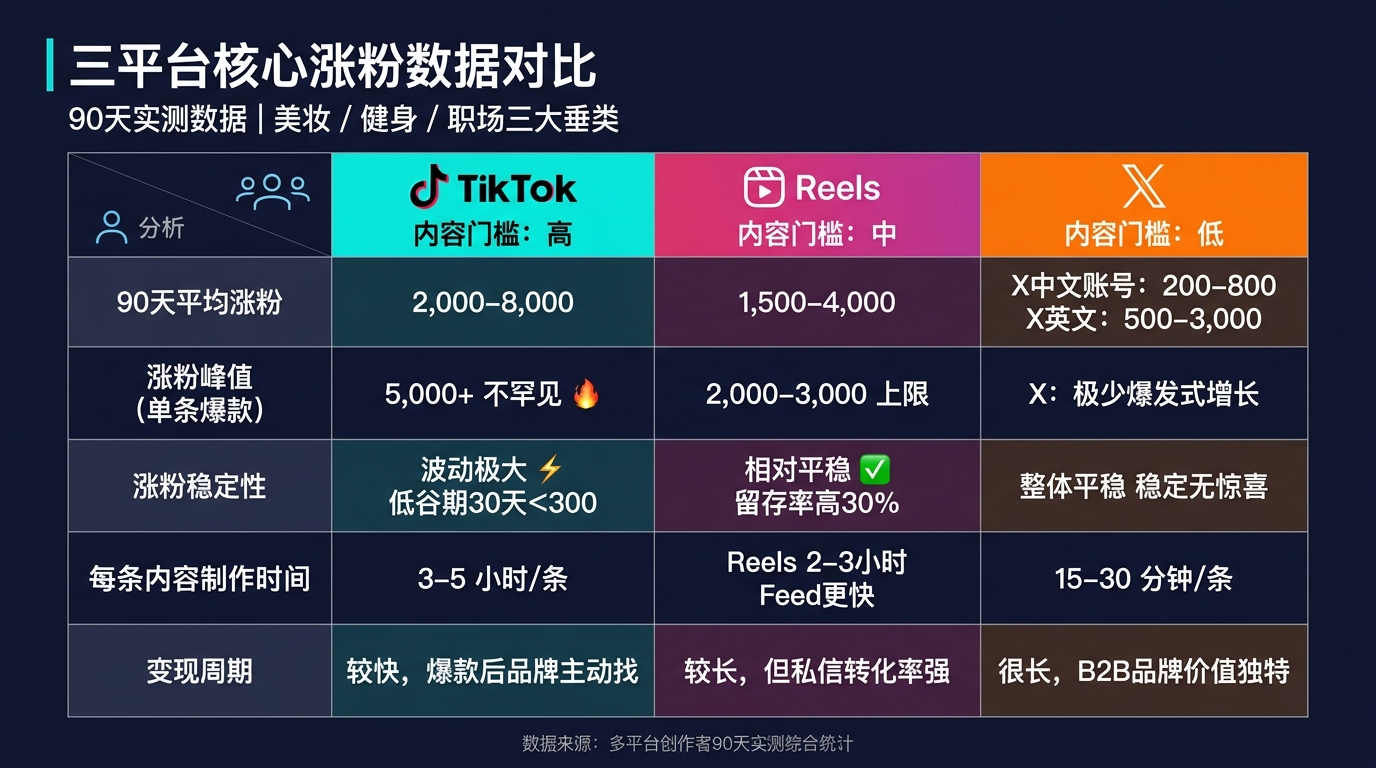
TikTok (Content creation threshold: high)
- Average follower growth in 90 days: 2,000–8,000
- Peak follower growth: It's not uncommon for a single viral video to gain 5,000+ followers.
- Follower growth stability: Extremely volatile; during low periods, the number of followers may be less than 300 in 30 days.
- Content production time: 3–5 hours per video (full edit) on average
- Monetization cycle: Relatively fast; brands actively seek out products after they become bestsellers.
Instagram Reels (Content creation threshold: Medium)
- Average follower growth in 90 days: 1,500–4,000 (Reels account)
- Peak follower growth: 2,000–3,000 followers for a single viral post, but the upper limit is lower than TikTok.
- Follower growth stability: Relatively stable, with a retention rate approximately 30% higher after following compared to TikTok.
- Content creation time: Reels take approximately 2–3 hours per post, Feed posts are faster.
- Monetization cycle: longer, but fan loyalty is higher, and the conversion rate for inquiries via private messages is stronger.
X (Content creation barrier: low)
- Average follower growth in 90 days (Chinese account): 200–800
- Average follower growth in 90 days (English-language overseas accounts): 500–3,000
- Follower growth stability: Overall stable, with very few explosive growth events.
- Content creation time: 15–30 minutes per tweet
- Monetization cycle: very long, but unique to B2B brand value.
The "Who is it suitable for" judgment matrix of the three platforms
Looking solely at the number of new followers leads to a very limited conclusion. More importantly, the ROI for different types of creators varies drastically across the three platforms.
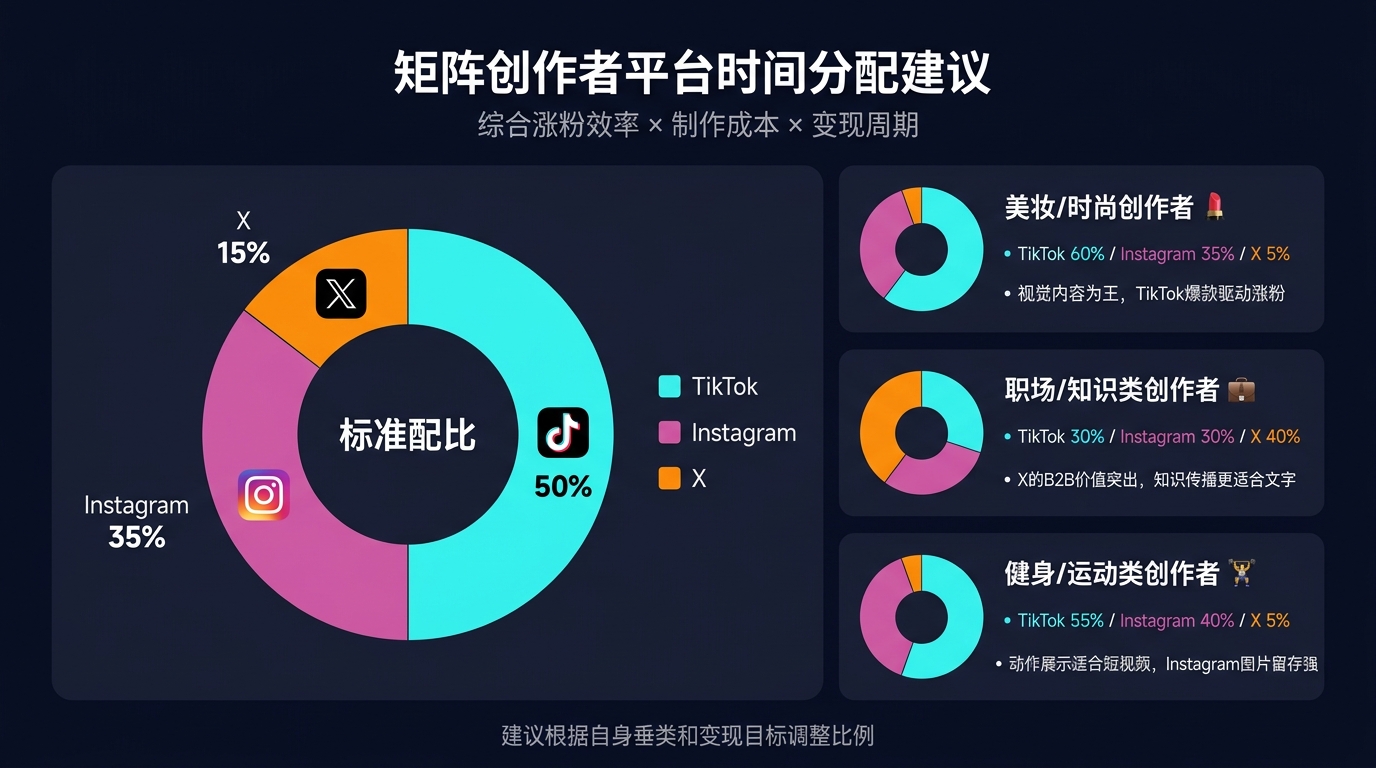
If you're a content creator in the beauty, fashion, fitness, or other general entertainment sectors , TikTok is your primary battleground—though unstable, its ability to generate viral content and drive conversions through brand collaborations is unparalleled. Instagram serves as your secondary battleground, responsible for building your fanbase and securing image/text advertising collaborations. The ROI of Instagram is negligible for this type of account unless you have a clear intention to expand into English-language markets overseas.
If you're a content creator focusing on professional/business/entrepreneurial knowledge , Instagram's increased search ranking is actually beneficial—your text content is more likely to be found by users actively searching. TikTok's audience is younger, and the path to monetizing knowledge is more complex. On X, it's possible to build high-quality industry connections through long posts like Thread, which is suitable for front-end traffic generation in B2B businesses.
If you are a brand expanding overseas, a cross-border e-commerce seller, or a content creator producing English content , you need to re-evaluate the logic behind these three platforms. TikTok Shop's rapid expansion in the US has made it a core platform for integrating brand building and sales performance, while X's English tweets remain irreplaceable for brands expanding overseas to establish industry influence. Instagram, as a showcase for text and image content, is suitable for building brand image.
If you're a multi-platform creator managing five or more accounts , the issue isn't "which platform is best," but rather "how to maintain basic activity across three platforms with minimal time investment, while focusing your main efforts on the fastest-growing one." In this case, efficient cross-platform data comparison tools are crucial—you need to be able to see the data from all three platforms at a glance instead of logging into three different apps, and quickly identify which content is suitable for "multiple publications from the same source."
From Data to Execution: A Cross-Platform Strategy for Matrix Creators
The biggest pitfall in operating across multiple platforms is not content quality, but the waste of creative energy due to repetitive work .
A video that performs well on TikTok can be posted on Instagram Reels after adjusting the subtitles and cover. The core message can be extracted into 2-3 tweets and posted on X. This process seems simple, but in reality, the manual operation every day consumes a lot of the creator's time, and it is easy to forget the format differences (for example, the 9:16 vertical cover of TikTok will be distorted in the Instagram Feed, and the long tweet of X cannot be fully displayed in the comment section of TikTok).
Anyone who has been operating a platform for more than six months knows that content distribution is not just about "copying and pasting," but rather "creating once and adapting multiple times." This adaptation cost is the real reason why most multi-platform creators eventually give up operating on multiple platforms.
The efficient solution is to transform the "distribution + adaptation" process from manual to a systematic workflow. SocialEcho's one-click multi-platform publishing supports differentiated format adjustments for different platforms, eliminating the need to repeatedly log into three backends—you complete content editing and platform adaptation on one interface, set the publishing time, and let the system handle the rest.
At the data level, SocialEcho's data analytics supports aggregating account data from three platforms into a single dashboard. Fan growth, engagement rates, and content performance can be viewed daily, eliminating the need for manual comparisons between the three apps—you can instantly see which platform generated the most content this week.
Our prediction for 2026: Bet on TikTok, but don't abandon the long-term value of Instagram.
If you could only bet on one platform, the 2026 data points to TikTok—its follower growth rate has the highest ceiling, and its viral content mechanism remains the least biased among the three platforms. A new account gaining 10,000 followers from zero with a single post is still possible on TikTok, difficult on Instagram, and virtually impossible on X.
However, "betting on TikTok" does not mean "abandoning Instagram." Instagram's 2026 search ranking upgrade means that the content you post this year will continue to generate traffic next year—this long-tail effect is something TikTok lacks. The ideal strategy for a mature matrix creator is: TikTok is responsible for scale growth, Instagram is responsible for follower retention and long-tail search, and X is responsible for B2B persona and front-end traffic generation for overseas brands.
The resource allocation ratios for the three platforms will differ depending on the type of content and the stage of the account – this is exactly what account data comparison and analysis can help you with: using data to tell you which platform your account is most efficient at gaining followers, instead of guessing based on feelings.
Weekly time allocation suggestions for 3 platforms
Finally, here's a specific suggestion for creators who are already operating on multiple platforms but feel their energy is scattered:
A week's content creation work shouldn't start with "what to post," but rather with "which platform performed best last week." Let data drive your creative focus, rather than allocating time based on gut feeling.
The workflow can be designed as follows: On Monday, compare the platform data from the previous Wednesday to determine which platform's original content should be prioritized this week; on Wednesday, complete the original video for the main platform and simultaneously organize the adapted versions for other platforms; on Friday, schedule the release in a unified manner and set the content for all platforms this week.
The core of this process is to transform the "management of three platforms" into "the output of a single workflow," rather than three separate tasks.
SocialEcho's unified multi-account management and AI-automated interaction are designed around this workflow. If you want to transform multi-platform operations from "time-consuming chores" into a "sustainable growth system," you can try it out for free first.
👉 Try SocialEcho for free now and experience intelligent multi-account management → https://www.socialecho.net
;}.cls-2{fill:%230868f7;}.cls-3{fill:url(%23未命名的渐变_44);}.cls-4{fill:%23333;}%3c/style%3e%3clinearGradient%20id='未命名的渐变_8'%20x1='33.73'%20y1='100.61'%20x2='-0.03'%20y2='-1.06'%20gradientUnits='userSpaceOnUse'%3e%3cstop%20offset='0'%20stop-color='%237ae9fb'/%3e%3cstop%20offset='0.67'%20stop-color='%232b90f8'/%3e%3cstop%20offset='1'%20stop-color='%230868f7'/%3e%3c/linearGradient%3e%3clinearGradient%20id='未命名的渐变_44'%20x1='27.86'%20y1='18.67'%20x2='68.36'%20y2='22.22'%20gradientUnits='userSpaceOnUse'%3e%3cstop%20offset='0'%20stop-color='%235ac7f2'/%3e%3cstop%20offset='1'%20stop-color='%230868f7'/%3e%3c/linearGradient%3e%3c/defs%3e%3cpath%20class='cls-1'%20d='M29,28.74V81.91l-9.51-3.68v0L8.52,74A7.17,7.17,0,0,1,4,67.32V24.54A3.76,3.76,0,0,1,9.08,21Z'/%3e%3cpath%20class='cls-2'%20d='M68.09,78.07a13.15,13.15,0,0,1-17.9,12.06L29,81.91h0V28.74L50.19,37A13.17,13.17,0,0,0,68.08,25.3h0Z'/%3e%3cpath%20class='cls-3'%20d='M68.08,25.3a13.19,13.19,0,0,1-6.73,10.87A13.09,13.09,0,0,1,50.19,37L29,28.74V6A3.76,3.76,0,0,1,34.1,2.52l25.59,9.91A13.22,13.22,0,0,1,68.08,25.3Z'/%3e%3cpath%20class='cls-4'%20d='M129.06,81.76a4.33,4.33,0,0,1-3.19-1.31,4.4,4.4,0,0,1-1.31-3.24V56.86H97.65V77.21a4.36,4.36,0,0,1-1.35,3.2A4.68,4.68,0,0,1,93,81.76a4.32,4.32,0,0,1-3.19-1.31,4.37,4.37,0,0,1-1.32-3.24V27.27A4.58,4.58,0,0,1,89.83,24a4.59,4.59,0,0,1,7.82,3.27V48.15h26.91V27.27A4.58,4.58,0,0,1,125.91,24a4.59,4.59,0,0,1,7.82,3.27V77.21a4.37,4.37,0,0,1-1.36,3.2A4.65,4.65,0,0,1,129.06,81.76Z'/%3e%3cpath%20class='cls-4'%20d='M163.77,81.66c-6.57,0-11.76-1.92-15.44-5.7s-5.54-9.07-5.54-15.74a26.76,26.76,0,0,1,2.09-10.43,17.72,17.72,0,0,1,6.67-8.06,19.15,19.15,0,0,1,10.68-2.95,19,19,0,0,1,10.46,2.8,18.7,18.7,0,0,1,6.55,7.36,22.53,22.53,0,0,1,2.36,10.28A4.51,4.51,0,0,1,177,63.77H152.23a10.8,10.8,0,0,0,3.49,6.65c2,1.68,4.88,2.52,8.66,2.52a22.25,22.25,0,0,0,7.54-1.21c.74-.3,1.55-.67,2.37-1.07a3.75,3.75,0,0,1,1.84-.4,4.09,4.09,0,0,1,3,1.15,4,4,0,0,1,1.12,3,4.38,4.38,0,0,1-2.58,3.82,32.34,32.34,0,0,1-6.36,2.61A28.67,28.67,0,0,1,163.77,81.66ZM172.4,55.9a9.72,9.72,0,0,0-1.63-4.56A9.9,9.9,0,0,0,167,48a10.38,10.38,0,0,0-4.64-1.14,12,12,0,0,0-4.77,1.06,9.54,9.54,0,0,0-4.89,5.66,11.78,11.78,0,0,0-.51,2.3Z'/%3e%3cpath%20class='cls-4'%20d='M193,81.64a4.49,4.49,0,0,1-4.51-4.55V27.28A4.58,4.58,0,0,1,189.84,24a4.48,4.48,0,0,1,3.28-1.36A4.36,4.36,0,0,1,196.35,24a4.46,4.46,0,0,1,1.31,3.31V77.09a4.34,4.34,0,0,1-1.35,3.2A4.67,4.67,0,0,1,193,81.64Z'/%3e%3cpath%20class='cls-4'%20d='M263.79,81.71a5.7,5.7,0,0,1-4.2-1.74,5.76,5.76,0,0,1-1.73-4.19V27.37a4.58,4.58,0,0,1,1.35-3.27A4.59,4.59,0,0,1,267,27.37V72.53h24a4.58,4.58,0,0,1,3.27,7.82A4.66,4.66,0,0,1,291,81.71Z'/%3e%3cpath%20class='cls-4'%20d='M424.48,81.74a4.71,4.71,0,0,1-2.71-.88,5.43,5.43,0,0,1-1-1l-.07-.09-12.41-17-5.41,5v9.44a4.31,4.31,0,0,1-1.36,3.19,4.66,4.66,0,0,1-3.3,1.36A4.29,4.29,0,0,1,395,80.42a4.36,4.36,0,0,1-1.32-3.23V27.37A4.58,4.58,0,0,1,395,24.1a4.52,4.52,0,0,1,6.58.12,4.54,4.54,0,0,1,1.24,3.15V56.31l17.72-16.38.05,0a4.8,4.8,0,0,1,2.94-1.11,4.4,4.4,0,0,1,3.27,1.2,4.57,4.57,0,0,1,1.2,3.27,4.44,4.44,0,0,1-.77,2.33,7.45,7.45,0,0,1-1.43,1.65l-11,9.64,13.34,17.68a5,5,0,0,1,1,2.71,4.12,4.12,0,0,1-1.36,3.24A4.64,4.64,0,0,1,424.48,81.74Z'/%3e%3cpath%20class='cls-4'%20d='M317.93,81.76a21.5,21.5,0,1,1,21.17-21.5A21.37,21.37,0,0,1,317.93,81.76Zm0-34.1a12.61,12.61,0,1,0,12.42,12.6A12.52,12.52,0,0,0,317.93,47.66Z'/%3e%3cpath%20class='cls-4'%20d='M212.18,101.22a4.12,4.12,0,0,1-3.05-1.26,4.17,4.17,0,0,1-1.26-3.1V43.34a4.37,4.37,0,0,1,1.3-3.14,4.26,4.26,0,0,1,3.13-1.3,4.19,4.19,0,0,1,3.1,1.26,4.32,4.32,0,0,1,1.26,3.16,20.77,20.77,0,0,1,13-4.54,21.51,21.51,0,0,1,0,43,20.51,20.51,0,0,1-13-4.57V96.86a4.15,4.15,0,0,1-1.3,3.06A4.5,4.5,0,0,1,212.18,101.22Zm17.43-53.63c-6.23,0-12.93,4.11-12.93,12.72a12.73,12.73,0,0,0,25.46,0A12.71,12.71,0,0,0,229.61,47.59Z'/%3e%3cpath%20class='cls-4'%20d='M365.76,81.76a21.5,21.5,0,1,1,21.18-21.5A21.37,21.37,0,0,1,365.76,81.76Zm0-34.1a12.61,12.61,0,1,0,12.42,12.6A12.52,12.52,0,0,0,365.76,47.66Z'/%3e%3c/svg%3e)