
Instagram vs TikTok for Brands in 2026: Which Platform Should You Bet On?
Instagram vs TikTok: Where Should Your Brand Put Its Money in 2026? (Data-Backed)
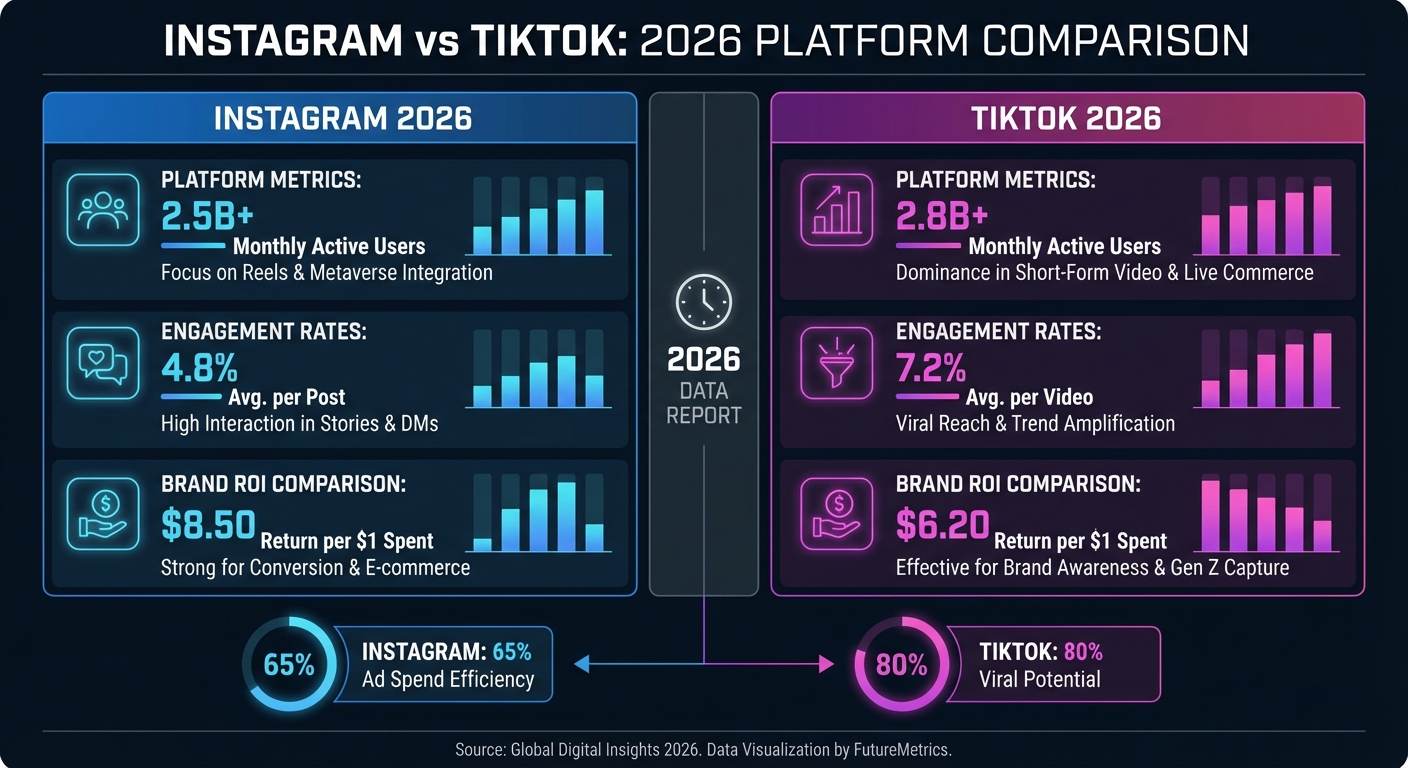
End of last year, a social media agency friend told me: he'd cut a beauty brand's content budget completely from Instagram and gone all-in on TikTok. The result? Impressions tripled in the first month — but sales conversion rate dropped by half.
His post-mortem: "I chased traffic, but lost the buyer."
Instagram vs TikTok isn't a "which is better" multiple-choice question — it's a strategic judgment call about what stage your brand is at and what problem you're trying to solve.
The competitive landscape between these two platforms in 2026 is more nuanced than ever before — and worth a serious deep dive.
Two Platforms, Two Fundamentally Different Traffic Logics
Let's start with the most fundamental point: these two platforms operate on completely different algorithmic systems, which means the same piece of content can have radically different outcomes on each.
TikTok: Interest Graph-Driven Distribution
TikTok distributes content primarily through an "interest graph," not social relationships. After you post a video, the platform pushes it to a small cold pool (typically 1,000–3,000 users), watches their completion rate and engagement rate; if performance is good, it expands to a larger pool.
The upside: new accounts can blow up, and a small following doesn't mean no reach. A zero-follower account, with content that hits the right interest signals, can get 100,000+ views on a single video.
The tradeoff: each piece of content is like entering a new lottery. Going viral once doesn't mean the next one will too. Follower count has far less influence on individual post reach than on Instagram.
Instagram: Social Relationship-Weighted Recommendations
Instagram has Reels, but its overall logic leans more toward social relationships. Follows, saves, and dense engagement — these signals keep the platform distributing your content to more relevant users.
The upside: the longer the account exists, the more stable the reach. Once a follower base is established, new content has a more guaranteed baseline reach, and brand equity can compound.
The tradeoff: harder to cold-start, longer runway for new accounts to gain traffic, requiring more content accumulation over time.
Practical implication for brand marketing: If your brand is new to the market and needs to build awareness fast, TikTok's interest-graph recommendation mechanism makes it easier to get off the ground; if your brand already has a follower base and wants stable community maintenance, Instagram's relationship-weighted mechanism is better suited for long-term operations.
Audience Profile: Where Are Your Buyers?
TikTok 2026 Audience Profile
Ages 18–34 make up over 60% of the user base, with 18–24 being the most actively engaging group. Users' primary use case is "entertainment and leisure" — the TikTok mindset is closer to "just browsing around" — meaning they're more easily exposed to new products, but the decision path is longer. From seeing to buying typically requires multiple touchpoints.
Instagram 2026 Audience Profile
Ages 25–44 are the primary demographic, with overall users having higher purchasing power and greater purchase decision maturity. Especially in North American and European markets, Instagram users' average order value acceptance is markedly higher than TikTok. The ongoing development of the "Shop" feature has made conversion paths on Instagram significantly smoother than two years ago.
A practical decision framework: Does your product sell for over $50? Is your target customer a working adult aged 25+? If both answers are yes, Instagram's user quality is friendlier to your brand. If you're selling fast-moving consumer goods for younger audiences, or a category that depends on visual impact to drive impulse purchases, TikTok is the smoother path.
Content Format: Which Platform Suits Your Content Capabilities?
A question operations colleagues always ask: our team isn't good at shooting video — does that mean we can only do Instagram images?
This question is already outdated by 2026. Both platforms are video-first, but differ in style and production threshold.
TikTok's content ecosystem has higher tolerance — vertical video, handheld shooting, bare-faced clips, real-life documentation — these styles actually perform better on TikTok. Highly polished brand ad spots sometimes underperform a raw, authentic "I'm using this product" video.
Instagram Reels' content, overall, has a higher aesthetic bar. Users have stronger "brand feel" expectations around image quality, composition, and typography. A low-res video on Instagram might not get clicks, but the same content on TikTok might actually score points for "authenticity."
For teams with limited content resources, there's a practical choice: build your content production rhythm on TikTok first — lower production costs, faster feedback loop — quickly validating which topic categories have market resonance; then take the proven hit topics from TikTok and repurpose them for Instagram with higher production quality, reducing the cost of content trial and error.

Conversion Pathways: Which Platform Has Better ROI?
There's no universal answer here, but a concrete reference framework:
TikTok Conversion Pathway
TikTok Shop's GMV numbers in Southeast Asia are impressive, but direct purchase behavior maturity in Western markets still lags Instagram. More brands currently choose the "TikTok seeding + independent site conversion" path — using TikTok's traffic to build awareness, then driving to branded sites for purchase.
This path's advantage is low traffic cost, but the funnel is longer, with higher demands on user tracking and attribution.
Instagram Conversion Pathway
Instagram Shopping's product tag feature has dramatically shortened the "see-to-buy" path. Combined with Stories' "swipe up to shop" and direct product tagging in posts, Western market brands generally report cleaner order attribution from Instagram.
Additionally, Instagram's DM commerce is something TikTok currently can't match. High-value users inquiring about pricing or requesting samples via Instagram DM is a major conversion method for many B2B and high-ticket product categories.
A key data reference: Based on actual data from multiple agencies, with equal ad spend, Instagram's CPA (cost per acquisition) in Western markets is typically lower than TikTok's, but TikTok's CPM (cost per thousand impressions) is lower — TikTok is better for mass awareness, Instagram for precision conversion.
It's Not Either/Or — It's Division of Labor
After all this comparison, you might wonder: so which platform is better?
The answer: brands doing well in 2026 aren't "choosing one."
Their strategy: TikTok as the traffic funnel, Instagram as brand equity accumulation. TikTok content emphasizes fast, authentic, explosive; Instagram content emphasizes polished, curated, long-term relationship building. Both platforms have completely different content rhythms and styles, but complement each other — TikTok's new traffic converts into loyal followers through sustained Instagram operations.
This naturally requires running both platforms simultaneously, which demands more from content teams. Using scheduling features, you can create once and distribute with platform-specific customization to both, with content automatically adapting to each platform's format requirements, reducing redundant work. Use analytics to monitor content performance on both platforms simultaneously, enabling real-time resource allocation decisions.
Specific Recommendations for Brands in 2026
If your brand is currently on only one platform, here are recommendations by category:
The following categories should prioritize TikTok: FMCG, cosmetics and makeup, food and beverage, fashion/accessories for younger audiences, apps, gaming and entertainment content. TikTok's entertainment-driven recommendation mechanism makes these categories more likely to trigger impulse purchases.
The following categories should prioritize Instagram: Home décor and furniture, high-ticket apparel, jewelry and accessories, B2B services, premium food, photography and creative services. Instagram's visual community attributes and user base with higher purchasing power make it better suited for these categories' brand tone.
The following scenarios warrant simultaneous presence on both: Brand already has some content production capacity and targets users spanning multiple age groups; or brand is in early market entry and needs to quickly validate which markets and audience segments respond better.
Final Word
Your competitors are probably already running both platforms simultaneously.
Not because they have more people — but because they have the right tools to make one person fully capable of managing two platforms.
Related features: Instagram Multi-Account Management · TikTok Multi-Account Management · Facebook Multi-Account Management · X/Twitter Management
Try SocialEcho free — run Instagram and TikTok simultaneously from one backend →
👉 https://www.socialecho.net
;}.cls-2{fill:%230868f7;}.cls-3{fill:url(%23未命名的渐变_44);}.cls-4{fill:%23333;}%3c/style%3e%3clinearGradient%20id='未命名的渐变_8'%20x1='33.73'%20y1='100.61'%20x2='-0.03'%20y2='-1.06'%20gradientUnits='userSpaceOnUse'%3e%3cstop%20offset='0'%20stop-color='%237ae9fb'/%3e%3cstop%20offset='0.67'%20stop-color='%232b90f8'/%3e%3cstop%20offset='1'%20stop-color='%230868f7'/%3e%3c/linearGradient%3e%3clinearGradient%20id='未命名的渐变_44'%20x1='27.86'%20y1='18.67'%20x2='68.36'%20y2='22.22'%20gradientUnits='userSpaceOnUse'%3e%3cstop%20offset='0'%20stop-color='%235ac7f2'/%3e%3cstop%20offset='1'%20stop-color='%230868f7'/%3e%3c/linearGradient%3e%3c/defs%3e%3cpath%20class='cls-1'%20d='M29,28.74V81.91l-9.51-3.68v0L8.52,74A7.17,7.17,0,0,1,4,67.32V24.54A3.76,3.76,0,0,1,9.08,21Z'/%3e%3cpath%20class='cls-2'%20d='M68.09,78.07a13.15,13.15,0,0,1-17.9,12.06L29,81.91h0V28.74L50.19,37A13.17,13.17,0,0,0,68.08,25.3h0Z'/%3e%3cpath%20class='cls-3'%20d='M68.08,25.3a13.19,13.19,0,0,1-6.73,10.87A13.09,13.09,0,0,1,50.19,37L29,28.74V6A3.76,3.76,0,0,1,34.1,2.52l25.59,9.91A13.22,13.22,0,0,1,68.08,25.3Z'/%3e%3cpath%20class='cls-4'%20d='M129.06,81.76a4.33,4.33,0,0,1-3.19-1.31,4.4,4.4,0,0,1-1.31-3.24V56.86H97.65V77.21a4.36,4.36,0,0,1-1.35,3.2A4.68,4.68,0,0,1,93,81.76a4.32,4.32,0,0,1-3.19-1.31,4.37,4.37,0,0,1-1.32-3.24V27.27A4.58,4.58,0,0,1,89.83,24a4.59,4.59,0,0,1,7.82,3.27V48.15h26.91V27.27A4.58,4.58,0,0,1,125.91,24a4.59,4.59,0,0,1,7.82,3.27V77.21a4.37,4.37,0,0,1-1.36,3.2A4.65,4.65,0,0,1,129.06,81.76Z'/%3e%3cpath%20class='cls-4'%20d='M163.77,81.66c-6.57,0-11.76-1.92-15.44-5.7s-5.54-9.07-5.54-15.74a26.76,26.76,0,0,1,2.09-10.43,17.72,17.72,0,0,1,6.67-8.06,19.15,19.15,0,0,1,10.68-2.95,19,19,0,0,1,10.46,2.8,18.7,18.7,0,0,1,6.55,7.36,22.53,22.53,0,0,1,2.36,10.28A4.51,4.51,0,0,1,177,63.77H152.23a10.8,10.8,0,0,0,3.49,6.65c2,1.68,4.88,2.52,8.66,2.52a22.25,22.25,0,0,0,7.54-1.21c.74-.3,1.55-.67,2.37-1.07a3.75,3.75,0,0,1,1.84-.4,4.09,4.09,0,0,1,3,1.15,4,4,0,0,1,1.12,3,4.38,4.38,0,0,1-2.58,3.82,32.34,32.34,0,0,1-6.36,2.61A28.67,28.67,0,0,1,163.77,81.66ZM172.4,55.9a9.72,9.72,0,0,0-1.63-4.56A9.9,9.9,0,0,0,167,48a10.38,10.38,0,0,0-4.64-1.14,12,12,0,0,0-4.77,1.06,9.54,9.54,0,0,0-4.89,5.66,11.78,11.78,0,0,0-.51,2.3Z'/%3e%3cpath%20class='cls-4'%20d='M193,81.64a4.49,4.49,0,0,1-4.51-4.55V27.28A4.58,4.58,0,0,1,189.84,24a4.48,4.48,0,0,1,3.28-1.36A4.36,4.36,0,0,1,196.35,24a4.46,4.46,0,0,1,1.31,3.31V77.09a4.34,4.34,0,0,1-1.35,3.2A4.67,4.67,0,0,1,193,81.64Z'/%3e%3cpath%20class='cls-4'%20d='M263.79,81.71a5.7,5.7,0,0,1-4.2-1.74,5.76,5.76,0,0,1-1.73-4.19V27.37a4.58,4.58,0,0,1,1.35-3.27A4.59,4.59,0,0,1,267,27.37V72.53h24a4.58,4.58,0,0,1,3.27,7.82A4.66,4.66,0,0,1,291,81.71Z'/%3e%3cpath%20class='cls-4'%20d='M424.48,81.74a4.71,4.71,0,0,1-2.71-.88,5.43,5.43,0,0,1-1-1l-.07-.09-12.41-17-5.41,5v9.44a4.31,4.31,0,0,1-1.36,3.19,4.66,4.66,0,0,1-3.3,1.36A4.29,4.29,0,0,1,395,80.42a4.36,4.36,0,0,1-1.32-3.23V27.37A4.58,4.58,0,0,1,395,24.1a4.52,4.52,0,0,1,6.58.12,4.54,4.54,0,0,1,1.24,3.15V56.31l17.72-16.38.05,0a4.8,4.8,0,0,1,2.94-1.11,4.4,4.4,0,0,1,3.27,1.2,4.57,4.57,0,0,1,1.2,3.27,4.44,4.44,0,0,1-.77,2.33,7.45,7.45,0,0,1-1.43,1.65l-11,9.64,13.34,17.68a5,5,0,0,1,1,2.71,4.12,4.12,0,0,1-1.36,3.24A4.64,4.64,0,0,1,424.48,81.74Z'/%3e%3cpath%20class='cls-4'%20d='M317.93,81.76a21.5,21.5,0,1,1,21.17-21.5A21.37,21.37,0,0,1,317.93,81.76Zm0-34.1a12.61,12.61,0,1,0,12.42,12.6A12.52,12.52,0,0,0,317.93,47.66Z'/%3e%3cpath%20class='cls-4'%20d='M212.18,101.22a4.12,4.12,0,0,1-3.05-1.26,4.17,4.17,0,0,1-1.26-3.1V43.34a4.37,4.37,0,0,1,1.3-3.14,4.26,4.26,0,0,1,3.13-1.3,4.19,4.19,0,0,1,3.1,1.26,4.32,4.32,0,0,1,1.26,3.16,20.77,20.77,0,0,1,13-4.54,21.51,21.51,0,0,1,0,43,20.51,20.51,0,0,1-13-4.57V96.86a4.15,4.15,0,0,1-1.3,3.06A4.5,4.5,0,0,1,212.18,101.22Zm17.43-53.63c-6.23,0-12.93,4.11-12.93,12.72a12.73,12.73,0,0,0,25.46,0A12.71,12.71,0,0,0,229.61,47.59Z'/%3e%3cpath%20class='cls-4'%20d='M365.76,81.76a21.5,21.5,0,1,1,21.18-21.5A21.37,21.37,0,0,1,365.76,81.76Zm0-34.1a12.61,12.61,0,1,0,12.42,12.6A12.52,12.52,0,0,0,365.76,47.66Z'/%3e%3c/svg%3e)