
Go from 0 to 100 accounts in just 4 weeks! This matrix account setup SOP is worth millions.
I. Why is it necessary to create a matrix number in 2026?
If you're still relying on a single account to operate your social media, you've already lost at the starting line.
In 2026, the ceiling for social media traffic will be very clear: 500,000 monthly impressions for a single account is the limit, while a matrix of accounts can easily break through 5 million+. More importantly, a matrix of accounts is not as simple as "opening more accounts", but a complete system engineering project.
Data doesn't lie:
- Single account operation: 500,000 monthly exposures, 500-1000 new followers.
- Matrix account operation: 5 million+ monthly exposure, 5,000-10,000 new followers
- Risk Comparison: Single account ban = total wipeout; Matrix account ban = manageable losses
100 accounts sounds like an exaggeration? Actually, no. With a complete SOP, suitable tools, and a clear division of labor, setting up 100 accounts from scratch can be completed within one month.
Value of this article:
- Complete SOP: The entire process from equipment preparation to data optimization
- Avoidance Guide: Common Issues such as Device Association, Content Homogenization, and Batch Operations
- Tool Recommendation: How to efficiently manage 100 accounts using SocialEcho
If you are an agency, e-commerce team, MCN agency, or any team that needs to scale up social media operations, this article will be your practical guide.
II. Core Logic of Matrix Account Operation
Before you start building, make sure you understand the underlying logic of the matrix number.
2.1 Definition and Classification of Matrix Numbers
Matrix accounts are not simply "multiple accounts," but rather an account system with a clear division of labor:
Main account: Brand Image Representative
- Positioning: Official brand account, providing high-quality content.
- Content: In-depth insights, industry perspectives, brand stories
- Objectives: Fan base building, brand awareness, and trust endorsement
- Posting frequency: 2-3 posts per week
Smaller: Traffic Distributor
- Positioning: Vertical niche market, testing content direction
- Content: Lightweight content, trending topics, quick tests
- Objectives: Traffic acquisition, topic selection verification, and multi-entry point layout
- Posting frequency: 1-2 posts per day
Amateur account: Trust endorsement
- Positioning: Real user perspective, word-of-mouth marketing
- Content: Real experiences, user feedback, and everyday life sharing
- Objectives: Authentic interaction, word-of-mouth marketing, and reduced marketing feel.
- Posting frequency: 1-2 posts per week
2.2 The Core Value of Matrix Number
Risk diversification: A single account ban does not affect the overall system. Even if the main account is banned, secondary accounts and amateur accounts can still operate normally, and traffic will not plummet.
Multi-entry point layout: covering different user groups. The main account attracts professional users, secondary accounts attract general traffic users, and ordinary accounts attract real users, forming a three-dimensional coverage.
Content testing: Validate topic selection directions at low cost. Quickly test topics on secondary accounts, and then further develop content that performs well on the main account, avoiding wasted resources.
2.3 Common Matrix Number Layout Patterns
Vertical domain matrix: suitable for niche markets such as beauty, maternal and infant products, and technology. The main account focuses on professional content, while the secondary accounts cover niche scenarios (e.g., "main beauty account + secondary lipstick account + secondary skincare account + secondary makeup account").
Broad Traffic Matrix: Suitable for popular content such as comedy, emotions, and lifestyle. The main account builds a brand persona, while secondary accounts produce broad traffic content in bulk, quickly acquiring traffic.
Hybrid matrix: Main account specializing in vertical fields, secondary accounts attracting general traffic, and ordinary accounts providing genuine endorsements. This is the most common and effective model.
III. Building a complete SOP for 100 accounts from scratch
Here comes the key point. This is the core of the entire article, and the practical guide you need most.
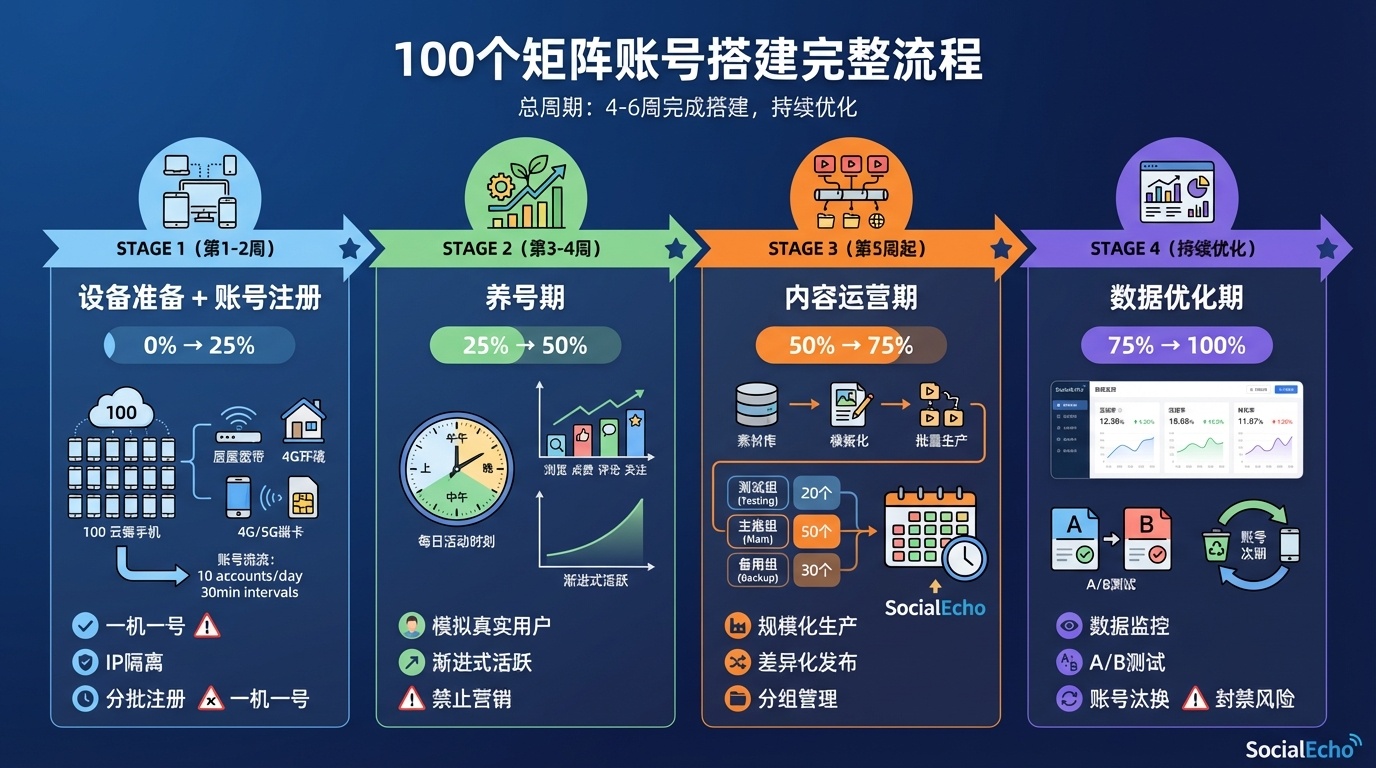
Phase 1: Account Preparation Period (Weeks 1-2)
3.1 Equipment and Environmental Preparation
The principle of one device, one account is an ironclad rule. The platform's risk control system will detect device fingerprints, IP addresses, and operational behaviors. If multiple accounts use the same device or IP address, it will be judged as batch operation, and traffic will be directly limited or even banned.
Option A: Purchase a used mobile phone
- Cost: 100-200 yuan/unit
- Advantages: Stable and reliable, completely isolated
- Disadvantages: High cost and complicated management (100 mobile phones require dedicated equipment for management)
Option B: Cloud Phone Rental
- Cost: 50-80 yuan/month/unit
- Advantages: Controllable cost, no physical equipment required.
- Disadvantages: Stability depends on the service provider; some platforms may detect a virtual environment.
IP environment setup:
- Static IP: Stable but expensive (suitable for the main account). You can purchase a dedicated IP or use home broadband.
- Dynamic IP: Low cost but requires frequent switching (suitable for smaller accounts). 4G/5G data SIM cards can be used, and the IP address changes each time you log in.
- Recommended plan: Home broadband (main account) + 4G/5G data SIM card (secondary account) + Duoplus account isolation (all accounts)
3.2 Account Registration Strategy
The core principle of batch registration: take your time, don't rush.
The platform's risk control system monitors registration behavior. If a large number of accounts are registered in a short period of time, it will be judged as abnormal behavior and the accounts will be banned directly.
Frequency control:
- Register no more than 10 accounts per day
- Each account registration must be spaced at least 30 minutes apart.
- Register in batches, completing 100 accounts over 10-15 days.
Information differentiation:
- Name: Use your real name or a common name to avoid obviously mass-produced accounts like "Test 1" or "Test 2".
- Profile Picture: Use different real photos to avoid using the same image or the default profile picture.
- Introduction: Each account's introduction is different; please avoid copying and pasting.
Mobile phone number resources:
- Carrier-registered SIM cards: High cost but stable, suitable for primary phone numbers
- Virtual phone numbers: low cost but high risk; some platforms do not support virtual phone number registration.
- Recommendation: SIM card registered under a real name with a major carrier (main number) + virtual number segment (secondary number)
Batch processing of real-name authentication:
- Prepare your identity information in advance (through compliant channels; do not use illegally purchased identity information).
- Authentication is conducted in batches to avoid centralized operations.
- Record account information: Create a table mapping "Account - Mobile Number - Password" and manage it using Excel or a professional tool.
Key reminder: Account registration is the foundation of the entire account matrix setup; do not rush it. It's better to be slower than to get banned by the platform for bulk registration.
Phase Two: Account Nurturing Period (Weeks 3-4)
After registering an account, do not post content immediately. Nurturing the account is a crucial step in operating a matrix of accounts, directly determining the account's initial traffic and health.
3.3 Core Principles of Account Nurturing
Simulating real user behavior: The platform's algorithm determines whether an account is from a genuine user. If an account posts marketing content immediately after registration, it will be flagged as a marketing account and its traffic will be restricted.
Gradually increase activity level:
- Week 1: Low-frequency interaction (view 10-15 pieces of content per day, like 3-5 times)
- Week 2: Medium-frequency interaction (view 20-25 pieces of content per day, like 5-8 times, comment 1-2 times)
- Week 3: Normal frequency (30 posts per day, 10 likes, 2-3 comments, 3-5 accounts followed)
3.4 Daily Account Maintenance SOP
| operate | frequency | Duration | Precautions |
|---|---|---|---|
| Browse content | 20-30 items/day | 5-10 minutes | Read the entire video; do not scroll quickly. |
| Like | 5-10 times/day | - | Like different types of content |
| collect | 2-3 times/day | - | Collect high-quality content |
| focus on | 3-5 per day | - | Follow accounts in the same field |
| Comment | 1-2 times/day | - | Genuine reviews, avoid copy-pasting. |
Time allocation during the account nurturing period:
- 7-9 AM: Browse 10 posts and like 3 times
- 12 PM - 2 PM: Browse 10 posts, like 3 times, comment 1 time
- 7 PM - 10 PM: Browse 10 posts, like 4 times, comment once, and follow 2-3 accounts.
3.5 List of Prohibited Behaviors During Account Farming Period
- ❌ Avoid frequently switching accounts (with intervals of at least 30 minutes).
- ❌ Bulk liking/following (will be identified as bot activity)
- ❌ Do not publish marketing content (during the account nurturing period, only interact and do not publish).
- ❌ Using third-party tools to automate operations (will be detected).
- ❌ Doing operations on all accounts at the same time (will be considered batch operation)
3.6 Criteria for Judging Account Nurturing Effectiveness
How can I tell if my account nurturing process has been successful?
✅Account Health: Able to post content normally, unlimited streaming notifications, no abnormal alerts.
✅Initial Traffic: First post views > 200 (Douyin) / Impressions > 500 (Xiaohongshu) / Reads > 100 (WeChat Channel)
✅Interaction is normal: Users can like, comment, and send private messages without any operational restrictions.
If the data for the first post is below the above standard, it means the account nurturing is inadequate and needs to continue for another 1-2 weeks.
Phase 3: Content Operation Period (Starting from Week 5)
Once the account has been nurtured, you can begin official operation. The core of content operation is: large-scale production + differentiated release.
3.7 Setting up a content production pipeline
Resource library construction:
- Topic pool: Prepare 100 topic options, categorized by platform (Douyin topics, Xiaohongshu topics, Video Account topics).
- Copywriting library: Prepare 50 best-selling copywriting templates, categorized by type (opening templates, conflict point templates, CTA templates).
- Resource Library: Prepare 1000+ image/video resources, categorized by theme (product resources, scene resources, emotion resources).
Content templated:
The formula for creating a viral hit: The first 3 seconds (attract attention) + Conflict point (create suspense) + Solution (provide value) + CTA (guide action)
For example:
- The first three seconds: "Did you know? 90% of people are using this feature incorrectly!"
- Point of conflict: "Many people believe XXX, but the truth is just wishful thinking."
- Solution: "The correct procedure is: Step 1... Step 2... Step 3..."
- CTA: "Follow me for daily tips and tricks on XXX."
Batch editing tools:
- CapCut Pro: Supports batch import of materials, batch addition of subtitles, music, and effects.
- Batch Export in Premiere Pro: Generate Videos in Batches Using Templates
- Use SocialEcho's multi-account management feature to batch upload content to different accounts.
Content differentiation strategy:
- The same topic, approached from different angles: The topic "How to improve work efficiency" can be approached from different angles such as tools, methods, and mindset.
- Same material, different copywriting: The same video clip, paired with different copywriting and music, creates different content.
- The same account uses a mix of different content types: practical tips, case studies, stories, and interactive elements to avoid monotony.
3.8 Release Strategy
Content differentiation across multiple accounts:
- Main account: In-depth content, 2-3 posts per week (e.g., "5000-word in-depth article: How to build a matrix of accounts from scratch")
- Small account: Lightweight content, 1-2 posts per day (e.g., "Teach you a matrix account technique in 3 minutes")
- Amateur accounts: Authentic sharing, 1-2 posts per week (e.g., "I used a matrix of accounts to grow my followers from 0 to 100,000 in 3 months").
Release time matrix:
- Staggered releases: Avoid releasing at the same time period, as this will be judged as batch operations.
- Prime working hours: 7-9 AM (commuting to work), 12-2 PM (lunch break), 7-10 PM (after work)
- Use SocialEcho's scheduled publishing feature: batch set publishing times for automatic publishing without manual intervention.
Release frequency control:
- New account: Post 1 message per day for 7 days (to establish a posting habit)
- Mature accounts: 2-3 posts per day (stable output)
- Test account: 3-5 posts per day (quickly test topic selection direction)
3.9 Account Group Management
Test group (20 accounts): Quickly test topic selection directions; content with good data is replicated in the main group.
Main team (50 accounts): Consistently produces high-quality content and undertakes the main task of acquiring traffic.
Backup group (30 accounts): To mitigate the risk of account bans, and can be activated at any time.
Using SocialEcho for group management:
- Grouped by platform: Douyin group, Xiaohongshu group, WeChat Channels group
- Grouped by project: Project A, Project B, Project C
- Grouped by phase: Account nurturing period, operation period, optimization period
The advantages of group management are: different operational strategies can be developed for different groups, allowing for flexible adjustments and efficient management.
Phase Four: Data Optimization Period (Ongoing)
Data is the compass for Matrix Account operations. Without data monitoring, it's like the blind men and the elephant.
3.10 Data Monitoring System
Definition of core indicators:
- Interaction rate = (Likes + Comments + Favorites) / Views (a measure of content quality)
- Completion rate = Number of complete views / Number of plays (a measure of content appeal)
- Conversion rate = Number of followers / Number of views (a measure of account attractiveness)
Multi-account data comparison and analysis:
- Horizontal comparison: Data performance of different accounts on the same topic (identifying the best-performing account)
- Longitudinal comparison: Data changes of the same account over different periods (identifying growth trends)
- Use SocialEcho data dashboards : centrally monitor all accounts for a clear overview.
3.11 Content Optimization Strategy
Low data account diagnostics:
- Low play count: Check the title, cover image, and the first 3 seconds (are they engaging?)
- Low completion rate: Check the pacing and duration of the content (is it dragging?).
- Low engagement rate: Check the content value and CTA design (does it guide you to engage with the content)
Replication and iteration of viral content:
- Extract the key elements of a viral hit (topic selection + structure + copywriting + materials)
- Copy the verification to other accounts (at least 10 accounts).
- Continuous iterative optimization (A/B testing of different variables)
A/B testing execution method:
- Test variables: title, cover, opening, duration (test only one variable at a time).
- Test accounts: At least 10 accounts should be tested simultaneously (sufficient sample size).
- Testing period: 3-7 days to draw conclusions (to avoid randomness).
3.12 Account Replacement Mechanism
Low-quality account identification criteria:
- 10 consecutive posts viewed
- Accounts are subject to traffic restrictions or account demotion.
- Warning issued for content violation
Handling of risky accounts:
- Stop publishing immediately
- Appeal reinstated (if appeal is possible)
- Enable backup account
Continuous strategy to add new accounts:
- 10-20 new accounts per month
- Maintain dynamic balance of the account pool
- Survival of the fittest, continuous optimization
IV. Common Problems and Avoidance Guidelines for Matrix Account Operation
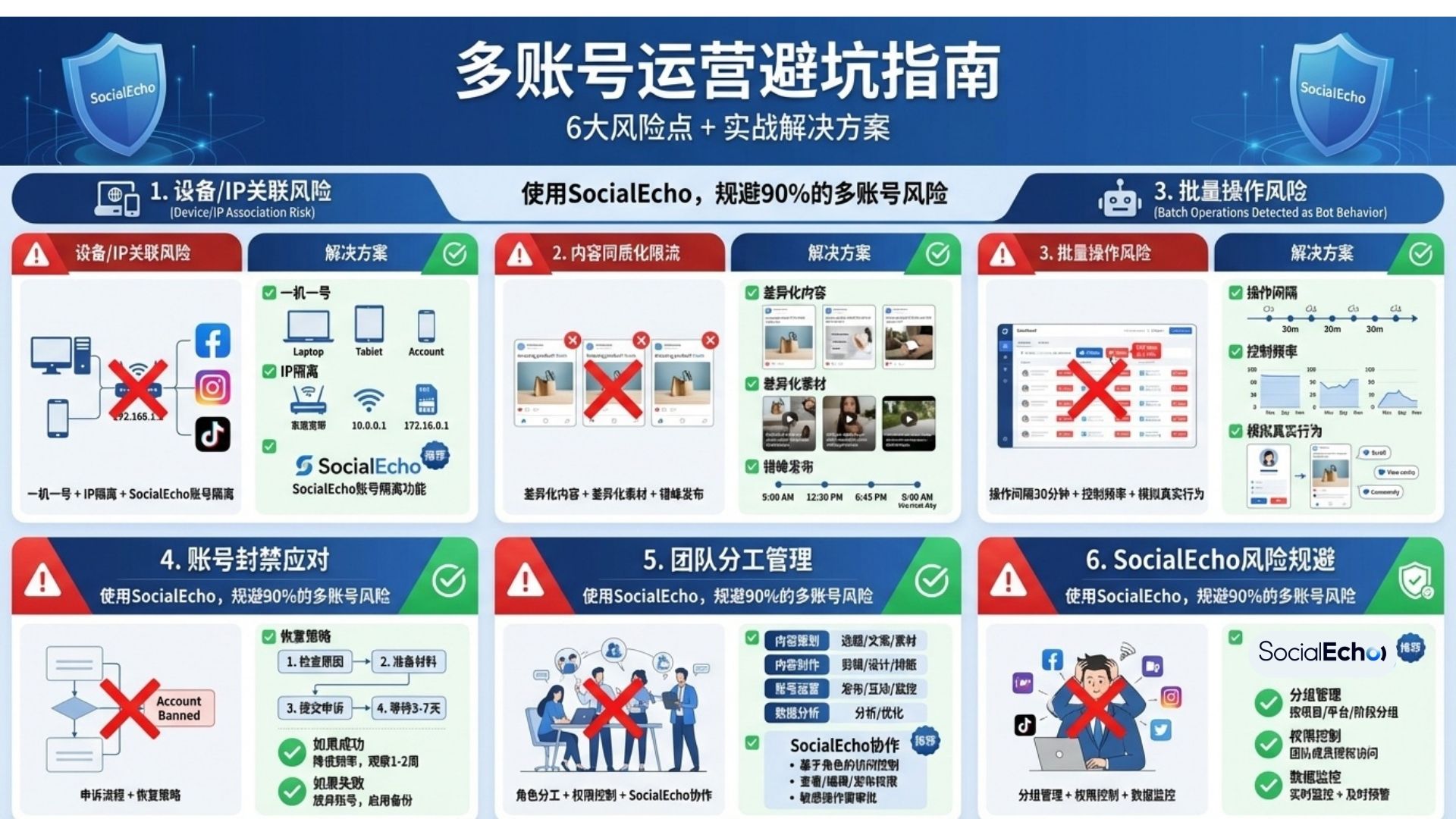
4.1 Device/IP Association Risks and Mitigation Methods
Problem: Multiple accounts using the same device/IP are identified by the platform as batch operations.
Avoidance methods:
- Log in using different devices (one device, one account)
- Using different IP addresses (home broadband + data SIM card)
- Use SocialEcho's account isolation feature (recommended, lowest cost).
4.2 Content homogenization leads to traffic throttling issues
Problem: Multiple accounts posting similar content are flagged as plagiarism.
Avoidance methods:
- Content Differentiation: Different Angles on the Same Topic
- Material Differentiation: Different Materials, Different Copywriting
- Timing differentiation: staggered release
4.3 Batch operations are judged as machine behavior.
Problem: Restriction on mass liking/following/commenting within a short period of time
Avoidance methods:
- Operation interval: at least 30 minutes between each operation.
- Operation frequency: The number of operations per day shall not exceed the platform limit.
- Simulate real-world behavior: Avoid operating at fixed times or frequencies.
4.4 Appeals and Reinstatement after Account Ban
Appeal process:
- Check the reason for the ban (violation of rules, unusual behavior, etc.).
- Prepare appeal materials (account information, content description)
- Submit an appeal (Platform customer service, appeal portal)
- Awaiting review (3-7 business days)
Recovery strategy:
- If the appeal is successful: reduce the frequency of posting and observe for 1-2 weeks.
- If the appeal fails: abandon this account and start a backup account.
4.5 Suggestions for Team Division of Labor and Access Control
Role division:
- Content planning: Responsible for topic selection, copywriting, and material preparation.
- Content creation: Responsible for editing, design, and layout.
- Account Operations: Responsible for posting, interaction, and data monitoring.
- Data Analysis: Responsible for data analysis and optimization suggestions.
Access control:
- Use SocialEcho's team collaboration features
- Different roles are assigned different permissions (view/edit/publish).
- Sensitive operations require approval (deleting an account, changing a password).
4.6 Methods to mitigate the risks of multiple accounts using SocialEcho
- Group management: Flexible grouping by project/platform/phase
- Access control: Team members can only access authorized accounts.
- Data monitoring: Real-time monitoring of account health and timely alerts.
V. How to manage 100 accounts using SocialEcho
If you manually manage 100 accounts, you'll spend 2-3 hours a day just logging in. Not to mention content posting, data monitoring, and team collaboration.
That's why you need a professional multi-account management tool.
5.1 Introduction to SocialEcho's Core Multi-Account Management Functions
One-click login for 100+ accounts:
- No need to switch frequently, manage all accounts with one interface
- Supports mainstream platforms such as Douyin, Xiaohongshu, WeChat Video, and Kuaishou.
- Account information is stored in encrypted form, ensuring security and reliability.
Account group management:
- Grouped by platform: Douyin group, Xiaohongshu group, WeChat Channels group
- Grouped by project: Project A, Project B, Project C
- Grouped by phase: Account nurturing period, operation period, optimization period
- Flexible switching, efficient management
Centralized Data Dashboard:
- Monitor the performance of all accounts in real time (views, engagement rate, follower growth).
- Multi-account data comparison and analysis
- Automatic alerts for abnormal accounts
Team collaboration permission management:
- Different roles are assigned different permissions (view/edit/publish).
- Operation logs are recorded, and responsibility can be traced.
- Sensitive operations require approval; security is controllable.
5.2 Typical Use Cases
Outsourcing agencies: Implement isolated management of multiple client accounts to avoid confusion.
E-commerce team: Multi-store account matrix operation, unified management
MCN agencies: Batch management of influencer accounts, centralized data monitoring
5.3 Experience it now
VI. Conclusion: Matrix accounts are an inevitable trend in social media operations.
Key takeaways:
- Matrix account operation is a must for social media operations in 2025.
- Setting up 100 accounts is a feasible and systematic project.
- Complete SOP: Preparation Phase → Account Nurturing Phase → Operation Phase → Optimization Phase
Feasibility summary:
- Cost-controllable: Cloud phone rental + SocialEcho tool, single account cost
- Risks are manageable: Account isolation + content differentiation + data monitoring, resulting in a low ban rate.
- Promising Results: Risk of Traffic Diversification + Multi-Entry Strategy + Scalable Growth, 5 Million+ Monthly Exposures
Action recommendations:
- Start with a small-scale verification (10-20 accounts).
- After successfully implementing the Standard Operating Procedure (SOP), scale up operations (50-100 accounts).
- Continuous optimization and iteration to form our own methodology
Looking to the future:
Matrix accounts are an inevitable trend in social media operations. The era of single-account operation is over; scaling, systematization, and tool-based approaches are the future direction.
SocialEcho helps businesses efficiently manage multiple accounts and achieve scalable growth.
Start now and build your matrix account system!
About SocialEcho:
SocialEcho is a professional social media management tool that supports multi-account management, content publishing, data analysis, team collaboration, and other functions. It has served over 1000 enterprise clients and managed over 100,000 social media accounts.
;}.cls-2{fill:%230868f7;}.cls-3{fill:url(%23未命名的渐变_44);}.cls-4{fill:%23333;}%3c/style%3e%3clinearGradient%20id='未命名的渐变_8'%20x1='33.73'%20y1='100.61'%20x2='-0.03'%20y2='-1.06'%20gradientUnits='userSpaceOnUse'%3e%3cstop%20offset='0'%20stop-color='%237ae9fb'/%3e%3cstop%20offset='0.67'%20stop-color='%232b90f8'/%3e%3cstop%20offset='1'%20stop-color='%230868f7'/%3e%3c/linearGradient%3e%3clinearGradient%20id='未命名的渐变_44'%20x1='27.86'%20y1='18.67'%20x2='68.36'%20y2='22.22'%20gradientUnits='userSpaceOnUse'%3e%3cstop%20offset='0'%20stop-color='%235ac7f2'/%3e%3cstop%20offset='1'%20stop-color='%230868f7'/%3e%3c/linearGradient%3e%3c/defs%3e%3cpath%20class='cls-1'%20d='M29,28.74V81.91l-9.51-3.68v0L8.52,74A7.17,7.17,0,0,1,4,67.32V24.54A3.76,3.76,0,0,1,9.08,21Z'/%3e%3cpath%20class='cls-2'%20d='M68.09,78.07a13.15,13.15,0,0,1-17.9,12.06L29,81.91h0V28.74L50.19,37A13.17,13.17,0,0,0,68.08,25.3h0Z'/%3e%3cpath%20class='cls-3'%20d='M68.08,25.3a13.19,13.19,0,0,1-6.73,10.87A13.09,13.09,0,0,1,50.19,37L29,28.74V6A3.76,3.76,0,0,1,34.1,2.52l25.59,9.91A13.22,13.22,0,0,1,68.08,25.3Z'/%3e%3cpath%20class='cls-4'%20d='M129.06,81.76a4.33,4.33,0,0,1-3.19-1.31,4.4,4.4,0,0,1-1.31-3.24V56.86H97.65V77.21a4.36,4.36,0,0,1-1.35,3.2A4.68,4.68,0,0,1,93,81.76a4.32,4.32,0,0,1-3.19-1.31,4.37,4.37,0,0,1-1.32-3.24V27.27A4.58,4.58,0,0,1,89.83,24a4.59,4.59,0,0,1,7.82,3.27V48.15h26.91V27.27A4.58,4.58,0,0,1,125.91,24a4.59,4.59,0,0,1,7.82,3.27V77.21a4.37,4.37,0,0,1-1.36,3.2A4.65,4.65,0,0,1,129.06,81.76Z'/%3e%3cpath%20class='cls-4'%20d='M163.77,81.66c-6.57,0-11.76-1.92-15.44-5.7s-5.54-9.07-5.54-15.74a26.76,26.76,0,0,1,2.09-10.43,17.72,17.72,0,0,1,6.67-8.06,19.15,19.15,0,0,1,10.68-2.95,19,19,0,0,1,10.46,2.8,18.7,18.7,0,0,1,6.55,7.36,22.53,22.53,0,0,1,2.36,10.28A4.51,4.51,0,0,1,177,63.77H152.23a10.8,10.8,0,0,0,3.49,6.65c2,1.68,4.88,2.52,8.66,2.52a22.25,22.25,0,0,0,7.54-1.21c.74-.3,1.55-.67,2.37-1.07a3.75,3.75,0,0,1,1.84-.4,4.09,4.09,0,0,1,3,1.15,4,4,0,0,1,1.12,3,4.38,4.38,0,0,1-2.58,3.82,32.34,32.34,0,0,1-6.36,2.61A28.67,28.67,0,0,1,163.77,81.66ZM172.4,55.9a9.72,9.72,0,0,0-1.63-4.56A9.9,9.9,0,0,0,167,48a10.38,10.38,0,0,0-4.64-1.14,12,12,0,0,0-4.77,1.06,9.54,9.54,0,0,0-4.89,5.66,11.78,11.78,0,0,0-.51,2.3Z'/%3e%3cpath%20class='cls-4'%20d='M193,81.64a4.49,4.49,0,0,1-4.51-4.55V27.28A4.58,4.58,0,0,1,189.84,24a4.48,4.48,0,0,1,3.28-1.36A4.36,4.36,0,0,1,196.35,24a4.46,4.46,0,0,1,1.31,3.31V77.09a4.34,4.34,0,0,1-1.35,3.2A4.67,4.67,0,0,1,193,81.64Z'/%3e%3cpath%20class='cls-4'%20d='M263.79,81.71a5.7,5.7,0,0,1-4.2-1.74,5.76,5.76,0,0,1-1.73-4.19V27.37a4.58,4.58,0,0,1,1.35-3.27A4.59,4.59,0,0,1,267,27.37V72.53h24a4.58,4.58,0,0,1,3.27,7.82A4.66,4.66,0,0,1,291,81.71Z'/%3e%3cpath%20class='cls-4'%20d='M424.48,81.74a4.71,4.71,0,0,1-2.71-.88,5.43,5.43,0,0,1-1-1l-.07-.09-12.41-17-5.41,5v9.44a4.31,4.31,0,0,1-1.36,3.19,4.66,4.66,0,0,1-3.3,1.36A4.29,4.29,0,0,1,395,80.42a4.36,4.36,0,0,1-1.32-3.23V27.37A4.58,4.58,0,0,1,395,24.1a4.52,4.52,0,0,1,6.58.12,4.54,4.54,0,0,1,1.24,3.15V56.31l17.72-16.38.05,0a4.8,4.8,0,0,1,2.94-1.11,4.4,4.4,0,0,1,3.27,1.2,4.57,4.57,0,0,1,1.2,3.27,4.44,4.44,0,0,1-.77,2.33,7.45,7.45,0,0,1-1.43,1.65l-11,9.64,13.34,17.68a5,5,0,0,1,1,2.71,4.12,4.12,0,0,1-1.36,3.24A4.64,4.64,0,0,1,424.48,81.74Z'/%3e%3cpath%20class='cls-4'%20d='M317.93,81.76a21.5,21.5,0,1,1,21.17-21.5A21.37,21.37,0,0,1,317.93,81.76Zm0-34.1a12.61,12.61,0,1,0,12.42,12.6A12.52,12.52,0,0,0,317.93,47.66Z'/%3e%3cpath%20class='cls-4'%20d='M212.18,101.22a4.12,4.12,0,0,1-3.05-1.26,4.17,4.17,0,0,1-1.26-3.1V43.34a4.37,4.37,0,0,1,1.3-3.14,4.26,4.26,0,0,1,3.13-1.3,4.19,4.19,0,0,1,3.1,1.26,4.32,4.32,0,0,1,1.26,3.16,20.77,20.77,0,0,1,13-4.54,21.51,21.51,0,0,1,0,43,20.51,20.51,0,0,1-13-4.57V96.86a4.15,4.15,0,0,1-1.3,3.06A4.5,4.5,0,0,1,212.18,101.22Zm17.43-53.63c-6.23,0-12.93,4.11-12.93,12.72a12.73,12.73,0,0,0,25.46,0A12.71,12.71,0,0,0,229.61,47.59Z'/%3e%3cpath%20class='cls-4'%20d='M365.76,81.76a21.5,21.5,0,1,1,21.18-21.5A21.37,21.37,0,0,1,365.76,81.76Zm0-34.1a12.61,12.61,0,1,0,12.42,12.6A12.52,12.52,0,0,0,365.76,47.66Z'/%3e%3c/svg%3e)