
Matrix account private message management: How many of the missed direct mail messages each day are high-intent customers?
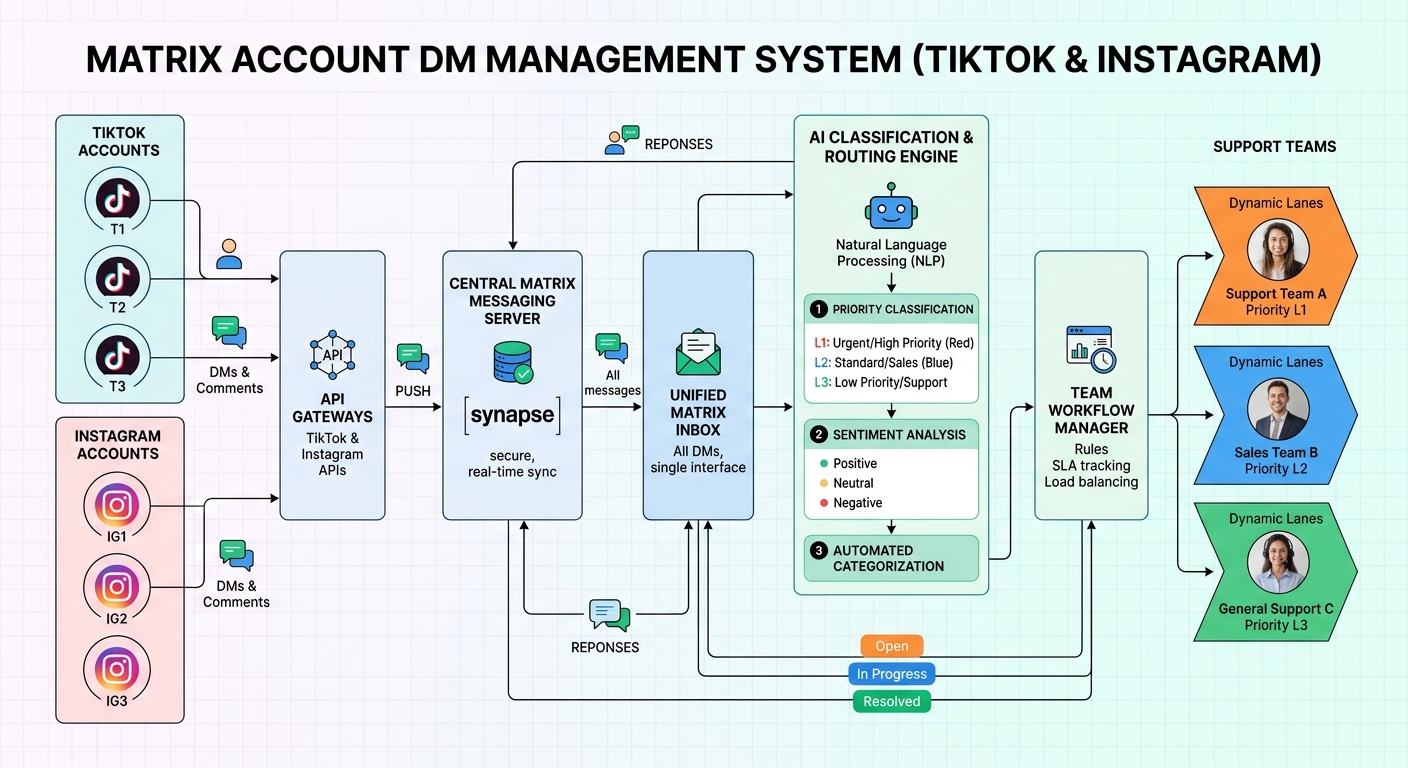
The first thing Liu Wei does every morning is to check the DMs (direct mail) for her accounts on her phone—only to find that she hasn't had time to reply to more than a dozen private messages from the previous day. She is in charge of the company's 8 TikTok accounts and 4 Instagram accounts, which together generate about 60-80 DMs per day. Even with two people taking turns on duty, they often can't keep up.
The worst time was when a direct mail (DM) stayed in their inbox for five days. By the time they replied, the recipient had already bought a competitor's product: "You guys are too slow to respond; I've already bought from someone else."
This isn't just a customer service experience issue; it's a waste of real money.
How many high-potential customers are you possibly missing?
Let's start with a calculation problem.
Assuming your matrix account receives 100 direct mail messages per day, these messages can be roughly categorized by intent as follows:
- Pure inquiries (asking about product information, shipping costs, and usage): Approximately 40 inquiries
- High intent (explicitly inquiring about purchasing, comparing prices, requesting links): Approximately 15-20 results
- Complaints/After-sales Service : Approximately 10
- Collaboration/promotion inquiries : Approximately 5
- Spam/meaningless messages : Approximately 30
Out of 100 direct mail (DM) messages, 15-20 are from customers with a clear intention to buy.
If the response time exceeds 24 hours, how much will the conversion probability of these high-intent customers decrease?
Research data shows that when the response time for social media private messages is delayed from 1 hour to 24 hours , the churn rate of potential customers increases by about 60%. In other words, out of 20 people who might have placed an order, only 8 are willing to wait for you.
For an account that processes 100 direct mail messages per day, the number of high-potential customers lost in a year due to untimely responses could be as high as several thousand.
Why is managing private messages in matrix operations much more difficult than imagined?
Managing private messages for a single account is manageable for most people using a native app. However, managing private messages for a matrix of accounts presents a different challenge:
Question 1: Scattered across multiple apps and accounts
Having 12 accounts means logging into TikTok, Instagram, and Facebook simultaneously, with multiple accounts on each platform constantly switching between them. Just checking for new messages requires repeatedly switching between logins, each time taking at least 5 minutes. How much time would that take in a day?
Question 2: Inability to quickly identify message priority
Across 12 inboxes, there's no unified view to tell you "which message is the most urgent today." Operations might prioritize replying to a bunch of "Nice video!" messages, but the real "I want to place an order, what's the price?" messages get buried in the list and go unseen.
Question 3: Lack of division of labor mechanism in team collaboration
When two operations teams simultaneously respond to responses from different accounts, there is no system to prevent "duplicate replies" or "missed replies." This type of coordination error is extremely common in team operations.
Question 4: Inconsistent response quality
Without standardized templates, different people and different times will respond with completely different styles and messages, which will damage the brand image.
Identifying signals of high-intent DM
Not all private messages deserve equal attention; learning to quickly identify high-value messages is an essential skill for matrix operations.
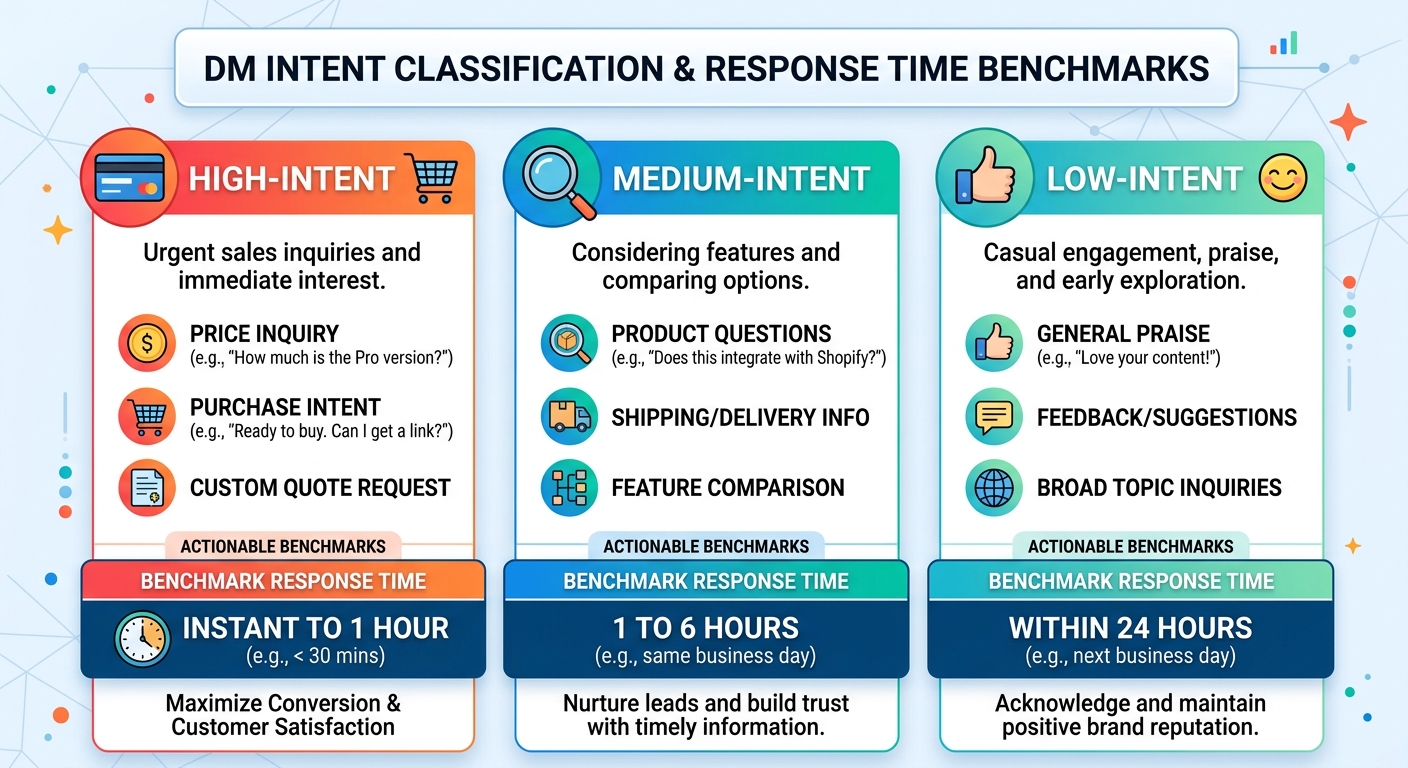
Level 1 High Intention Signal (Immediate Response, within 1 hour) :
- Ask the price directly: How much? What's the price?
- Inquiry about purchasing channels: Where can I buy? Do you ship to...?
- Check inventory: Is this still available?
- Confirming order intention: I want to order / Can I purchase this?
Level 2 High Intention Signal (Priority Response, within 4 hours) :
- Product comparison question: How does this compare to...?
- Multi-product consultation: Do you also have...?
- Detailed specifications (please study carefully)
Normal priority (within 24 hours) :
- General compliments (Love this! Great content!)
- Collaboration inquiry (Collab?)
Batch processing or automatic replies are possible :
- Shipping costs/delivery time (standard answer)
- Size/Color (Standard Chart)
- How to use (fixed tutorial)
Establish an efficient matrix private message management system
Key point 1: Unified inbox
Aggregating private messages from all accounts into one place is a prerequisite for solving the problem. The multi-account management function supports unified management of accounts across multiple platforms, establishing a cross-account priority queue —high-intent messages are pushed first, regardless of which account they come from.
Key point two: AI recognition + automatic classification
Manually filtering high-intent messages is extremely inefficient and prone to missing them. Configuring keyword trigger rules through AI automation is a better approach.
- Direct mail containing keywords such as "price", "how much", "buy", and "order" → Mark as high priority and trigger notification.
- Includes standardized questions such as "shipping" and "delivery time" → Triggers an automatic reply template.
- Keywords containing "complaint" or "refund" → Mark as urgent + Assign to specific customer service representative
TikTokDM and InstagramDM auto-response can be configured with different automation rules for the two platforms to adapt to the communication habits of users on different platforms.
Key Point 3: Layered Response Strategy
Establish a clear response hierarchy standard:
First level (auto-reply, 0 delay) :
- Immediate response within 30 minutes: "Hi [name]! Thanks for reaching out. Our team will get back to you within a few hours!"
- Direct answers to standardized consulting questions
Second level (rapid human response, 1-4 hours) :
- Personalized follow-up on messages with high intent
- The key is not to just answer questions, but to proactively guide the conversation to the next step ("Would you like me to send you the purchase link?").
Third level (standard response, 12-24 hours) :
- General inquiries and interactive messages
- Templates can be used, but personalized adjustments will be necessary.
Key Point 4: Establish a reply template library
Collect and organize the team's past high-quality direct mail responses, and categorize them to create a response template library:
| Scene | Template Title | Key elements |
|---|---|---|
| Price Inquiry | PriceInquiry-EN | Price + Link + Free Shipping Instructions |
| Shipping cost inquiry | Shipping-US | US Shipping Costs, Delivery Time, and Tracking Information |
| Size Inquiry | SizeGuide-Women | Size chart link + size selection advice |
| After-sales service | AfterSale-Start | Apology + Information Gathering + Promise of Resolution |
| Cooperation Consulting | Collab-Initial | Cooperation type + email follow-up guidance |
Templates are the starting point for high-quality responses, but the value of operations lies in adding personalized details.
Case Study: How a matrix account can increase direct mail conversion rate by 3 times
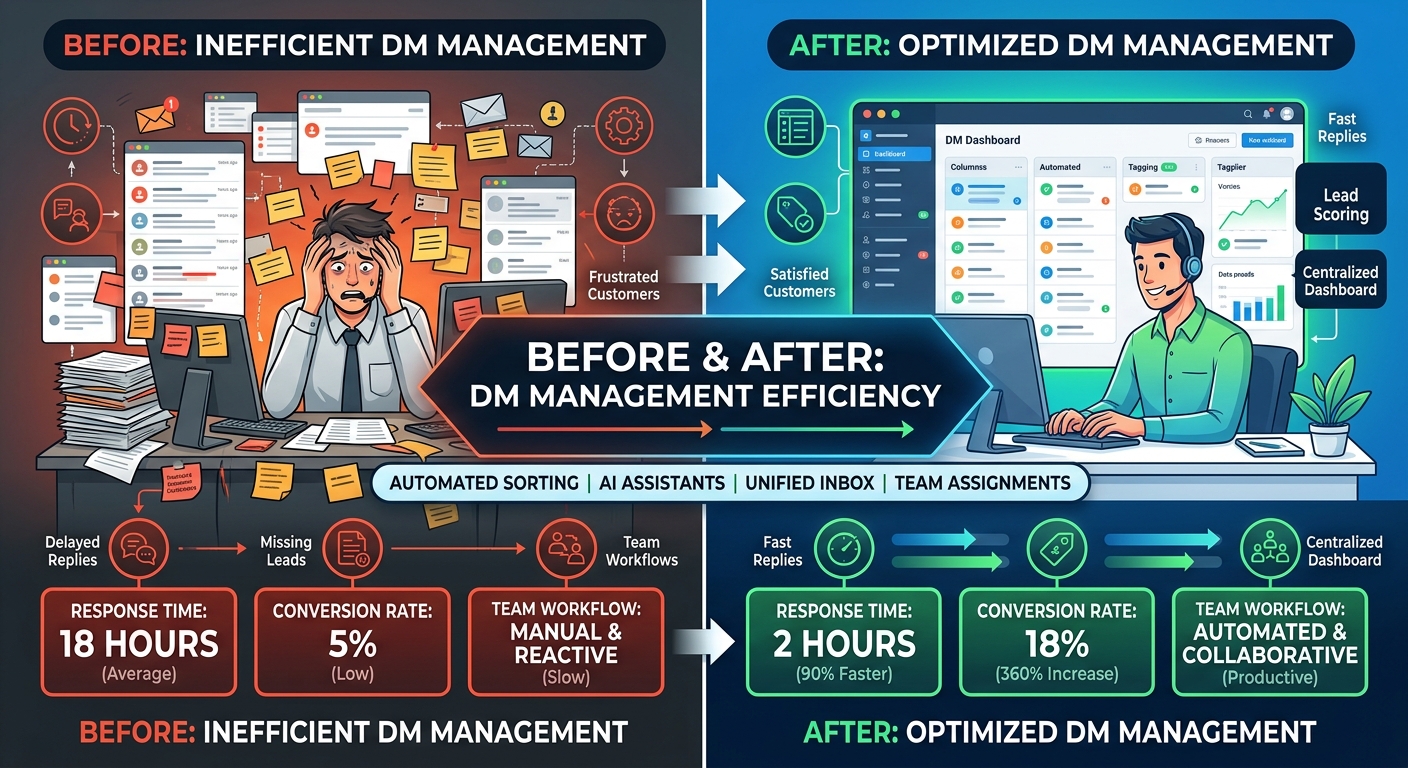
A clothing brand operating eight TikTok accounts increased its direct mail conversion rate from approximately 5% to 18% through the following changes:
Change 1: Response time reduced from an average of 18 hours to 2 hours.
Method: Configure automatic instant confirmation reply + manual processing according to priority, and achieve manual response within 1 hour for high-intent messages.
Change 2: Proactively provide purchase links for messages with high interest.
The original approach was to wait for customers to ask follow-up questions. Now, after identifying messages with high interest, the system proactively includes a product link and the prompt "Here's the direct link to purchase" during the first manual response.
Change 3: Personalized address using names
Changing "Hi there" to "Hi [username]!" makes the reply sound warmer and encourages more people to continue the conversation.
Change 4: Add social proof for hesitant customers
For questions like "Is this good quality?", include screenshots of user reviews or star ratings in the standard response to reduce purchase concerns.
FAQ
Q1: Will automated replies make customers feel like they are talking to a robot?
The key lies in the quality of the automated response design. An immediate "thank you message" is acceptable, as users understand it's an automated message. The recommended approach is to automatically send an immediate confirmation plus a clear statement that "a real person will follow up within X hours," and then actually deliver within the promised timeframe.
Q2: What are the differences in DM management between TikTok and Instagram?
TikTok private messages are typically shorter and more conversational, allowing for a more relaxed response style. Instagram private messages, on the other hand, often come from more sophisticated shopping decision-making scenarios, where users expect more professional replies. The wording on the two platforms needs to be differentiated; identical templates cannot be used.
Q3: How many people should manage the private messages of a matrix account?
This depends on the total number of direct mail (DMs). A rough suggestion: 1-2 people can manage up to 100 DMs per day; 2-3 people plus AI assistance for 100-300 DMs; and a complete AI automation team plus a dedicated customer service team is required for more than 300 DMs per day.
Q4: How to measure the effectiveness of private message management?
Key metrics: average response time, first response rate (the percentage of responses within a certain timeframe), and direct mail conversion rate (the percentage of high-intent direct mail messages that ultimately result in a purchase). It is recommended to record these three metrics weekly and observe trend changes.
Q5: Which platform typically has the highest direct mail conversion rate?
Data varies by product category, but generally, Instagram private messages have a higher purchase conversion rate than TikTok (users have stronger purchase intent and a higher average order value). TikTok sends more private messages, but more of these are fan interaction messages rather than purchase inquiries. Instagram and TikTok private message management supports tracking data across both platforms for easy comparison.
Q6: How to legally safeguard personal data in private messages?
User private messages contain personal information and must be processed in accordance with regulations such as GDPR (EU) and CCPA (California). Core principles: collect only necessary information, clearly define the purpose of data use, and allow users to request the deletion of personal data. SocialEcho is ISO 27001/27701 certified, uses encrypted data transmission, and complies with mainstream compliance requirements.
Q7: When managing private messages across multiple accounts, how can we prevent customers from perceiving that the message is not from a real person?
Core strategies: (1) Call the other party using their username; (2) Mention the specific content of their message in your reply, and do not copy the template; (3) Maintain a consistent brand tone in your reply; (4) Avoid sending the exact same reply to multiple different users in a very short period of time.
Want to learn how to systematically manage all interactions across your matrix of accounts? Comment management unifies comments and private messages from multiple platforms, and with AI-powered sentiment categorization, it helps you focus your attention on the conversations most worthy of follow-up.
;}.cls-2{fill:%230868f7;}.cls-3{fill:url(%23未命名的渐变_44);}.cls-4{fill:%23333;}%3c/style%3e%3clinearGradient%20id='未命名的渐变_8'%20x1='33.73'%20y1='100.61'%20x2='-0.03'%20y2='-1.06'%20gradientUnits='userSpaceOnUse'%3e%3cstop%20offset='0'%20stop-color='%237ae9fb'/%3e%3cstop%20offset='0.67'%20stop-color='%232b90f8'/%3e%3cstop%20offset='1'%20stop-color='%230868f7'/%3e%3c/linearGradient%3e%3clinearGradient%20id='未命名的渐变_44'%20x1='27.86'%20y1='18.67'%20x2='68.36'%20y2='22.22'%20gradientUnits='userSpaceOnUse'%3e%3cstop%20offset='0'%20stop-color='%235ac7f2'/%3e%3cstop%20offset='1'%20stop-color='%230868f7'/%3e%3c/linearGradient%3e%3c/defs%3e%3cpath%20class='cls-1'%20d='M29,28.74V81.91l-9.51-3.68v0L8.52,74A7.17,7.17,0,0,1,4,67.32V24.54A3.76,3.76,0,0,1,9.08,21Z'/%3e%3cpath%20class='cls-2'%20d='M68.09,78.07a13.15,13.15,0,0,1-17.9,12.06L29,81.91h0V28.74L50.19,37A13.17,13.17,0,0,0,68.08,25.3h0Z'/%3e%3cpath%20class='cls-3'%20d='M68.08,25.3a13.19,13.19,0,0,1-6.73,10.87A13.09,13.09,0,0,1,50.19,37L29,28.74V6A3.76,3.76,0,0,1,34.1,2.52l25.59,9.91A13.22,13.22,0,0,1,68.08,25.3Z'/%3e%3cpath%20class='cls-4'%20d='M129.06,81.76a4.33,4.33,0,0,1-3.19-1.31,4.4,4.4,0,0,1-1.31-3.24V56.86H97.65V77.21a4.36,4.36,0,0,1-1.35,3.2A4.68,4.68,0,0,1,93,81.76a4.32,4.32,0,0,1-3.19-1.31,4.37,4.37,0,0,1-1.32-3.24V27.27A4.58,4.58,0,0,1,89.83,24a4.59,4.59,0,0,1,7.82,3.27V48.15h26.91V27.27A4.58,4.58,0,0,1,125.91,24a4.59,4.59,0,0,1,7.82,3.27V77.21a4.37,4.37,0,0,1-1.36,3.2A4.65,4.65,0,0,1,129.06,81.76Z'/%3e%3cpath%20class='cls-4'%20d='M163.77,81.66c-6.57,0-11.76-1.92-15.44-5.7s-5.54-9.07-5.54-15.74a26.76,26.76,0,0,1,2.09-10.43,17.72,17.72,0,0,1,6.67-8.06,19.15,19.15,0,0,1,10.68-2.95,19,19,0,0,1,10.46,2.8,18.7,18.7,0,0,1,6.55,7.36,22.53,22.53,0,0,1,2.36,10.28A4.51,4.51,0,0,1,177,63.77H152.23a10.8,10.8,0,0,0,3.49,6.65c2,1.68,4.88,2.52,8.66,2.52a22.25,22.25,0,0,0,7.54-1.21c.74-.3,1.55-.67,2.37-1.07a3.75,3.75,0,0,1,1.84-.4,4.09,4.09,0,0,1,3,1.15,4,4,0,0,1,1.12,3,4.38,4.38,0,0,1-2.58,3.82,32.34,32.34,0,0,1-6.36,2.61A28.67,28.67,0,0,1,163.77,81.66ZM172.4,55.9a9.72,9.72,0,0,0-1.63-4.56A9.9,9.9,0,0,0,167,48a10.38,10.38,0,0,0-4.64-1.14,12,12,0,0,0-4.77,1.06,9.54,9.54,0,0,0-4.89,5.66,11.78,11.78,0,0,0-.51,2.3Z'/%3e%3cpath%20class='cls-4'%20d='M193,81.64a4.49,4.49,0,0,1-4.51-4.55V27.28A4.58,4.58,0,0,1,189.84,24a4.48,4.48,0,0,1,3.28-1.36A4.36,4.36,0,0,1,196.35,24a4.46,4.46,0,0,1,1.31,3.31V77.09a4.34,4.34,0,0,1-1.35,3.2A4.67,4.67,0,0,1,193,81.64Z'/%3e%3cpath%20class='cls-4'%20d='M263.79,81.71a5.7,5.7,0,0,1-4.2-1.74,5.76,5.76,0,0,1-1.73-4.19V27.37a4.58,4.58,0,0,1,1.35-3.27A4.59,4.59,0,0,1,267,27.37V72.53h24a4.58,4.58,0,0,1,3.27,7.82A4.66,4.66,0,0,1,291,81.71Z'/%3e%3cpath%20class='cls-4'%20d='M424.48,81.74a4.71,4.71,0,0,1-2.71-.88,5.43,5.43,0,0,1-1-1l-.07-.09-12.41-17-5.41,5v9.44a4.31,4.31,0,0,1-1.36,3.19,4.66,4.66,0,0,1-3.3,1.36A4.29,4.29,0,0,1,395,80.42a4.36,4.36,0,0,1-1.32-3.23V27.37A4.58,4.58,0,0,1,395,24.1a4.52,4.52,0,0,1,6.58.12,4.54,4.54,0,0,1,1.24,3.15V56.31l17.72-16.38.05,0a4.8,4.8,0,0,1,2.94-1.11,4.4,4.4,0,0,1,3.27,1.2,4.57,4.57,0,0,1,1.2,3.27,4.44,4.44,0,0,1-.77,2.33,7.45,7.45,0,0,1-1.43,1.65l-11,9.64,13.34,17.68a5,5,0,0,1,1,2.71,4.12,4.12,0,0,1-1.36,3.24A4.64,4.64,0,0,1,424.48,81.74Z'/%3e%3cpath%20class='cls-4'%20d='M317.93,81.76a21.5,21.5,0,1,1,21.17-21.5A21.37,21.37,0,0,1,317.93,81.76Zm0-34.1a12.61,12.61,0,1,0,12.42,12.6A12.52,12.52,0,0,0,317.93,47.66Z'/%3e%3cpath%20class='cls-4'%20d='M212.18,101.22a4.12,4.12,0,0,1-3.05-1.26,4.17,4.17,0,0,1-1.26-3.1V43.34a4.37,4.37,0,0,1,1.3-3.14,4.26,4.26,0,0,1,3.13-1.3,4.19,4.19,0,0,1,3.1,1.26,4.32,4.32,0,0,1,1.26,3.16,20.77,20.77,0,0,1,13-4.54,21.51,21.51,0,0,1,0,43,20.51,20.51,0,0,1-13-4.57V96.86a4.15,4.15,0,0,1-1.3,3.06A4.5,4.5,0,0,1,212.18,101.22Zm17.43-53.63c-6.23,0-12.93,4.11-12.93,12.72a12.73,12.73,0,0,0,25.46,0A12.71,12.71,0,0,0,229.61,47.59Z'/%3e%3cpath%20class='cls-4'%20d='M365.76,81.76a21.5,21.5,0,1,1,21.18-21.5A21.37,21.37,0,0,1,365.76,81.76Zm0-34.1a12.61,12.61,0,1,0,12.42,12.6A12.52,12.52,0,0,0,365.76,47.66Z'/%3e%3c/svg%3e)