
Brand operations in the Middle East: 3 major social media pitfalls encountered (with solutions to avoid them)
Lin, the brand operations director in charge of the Middle East business, stared blankly at the data in the Instagram backend—the Ramadan marketing content that the company spent tens of thousands of dollars on only had one-third of the usual engagement on the Saudi Arabia account, while the Middle East accounts of competing products achieved the highest engagement rate of the year during Ramadan.
This is not an isolated case. Almost every brand operations team that "transfers" experience from the European, American, or Southeast Asian markets to the Middle East will encounter this counterintuitive data collapse at some point. The problem is not insufficient budget, nor is it poor content—it's that you're using the wrong rules.
The Counterintuitive Patterns of the Middle Eastern Social Media Market
Middle Eastern social media data you don't know
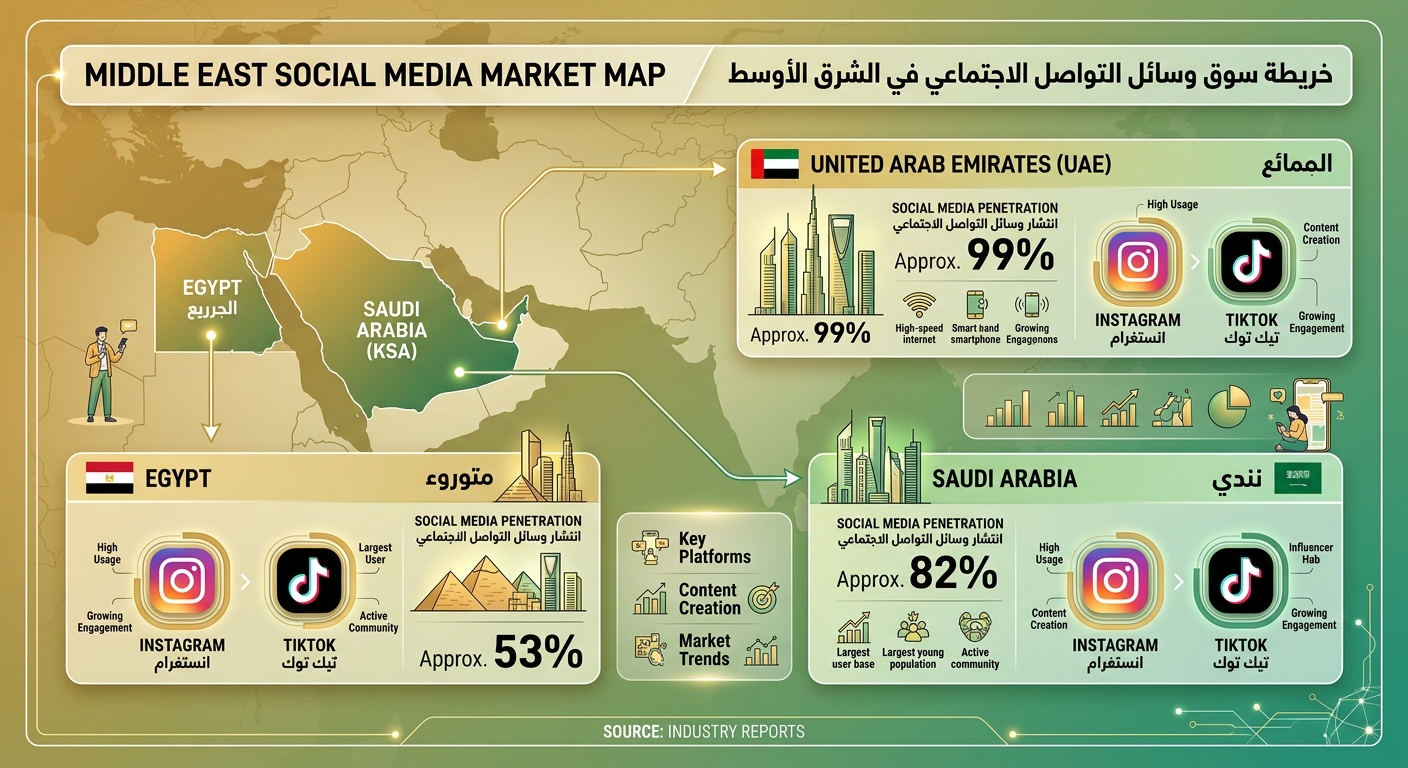
Let's look at some figures to shatter your stereotypes about the Middle Eastern market:
- UAE : With a social media penetration rate of 99% , it is one of the countries with the highest social media penetration rates in the world. The average number of social media accounts per person exceeds 7.
- Saudi Arabia : Social media penetration rate is approximately 84% , with over 30 million active social media users out of a national population of 36 million. YouTube, Instagram, Snapchat, and TikTok are all highly active.
- Egypt : Social media penetration rate is about 68% . Facebook remains the largest traffic source, but TikTok and Instagram are growing rapidly and have a very high proportion of young users.
The total number of social media users in the entire MENA (Middle East and North Africa) region has exceeded 250 million, with an annual growth rate of 8%-12%. This is a huge and rapidly growing market—but it has a completely different operating logic from Europe and the United States.
Social media behavior characteristics of Middle Eastern users
1. Active late at night, not during the morning rush hour.
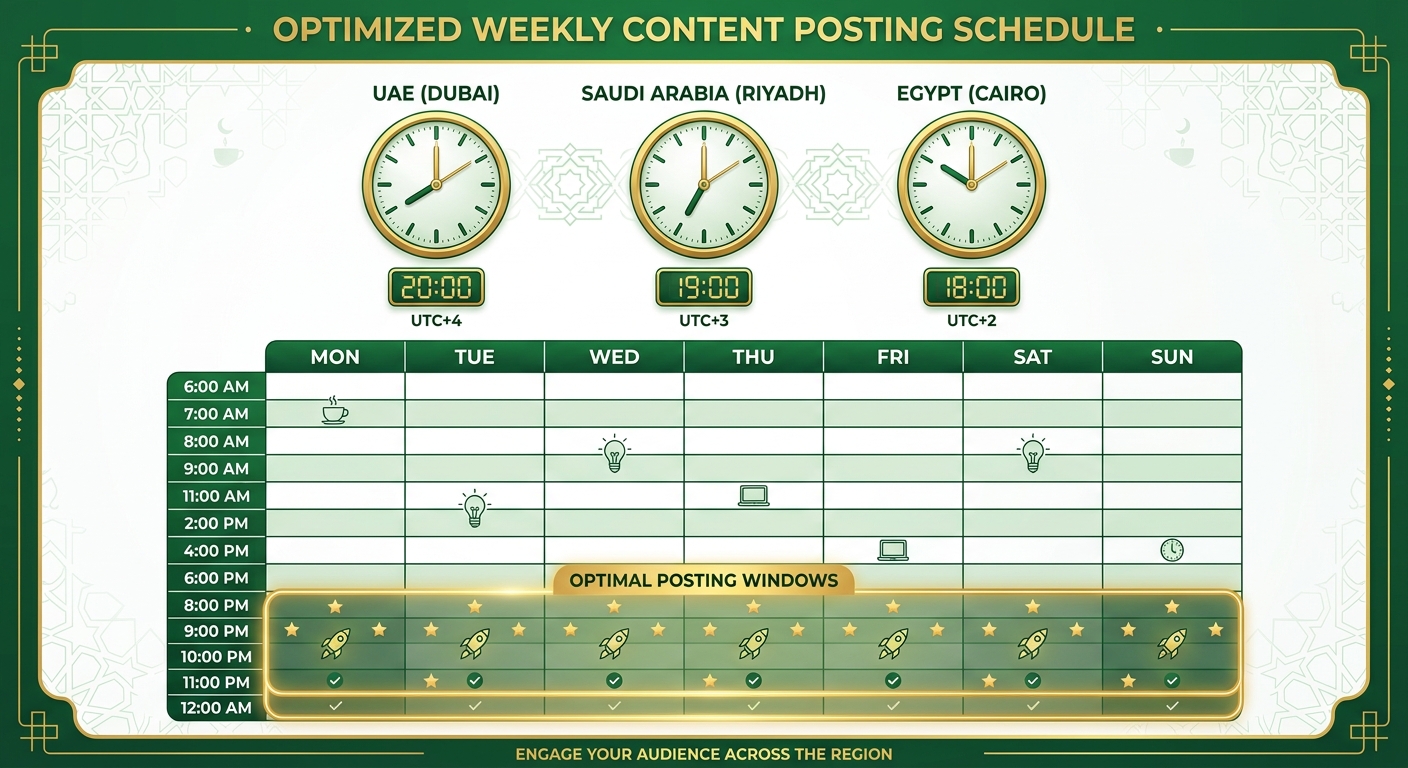
The hot climate in the Middle East, coupled with the influence of Ramadan culture, leads users to be active at night. 8 PM to midnight is the true golden hour for social media in the Middle East, while the commonly held belief in Europe and America that "posting content between 7 and 9 AM" is almost ineffective in the Middle East.
2. Video-first, Reels and Shorts dominate.
Middle Eastern users have an extremely strong preference for short-video content. Saudi Arabia has one of the highest per capita YouTube viewing times globally, and TikTok is growing at more than twice the global average on UAE and Egypt. Organic reach for text and image content is declining rapidly.
3. Strong word-of-mouth effect and significant KOL influence.
Middle Eastern consumers heavily rely on genuine word-of-mouth and KOL endorsements to trust brand recommendations. A single video recommendation from a local influencer is often more effective than dozens of posts from a brand's official account.
The biggest misconception: directly transplanting European and American experiences.
Many teams expanding overseas have Middle East social media operations managers whose experience comes primarily from Europe, America, or China. Their "best practices" often fail to adapt effectively in the Middle East.
- The plan will be released using Eastern Time.
- Reaching Arab users with English hashtags
- Understanding Ramadan Marketing Through the Logic of Western Holidays
- The same content is published simultaneously on accounts in Europe, America, and the Middle East.
These four habits correspond to the three most common pitfalls that brands venturing into the Middle East encounter. Let's break them down one by one.
Further Reading: Analysis of Three Major Changes in Social Media Platforms in 2026 , Understanding the Latest Trends in Global Social Media Algorithms
3 common pitfalls for brands going global in the Middle East
Pitfall 1: Ramadan's release schedule and content strategy were reversed.
Typical scenario : The brand operations team believes that Ramadan is a "religious holiday" and is worried that aggressive marketing would be offensive, so they reduce the frequency of content releases and resume the normal pace after Ramadan ends.
The actual result : Account engagement plummeted during Ramadan, missing the biggest social media traffic window of the year.
More people fall into this trap than you might imagine. Director Lin's case perfectly illustrates this logic—the content was "restrained," but the user's attention was completely stolen by competitors.
What is the truth?
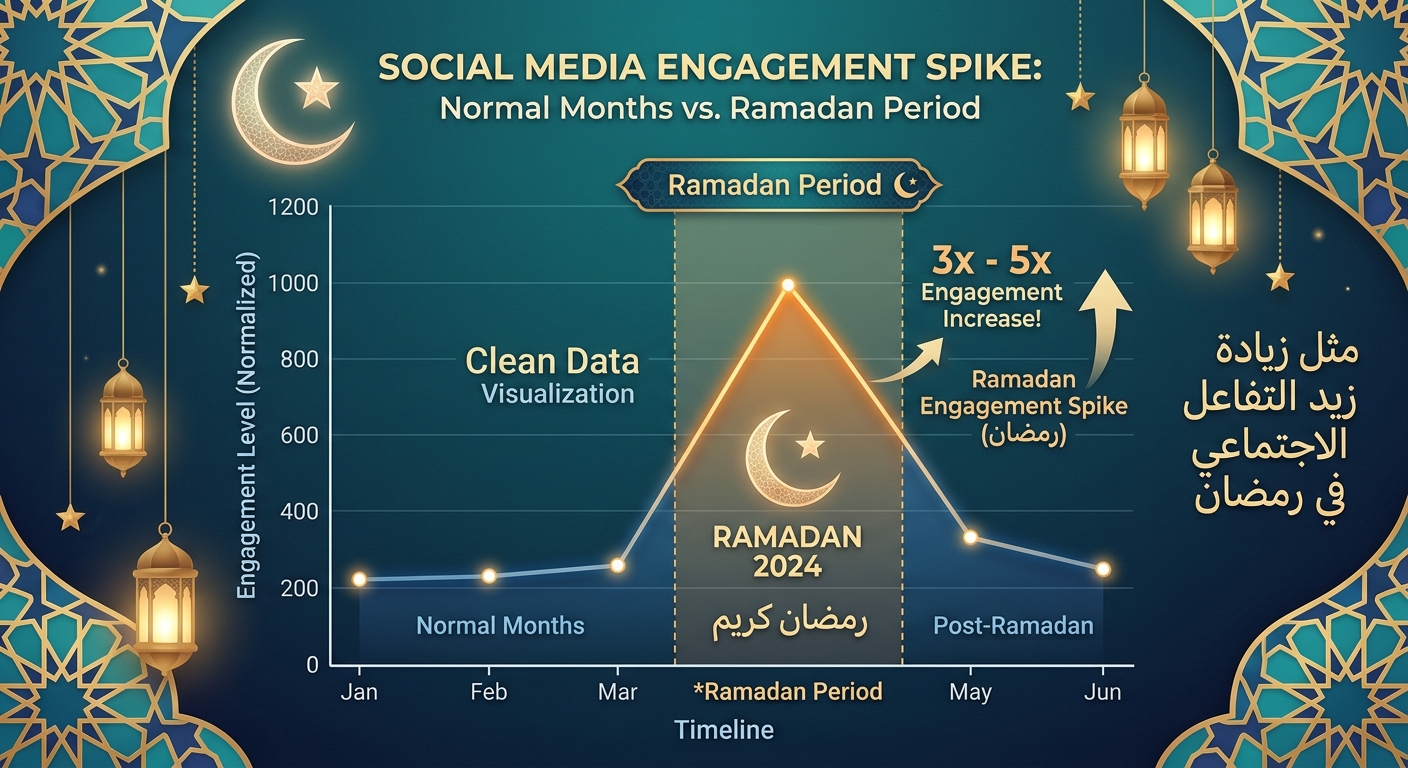
Ramadan (the Islamic month of fasting) is the period with the highest social media engagement in the Middle East throughout the year. Data shows:
- During Ramadan, daily content consumption on Middle Eastern social media platforms is 3-5 times higher than usual.
- Instagram and TikTok saw an average increase of 30%-50% in ad click-through rates during Ramadan.
- Snapchat's peak daily active users in Saudi Arabia during Ramadan were the highest of the year.
The reason is simple: during Ramadan, people cannot eat during the day, and after the Iftar (breakfast) at night, the whole family gathers together to browse their phones, watch videos, and shop—this is the largest "family entertainment period" in the entire region.
The right Ramadan content strategy :
- Two weeks in advance : Start releasing "Ramadan Kareem" themed content 14 days before Ramadan begins to create a festive atmosphere.
- Encrypted releases during Ramadan : Daily content volume increased by 50%-100% compared to usual, with a focus on the Iftar (after sunset) period.
- Content focused on family, gratitude, and community : these three themes resonated most strongly during Ramadan.
- Eid al-Fitr Sprint : The three days before the end of Ramadan are the period of strongest purchasing power, and brand promotions are most effective during this time.
Absolutely forbidden : Never post content related to food or drinks between sunrise and sunset. This will not only be culturally offensive but will also directly impact your account's reputation among local users.
Pitfall 2: The chaos of operating Arabic hashtags and English accounts simultaneously
Typical Scenario A : A brand runs Instagram ads in the Middle East using English hashtags such as #Dubai #MiddleEast #SaudiArabia. The result is that the ads primarily reach expatriates in the Middle East, rather than the target Arab audience.
Typical Scenario B : The same Instagram account posts in Arabic one day and in English the next, alternating between the two. The algorithm can't understand who the account's audience is, resulting in poor reach on both sides.
Why do English hashtags fail in the Middle East?
Arab users' search habits on social media platforms are primarily in Arabic. They search for #رمضان (Ramadan) instead of #Ramadan, and #دبي instead of #Dubai. Meta internal data shows that Arabic content achieves 2.3 times higher organic reach in the Middle Eastern market than English content .
The right language operation strategy :
- Preferred solution : Create separate accounts for Arabic and English-speaking audiences to clearly define the target audience and enable the algorithm to deliver targeted content accurately.
- Alternative option : Use Arabic as the primary language and English as a secondary language for unified accounts (suitable for teams with limited resources).
- Hashtag strategy : Each piece of content should include at least 3-5 Arabic hashtags, along with 2-3 English hashtags.
- Content localization : more than just translation, it involves rewriting content using local expressions—there are significant differences in Arabic expressions between the Gulf region and Egypt.
Reference: The same content distributed across multiple platforms has a 10-fold difference in performance —language localization is one of the core reasons for the difference in distribution results.
Pitfall 3: The release time used Eastern Time.
Real-world example : A brand using Buffer to manage its Middle Eastern accounts for overseas expansion forgot to change the timezone setting in the scheduling tool, defaulting to Eastern Time (UTC-5). As a result, their carefully prepared "Good Morning Tweet," sent at 3 AM in Riyadh, arrived at the user's location at 2 AM in Dubai—with absolutely no interaction.
This is not a joke; these are basic mistakes that many teams going global have actually made.
Time zones of the three major markets in the Middle East :
| market | Time zone | Time difference with Beijing | Time difference with the Eastern United States |
|---|---|---|---|
| Saudi Arabia | UTC+3 (AST) | -5 hours | +8 hours |
| UAE (United Arab Emirates) | UTC+4 (GST) | -4 hours | +9 hours |
| Egypt | UTC+2 (EET) | -6 hours | +7 hours |
Best time to post on social media in the Middle East :
- Lunch break : 12:30-14:00 local time
- Golden Evening : 20:00-23:00 local time (especially important after Iftar during Ramadan)
- Weekend Notice : Friday is a major rest day in the Middle East (not Sunday), and Thursday evening is the peak travel period "before the weekend."
Key issue : The three main markets have different time zones, requiring the same content to be pushed out at different times—the optimal posting time for the Saudi account differs from that of the UAE account by 1 hour and from that of the Egypt account by 1-2 hours. Manually managing the posting times for multiple accounts results in an extremely high error rate.
In-depth understanding: The impact of content release timing on interaction – Data proves that a 2-hour difference in the release time of the same content can result in a 40% difference in interaction rate.
Localized Operation System Solution
Once the pitfalls have been identified, the next step is to establish a system so that your team no longer relies on "remembering not to fall into the pitfalls" to avoid mistakes, but instead uses processes and tools to ensure that every release is correct.
Step 1: Create a Middle East-specific content calendar
The Middle Eastern market has a unique set of festivals and cultural periods that need to be separately marked and planned in the content calendar:
Important time slots that must be included :
- Ramadan : The month moves annually; in 2026, it will fall approximately from late February to late March. Planning should begin 6 weeks in advance.
- Eid al-Fitr (Eid al-Fitr) : A three-day holiday following the end of Ramadan, a period of peak purchasing power.
- Eid al-Adha (Feast of Sacrifice) : An important festival in the Islamic calendar, a peak time for social media interaction.
- Saudi National Day : September 23rd, a crucial opportunity for brands to express their localization strategies.
- UAE National Day : December 2nd, a must-participate event for Dubai and Abu Dhabi brands.
- Egypt Revolution Day : January 25
With this calendar, content planning has a framework: which months require concentrated investment, which periods are peak traffic times, and which nodes require a surge in localized content.
Step 2: Establish a multi-timezone release management process
Manually managing timezone updates for multiple Middle Eastern accounts is the most error-prone aspect for operations teams. The following is a recommended standardized process:
- Content creation phase : Use UTC time to plan and release schedules to avoid confusion from time zone conversions.
- Tool setup phase : Configure the target timezone separately for each account: Saudi account set to UTC+3, UAE account set to UTC+4, and Egypt account set to UTC+2.
- Release Review Stage : Pre-release Checklist – Is the time zone correct? Is the release time during prime time? Has sensitive content been avoided during Ramadan?
- Data review phase : Weekly analysis of the optimal posting times for each market account, and continuous optimization based on actual interaction data.
SocialEcho is recommended for managing multiple Middle Eastern accounts. SocialEcho allows you to set the timezone for each account independently, and multiple Middle Eastern accounts can schedule their publishing activities in a unified console according to their respective timezones without manual conversion—this is the core tool for solving "Pitfall 3".
Step 3: Establish an Arabic content review process
Arabic content cannot be translated by machine. There are three main Arabic variants in the Middle Eastern market:
- Gulf Arabic : Used in Saudi Arabia, UAE, and Kuwait; it is a more formal language.
- Egyptian Arabic : Used in Egypt, it is colloquial and has the greatest influence on entertainment content in the pan-Arab region.
- Modern Standard Arabic (MSA) : Suitable for news and official content, but sounds stiff in social media content.
Recommended review process: Content creation (Chinese/English) → Professional localization translation (selecting dialects according to the target market) → Local compliance review (cultural taboo checks) → Final release.
SocialEcho: An Efficient Solution for Localized Operations in the Middle East
The core pain point of systematic Middle Eastern social media operations is the complexity of managing multiple accounts, time zones, and languages. SocialEcho is designed specifically for cross-platform, cross-time zone social media teams, making it particularly friendly to brands expanding into the Middle East.
- ✅Unified management of multiple accounts : Accounts from the Saudi, UAE, and Egypt markets can be managed centrally from a single console.
- ✅Independent time zone setting : Each account can be configured with its own target time zone, and the system will automatically publish at the best local time.
- ✅Content calendar visualization : Important Middle Eastern events such as Ramadan and National Day can be marked in advance, making team collaboration clearer.
- ✅Multi -platform coverage : Manage Instagram, TikTok, YouTube, Twitter/X, and Facebook all in one place.
Reference: A complete comparison of multi-platform operation tools , understanding the functional differences between SocialEcho and other tools.
Pricing : Basic plan starts at 12.5/month, Team plan starts at 18.75/month, with a 20% discount for annual payments. For brand operations teams expanding their business in the Middle East, this cost is far lower than the losses caused by time zone errors or missing Ramadan traffic peaks.
Summary: 3 pitfalls + 3 systematic solutions
| pit | Root cause of the problem | Systematic solution |
|---|---|---|
| Ramadan content strategy backfires | Understanding Ramadan using the logic of Western holidays | Create a Middle East-specific content calendar and plan Ramadan 6 weeks in advance. |
| Hashtag language strategy is confusing. | Lack of understanding of Arabic users' search habits | Language-specific account management, Arabic hashtags prioritized. |
| Release time zone error | The tool's default timezone has not been modified. | Multiple accounts with independent timezone configurations, unified management via SocialEcho |
Operating social media in the Middle East market requires more than just "understanding social media"; it also requires "understanding the Middle East." Filling these three gaps will not just result in a slight increase in engagement on your Middle Eastern accounts, but a dramatic shift.
Frequently Asked Questions (FAQ)
Is social media marketing really effective during Ramadan?
More than just effective, Ramadan is one of the most productive periods for social media marketing in the Middle East throughout the year. During Ramadan, daily content consumption on Middle Eastern social media platforms increases 3-5 times compared to normal times, with users spending a significant amount of time on their phones, shopping, and sharing content during the nighttime hours after Iftar (the meal of breaking the fast). Brands that invest strategically during Ramadan often achieve their highest engagement and conversion rates of the year. The key is to understand the cultural significance of Ramadan and focus content themes on family, gratitude, and generosity, rather than aggressive promotions.
Do brands expanding into the Middle East need to create separate Arabic accounts?
It is strongly recommended to create a separate Arabic account, especially if your target market includes Saudi Arabia and the UAE. There are two reasons for this: First, algorithmic logic – using two languages in one account makes it difficult for the platform's algorithm to accurately identify the audience, resulting in poor reach to both sides. Second, user psychology – Arab users have higher trust in brand accounts that operate exclusively in their local language, viewing them as brands that "truly understand them." If resources are limited, at least ensure that Arabic content is primary, with English as a secondary language.
What are the most active social media platforms in the Middle East?
While there are slight differences across markets, the overall ranking is as follows: YouTube (number one in video consumption), Instagram (number one in brand interaction), TikTok (fastest growing, primarily targeting a young audience), Snapchat (particularly strong in Saudi Arabia, with a daily active user penetration rate exceeding 80%), and Facebook (still the largest traffic source in the Egypt market). Brands expanding overseas are advised to cover at least Instagram + TikTok + platforms specific to their target market (Snapchat is preferred in Saudi Arabia, and Facebook is preferred in Egypt).
How to manage multiple Middle Eastern social media accounts that span different time zones?
Manual management is prone to errors, so we strongly recommend using a social media management tool that supports multiple time zones. SocialEcho allows you to configure the time zone independently for each account, managing multiple accounts across three markets (Saudi (UTC+3), UAE (UTC+4), and Egypt (UTC+2)) within a unified content calendar. It automatically publishes at the optimal time for each account, eliminating the need for manual conversion. The basic version starts at $12.5/month, covering the multi-account management needs of small to medium-sized teams.
What are the three most important localization principles for operating social media in the Middle East?
First, time localization : Publish during prime time in the local time zone, prioritizing nighttime. Second, language localization : Prioritize Arabic content, using the target market dialect (Gulf vs. Egypt), avoiding machine translation. Third, cultural localization : Understand the content rules for religious holidays such as Ramadan and Eid al-Adha; family and community themes resonate more with audiences than individualistic content. Mastering these three points can increase the organic reach of Middle Eastern accounts by 2-3 times.
What are the absolute taboos in Ramadan marketing content?
From sunrise to sunset, posting any content related to food, drinks, or restaurants is prohibited—this is the most direct offense to those fasting. Furthermore, avoid emphasizing themes of "pleasure" or "indulgence" during Ramadan; do not use images that may conflict with Islamic culture (including revealing clothing, alcoholic beverages, etc.); and do not ignore Eid al-Fitr's blessings—the end-of-Ramadan greeting is often the most interacted single post of the year.
What are the biggest differences between social media operations in the Middle East and Southeast Asia markets?
The core differences lie in three points: First, the weight of religious culture . The influence of Islamic culture on content in the Middle East is far more systematic than in Southeast Asia, and the operational strategies for events such as Ramadan and Eid al-Adha are unique to the Middle East. Second, language barriers . English is widely spoken in many Southeast Asian countries, while the localization requirements for Arabic in the Middle East are more stringent. Third, purchasing power . The per capita purchasing power in the UAE and Saudi Arabia far exceeds that of major Southeast Asian markets, and high-end brands have a higher conversion rate in the Middle East, but the entry barriers (localization investment, compliance requirements) are also relatively higher.
;}.cls-2{fill:%230868f7;}.cls-3{fill:url(%23未命名的渐变_44);}.cls-4{fill:%23333;}%3c/style%3e%3clinearGradient%20id='未命名的渐变_8'%20x1='33.73'%20y1='100.61'%20x2='-0.03'%20y2='-1.06'%20gradientUnits='userSpaceOnUse'%3e%3cstop%20offset='0'%20stop-color='%237ae9fb'/%3e%3cstop%20offset='0.67'%20stop-color='%232b90f8'/%3e%3cstop%20offset='1'%20stop-color='%230868f7'/%3e%3c/linearGradient%3e%3clinearGradient%20id='未命名的渐变_44'%20x1='27.86'%20y1='18.67'%20x2='68.36'%20y2='22.22'%20gradientUnits='userSpaceOnUse'%3e%3cstop%20offset='0'%20stop-color='%235ac7f2'/%3e%3cstop%20offset='1'%20stop-color='%230868f7'/%3e%3c/linearGradient%3e%3c/defs%3e%3cpath%20class='cls-1'%20d='M29,28.74V81.91l-9.51-3.68v0L8.52,74A7.17,7.17,0,0,1,4,67.32V24.54A3.76,3.76,0,0,1,9.08,21Z'/%3e%3cpath%20class='cls-2'%20d='M68.09,78.07a13.15,13.15,0,0,1-17.9,12.06L29,81.91h0V28.74L50.19,37A13.17,13.17,0,0,0,68.08,25.3h0Z'/%3e%3cpath%20class='cls-3'%20d='M68.08,25.3a13.19,13.19,0,0,1-6.73,10.87A13.09,13.09,0,0,1,50.19,37L29,28.74V6A3.76,3.76,0,0,1,34.1,2.52l25.59,9.91A13.22,13.22,0,0,1,68.08,25.3Z'/%3e%3cpath%20class='cls-4'%20d='M129.06,81.76a4.33,4.33,0,0,1-3.19-1.31,4.4,4.4,0,0,1-1.31-3.24V56.86H97.65V77.21a4.36,4.36,0,0,1-1.35,3.2A4.68,4.68,0,0,1,93,81.76a4.32,4.32,0,0,1-3.19-1.31,4.37,4.37,0,0,1-1.32-3.24V27.27A4.58,4.58,0,0,1,89.83,24a4.59,4.59,0,0,1,7.82,3.27V48.15h26.91V27.27A4.58,4.58,0,0,1,125.91,24a4.59,4.59,0,0,1,7.82,3.27V77.21a4.37,4.37,0,0,1-1.36,3.2A4.65,4.65,0,0,1,129.06,81.76Z'/%3e%3cpath%20class='cls-4'%20d='M163.77,81.66c-6.57,0-11.76-1.92-15.44-5.7s-5.54-9.07-5.54-15.74a26.76,26.76,0,0,1,2.09-10.43,17.72,17.72,0,0,1,6.67-8.06,19.15,19.15,0,0,1,10.68-2.95,19,19,0,0,1,10.46,2.8,18.7,18.7,0,0,1,6.55,7.36,22.53,22.53,0,0,1,2.36,10.28A4.51,4.51,0,0,1,177,63.77H152.23a10.8,10.8,0,0,0,3.49,6.65c2,1.68,4.88,2.52,8.66,2.52a22.25,22.25,0,0,0,7.54-1.21c.74-.3,1.55-.67,2.37-1.07a3.75,3.75,0,0,1,1.84-.4,4.09,4.09,0,0,1,3,1.15,4,4,0,0,1,1.12,3,4.38,4.38,0,0,1-2.58,3.82,32.34,32.34,0,0,1-6.36,2.61A28.67,28.67,0,0,1,163.77,81.66ZM172.4,55.9a9.72,9.72,0,0,0-1.63-4.56A9.9,9.9,0,0,0,167,48a10.38,10.38,0,0,0-4.64-1.14,12,12,0,0,0-4.77,1.06,9.54,9.54,0,0,0-4.89,5.66,11.78,11.78,0,0,0-.51,2.3Z'/%3e%3cpath%20class='cls-4'%20d='M193,81.64a4.49,4.49,0,0,1-4.51-4.55V27.28A4.58,4.58,0,0,1,189.84,24a4.48,4.48,0,0,1,3.28-1.36A4.36,4.36,0,0,1,196.35,24a4.46,4.46,0,0,1,1.31,3.31V77.09a4.34,4.34,0,0,1-1.35,3.2A4.67,4.67,0,0,1,193,81.64Z'/%3e%3cpath%20class='cls-4'%20d='M263.79,81.71a5.7,5.7,0,0,1-4.2-1.74,5.76,5.76,0,0,1-1.73-4.19V27.37a4.58,4.58,0,0,1,1.35-3.27A4.59,4.59,0,0,1,267,27.37V72.53h24a4.58,4.58,0,0,1,3.27,7.82A4.66,4.66,0,0,1,291,81.71Z'/%3e%3cpath%20class='cls-4'%20d='M424.48,81.74a4.71,4.71,0,0,1-2.71-.88,5.43,5.43,0,0,1-1-1l-.07-.09-12.41-17-5.41,5v9.44a4.31,4.31,0,0,1-1.36,3.19,4.66,4.66,0,0,1-3.3,1.36A4.29,4.29,0,0,1,395,80.42a4.36,4.36,0,0,1-1.32-3.23V27.37A4.58,4.58,0,0,1,395,24.1a4.52,4.52,0,0,1,6.58.12,4.54,4.54,0,0,1,1.24,3.15V56.31l17.72-16.38.05,0a4.8,4.8,0,0,1,2.94-1.11,4.4,4.4,0,0,1,3.27,1.2,4.57,4.57,0,0,1,1.2,3.27,4.44,4.44,0,0,1-.77,2.33,7.45,7.45,0,0,1-1.43,1.65l-11,9.64,13.34,17.68a5,5,0,0,1,1,2.71,4.12,4.12,0,0,1-1.36,3.24A4.64,4.64,0,0,1,424.48,81.74Z'/%3e%3cpath%20class='cls-4'%20d='M317.93,81.76a21.5,21.5,0,1,1,21.17-21.5A21.37,21.37,0,0,1,317.93,81.76Zm0-34.1a12.61,12.61,0,1,0,12.42,12.6A12.52,12.52,0,0,0,317.93,47.66Z'/%3e%3cpath%20class='cls-4'%20d='M212.18,101.22a4.12,4.12,0,0,1-3.05-1.26,4.17,4.17,0,0,1-1.26-3.1V43.34a4.37,4.37,0,0,1,1.3-3.14,4.26,4.26,0,0,1,3.13-1.3,4.19,4.19,0,0,1,3.1,1.26,4.32,4.32,0,0,1,1.26,3.16,20.77,20.77,0,0,1,13-4.54,21.51,21.51,0,0,1,0,43,20.51,20.51,0,0,1-13-4.57V96.86a4.15,4.15,0,0,1-1.3,3.06A4.5,4.5,0,0,1,212.18,101.22Zm17.43-53.63c-6.23,0-12.93,4.11-12.93,12.72a12.73,12.73,0,0,0,25.46,0A12.71,12.71,0,0,0,229.61,47.59Z'/%3e%3cpath%20class='cls-4'%20d='M365.76,81.76a21.5,21.5,0,1,1,21.18-21.5A21.37,21.37,0,0,1,365.76,81.76Zm0-34.1a12.61,12.61,0,1,0,12.42,12.6A12.52,12.52,0,0,0,365.76,47.66Z'/%3e%3c/svg%3e)