
Official API vs Simulation: Two Paths in Social Media Management, How High Is the Cost of Choosing Wrong?
Introduction
On a morning in November 2025, Li Min, operations director at a Shenzhen cross-border e-commerce brand, received an email — all three of their main Facebook advertising accounts had been banned, along with 12 associated Instagram accounts.
The reason? The "social media management tool" they had been using was logging in via simulation to batch-operate accounts.
At almost the same time, a brand in Shanghai using the official API was growing steadily, with monthly exposure exceeding 50 million.
These two paths represent the two technical routes in social media management: Official API and Simulation Operation. Choose the right path, and your brand grows steadily; choose the wrong one, and you could lose everything overnight.
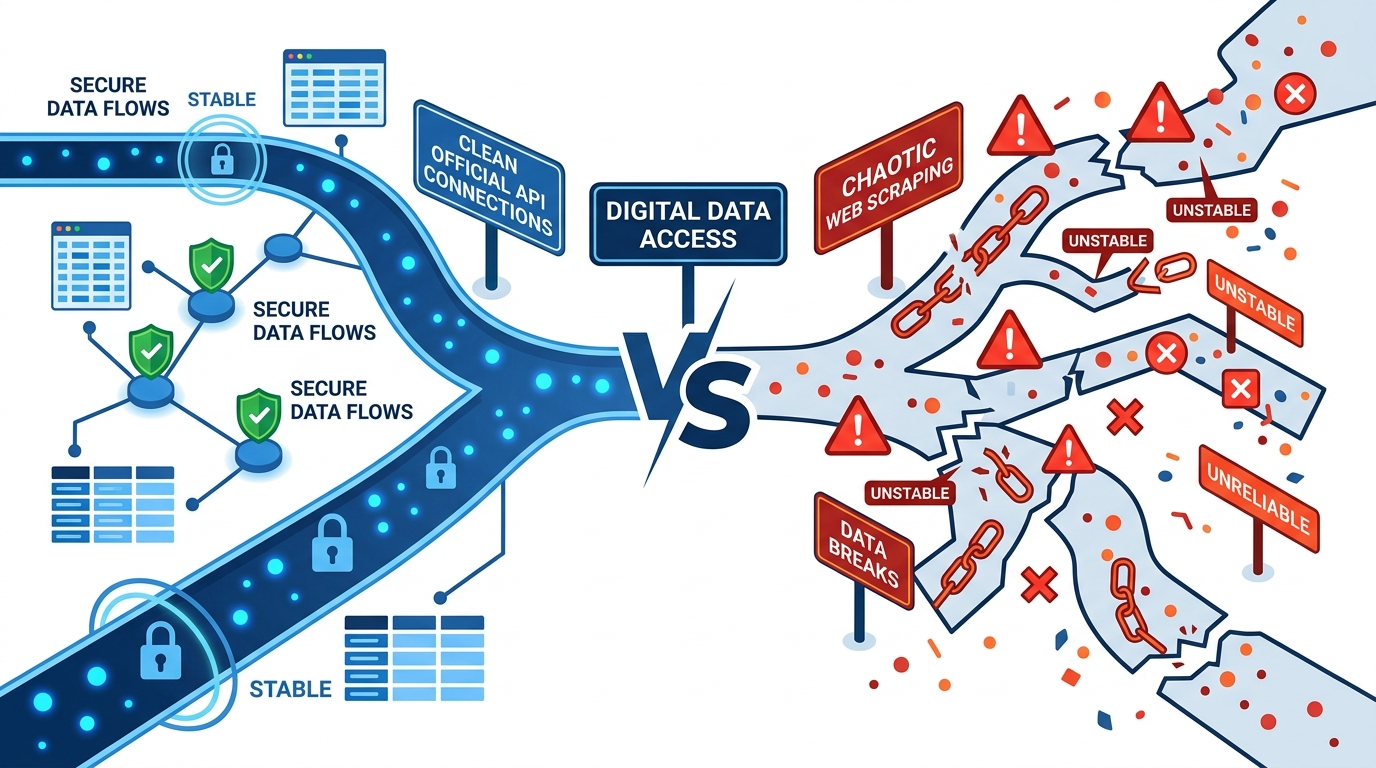
Li Min's story is not an isolated case. In 2025, over 20,000 social media accounts across China were banned for using simulation tools, with direct economic losses exceeding 1.5 billion yuan. Behind these numbers are countless anxious operators like Li Min.
What Is an Official API? What Is Simulation Operation?
Official API: The "Legitimate Pass" Given by the Platform
Imagine you need to enter an office building. An official API is like an access card issued by the property management — officially authorized by the platform, with clear permission scopes and usage rules, but safe and reliable.
Social media platforms (Facebook, Instagram, TikTok, X, etc.) provide official API interfaces for developers, allowing compliant tools to read data, publish content, and manage interactions through standardized methods. This process is like conducting business at a bank counter — you submit an application, the bank reviews it, and upon approval, grants you access. Every step is recorded, every step is compliant.
Tools powered by SocialEcho's official API have every request authenticated by the platform, every operation traceable. The platform knows who you are, what you're doing, and whether you've crossed any boundaries. This transparency is precisely what guarantees safety.
Simulation Operation: The "Backdoor Route" of Climbing Over the Wall
Simulation operation is entirely different. It doesn't go through official channels but instead simulates real user actions in a browser or app — automatic clicking, automatic input, automatic scrolling.
Technically, this is usually achieved through browser automation tools like Selenium or Puppeteer, or by reverse-engineering the platform's private protocols. Developers don't need to apply for any permissions from the platform — they just need to analyze the frontend page structure and write code to simulate user behavior.
Sounds clever? But it's like climbing over a wall to enter a building — you might get away with it temporarily, but once security catches you, the consequences are severe. And the climbing method is always in the shadows; you never know when security will upgrade their surveillance system.
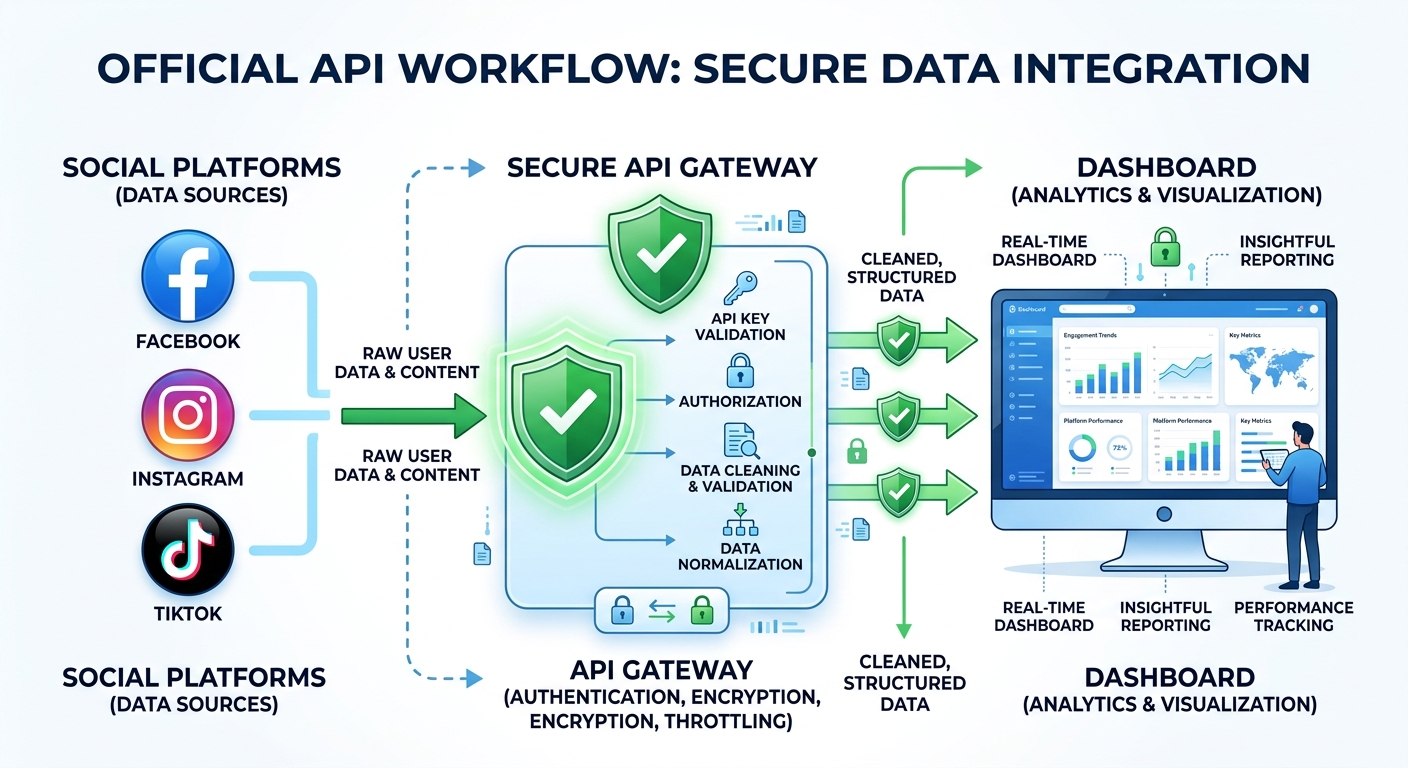
Official API workflow: Platform authorization → Security authentication → Data exchange → Compliant operations
The Essential Differences Between the Two Paths
The authorization method is the most fundamental difference. Official APIs require applying for a developer account with the platform, submitting enterprise credentials, and upon review, receiving an API Key and access permissions. The entire process is transparent and traceable, just like registering a company requires official business registration. Simulation operations require no authorization whatsoever — they directly simulate user behavior, bypassing the platform's developer system. This "act first, ask later" approach plants the seeds of risk from the very beginning.
Data acquisition is another key difference. Data obtained through APIs is structured data officially provided by the platform, with stable formats and reliable quality. The platform guarantees the completeness and accuracy of data fields, so developers can use it with confidence. Simulation operations, on the other hand, scrape data displayed on the frontend, where formats can change at any time and key information may be missing. A single frontend update by the platform can render scraping rules useless — this uncertainty is a pain point that simulation operations cannot avoid.
The difference in operation frequency is equally significant. APIs have clear rate limits — for example, a maximum of 100 requests per minute — which is the safe range allowed by the platform. Operating within this range will never trigger risk control. Simulation operations, in pursuit of efficiency, often exceed normal user behavior frequencies — liking 50 times per minute, following 30 accounts — such abnormal behavior easily triggers platform risk control. It's like pressing the elevator door button 10 times; security will definitely come to check. Using the official API's bulk publishing feature automatically queues requests within the platform's allowed rate limits, ensuring both efficiency and safety.
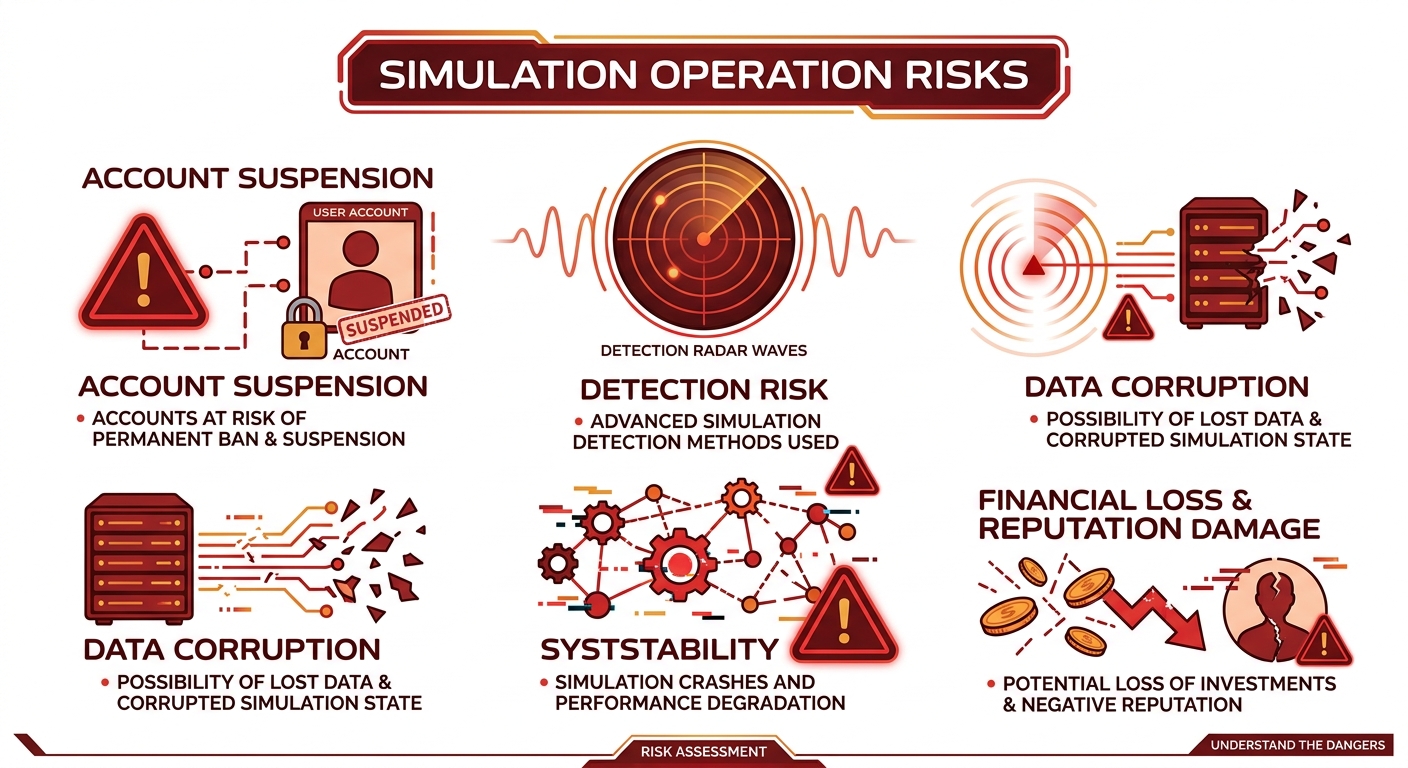
Risks of simulation operations: Account bans, data breaches, legal risks
How High Is the Cost of Choosing the Wrong Path?
Account bans are the most direct cost. In 2025, a well-known MCN agency used simulation tools to manage over 200 Instagram accounts, and within three months, 47 were banned, with estimated losses exceeding 3 million yuan. These accounts had accumulated years of followers and content, wiped out overnight. Platform risk control systems are becoming increasingly intelligent — IP fingerprints, device fingerprints, behavior patterns, any anomalous dimension can trigger a ban. Worse still, bans are often连锁 reactions — when one account is banned, associated accounts are also implicated.
Data breaches are the most hidden cost. Simulation tools need to store your account passwords to simulate login. In 2024, a domestic social media management tool was exposed for storing user credentials in plaintext, leading to thousands of accounts being stolen. These accounts were used to publish spam and fraudulent messages, and the original account owners could even face legal liability. Official APIs use OAuth authorization — the tool never gets your password, eliminating the risk of password leaks at the source. In the OAuth authorization flow, users only need to click "Allow" on the platform's official page, and the tool receives a limited-permission access token, not the password itself. Even if the tool is compromised, only the token is lost, which can be revoked at any time — the account password remains secure.
Legal risks are the most severe cost. In 2025, the US FTC fined a company $5 million for using crawlers to scrape LinkedIn data. In China, after the implementation of the Data Security Law and the Personal Information Protection Law, unauthorized data scraping can face criminal liability. In 2025, the founder of a Hangzhou company was sentenced to 3 years in prison for using crawlers to scrape Weibo user data. These cases show that simulation operations are not just a technical issue — they are a legal issue.
Business interruption is the most devastating cost. Account bans, data loss, legal disputes — any of these can bring business to a halt. For brands that rely on social media for customer acquisition, this could be a death blow. On the day Li Min's company was banned, Taobao store visitors dropped by 52%, with sales losses of 180,000 yuan. This kind of loss cannot be recovered in a few days. Later, she chose SocialEcho, and through features like comment management and scheduled publishing, not only recovered traffic within 3 months but also doubled engagement rates.
Why Do Some People Still Choose Simulation Operations?
Since the risks are so great, why do some tools still choose simulation operations? This question is worth pondering.
Some platforms' official APIs have extremely high thresholds, only open to a few partners. Domestic platforms like Xiaohongshu and Douyin require enterprise credentials and business scale reviews for API applications — small tool developers can't get API permissions and can only resort to simulation operations. This "forced" choice may seem reasonable in the short term, but in the long run, the risks are enormous.
Official APIs often have limited functionality — they may not support certain advanced operations, or data fields may be incomplete. Simulation operations can "do whatever they want," achieving more features. For example, bulk following, bulk private messaging, scraping non-public data. But these "features" are essentially challenging platform rules, and once the platform discovers them, they will not show mercy.
Applying for API credentials requires enterprise credentials, review cycles, and possibly fees. Simulation operations have "zero threshold" and low development costs. Many small teams choose simulation operations to launch quickly. But low cost doesn't mean low total cost — ban losses, maintenance costs, legal risks, these hidden costs often far exceed the subscription price difference.
How to Identify Whether a Tool Uses API or Simulation?
Legitimate tools will clearly state they use official APIs. If customer service is evasive, saying "this is our core technology and cannot be disclosed," it's likely simulation operations. You can ask directly: "Which platform's official API do you use? Do you have developer certification?" Legitimate tools will proudly display their credentials.
Tools using APIs will redirect to the platform's official OAuth page during authorization. For example, Facebook's authorization page will show "XXX app requests access to your Facebook account," and you need to click "Allow" to complete authorization. Simulation tools will directly ask you to enter your account password — this is a red flag. Remember: any tool that asks you to directly enter your social media password should be treated with caution.
Check the platform's developer center to see if the tool has official certification. Facebook's App Dashboard, TikTok's Developer Portal, X's Developer Portal — all can query certified applications. If the tool is not on the list, it means it's not using the official API. SocialEcho has official certification on all major platforms.
APIs have clear functional boundaries. If a tool claims to achieve features that even the platform officially doesn't support, such as "bulk follow strangers" or "auto-DM non-followers," be cautious. These features are likely achieved through simulation operations and carry extremely high risks.
Conclusion
Back to the opening question — official API vs simulation operation, which path to choose?
The answer is clear. Official APIs are legitimate passes, safe and reliable, beneficial in the long run. Simulation operations are backdoor routes, momentarily satisfying, but account bans are only a matter of time.
Li Min's story tells us: choosing the right path is more important than walking fast.
Can your social media accounts survive even one ban?
Free Trial: 7 days SocialEcho Official API Powered
FAQ
Q1: What is the biggest difference between official APIs and simulation operations?
The authorization method. Official APIs are actively opened by platforms to developers, with clear permission scopes and usage rules. Simulation operations bypass the platform and directly simulate user behavior — essentially challenging platform rules.
Q2: Will using simulation operations definitely result in account bans?
Not necessarily, but the risk is extremely high. In 2025, the ban rate for simulation users was 45%, compared to only 0.2% for API users. Platform risk control systems are constantly upgrading, and the survival space for simulation operations is shrinking.
Q3: How can I confirm whether the tool I'm using is safe?
Check whether it uses official APIs, verify if the authorization process redirects to the platform's OAuth page, and query the platform's developer center certification list. Legitimate tools will proactively provide this information.
Q4: Is migrating from simulation operations to APIs complex?
It depends on account scale. Small matrices of 5-10 accounts take about 1-2 weeks, medium matrices of 10-50 accounts take 2-4 weeks, and large matrices of 50+ accounts take 4-8 weeks.
Q5: What is the approximate price for API tools?
Depending on features and services, ranging from 3,000 to 20,000 per month. But calculating total cost (including maintenance, ban losses, data losses), API tools are actually 72% cheaper than simulation operations.
Word count: approximately 3,500 words
;}.cls-2{fill:%230868f7;}.cls-3{fill:url(%23未命名的渐变_44);}.cls-4{fill:%23333;}%3c/style%3e%3clinearGradient%20id='未命名的渐变_8'%20x1='33.73'%20y1='100.61'%20x2='-0.03'%20y2='-1.06'%20gradientUnits='userSpaceOnUse'%3e%3cstop%20offset='0'%20stop-color='%237ae9fb'/%3e%3cstop%20offset='0.67'%20stop-color='%232b90f8'/%3e%3cstop%20offset='1'%20stop-color='%230868f7'/%3e%3c/linearGradient%3e%3clinearGradient%20id='未命名的渐变_44'%20x1='27.86'%20y1='18.67'%20x2='68.36'%20y2='22.22'%20gradientUnits='userSpaceOnUse'%3e%3cstop%20offset='0'%20stop-color='%235ac7f2'/%3e%3cstop%20offset='1'%20stop-color='%230868f7'/%3e%3c/linearGradient%3e%3c/defs%3e%3cpath%20class='cls-1'%20d='M29,28.74V81.91l-9.51-3.68v0L8.52,74A7.17,7.17,0,0,1,4,67.32V24.54A3.76,3.76,0,0,1,9.08,21Z'/%3e%3cpath%20class='cls-2'%20d='M68.09,78.07a13.15,13.15,0,0,1-17.9,12.06L29,81.91h0V28.74L50.19,37A13.17,13.17,0,0,0,68.08,25.3h0Z'/%3e%3cpath%20class='cls-3'%20d='M68.08,25.3a13.19,13.19,0,0,1-6.73,10.87A13.09,13.09,0,0,1,50.19,37L29,28.74V6A3.76,3.76,0,0,1,34.1,2.52l25.59,9.91A13.22,13.22,0,0,1,68.08,25.3Z'/%3e%3cpath%20class='cls-4'%20d='M129.06,81.76a4.33,4.33,0,0,1-3.19-1.31,4.4,4.4,0,0,1-1.31-3.24V56.86H97.65V77.21a4.36,4.36,0,0,1-1.35,3.2A4.68,4.68,0,0,1,93,81.76a4.32,4.32,0,0,1-3.19-1.31,4.37,4.37,0,0,1-1.32-3.24V27.27A4.58,4.58,0,0,1,89.83,24a4.59,4.59,0,0,1,7.82,3.27V48.15h26.91V27.27A4.58,4.58,0,0,1,125.91,24a4.59,4.59,0,0,1,7.82,3.27V77.21a4.37,4.37,0,0,1-1.36,3.2A4.65,4.65,0,0,1,129.06,81.76Z'/%3e%3cpath%20class='cls-4'%20d='M163.77,81.66c-6.57,0-11.76-1.92-15.44-5.7s-5.54-9.07-5.54-15.74a26.76,26.76,0,0,1,2.09-10.43,17.72,17.72,0,0,1,6.67-8.06,19.15,19.15,0,0,1,10.68-2.95,19,19,0,0,1,10.46,2.8,18.7,18.7,0,0,1,6.55,7.36,22.53,22.53,0,0,1,2.36,10.28A4.51,4.51,0,0,1,177,63.77H152.23a10.8,10.8,0,0,0,3.49,6.65c2,1.68,4.88,2.52,8.66,2.52a22.25,22.25,0,0,0,7.54-1.21c.74-.3,1.55-.67,2.37-1.07a3.75,3.75,0,0,1,1.84-.4,4.09,4.09,0,0,1,3,1.15,4,4,0,0,1,1.12,3,4.38,4.38,0,0,1-2.58,3.82,32.34,32.34,0,0,1-6.36,2.61A28.67,28.67,0,0,1,163.77,81.66ZM172.4,55.9a9.72,9.72,0,0,0-1.63-4.56A9.9,9.9,0,0,0,167,48a10.38,10.38,0,0,0-4.64-1.14,12,12,0,0,0-4.77,1.06,9.54,9.54,0,0,0-4.89,5.66,11.78,11.78,0,0,0-.51,2.3Z'/%3e%3cpath%20class='cls-4'%20d='M193,81.64a4.49,4.49,0,0,1-4.51-4.55V27.28A4.58,4.58,0,0,1,189.84,24a4.48,4.48,0,0,1,3.28-1.36A4.36,4.36,0,0,1,196.35,24a4.46,4.46,0,0,1,1.31,3.31V77.09a4.34,4.34,0,0,1-1.35,3.2A4.67,4.67,0,0,1,193,81.64Z'/%3e%3cpath%20class='cls-4'%20d='M263.79,81.71a5.7,5.7,0,0,1-4.2-1.74,5.76,5.76,0,0,1-1.73-4.19V27.37a4.58,4.58,0,0,1,1.35-3.27A4.59,4.59,0,0,1,267,27.37V72.53h24a4.58,4.58,0,0,1,3.27,7.82A4.66,4.66,0,0,1,291,81.71Z'/%3e%3cpath%20class='cls-4'%20d='M424.48,81.74a4.71,4.71,0,0,1-2.71-.88,5.43,5.43,0,0,1-1-1l-.07-.09-12.41-17-5.41,5v9.44a4.31,4.31,0,0,1-1.36,3.19,4.66,4.66,0,0,1-3.3,1.36A4.29,4.29,0,0,1,395,80.42a4.36,4.36,0,0,1-1.32-3.23V27.37A4.58,4.58,0,0,1,395,24.1a4.52,4.52,0,0,1,6.58.12,4.54,4.54,0,0,1,1.24,3.15V56.31l17.72-16.38.05,0a4.8,4.8,0,0,1,2.94-1.11,4.4,4.4,0,0,1,3.27,1.2,4.57,4.57,0,0,1,1.2,3.27,4.44,4.44,0,0,1-.77,2.33,7.45,7.45,0,0,1-1.43,1.65l-11,9.64,13.34,17.68a5,5,0,0,1,1,2.71,4.12,4.12,0,0,1-1.36,3.24A4.64,4.64,0,0,1,424.48,81.74Z'/%3e%3cpath%20class='cls-4'%20d='M317.93,81.76a21.5,21.5,0,1,1,21.17-21.5A21.37,21.37,0,0,1,317.93,81.76Zm0-34.1a12.61,12.61,0,1,0,12.42,12.6A12.52,12.52,0,0,0,317.93,47.66Z'/%3e%3cpath%20class='cls-4'%20d='M212.18,101.22a4.12,4.12,0,0,1-3.05-1.26,4.17,4.17,0,0,1-1.26-3.1V43.34a4.37,4.37,0,0,1,1.3-3.14,4.26,4.26,0,0,1,3.13-1.3,4.19,4.19,0,0,1,3.1,1.26,4.32,4.32,0,0,1,1.26,3.16,20.77,20.77,0,0,1,13-4.54,21.51,21.51,0,0,1,0,43,20.51,20.51,0,0,1-13-4.57V96.86a4.15,4.15,0,0,1-1.3,3.06A4.5,4.5,0,0,1,212.18,101.22Zm17.43-53.63c-6.23,0-12.93,4.11-12.93,12.72a12.73,12.73,0,0,0,25.46,0A12.71,12.71,0,0,0,229.61,47.59Z'/%3e%3cpath%20class='cls-4'%20d='M365.76,81.76a21.5,21.5,0,1,1,21.18-21.5A21.37,21.37,0,0,1,365.76,81.76Zm0-34.1a12.61,12.61,0,1,0,12.42,12.6A12.52,12.52,0,0,0,365.76,47.66Z'/%3e%3c/svg%3e)