
Localization Content Strategy for Export Brands: Why Does the Same Content Perform So Differently Across Markets?
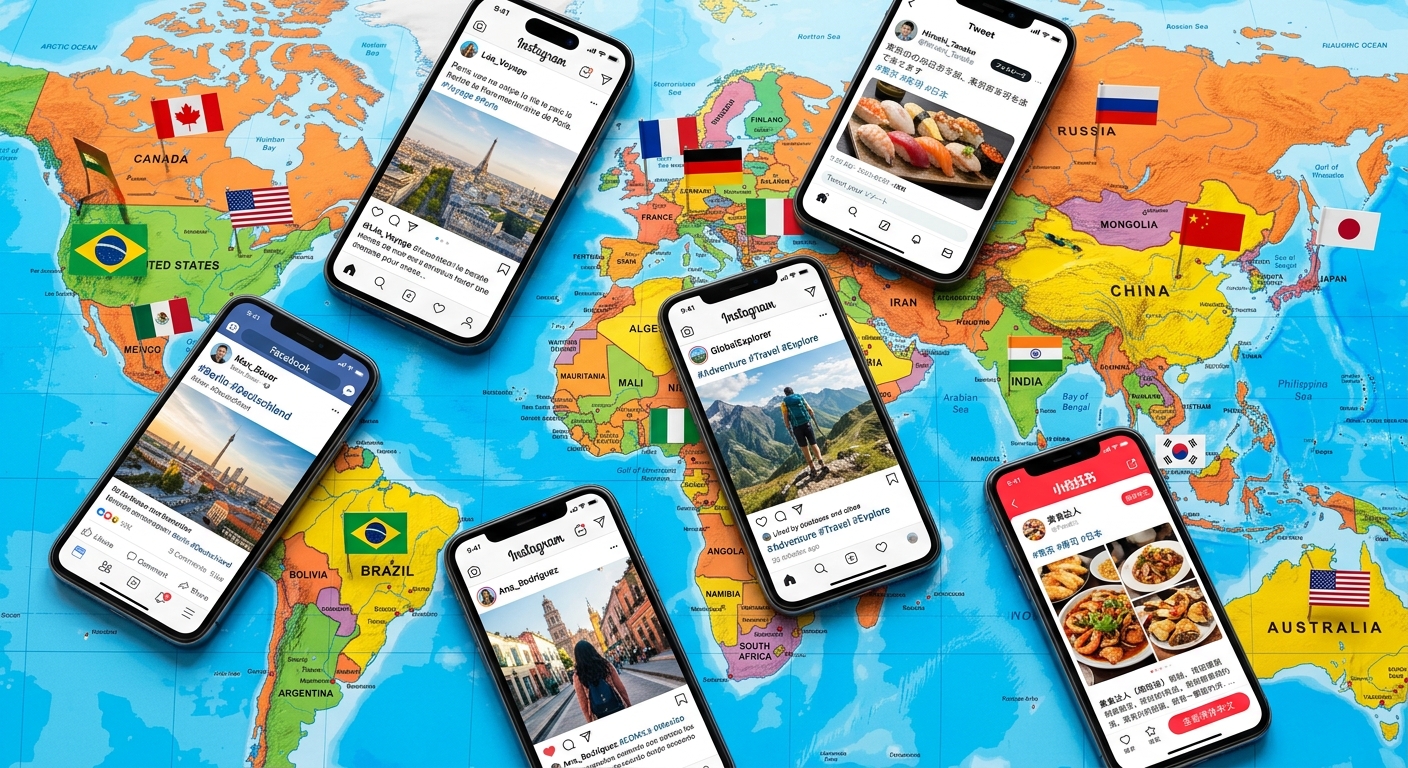
Summer 2025. An export brand for home appliances simultaneously launched identical content in the US and Mexico markets.
Same video, same copy (Spanish direct translation), same posting time.
The US market post performed flat. The same content in the Mexican market had only one-third the engagement.
The brand operations director Duan Wei first reaction was: "Do Mexican users have no demand for this category?"
But later they discovered, local Mexican brand accounts in the same category had 7x their engagement rate.
Demand existed. The problem was the content.
Why Does the Same Content Perform So Differently Across Markets?
This question has multiple layers of answers.
Layer 1: Language Is Not the Same as Culture
Many brands think translating content into the local language is what "localization" means. But language is merely the carrier of culture. Culture is what determines whether content can move people.
In Spanish-speaking markets alone, users in Mexico, Spain, Argentina, and Colombia have significant differences in humor, family values, and consumer decision-making logic.
Content considered "down-to-earth" in Mexico might seem "tacky" in Spain.
Directly translated content often loses the flavor of the original language while failing to融入 local cultural rhythm.
Learn Instagram AI Content Rewrite
Layer 2: Platform Usage Habits Differ
Even on the same platform (such as Instagram), user usage habits differ across markets.
- US users are more receptive to information-dense Carousel posts
- Southeast Asian users prefer content with local celebrity/influencer elements
- Middle East market users have specific content expectations during Ramadan
- Latin American users have higher acceptance of emotional, story-driven content over informational content
Content format designed for the US market, when directly transplanted to other markets, does not even get an "admission ticket."
Layer 3: Purchase Decision Logic Differs
Consumer purchase decision-making methods differ across markets:
- Some markets highly depend on KOL recommendations and word-of-mouth
- Some markets value price signals and promotions
- Some markets family decision-making patterns affect how product use scenarios are presented
Content that does not understand local purchase decision logic, even if distributed, struggles to drive conversions.
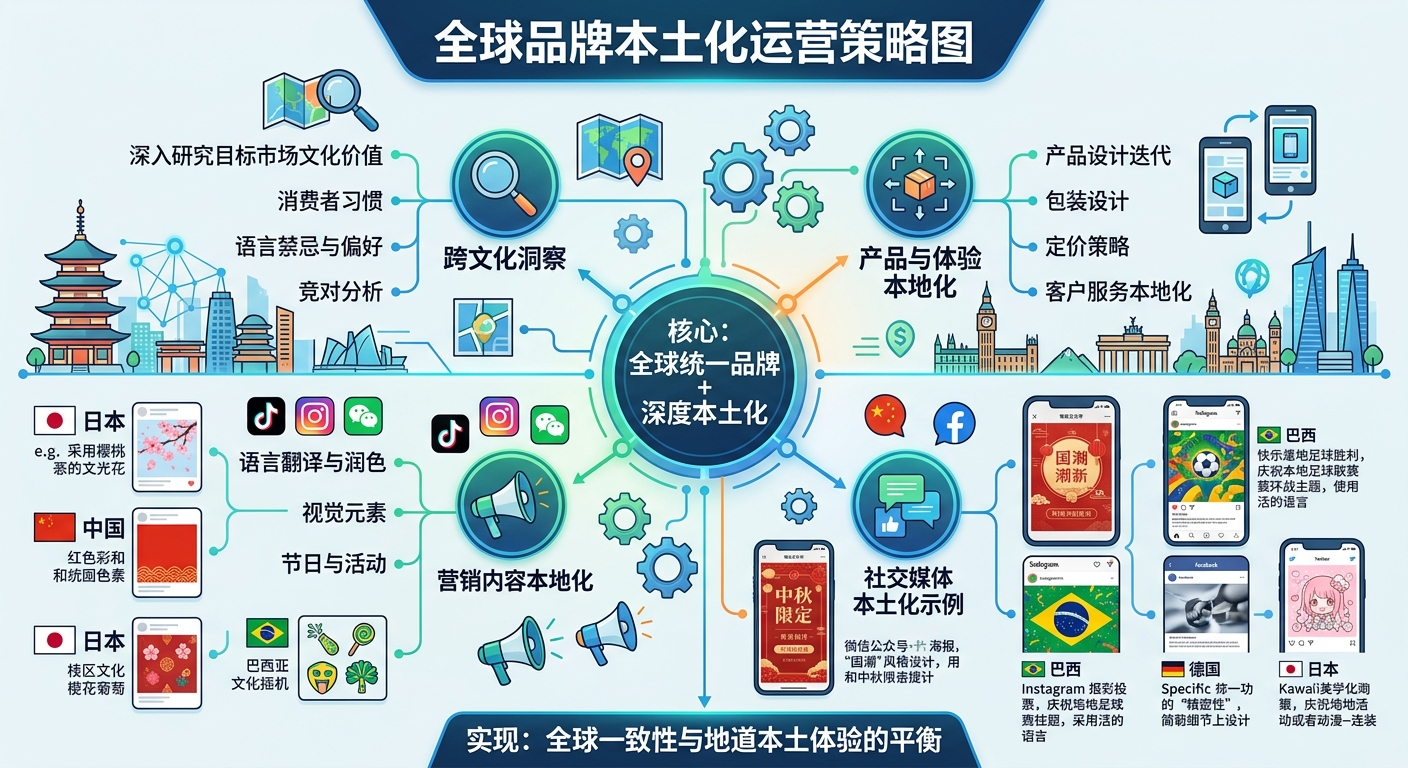
Duan Wei Team Localization Upgrade Path
Returning to the case. After discovering the problem, Duan Wei team underwent a complete localization content strategy restructuring.
Step 1: Market Segmentation, Abandon "One-Size-Fits-All" Strategy
They split the original "English-speaking unified strategy" and "Spanish-speaking unified strategy" into:
- North American English market (US + Canada)
- North American Spanish-speaking market (US Hispanic)
- Mexican market
- Other Latin American markets (Brazil separately, as it is Portuguese-speaking)
Each market has an independent content strategy document, including:
- Target user profile
- Content style guide (tone, humor, emotional expression methods)
- Taboos (cultural minefields that cannot be stepped on)
- High-performing content formats
Learn Facebook AI Content Rewrite
Step 2: Local Content Creation, Not Just Translation
They introduced local content consultants (freelance) in the Mexican market, responsible for:
- Reviewing all content to be published in Mexico
- Providing localization rewrite suggestions
- Confirming content is locally culturally appropriate, not just linguistically
Core shift: Translation is not equal to localization.
Local content creation requires重新 thinking within the target market cultural context:
- What role does this product play in local users daily lives?
- What language and expressions do local users use when discussing this category on social media?
- What kind of content makes local users feel "this is talking about me"?
Learn SocialEcho AI Automation
Step 3: Using AI Tools to Improve Localization Efficiency
After introducing local content consultants, costs increased significantly. To find balance between efficiency and cost, they used AI tools to assist:
- Draft generation: Use English original content, AI rewrites into target market language and style
- Local consultant review: Cultural review and adjustment of AI rewritten content
- Batch rewriting: Localization rewriting of existing large volume of historical content for new markets
This process reduced localization costs by approximately 40%, while quality did not noticeably decline.
Results: Data Comparison Before and After Localization
After transformation, Duan Wei team conducted a 3-month A/B test (Q4 2025):
Mexico market vs. baseline:
- Same content directly published (control group): engagement rate 1.2%
- Localized content (experimental group): engagement rate 4.7%
- Improvement: 291%
US Hispanic market vs. baseline:
- English content directly translated to Spanish (control group): engagement rate 2.1%
- Localized content (experimental group): engagement rate 5.8%
- Improvement: 176%
During the same period, sales also changed noticeably:
- Mexico market monthly sales: +67% (3-month average)
- US Hispanic market monthly sales: +43% (3-month average)
4 Common Localization Mistakes for Export Brands
Mistake 1: Believing "Good English Ability Can Do Export Well"
English ability only helps you do the English market. Doing export well requires not just language ability, but deep understanding of target markets.
Mistake 2: Treating Localization as a Translation Company Business
Translation companies solve language problems, not cultural problems. Good localization requires cultural consultants who understand the target market.
Mistake 3: Only Doing Language Localization, Not Format Localization
Even Instagram Stories, Southeast Asian users and North American users have different expectations for duration, rhythm, and visual style.
Mistake 4: One-Time Localization, Long-Term No Updates
Markets are dynamic. Localization content needs continuous iteration. It is recommended to review localization content performance every quarter.
How to Get Started: Localization Path Suitable for Small Teams
Phase 1 (1-2 months): Deep Localization of Key Market
Select 1 most important overseas market, concentrate resources for complete localization:
- Recruit 1-2 local part-time content consultants
- Build that market content style guide
- Remake core content for that market (do not just translate, recreate)
Phase 2 (3-6 months): Expand Localization Scope
Template and generalize Phase 1 experience, expand to more markets:
- Simplify and standardize the Phase 1 content style guide
- Use AI tools to assist translation and rewriting, reducing local consultant workload
- Gradually expand to 2-3 markets
Phase 3 (Continuous): Build Localization Content Asset Library
Accumulate localization content assets across different markets:
- Build "high-performing content template library" for different markets
- Accumulate popular topics and holiday node calendars for different markets
- Regularly analyze localization content data, continuously optimize strategy
FAQ
Q1: Must localized content be made by locals? Can we learn local culture ourselves?
A:初级 localization can be done through self-study (using target market social media accounts and local KOL content as reference). But deep localization requires "native intuition" — only people who have grown up in that cultural environment for a long time can accurately judge what content will resonate.
Q2: Is localization expensive? Is it worthwhile for small brands?
A: Cost depends on depth. Can start with low cost (use AI tools to assist translation + local consultant review), and deepen investment as market scale grows. The key is to make the right market selection — if a market is large enough, localization investment ROI is definitely positive.
Q3: Translation tools (such as DeepL) are already quite powerful. Is localization still needed?
A: Translation tools solve the problem of "accurately conveying meaning," but cannot solve the problem of "how to express in the local cultural context to resonate." Translation tells you "what the other person said," localization tells you "speak in locals way, and the other person will listen."
Q4: Our product is relatively standardized (such as industrial parts). Is there much localization room?
A: Even industrial B2B products, localization still has value. Differences may not be in "expression style," but in: local market application case displays, local certification standards and compliance information presentation methods, comparison angles with local competitors. These adjustments can still significantly improve content credibility and conversion rate.
Q5: Different markets have different social platform preferences. How should energy be allocated?
A: Refer to target market platform penetration rate data, prioritize investing in the top 1-2 platforms with highest penetration. After achieving results in one market, gradually expand platform and market combinations.
Summary
Export brand localization is not simply translating Chinese content into English — it is a systematic project that requires重新 thinking from a cultural perspective.
The poor performance of directly translated and published content is not because translation quality is insufficient, but because content has not truly entered the target market cultural context.
When localization is done correctly, engagement rates can improve 2-3 times, and corresponding sales conversions will also noticeably change.
This is not icing on the cake — it is a basic capability export brands must build to survive in the competitive global market.
Visit SocialEcho to learn how SocialEcho helps export brands achieve efficient localized content operations.
;}.cls-2{fill:%230868f7;}.cls-3{fill:url(%23未命名的渐变_44);}.cls-4{fill:%23333;}%3c/style%3e%3clinearGradient%20id='未命名的渐变_8'%20x1='33.73'%20y1='100.61'%20x2='-0.03'%20y2='-1.06'%20gradientUnits='userSpaceOnUse'%3e%3cstop%20offset='0'%20stop-color='%237ae9fb'/%3e%3cstop%20offset='0.67'%20stop-color='%232b90f8'/%3e%3cstop%20offset='1'%20stop-color='%230868f7'/%3e%3c/linearGradient%3e%3clinearGradient%20id='未命名的渐变_44'%20x1='27.86'%20y1='18.67'%20x2='68.36'%20y2='22.22'%20gradientUnits='userSpaceOnUse'%3e%3cstop%20offset='0'%20stop-color='%235ac7f2'/%3e%3cstop%20offset='1'%20stop-color='%230868f7'/%3e%3c/linearGradient%3e%3c/defs%3e%3cpath%20class='cls-1'%20d='M29,28.74V81.91l-9.51-3.68v0L8.52,74A7.17,7.17,0,0,1,4,67.32V24.54A3.76,3.76,0,0,1,9.08,21Z'/%3e%3cpath%20class='cls-2'%20d='M68.09,78.07a13.15,13.15,0,0,1-17.9,12.06L29,81.91h0V28.74L50.19,37A13.17,13.17,0,0,0,68.08,25.3h0Z'/%3e%3cpath%20class='cls-3'%20d='M68.08,25.3a13.19,13.19,0,0,1-6.73,10.87A13.09,13.09,0,0,1,50.19,37L29,28.74V6A3.76,3.76,0,0,1,34.1,2.52l25.59,9.91A13.22,13.22,0,0,1,68.08,25.3Z'/%3e%3cpath%20class='cls-4'%20d='M129.06,81.76a4.33,4.33,0,0,1-3.19-1.31,4.4,4.4,0,0,1-1.31-3.24V56.86H97.65V77.21a4.36,4.36,0,0,1-1.35,3.2A4.68,4.68,0,0,1,93,81.76a4.32,4.32,0,0,1-3.19-1.31,4.37,4.37,0,0,1-1.32-3.24V27.27A4.58,4.58,0,0,1,89.83,24a4.59,4.59,0,0,1,7.82,3.27V48.15h26.91V27.27A4.58,4.58,0,0,1,125.91,24a4.59,4.59,0,0,1,7.82,3.27V77.21a4.37,4.37,0,0,1-1.36,3.2A4.65,4.65,0,0,1,129.06,81.76Z'/%3e%3cpath%20class='cls-4'%20d='M163.77,81.66c-6.57,0-11.76-1.92-15.44-5.7s-5.54-9.07-5.54-15.74a26.76,26.76,0,0,1,2.09-10.43,17.72,17.72,0,0,1,6.67-8.06,19.15,19.15,0,0,1,10.68-2.95,19,19,0,0,1,10.46,2.8,18.7,18.7,0,0,1,6.55,7.36,22.53,22.53,0,0,1,2.36,10.28A4.51,4.51,0,0,1,177,63.77H152.23a10.8,10.8,0,0,0,3.49,6.65c2,1.68,4.88,2.52,8.66,2.52a22.25,22.25,0,0,0,7.54-1.21c.74-.3,1.55-.67,2.37-1.07a3.75,3.75,0,0,1,1.84-.4,4.09,4.09,0,0,1,3,1.15,4,4,0,0,1,1.12,3,4.38,4.38,0,0,1-2.58,3.82,32.34,32.34,0,0,1-6.36,2.61A28.67,28.67,0,0,1,163.77,81.66ZM172.4,55.9a9.72,9.72,0,0,0-1.63-4.56A9.9,9.9,0,0,0,167,48a10.38,10.38,0,0,0-4.64-1.14,12,12,0,0,0-4.77,1.06,9.54,9.54,0,0,0-4.89,5.66,11.78,11.78,0,0,0-.51,2.3Z'/%3e%3cpath%20class='cls-4'%20d='M193,81.64a4.49,4.49,0,0,1-4.51-4.55V27.28A4.58,4.58,0,0,1,189.84,24a4.48,4.48,0,0,1,3.28-1.36A4.36,4.36,0,0,1,196.35,24a4.46,4.46,0,0,1,1.31,3.31V77.09a4.34,4.34,0,0,1-1.35,3.2A4.67,4.67,0,0,1,193,81.64Z'/%3e%3cpath%20class='cls-4'%20d='M263.79,81.71a5.7,5.7,0,0,1-4.2-1.74,5.76,5.76,0,0,1-1.73-4.19V27.37a4.58,4.58,0,0,1,1.35-3.27A4.59,4.59,0,0,1,267,27.37V72.53h24a4.58,4.58,0,0,1,3.27,7.82A4.66,4.66,0,0,1,291,81.71Z'/%3e%3cpath%20class='cls-4'%20d='M424.48,81.74a4.71,4.71,0,0,1-2.71-.88,5.43,5.43,0,0,1-1-1l-.07-.09-12.41-17-5.41,5v9.44a4.31,4.31,0,0,1-1.36,3.19,4.66,4.66,0,0,1-3.3,1.36A4.29,4.29,0,0,1,395,80.42a4.36,4.36,0,0,1-1.32-3.23V27.37A4.58,4.58,0,0,1,395,24.1a4.52,4.52,0,0,1,6.58.12,4.54,4.54,0,0,1,1.24,3.15V56.31l17.72-16.38.05,0a4.8,4.8,0,0,1,2.94-1.11,4.4,4.4,0,0,1,3.27,1.2,4.57,4.57,0,0,1,1.2,3.27,4.44,4.44,0,0,1-.77,2.33,7.45,7.45,0,0,1-1.43,1.65l-11,9.64,13.34,17.68a5,5,0,0,1,1,2.71,4.12,4.12,0,0,1-1.36,3.24A4.64,4.64,0,0,1,424.48,81.74Z'/%3e%3cpath%20class='cls-4'%20d='M317.93,81.76a21.5,21.5,0,1,1,21.17-21.5A21.37,21.37,0,0,1,317.93,81.76Zm0-34.1a12.61,12.61,0,1,0,12.42,12.6A12.52,12.52,0,0,0,317.93,47.66Z'/%3e%3cpath%20class='cls-4'%20d='M212.18,101.22a4.12,4.12,0,0,1-3.05-1.26,4.17,4.17,0,0,1-1.26-3.1V43.34a4.37,4.37,0,0,1,1.3-3.14,4.26,4.26,0,0,1,3.13-1.3,4.19,4.19,0,0,1,3.1,1.26,4.32,4.32,0,0,1,1.26,3.16,20.77,20.77,0,0,1,13-4.54,21.51,21.51,0,0,1,0,43,20.51,20.51,0,0,1-13-4.57V96.86a4.15,4.15,0,0,1-1.3,3.06A4.5,4.5,0,0,1,212.18,101.22Zm17.43-53.63c-6.23,0-12.93,4.11-12.93,12.72a12.73,12.73,0,0,0,25.46,0A12.71,12.71,0,0,0,229.61,47.59Z'/%3e%3cpath%20class='cls-4'%20d='M365.76,81.76a21.5,21.5,0,1,1,21.18-21.5A21.37,21.37,0,0,1,365.76,81.76Zm0-34.1a12.61,12.61,0,1,0,12.42,12.6A12.52,12.52,0,0,0,365.76,47.66Z'/%3e%3c/svg%3e)