
Improving overseas social media operational efficiency by 10 times: 5 proven key strategies
Improving overseas social media operational efficiency tenfold: 5 proven key strategies
Overseas social media operations intelligence agents are key tools that help operations personnel improve efficiency. Wang Fang is a marketing manager for a DTC brand, responsible for the operation of five overseas social media platforms.
Every morning at 8 o'clock, she turns on her computer and begins her day's "battle"—
She logged into the backends of five platforms, published content, replied to comments, checked data, and prepared weekly reports. At 8 p.m., she finally shut down her computer, but her mind was still preoccupied with what to publish the next day.
She works more than 10 hours a day, including weekends. Her boss still thinks she's inefficient.
This is a typical day for many social media operators. However, overseas social media operation AI can help you increase efficiency by 10 times.
In this article, we share 5 proven productivity strategies to help you reduce your daily work from 10 hours to 1 hour.
Strategy 1: Use social media management tools to manage all your social media accounts from a single backend.
1.1 The Efficiency Nightmare of Manual Management
When you manually manage multiple platforms, a significant amount of time is wasted on:
- Log in and switch between different platform backends
- Repeated operations on different interfaces
- Manually copy and paste content to various platforms
- Copy data between various backends to generate reports.
If it takes 10 minutes to operate one platform, then 5 platforms would take 50 minutes. In a day, just "operating" takes up 2-3 hours.
1.2 The power of one back-end management
A social media management platform lets you manage all your platforms from a single backend:
- One interface to publish content to all platforms
- View data from all platforms in one interface
- One interface handles comments from all platforms.
- Automatically generate multi-platform data reports
Efficiency improvement: Saves 2-3 hours of operation time per day.
1.3 Best Practices for Tool Use
Batch content creation: Create all the content to be published this week at once, set the publication time, and let the tool publish automatically.
Use content templates: Create frequently used content templates and modify them each time you create new content, instead of starting from scratch.
Set default settings: Set the default tags and default posting times for each platform to reduce repetitive operations each time.
Strategy Two: Batch Creation, One-Time Preparation for Continuous Output
2.1 Inefficiency of ad-hoc creation
Many people create content the same way they do: they think of something today and post it today. They come up with a theme, write the text, and add pictures on the fly.
This method is very inefficient—each creative process involves a "cold start," and the brain needs time to get into the zone.
2.2 High efficiency of batch creation
Batch creation involves concentrating the time spent on content creation and creating a batch of content at once.
Time Segmentation: A fixed time each week (e.g., Friday afternoon) is dedicated to creating content for the following week. Other times are used only for publishing and interaction.
Content creation template: Create a content creation template (introduction + key points + conclusion), so that you only need to fill in the content each time you create content instead of thinking about the structure.
Content reuse: A long article can be split into multiple tweets, and an image can be posted on multiple platforms, allowing for multiple uses from a single creation.
Efficiency improvement: Content creation time reduced by 60%.
Intelligent automation tools can help you:
Strategy 3: Intelligent Automation – Let Tools Do the Work for You
3.1 Automated Deployment
Scheduled publishing is the most basic form of automation—set the publishing time, and the tool will publish automatically, so you don't need to be in front of your computer.
But a more advanced level of automation is:
Content reuse automation: A blog post is automatically split into multiple tweets, and a single tweet is automatically adapted to different platforms.
Cross-platform synchronization automation: After being published on one platform, it is automatically synchronized to other platforms.
Optimal timing automation: Automatically selects the best release time based on historical data.
3.2 Automated Comment Management
Comment management is one of the most time-consuming tasks. Good automation can help you:
Keyword auto-reply: When a user asks "price", the system will automatically reply with price information; when a user asks "features", the system will automatically reply with a feature description.
Sentiment recognition prioritization: AI automatically identifies negative comments and marks them as high priority, allowing the team to handle them first.
FAQ Auto-summarization: Templates the replies to frequently asked questions, and automatically reply to new comments by matching them to the FAQ.
Efficiency improvement: Comment processing time reduced by 80%.
3.3 Automated Data Analysis
Manually creating data reports is one of the most time-consuming tasks. Good automation can help you:
Automatic data aggregation: Data from all platforms is automatically aggregated into a single dashboard, eliminating the need for manual export.
Automatic report generation: Weekly and monthly data reports are automatically generated and sent to your email.
Automatic alerts for anomalies: When abnormal fluctuations occur in the data, you will be automatically notified to pay attention.
Efficiency improvement: Data analysis time reduced by 90%.
IV. Strategy Four: Optimize processes and establish standardized operations

Team collaboration tools can help you:
4.1 The problem of no process
For teams without standardized processes, the problem is:
- Everyone does it differently, and the results vary.
- Knowledge loss during personnel changes
- Unable to scale
4.2 Establishment of Standardized Processes
Establish standardized operating procedures:
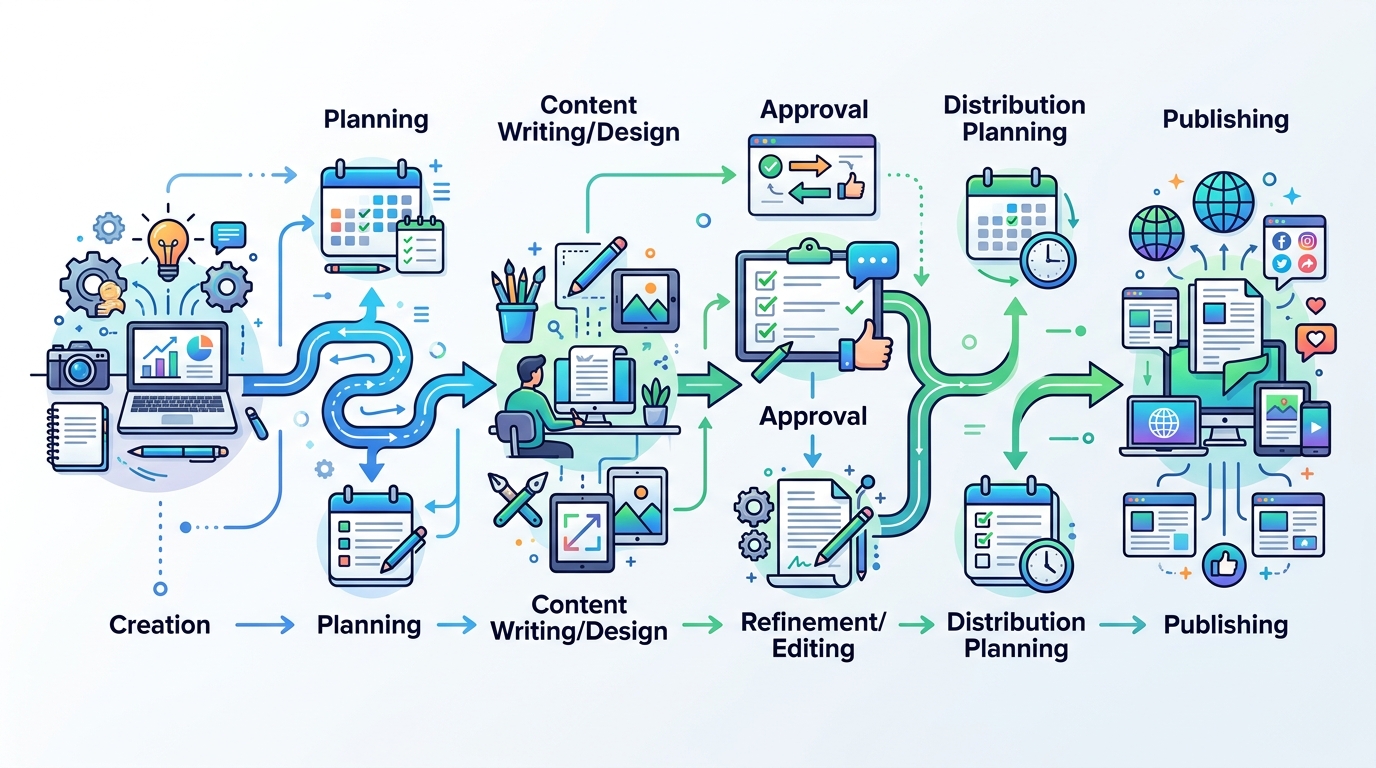
Content creation process: Topic selection → Creation → Review → Revision → Final draft
Content publishing process: Scheduling → Format adaptation → Publishing → Inspection
Data review process: Weekly data → Analysis → Optimization suggestions → Strategy adjustment
Write down the process so that every team member works in the same way.
4.3 Process Documentation
Document the process, including:
- What to do in each step
- What are the standards and requirements?
- Common problems and solutions
New employees can quickly learn and get started when they join the company.
Strategy 5: Focus on high-value work and abandon low-value tasks
5.1 What is high-value work?
In social media operations, different roles have different values:
High-value jobs:
- Create high-quality content
- Analysis of data optimization strategies
- Handling complex customer issues
- Building brand relationships
Low-value jobs:
- Simple repetitive publishing
- Mechanical FAQ
- Manually copy and paste data
- Meaningless social interactions
5.2 Automating low-value tasks
Automate low-value tasks and focus your time on high-value tasks:
Replace with tools: Automate simple deployments with tools. Replace with processes: Establish standardized processes for repetitive tasks . Replace with outsourcing: Use templates or outsource simple image editing.
5.3 Focus on creating value
Focus your time on things that only humans can do:
Strategy Formulation: Determine direction, prioritize key areas, and develop a plan.
Content creation: Write in-depth and insightful content.
Relationship Building: Establishing a genuine emotional connection with users
These are things that tools cannot replace, and these are where real value is created.
VI. Quantitative Results of Efficiency Improvement
The efficiency improvement after implementing these 5 strategies can be quantified:
| Job type | Before optimization | After optimization | Efficiency improvement |
|---|---|---|---|
| Content publishing | 3 hours/day | 0.5 hours/day | 6 times |
| Comment handling | 2 hours/day | 0.5 hours/day | 4 times |
| Data Report | 2 hours/week | 0.5 hours/week | 4 times |
| Content creation | 5 hours/week | 2 hours/week | 2.5 times |
| total | 10+ hours/day | 1-2 hours/day | 5-10 times |
VII. Implementation Path
7.1 Phase 1: Tool Automation (1-2 weeks)
Objective: To automate repetitive tasks
action:
- Select and launch social media management tools
- Set up scheduled publishing
- Set up automatic replies to comments
7.2 Phase Two: Process Standardization (1 month)
Objective: To establish standardized operating procedures.
action:
- Streamline existing workflows
- Create content creation templates
- Write operation documents
7.3 Phase Three: Continuous Optimization (Ongoing)
Goal: Continuously optimize efficiency
action:
- Weekly review of efficiency data
- Identify new efficiency bottlenecks
- Continuous iterative optimization
Conclusion
Improving the efficiency of social media operations is not something that can be achieved overnight, but it is not a difficult task either.
The core principles are: tool automation + batch creation + intelligent automation + process standardization + focusing on high value.
With the right tools and methods, you can reduce a 10-hour workday to 1 hour.
This isn't laziness; it's working smartly. Use the time you save to create real value.
Want to learn more about how social media management agents can improve operational efficiency? You can visit the Overseas Social Media Operation Efficiency Improvement Guide .
Free Trial: 7-Day Full-Featured Experience of SocialEcho
FAQ
Q1: Will automation make content lose its human touch?
A: No. Automation automates repetitive tasks, not all interactions. Key content still requires human review, and complex issues require human handling. Automation allows you to focus your time on what truly requires human creativity.
Q2: Will the cost of tools offset the value of efficiency improvements?
A: Good tools are worth the cost. If a tool costs $100 per month but saves you 5 hours a day, that's 100+ hours a month. The value of the increased efficiency far outweighs the cost of the tool.
Q3: Do small teams need such a complicated process?
A: No. The complexity of the process should match the team size. Small teams can focus on the 1-2 core strategies first—tool automation and batch creation. More complete processes can be gradually built as the team expands.
Q4: How do you determine which tasks should be automated?
A: Ask yourself two questions: 1) Is this job repetitive and routine? 2) Does this job require creativity? If the answer to both is "no", then it can most likely be automated.
Q5: What do you do with the extra time after the efficiency is improved?
A: Focus on higher-value work: in-depth data analysis to optimize strategies, create higher-quality content, build deeper user relationships, and plan for long-term brand building. These are where you truly create differentiated value.
Word count: Approximately 3500 words
;}.cls-2{fill:%230868f7;}.cls-3{fill:url(%23未命名的渐变_44);}.cls-4{fill:%23333;}%3c/style%3e%3clinearGradient%20id='未命名的渐变_8'%20x1='33.73'%20y1='100.61'%20x2='-0.03'%20y2='-1.06'%20gradientUnits='userSpaceOnUse'%3e%3cstop%20offset='0'%20stop-color='%237ae9fb'/%3e%3cstop%20offset='0.67'%20stop-color='%232b90f8'/%3e%3cstop%20offset='1'%20stop-color='%230868f7'/%3e%3c/linearGradient%3e%3clinearGradient%20id='未命名的渐变_44'%20x1='27.86'%20y1='18.67'%20x2='68.36'%20y2='22.22'%20gradientUnits='userSpaceOnUse'%3e%3cstop%20offset='0'%20stop-color='%235ac7f2'/%3e%3cstop%20offset='1'%20stop-color='%230868f7'/%3e%3c/linearGradient%3e%3c/defs%3e%3cpath%20class='cls-1'%20d='M29,28.74V81.91l-9.51-3.68v0L8.52,74A7.17,7.17,0,0,1,4,67.32V24.54A3.76,3.76,0,0,1,9.08,21Z'/%3e%3cpath%20class='cls-2'%20d='M68.09,78.07a13.15,13.15,0,0,1-17.9,12.06L29,81.91h0V28.74L50.19,37A13.17,13.17,0,0,0,68.08,25.3h0Z'/%3e%3cpath%20class='cls-3'%20d='M68.08,25.3a13.19,13.19,0,0,1-6.73,10.87A13.09,13.09,0,0,1,50.19,37L29,28.74V6A3.76,3.76,0,0,1,34.1,2.52l25.59,9.91A13.22,13.22,0,0,1,68.08,25.3Z'/%3e%3cpath%20class='cls-4'%20d='M129.06,81.76a4.33,4.33,0,0,1-3.19-1.31,4.4,4.4,0,0,1-1.31-3.24V56.86H97.65V77.21a4.36,4.36,0,0,1-1.35,3.2A4.68,4.68,0,0,1,93,81.76a4.32,4.32,0,0,1-3.19-1.31,4.37,4.37,0,0,1-1.32-3.24V27.27A4.58,4.58,0,0,1,89.83,24a4.59,4.59,0,0,1,7.82,3.27V48.15h26.91V27.27A4.58,4.58,0,0,1,125.91,24a4.59,4.59,0,0,1,7.82,3.27V77.21a4.37,4.37,0,0,1-1.36,3.2A4.65,4.65,0,0,1,129.06,81.76Z'/%3e%3cpath%20class='cls-4'%20d='M163.77,81.66c-6.57,0-11.76-1.92-15.44-5.7s-5.54-9.07-5.54-15.74a26.76,26.76,0,0,1,2.09-10.43,17.72,17.72,0,0,1,6.67-8.06,19.15,19.15,0,0,1,10.68-2.95,19,19,0,0,1,10.46,2.8,18.7,18.7,0,0,1,6.55,7.36,22.53,22.53,0,0,1,2.36,10.28A4.51,4.51,0,0,1,177,63.77H152.23a10.8,10.8,0,0,0,3.49,6.65c2,1.68,4.88,2.52,8.66,2.52a22.25,22.25,0,0,0,7.54-1.21c.74-.3,1.55-.67,2.37-1.07a3.75,3.75,0,0,1,1.84-.4,4.09,4.09,0,0,1,3,1.15,4,4,0,0,1,1.12,3,4.38,4.38,0,0,1-2.58,3.82,32.34,32.34,0,0,1-6.36,2.61A28.67,28.67,0,0,1,163.77,81.66ZM172.4,55.9a9.72,9.72,0,0,0-1.63-4.56A9.9,9.9,0,0,0,167,48a10.38,10.38,0,0,0-4.64-1.14,12,12,0,0,0-4.77,1.06,9.54,9.54,0,0,0-4.89,5.66,11.78,11.78,0,0,0-.51,2.3Z'/%3e%3cpath%20class='cls-4'%20d='M193,81.64a4.49,4.49,0,0,1-4.51-4.55V27.28A4.58,4.58,0,0,1,189.84,24a4.48,4.48,0,0,1,3.28-1.36A4.36,4.36,0,0,1,196.35,24a4.46,4.46,0,0,1,1.31,3.31V77.09a4.34,4.34,0,0,1-1.35,3.2A4.67,4.67,0,0,1,193,81.64Z'/%3e%3cpath%20class='cls-4'%20d='M263.79,81.71a5.7,5.7,0,0,1-4.2-1.74,5.76,5.76,0,0,1-1.73-4.19V27.37a4.58,4.58,0,0,1,1.35-3.27A4.59,4.59,0,0,1,267,27.37V72.53h24a4.58,4.58,0,0,1,3.27,7.82A4.66,4.66,0,0,1,291,81.71Z'/%3e%3cpath%20class='cls-4'%20d='M424.48,81.74a4.71,4.71,0,0,1-2.71-.88,5.43,5.43,0,0,1-1-1l-.07-.09-12.41-17-5.41,5v9.44a4.31,4.31,0,0,1-1.36,3.19,4.66,4.66,0,0,1-3.3,1.36A4.29,4.29,0,0,1,395,80.42a4.36,4.36,0,0,1-1.32-3.23V27.37A4.58,4.58,0,0,1,395,24.1a4.52,4.52,0,0,1,6.58.12,4.54,4.54,0,0,1,1.24,3.15V56.31l17.72-16.38.05,0a4.8,4.8,0,0,1,2.94-1.11,4.4,4.4,0,0,1,3.27,1.2,4.57,4.57,0,0,1,1.2,3.27,4.44,4.44,0,0,1-.77,2.33,7.45,7.45,0,0,1-1.43,1.65l-11,9.64,13.34,17.68a5,5,0,0,1,1,2.71,4.12,4.12,0,0,1-1.36,3.24A4.64,4.64,0,0,1,424.48,81.74Z'/%3e%3cpath%20class='cls-4'%20d='M317.93,81.76a21.5,21.5,0,1,1,21.17-21.5A21.37,21.37,0,0,1,317.93,81.76Zm0-34.1a12.61,12.61,0,1,0,12.42,12.6A12.52,12.52,0,0,0,317.93,47.66Z'/%3e%3cpath%20class='cls-4'%20d='M212.18,101.22a4.12,4.12,0,0,1-3.05-1.26,4.17,4.17,0,0,1-1.26-3.1V43.34a4.37,4.37,0,0,1,1.3-3.14,4.26,4.26,0,0,1,3.13-1.3,4.19,4.19,0,0,1,3.1,1.26,4.32,4.32,0,0,1,1.26,3.16,20.77,20.77,0,0,1,13-4.54,21.51,21.51,0,0,1,0,43,20.51,20.51,0,0,1-13-4.57V96.86a4.15,4.15,0,0,1-1.3,3.06A4.5,4.5,0,0,1,212.18,101.22Zm17.43-53.63c-6.23,0-12.93,4.11-12.93,12.72a12.73,12.73,0,0,0,25.46,0A12.71,12.71,0,0,0,229.61,47.59Z'/%3e%3cpath%20class='cls-4'%20d='M365.76,81.76a21.5,21.5,0,1,1,21.18-21.5A21.37,21.37,0,0,1,365.76,81.76Zm0-34.1a12.61,12.61,0,1,0,12.42,12.6A12.52,12.52,0,0,0,365.76,47.66Z'/%3e%3c/svg%3e)