
A Must-Read for E-commerce Platforms: Planable vs SocialEcho – Which One Can Truly Eliminate the Hassle of Client Review Processes?
Lily, who has been working in content marketing for 3 years, manages 11 client accounts at the same time. Every time she pushes out a content plan, she has to go through the process of "sending a WeChat message → the client didn't see it → chasing again → revising three versions → finally using the first version". Just the review process alone consumes 40% of her working time each month.
If you're also involved in social media account management, this scenario is probably familiar. The peer review process is the biggest killer of efficiency for account management services. Today, we'll discuss two mainstream tools—Planable and SocialEcho—and see which one can truly help you cut out the hassle of client peer review.
Crisis: The "Plaintiffing Hell" of Outsourced Content Management—Where is the Time Black Hole?
Typical scenario: The nightmare of peer reviewing in WeChat groups
Every e-commerce service provider has had this experience:
- Send a screenshot of this week's calendar to the WeChat group.
- After waiting for two days, the customer said, "I haven't seen it."
- I resent it, and the client said, "Change the third point."
- After making the changes and sending it over, the client said, "Oh, then let's use the original version."
- On the day of the official release, the client suddenly said, "I remember we said we were going to make changes?"
Throughout this process, communication records are scattered across WeChat, email, and Lark. Who changed which version and which version the client ultimately confirmed all depend on luck.
The same applies to WhatsApp groups. Taking screenshots for record-keeping can easily lead to information being buried by subsequent messages, making it extremely difficult to find historical peer review records – like searching for a needle in a haystack.
Data Speaks: How Low is the Efficiency of Outsourced Article Review?
According to industry survey data, on average, outsourced service providers conduct as many as 4.7 rounds of review per project , with each communication session taking an average of 1.2 working hours. Assuming a medium-sized outsourced service provider manages 10 client projects, this translates to nearly 50 hours of review and communication per month – equivalent to more than 30% of a full-time employee's monthly working hours.
Worse still, this internal friction intensifies as the team grows. While a small team of three can rely on human memory to mitigate the problem, when the team expands to ten people and manages 30 client accounts, version confusion, information misalignment, and lost review records become commonplace incidents.
Conclusion: Without optimizing the peer review process, the larger the team, the greater the internal friction.
The core competitiveness of content creation agencies lies not only in content quality but also in process efficiency . Without optimizing the review process, hiring more people will only dilute efficiency rather than build economies of scale.
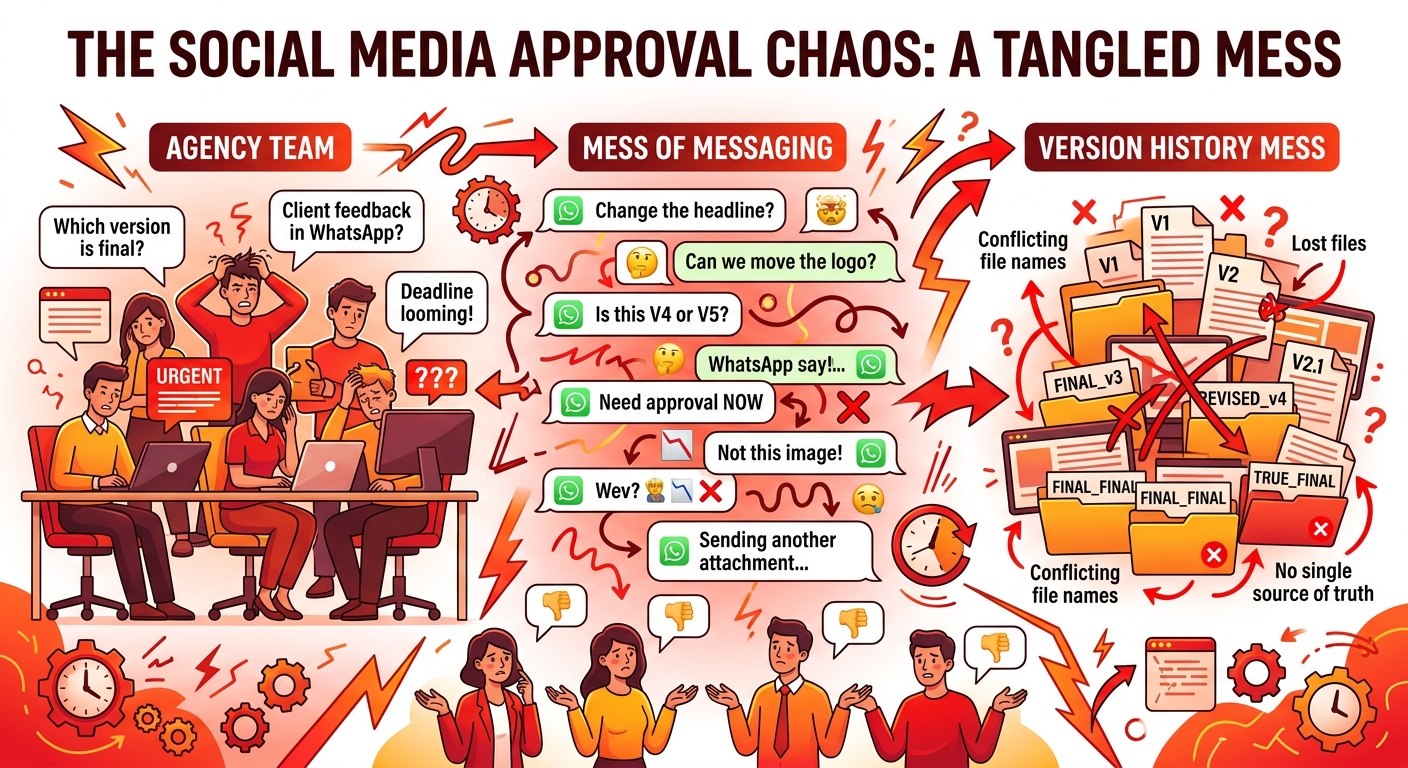
The chaotic review process of third-party review agencies is often the biggest black hole in efficiency.
Struggle: The Advantages and Limitations of Planable
Faced with the hell of peer review, many content management agencies' first thought is Planable —a social media management tool specifically designed for content teams and agencies. While Planable has indeed solved some problems, it has also introduced new limitations.
If you want to systematically understand the selection logic of agency operation tools, you can first read this article: Agency Operation Tool Selection Guide , which provides a complete overview of mainstream tools.
Planable's three major advantages
1. The Planable visual content calendar provides an intuitive view of the content calendar, allowing team members to clearly see the schedule for each platform and avoid publishing conflicts. This is a core requirement for agencies managing multiple brand accounts simultaneously.
2. Planable's personalized client feedback interface generates a unique review link for each client, allowing them to leave comments and annotations directly without needing to register an account. This significantly improves the user experience compared to communicating via screenshots in WeChat groups.
Three major limitations of Planable
However, Planable is not without its problems. For third-party service providers, there are three unavoidable pain points:
Limitation 1: High posting limit + high payment threshold
The free version of Planable only allows 50 posts per month. For account management services covering more than 10 client accounts, 50 posts are simply not enough. Once this limit is exceeded, an upgrade to the paid version is necessary.
Planable pricing:
- Basic version: $33/month (supports only 1 workspace)
- Agency version: Starting from $83/month (multiple workspaces, but charged per seat)
For a small, newly established agency, the $83/month Agency plan is a significant expense, and the cost will continue to rise as the team expands.
Limitation 2: Incomplete platform coverage
Planable supports mainstream platforms such as Facebook, Instagram, Twitter/X, and LinkedIn, but its direct posting support for emerging platforms like TikTok and Pinterest is limited, requiring manual operation for some platforms. This is a significant drawback for clients who need full platform coverage.
For a detailed comparison of multi-platform publishing tools, please refer to: Comparison of Multi-Platform Operation Tools .
Limitation 3: Weak data analysis capabilities
Planable's core focus is on content planning and approval, with relatively basic data analytics capabilities. Agencies need to provide monthly reports to clients, but Planable offers limited data dimensions, often requiring additional analytics tools and manual data integration to create the monthly reports.
This means that the review time you save may be partially consumed by the production of the monthly report.
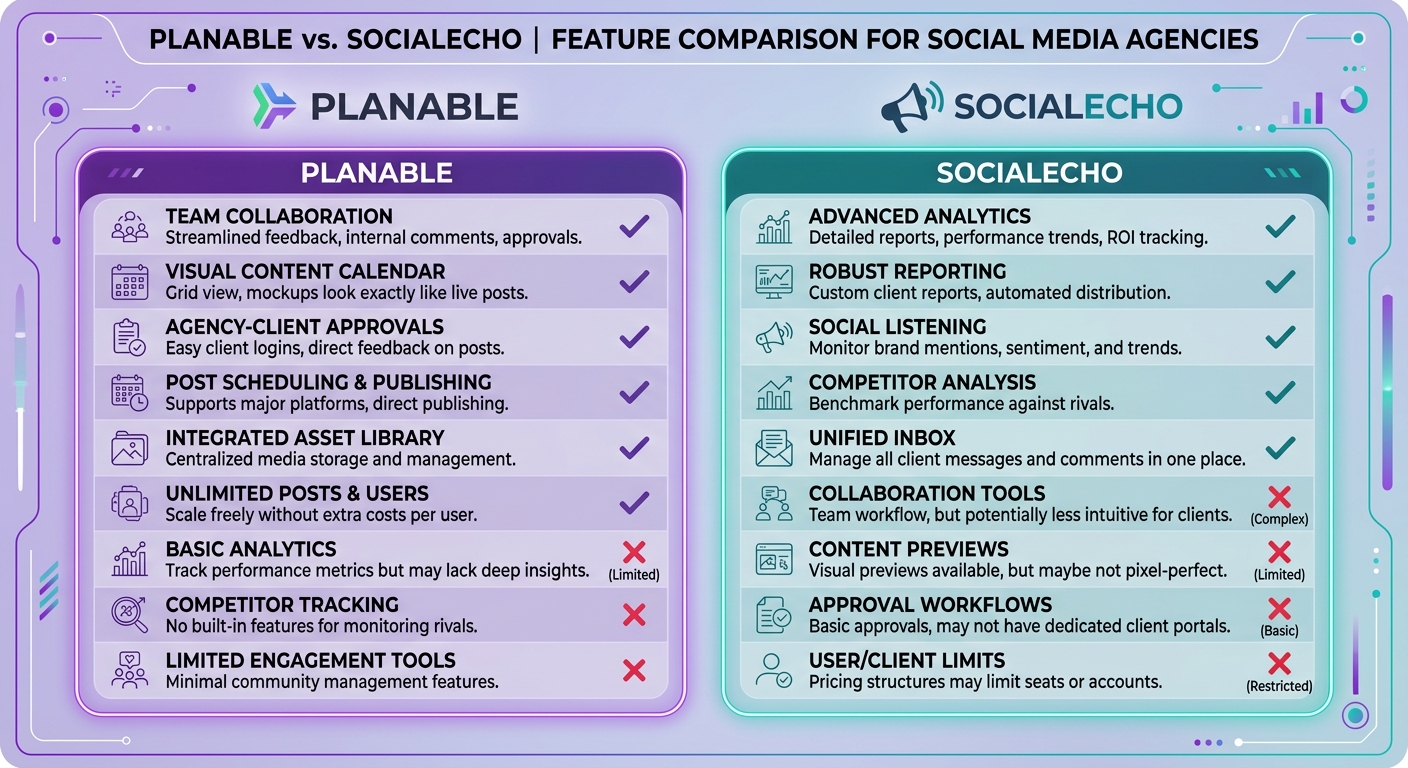
Planable has solved some peer review issues, but pricing and feature completeness remain potential risks for third-party operation services.
Breaking the deadlock: SocialEcho's solution through outsourced operations
Just when Lily was about to give up on optimizing the peer review process, her colleague recommended that she try SocialEcho .
SocialEcho is a one-stop social media management platform designed for content teams and agency management services. Its core solution is: AI-assisted content generation + unified management of multiple accounts + built-in approval workflow . These three modules are seamlessly integrated, improving the efficiency of the entire agency management process.
Key Feature Comparison: Planable vs SocialEcho
| Functional dimensions | Planable | SocialEcho |
|---|---|---|
| Client review process | ✅ Dedicated peer review link; clients can leave comments. | ✅ Built-in approval workflow, supporting multi-level approval |
| Multi-account management | ✅ Supports multiple workspaces (Agency version) | ✅ Unified panel management of all customer accounts |
| AI content generation | ❌ Not supported | ✅ AI-assisted generation reduces initial draft time |
| Data Report | ⚠️ Basic analysis and monthly reports require manual integration. | ✅ Built-in data report, one-click export |
| Platform Coverage | ⚠️ Mainstream platforms, some require manual operation | ✅ Full platform coverage, direct publishing |
| Price (starting price) | 33/month (basic) / 83/month (Agency) | Starting at 12.50/month, team plan starting at 18.75/month |
| Annual payment discount | Discount available | 20% off annual payment |
Real-life scenario: Lily's transformation
After Lily integrated with SocialEcho, the peer review process underwent a fundamental change:
- Content creation stage : AI-assisted draft generation reduces creation time by 40%.
- Internal review stage : The team completes the initial review within the platform, eliminating the need to send screenshots to groups.
- Customer approval stage : Customers receive a personalized approval link and can directly add comments or approve the application with one click on the platform.
- Change tracking : All version records are clearly maintained, eliminating confusion about "which version to use".
- Data Reports : Monthly reports are exported directly from the platform, eliminating the need for manual screenshotting and stitching.
Result: Lily's review time decreased from 40% to 12% per month.
She used the 28% of her freed-up work time to take on two new client projects, resulting in a 35% increase in monthly income. For more information on how outsourced operations can achieve revenue growth through process optimization, please refer to: Outsourced Operations Monthly Income Growth Case Studies .
Say goodbye to manual screenshots, monthly reports can be automated.
Another pain point for many e-commerce service providers is the creation of weekly and monthly reports. If your boss or clients require you to manually take screenshots and organize data every time, SocialEcho's built-in reporting function can directly solve this problem.
Related reading: The boss is still manually taking screenshots of the weekly report.
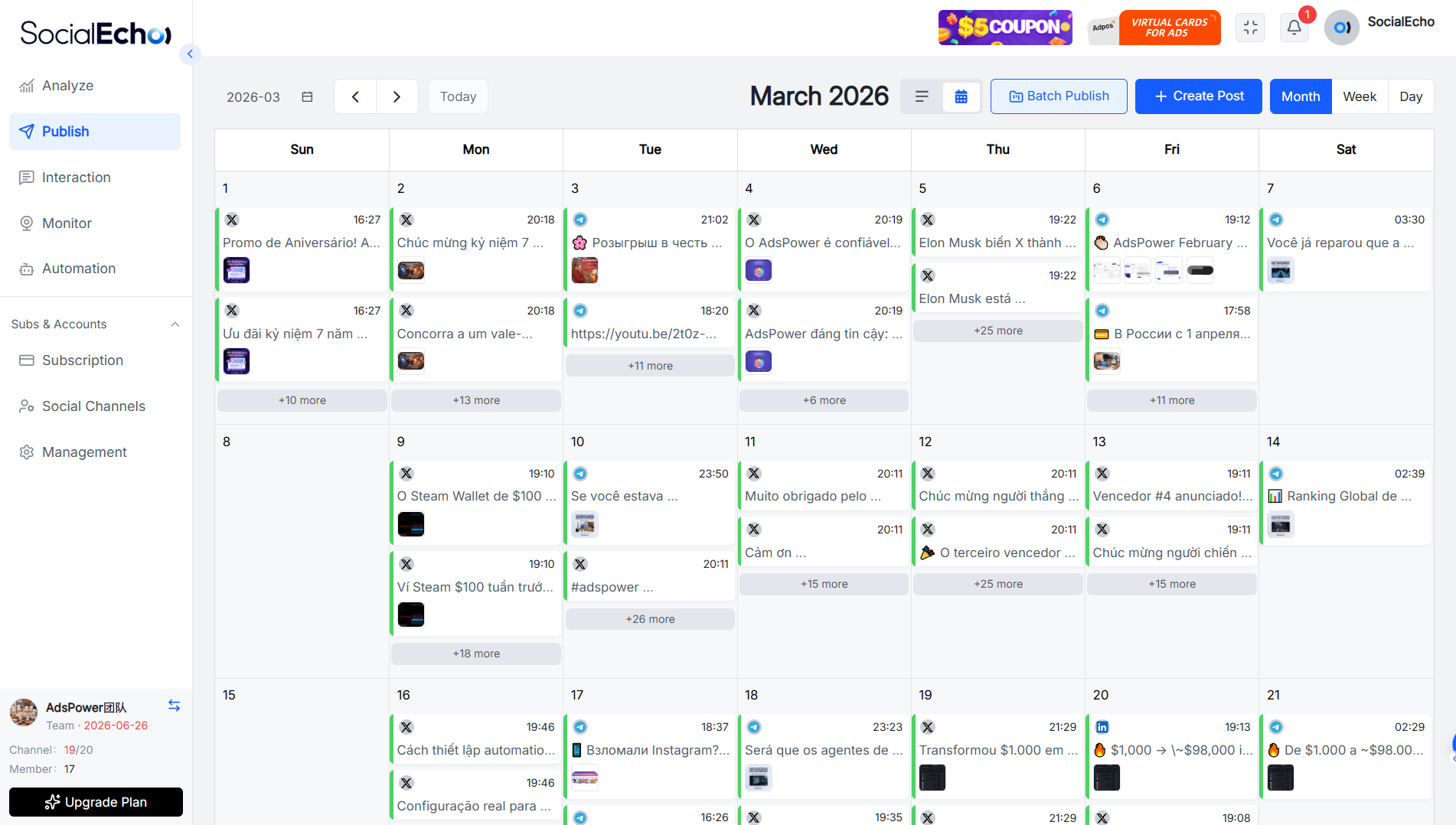
SocialEcho pricing
- Basic version : starting at $12.5/month
- Team version : starting at $18.75/month
- Annual payment discount : 20% off annual payments
Compared to Planable's Agency version at $83/month, SocialEcho offers a significant price advantage and more comprehensive functionality. For expanding outsourcing agencies, cost-effectiveness is a key consideration.
To learn more, visit the SocialEcho official website .
Summary: Which one should I choose?
If you are a newly established individual account manager , Planable's free version can serve as a transitional solution, helping you establish basic approval process standards.
However, if you manage more than 5 customer accounts, have a team of more than 2 people, and need to generate monthly reports , SocialEcho is a more reasonable choice: it is cheaper, has more features, and the approval process is streamlined from start to finish, so you don't need to piece together multiple tools.
The essence of outsourced operations is trading efficiency for scale. Every step of optimization in the review process creates space for your business growth.
FAQ

Q1: What is the biggest difference between Planable and SocialEcho?
Planable primarily focuses on content planning and client approval processes, making it a dedicated approval collaboration tool. SocialEcho, on the other hand, is a one-stop platform encompassing AI content generation, multi-account management, approval workflows, and data reporting, making it more suitable for agencies that require end-to-end management.
Q2: What are the core advantages of Planable for third-party operation agencies?
Planable's core advantage lies in its professional client approval interface—clients can view content and leave feedback without registration, and approval records are clear and traceable. This is valuable for agencies that need to demonstrate the professionalism of their processes to clients. However, its price point and functional limitations should be noted.
Q3: Does SocialEcho support client review processes?
Fully supported. SocialEcho features a built-in multi-level approval workflow, supporting the complete chain of "drafting → internal review → customer approval → release". Customers can view content, leave comments, or approve with one click through a dedicated link. All operations are recorded, and version management is clear.
Q4: Which tool would you recommend for managing more than 10 customer accounts?
I recommend SocialEcho. SocialEcho's team edition supports unified management of multiple client accounts, and approval workflows can be configured independently for different clients. In terms of pricing, the team edition starts at 18.75/month (20% off for annual payments), a significant advantage compared to the Planable Agency edition's 83/month+. Furthermore, SocialEcho's AI content generation feature significantly reduces content production time, making it more suitable for outsourced management scenarios with a large number of clients.
Q5: Is Planable's pricing reasonable for third-party service providers?
For small-scale outsourcing (3 or fewer clients), Planable's basic plan at 33/month is acceptable. However, once Agency features (multi-workspace, white-label reporting) are needed, the cost jumps to 83/month and above, with additional charges per seat, which puts significant cost pressure on rapidly expanding outsourcing agencies.
Q6: What are the problems with using WeChat groups for the peer review process?
There are three main problems: First, version management is chaotic, and after multiple revisions, it's easy to get confused about which version is the final confirmed version; second, information is easily buried, with customer approval records scattered in chat logs, making them difficult to find; and third, accountability is impossible, as it's unclear which step went wrong when problems occur. Professional approval tools can fundamentally solve these problems.
Q7: How can e-commerce service providers use SocialEcho to reduce customer communication costs?
The core approach is to migrate the approval process from "instant messaging tools" to a "professional platform." Specifically: ① Generate weekly content plans using SocialEcho and send approval links directly to clients; ② Clients can leave comments or approve with a single click on the platform, eliminating the need for repeated follow-ups; ③ Modification records are visible throughout the process, preventing disputes over "which version to use"; ④ Monthly reports can be exported with a single click, saving time spent manually integrating data. This entire process saves each client 3-5 hours of communication time per month.
;}.cls-2{fill:%230868f7;}.cls-3{fill:url(%23未命名的渐变_44);}.cls-4{fill:%23333;}%3c/style%3e%3clinearGradient%20id='未命名的渐变_8'%20x1='33.73'%20y1='100.61'%20x2='-0.03'%20y2='-1.06'%20gradientUnits='userSpaceOnUse'%3e%3cstop%20offset='0'%20stop-color='%237ae9fb'/%3e%3cstop%20offset='0.67'%20stop-color='%232b90f8'/%3e%3cstop%20offset='1'%20stop-color='%230868f7'/%3e%3c/linearGradient%3e%3clinearGradient%20id='未命名的渐变_44'%20x1='27.86'%20y1='18.67'%20x2='68.36'%20y2='22.22'%20gradientUnits='userSpaceOnUse'%3e%3cstop%20offset='0'%20stop-color='%235ac7f2'/%3e%3cstop%20offset='1'%20stop-color='%230868f7'/%3e%3c/linearGradient%3e%3c/defs%3e%3cpath%20class='cls-1'%20d='M29,28.74V81.91l-9.51-3.68v0L8.52,74A7.17,7.17,0,0,1,4,67.32V24.54A3.76,3.76,0,0,1,9.08,21Z'/%3e%3cpath%20class='cls-2'%20d='M68.09,78.07a13.15,13.15,0,0,1-17.9,12.06L29,81.91h0V28.74L50.19,37A13.17,13.17,0,0,0,68.08,25.3h0Z'/%3e%3cpath%20class='cls-3'%20d='M68.08,25.3a13.19,13.19,0,0,1-6.73,10.87A13.09,13.09,0,0,1,50.19,37L29,28.74V6A3.76,3.76,0,0,1,34.1,2.52l25.59,9.91A13.22,13.22,0,0,1,68.08,25.3Z'/%3e%3cpath%20class='cls-4'%20d='M129.06,81.76a4.33,4.33,0,0,1-3.19-1.31,4.4,4.4,0,0,1-1.31-3.24V56.86H97.65V77.21a4.36,4.36,0,0,1-1.35,3.2A4.68,4.68,0,0,1,93,81.76a4.32,4.32,0,0,1-3.19-1.31,4.37,4.37,0,0,1-1.32-3.24V27.27A4.58,4.58,0,0,1,89.83,24a4.59,4.59,0,0,1,7.82,3.27V48.15h26.91V27.27A4.58,4.58,0,0,1,125.91,24a4.59,4.59,0,0,1,7.82,3.27V77.21a4.37,4.37,0,0,1-1.36,3.2A4.65,4.65,0,0,1,129.06,81.76Z'/%3e%3cpath%20class='cls-4'%20d='M163.77,81.66c-6.57,0-11.76-1.92-15.44-5.7s-5.54-9.07-5.54-15.74a26.76,26.76,0,0,1,2.09-10.43,17.72,17.72,0,0,1,6.67-8.06,19.15,19.15,0,0,1,10.68-2.95,19,19,0,0,1,10.46,2.8,18.7,18.7,0,0,1,6.55,7.36,22.53,22.53,0,0,1,2.36,10.28A4.51,4.51,0,0,1,177,63.77H152.23a10.8,10.8,0,0,0,3.49,6.65c2,1.68,4.88,2.52,8.66,2.52a22.25,22.25,0,0,0,7.54-1.21c.74-.3,1.55-.67,2.37-1.07a3.75,3.75,0,0,1,1.84-.4,4.09,4.09,0,0,1,3,1.15,4,4,0,0,1,1.12,3,4.38,4.38,0,0,1-2.58,3.82,32.34,32.34,0,0,1-6.36,2.61A28.67,28.67,0,0,1,163.77,81.66ZM172.4,55.9a9.72,9.72,0,0,0-1.63-4.56A9.9,9.9,0,0,0,167,48a10.38,10.38,0,0,0-4.64-1.14,12,12,0,0,0-4.77,1.06,9.54,9.54,0,0,0-4.89,5.66,11.78,11.78,0,0,0-.51,2.3Z'/%3e%3cpath%20class='cls-4'%20d='M193,81.64a4.49,4.49,0,0,1-4.51-4.55V27.28A4.58,4.58,0,0,1,189.84,24a4.48,4.48,0,0,1,3.28-1.36A4.36,4.36,0,0,1,196.35,24a4.46,4.46,0,0,1,1.31,3.31V77.09a4.34,4.34,0,0,1-1.35,3.2A4.67,4.67,0,0,1,193,81.64Z'/%3e%3cpath%20class='cls-4'%20d='M263.79,81.71a5.7,5.7,0,0,1-4.2-1.74,5.76,5.76,0,0,1-1.73-4.19V27.37a4.58,4.58,0,0,1,1.35-3.27A4.59,4.59,0,0,1,267,27.37V72.53h24a4.58,4.58,0,0,1,3.27,7.82A4.66,4.66,0,0,1,291,81.71Z'/%3e%3cpath%20class='cls-4'%20d='M424.48,81.74a4.71,4.71,0,0,1-2.71-.88,5.43,5.43,0,0,1-1-1l-.07-.09-12.41-17-5.41,5v9.44a4.31,4.31,0,0,1-1.36,3.19,4.66,4.66,0,0,1-3.3,1.36A4.29,4.29,0,0,1,395,80.42a4.36,4.36,0,0,1-1.32-3.23V27.37A4.58,4.58,0,0,1,395,24.1a4.52,4.52,0,0,1,6.58.12,4.54,4.54,0,0,1,1.24,3.15V56.31l17.72-16.38.05,0a4.8,4.8,0,0,1,2.94-1.11,4.4,4.4,0,0,1,3.27,1.2,4.57,4.57,0,0,1,1.2,3.27,4.44,4.44,0,0,1-.77,2.33,7.45,7.45,0,0,1-1.43,1.65l-11,9.64,13.34,17.68a5,5,0,0,1,1,2.71,4.12,4.12,0,0,1-1.36,3.24A4.64,4.64,0,0,1,424.48,81.74Z'/%3e%3cpath%20class='cls-4'%20d='M317.93,81.76a21.5,21.5,0,1,1,21.17-21.5A21.37,21.37,0,0,1,317.93,81.76Zm0-34.1a12.61,12.61,0,1,0,12.42,12.6A12.52,12.52,0,0,0,317.93,47.66Z'/%3e%3cpath%20class='cls-4'%20d='M212.18,101.22a4.12,4.12,0,0,1-3.05-1.26,4.17,4.17,0,0,1-1.26-3.1V43.34a4.37,4.37,0,0,1,1.3-3.14,4.26,4.26,0,0,1,3.13-1.3,4.19,4.19,0,0,1,3.1,1.26,4.32,4.32,0,0,1,1.26,3.16,20.77,20.77,0,0,1,13-4.54,21.51,21.51,0,0,1,0,43,20.51,20.51,0,0,1-13-4.57V96.86a4.15,4.15,0,0,1-1.3,3.06A4.5,4.5,0,0,1,212.18,101.22Zm17.43-53.63c-6.23,0-12.93,4.11-12.93,12.72a12.73,12.73,0,0,0,25.46,0A12.71,12.71,0,0,0,229.61,47.59Z'/%3e%3cpath%20class='cls-4'%20d='M365.76,81.76a21.5,21.5,0,1,1,21.18-21.5A21.37,21.37,0,0,1,365.76,81.76Zm0-34.1a12.61,12.61,0,1,0,12.42,12.6A12.52,12.52,0,0,0,365.76,47.66Z'/%3e%3c/svg%3e)