
How to implement social listening in Chinese? Brand mentions, public opinion alerts, and competitor updates are not simply a matter of installing a tool.
When many teams first discuss Social Listening, their reactions are often quite similar: find a tool, input brand keywords, competitor keywords, and industry keywords, and then wait for system notifications. While this seems like a quick approach, they often encounter the same problem two weeks later: a lot of messages, but very little content that can actually guide operations, customer service, PR, or marketing decisions.
This isn't because the tools are useless, but because most Chinese teams have too narrow a understanding of Social Listening. It's not as simple as "catching social media mentions," but rather a complete working methodology that needs to be in place, from the scope of listening and alerting rules to the handling process and post-mortem analysis. Brand mentions are just the entry point; the real value lies in your ability to distinguish between noise and signals, to detect risks early, to understand competitor changes, and to adjust your content strategy more accurately.
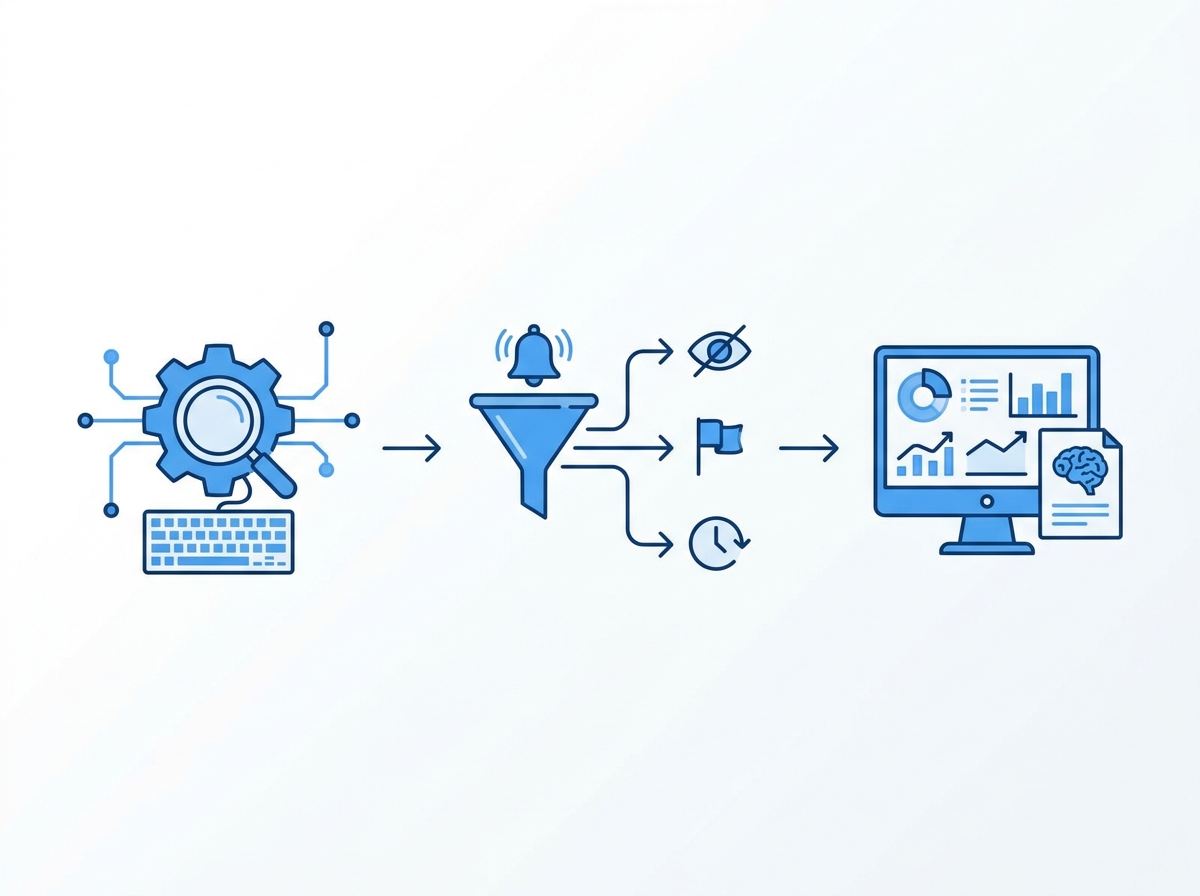
What you really need to figure out first isn't what tools to buy, but what question you want to answer.
If your goals are vague, social listening can easily degenerate into "someone glancing at your dashboard every day." The three most common goals for Chinese teams actually boil down to only three:
The first category is brand mention management. Who is mentioning you? Are they praising you, asking questions, complaining, or spreading misinformation? This determines whether you need to intervene with customer service, provide explanations, or issue a PR warning.
The second type is public opinion early warning. It's not about waiting until the boss sees the news before trying to remedy the situation. Truly effective early warnings are issued when negative emotions begin to accumulate, keywords start to rise abnormally, and a topic begins to spread beyond niche circles.
The third category is competitor activity monitoring. Many brands don't lose because of slow execution, but because they're slow to react. What activities competitors launch, what kind of messaging sparks discussion, and which platforms suddenly start investing in content—all of these can be detected in advance through monitoring.
So before actually using any tools, write down the questions: What do we need to discover in advance? Who will handle the discovery? How quickly is timely enough? If these questions are unanswered, even the most expensive tool is just a more elegant information collector.
In the Chinese context, the difficulty in wiretapping is never "not being able to catch them," but rather "not being able to catch them accurately."
One of the biggest misconceptions in Chinese social listening is that the more keywords you include, the better. The reality is quite the opposite. The Chinese environment is rife with synonyms, abbreviations, alternative names, homophones, misspellings, and emotional expressions. The result is: you think you're capturing brand mentions, but you're actually capturing a bunch of irrelevant noise; you think you're listening for negative feedback, but you're actually seeing jokes, fan-made content, and random people using memes.
Therefore, keyword strategies should be layered.
The core layer consists of the brand's standard name, common abbreviations, product line names, and frequently misspelled words; the extended layer includes words strongly related to behaviors such as purchasing, experiencing, complaining, substitution, failure, and recommendation; the risk layer needs to be examined separately, such as expressions that trigger emotional escalation, like "cannot be opened," "runs away," "counterfeit goods," and "no one responds to after-sales service." Competitor monitoring should follow the same principle, not just monitoring the brand name, but also including event names, key features, spokespeople, and popular content formats.
If you simply dump a set of words into the system without continuous word refinement, the monitoring results will quickly become distorted. A more practical approach is to first use a lightweight entry point for initial observation, such as quickly verifying which expressions users are using from SocialEcho Free Tools , and then sync high-value words into the official rules.
Public opinion early warning is not about "calling the police every time there is negative news," but about knowing what warrants an immediate escalation.
Many teams initially set their warning thresholds too sensitive, eventually leading to a state of numbness and desensitization to being constantly alerted. Truly effective warnings don't involve highlighting every negative event in red, but rather designing conditions that indicate "escalation is needed."
For example, the same complaint point is repeatedly mentioned by multiple accounts within a short period of time; a complaint post starts to be reposted by high-influence accounts; competitors, media, or KOLs start quoting similar statements; although the volume of discussion is not large, the sentiment has clearly shifted from "complaining" to "questioning the brand's credibility." These are the situations that deserve priority attention.
In other words, early warning logic cannot rely solely on sentiment tags; it must also consider the magnitude, speed of dissemination, types of participants, and the direction of topic spillover. SocialEcho's Listening feature is better suited for this task because it addresses not "how many mentions I've seen," but rather "which type of signal should I handle first." If you plan to include abnormal fluctuations in weekly or monthly reports, it's best to also have an Analytics review session; otherwise, you'll still be relying on screenshots in meetings.
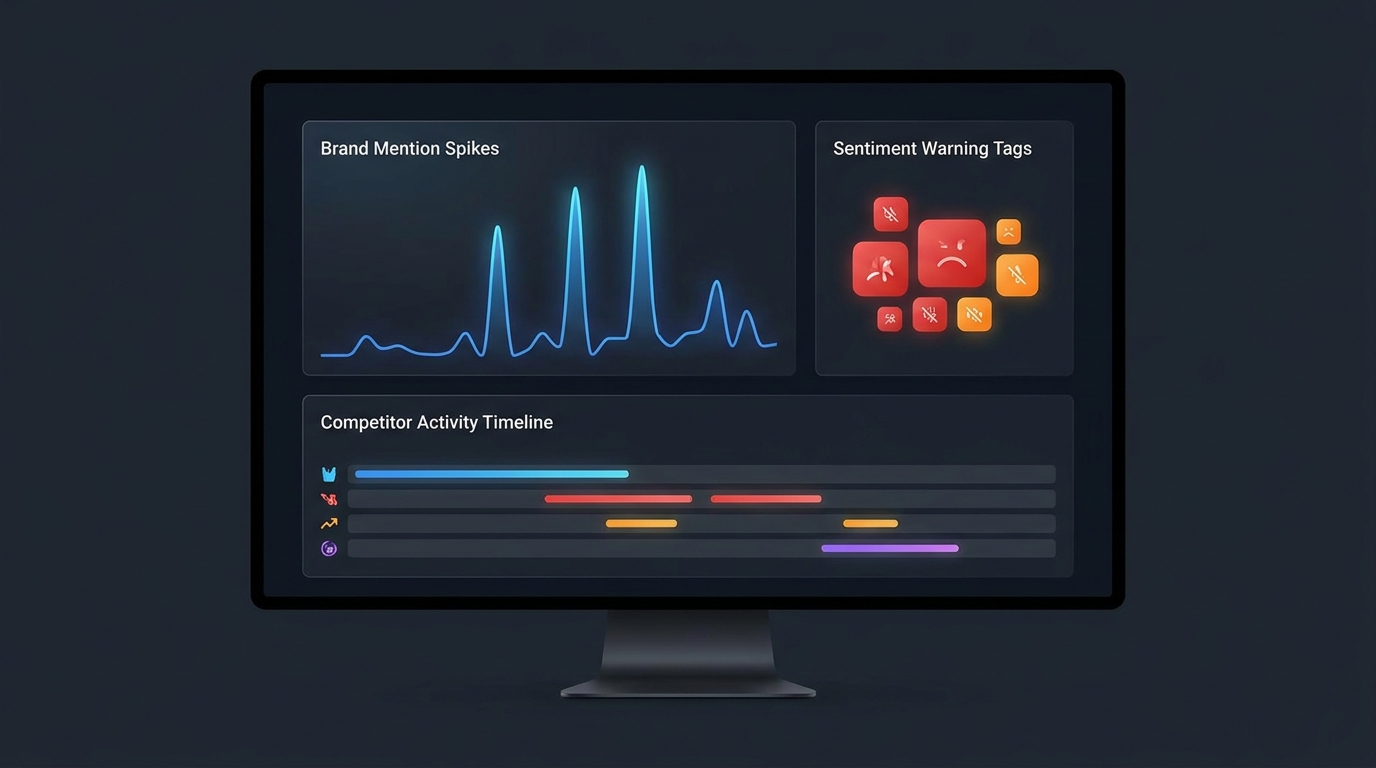
The worst thing about competitor activities is just watching the excitement; the best thing is to read them slowly.
Many teams spend their days monitoring what competitors are doing, but rarely ask themselves: what insights can we gain from these actions? Competitor monitoring is most prone to falling into "information consumption" rather than "strategy extraction."
A more effective approach is to consider several stable dimensions:
- What themes are our competitors promoting lately? Are they trying to grab awareness, conversions, or reputation?
- Which posts do users interact with the most: those featuring selling points, those about pricing mechanisms, or those about service response?
- What content appears consecutively within a short period of time, indicating that the other party is not conducting occasional testing, but rather systematically advancing in a certain direction?
- When users compare you with your competitors, what are the most common comparison words?
If your business spans multiple platforms, don't focus on just one channel. Real-time discussions on X, competitor updates on Facebook, and scattered feedback in social media comment sections often only provide a complete picture when pieced together. Pages like X Keyword Monitoring and Facebook Competitor Monitoring are better suited for helping teams understand monitoring in real-world platform scenarios, because genuine competitor insights rarely occur on a single platform.
What truly enables Social Listening to function is the processing flow.
Why do many teams shut down their tools after only three months? It's not because they don't have data, but because no one is there to handle the incoming data.
A brand mention involving after-sales service should be directed to customer service; a misleading discussion that could potentially escalate should be reported to PR or marketing; a competitor's post pointing to a price war or content strategy change should be reported to growth or product. These aren't things tools automatically handle; you need to clearly define these flows beforehand.
Ideally, the process should be broken down into four steps: who collects the information, how to categorize it, who escalates it, and how to review the process. Collecting the information means someone is monitoring it; categorizing it means assigning it to different categories such as brand, customer service, risk, and competitors; escalating it means determining which situations need to be handled within 30 minutes, 2 hours, or the same day; and reviewing the process involves weekly analysis of which rules were overused and which actually influenced decision-making.
For a Chinese team working on Social Listening, the true mark of maturity isn't how complex the dashboard is, but rather that everyone knows how to respond when something goes wrong.

FAQ
1. What are the differences between Social Listening and regular keyword monitoring?
Regular keyword monitoring is more like "catching mentions," while Social Listening emphasizes interpreting context, identifying risks, observing trends, and driving action. The former is data collection, while the latter is input for operational decision-making.
2. Do small teams also need to do social listening?
It's necessary, but it doesn't necessarily have to be very heavy from the start. Small teams can start by focusing on brand keywords, core product keywords, two competitors, and a set of risk keywords, getting the early warning and handling systems working properly before gradually expanding.
3. What are the most common mistakes made in Chinese public opinion early warning systems?
The most common problem is that the rules are too lenient, resulting in too much noise; or only looking at the "negative" aspects while ignoring the dissemination path, so that topics that will actually spread are not upgraded in time.
4. How long does it take to see the value of competitor monitoring?
If the keywords and processing framework are set up correctly, you can usually see the value in two to four weeks: you will know more quickly what your competitors are promoting, what users are comparing, and which discussions are worth your proactive response.
Take immediate action
If you're planning to transform Social Listening from something that "people occasionally look at" into a truly effective mechanism, I recommend starting with three things: first, use a lightweight entry point to organize brand and risky keywords; second, establish formal listening rules; and finally, integrate abnormal trends for analysis and review. You can start by using SocialEcho Free Tools for initial keyword validation, and then further explore Listening , Analytics , and cross-platform listening pages such as X Keyword Monitoring . Tools only begin to demonstrate their true value when the listening results can genuinely influence response priority.
;}.cls-2{fill:%230868f7;}.cls-3{fill:url(%23未命名的渐变_44);}.cls-4{fill:%23333;}%3c/style%3e%3clinearGradient%20id='未命名的渐变_8'%20x1='33.73'%20y1='100.61'%20x2='-0.03'%20y2='-1.06'%20gradientUnits='userSpaceOnUse'%3e%3cstop%20offset='0'%20stop-color='%237ae9fb'/%3e%3cstop%20offset='0.67'%20stop-color='%232b90f8'/%3e%3cstop%20offset='1'%20stop-color='%230868f7'/%3e%3c/linearGradient%3e%3clinearGradient%20id='未命名的渐变_44'%20x1='27.86'%20y1='18.67'%20x2='68.36'%20y2='22.22'%20gradientUnits='userSpaceOnUse'%3e%3cstop%20offset='0'%20stop-color='%235ac7f2'/%3e%3cstop%20offset='1'%20stop-color='%230868f7'/%3e%3c/linearGradient%3e%3c/defs%3e%3cpath%20class='cls-1'%20d='M29,28.74V81.91l-9.51-3.68v0L8.52,74A7.17,7.17,0,0,1,4,67.32V24.54A3.76,3.76,0,0,1,9.08,21Z'/%3e%3cpath%20class='cls-2'%20d='M68.09,78.07a13.15,13.15,0,0,1-17.9,12.06L29,81.91h0V28.74L50.19,37A13.17,13.17,0,0,0,68.08,25.3h0Z'/%3e%3cpath%20class='cls-3'%20d='M68.08,25.3a13.19,13.19,0,0,1-6.73,10.87A13.09,13.09,0,0,1,50.19,37L29,28.74V6A3.76,3.76,0,0,1,34.1,2.52l25.59,9.91A13.22,13.22,0,0,1,68.08,25.3Z'/%3e%3cpath%20class='cls-4'%20d='M129.06,81.76a4.33,4.33,0,0,1-3.19-1.31,4.4,4.4,0,0,1-1.31-3.24V56.86H97.65V77.21a4.36,4.36,0,0,1-1.35,3.2A4.68,4.68,0,0,1,93,81.76a4.32,4.32,0,0,1-3.19-1.31,4.37,4.37,0,0,1-1.32-3.24V27.27A4.58,4.58,0,0,1,89.83,24a4.59,4.59,0,0,1,7.82,3.27V48.15h26.91V27.27A4.58,4.58,0,0,1,125.91,24a4.59,4.59,0,0,1,7.82,3.27V77.21a4.37,4.37,0,0,1-1.36,3.2A4.65,4.65,0,0,1,129.06,81.76Z'/%3e%3cpath%20class='cls-4'%20d='M163.77,81.66c-6.57,0-11.76-1.92-15.44-5.7s-5.54-9.07-5.54-15.74a26.76,26.76,0,0,1,2.09-10.43,17.72,17.72,0,0,1,6.67-8.06,19.15,19.15,0,0,1,10.68-2.95,19,19,0,0,1,10.46,2.8,18.7,18.7,0,0,1,6.55,7.36,22.53,22.53,0,0,1,2.36,10.28A4.51,4.51,0,0,1,177,63.77H152.23a10.8,10.8,0,0,0,3.49,6.65c2,1.68,4.88,2.52,8.66,2.52a22.25,22.25,0,0,0,7.54-1.21c.74-.3,1.55-.67,2.37-1.07a3.75,3.75,0,0,1,1.84-.4,4.09,4.09,0,0,1,3,1.15,4,4,0,0,1,1.12,3,4.38,4.38,0,0,1-2.58,3.82,32.34,32.34,0,0,1-6.36,2.61A28.67,28.67,0,0,1,163.77,81.66ZM172.4,55.9a9.72,9.72,0,0,0-1.63-4.56A9.9,9.9,0,0,0,167,48a10.38,10.38,0,0,0-4.64-1.14,12,12,0,0,0-4.77,1.06,9.54,9.54,0,0,0-4.89,5.66,11.78,11.78,0,0,0-.51,2.3Z'/%3e%3cpath%20class='cls-4'%20d='M193,81.64a4.49,4.49,0,0,1-4.51-4.55V27.28A4.58,4.58,0,0,1,189.84,24a4.48,4.48,0,0,1,3.28-1.36A4.36,4.36,0,0,1,196.35,24a4.46,4.46,0,0,1,1.31,3.31V77.09a4.34,4.34,0,0,1-1.35,3.2A4.67,4.67,0,0,1,193,81.64Z'/%3e%3cpath%20class='cls-4'%20d='M263.79,81.71a5.7,5.7,0,0,1-4.2-1.74,5.76,5.76,0,0,1-1.73-4.19V27.37a4.58,4.58,0,0,1,1.35-3.27A4.59,4.59,0,0,1,267,27.37V72.53h24a4.58,4.58,0,0,1,3.27,7.82A4.66,4.66,0,0,1,291,81.71Z'/%3e%3cpath%20class='cls-4'%20d='M424.48,81.74a4.71,4.71,0,0,1-2.71-.88,5.43,5.43,0,0,1-1-1l-.07-.09-12.41-17-5.41,5v9.44a4.31,4.31,0,0,1-1.36,3.19,4.66,4.66,0,0,1-3.3,1.36A4.29,4.29,0,0,1,395,80.42a4.36,4.36,0,0,1-1.32-3.23V27.37A4.58,4.58,0,0,1,395,24.1a4.52,4.52,0,0,1,6.58.12,4.54,4.54,0,0,1,1.24,3.15V56.31l17.72-16.38.05,0a4.8,4.8,0,0,1,2.94-1.11,4.4,4.4,0,0,1,3.27,1.2,4.57,4.57,0,0,1,1.2,3.27,4.44,4.44,0,0,1-.77,2.33,7.45,7.45,0,0,1-1.43,1.65l-11,9.64,13.34,17.68a5,5,0,0,1,1,2.71,4.12,4.12,0,0,1-1.36,3.24A4.64,4.64,0,0,1,424.48,81.74Z'/%3e%3cpath%20class='cls-4'%20d='M317.93,81.76a21.5,21.5,0,1,1,21.17-21.5A21.37,21.37,0,0,1,317.93,81.76Zm0-34.1a12.61,12.61,0,1,0,12.42,12.6A12.52,12.52,0,0,0,317.93,47.66Z'/%3e%3cpath%20class='cls-4'%20d='M212.18,101.22a4.12,4.12,0,0,1-3.05-1.26,4.17,4.17,0,0,1-1.26-3.1V43.34a4.37,4.37,0,0,1,1.3-3.14,4.26,4.26,0,0,1,3.13-1.3,4.19,4.19,0,0,1,3.1,1.26,4.32,4.32,0,0,1,1.26,3.16,20.77,20.77,0,0,1,13-4.54,21.51,21.51,0,0,1,0,43,20.51,20.51,0,0,1-13-4.57V96.86a4.15,4.15,0,0,1-1.3,3.06A4.5,4.5,0,0,1,212.18,101.22Zm17.43-53.63c-6.23,0-12.93,4.11-12.93,12.72a12.73,12.73,0,0,0,25.46,0A12.71,12.71,0,0,0,229.61,47.59Z'/%3e%3cpath%20class='cls-4'%20d='M365.76,81.76a21.5,21.5,0,1,1,21.18-21.5A21.37,21.37,0,0,1,365.76,81.76Zm0-34.1a12.61,12.61,0,1,0,12.42,12.6A12.52,12.52,0,0,0,365.76,47.66Z'/%3e%3c/svg%3e)