
The same 5 platforms, some people can get it done in 2 hours, while others take 8 hours - what's the difference?
The same 5 platforms, some people can get it done in 2 hours, while others take 8 hours - what's the difference?
Word count: Approximately 2800 words. Reading time: 8 minutes.

Let me start with a fact that many brand operators find disheartening.
The same workload: 5 social media platforms, posting, checking data, replying to comments, and monitoring competitors every day—some teams can finish it in 2 hours with 1 person, while some teams have 3 people working all day and still feel like they haven't finished.
This isn't a difference in ability, but a difference in work methods. More precisely, it's a difference in the "toolchain."
Where do you spend your 8 hours?
Anyone who has worked on multiple platforms knows how those 8 hours disappear.
I started the morning by opening Instagram, posting, then switching to TikTok, logging back in, and finding the format incorrect, so I adjusted it. Next, I switched to Facebook, needing to change the text, as Facebook doesn't support this emoji. Then came the "X," which exceeded the character limit, so I deleted it. Finally, I posted on LinkedIn, only to realize after writing for ages that I'd forgotten to authorize the account…
The process of posting takes 1.5 to 2 hours, going through each of the 5 platforms.
I spent the afternoon looking at the data. I opened each platform separately, took screenshots, pasted them into a spreadsheet, and manually calculated the growth rate. The boss needed a weekly report, so I had to take screenshots, calculate, and then format it—and half a day was gone.
Then comes the comments. Someone asks about the price on Instagram, there's a bad review on TikTok, someone mentions you on Facebook, someone shares a post you missed on X… You scroll through five tabs in turn, afraid of missing a single one. Theoretically, this has no end; you only stop when you "run out of energy."
Competitor monitoring is the last thing to do, but it's often the first thing to be abandoned. Manually browsing every competitor's account's posts and recording interaction data is time-consuming and laborious, and it's often skipped when things get busy.
Eight hours just vanished like that. It's not that you're inefficient; it's that the process itself is wasting time.
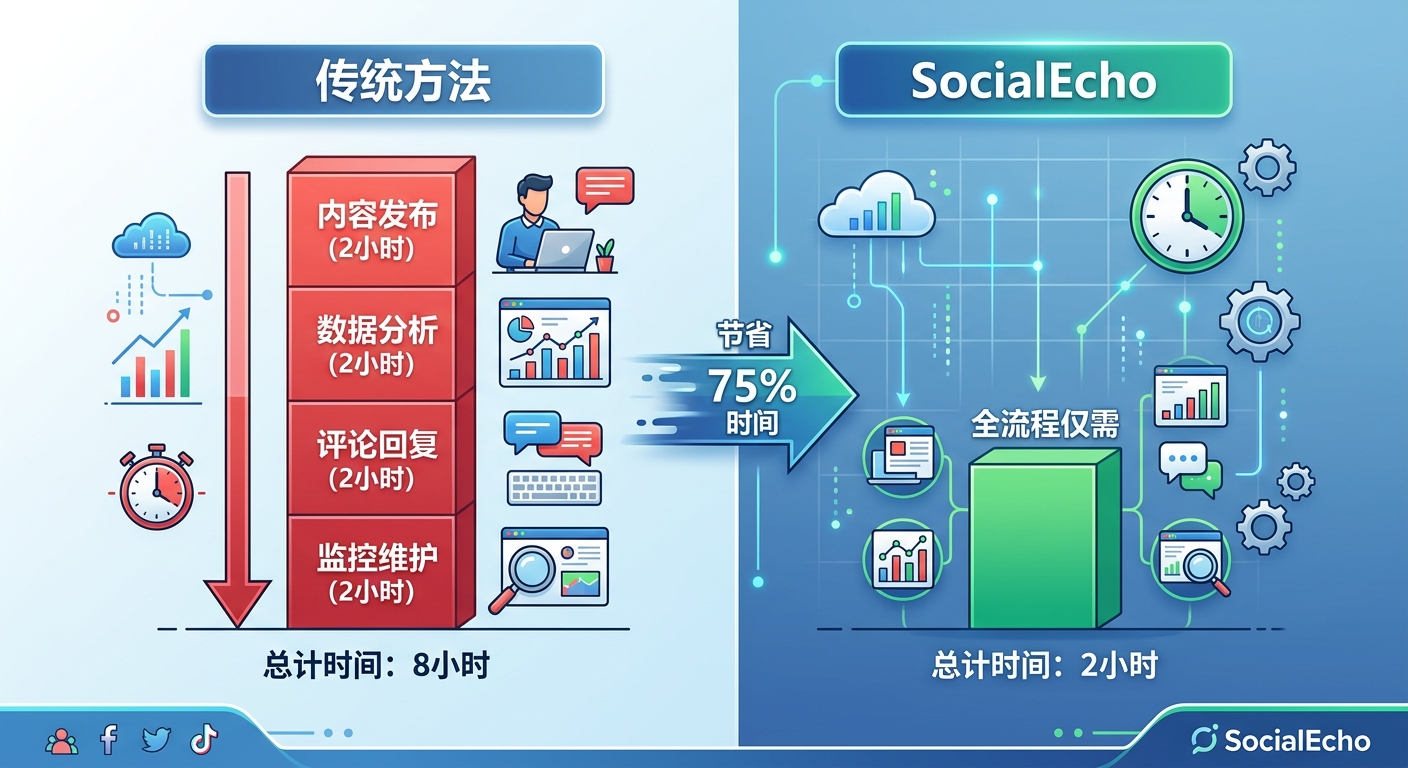
What did the team do right in 2 hours?
It's not that they're smarter, nor that they have less content—they simply eliminated the "switching costs" and "repetitive work" in the process.
The first thing: unify the release portal.
They don't publish individually on each platform. Instead, they write a piece of content, fine-tune it for each platform in a backend (format/word count/tags), and then distribute it with a single click. The entire publishing process is compressed to 20-30 minutes.
The second thing: summarize the data on one screen.
No need to take screenshots from each platform individually. Follower counts, engagement, and top-performing content from all platforms are automatically aggregated into a single dashboard. Weekly reports are transformed from "manual compilation" to "ready to use after export." Boss needs data? Get it done in 3 minutes.
The third thing: unify the inbox for comments.
No need to switch between 5 apps. Comments from all platforms are automatically aggregated, and AI identifies which comments are "price inquiries," "complaints," or "regular interactions." High-priority comments are processed first, and repetitive questions are answered automatically. What used to take 2 hours to monitor the comment section can now be processed in 20 minutes.
The fourth thing: Automated competitor monitoring.
No need to manually check competitor profiles. The system automatically tracks competitor accounts' posting frequency, interaction data, and comment sentiment, and automatically alerts you to any unusual activity. If a competitor posted a viral item yesterday, you'll see it in your backend today, instead of finding out three days later.
These four things combined make up the difference between 2 hours and 8 hours.
The value of time is not just about "how many hours are saved".
Many people calculate efficiency improvements by only considering the "time saved." But the time saved is money in itself.
The monthly salary for an operator, based on market rates in major cities like Beijing, Shanghai, Guangzhou, and Shenzhen, is 15,000 to 20,000 yuan, which translates to approximately 90 to 120 yuan per hour. If you save 6 hours per day, the monthly savings in labor costs would be 16,000 to 21,000 yuan.
This is still the most conservative calculation; it doesn't take into account the incremental benefits you would have gained by doing more valuable things during those 6 hours.
Faster competitor response – you'll know about a competitor's hit product on the same day it emerges, and you can follow up with relevant content within 24 hours, instead of only realizing it 3 days later when the traffic window has already closed.
Faster comment responses—as mentioned earlier: the conversion rate for potential customers who receive a response within 5 minutes is 100 times higher than those who receive a response after 1 hour. Every missed inquiry in the comments section represents a lost sale.
More data-driven content decisions – seeing which types of posts have high interaction rates and which posting times are effective, relying on data rather than intuition, resulting in a steady improvement in content quality.
The time saved, if used for these tasks, has a real value far exceeding the calculation of "how many hours were saved".

What is the actual magnitude of the efficiency gap?
Based on data from brand operations teams using SocialEcho :
Content publishing efficiency has increased by about 5 times —previously, posting on 5 separate platforms took 1.5-2 hours, but now a unified posting takes 20-30 minutes.
Weekly report production time has been reduced by about 80% – data is automatically aggregated, and the report is exported instantly, reducing the time from half a day to less than 30 minutes.
Comment response time has increased by about 10 times —from an average of 3 hours to within 15 minutes, with AI prioritizing high-value comments.
What do these three sets of figures mean? They mean that the same 1-2 person operations team can effectively manage 5-8 platforms instead of 2-3, without needing to increase manpower.
Here's a comparison test you can do right away.
We won't change any tools today.
Take 5 minutes to break down your operational time over the past week: How long did it take to create content? How long did it take to analyze data? How long did it take to process comments? How long did it take to monitor competitors? How long did it take to switch between different platforms and perform repetitive operations?
Add these numbers together and convert them into labor costs.
If this number makes you uncomfortable—then you've found a reason to change it.
SocialEcho supports unified management across 8 major platforms (TikTok/Instagram/Facebook/X/LinkedIn/YouTube/Pinterest/Telegram), enabling one-click multi-platform publishing , unified data analysis , AI-powered comment management , and real-time competitor monitoring . The free version is available to start experiencing it.
Try it for free now → 👉 https://www.socialecho.net
;}.cls-2{fill:%230868f7;}.cls-3{fill:url(%23未命名的渐变_44);}.cls-4{fill:%23333;}%3c/style%3e%3clinearGradient%20id='未命名的渐变_8'%20x1='33.73'%20y1='100.61'%20x2='-0.03'%20y2='-1.06'%20gradientUnits='userSpaceOnUse'%3e%3cstop%20offset='0'%20stop-color='%237ae9fb'/%3e%3cstop%20offset='0.67'%20stop-color='%232b90f8'/%3e%3cstop%20offset='1'%20stop-color='%230868f7'/%3e%3c/linearGradient%3e%3clinearGradient%20id='未命名的渐变_44'%20x1='27.86'%20y1='18.67'%20x2='68.36'%20y2='22.22'%20gradientUnits='userSpaceOnUse'%3e%3cstop%20offset='0'%20stop-color='%235ac7f2'/%3e%3cstop%20offset='1'%20stop-color='%230868f7'/%3e%3c/linearGradient%3e%3c/defs%3e%3cpath%20class='cls-1'%20d='M29,28.74V81.91l-9.51-3.68v0L8.52,74A7.17,7.17,0,0,1,4,67.32V24.54A3.76,3.76,0,0,1,9.08,21Z'/%3e%3cpath%20class='cls-2'%20d='M68.09,78.07a13.15,13.15,0,0,1-17.9,12.06L29,81.91h0V28.74L50.19,37A13.17,13.17,0,0,0,68.08,25.3h0Z'/%3e%3cpath%20class='cls-3'%20d='M68.08,25.3a13.19,13.19,0,0,1-6.73,10.87A13.09,13.09,0,0,1,50.19,37L29,28.74V6A3.76,3.76,0,0,1,34.1,2.52l25.59,9.91A13.22,13.22,0,0,1,68.08,25.3Z'/%3e%3cpath%20class='cls-4'%20d='M129.06,81.76a4.33,4.33,0,0,1-3.19-1.31,4.4,4.4,0,0,1-1.31-3.24V56.86H97.65V77.21a4.36,4.36,0,0,1-1.35,3.2A4.68,4.68,0,0,1,93,81.76a4.32,4.32,0,0,1-3.19-1.31,4.37,4.37,0,0,1-1.32-3.24V27.27A4.58,4.58,0,0,1,89.83,24a4.59,4.59,0,0,1,7.82,3.27V48.15h26.91V27.27A4.58,4.58,0,0,1,125.91,24a4.59,4.59,0,0,1,7.82,3.27V77.21a4.37,4.37,0,0,1-1.36,3.2A4.65,4.65,0,0,1,129.06,81.76Z'/%3e%3cpath%20class='cls-4'%20d='M163.77,81.66c-6.57,0-11.76-1.92-15.44-5.7s-5.54-9.07-5.54-15.74a26.76,26.76,0,0,1,2.09-10.43,17.72,17.72,0,0,1,6.67-8.06,19.15,19.15,0,0,1,10.68-2.95,19,19,0,0,1,10.46,2.8,18.7,18.7,0,0,1,6.55,7.36,22.53,22.53,0,0,1,2.36,10.28A4.51,4.51,0,0,1,177,63.77H152.23a10.8,10.8,0,0,0,3.49,6.65c2,1.68,4.88,2.52,8.66,2.52a22.25,22.25,0,0,0,7.54-1.21c.74-.3,1.55-.67,2.37-1.07a3.75,3.75,0,0,1,1.84-.4,4.09,4.09,0,0,1,3,1.15,4,4,0,0,1,1.12,3,4.38,4.38,0,0,1-2.58,3.82,32.34,32.34,0,0,1-6.36,2.61A28.67,28.67,0,0,1,163.77,81.66ZM172.4,55.9a9.72,9.72,0,0,0-1.63-4.56A9.9,9.9,0,0,0,167,48a10.38,10.38,0,0,0-4.64-1.14,12,12,0,0,0-4.77,1.06,9.54,9.54,0,0,0-4.89,5.66,11.78,11.78,0,0,0-.51,2.3Z'/%3e%3cpath%20class='cls-4'%20d='M193,81.64a4.49,4.49,0,0,1-4.51-4.55V27.28A4.58,4.58,0,0,1,189.84,24a4.48,4.48,0,0,1,3.28-1.36A4.36,4.36,0,0,1,196.35,24a4.46,4.46,0,0,1,1.31,3.31V77.09a4.34,4.34,0,0,1-1.35,3.2A4.67,4.67,0,0,1,193,81.64Z'/%3e%3cpath%20class='cls-4'%20d='M263.79,81.71a5.7,5.7,0,0,1-4.2-1.74,5.76,5.76,0,0,1-1.73-4.19V27.37a4.58,4.58,0,0,1,1.35-3.27A4.59,4.59,0,0,1,267,27.37V72.53h24a4.58,4.58,0,0,1,3.27,7.82A4.66,4.66,0,0,1,291,81.71Z'/%3e%3cpath%20class='cls-4'%20d='M424.48,81.74a4.71,4.71,0,0,1-2.71-.88,5.43,5.43,0,0,1-1-1l-.07-.09-12.41-17-5.41,5v9.44a4.31,4.31,0,0,1-1.36,3.19,4.66,4.66,0,0,1-3.3,1.36A4.29,4.29,0,0,1,395,80.42a4.36,4.36,0,0,1-1.32-3.23V27.37A4.58,4.58,0,0,1,395,24.1a4.52,4.52,0,0,1,6.58.12,4.54,4.54,0,0,1,1.24,3.15V56.31l17.72-16.38.05,0a4.8,4.8,0,0,1,2.94-1.11,4.4,4.4,0,0,1,3.27,1.2,4.57,4.57,0,0,1,1.2,3.27,4.44,4.44,0,0,1-.77,2.33,7.45,7.45,0,0,1-1.43,1.65l-11,9.64,13.34,17.68a5,5,0,0,1,1,2.71,4.12,4.12,0,0,1-1.36,3.24A4.64,4.64,0,0,1,424.48,81.74Z'/%3e%3cpath%20class='cls-4'%20d='M317.93,81.76a21.5,21.5,0,1,1,21.17-21.5A21.37,21.37,0,0,1,317.93,81.76Zm0-34.1a12.61,12.61,0,1,0,12.42,12.6A12.52,12.52,0,0,0,317.93,47.66Z'/%3e%3cpath%20class='cls-4'%20d='M212.18,101.22a4.12,4.12,0,0,1-3.05-1.26,4.17,4.17,0,0,1-1.26-3.1V43.34a4.37,4.37,0,0,1,1.3-3.14,4.26,4.26,0,0,1,3.13-1.3,4.19,4.19,0,0,1,3.1,1.26,4.32,4.32,0,0,1,1.26,3.16,20.77,20.77,0,0,1,13-4.54,21.51,21.51,0,0,1,0,43,20.51,20.51,0,0,1-13-4.57V96.86a4.15,4.15,0,0,1-1.3,3.06A4.5,4.5,0,0,1,212.18,101.22Zm17.43-53.63c-6.23,0-12.93,4.11-12.93,12.72a12.73,12.73,0,0,0,25.46,0A12.71,12.71,0,0,0,229.61,47.59Z'/%3e%3cpath%20class='cls-4'%20d='M365.76,81.76a21.5,21.5,0,1,1,21.18-21.5A21.37,21.37,0,0,1,365.76,81.76Zm0-34.1a12.61,12.61,0,1,0,12.42,12.6A12.52,12.52,0,0,0,365.76,47.66Z'/%3e%3c/svg%3e)