
Urgent! Your account is being throttled, but you may not know it yet.
Tags: Account traffic limiting, social media operations, multi-account management, platform algorithm, matrix operation, brand marketing, cross-border e-commerce, account suspension risk . Reading time: approximately 8 minutes.
At 2 a.m., you are jolted awake by a WeChat message.
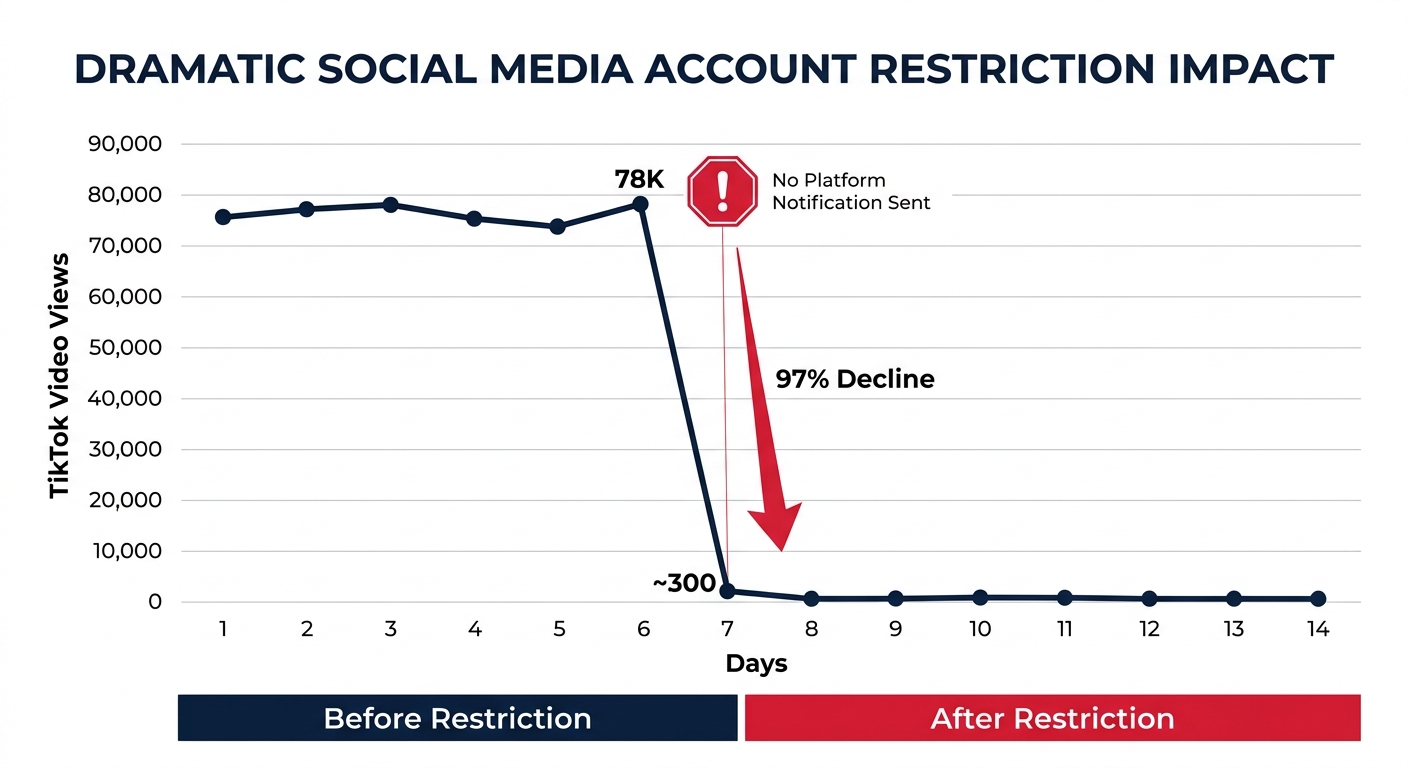
It wasn't a client, but a screenshot sent by Xiao Wang from the team: "Boss, our TikTok video's views dropped from 80,000 yesterday to just over 300."
You rubbed your eyes and checked three times: it was the same account, the same video, and the view count was fine the day before.
You turn on your computer, log in to the backend, and refresh the page, but the numbers haven't changed. Without any platform notifications or warnings, a large portion of your data has simply vanished into thin air.
This is what traffic throttling is all about. And you may be experiencing it right now without even realizing it.
Traffic throttling is more common than you think.
Last year, a client who runs a cross-border beauty business contacted me, saying that their main Facebook account had suddenly "gone silent"—posts were not getting any push notifications, and organic reach had plummeted from 12,000 to less than 800. Their first thought was that there was a problem with the content, and they spent a week repeatedly changing the cover and adjusting the copy, but the data remained unchanged.
It was later discovered that Facebook's algorithm had categorized these accounts as "high-risk posting behavior" and quietly reduced their distribution weight.
This kind of traffic restriction is called "gray line restriction" in the industry—the platform will not officially notify you, but your content just can't be pushed out.
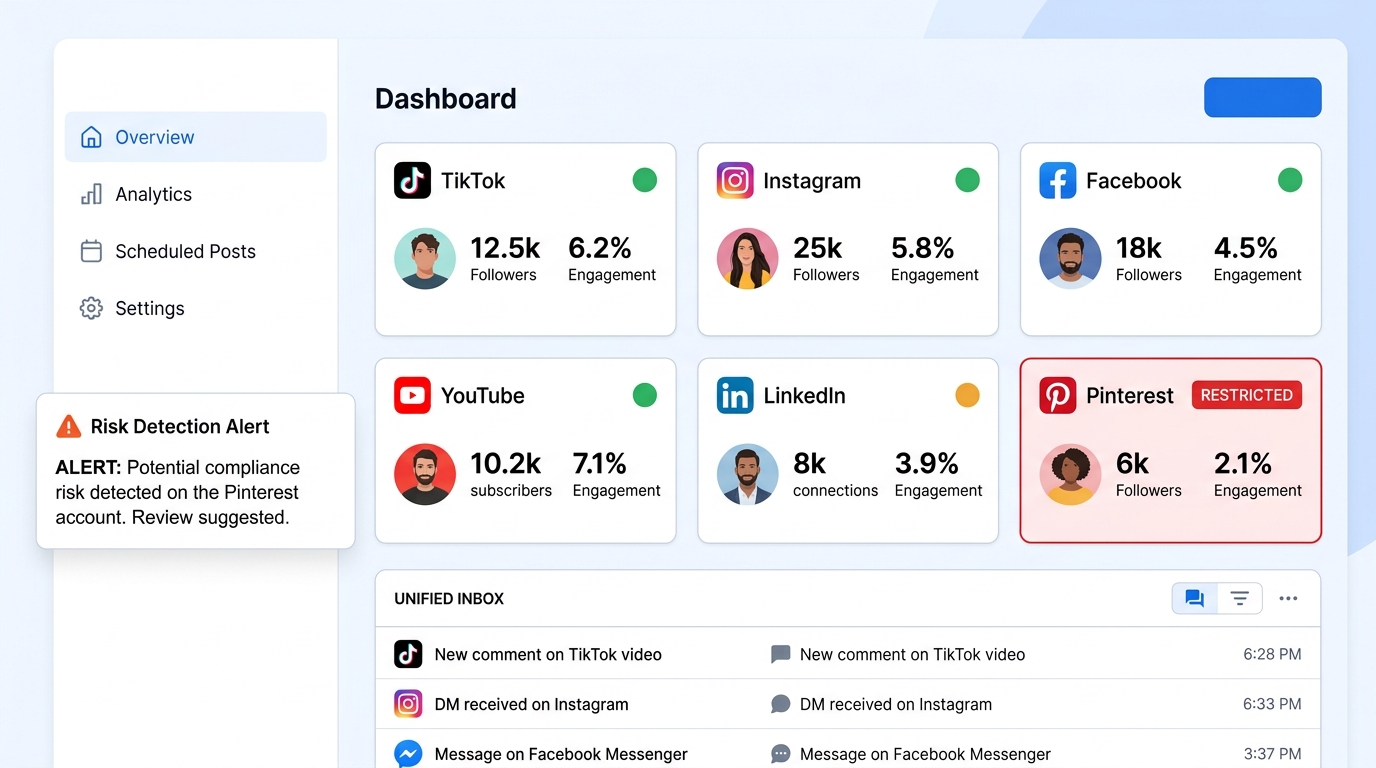
Anyone who runs a matrix of accounts knows that the worst thing isn't platform account bans—at least there's a notification and an appeal process. The worst thing is traffic throttling: it makes your content disappear without a trace, while you keep posting, posting, and posting, completely unaware that you're already on a sinking ship.
Multi-account operators are particularly vulnerable. Managing 3 accounts and managing 8 accounts are completely different games – with 3 accounts you can monitor the backend every day, but with 8 accounts you can only rely on "gut feeling" to judge which account has a problem. By the time you discover it, it's often three or four days too late, and in the world of algorithms, three or four days is enough for the platform to "classify" your account.
The real reason for traffic restrictions is often not what you think.
Many operators believe that traffic restrictions are due to poor content quality. While poor content certainly affects distribution, a closer look at the platform's data reports reveals a counterintuitive fact: most traffic restrictions are not so much related to content quality.
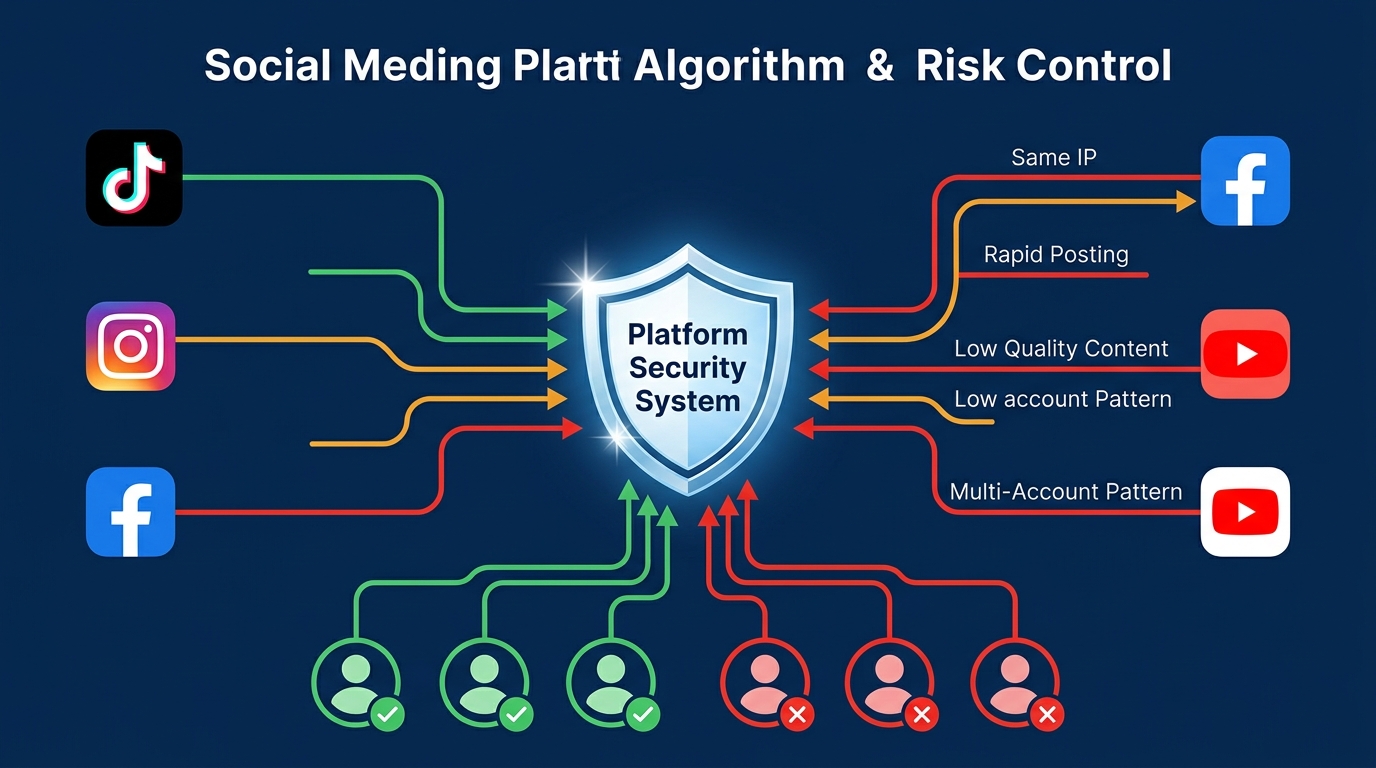
The fundamental reason for traffic restrictions is that the platform considers your "behavior suspicious".
What constitutes suspicious behavior?
You may have heard the term "bot-generated traffic." To combat cheating, platforms monitor account interaction patterns. If your content consistently receives a large number of likes and comments within a short period (e.g., 10 minutes) after being posted—even though you only have 5,000 followers—the platform will consider this artificially generated fake interaction.
Another more common situation is the "crossing the line" caused by simultaneous releases on multiple platforms.
In pursuit of efficiency, some teams use third-party tools to push content to multiple platforms simultaneously. As a result, multiple accounts from the same IP address publish content, start live streams, or modify homepage information at almost the same time. The platform's security system will automatically identify this as "multiple accounts controlled by the same operator," resulting in anything from traffic restrictions to account bans—all accounts will be implicated.
A friend of mine who works in account management had a mishap last year: they were managing six accounts for a clothing brand, including two Facebook pages and four Instagram accounts. One of the Instagram accounts was reported for posting a slightly suggestive product image, and the platform not only banned that account but also demoted all other accounts under the same name. The reason was that the operating IP addresses and management backends of these accounts highly overlapped.
He said something that really stuck with me: "We thought we were only banning that one account that violated the rules, but actually the entire account matrix was wiped out along with it."
This is the most terrifying aspect of operating multiple accounts: what you perceive as risk isolation is simply nonexistent in the platform's eyes.
Another reason that many people overlook is the mismatch between account authority and content type.
Each platform has its own standards for "high-quality content." If you consistently publish content with low engagement rates—such as blurry images, densely packed text, or poor-quality videos—the platform will gradually reduce its distribution ranking for you. This is because the platform also wants you to contribute high-quality content; if users don't like your content, why would the platform give you prime placement?
This isn't a conspiracy theory; it's a normal mechanism for platforms to maintain content quality. The problem is that many operators are unaware that they're already on the verge of being blacklisted.
Things You Need to Know to Reduce Risk
Now that we know the reason, we can talk about how to deal with it.
The first and most important thing: manage your account as an "asset," not as a "tool."
What does it mean to be used as a tool? It means to use someone and then leave, post something and then close the window, and the next time you log in will be three days later.
What does it mean to treat an account as an asset? It means checking the account's health weekly, monitoring for abnormal fluctuations in follower growth and interaction data, and remaining sensitive to changes in platform policies.
I know a team that does a great job with operations. They have an internal rule: if the data fluctuation of any account exceeds 20% daily, the cause must be investigated that same day. Is it a content issue, an activity issue, or a platform algorithm adjustment? This is documented and becomes part of the team's knowledge base.
This habit can be maintained when a team only has 2-3 accounts. However, once the number of accounts exceeds 5, many teams abandon this meticulous management and adopt a "problem arises first" attitude. And problems often quietly fester during this gap.
The second thing: Don't put all your eggs in one basket, and definitely don't put all your eggs in one basket.
Many brands operate on the strategy of "rushing to wherever there is traffic"—they see TikTok is popular, so they go all in on TikTok; they see an opportunity on Xiaohongshu, so they switch to Xiaohongshu. The result is that the main account accumulates tens of thousands of followers, but one day the account is suddenly banned or its traffic is limited, and they are back to square one.
A sound matrix strategy should involve different platforms focusing on different aspects, with different accounts fulfilling different functions. Even if one account encounters problems, the others remain active, ensuring the brand's overall reach doesn't drop to zero.
Professional multi-platform operation teams typically develop differentiated operation strategies for each platform: TikTok is suitable for short video seeding and viral content creation, Instagram focuses on high-quality images and text and Stories interaction, YouTube carries in-depth content and brand trust building, while Facebook and LinkedIn have unique advantages in private domain conversion and B2B reach, and Pinterest is a channel for discovering high-intent buyers.
At the same time, avoid over-concentrating resources on the same platform. If you have five Instagram accounts, don't let them all post the same type of content, at the same frequency, or at the same time—this highly consistent "behavioral pattern" is itself one of the signals the platform uses to identify multi-account operations.
The third thing: establish a quality threshold for content, and don't sacrifice quality for quantity.
Platform algorithms are becoming increasingly intelligent and focused on "user value." The era of winning by sheer volume is over. A single high-quality video is far more valuable than five low-quality text and image posts.
I've seen teams force themselves to post 3-5 pieces of content every day to maintain account activity. And what's the result? The content is posted, but the interaction data is abysmal, and the account's ranking is actually lowered. The algorithm thinks you're "contributing low-quality content," so it starts reducing push notifications. Then, seeing the poor data, the operators continue to post more, creating a vicious cycle.
The truly effective approach is to control the posting frequency and ensure that every piece of content is "worth posting." It's better to post less than to post something you'll regret.
The fourth thing: Add another layer of protection to your account matrix.
If you are managing more than 5 accounts at the same time, it is recommended to use a legitimate tool with "official API authorization" rather than a third-party script tool that requires you to provide your account password.
What's the difference? Tools with officially authorized interfaces can access data in a way that is recognized by the platform as normal operational behavior. Third-party tools that require account and password login are essentially simulating human operation, and the risk of the account being identified by the platform is much higher—at best, traffic will be limited, and at worst, the account will be banned. Moreover, the account that you have worked hard to build over the years and accumulated tens of thousands of fans will be banned.
This is why we chose to only use the official API when designing SocialEcho. Account security and no account bans are not just a slogan, but a genuine technical choice.
A reliable multi-account management tool should have three capabilities:
- One is data analysis capabilities, which allow you to see key data for all accounts in one backend without having to log in to each account individually;
- One is content monitoring capabilities, which help you track competitor activities and account health, detecting problems when they are still small;
- Another feature is AI automation capabilities. When your account exhibits abnormal interaction patterns, AI can help you perform preliminary sentiment analysis, reducing the pressure of manual investigation.
If you are currently managing more than three accounts, these skills are indispensable.
Act quickly, not because of anxiety, but because of the time window.
The purpose of writing this article is not to create anxiety, but because this problem is really happening and is becoming more widespread.
The platform's algorithm is adjusted every year, with increasingly higher requirements for content quality and more accurate identification of "suspicious behavior." If you're still managing your account using methods from three years ago, traffic restrictions are only a matter of time.
This is not alarmist. This is a natural phenomenon.
Every time the platform makes a major algorithm adjustment, a batch of accounts that "do not meet the new standards" will be demoted. The owners of these accounts are often the last to know—because the notification of the traffic restriction is never sent to your phone.
Give your account matrix a "check-up" and see if there are any abnormal fluctuations in the data over the past 30 days. If so, start investigating now. Don't wait until your views drop from 80,000 to 300 before you start looking for the cause.
If you manage more than 5 platform accounts and are struggling with "how to manage them efficiently", you might want to learn about SocialEcho.
As a multi-platform management tool for overseas brand operation teams, we support unified account management across 8 major platforms, including TikTok , Instagram , Facebook , YouTube , X , LinkedIn , Telegram, and Pinterest . Direct connection to official APIs ensures account security, content publishing allows for one-click distribution to multiple platforms, interaction management aggregates all comments and private messages, and AI automatically recognizes sentiment and user intent.
This isn't a sponsored post; it's a practical piece of advice for serious account managers: choosing the right tools means your account is already halfway to safety.
Your account matrix deserves to be taken seriously. Starting today, stop ignoring those tiny data fluctuations.
;}.cls-2{fill:%230868f7;}.cls-3{fill:url(%23未命名的渐变_44);}.cls-4{fill:%23333;}%3c/style%3e%3clinearGradient%20id='未命名的渐变_8'%20x1='33.73'%20y1='100.61'%20x2='-0.03'%20y2='-1.06'%20gradientUnits='userSpaceOnUse'%3e%3cstop%20offset='0'%20stop-color='%237ae9fb'/%3e%3cstop%20offset='0.67'%20stop-color='%232b90f8'/%3e%3cstop%20offset='1'%20stop-color='%230868f7'/%3e%3c/linearGradient%3e%3clinearGradient%20id='未命名的渐变_44'%20x1='27.86'%20y1='18.67'%20x2='68.36'%20y2='22.22'%20gradientUnits='userSpaceOnUse'%3e%3cstop%20offset='0'%20stop-color='%235ac7f2'/%3e%3cstop%20offset='1'%20stop-color='%230868f7'/%3e%3c/linearGradient%3e%3c/defs%3e%3cpath%20class='cls-1'%20d='M29,28.74V81.91l-9.51-3.68v0L8.52,74A7.17,7.17,0,0,1,4,67.32V24.54A3.76,3.76,0,0,1,9.08,21Z'/%3e%3cpath%20class='cls-2'%20d='M68.09,78.07a13.15,13.15,0,0,1-17.9,12.06L29,81.91h0V28.74L50.19,37A13.17,13.17,0,0,0,68.08,25.3h0Z'/%3e%3cpath%20class='cls-3'%20d='M68.08,25.3a13.19,13.19,0,0,1-6.73,10.87A13.09,13.09,0,0,1,50.19,37L29,28.74V6A3.76,3.76,0,0,1,34.1,2.52l25.59,9.91A13.22,13.22,0,0,1,68.08,25.3Z'/%3e%3cpath%20class='cls-4'%20d='M129.06,81.76a4.33,4.33,0,0,1-3.19-1.31,4.4,4.4,0,0,1-1.31-3.24V56.86H97.65V77.21a4.36,4.36,0,0,1-1.35,3.2A4.68,4.68,0,0,1,93,81.76a4.32,4.32,0,0,1-3.19-1.31,4.37,4.37,0,0,1-1.32-3.24V27.27A4.58,4.58,0,0,1,89.83,24a4.59,4.59,0,0,1,7.82,3.27V48.15h26.91V27.27A4.58,4.58,0,0,1,125.91,24a4.59,4.59,0,0,1,7.82,3.27V77.21a4.37,4.37,0,0,1-1.36,3.2A4.65,4.65,0,0,1,129.06,81.76Z'/%3e%3cpath%20class='cls-4'%20d='M163.77,81.66c-6.57,0-11.76-1.92-15.44-5.7s-5.54-9.07-5.54-15.74a26.76,26.76,0,0,1,2.09-10.43,17.72,17.72,0,0,1,6.67-8.06,19.15,19.15,0,0,1,10.68-2.95,19,19,0,0,1,10.46,2.8,18.7,18.7,0,0,1,6.55,7.36,22.53,22.53,0,0,1,2.36,10.28A4.51,4.51,0,0,1,177,63.77H152.23a10.8,10.8,0,0,0,3.49,6.65c2,1.68,4.88,2.52,8.66,2.52a22.25,22.25,0,0,0,7.54-1.21c.74-.3,1.55-.67,2.37-1.07a3.75,3.75,0,0,1,1.84-.4,4.09,4.09,0,0,1,3,1.15,4,4,0,0,1,1.12,3,4.38,4.38,0,0,1-2.58,3.82,32.34,32.34,0,0,1-6.36,2.61A28.67,28.67,0,0,1,163.77,81.66ZM172.4,55.9a9.72,9.72,0,0,0-1.63-4.56A9.9,9.9,0,0,0,167,48a10.38,10.38,0,0,0-4.64-1.14,12,12,0,0,0-4.77,1.06,9.54,9.54,0,0,0-4.89,5.66,11.78,11.78,0,0,0-.51,2.3Z'/%3e%3cpath%20class='cls-4'%20d='M193,81.64a4.49,4.49,0,0,1-4.51-4.55V27.28A4.58,4.58,0,0,1,189.84,24a4.48,4.48,0,0,1,3.28-1.36A4.36,4.36,0,0,1,196.35,24a4.46,4.46,0,0,1,1.31,3.31V77.09a4.34,4.34,0,0,1-1.35,3.2A4.67,4.67,0,0,1,193,81.64Z'/%3e%3cpath%20class='cls-4'%20d='M263.79,81.71a5.7,5.7,0,0,1-4.2-1.74,5.76,5.76,0,0,1-1.73-4.19V27.37a4.58,4.58,0,0,1,1.35-3.27A4.59,4.59,0,0,1,267,27.37V72.53h24a4.58,4.58,0,0,1,3.27,7.82A4.66,4.66,0,0,1,291,81.71Z'/%3e%3cpath%20class='cls-4'%20d='M424.48,81.74a4.71,4.71,0,0,1-2.71-.88,5.43,5.43,0,0,1-1-1l-.07-.09-12.41-17-5.41,5v9.44a4.31,4.31,0,0,1-1.36,3.19,4.66,4.66,0,0,1-3.3,1.36A4.29,4.29,0,0,1,395,80.42a4.36,4.36,0,0,1-1.32-3.23V27.37A4.58,4.58,0,0,1,395,24.1a4.52,4.52,0,0,1,6.58.12,4.54,4.54,0,0,1,1.24,3.15V56.31l17.72-16.38.05,0a4.8,4.8,0,0,1,2.94-1.11,4.4,4.4,0,0,1,3.27,1.2,4.57,4.57,0,0,1,1.2,3.27,4.44,4.44,0,0,1-.77,2.33,7.45,7.45,0,0,1-1.43,1.65l-11,9.64,13.34,17.68a5,5,0,0,1,1,2.71,4.12,4.12,0,0,1-1.36,3.24A4.64,4.64,0,0,1,424.48,81.74Z'/%3e%3cpath%20class='cls-4'%20d='M317.93,81.76a21.5,21.5,0,1,1,21.17-21.5A21.37,21.37,0,0,1,317.93,81.76Zm0-34.1a12.61,12.61,0,1,0,12.42,12.6A12.52,12.52,0,0,0,317.93,47.66Z'/%3e%3cpath%20class='cls-4'%20d='M212.18,101.22a4.12,4.12,0,0,1-3.05-1.26,4.17,4.17,0,0,1-1.26-3.1V43.34a4.37,4.37,0,0,1,1.3-3.14,4.26,4.26,0,0,1,3.13-1.3,4.19,4.19,0,0,1,3.1,1.26,4.32,4.32,0,0,1,1.26,3.16,20.77,20.77,0,0,1,13-4.54,21.51,21.51,0,0,1,0,43,20.51,20.51,0,0,1-13-4.57V96.86a4.15,4.15,0,0,1-1.3,3.06A4.5,4.5,0,0,1,212.18,101.22Zm17.43-53.63c-6.23,0-12.93,4.11-12.93,12.72a12.73,12.73,0,0,0,25.46,0A12.71,12.71,0,0,0,229.61,47.59Z'/%3e%3cpath%20class='cls-4'%20d='M365.76,81.76a21.5,21.5,0,1,1,21.18-21.5A21.37,21.37,0,0,1,365.76,81.76Zm0-34.1a12.61,12.61,0,1,0,12.42,12.6A12.52,12.52,0,0,0,365.76,47.66Z'/%3e%3c/svg%3e)