
A day in the life of an account manager: managing 20 accounts, spending 3 hours a day logging in and switching between them.
A day in the life of an account manager: managing 20 accounts, spending 3 hours a day logging in and switching between them.
Mike is the manager of a social media management company, overseeing six executives and serving 20 brand clients. Every morning at 9 a.m., the first thing he does isn't to look at data or arrange content, but to open an Excel spreadsheet filled with usernames and passwords and begin logging in round after round.
TikTok account A: Log in, post, log out. Instagram account B: Log in, post, log out. Facebook account C...
He did the math: with 20 clients, each client having an average of 2 platform accounts, and each login and switching taking 3 minutes, this one task alone would take nearly 2 hours a day. If there was urgent content to be changed that day, plus the need to log in and confirm again, it would easily exceed 3 hours.
3 hours. Nearly half a workday.
This isn't an efficiency issue; it's a structural trap.
Many outsourced operations professionals attribute this problem to "not being skilled enough" or "not having good enough tools." But in reality, this is a structural trap in the entire outsourced operations industry—the more clients and accounts you serve, the larger this time black hole becomes, and it will devour your team's productivity in an extremely insidious way.
In 2026, this problem will become even more serious.
Platform X (formerly Twitter) just launched a country-wide post visibility control feature in March 2026—the same content may appear differently to users in different countries, and some content may even be automatically blocked in specific regions. This means that the management team not only has to manage the posting schedule of multiple accounts, but also has to start developing differentiated content strategies for audiences in different regions.
What used to be a simple matter of posting content and being done with it has now become: Will this content be visible to users in Southeast Asia? In Europe? Is a localized version necessary?
The platform rules are becoming more complex, but the number of people in the outsourced operations team has not increased, nor has the clients' budgets.
Numerous difficulties
Number of accounts × Number of platforms = Exponential complexity
A third-party operations company serves 10 clients, with each client operating an average of 3 platforms, totaling 30 accounts. Serving 20 clients results in 60 accounts. Each additional client doesn't linearly increase the workload; instead, it adds a layer of complexity to every step of the process—content scheduling, posting confirmation, data collection, and client reporting all need to be multiplied by this factor.
Many third-party service providers find that after expanding to a certain scale, the revenue from acquiring a new client is almost entirely eaten up by the increased labor and management costs. Profit margins decline instead of increase.
The platform algorithm is changing, but your response time can't keep up.
TikTok made a major algorithm change at the end of 2025, further increasing the weight of completion rate and imposing higher requirements on the frequency of account posting. Instagram began compressing the interaction window for Reels in early 2026, with interaction data in the first 30 minutes after posting having a significant impact on subsequent streaming.
This means that the outsourced content management team not only needs to ensure content quality but also the accuracy of the timing of publication. But if your team spends 3 hours a day just logging in and switching between accounts, where will they find the energy to research the optimal publication time?
The client needs data, and you're still manually taking screenshots.
Every Friday afternoon, Mike's biggest fear isn't unfinished content, but rather the client weekly reports. With 20 clients, each needing to review data from three platforms, his team spends an entire afternoon taking screenshots from each platform's backend, pasting them into the PowerPoint presentation, and then manually entering the growth figures.
Sometimes the numbers don't match, and we have to log in again to verify them. A weekly report, from data collection to final issuance, takes an average of 4 hours.
These four hours could have been used to develop content strategies, analyze competitors, and optimize next week's schedule.
It's not about hiring more people, it's about rebuilding the workflow.
Most third-party service providers' first reaction to this problem is to hire people. But hiring people doesn't solve the structural problem—even if you hire a new executor, they will still spend 3 hours on login switching and 4 hours on weekly reports.
The real solution is to rebuild the workflow and completely remove repetitive, mechanical operations from people's to-do lists.
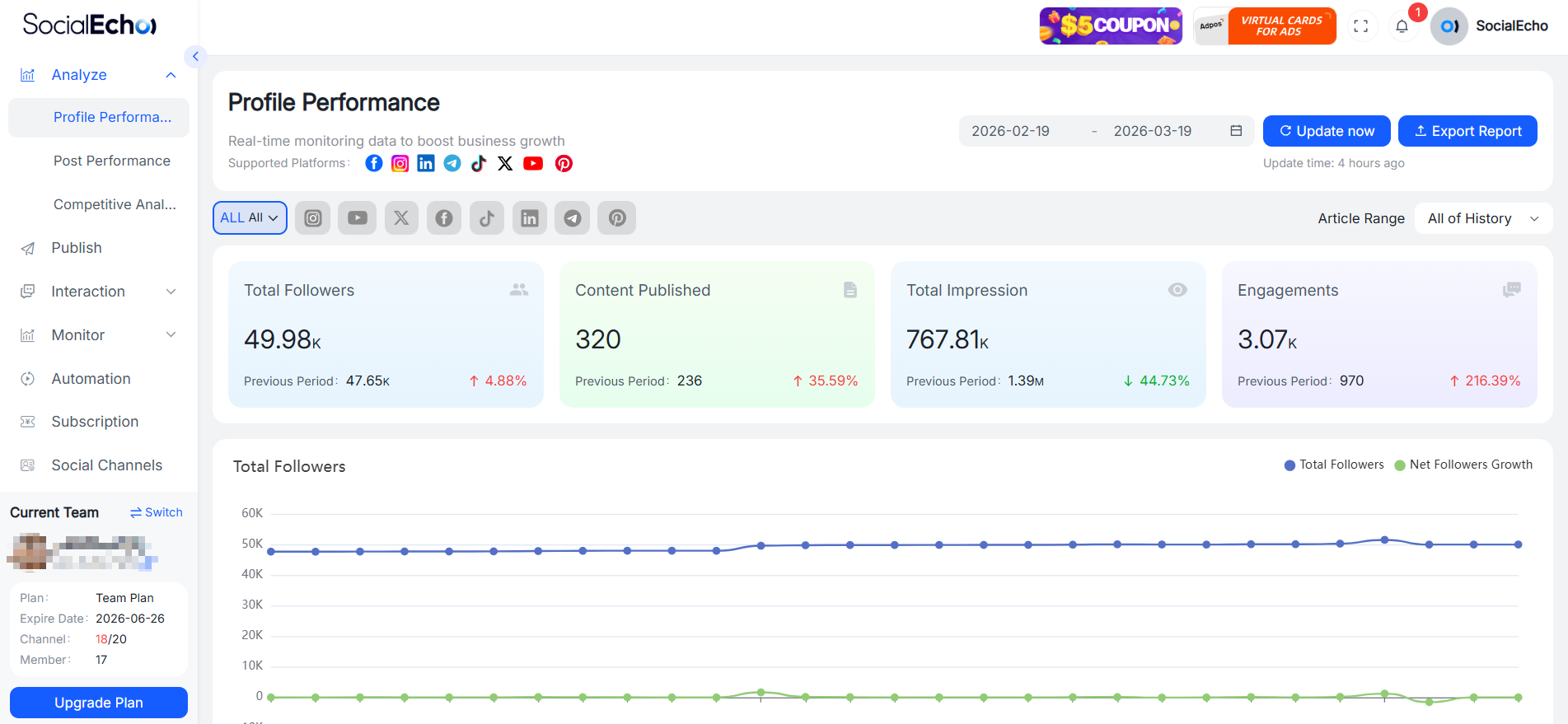
SocialEcho's unified multi-account management solves this core problem: no more need to log in to each account individually; all accounts are managed uniformly in one backend; content can be distributed to multiple platforms and accounts with one click; and differentiated settings can be made for the algorithm preferences of different platforms.
Specifically, the outsourced operations team can manage all client accounts across seven platforms—Facebook, Instagram, X, LinkedIn, TikTok, YouTube, and Pinterest—all within a single interface. Content scheduling, timed posting, and batch operations are all completed in one place. That Excel spreadsheet filled with account passwords can be completely eliminated.
With the new country-level visibility control added to the X platform, the outsourced operations team can directly set content strategies for different regions when publishing, without having to log in to different accounts to operate.
Data reporting can no longer be a nightmare.
SocialEcho's data analytics features support real-time aggregation of data from multiple platforms and accounts, displaying follower counts, impressions, interactions, comments, likes, and shares all on a single screen. The data is detailed down to the daily level and supports viewing 180 days of historical data.
More importantly, the data can be directly exported to Excel format, supporting customized report content and time ranges. Mike's team no longer needs to spend an afternoon taking screenshots and putting together a PowerPoint presentation—the entire process of exporting data, formatting, and sending it to the client is compressed to less than 20 minutes.
This isn't a minor optimization; it means giving back 4 hours of time per week directly to the team.
Can you see the price inquiries in the comments section within 3 hours?
Another problem that many outsourced operators don't realize how serious is: the speed of interaction and response in the comment section.
An e-commerce client posted a product video on TikTok, and someone in the comments asked, "Do you have a white version?" If this question hadn't been seen for three hours, the potential buyer would have already purchased a competitor's product. However, if you're managing 20 accounts across 60 platforms, it's impossible to monitor every comment in real time.
SocialEcho's interaction management feature automatically aggregates user comments from multiple platforms. AI identifies user emotions and intentions—which are purchase intentions, which are complaints, and which are general inquiries—and supports automatic and template replies. The outsourced operations team doesn't need to manually post comments on each platform; important interactions are prioritized and pushed out.
For e-commerce clients, this directly impacts conversion rates.
Executable action instructions
If you currently manage more than 10 client accounts, you can take a simple self-test:
Last week, how many hours did your team spend on account logins and switching? How many hours on data screenshots and weekly report preparation? How many hours on posting comments on various platforms?
Add these three numbers together and multiply them by your team's hourly wage; this is your hidden cost per week for repetitive tasks.
If this number exceeds the monthly fee you charge a client, then you are actually losing money serving that client.
Rebuilding workflows is not a complicated task. SocialEcho's batch scheduled publishing can be migrated in an afternoon, setting up content schedules for all clients for the following week and then letting the system execute automatically.

The profit margin in the e-commerce operations outsourcing industry is inherently thin. Whether you can survive depends not on how many clients you serve, but on how low your actual cost per client is.
Give those 3 hours back to yourself and use them for things that are truly valuable: content strategy, customer relations, and new business development.
This is the real moat of an agency.
SocialEcho is a social media management tool that supports unified management across 8 major platforms, helping outsourced management teams save 90% of their posting time.
;}.cls-2{fill:%230868f7;}.cls-3{fill:url(%23未命名的渐变_44);}.cls-4{fill:%23333;}%3c/style%3e%3clinearGradient%20id='未命名的渐变_8'%20x1='33.73'%20y1='100.61'%20x2='-0.03'%20y2='-1.06'%20gradientUnits='userSpaceOnUse'%3e%3cstop%20offset='0'%20stop-color='%237ae9fb'/%3e%3cstop%20offset='0.67'%20stop-color='%232b90f8'/%3e%3cstop%20offset='1'%20stop-color='%230868f7'/%3e%3c/linearGradient%3e%3clinearGradient%20id='未命名的渐变_44'%20x1='27.86'%20y1='18.67'%20x2='68.36'%20y2='22.22'%20gradientUnits='userSpaceOnUse'%3e%3cstop%20offset='0'%20stop-color='%235ac7f2'/%3e%3cstop%20offset='1'%20stop-color='%230868f7'/%3e%3c/linearGradient%3e%3c/defs%3e%3cpath%20class='cls-1'%20d='M29,28.74V81.91l-9.51-3.68v0L8.52,74A7.17,7.17,0,0,1,4,67.32V24.54A3.76,3.76,0,0,1,9.08,21Z'/%3e%3cpath%20class='cls-2'%20d='M68.09,78.07a13.15,13.15,0,0,1-17.9,12.06L29,81.91h0V28.74L50.19,37A13.17,13.17,0,0,0,68.08,25.3h0Z'/%3e%3cpath%20class='cls-3'%20d='M68.08,25.3a13.19,13.19,0,0,1-6.73,10.87A13.09,13.09,0,0,1,50.19,37L29,28.74V6A3.76,3.76,0,0,1,34.1,2.52l25.59,9.91A13.22,13.22,0,0,1,68.08,25.3Z'/%3e%3cpath%20class='cls-4'%20d='M129.06,81.76a4.33,4.33,0,0,1-3.19-1.31,4.4,4.4,0,0,1-1.31-3.24V56.86H97.65V77.21a4.36,4.36,0,0,1-1.35,3.2A4.68,4.68,0,0,1,93,81.76a4.32,4.32,0,0,1-3.19-1.31,4.37,4.37,0,0,1-1.32-3.24V27.27A4.58,4.58,0,0,1,89.83,24a4.59,4.59,0,0,1,7.82,3.27V48.15h26.91V27.27A4.58,4.58,0,0,1,125.91,24a4.59,4.59,0,0,1,7.82,3.27V77.21a4.37,4.37,0,0,1-1.36,3.2A4.65,4.65,0,0,1,129.06,81.76Z'/%3e%3cpath%20class='cls-4'%20d='M163.77,81.66c-6.57,0-11.76-1.92-15.44-5.7s-5.54-9.07-5.54-15.74a26.76,26.76,0,0,1,2.09-10.43,17.72,17.72,0,0,1,6.67-8.06,19.15,19.15,0,0,1,10.68-2.95,19,19,0,0,1,10.46,2.8,18.7,18.7,0,0,1,6.55,7.36,22.53,22.53,0,0,1,2.36,10.28A4.51,4.51,0,0,1,177,63.77H152.23a10.8,10.8,0,0,0,3.49,6.65c2,1.68,4.88,2.52,8.66,2.52a22.25,22.25,0,0,0,7.54-1.21c.74-.3,1.55-.67,2.37-1.07a3.75,3.75,0,0,1,1.84-.4,4.09,4.09,0,0,1,3,1.15,4,4,0,0,1,1.12,3,4.38,4.38,0,0,1-2.58,3.82,32.34,32.34,0,0,1-6.36,2.61A28.67,28.67,0,0,1,163.77,81.66ZM172.4,55.9a9.72,9.72,0,0,0-1.63-4.56A9.9,9.9,0,0,0,167,48a10.38,10.38,0,0,0-4.64-1.14,12,12,0,0,0-4.77,1.06,9.54,9.54,0,0,0-4.89,5.66,11.78,11.78,0,0,0-.51,2.3Z'/%3e%3cpath%20class='cls-4'%20d='M193,81.64a4.49,4.49,0,0,1-4.51-4.55V27.28A4.58,4.58,0,0,1,189.84,24a4.48,4.48,0,0,1,3.28-1.36A4.36,4.36,0,0,1,196.35,24a4.46,4.46,0,0,1,1.31,3.31V77.09a4.34,4.34,0,0,1-1.35,3.2A4.67,4.67,0,0,1,193,81.64Z'/%3e%3cpath%20class='cls-4'%20d='M263.79,81.71a5.7,5.7,0,0,1-4.2-1.74,5.76,5.76,0,0,1-1.73-4.19V27.37a4.58,4.58,0,0,1,1.35-3.27A4.59,4.59,0,0,1,267,27.37V72.53h24a4.58,4.58,0,0,1,3.27,7.82A4.66,4.66,0,0,1,291,81.71Z'/%3e%3cpath%20class='cls-4'%20d='M424.48,81.74a4.71,4.71,0,0,1-2.71-.88,5.43,5.43,0,0,1-1-1l-.07-.09-12.41-17-5.41,5v9.44a4.31,4.31,0,0,1-1.36,3.19,4.66,4.66,0,0,1-3.3,1.36A4.29,4.29,0,0,1,395,80.42a4.36,4.36,0,0,1-1.32-3.23V27.37A4.58,4.58,0,0,1,395,24.1a4.52,4.52,0,0,1,6.58.12,4.54,4.54,0,0,1,1.24,3.15V56.31l17.72-16.38.05,0a4.8,4.8,0,0,1,2.94-1.11,4.4,4.4,0,0,1,3.27,1.2,4.57,4.57,0,0,1,1.2,3.27,4.44,4.44,0,0,1-.77,2.33,7.45,7.45,0,0,1-1.43,1.65l-11,9.64,13.34,17.68a5,5,0,0,1,1,2.71,4.12,4.12,0,0,1-1.36,3.24A4.64,4.64,0,0,1,424.48,81.74Z'/%3e%3cpath%20class='cls-4'%20d='M317.93,81.76a21.5,21.5,0,1,1,21.17-21.5A21.37,21.37,0,0,1,317.93,81.76Zm0-34.1a12.61,12.61,0,1,0,12.42,12.6A12.52,12.52,0,0,0,317.93,47.66Z'/%3e%3cpath%20class='cls-4'%20d='M212.18,101.22a4.12,4.12,0,0,1-3.05-1.26,4.17,4.17,0,0,1-1.26-3.1V43.34a4.37,4.37,0,0,1,1.3-3.14,4.26,4.26,0,0,1,3.13-1.3,4.19,4.19,0,0,1,3.1,1.26,4.32,4.32,0,0,1,1.26,3.16,20.77,20.77,0,0,1,13-4.54,21.51,21.51,0,0,1,0,43,20.51,20.51,0,0,1-13-4.57V96.86a4.15,4.15,0,0,1-1.3,3.06A4.5,4.5,0,0,1,212.18,101.22Zm17.43-53.63c-6.23,0-12.93,4.11-12.93,12.72a12.73,12.73,0,0,0,25.46,0A12.71,12.71,0,0,0,229.61,47.59Z'/%3e%3cpath%20class='cls-4'%20d='M365.76,81.76a21.5,21.5,0,1,1,21.18-21.5A21.37,21.37,0,0,1,365.76,81.76Zm0-34.1a12.61,12.61,0,1,0,12.42,12.6A12.52,12.52,0,0,0,365.76,47.66Z'/%3e%3c/svg%3e)