
5 Common Social Media Mistakes Beginners Make (And How to Avoid Them)
5 Social Media Mistakes Beginners Always Make (And How to Fix Them)
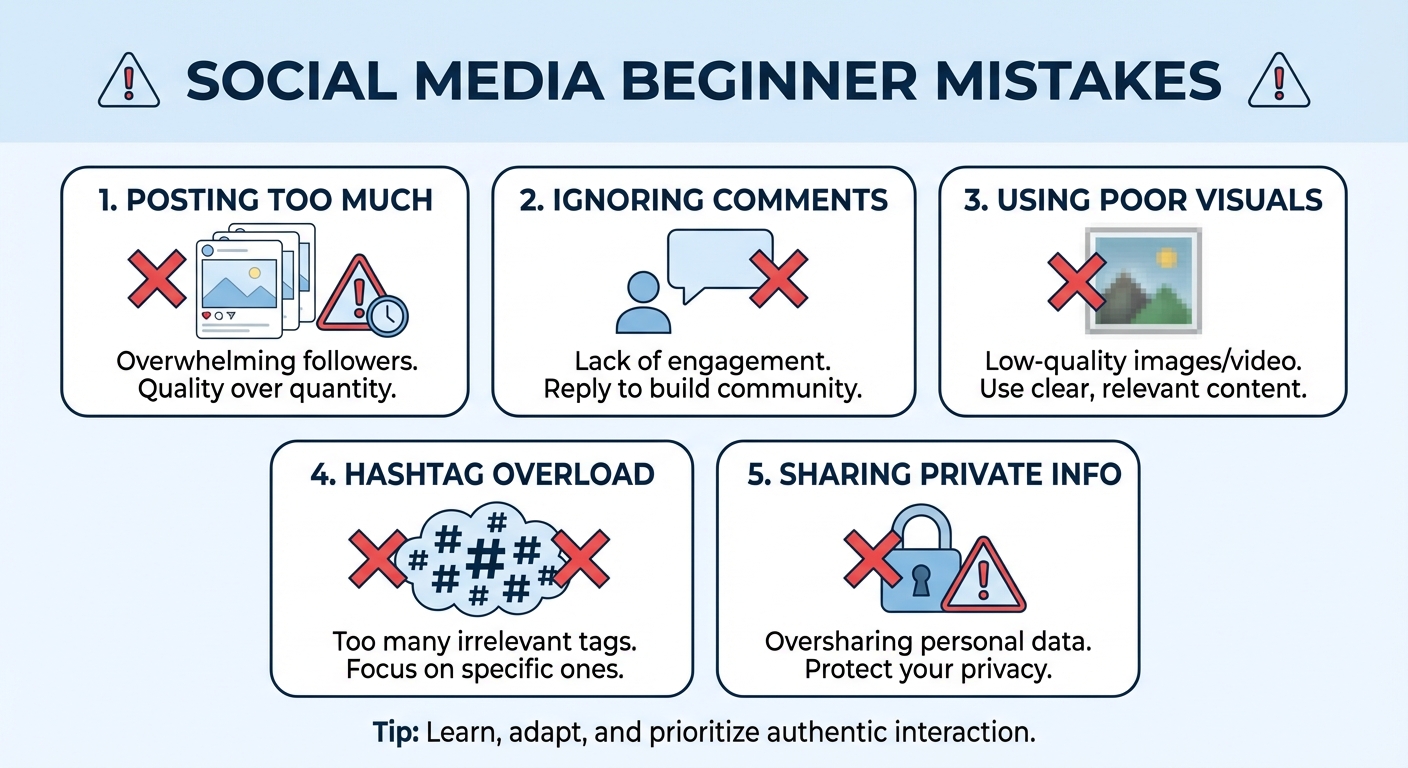
Social media management has a low barrier to entry — but plenty of pitfalls.
A lot of people assume that just "posting and replying" is enough to run an account. Three months later: followers haven't grown, engagement is zero, and they're second-guessing their own content.
This guide breaks down the 5 most common mistakes new social media managers make, each with concrete diagnostic criteria and fixes — read it carefully and you'll save yourself at least six months of trial and error.
Mistake #1: Starting to Post Without a Clear Account Positioning
This is the most common — and most costly — mistake.
"Post first, find my style later" — this mindset almost always fails in social media management. The reason is simple: the algorithm needs time to learn your account, and users need signals to decide whether you're worth following. If your content is all over the place — tools tips on Monday, motivational quotes on Tuesday, product promotions on Wednesday — the algorithm doesn't know who to push your content to, and followers don't know why they have to follow you specifically.
How to diagnose whether your account positioning is clear: Open your account profile and ask: can a stranger figure out "what this account does and who it's for" within 3 seconds? If not, your positioning is vague.
The fix:
- Write one "account positioning statement": "Providing [type of value] about [content topic] for [target audience]." Example: "Providing social media management tool tutorials and case studies for independent e-commerce sellers"
- All content should revolve around this positioning — don't post anything that doesn't fit
Mistake #2: Only Caring About Follower Growth, Ignoring Retention
Most new managers have only one core metric: follower count. Numbers go up, happy. Numbers stop, worried.
But in reality, an account's true value isn't follower quantity — it's active follower quantity. An account with 100,000 followers getting only 200 likes per post is a "zombie audience graveyard"; an account with 10,000 followers getting 1,000 likes per post gets far more algorithm distribution weight than the former.
Retention is harder than growth, but more valuable.
How to diagnose retention quality: Check native platform Insights and look at "engagement rate" (total interactions/follower count) and "reach rate" (people reached/total followers). Generally speaking, an engagement rate above 1% is considered a healthy account, above 3% indicates fairly strong follower stickiness — though benchmarks vary significantly by industry and platform, so use your own account's historical data as the baseline.
The fix:
- Add "engagement rate" to your weekly review metrics alongside follower count
- Build "retention hooks" into your content strategy: end posts by prompting comments, set up conversation topics that give followers something to say
Mistake #3: Ignoring Analytics and Running on Gut Feeling
"I feel like this topic will blow up." "I feel like this time slot performs better." — Running your account on gut feeling is the growth bottleneck that new managers are slowest to recognize.
Gut feeling is sometimes right, but it can't be replicated, accumulated, or scaled. Data tells you the truth.
The metrics beginners should actually be watching:
- Reach: How many people saw this piece of content
- Engagement Rate: (Likes + Comments + Shares) / Reach
- Follower growth trend: Look at week-over-week, not single-day fluctuations
- Traffic source: Which entry point led users to discover your content
The fix:
- Set a fixed time each week to review data (Monday mornings recommended)
- Record each post's core metrics and build your own "content data library"
- Use data to validate hypotheses: guess "posting at 6 PM performs better than 10 AM," then run a two-week A/B test and let the data speak
Mistake #4: Only Posting, Never Engaging — Treating Social Media Like a Billboard
The core of social media is "social" — not "media."
Many new managers run accounts like official announcement boards: post content on a fixed schedule, never reply to comments, never follow back followers, never participate in peer interactions. That's not management — that's broadcasting.
Platform algorithms factor "depth of user engagement with content" into distribution weight. The more conversations an account has with users, the higher its activity score, and the more free distribution it earns.
Specific engagement tactics:
- For comments on your own content, reply to every single one (quality replies, not just "Thanks!")
- Proactively leave comments on popular content in your niche, expressing valuable points of view (not self-promotion)
- Regularly participate in trending platform challenges (especially TikTok and Instagram Reels trending topics)

Good engagement strategy is a two-way return — you get more visibility, and peers may return the favor with visits and cross-promotions.
Mistake #5: Not Understanding Platform Rules, Getting Shadowbanned Without Knowing Why
This is the most frustrating mistake — content quality is solid, posting frequency is consistent, but because you triggered hidden platform rules, your account got shadowbanned and you don't even know why.
Common shadowban triggers by platform:
- Instagram: Frequently switching accounts, bulk following/unfollowing in short time periods, using non-compliant third-party tools
- TikTok: Reposting content with watermarks, engagement farming (buying likes/followers), video content containing sensitive keywords
- Facebook: Page getting reported, sending private messages too frequently, repeatedly sharing the same link
- X: High-frequency posting flagged as bot behavior, triggering mass reports
The fix:
- Set aside time to read the Community Guidelines for your main platforms (every platform's official site has them — takes about 30 minutes)
- Use compliant multi-account management tools (like SocialEcho) to avoid manually switching accounts and triggering risk controls
- When you get shadowbanned, first self-audit recent behavior, then appeal through official channels
Closing Thoughts
Making mistakes as a beginner is inevitable — stepping in pitfalls is part of the growth journey. But some pitfalls have already been documented by countless others, with proven workarounds available. No need to explore them all on your own.
Run through the 5 mistakes in this guide against your current operations and do a self-audit. The gap in social media management ability isn't about how much you know — it's about how much you actually change.
FAQ
Q: I've made all of the mistakes above — is it too late?
A: It's not too late. Start fixing from the ones most affecting account health — address positioning and shadowban risk first. Once those two are fixed, the rest can be repaired gradually. Account data recovery takes 4–6 weeks of sustained optimization — don't expect overnight results.
Q: I'm a small team (1–2 people) — how do I have time for that much engagement?
A: Quality over quantity. Rather than posting 5 pieces of content with zero engagement, post 1–2 pieces and genuinely reply to every comment. Tools (like SocialEcho's unified inbox
Related features: Instagram Multi-Account Management · TikTok Multi-Account Management · Facebook Multi-Account Management · X/Twitter Management · YouTube Management

) can cut interaction management time by more than half.
Q: I got shadowbanned — does appealing actually work?
A: It works, but results aren't instant. First confirm the reason for the ban, then appeal through official channels. If the appeal doesn't go through, stop the offending behavior and maintain normal operations for 2–4 weeks — most light shadowbans will lift automatically.
;}.cls-2{fill:%230868f7;}.cls-3{fill:url(%23未命名的渐变_44);}.cls-4{fill:%23333;}%3c/style%3e%3clinearGradient%20id='未命名的渐变_8'%20x1='33.73'%20y1='100.61'%20x2='-0.03'%20y2='-1.06'%20gradientUnits='userSpaceOnUse'%3e%3cstop%20offset='0'%20stop-color='%237ae9fb'/%3e%3cstop%20offset='0.67'%20stop-color='%232b90f8'/%3e%3cstop%20offset='1'%20stop-color='%230868f7'/%3e%3c/linearGradient%3e%3clinearGradient%20id='未命名的渐变_44'%20x1='27.86'%20y1='18.67'%20x2='68.36'%20y2='22.22'%20gradientUnits='userSpaceOnUse'%3e%3cstop%20offset='0'%20stop-color='%235ac7f2'/%3e%3cstop%20offset='1'%20stop-color='%230868f7'/%3e%3c/linearGradient%3e%3c/defs%3e%3cpath%20class='cls-1'%20d='M29,28.74V81.91l-9.51-3.68v0L8.52,74A7.17,7.17,0,0,1,4,67.32V24.54A3.76,3.76,0,0,1,9.08,21Z'/%3e%3cpath%20class='cls-2'%20d='M68.09,78.07a13.15,13.15,0,0,1-17.9,12.06L29,81.91h0V28.74L50.19,37A13.17,13.17,0,0,0,68.08,25.3h0Z'/%3e%3cpath%20class='cls-3'%20d='M68.08,25.3a13.19,13.19,0,0,1-6.73,10.87A13.09,13.09,0,0,1,50.19,37L29,28.74V6A3.76,3.76,0,0,1,34.1,2.52l25.59,9.91A13.22,13.22,0,0,1,68.08,25.3Z'/%3e%3cpath%20class='cls-4'%20d='M129.06,81.76a4.33,4.33,0,0,1-3.19-1.31,4.4,4.4,0,0,1-1.31-3.24V56.86H97.65V77.21a4.36,4.36,0,0,1-1.35,3.2A4.68,4.68,0,0,1,93,81.76a4.32,4.32,0,0,1-3.19-1.31,4.37,4.37,0,0,1-1.32-3.24V27.27A4.58,4.58,0,0,1,89.83,24a4.59,4.59,0,0,1,7.82,3.27V48.15h26.91V27.27A4.58,4.58,0,0,1,125.91,24a4.59,4.59,0,0,1,7.82,3.27V77.21a4.37,4.37,0,0,1-1.36,3.2A4.65,4.65,0,0,1,129.06,81.76Z'/%3e%3cpath%20class='cls-4'%20d='M163.77,81.66c-6.57,0-11.76-1.92-15.44-5.7s-5.54-9.07-5.54-15.74a26.76,26.76,0,0,1,2.09-10.43,17.72,17.72,0,0,1,6.67-8.06,19.15,19.15,0,0,1,10.68-2.95,19,19,0,0,1,10.46,2.8,18.7,18.7,0,0,1,6.55,7.36,22.53,22.53,0,0,1,2.36,10.28A4.51,4.51,0,0,1,177,63.77H152.23a10.8,10.8,0,0,0,3.49,6.65c2,1.68,4.88,2.52,8.66,2.52a22.25,22.25,0,0,0,7.54-1.21c.74-.3,1.55-.67,2.37-1.07a3.75,3.75,0,0,1,1.84-.4,4.09,4.09,0,0,1,3,1.15,4,4,0,0,1,1.12,3,4.38,4.38,0,0,1-2.58,3.82,32.34,32.34,0,0,1-6.36,2.61A28.67,28.67,0,0,1,163.77,81.66ZM172.4,55.9a9.72,9.72,0,0,0-1.63-4.56A9.9,9.9,0,0,0,167,48a10.38,10.38,0,0,0-4.64-1.14,12,12,0,0,0-4.77,1.06,9.54,9.54,0,0,0-4.89,5.66,11.78,11.78,0,0,0-.51,2.3Z'/%3e%3cpath%20class='cls-4'%20d='M193,81.64a4.49,4.49,0,0,1-4.51-4.55V27.28A4.58,4.58,0,0,1,189.84,24a4.48,4.48,0,0,1,3.28-1.36A4.36,4.36,0,0,1,196.35,24a4.46,4.46,0,0,1,1.31,3.31V77.09a4.34,4.34,0,0,1-1.35,3.2A4.67,4.67,0,0,1,193,81.64Z'/%3e%3cpath%20class='cls-4'%20d='M263.79,81.71a5.7,5.7,0,0,1-4.2-1.74,5.76,5.76,0,0,1-1.73-4.19V27.37a4.58,4.58,0,0,1,1.35-3.27A4.59,4.59,0,0,1,267,27.37V72.53h24a4.58,4.58,0,0,1,3.27,7.82A4.66,4.66,0,0,1,291,81.71Z'/%3e%3cpath%20class='cls-4'%20d='M424.48,81.74a4.71,4.71,0,0,1-2.71-.88,5.43,5.43,0,0,1-1-1l-.07-.09-12.41-17-5.41,5v9.44a4.31,4.31,0,0,1-1.36,3.19,4.66,4.66,0,0,1-3.3,1.36A4.29,4.29,0,0,1,395,80.42a4.36,4.36,0,0,1-1.32-3.23V27.37A4.58,4.58,0,0,1,395,24.1a4.52,4.52,0,0,1,6.58.12,4.54,4.54,0,0,1,1.24,3.15V56.31l17.72-16.38.05,0a4.8,4.8,0,0,1,2.94-1.11,4.4,4.4,0,0,1,3.27,1.2,4.57,4.57,0,0,1,1.2,3.27,4.44,4.44,0,0,1-.77,2.33,7.45,7.45,0,0,1-1.43,1.65l-11,9.64,13.34,17.68a5,5,0,0,1,1,2.71,4.12,4.12,0,0,1-1.36,3.24A4.64,4.64,0,0,1,424.48,81.74Z'/%3e%3cpath%20class='cls-4'%20d='M317.93,81.76a21.5,21.5,0,1,1,21.17-21.5A21.37,21.37,0,0,1,317.93,81.76Zm0-34.1a12.61,12.61,0,1,0,12.42,12.6A12.52,12.52,0,0,0,317.93,47.66Z'/%3e%3cpath%20class='cls-4'%20d='M212.18,101.22a4.12,4.12,0,0,1-3.05-1.26,4.17,4.17,0,0,1-1.26-3.1V43.34a4.37,4.37,0,0,1,1.3-3.14,4.26,4.26,0,0,1,3.13-1.3,4.19,4.19,0,0,1,3.1,1.26,4.32,4.32,0,0,1,1.26,3.16,20.77,20.77,0,0,1,13-4.54,21.51,21.51,0,0,1,0,43,20.51,20.51,0,0,1-13-4.57V96.86a4.15,4.15,0,0,1-1.3,3.06A4.5,4.5,0,0,1,212.18,101.22Zm17.43-53.63c-6.23,0-12.93,4.11-12.93,12.72a12.73,12.73,0,0,0,25.46,0A12.71,12.71,0,0,0,229.61,47.59Z'/%3e%3cpath%20class='cls-4'%20d='M365.76,81.76a21.5,21.5,0,1,1,21.18-21.5A21.37,21.37,0,0,1,365.76,81.76Zm0-34.1a12.61,12.61,0,1,0,12.42,12.6A12.52,12.52,0,0,0,365.76,47.66Z'/%3e%3c/svg%3e)