
Social Media Crisis Management: A Complete Standard Operating Procedure for Controlling Public Opinion Within 24 Hours
introduction
At 2 a.m., you are awakened by your phone vibrating.
Upon opening it, I saw that the comments section under the brand's official account had exploded. Screenshots were circulating in various WeChat groups, someone posted a long article on Twitter accusing you, and the brand name had become a trending topic.
What was your first reaction?
Many brands are choosing to wait until tomorrow to take action, or delete comments to quell the situation, or issue an official statement saying "We are investigating."
These are all wrong.
The golden response time for a social media crisis is 24 hours. Within this window, your reaction speed, response strategy, and execution quality directly determine whether it's a minor incident or a public relations disaster.
This article breaks down the complete Standard Operating Procedure (SOP) for social media crisis communication: from crisis monitoring to response strategies to specific execution actions. Whether your brand has encountered a crisis before or not, you should prepare this plan in advance.
I. Why a Quick Response is Essential for Social Media Crises
The speed at which crises spread in the social media era is on a completely different scale compared to the traditional media era.
A piece of negative content can go from being posted to escalating into a crisis in just a few hours. On platforms like Weibo, Twitter, and TikTok, information spreads at an explosive rate—a complaint from an ordinary user can become a trending topic online within 24 hours because of a few influential users sharing it.
The stages of a crisis:
Phase 1: Fermentation period (0-6 hours)
Negative content has just emerged, and comments are beginning to gather. This stage presents the optimal time for intervention. If it can be detected promptly, responded to quickly, and effectively resolved, the crisis can be nipped in the bud.
Phase Two: Diffusion Period (6-24 hours)
Negative content began to be shared more widely, the media started to get involved, and public opinion intensified. At this stage, a more systematic response strategy is needed; simply deleting comments or issuing statements is no longer sufficient.
Phase 3: Outbreak (24-72 hours)
The crisis has fully erupted, making headlines and trending topics, and mainstream media has begun reporting on it. The focus at this stage is on controlling losses, guiding public opinion, and clarifying our stance.
Phase 4: Regression Period (after 72 hours)
Without a new catalyst, public attention will naturally subside. However, this does not mean the crisis is over—the negative public perception of the brand will persist for a long time, impacting subsequent brand building and sales conversion.
Remember: The core of crisis public relations is not putting out a fire after it happens, but discovering and resolving it during its escalation.
II. Crisis Monitoring: Detecting crises earlier than they occur.
The first step in crisis prevention is to establish an effective public opinion monitoring system , which, together with comment management, tracks user feedback in real time.
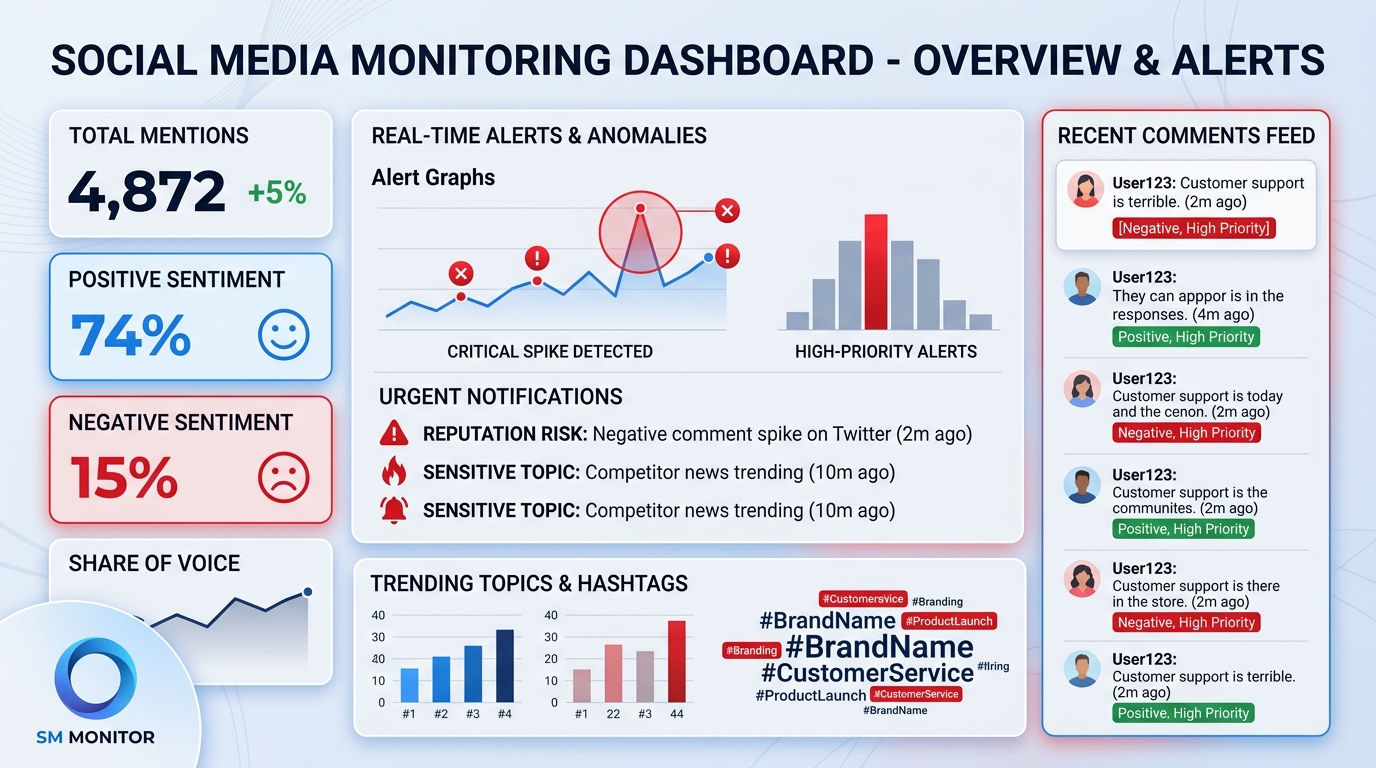
Many brands fail in crisis management not because of poor response, but because they discover the problem too late—by the time they see it trending, the negative information has already been circulating for several hours, and the best time to intervene has long been missed.
2.1 What to monitor
Brand keywords: brand name, brand name + product, CEO/founder's name, brand slogan, etc.
Competitor dynamics: Sometimes a brand crisis can affect the entire industry, and monitoring competitors can provide early warnings.
Industry-sensitive keywords: Negative and sensitive keywords related to your industry, such as food safety, brand fraud, privacy leaks, and other common crisis triggers in the industry.
KOL/KOC reviews: Pay attention to the reviews of influential users in the industry, as their content is more likely to generate secondary dissemination.
2.2 Establishment of an early warning mechanism
Monitoring is not just about collecting data; more importantly, it's about establishing early warning mechanisms.
It is recommended to set an early warning level:
- Yellow alert: Single negative post, number of interactions
- Orange alert: Negative content with over 50 interactions, or appearing on an industry KOL's account → Prepare to respond.
- Red Alert: Negative content is spreading rapidly, possibly involving influential online figures → Initiate Crisis Response Immediately
III. What to do in the first hour of crisis response?
The quality of handling a crisis in the first hour directly determines its subsequent course.
3.1 Internal confirmation (0-15 minutes)
The first thing to do is not to issue a statement, but to find out the facts.
Before making any statements to the public, confirm internally first:
- Is this negative information true or false?
- If true, how serious is it?
- How many people are discussing this right now?
- What is the main discussion platform?
- Did any media outlets or influential figures get involved?
Don't issue a statement before you've figured out the facts; saying the wrong thing is worse than saying nothing at all.
3.2 Establish a crisis management team (15-30 minutes)
Medium to large brands should have a pre-established crisis management team structure. Team members typically include:
- Brand Manager (Decision-Making)
- Public Relations/Communications Manager (External Communication)
- Legal Affairs (Legal Risk Assessment)
- Product/Operations Manager (if the issue is product-related)
- Customer Service Manager (User Communication)
After the team was established, the division of labor was clearly defined: who was responsible for issuing external statements, who was responsible for contacting the media, who was responsible for responding to social media comments, and who was responsible for data monitoring.
3.3 Determine the response strategy (30-60 minutes)
Before the first hour ends, a basic response strategy needs to be determined:
If it's a brand issue (a genuine error):
- Admitting mistakes
- Make your stance clear (a sincere apology, not a perfunctory one).
- Explain the solution
- Commitment to follow-up improvements
If it is a rumor or a misunderstanding:
- Provide factual basis
- Clarifying Misunderstandings
- Don't argue too forcefully (it will trigger a bigger backlash).
If it is a malicious attack:
- Collect evidence
- Legal alternatives
- State your position and do not escalate the conflict.
IV. The Golden Rule of Crisis Communication: Sincerity is More Important than Technique
Before embarking on any specific operations, it is essential to understand the core principles of crisis public relations.
The public's bottom line for tolerance in crisis communication is sincerity.
The internet remembers. In the 2009 Toyota brake scandal, Akio Toyoda bowed 90 degrees to the media, but American users didn't buy it, feeling the apology was forced and insincere. In the 2021 Tesla female owner protest, Tesla's arrogant response completely spiraled out of control of public opinion.
What does sincerity mean?
It's not enough to just issue a template "We regret" statement. Sincerity means:
- Admit your mistakes (if you were wrong).
- Take responsibility (do not shirk or pass the buck).
- Take concrete actions (not just talk).
- Continue to follow up (let the public see the changes).
The biggest mistake many brands make in crisis public relations is focusing their energy on "how to say it" rather than "how to do it." But the public isn't stupid; they can tell whether you're genuinely solving the problem or just putting on a crisis public relations show.
V. Complete 24-hour response process
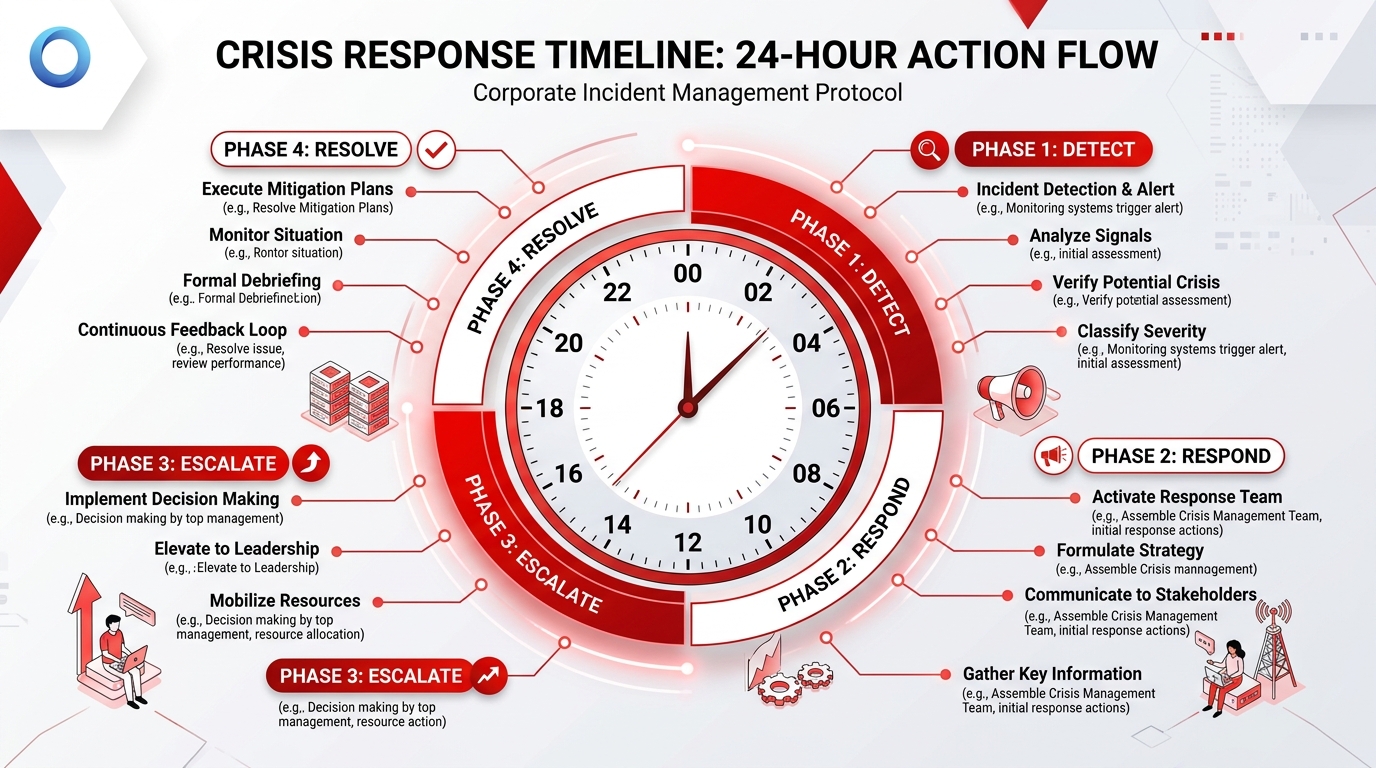
5.1 Phase 1: Rapid Response (0-4 hours)
Action 1: Reply to comments on official accounts
On social media, the comments section of the brand's official account that's being criticized is where public sentiment is most directly expressed. Don't disable comments, and don't just delete negative comments (this will be screenshotted and spread by users).
Correct approach:
- The official account posted a short but sincere reply template.
- For example: "We are aware of this issue, and the team is working on it urgently. We will give you a clear response before X o'clock."
- Speed is more important than perfection; stay calm first.
Action 2: Connect with key opinion leaders
If you have good relationships with KOLs or media professionals in the industry, you can proactively contact them, explain the situation, and request their support. However, please note that while honestly explaining the situation is fine, requests like "help me clear my name" will be rejected and may even backfire.
Action 3: Prepare a detailed statement
At this stage, a detailed official statement should already be being drafted. The statement should include:
- A description of the incident (without concealment or distortion).
- The brand's attitude (sincere apology or clarification)
- Specific solutions
- Commitment to further improvements
- Contact information (for user complaint channels)
5.2 Second Phase: System Response (4-12 hours)
Action 4: Issue an official statement
Once the statement is written, it should be released through official channels. In the case of a serious crisis, it should be released simultaneously on the official website, official social media, and press releases.
The statement's release does not signify the end of the process—we are monitoring public opinion in real time and preparing for follow-up actions.
Action 5: Expanding Customer Service Channels
If a crisis involves a large number of user complaints, customer service channels will be under pressure. Prepare FAQs in advance so that customer service staff have a consistent response. Also, prepare refund/compensation plans (if applicable).
5.3 Phase Three: Crisis Control (12-24 hours)
Action 6: Phase Progress Update
If the crisis is not completely resolved within 24 hours, at least a "progress update" should be released to inform the public what you are doing. Don't let the public feel that the brand has disappeared or that you no longer care.
Action 7: Address the core negative sources
If you can find the user who initially posted the negative information, try to resolve the issue privately without escalating the conflict. Sometimes, a sincere one-on-one conversation is more effective than issuing 100 official statements.
VI. Brand Repair After the Crisis
The crisis subsiding does not mean the end. The damage a crisis inflicts on a brand is long-term and requires continuous repair.
6.1 Trust rebuilding takes time.
In the aftermath of a crisis, public trust in brands will decline significantly. This recovery period could take several months or even longer.
The core of rebuilding trust is action, not promises.
Don't think that issuing a "we've corrected it" statement will make everything go back to the way it was. The public is watching what you do next—has your product actually improved? Have you delivered on your promised changes?
6.2 Continuous positive content output
In the months following a crisis, brands should consciously increase positive content on their social media: user testimonials, brand philanthropy, and product improvement stories. This content is not intended to "whitewash" the brand, but rather to genuinely showcase its actions.
6.3 Regular third-party endorsements
If a brand has certifications from authoritative organizations, third-party testing reports, and genuine user reviews, now is the time to showcase them. Third-party endorsements are far more credible than a brand's own statements.
VII. Crisis prevention is more important than crisis management
Finally, let me mention the most important point.
No matter how well a crisis management strategy is handled, it's not as good as preventing a crisis in the first place. Truly powerful brands don't just put out crises when they happen, but they nip them in the bud through daily operations.
What should I do on a daily basis?
- Product quality control is fundamental.
- Customer service response time needs to be fast (many crises escalate only when users have nowhere else to turn for help).
- Regular public opinion monitoring and problem investigation
- Establish a comprehensive crisis response plan (SOP).
- Cultivating a sense of crisis within the team
FAQ
Q1: What should you do immediately after a crisis occurs?
A1: Internally confirming the facts is the top priority. This doesn't mean issuing statements or deleting comments; it means figuring out exactly what happened. Incorrect information leads to incorrect responses, which is worse than no response at all. Simultaneously, immediately establish a crisis management team with clearly defined roles. Within the first hour, at least the following must be determined: the authenticity of the incident, its severity, its current scope, and whether it involves legal risks. Only after obtaining this information should a decision be made on how to respond.
Q2: What should I do if I have too many negative comments to delete?
A2: Don't try to delete all negative comments, as this will trigger a public opinion crisis of "post deletion" and exacerbate the conflict. The correct approach is to selectively delete obvious rumors or personal attacks, retaining genuine criticism; then use a large amount of positive content to "dilute" the negative content. At the same time, respond quickly to the core criticisms, provide solutions, and resolve the root cause of the crisis.
Q3: When should a brand issue an official statement?
A3: Statements should be issued after the facts are basically confirmed; not too early (to avoid making mistakes when the facts are unclear) and not too late (to give the public the impression that the brand is evading responsibility). It is generally recommended to issue an initial statement within 2-6 hours of a crisis. An initial statement could be a transitional statement such as, "We are aware of this issue and are handling it urgently. We will provide a formal response before X o'clock," giving the team time. A detailed formal statement can be issued within 6-12 hours.
Q4: How do you determine whether negative content will escalate into a crisis?
A4: Several key indicators: 1. Who is the publisher? If it's an influential KOL or media outlet, the probability of it escalating into a crisis is high. 2. What is the nature of the content? If it involves sensitive topics such as security, law, or fraud, it's prone to escalation. 3. How fast is it spreading? If sharing and discussion are growing rapidly, it indicates that the situation is developing. 4. What is the intensity of the emotion? If public sentiment is very agitated (not just criticism, but anger), it's easy for things to get out of control. It is recommended that each brand establish an early warning mechanism and set thresholds for these indicators.
Q5: Is it acceptable to ask the media to "suppress" press releases during crisis public relations?
A5: Not recommended. Suppressing press releases is a gray area in PR, and once exposed (which is very common), the consequences are more serious than the original event itself. Moreover, in today's era of social media, there are too many channels for information dissemination, making suppression impossible. The correct approach is to be honest with the media, provide facts, communicate actively, and let the media see that you are seriously addressing the problem. The media also needs news; if the brand's attitude is positive, most media outlets will give the brand a chance to explain the situation.
Conclusion
Simultaneously, Instagram and TikTok comment management can be used to cover multiple platforms. Crisis public relations is a challenge that every brand may face.
Good crisis communication isn't about skills and rhetoric, but about sincerity, speed, and a responsible attitude. The golden 24-hour window for response is fleeting.
Hopefully, this article will help you know what to do when a crisis actually hits. More importantly, hopefully your brand will never need to use these methods.
But things are unpredictable. It's always better to be prepared than caught off guard.
Want to learn more about public opinion monitoring and crisis prevention? Check out SocialEcho's comment monitoring feature to help you spot potential crisis signals immediately.
Free trial: SocialEcho public opinion monitoring
Word count: Approximately 3600 words
;}.cls-2{fill:%230868f7;}.cls-3{fill:url(%23未命名的渐变_44);}.cls-4{fill:%23333;}%3c/style%3e%3clinearGradient%20id='未命名的渐变_8'%20x1='33.73'%20y1='100.61'%20x2='-0.03'%20y2='-1.06'%20gradientUnits='userSpaceOnUse'%3e%3cstop%20offset='0'%20stop-color='%237ae9fb'/%3e%3cstop%20offset='0.67'%20stop-color='%232b90f8'/%3e%3cstop%20offset='1'%20stop-color='%230868f7'/%3e%3c/linearGradient%3e%3clinearGradient%20id='未命名的渐变_44'%20x1='27.86'%20y1='18.67'%20x2='68.36'%20y2='22.22'%20gradientUnits='userSpaceOnUse'%3e%3cstop%20offset='0'%20stop-color='%235ac7f2'/%3e%3cstop%20offset='1'%20stop-color='%230868f7'/%3e%3c/linearGradient%3e%3c/defs%3e%3cpath%20class='cls-1'%20d='M29,28.74V81.91l-9.51-3.68v0L8.52,74A7.17,7.17,0,0,1,4,67.32V24.54A3.76,3.76,0,0,1,9.08,21Z'/%3e%3cpath%20class='cls-2'%20d='M68.09,78.07a13.15,13.15,0,0,1-17.9,12.06L29,81.91h0V28.74L50.19,37A13.17,13.17,0,0,0,68.08,25.3h0Z'/%3e%3cpath%20class='cls-3'%20d='M68.08,25.3a13.19,13.19,0,0,1-6.73,10.87A13.09,13.09,0,0,1,50.19,37L29,28.74V6A3.76,3.76,0,0,1,34.1,2.52l25.59,9.91A13.22,13.22,0,0,1,68.08,25.3Z'/%3e%3cpath%20class='cls-4'%20d='M129.06,81.76a4.33,4.33,0,0,1-3.19-1.31,4.4,4.4,0,0,1-1.31-3.24V56.86H97.65V77.21a4.36,4.36,0,0,1-1.35,3.2A4.68,4.68,0,0,1,93,81.76a4.32,4.32,0,0,1-3.19-1.31,4.37,4.37,0,0,1-1.32-3.24V27.27A4.58,4.58,0,0,1,89.83,24a4.59,4.59,0,0,1,7.82,3.27V48.15h26.91V27.27A4.58,4.58,0,0,1,125.91,24a4.59,4.59,0,0,1,7.82,3.27V77.21a4.37,4.37,0,0,1-1.36,3.2A4.65,4.65,0,0,1,129.06,81.76Z'/%3e%3cpath%20class='cls-4'%20d='M163.77,81.66c-6.57,0-11.76-1.92-15.44-5.7s-5.54-9.07-5.54-15.74a26.76,26.76,0,0,1,2.09-10.43,17.72,17.72,0,0,1,6.67-8.06,19.15,19.15,0,0,1,10.68-2.95,19,19,0,0,1,10.46,2.8,18.7,18.7,0,0,1,6.55,7.36,22.53,22.53,0,0,1,2.36,10.28A4.51,4.51,0,0,1,177,63.77H152.23a10.8,10.8,0,0,0,3.49,6.65c2,1.68,4.88,2.52,8.66,2.52a22.25,22.25,0,0,0,7.54-1.21c.74-.3,1.55-.67,2.37-1.07a3.75,3.75,0,0,1,1.84-.4,4.09,4.09,0,0,1,3,1.15,4,4,0,0,1,1.12,3,4.38,4.38,0,0,1-2.58,3.82,32.34,32.34,0,0,1-6.36,2.61A28.67,28.67,0,0,1,163.77,81.66ZM172.4,55.9a9.72,9.72,0,0,0-1.63-4.56A9.9,9.9,0,0,0,167,48a10.38,10.38,0,0,0-4.64-1.14,12,12,0,0,0-4.77,1.06,9.54,9.54,0,0,0-4.89,5.66,11.78,11.78,0,0,0-.51,2.3Z'/%3e%3cpath%20class='cls-4'%20d='M193,81.64a4.49,4.49,0,0,1-4.51-4.55V27.28A4.58,4.58,0,0,1,189.84,24a4.48,4.48,0,0,1,3.28-1.36A4.36,4.36,0,0,1,196.35,24a4.46,4.46,0,0,1,1.31,3.31V77.09a4.34,4.34,0,0,1-1.35,3.2A4.67,4.67,0,0,1,193,81.64Z'/%3e%3cpath%20class='cls-4'%20d='M263.79,81.71a5.7,5.7,0,0,1-4.2-1.74,5.76,5.76,0,0,1-1.73-4.19V27.37a4.58,4.58,0,0,1,1.35-3.27A4.59,4.59,0,0,1,267,27.37V72.53h24a4.58,4.58,0,0,1,3.27,7.82A4.66,4.66,0,0,1,291,81.71Z'/%3e%3cpath%20class='cls-4'%20d='M424.48,81.74a4.71,4.71,0,0,1-2.71-.88,5.43,5.43,0,0,1-1-1l-.07-.09-12.41-17-5.41,5v9.44a4.31,4.31,0,0,1-1.36,3.19,4.66,4.66,0,0,1-3.3,1.36A4.29,4.29,0,0,1,395,80.42a4.36,4.36,0,0,1-1.32-3.23V27.37A4.58,4.58,0,0,1,395,24.1a4.52,4.52,0,0,1,6.58.12,4.54,4.54,0,0,1,1.24,3.15V56.31l17.72-16.38.05,0a4.8,4.8,0,0,1,2.94-1.11,4.4,4.4,0,0,1,3.27,1.2,4.57,4.57,0,0,1,1.2,3.27,4.44,4.44,0,0,1-.77,2.33,7.45,7.45,0,0,1-1.43,1.65l-11,9.64,13.34,17.68a5,5,0,0,1,1,2.71,4.12,4.12,0,0,1-1.36,3.24A4.64,4.64,0,0,1,424.48,81.74Z'/%3e%3cpath%20class='cls-4'%20d='M317.93,81.76a21.5,21.5,0,1,1,21.17-21.5A21.37,21.37,0,0,1,317.93,81.76Zm0-34.1a12.61,12.61,0,1,0,12.42,12.6A12.52,12.52,0,0,0,317.93,47.66Z'/%3e%3cpath%20class='cls-4'%20d='M212.18,101.22a4.12,4.12,0,0,1-3.05-1.26,4.17,4.17,0,0,1-1.26-3.1V43.34a4.37,4.37,0,0,1,1.3-3.14,4.26,4.26,0,0,1,3.13-1.3,4.19,4.19,0,0,1,3.1,1.26,4.32,4.32,0,0,1,1.26,3.16,20.77,20.77,0,0,1,13-4.54,21.51,21.51,0,0,1,0,43,20.51,20.51,0,0,1-13-4.57V96.86a4.15,4.15,0,0,1-1.3,3.06A4.5,4.5,0,0,1,212.18,101.22Zm17.43-53.63c-6.23,0-12.93,4.11-12.93,12.72a12.73,12.73,0,0,0,25.46,0A12.71,12.71,0,0,0,229.61,47.59Z'/%3e%3cpath%20class='cls-4'%20d='M365.76,81.76a21.5,21.5,0,1,1,21.18-21.5A21.37,21.37,0,0,1,365.76,81.76Zm0-34.1a12.61,12.61,0,1,0,12.42,12.6A12.52,12.52,0,0,0,365.76,47.66Z'/%3e%3c/svg%3e)