
How to choose social media marketing tools in 2026? Stop looking at the big lists, first see if your team is stuck on posting, engaging, or listening.
Every year during budget season, the team goes through "Top 20 Social Media Marketing Tools," "Best Social Media Platforms," and "2026 Must-Have Growth Tools List" again. The more lists they look at, the harder it becomes to choose. This is because these kinds of lists usually answer "What's on the market?" but don't really answer the question you need most: Where exactly is your team stuck?
If you don't think this through, the selection process can become an expensive misunderstanding. You might be stuck on interaction management but end up buying a tool with particularly strong release scheduling capabilities; you might be lacking in monitoring and alerts but be attracted by a beautiful reporting interface; you might think you need a comprehensive suite of features but end up discovering that you only use 20% of the functions every day.
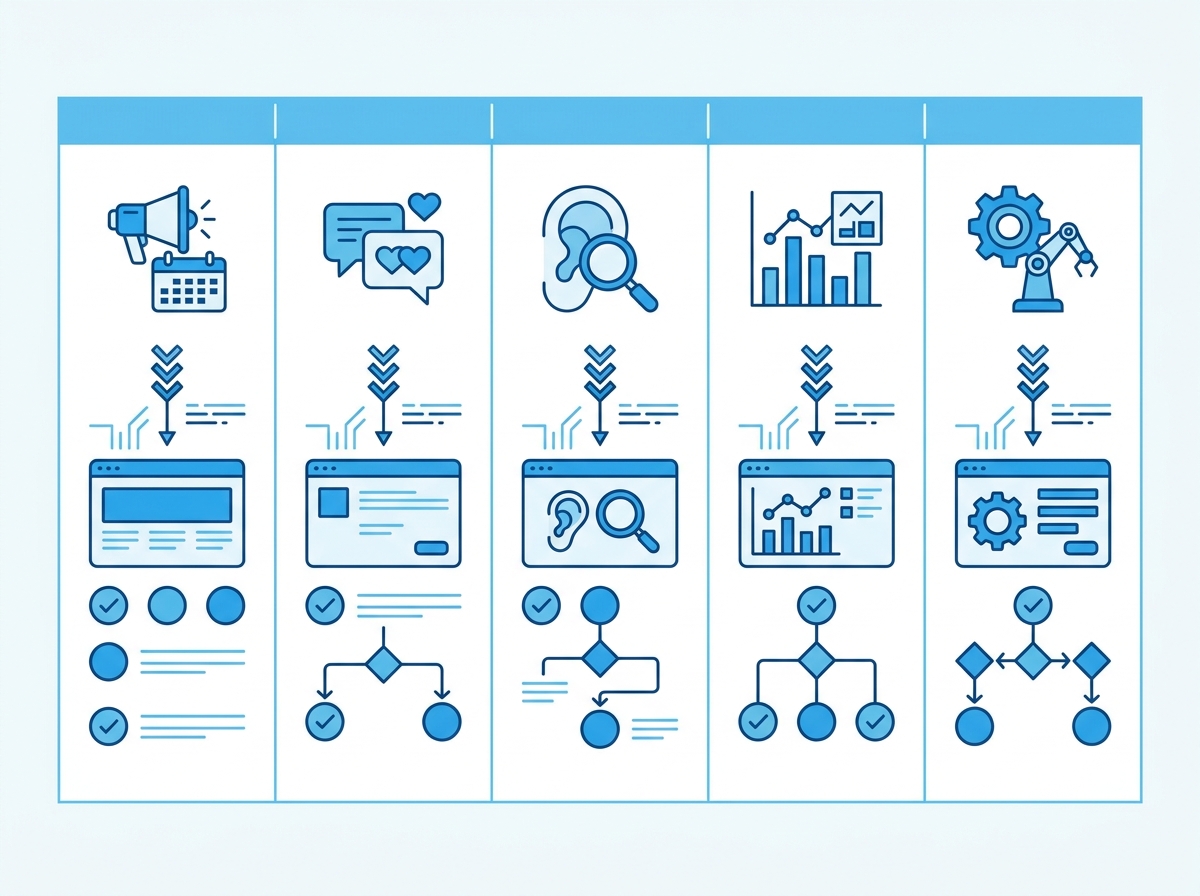
Therefore, when choosing social media marketing tools in 2026, the most important thing is not to look at which one has the longest feature list, but to first determine whether your bottleneck lies in posting, interacting, listening, or automation.
If the team is stuck before "posting content," first check their publishing capabilities.
Some teams face very basic problems: they have to manually switch between platforms when publishing content, their approval processes rely on screenshots and group messages, their posting times are scattered, and there are multiple versions of materials scattered everywhere. What these teams need most is not complex analysis, but a stable publishing and collaboration mechanism.
At this point, priority should be given to capabilities such as: smooth cross-platform scheduling, clear multi-person collaborative approval processes, centralized management of material and copy versions, and support for differentiated publishing by channel or market. Because if content publishing is chaotic, subsequent interactions, analysis, and debriefing will become distorted.
If you've already identified the problem at this step, product pages like Publish are more relevant than "big lists" because they directly address whether the publishing process can be standardized, rather than simply providing more feature names.
If the team is stuck on the issue of "no one responding after the message is sent," prioritize reviewing interaction management.
Another type of team appears very busy, but their real pain points lie after content is published. They experience issues like missed replies to comments, inability to handle private messages, customer service and operations teams fighting each other within the same entry point, and sales leads being mixed in with after-sales inquiries. Ultimately, this results in either a poor user experience or missed high-potential opportunities.
In this situation, adding a more powerful publishing tool is usually not very meaningful. The problem isn't that the content wasn't published, but rather that there's a lack of engagement after it's published. What you really need is a unified system for managing comments, private messages, tags, allocation, and status updates; a system that transforms team interaction from "whoever sees it replies" to "systematic collaborative processing."
This is why many brands, despite not having a large amount of content, still find operations very tiring. The real drain on energy isn't on posting, but on receiving. The value of products like Engagement lies in turning interaction management into a process, rather than having the team continue working from memory within the platform's native interface.
If you're unsure if you're stuck at this step, you can do a quick self-check by browsing through SocialEcho Free Tools . Many teams find after completing this that what they thought was a lack of "growth tools" is actually a lack of interactive engagement.
If a team is always slow to react, what they really lack is listening.
Another typical scenario is this: the team produces good content, and people read the comments, but they're always a step behind when industry trends change, competitors make big moves, or negative signs emerge about the brand. The boss thinks they're not sensitive to the market, operations think the information is too scattered, and PR thinks the warnings are too late.
These types of teams often don't need to be better at publishing, but rather to see things earlier. In other words, the core capability needs to shift from publishing to monitoring. Your focus shouldn't be on how pretty the scheduling interface is, but rather on whether the keyword strategy, alert rules, competitor monitoring, cross-platform mention attribution, and trend analysis are truly usable.
If your business relies heavily on real-time public opinion or industry discussions, platform capabilities like X Keyword Monitoring are worth paying close attention to, because they better reflect whether the monitoring tool can help you discover problems early in real-world platform scenarios, rather than just generating reports after the fact.

When choosing a model in 2026, be wary of the illusion of "large and comprehensive".
Being comprehensive isn't inherently bad; the problem lies in the fact that many teams lack the resources to truly utilize such comprehensive features effectively. Extensive functionality often translates to more complex configurations, slower deployments, and higher collaboration costs. For teams whose processes aren't yet running smoothly, such tools can easily become a case of "buying them with confidence, but using them with apprehension."
A more pragmatic approach is to first identify the core bottlenecks, and then see if a single product can streamline the critical workflows. For example, you could first streamline the publishing and interaction processes, and then add monitoring; or you could first integrate monitoring and analysis, and then optimize automation. This is more realistic than initially pursuing a "one-platform solution for all problems."
Moreover, tool selection in 2026 will no longer be just about "whether it has features," but also about whether it can truly integrate into your existing team. Can customer service, operations, and sales use the same set of statuses? Can monitoring results be used for debriefing? Can it maintain contextual consistency in cross-platform work? These are all more important than parameter tables.
The final criterion: Does your team actually open it every day?
This is the simplest, yet most easily overlooked, standard. Many software programs seem satisfactory to everyone during the procurement process, but three months later, only one or two people occasionally log in. The reason is usually simple: it's not integrated into daily workflows.
A truly suitable social media marketing tool doesn't necessarily have the most cutting-edge features, but it must be integrated into your team's key daily actions. Those who create content need it, those who handle interactions need it, and those who need to analyze trends and conduct reviews need it. Only then will the tool not be just for show, but rather an essential operational infrastructure.
Therefore, instead of continuing to collect various "best tools of 2026" lists, it's better to first answer honestly: what's slowing us down the most right now—publishing, interacting, listening, or automation? Once you figure this out, the selection process will be much easier.

FAQ
1. Should small teams directly choose a "comprehensive" tool?
Not necessarily. Small teams often need tools that can be deployed quickly, have clear workflows, and are easy to use. Too many features may actually increase learning and maintenance costs.
2. Should I buy publishing tools or interaction tools first?
Identify the bottlenecks. If content delivery is unstable or the approval process is chaotic, address the issue by re-posting; if comments and private messages are overwhelming, improve interaction management.
3. Is monitoring only necessary for big brands?
No. Listening is valuable as long as you need to see brand mentions, competitor actions, user sentiment, and platform trends; it's just that the depth and scope will vary depending on the team size.
4. What is the most common misconception when selecting a product?
You're most easily misled by feature lists and rankings. They show what "looks powerful," but that doesn't necessarily address your team's current biggest pain point.
Try SocialEcho
If you're currently selecting social media tools for 2026, I suggest you stop chasing rankings and first identify the processes that are currently most impacting your team's efficiency. You can start with a quick assessment using SocialEcho Free Tools , and then compare your choices with Publishing , Engagement , and platform capabilities pages such as Facebook Platform Overview and X Keyword Monitoring for more specific solutions. The key to choosing the right tools isn't about buying a wide variety, but about whether they can precisely solve your current bottleneck.
;}.cls-2{fill:%230868f7;}.cls-3{fill:url(%23未命名的渐变_44);}.cls-4{fill:%23333;}%3c/style%3e%3clinearGradient%20id='未命名的渐变_8'%20x1='33.73'%20y1='100.61'%20x2='-0.03'%20y2='-1.06'%20gradientUnits='userSpaceOnUse'%3e%3cstop%20offset='0'%20stop-color='%237ae9fb'/%3e%3cstop%20offset='0.67'%20stop-color='%232b90f8'/%3e%3cstop%20offset='1'%20stop-color='%230868f7'/%3e%3c/linearGradient%3e%3clinearGradient%20id='未命名的渐变_44'%20x1='27.86'%20y1='18.67'%20x2='68.36'%20y2='22.22'%20gradientUnits='userSpaceOnUse'%3e%3cstop%20offset='0'%20stop-color='%235ac7f2'/%3e%3cstop%20offset='1'%20stop-color='%230868f7'/%3e%3c/linearGradient%3e%3c/defs%3e%3cpath%20class='cls-1'%20d='M29,28.74V81.91l-9.51-3.68v0L8.52,74A7.17,7.17,0,0,1,4,67.32V24.54A3.76,3.76,0,0,1,9.08,21Z'/%3e%3cpath%20class='cls-2'%20d='M68.09,78.07a13.15,13.15,0,0,1-17.9,12.06L29,81.91h0V28.74L50.19,37A13.17,13.17,0,0,0,68.08,25.3h0Z'/%3e%3cpath%20class='cls-3'%20d='M68.08,25.3a13.19,13.19,0,0,1-6.73,10.87A13.09,13.09,0,0,1,50.19,37L29,28.74V6A3.76,3.76,0,0,1,34.1,2.52l25.59,9.91A13.22,13.22,0,0,1,68.08,25.3Z'/%3e%3cpath%20class='cls-4'%20d='M129.06,81.76a4.33,4.33,0,0,1-3.19-1.31,4.4,4.4,0,0,1-1.31-3.24V56.86H97.65V77.21a4.36,4.36,0,0,1-1.35,3.2A4.68,4.68,0,0,1,93,81.76a4.32,4.32,0,0,1-3.19-1.31,4.37,4.37,0,0,1-1.32-3.24V27.27A4.58,4.58,0,0,1,89.83,24a4.59,4.59,0,0,1,7.82,3.27V48.15h26.91V27.27A4.58,4.58,0,0,1,125.91,24a4.59,4.59,0,0,1,7.82,3.27V77.21a4.37,4.37,0,0,1-1.36,3.2A4.65,4.65,0,0,1,129.06,81.76Z'/%3e%3cpath%20class='cls-4'%20d='M163.77,81.66c-6.57,0-11.76-1.92-15.44-5.7s-5.54-9.07-5.54-15.74a26.76,26.76,0,0,1,2.09-10.43,17.72,17.72,0,0,1,6.67-8.06,19.15,19.15,0,0,1,10.68-2.95,19,19,0,0,1,10.46,2.8,18.7,18.7,0,0,1,6.55,7.36,22.53,22.53,0,0,1,2.36,10.28A4.51,4.51,0,0,1,177,63.77H152.23a10.8,10.8,0,0,0,3.49,6.65c2,1.68,4.88,2.52,8.66,2.52a22.25,22.25,0,0,0,7.54-1.21c.74-.3,1.55-.67,2.37-1.07a3.75,3.75,0,0,1,1.84-.4,4.09,4.09,0,0,1,3,1.15,4,4,0,0,1,1.12,3,4.38,4.38,0,0,1-2.58,3.82,32.34,32.34,0,0,1-6.36,2.61A28.67,28.67,0,0,1,163.77,81.66ZM172.4,55.9a9.72,9.72,0,0,0-1.63-4.56A9.9,9.9,0,0,0,167,48a10.38,10.38,0,0,0-4.64-1.14,12,12,0,0,0-4.77,1.06,9.54,9.54,0,0,0-4.89,5.66,11.78,11.78,0,0,0-.51,2.3Z'/%3e%3cpath%20class='cls-4'%20d='M193,81.64a4.49,4.49,0,0,1-4.51-4.55V27.28A4.58,4.58,0,0,1,189.84,24a4.48,4.48,0,0,1,3.28-1.36A4.36,4.36,0,0,1,196.35,24a4.46,4.46,0,0,1,1.31,3.31V77.09a4.34,4.34,0,0,1-1.35,3.2A4.67,4.67,0,0,1,193,81.64Z'/%3e%3cpath%20class='cls-4'%20d='M263.79,81.71a5.7,5.7,0,0,1-4.2-1.74,5.76,5.76,0,0,1-1.73-4.19V27.37a4.58,4.58,0,0,1,1.35-3.27A4.59,4.59,0,0,1,267,27.37V72.53h24a4.58,4.58,0,0,1,3.27,7.82A4.66,4.66,0,0,1,291,81.71Z'/%3e%3cpath%20class='cls-4'%20d='M424.48,81.74a4.71,4.71,0,0,1-2.71-.88,5.43,5.43,0,0,1-1-1l-.07-.09-12.41-17-5.41,5v9.44a4.31,4.31,0,0,1-1.36,3.19,4.66,4.66,0,0,1-3.3,1.36A4.29,4.29,0,0,1,395,80.42a4.36,4.36,0,0,1-1.32-3.23V27.37A4.58,4.58,0,0,1,395,24.1a4.52,4.52,0,0,1,6.58.12,4.54,4.54,0,0,1,1.24,3.15V56.31l17.72-16.38.05,0a4.8,4.8,0,0,1,2.94-1.11,4.4,4.4,0,0,1,3.27,1.2,4.57,4.57,0,0,1,1.2,3.27,4.44,4.44,0,0,1-.77,2.33,7.45,7.45,0,0,1-1.43,1.65l-11,9.64,13.34,17.68a5,5,0,0,1,1,2.71,4.12,4.12,0,0,1-1.36,3.24A4.64,4.64,0,0,1,424.48,81.74Z'/%3e%3cpath%20class='cls-4'%20d='M317.93,81.76a21.5,21.5,0,1,1,21.17-21.5A21.37,21.37,0,0,1,317.93,81.76Zm0-34.1a12.61,12.61,0,1,0,12.42,12.6A12.52,12.52,0,0,0,317.93,47.66Z'/%3e%3cpath%20class='cls-4'%20d='M212.18,101.22a4.12,4.12,0,0,1-3.05-1.26,4.17,4.17,0,0,1-1.26-3.1V43.34a4.37,4.37,0,0,1,1.3-3.14,4.26,4.26,0,0,1,3.13-1.3,4.19,4.19,0,0,1,3.1,1.26,4.32,4.32,0,0,1,1.26,3.16,20.77,20.77,0,0,1,13-4.54,21.51,21.51,0,0,1,0,43,20.51,20.51,0,0,1-13-4.57V96.86a4.15,4.15,0,0,1-1.3,3.06A4.5,4.5,0,0,1,212.18,101.22Zm17.43-53.63c-6.23,0-12.93,4.11-12.93,12.72a12.73,12.73,0,0,0,25.46,0A12.71,12.71,0,0,0,229.61,47.59Z'/%3e%3cpath%20class='cls-4'%20d='M365.76,81.76a21.5,21.5,0,1,1,21.18-21.5A21.37,21.37,0,0,1,365.76,81.76Zm0-34.1a12.61,12.61,0,1,0,12.42,12.6A12.52,12.52,0,0,0,365.76,47.66Z'/%3e%3c/svg%3e)