
Social Media Team Access Control: How can brands and agencies collaborate to avoid mutually damaging each other's reputations?
Many teams don't really start to value "permissions" until the day the project starts, but after the first mistake.
For example, consider this typical afternoon: the brand just finished a meeting and decided to postpone an event post originally scheduled for the next morning; the agency's designers had already replaced the materials, and the operations team casually moved the schedule back by half a day; the account manager, seeing that the draft hadn't been updated to the latest version, went back into the backend to add the copy himself. At 7 PM, all three thought it was "all sorted out," but the next morning, the incorrect version was still released.
The problem often isn't that anyone is unprofessional, but rather that everyone can make a little change, modify something, or post something, so in the end no one really knows: who has the final say, who has the right to publish, who is just viewing, or who made changes.
This is why, once a social media team enters a stage of collaboration between the brand, the agency, and multiple internal departments, access control is no longer a small option in the backend settings, but rather an essential infrastructure that determines whether the project can run stably.

It's not that we don't know how to create content, but rather that the boundaries of collaboration haven't been clearly defined.
Many brands choose the easiest approach in early collaborations: simply grant account access to the agency or share the backend account password with a few key colleagues. In the short term, this is indeed very efficient—those who need to revise the copy can do so, those who need to view the data can do so, and those who need to publish content don't have to wait through layers of bureaucracy.
However, problems will gradually emerge as soon as the project becomes even slightly more complex.
Brand managers want to view data at any time but worry about accidentally clicking the wrong settings; agencies need to expedite scheduling but fear that client revisions will disrupt the process; legal professionals only want to glance at the data at key moments but are pulled into a cumbersome backend; and those actually responsible for the launch often find at the last minute that they don't even know which version is the final one.
The most time-consuming part of social media collaboration is often not the content creation itself, but the repeated confirmation:
"Can this version be published now?" "Who changed the title just now?" "Who moved this schedule?" "Why can the client publish directly?"
If these problems occur every day, what the team usually lacks is not more hardworking people, but a clearer authority structure.
A mature team typically doesn't grant "full privileges" to everyone.
"Full authority" may seem to save the most communication, but in reality it just postpones the risks.
Because social media management is not a single step. Writing copy is one action, uploading materials is another, rescheduling is yet another, and replying to comments, checking data, and finally publishing are all completely different actions. Tying all these actions to the same key may seem convenient on the surface, but it actually amplifies the probability of misoperation.
A truly stable team will first accept the reality that not everyone involved in the collaboration needs the same permissions.
Clients may only need to see progress and results; brand marketing managers need to check schedules and materials at any time; agency executives need to be able to edit drafts, upload images, and organize hashtags; and those who truly have "one-click publishing" privileges should ideally always be a minority.
This has nothing to do with trust, nor does it contradict efficiency. On the contrary, once the boundaries are clear, everyone will feel more at ease. Because everyone knows what they can and cannot do, and knows who to contact when problems arise, instead of endlessly asking questions in the group chat.
If you're still using forms, chat logs, and verbal confirmations to maintain social media collaboration, it usually means that permissions and processes haven't been truly implemented. Many teams at this stage begin to introduce more systematic social media management platforms to unify content creation, approval, publishing, and record keeping, preventing the account backend from becoming a "high-risk site" that everyone has to access directly.
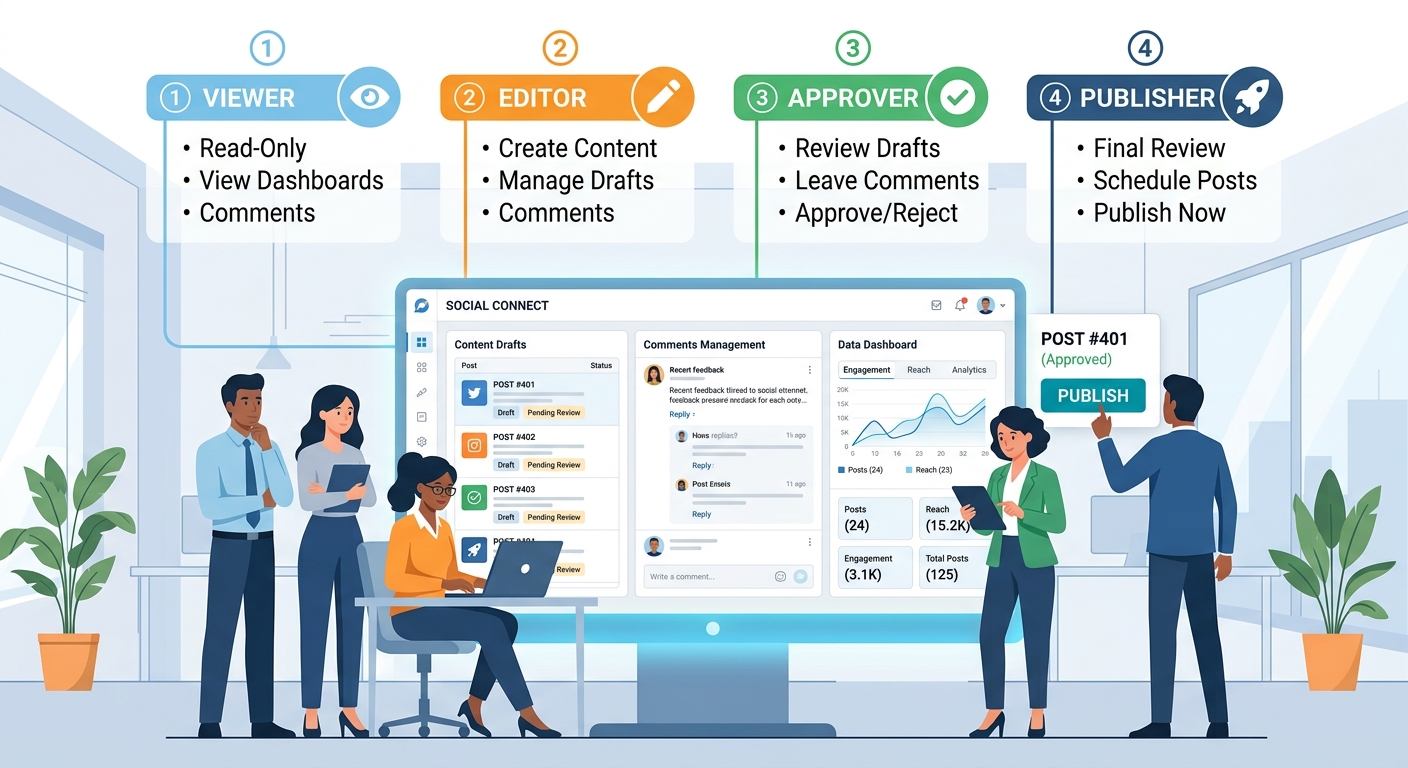
Truly effective permission design is not about complexity, but about tailoring it to specific roles.
In brand-agent collaborations, the easiest approach to implement is not to grant permissions to individuals one by one, but to design permissions based on roles first.
You can think of the people in a team as four very typical roles:
The first type is people who "need to know what happened, but don't need to take action." This includes brand managers, bosses, regional managers, or legal personnel who occasionally need to check results. What they need most is to see schedules, content status, data performance, and comment processing progress, not to directly access the editing area.
The second type is "the people who do the actual work every day." This includes copywriters, designers, operations staff, and agency executives—most fall into this category. They need to edit content, upload materials, revise drafts, organize tags, and may also need to handle comments and private messages, but they don't necessarily need final publishing permissions.
The third type is "the person responsible for the risk." This is usually the brand's project owner, the agency's account manager, or a marketing manager. They don't necessarily write every piece of content themselves, but they need to approve and confirm the version at key points.
The fourth type is the "final publisher." This role should ideally be small and fixed. Whoever publishes it is responsible; the system should have a clear record of who pressed the button. This way, even in subsequent reviews, it won't fall into the chaos of "everyone has touched it, so no one can explain it clearly."
It may seem like we're adding more rules, but we're actually reducing ineffective communication.
This layering is especially important when you are operating multiple platforms simultaneously. The posting rhythm, material specifications, and risk points are different on different platforms. Pages like the TikTok platform operation guide and the Instagram platform operation guide usually remind the team that platform strategies can be different, but the boundaries of permissions cannot be blurred.
The problem that easily goes wrong is never "who is incompetent," but rather that these key points are left unattended.
In real-world projects, permission issues don't usually appear under the name "permission problem." Rather, they are more like several recurring collaboration incidents.
One scenario is that the content can be changed, but no one knows about it afterward. The title is changed today, the cover is updated tomorrow, and the day after that, the client sends a message in the chat saying, "Let's stick with the previous version." In the end, the team has to spend ages figuring out which version was actually sent.
Another issue is that too few people can access the system. Many brands worry about accidental misoperation, so they only allow agents to have exclusive access to the backend. As a result, customers have to wait for screenshots, reports, and meetings every time they want to check schedules, data, or confirm comment processing. Over time, this breeds distrust.
There's an even more subtle type: the approval process is too late. The content is all laid out, the materials are all cut, and only then do the legal or brand executives see it for the first time, deeming a certain wording risky, so the entire process has to be restarted. This inefficiency, on the surface, appears to be due to "strict review," but in essence, it's because the approval authority wasn't designed in advance.
If you're currently streamlining your processes, besides clarifying permissions, you can also standardize some basic steps before content production. For example, use copywriting tools to standardize the style of the initial drafts, and use tag generation tools to help organize platform tags before proceeding to formal approval. This way, at least before deciding "who reviews and who publishes," the team can bring the content drafts to a point where they can be discussed.
A more stable collaborative rhythm usually looks like this.
The sense of collaboration in a mature team often comes from a quiet order: everyone is moving forward, but no one is vying for the steering wheel.
A relatively stable workflow typically goes like this: first, the execution team completes the draft, materials, and schedule; then, the project manager or brand owner approves it at key points; once approved, it enters the release queue; finally, only a few people with release rights execute the launch; after launch, data viewing, comment processing, and post-mortem recording continue according to the original division of labor.
This process may seem simple, but it has several very key features.
First, the actions have been separated. Editing, approving, publishing, and viewing are no longer mixed together.
Secondly, accountability has been made visible. Who made the changes, who approved them, and who issued them can all be traced back to the source.
Third, customers will not be excluded. Brands can see the project progress in real time without having to obtain too many high-risk permissions just to feel "involved".
This is something many agents later realize: what clients truly want isn't necessarily the ability to easily modify or release content; what clients usually want is transparency, traceability, and verifiability. Once these needs are met, the sense of antagonism in collaboration will be greatly reduced.
As the team grows larger, permissions are not an addition, but rather a brake to prevent the system from spiraling out of control.
The most common misjudgment in the early stages of a small team is thinking, "We don't have many people, so we don't need to manage such details."
However, once social media projects start to cross departments, regions, and brands, the complexity doesn't increase linearly. Today you might only have one brand manager and one agent, but tomorrow you'll have regional marketing, customer service, legal, and e-commerce teams, and the day after that you might even be adding overseas accounts and content lines for different platforms. As the number of people increases, if role boundaries remain blurred, the team will start operating on a "whoever is online handles the task" basis.
This model may seem flexible when things are busy, but it's actually the easiest way to burn out a project. Because no one can truly relax, and no one can truly detach themselves from the project.
The significance of an access control system is not to limit people, but to transform the system from one that "relies on a few reliable people" to one that "can run smoothly even when people are replaced and can expand without chaos."
This is especially true when you're managing multiple clients or brand accounts simultaneously. A consistent role template, consistent approval processes, and consistent record-keeping logic are far more reliable than "relying on experience to refine each project."

Ultimately, what customers really pay for is not the sense of process, but the sense of security.
Brands are willing to cooperate long-term not often because the agency can always write the most amazing content, but because the project is always stable: progress is visible, key nodes can be modified, problems can be traced, and temporary changes will not throw the whole team into chaos.
Similarly, for the brand's internal team, a clear permission mechanism is not to make the process seem more "standardized", but to reduce the hidden costs: no need to repeatedly confirm in the group, no need to worry about who accidentally touched it, and no need to trace the responsibility back from the chat history after something goes wrong.
When customers can watch with peace of mind, agents can focus on their work, and those in charge can clearly control risks, social media collaboration will truly begin to flow smoothly.
Ultimately, access control is never a trivial matter of "backend settings." It determines whether a team can maintain professionalism, speed, and mutual trust as collaboration becomes more complex.
If you've already felt that collaboration is starting to fall apart, the most important thing to address first is not more manpower, but a clearer permission design.
FAQ
What are the most common mistakes in social media team permission management?
The most common mistake isn't that no one does the work, but that many people can make minor changes, publish minor changes, and review minor changes, leaving no one able to clearly define who has the final say on what to publish, who made what changes, and who should be responsible for closing things down.
How should brand owners and distributors divide authority?
A more stable approach is for the brand to retain visibility and approval permissions, while the agent has execution and submission permissions. The actual publishing permissions are kept in the hands of a few owners, rather than being open to everyone.
Why is it not advisable for everyone to have full privileges?
While full access may seem to save on communication, it actually amplifies the risks of accidental posting, accidental deletion, scheduling conflicts, and unclear responsibilities. This problem becomes more pronounced the more complex the project.
Is access control only suitable for large teams?
No. Even if it's just the brand owner, the agent, and one operations team, as long as there's multi-person collaboration, scheduled publishing, and material review, it's worth designing the permission boundaries in advance.
If the team is already in disarray, what should be the first thing to fix?
Don't try to achieve everything at once. First, clarify the four key aspects: "who can view, who can modify, who can publish, and who approves." Then, add approval processes and operational logs. Once you've centralized control over publishing authority, many risks will immediately decrease.
;}.cls-2{fill:%230868f7;}.cls-3{fill:url(%23未命名的渐变_44);}.cls-4{fill:%23333;}%3c/style%3e%3clinearGradient%20id='未命名的渐变_8'%20x1='33.73'%20y1='100.61'%20x2='-0.03'%20y2='-1.06'%20gradientUnits='userSpaceOnUse'%3e%3cstop%20offset='0'%20stop-color='%237ae9fb'/%3e%3cstop%20offset='0.67'%20stop-color='%232b90f8'/%3e%3cstop%20offset='1'%20stop-color='%230868f7'/%3e%3c/linearGradient%3e%3clinearGradient%20id='未命名的渐变_44'%20x1='27.86'%20y1='18.67'%20x2='68.36'%20y2='22.22'%20gradientUnits='userSpaceOnUse'%3e%3cstop%20offset='0'%20stop-color='%235ac7f2'/%3e%3cstop%20offset='1'%20stop-color='%230868f7'/%3e%3c/linearGradient%3e%3c/defs%3e%3cpath%20class='cls-1'%20d='M29,28.74V81.91l-9.51-3.68v0L8.52,74A7.17,7.17,0,0,1,4,67.32V24.54A3.76,3.76,0,0,1,9.08,21Z'/%3e%3cpath%20class='cls-2'%20d='M68.09,78.07a13.15,13.15,0,0,1-17.9,12.06L29,81.91h0V28.74L50.19,37A13.17,13.17,0,0,0,68.08,25.3h0Z'/%3e%3cpath%20class='cls-3'%20d='M68.08,25.3a13.19,13.19,0,0,1-6.73,10.87A13.09,13.09,0,0,1,50.19,37L29,28.74V6A3.76,3.76,0,0,1,34.1,2.52l25.59,9.91A13.22,13.22,0,0,1,68.08,25.3Z'/%3e%3cpath%20class='cls-4'%20d='M129.06,81.76a4.33,4.33,0,0,1-3.19-1.31,4.4,4.4,0,0,1-1.31-3.24V56.86H97.65V77.21a4.36,4.36,0,0,1-1.35,3.2A4.68,4.68,0,0,1,93,81.76a4.32,4.32,0,0,1-3.19-1.31,4.37,4.37,0,0,1-1.32-3.24V27.27A4.58,4.58,0,0,1,89.83,24a4.59,4.59,0,0,1,7.82,3.27V48.15h26.91V27.27A4.58,4.58,0,0,1,125.91,24a4.59,4.59,0,0,1,7.82,3.27V77.21a4.37,4.37,0,0,1-1.36,3.2A4.65,4.65,0,0,1,129.06,81.76Z'/%3e%3cpath%20class='cls-4'%20d='M163.77,81.66c-6.57,0-11.76-1.92-15.44-5.7s-5.54-9.07-5.54-15.74a26.76,26.76,0,0,1,2.09-10.43,17.72,17.72,0,0,1,6.67-8.06,19.15,19.15,0,0,1,10.68-2.95,19,19,0,0,1,10.46,2.8,18.7,18.7,0,0,1,6.55,7.36,22.53,22.53,0,0,1,2.36,10.28A4.51,4.51,0,0,1,177,63.77H152.23a10.8,10.8,0,0,0,3.49,6.65c2,1.68,4.88,2.52,8.66,2.52a22.25,22.25,0,0,0,7.54-1.21c.74-.3,1.55-.67,2.37-1.07a3.75,3.75,0,0,1,1.84-.4,4.09,4.09,0,0,1,3,1.15,4,4,0,0,1,1.12,3,4.38,4.38,0,0,1-2.58,3.82,32.34,32.34,0,0,1-6.36,2.61A28.67,28.67,0,0,1,163.77,81.66ZM172.4,55.9a9.72,9.72,0,0,0-1.63-4.56A9.9,9.9,0,0,0,167,48a10.38,10.38,0,0,0-4.64-1.14,12,12,0,0,0-4.77,1.06,9.54,9.54,0,0,0-4.89,5.66,11.78,11.78,0,0,0-.51,2.3Z'/%3e%3cpath%20class='cls-4'%20d='M193,81.64a4.49,4.49,0,0,1-4.51-4.55V27.28A4.58,4.58,0,0,1,189.84,24a4.48,4.48,0,0,1,3.28-1.36A4.36,4.36,0,0,1,196.35,24a4.46,4.46,0,0,1,1.31,3.31V77.09a4.34,4.34,0,0,1-1.35,3.2A4.67,4.67,0,0,1,193,81.64Z'/%3e%3cpath%20class='cls-4'%20d='M263.79,81.71a5.7,5.7,0,0,1-4.2-1.74,5.76,5.76,0,0,1-1.73-4.19V27.37a4.58,4.58,0,0,1,1.35-3.27A4.59,4.59,0,0,1,267,27.37V72.53h24a4.58,4.58,0,0,1,3.27,7.82A4.66,4.66,0,0,1,291,81.71Z'/%3e%3cpath%20class='cls-4'%20d='M424.48,81.74a4.71,4.71,0,0,1-2.71-.88,5.43,5.43,0,0,1-1-1l-.07-.09-12.41-17-5.41,5v9.44a4.31,4.31,0,0,1-1.36,3.19,4.66,4.66,0,0,1-3.3,1.36A4.29,4.29,0,0,1,395,80.42a4.36,4.36,0,0,1-1.32-3.23V27.37A4.58,4.58,0,0,1,395,24.1a4.52,4.52,0,0,1,6.58.12,4.54,4.54,0,0,1,1.24,3.15V56.31l17.72-16.38.05,0a4.8,4.8,0,0,1,2.94-1.11,4.4,4.4,0,0,1,3.27,1.2,4.57,4.57,0,0,1,1.2,3.27,4.44,4.44,0,0,1-.77,2.33,7.45,7.45,0,0,1-1.43,1.65l-11,9.64,13.34,17.68a5,5,0,0,1,1,2.71,4.12,4.12,0,0,1-1.36,3.24A4.64,4.64,0,0,1,424.48,81.74Z'/%3e%3cpath%20class='cls-4'%20d='M317.93,81.76a21.5,21.5,0,1,1,21.17-21.5A21.37,21.37,0,0,1,317.93,81.76Zm0-34.1a12.61,12.61,0,1,0,12.42,12.6A12.52,12.52,0,0,0,317.93,47.66Z'/%3e%3cpath%20class='cls-4'%20d='M212.18,101.22a4.12,4.12,0,0,1-3.05-1.26,4.17,4.17,0,0,1-1.26-3.1V43.34a4.37,4.37,0,0,1,1.3-3.14,4.26,4.26,0,0,1,3.13-1.3,4.19,4.19,0,0,1,3.1,1.26,4.32,4.32,0,0,1,1.26,3.16,20.77,20.77,0,0,1,13-4.54,21.51,21.51,0,0,1,0,43,20.51,20.51,0,0,1-13-4.57V96.86a4.15,4.15,0,0,1-1.3,3.06A4.5,4.5,0,0,1,212.18,101.22Zm17.43-53.63c-6.23,0-12.93,4.11-12.93,12.72a12.73,12.73,0,0,0,25.46,0A12.71,12.71,0,0,0,229.61,47.59Z'/%3e%3cpath%20class='cls-4'%20d='M365.76,81.76a21.5,21.5,0,1,1,21.18-21.5A21.37,21.37,0,0,1,365.76,81.76Zm0-34.1a12.61,12.61,0,1,0,12.42,12.6A12.52,12.52,0,0,0,365.76,47.66Z'/%3e%3c/svg%3e)