
Telegram vs WhatsApp vs WeChat: A Guide to Choosing an Overseas Social Media Platform
introduction
Wang Hao, CEO of a Shenzhen-based cross-border e-commerce company, has been quite anxious lately. His independent website's monthly revenue has exceeded $500,000, and his next strategic move is clear—to develop private traffic on overseas social media platforms. However, when he actually started planning, he discovered that "overseas social media" is far more complex than he had imagined.
"Telegram, WhatsApp, and WeChat—which of these three platforms should you choose?" The team gave three different answers. None of them were wrong, but none of them were comprehensive either—these three platforms represent three completely different operational logics. Choosing the wrong one will not only waste money, but also the most valuable window of opportunity.
I. Platform User Scale and Geographical Distribution

Telegram: The world's fastest-growing private messaging tool
Telegram has over 900 million monthly active users, covering more than 180 countries and regions. However, its user base is highly concentrated in specific markets: Russia, Iran, India, Brazil, and Indonesia together account for over 40% of its active users.
For brands expanding overseas, Telegram's value lies in its high concentration of "high-end users." Known for its privacy and security, the platform attracts users who are generally well-educated and willing to pay—a particularly attractive feature for SaaS, technology products, and Web3 projects. Telegram is practically a national application in the CIS countries; if your target market is in these regions, Telegram is an unavoidable choice.
However, its penetration rate is relatively low in North America and Western Europe, with its main users concentrated in young tech circles. SocialEcho's Telegram competitive analysis provides insights into competitors' operational strategies on Telegram.
WhatsApp: The world's largest instant messaging platform
WhatsApp has over 3 billion monthly active users, covering the vast majority of countries and regions worldwide. In Europe and Latin America, WhatsApp's usage rate exceeds 80%, far surpassing other communication applications.
Core markets include India (over 500 million users), Brazil, major European countries, and the Middle East. For brands going global, WhatsApp's greatest value lies in "trust"—users are accustomed to communicating with brands daily through WhatsApp, a habit that is difficult for other platforms to replicate.
However, WhatsApp Business has relatively basic functions and limited API openness, making large-scale automated operation somewhat difficult.
WeChat: Irreplaceable in the Chinese market
Outside of mainland China, WeChat has approximately 100 million monthly active users, mainly concentrated in Southeast Asia (Malaysia and Singapore) and Chinese communities in North America and Europe.
If your market has a large Chinese population, or your brand employs a strategy of "blooming abroad but thriving domestically," WeChat is undoubtedly the primary battleground. Official accounts, mini-programs, video accounts, and WeChat Work form a closed-loop business ecosystem, with integration capabilities that Telegram and WhatsApp cannot match.
In summary : Choose WhatsApp for major global markets; choose Telegram for specific regional markets (Russian-speaking regions, the Middle East); and choose WeChat for markets with Chinese populations.
II. In-depth comparison of functional features
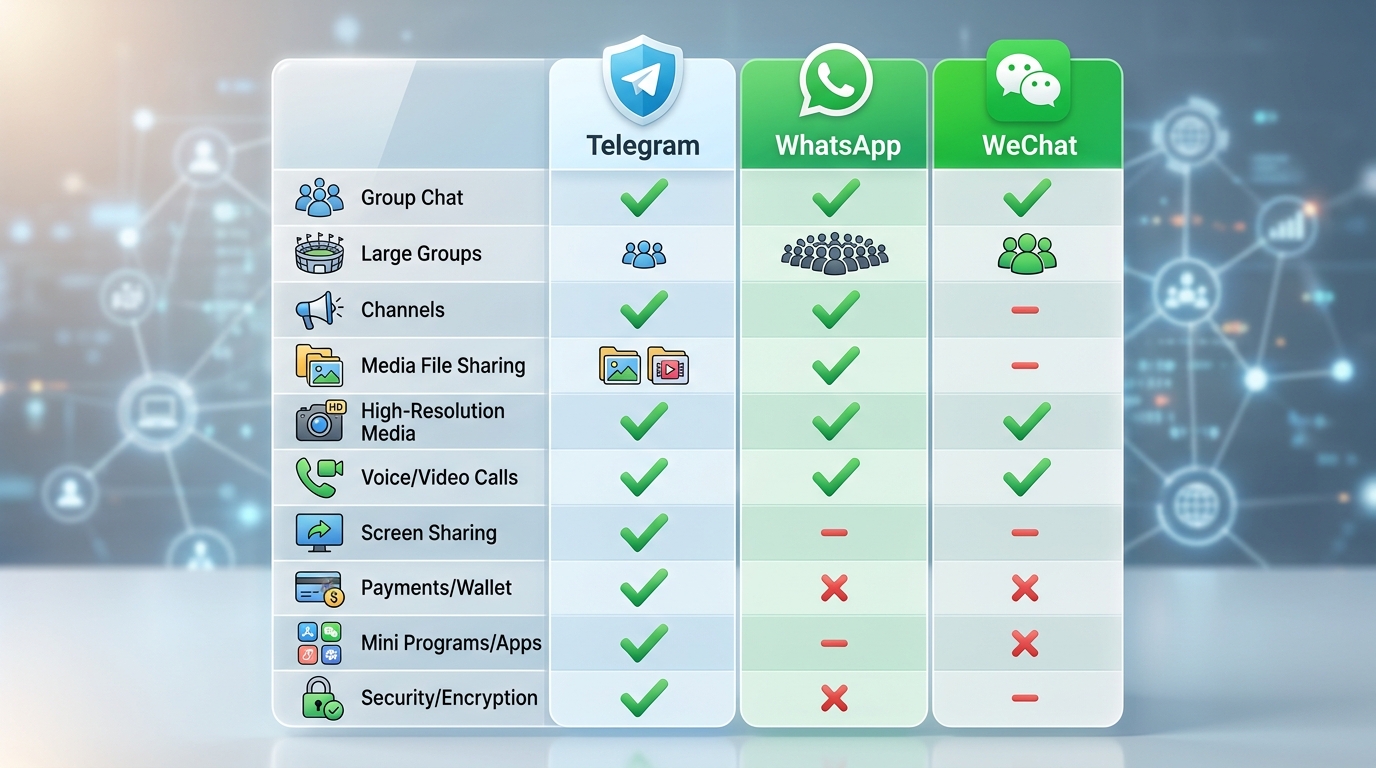
Messaging features: groups, channels, bots
Telegram is the most open in terms of feature design. Groups support up to 200,000 members, channels are one-way broadcasting tools, and the bot ecosystem is extremely mature, with almost all operational needs, from automatic replies and content distribution to data collection, being met through bots.
WhatsApp's features are relatively conservative. Group chats support a maximum of 1024 members and lack Telegram's channel mechanism. Bot support relies on the official API, resulting in limited functionality and high integration costs. If you need to manage Telegram and WhatsApp across platforms, you can leverage SocialEcho's social media management platform for unified operation.
WeChat boasts the most features but is also the most closed system. Official accounts, service accounts, and mini-programs form a comprehensive content distribution system; WeChat groups are the core of private domain operations; and WeChat for Business facilitates B2C communication. However, it has high technical barriers and compliance costs.
Marketing tools and data analysis
Telegram offers a fully functional bot API that supports calls from any programming language. With SocialEcho's Telegram data analytics tools , you can gain deep insights into audience engagement.
WhatsApp Business API has strict review processes for message templates, resulting in less flexibility in content. However, users actively connect with brands, leading to significantly higher message open and response rates compared to other channels.
WeChat offers the most comprehensive data, with detailed information provided by the official account backend. However, this data is scattered across different platforms, requiring additional resources for integration and analysis. SocialEcho's cross-platform data analytics allows for unified management of data from multiple platforms.
III. Operating Costs and Return on Investment
Account registration and maintenance costs
Registering a Telegram account is virtually free; all you need is a phone number, there's no limit to the number, and no monthly fee. However, there are strict limitations on batch operations and automated behavior.
WhatsApp Business App is free to use but has limited functionality; the Business API is charged per message, at 0.05-0.15 per thousand messages, and the cost cannot be ignored for brands with a large daily message volume.
WeChat needs to operate formally through WeChat for Business, which requires continuous investment in technology development, account registration, and content production.
Customer acquisition cost and conversion efficiency
- Telegram : Lowest CAC ($0.5-3 USD/user), longer conversion path, suitable for brand awareness and community building;
- WhatsApp : Medium CAC ($3-10 USD/user), highest conversion rate;
- WeChat : CAC in the overseas Chinese market is approximately $5-15 per user, with the highest LTV.
Brands can integrate operational data across platforms using SocialEcho's social media management platform .
IV. Platform Selection Recommendations for Different Industries
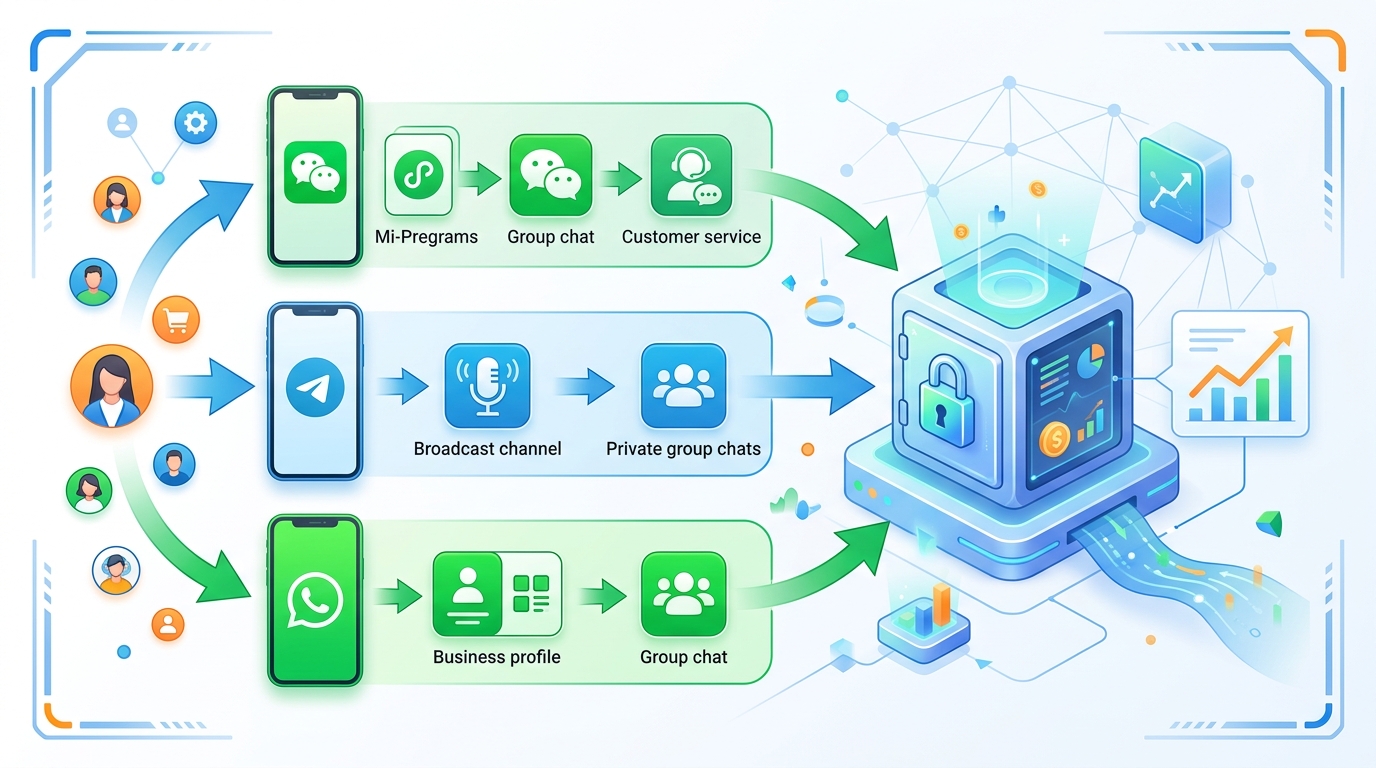
Cross-border e-commerce
If your target market is Europe and America, choose WhatsApp ; if it's Russia, the Middle East, or Southeast Asia, choose Telegram ; if your product has a strong "Chinese buyer" attribute (such as domestic cosmetics), choose WeChat .
SaaS/Technology
Telegram is ideal for community building—establishing brand influence and attracting potential customers through a tech community. Use SocialEcho's Telegram KOL monitoring tool to identify key industry opinion leaders.
WhatsApp is ideal for customer success – it helps you follow up on customer usage through one-on-one communication and improve renewal rates.
Web3/Blockchain
The Web3 industry relies on Telegram more than any other industry. Almost all mainstream cryptocurrency projects use Telegram as their official community portal.
The typical operational strategy is: Telegram for community building, Twitter for public opinion management, and Discord for in-depth interaction . SocialEcho's Telegram competitor monitoring feature tracks competitor activities.
V. Platform Selection Decision Framework
Define the target audience
- Tech professionals and cryptocurrency enthusiasts → Telegram is their main platform;
- For average consumers and users in mature markets , WhatsApp is a better fit.
- Overseas Chinese → WeChat is irreplaceable.
Assess operational resources
- Limited manpower and limited budget → Start with Telegram;
- With a certain budget and a focus on conversion efficiency → prioritize investment in WhatsApp;
- Multi-platform operation capabilities → In-depth operation of the WeChat ecosystem.
Each platform should play a different role, rather than repeating the same content.
📝 Conclusion
Wang Hao's decision: Use WhatsApp as the core conversion channel and Telegram as the community platform, temporarily refraining from investing in WeChat. Six months later, the number of private domain users exceeded 100,000, monthly revenue increased by 40%, and the operations team consisted of only 3 people.
Key takeaway : There is no best platform, only the platform that best suits you. Before making a decision, ask yourself three questions: Who are my target users? What is my core market? How many operational resources do I have? Once the answers are clear, the choice becomes simple.
If you're struggling to choose the right social media platform for your overseas expansion, consider starting with SocialEcho, a social media management platform that offers one-stop management for multiple platforms including Telegram and WhatsApp.
Try it free for 7 days and experience the efficiency improvements in cross-platform social media management.
❓ FAQ
Q1: Is Telegram suitable for all brands going global?
A1: That's not the case. Telegram's core users are tech-savvy young people and users in specific regions (such as Russian-speaking areas and the Middle East). In mature European and American markets, we recommend choosing WhatsApp as the primary platform and Telegram as a secondary platform.
Q2: What is the approximate cost of WhatsApp marketing?
A2: The Business API costs 0.05-0.15 per thousand messages. Including technical integration costs, the initial investment starts at several thousand dollars. If the daily message volume is low, the free Business App can meet basic needs.
Q3: Can WeChat be used for brand marketing overseas?
A3: Yes, but mainly limited to the Chinese market. Operating within the WeChat ecosystem is costly and carries compliance risks; therefore, it's necessary to conduct operations through official channels such as WeChat for Business.
Q4: Can the three platforms be operated simultaneously?
A4: Yes, but it requires resource support. We suggest focusing on validating the model on one platform initially, and then gradually expanding to multi-platform collaboration.
Q5: How to evaluate the effectiveness of platform operation?
A5: Telegram tracks channel views, member growth rate, and engagement rate; WhatsApp tracks follower open rates, response rates, and conversion rates; WeChat tracks official account views, mini-program usage, and private domain repurchase rates. SocialEcho provides unified monitoring across platforms for data analytics .
;}.cls-2{fill:%230868f7;}.cls-3{fill:url(%23未命名的渐变_44);}.cls-4{fill:%23333;}%3c/style%3e%3clinearGradient%20id='未命名的渐变_8'%20x1='33.73'%20y1='100.61'%20x2='-0.03'%20y2='-1.06'%20gradientUnits='userSpaceOnUse'%3e%3cstop%20offset='0'%20stop-color='%237ae9fb'/%3e%3cstop%20offset='0.67'%20stop-color='%232b90f8'/%3e%3cstop%20offset='1'%20stop-color='%230868f7'/%3e%3c/linearGradient%3e%3clinearGradient%20id='未命名的渐变_44'%20x1='27.86'%20y1='18.67'%20x2='68.36'%20y2='22.22'%20gradientUnits='userSpaceOnUse'%3e%3cstop%20offset='0'%20stop-color='%235ac7f2'/%3e%3cstop%20offset='1'%20stop-color='%230868f7'/%3e%3c/linearGradient%3e%3c/defs%3e%3cpath%20class='cls-1'%20d='M29,28.74V81.91l-9.51-3.68v0L8.52,74A7.17,7.17,0,0,1,4,67.32V24.54A3.76,3.76,0,0,1,9.08,21Z'/%3e%3cpath%20class='cls-2'%20d='M68.09,78.07a13.15,13.15,0,0,1-17.9,12.06L29,81.91h0V28.74L50.19,37A13.17,13.17,0,0,0,68.08,25.3h0Z'/%3e%3cpath%20class='cls-3'%20d='M68.08,25.3a13.19,13.19,0,0,1-6.73,10.87A13.09,13.09,0,0,1,50.19,37L29,28.74V6A3.76,3.76,0,0,1,34.1,2.52l25.59,9.91A13.22,13.22,0,0,1,68.08,25.3Z'/%3e%3cpath%20class='cls-4'%20d='M129.06,81.76a4.33,4.33,0,0,1-3.19-1.31,4.4,4.4,0,0,1-1.31-3.24V56.86H97.65V77.21a4.36,4.36,0,0,1-1.35,3.2A4.68,4.68,0,0,1,93,81.76a4.32,4.32,0,0,1-3.19-1.31,4.37,4.37,0,0,1-1.32-3.24V27.27A4.58,4.58,0,0,1,89.83,24a4.59,4.59,0,0,1,7.82,3.27V48.15h26.91V27.27A4.58,4.58,0,0,1,125.91,24a4.59,4.59,0,0,1,7.82,3.27V77.21a4.37,4.37,0,0,1-1.36,3.2A4.65,4.65,0,0,1,129.06,81.76Z'/%3e%3cpath%20class='cls-4'%20d='M163.77,81.66c-6.57,0-11.76-1.92-15.44-5.7s-5.54-9.07-5.54-15.74a26.76,26.76,0,0,1,2.09-10.43,17.72,17.72,0,0,1,6.67-8.06,19.15,19.15,0,0,1,10.68-2.95,19,19,0,0,1,10.46,2.8,18.7,18.7,0,0,1,6.55,7.36,22.53,22.53,0,0,1,2.36,10.28A4.51,4.51,0,0,1,177,63.77H152.23a10.8,10.8,0,0,0,3.49,6.65c2,1.68,4.88,2.52,8.66,2.52a22.25,22.25,0,0,0,7.54-1.21c.74-.3,1.55-.67,2.37-1.07a3.75,3.75,0,0,1,1.84-.4,4.09,4.09,0,0,1,3,1.15,4,4,0,0,1,1.12,3,4.38,4.38,0,0,1-2.58,3.82,32.34,32.34,0,0,1-6.36,2.61A28.67,28.67,0,0,1,163.77,81.66ZM172.4,55.9a9.72,9.72,0,0,0-1.63-4.56A9.9,9.9,0,0,0,167,48a10.38,10.38,0,0,0-4.64-1.14,12,12,0,0,0-4.77,1.06,9.54,9.54,0,0,0-4.89,5.66,11.78,11.78,0,0,0-.51,2.3Z'/%3e%3cpath%20class='cls-4'%20d='M193,81.64a4.49,4.49,0,0,1-4.51-4.55V27.28A4.58,4.58,0,0,1,189.84,24a4.48,4.48,0,0,1,3.28-1.36A4.36,4.36,0,0,1,196.35,24a4.46,4.46,0,0,1,1.31,3.31V77.09a4.34,4.34,0,0,1-1.35,3.2A4.67,4.67,0,0,1,193,81.64Z'/%3e%3cpath%20class='cls-4'%20d='M263.79,81.71a5.7,5.7,0,0,1-4.2-1.74,5.76,5.76,0,0,1-1.73-4.19V27.37a4.58,4.58,0,0,1,1.35-3.27A4.59,4.59,0,0,1,267,27.37V72.53h24a4.58,4.58,0,0,1,3.27,7.82A4.66,4.66,0,0,1,291,81.71Z'/%3e%3cpath%20class='cls-4'%20d='M424.48,81.74a4.71,4.71,0,0,1-2.71-.88,5.43,5.43,0,0,1-1-1l-.07-.09-12.41-17-5.41,5v9.44a4.31,4.31,0,0,1-1.36,3.19,4.66,4.66,0,0,1-3.3,1.36A4.29,4.29,0,0,1,395,80.42a4.36,4.36,0,0,1-1.32-3.23V27.37A4.58,4.58,0,0,1,395,24.1a4.52,4.52,0,0,1,6.58.12,4.54,4.54,0,0,1,1.24,3.15V56.31l17.72-16.38.05,0a4.8,4.8,0,0,1,2.94-1.11,4.4,4.4,0,0,1,3.27,1.2,4.57,4.57,0,0,1,1.2,3.27,4.44,4.44,0,0,1-.77,2.33,7.45,7.45,0,0,1-1.43,1.65l-11,9.64,13.34,17.68a5,5,0,0,1,1,2.71,4.12,4.12,0,0,1-1.36,3.24A4.64,4.64,0,0,1,424.48,81.74Z'/%3e%3cpath%20class='cls-4'%20d='M317.93,81.76a21.5,21.5,0,1,1,21.17-21.5A21.37,21.37,0,0,1,317.93,81.76Zm0-34.1a12.61,12.61,0,1,0,12.42,12.6A12.52,12.52,0,0,0,317.93,47.66Z'/%3e%3cpath%20class='cls-4'%20d='M212.18,101.22a4.12,4.12,0,0,1-3.05-1.26,4.17,4.17,0,0,1-1.26-3.1V43.34a4.37,4.37,0,0,1,1.3-3.14,4.26,4.26,0,0,1,3.13-1.3,4.19,4.19,0,0,1,3.1,1.26,4.32,4.32,0,0,1,1.26,3.16,20.77,20.77,0,0,1,13-4.54,21.51,21.51,0,0,1,0,43,20.51,20.51,0,0,1-13-4.57V96.86a4.15,4.15,0,0,1-1.3,3.06A4.5,4.5,0,0,1,212.18,101.22Zm17.43-53.63c-6.23,0-12.93,4.11-12.93,12.72a12.73,12.73,0,0,0,25.46,0A12.71,12.71,0,0,0,229.61,47.59Z'/%3e%3cpath%20class='cls-4'%20d='M365.76,81.76a21.5,21.5,0,1,1,21.18-21.5A21.37,21.37,0,0,1,365.76,81.76Zm0-34.1a12.61,12.61,0,1,0,12.42,12.6A12.52,12.52,0,0,0,365.76,47.66Z'/%3e%3c/svg%3e)