
TikTok 2026 Brand Account Data Report – These 3 Metrics Determine Your Streaming Weight
TikTok 2025 Brand Account Data Report – These 3 Metrics Determine Your Streaming Weight
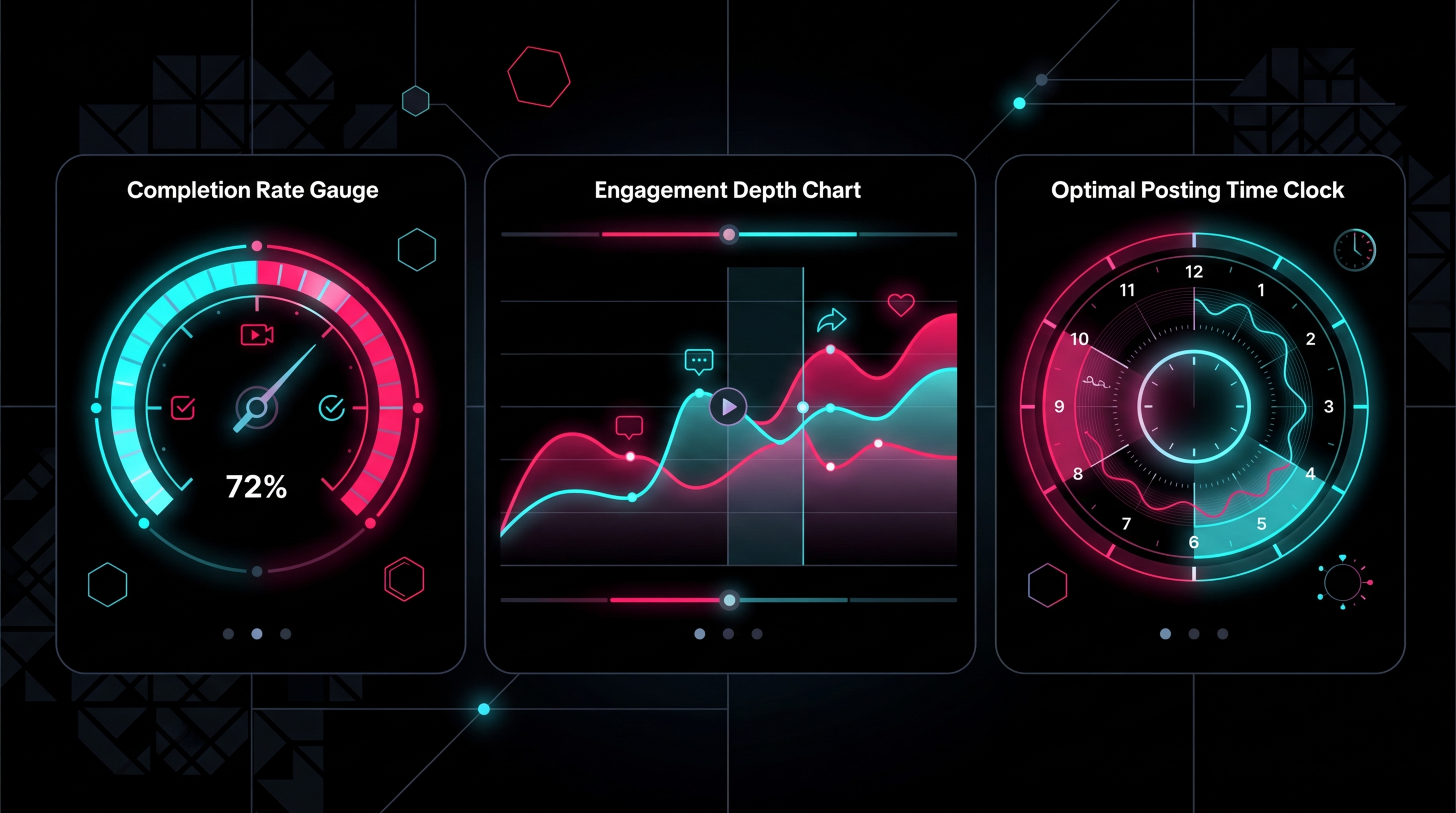
The core idea is that TikTok's algorithm is determined by three metrics: completion rate, engagement depth, and posting timing. This is because the platform's algorithm is essentially looking for "content worth spreading" rather than "content that can be paid for."
 She discovered something that had puzzled her for three months.
Zhou Min is in charge of a beauty brand's TikTok account. The team regularly updates the account with 5 posts per week. The content quality is high, and there are dedicated people responsible for shooting and editing.
What puzzled her was that content of the same quality, published at the same time, could have performance differences of up to 10 times—some videos had over 500,000 views, while other similar content only had a few thousand views, and then stopped at that number and never went any higher.
At first, she thought it was a problem with the content topic, so she changed the topic. Then she thought it was a problem with the video length, so she adjusted the duration. She tried many approaches over six months, but couldn't find a stable pattern.
It wasn't until she started seriously studying TikTok's streaming mechanism that she realized: what she had been optimizing was not what the platform truly cared about.
The underlying logic of TikTok's algorithm: What is it looking for?
To understand TikTok's streaming mechanism, you must first understand its goal: to retain users and keep them scrolling.
The platform doesn't care about your brand awareness, your number of followers, or your advertising budget. It only cares about one thing: whether users are willing to read this content to the end, and whether they will stay after reading it.
This objective dictates its algorithmic logic. After each new piece of content is published, TikTok provides it with an initial traffic pool (usually a few hundred to a few thousand impressions), and then decides whether to give it a larger push in the next round based on user response within this traffic pool. This process is repeated multiple times until the content's performance data no longer supports further increases in traffic.
Three key indicators determine the direction of this process.
Metric 1: Completion Rate – The First Threshold for Streaming Ranking
Completion rate is the single metric with the highest weight among all TikTok streaming metrics.
According to TikTok's internal creator education materials (Creator Learning Center content released in 2024) and A/B testing data from multiple marketing agencies, when a video's completion rate exceeds **40%**, the algorithm determines it as content "worth continuing to promote" and puts it into the next, larger traffic pool. A completion rate below 30% usually means that the content will remain in the initial traffic pool and will no longer receive organic traffic.
For brand accounts, this means a counterintuitive conclusion: a 15-second video with a high completion rate may have a much greater streaming impact than a 2-minute high-quality video.
Why? Because whether users are willing to watch the whole thing has less to do with video quality than you might think, and more to do with whether the first 3 seconds can grab their attention.
Anyone who has run a brand's TikTok campaign knows that the first three seconds are crucial. If users have no reason to keep scrolling after the third second, the completion rate drops. No matter how exciting the content becomes afterward, it won't reach the user.
Actionable suggestion : Redesign the video opening using a "conclusion-first" approach. Place the most valuable information or the most compelling visuals within the first 3 seconds, rather than laying out the brand background first. Many brand operations habitually start with the logo or brand trailer, which is a major enemy of completion rates.
Indicator 2: Interaction Depth – Not all interactions count towards the score.
TikTok's algorithm calculates interactions differently than most brands intuitively understand.
The platform doesn't simply accumulate likes, comments, and shares. It assigns different weights to different types of interactions, and these weights vary considerably.
Share has the highest weight because it's a user's initiative to take content beyond the platform's boundaries, indicating high content value and a user's willingness to "guarantee" it to their audience. Save has the next highest weight, indicating users believe the content has retention value and will be consumed again. Comments have the third highest weight, especially comments with substantial content (not just emojis), indicating the content has sparked genuine thought. Likes have the lowest weight—because it's the lowest-cost interaction, easily done by users, and has the least signal of content value.
According to data calculated through experiments by multiple TikTok creators, one retweet is roughly equivalent to 20-30 likes in the algorithm's calculations. While this ratio is not officially released data, it aligns with the actual push patterns observed by many accounts.
For brand accounts, this means: blindly pursuing likes is a mistake.
Actionable suggestions : When designing content, first ask yourself, "Does this video give users a reason to share it with their friends?" Content that triggers sharing typically falls into three categories: evoking strong emotional resonance ("That's exactly how I feel!"), providing practical information ("I'm going to save this"), and creating controversy or counterintuitive ideas ("I have to show this to my friends"). Brand content should cover at least one of these categories.
Indicator 3: Timing of Release – Not Just "When to Release"
The timing of release affects streaming not only "when to release", but also "in what content environment to release".
Time Dimension : TikTok's peak traffic times vary significantly depending on region and target audience. For brand accounts targeting users in Europe and America, peak traffic periods are typically 6 PM - 10 PM (weekdays) and 2 PM - 8 PM (weekends). However, this pattern isn't universally applicable—the real numbers to measure are which time zone your target users are in and when they browse TikTok. Data verification is far more effective than guesswork.
Content environment dimension : This is an aspect that many brands overlook. TikTok's topic traffic has a life cycle—a topic goes from obscurity to popularity, and then to saturation, with the entire cycle potentially lasting only 3-5 days. If you enter when a topic is just starting to gain traction, you can benefit from its upward trend; if you enter after the topic has saturated, your content will be diluted by a large amount of similar content.
TikTok's 2025 Best Practices Guide for Brand Accounts states that posting relevant content within the first 48 hours of a topic's fastest growth in traffic generates an average of 3.2 times more traffic than posting during the topic's saturation period . This timing cannot be achieved through manual monitoring.
Actionable suggestions : Link posting time and topic monitoring. Use competitor monitoring tools to track the content activity of accounts in the same industry, and act immediately when you detect signs of a topic gaining traction, rather than waiting until the topic has already filled the screen. Use the scheduled posting function to queue content for peak hours to avoid errors caused by time zone conversion.
Why budget allocations can't solve these three problems?
Many brand operations managers have this question: "Why spend so much effort studying the algorithm when we can directly run TikTok ads?"
This logic is correct, but there is a key premise: advertising can solve the exposure problem, but it cannot solve the trust problem.
TikTok users' ability to recognize brand ads is rapidly improving. A 2024 Kantar study showed that Gen Z users skipped over 85% of brand content in "hard-sell" format, while brand videos that "look like authentic content" had significantly higher completion and engagement rates.
This means that if your organic content isn't good enough, paid advertising simply pushes inferior content to more people, who then skip it. Your advertising budget buys exposure, but if the content doesn't retain users, the exposure is essentially a wasted cost.
The real leverage lies in first improving the three core metrics of the content, and then using advertising to amplify the effect—rather than using advertising to compensate for the shortcomings of the content.
How to track these three metrics in daily operations
Knowing that these three metrics are important, the next question is: how do we continuously track and optimize them in daily operations?
TikTok's native backend displays basic completion rates and engagement data, but it has several limitations: data refresh is delayed (usually 24-48 hours), multiple accounts require repeated switching, and it cannot directly compare data with competitors.
A more efficient approach is to use data analytics tools to view these metrics in a single interface and set alerts for key thresholds—for example, to immediately alert you when the completion rate of a piece of content exceeds 45% within 4 hours of its release, allowing you to seize this window of opportunity to decide whether to continue the campaign.
For brands managing multiple TikTok accounts, the multi-account management feature allows them to view all key metrics from all accounts in a single view, eliminating the need for repeated logins and switching. This is especially useful for teams operating in both overseas and domestic markets.
Optimization priority of these three indicators
If your current TikTok account is not performing well, what order should you optimize it in?
Completion rate is the highest priority because it's the first hurdle for algorithm-driven streaming—if the completion rate is insufficient, no matter how good other metrics are, it won't reach a larger traffic pool. The core of completion rate optimization is the first 3 seconds, and the effect can be quickly tested using a "conclusion-first" approach.
Once the completion rate stabilizes, optimize the depth of interaction, focusing on increasing the sharing and saving rates, rather than chasing likes. This requires adjustments to content selection, not just refining editing techniques.
Optimizing the timing of releases is the third most important factor, as its benefits are relatively stable, but the marginal returns are not as significant as the first two. You can use scheduled release tools to conduct A/B testing to find the time window when your target audience is most active.
The algorithm doesn't care how big your brand is; it only cares whether users are willing to continue watching. These three metrics are the core signals that the platform uses to determine whether "this content is worth spreading."
SocialEcho is a social media management tool for brand operations teams. It supports eight major platforms, including TikTok, Instagram, and Facebook, and provides features such as data analysis , competitor monitoring , and scheduled posting to help brand operations teams find certainty amidst algorithm changes.
Free trial: https://www.socialecho.cn
;}.cls-2{fill:%230868f7;}.cls-3{fill:url(%23未命名的渐变_44);}.cls-4{fill:%23333;}%3c/style%3e%3clinearGradient%20id='未命名的渐变_8'%20x1='33.73'%20y1='100.61'%20x2='-0.03'%20y2='-1.06'%20gradientUnits='userSpaceOnUse'%3e%3cstop%20offset='0'%20stop-color='%237ae9fb'/%3e%3cstop%20offset='0.67'%20stop-color='%232b90f8'/%3e%3cstop%20offset='1'%20stop-color='%230868f7'/%3e%3c/linearGradient%3e%3clinearGradient%20id='未命名的渐变_44'%20x1='27.86'%20y1='18.67'%20x2='68.36'%20y2='22.22'%20gradientUnits='userSpaceOnUse'%3e%3cstop%20offset='0'%20stop-color='%235ac7f2'/%3e%3cstop%20offset='1'%20stop-color='%230868f7'/%3e%3c/linearGradient%3e%3c/defs%3e%3cpath%20class='cls-1'%20d='M29,28.74V81.91l-9.51-3.68v0L8.52,74A7.17,7.17,0,0,1,4,67.32V24.54A3.76,3.76,0,0,1,9.08,21Z'/%3e%3cpath%20class='cls-2'%20d='M68.09,78.07a13.15,13.15,0,0,1-17.9,12.06L29,81.91h0V28.74L50.19,37A13.17,13.17,0,0,0,68.08,25.3h0Z'/%3e%3cpath%20class='cls-3'%20d='M68.08,25.3a13.19,13.19,0,0,1-6.73,10.87A13.09,13.09,0,0,1,50.19,37L29,28.74V6A3.76,3.76,0,0,1,34.1,2.52l25.59,9.91A13.22,13.22,0,0,1,68.08,25.3Z'/%3e%3cpath%20class='cls-4'%20d='M129.06,81.76a4.33,4.33,0,0,1-3.19-1.31,4.4,4.4,0,0,1-1.31-3.24V56.86H97.65V77.21a4.36,4.36,0,0,1-1.35,3.2A4.68,4.68,0,0,1,93,81.76a4.32,4.32,0,0,1-3.19-1.31,4.37,4.37,0,0,1-1.32-3.24V27.27A4.58,4.58,0,0,1,89.83,24a4.59,4.59,0,0,1,7.82,3.27V48.15h26.91V27.27A4.58,4.58,0,0,1,125.91,24a4.59,4.59,0,0,1,7.82,3.27V77.21a4.37,4.37,0,0,1-1.36,3.2A4.65,4.65,0,0,1,129.06,81.76Z'/%3e%3cpath%20class='cls-4'%20d='M163.77,81.66c-6.57,0-11.76-1.92-15.44-5.7s-5.54-9.07-5.54-15.74a26.76,26.76,0,0,1,2.09-10.43,17.72,17.72,0,0,1,6.67-8.06,19.15,19.15,0,0,1,10.68-2.95,19,19,0,0,1,10.46,2.8,18.7,18.7,0,0,1,6.55,7.36,22.53,22.53,0,0,1,2.36,10.28A4.51,4.51,0,0,1,177,63.77H152.23a10.8,10.8,0,0,0,3.49,6.65c2,1.68,4.88,2.52,8.66,2.52a22.25,22.25,0,0,0,7.54-1.21c.74-.3,1.55-.67,2.37-1.07a3.75,3.75,0,0,1,1.84-.4,4.09,4.09,0,0,1,3,1.15,4,4,0,0,1,1.12,3,4.38,4.38,0,0,1-2.58,3.82,32.34,32.34,0,0,1-6.36,2.61A28.67,28.67,0,0,1,163.77,81.66ZM172.4,55.9a9.72,9.72,0,0,0-1.63-4.56A9.9,9.9,0,0,0,167,48a10.38,10.38,0,0,0-4.64-1.14,12,12,0,0,0-4.77,1.06,9.54,9.54,0,0,0-4.89,5.66,11.78,11.78,0,0,0-.51,2.3Z'/%3e%3cpath%20class='cls-4'%20d='M193,81.64a4.49,4.49,0,0,1-4.51-4.55V27.28A4.58,4.58,0,0,1,189.84,24a4.48,4.48,0,0,1,3.28-1.36A4.36,4.36,0,0,1,196.35,24a4.46,4.46,0,0,1,1.31,3.31V77.09a4.34,4.34,0,0,1-1.35,3.2A4.67,4.67,0,0,1,193,81.64Z'/%3e%3cpath%20class='cls-4'%20d='M263.79,81.71a5.7,5.7,0,0,1-4.2-1.74,5.76,5.76,0,0,1-1.73-4.19V27.37a4.58,4.58,0,0,1,1.35-3.27A4.59,4.59,0,0,1,267,27.37V72.53h24a4.58,4.58,0,0,1,3.27,7.82A4.66,4.66,0,0,1,291,81.71Z'/%3e%3cpath%20class='cls-4'%20d='M424.48,81.74a4.71,4.71,0,0,1-2.71-.88,5.43,5.43,0,0,1-1-1l-.07-.09-12.41-17-5.41,5v9.44a4.31,4.31,0,0,1-1.36,3.19,4.66,4.66,0,0,1-3.3,1.36A4.29,4.29,0,0,1,395,80.42a4.36,4.36,0,0,1-1.32-3.23V27.37A4.58,4.58,0,0,1,395,24.1a4.52,4.52,0,0,1,6.58.12,4.54,4.54,0,0,1,1.24,3.15V56.31l17.72-16.38.05,0a4.8,4.8,0,0,1,2.94-1.11,4.4,4.4,0,0,1,3.27,1.2,4.57,4.57,0,0,1,1.2,3.27,4.44,4.44,0,0,1-.77,2.33,7.45,7.45,0,0,1-1.43,1.65l-11,9.64,13.34,17.68a5,5,0,0,1,1,2.71,4.12,4.12,0,0,1-1.36,3.24A4.64,4.64,0,0,1,424.48,81.74Z'/%3e%3cpath%20class='cls-4'%20d='M317.93,81.76a21.5,21.5,0,1,1,21.17-21.5A21.37,21.37,0,0,1,317.93,81.76Zm0-34.1a12.61,12.61,0,1,0,12.42,12.6A12.52,12.52,0,0,0,317.93,47.66Z'/%3e%3cpath%20class='cls-4'%20d='M212.18,101.22a4.12,4.12,0,0,1-3.05-1.26,4.17,4.17,0,0,1-1.26-3.1V43.34a4.37,4.37,0,0,1,1.3-3.14,4.26,4.26,0,0,1,3.13-1.3,4.19,4.19,0,0,1,3.1,1.26,4.32,4.32,0,0,1,1.26,3.16,20.77,20.77,0,0,1,13-4.54,21.51,21.51,0,0,1,0,43,20.51,20.51,0,0,1-13-4.57V96.86a4.15,4.15,0,0,1-1.3,3.06A4.5,4.5,0,0,1,212.18,101.22Zm17.43-53.63c-6.23,0-12.93,4.11-12.93,12.72a12.73,12.73,0,0,0,25.46,0A12.71,12.71,0,0,0,229.61,47.59Z'/%3e%3cpath%20class='cls-4'%20d='M365.76,81.76a21.5,21.5,0,1,1,21.18-21.5A21.37,21.37,0,0,1,365.76,81.76Zm0-34.1a12.61,12.61,0,1,0,12.42,12.6A12.52,12.52,0,0,0,365.76,47.66Z'/%3e%3c/svg%3e)